
Market Overview:
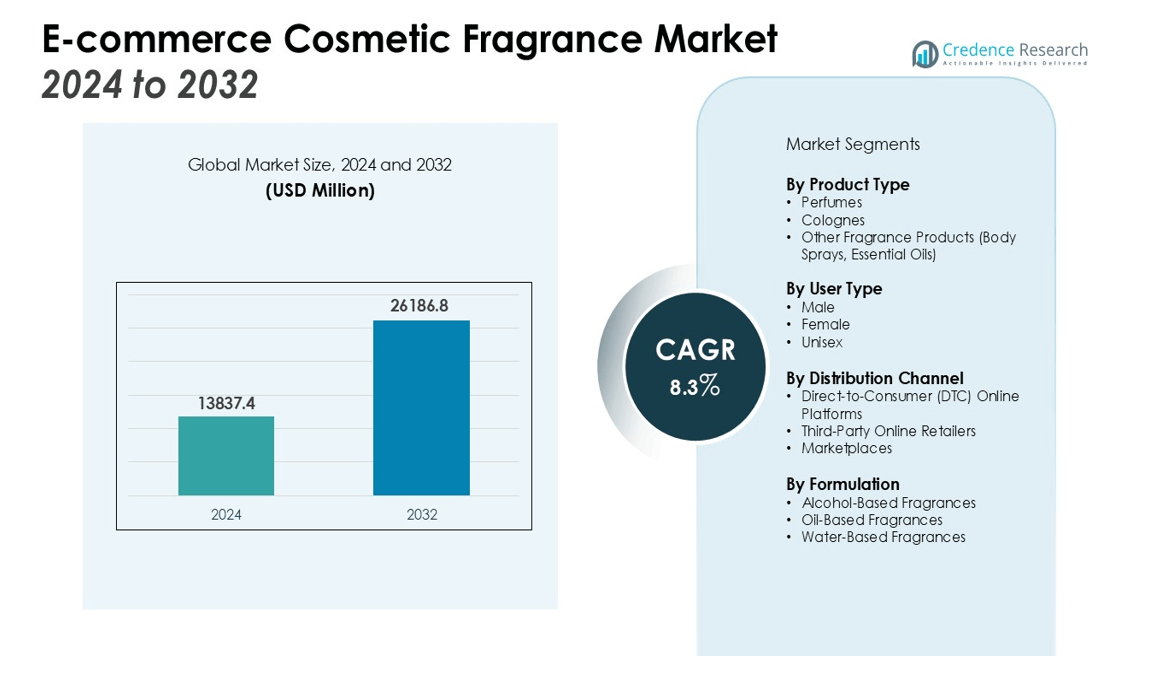
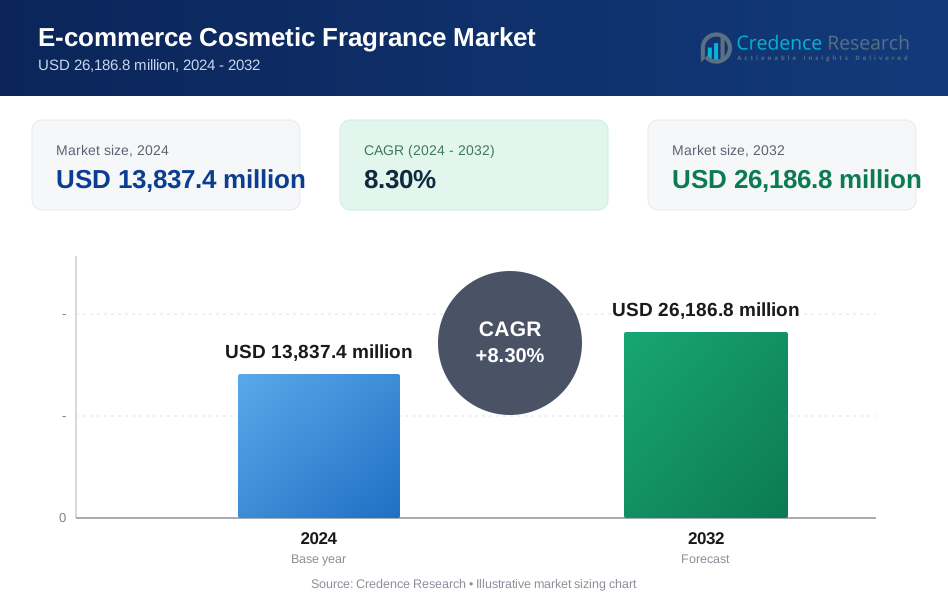
The E-commerce Cosmetic Fragrance Market size was valued at USD 13837.4 million in 2024 and is anticipated to reach USD 26186.8 million by 2032, at a CAGR of 8.3% during the forecast period (2024-2032).
| REPORT ATTRIBUTE | DETAILS |
|---|---|
| Historical Period | 2020-2023 |
| Base Year | 2024 |
| Forecast Period | 2025-2032 |
| E-commerce Cosmetic Fragrance Market Size 2024 | USD 13837.4 million |
| E-commerce Cosmetic Fragrance Market, CAGR | 8.3% |
| E-commerce Cosmetic Fragrance Market Size 2032 | SD 26186.8 million |
Key drivers of the market include the growing popularity of e-commerce platforms, which provide consumers with easy access to a variety of fragrance brands and the ability to compare products. Furthermore, the rising consumer preference for niche and luxury fragrances, along with innovations such as fragrance subscription services, is fueling market expansion. The trend towards sustainability and eco-friendly packaging also influences buying decisions, especially among younger consumers. Additionally, advancements in digital marketing and influencer-driven promotions are significantly contributing to the visibility and popularity of fragrance brands online.
Regionally, North America holds the largest market share, driven by strong consumer demand in the U.S. and Canada, where online shopping has become a preferred method for purchasing beauty and fragrance products. Europe is also a significant market, supported by established fragrance brands and the increasing shift toward digital channels. The Asia-Pacific region is expected to witness the highest growth rate, with rising disposable incomes and a growing inclination towards luxury and personalized products. This growth is further supported by the increasing penetration of e-commerce platforms in emerging markets like India and China.
Market Insights:
- The e-commerce cosmetic fragrance market was valued at USD 13,837.4 million in 2024 and is expected to reach USD 26,186.8 million by 2032, growing at a CAGR of 8.3%.
- E-commerce platforms are a key driver of market growth, providing consumers with easy access to a variety of fragrance brands and the convenience to compare and purchase products online.
- The rising demand for niche and luxury fragrances is fueling market expansion, as consumers seek personalized and high-end offerings, which are easily accessible through online platforms.
- Fragrance subscription services are gaining popularity, allowing consumers to try various scents before committing to full-sized purchases, driving customer loyalty and repeat business.
- Sustainability is influencing purchasing decisions, with consumers favoring eco-friendly packaging and sustainable practices, encouraging brands to adopt recyclable or refillable packaging solutions.
- A challenge in the market is the difficulty in scent discovery online, as consumers cannot physically test fragrances, making it harder to convert browsing into purchases.
- North America holds 33% of the market share, Europe holds 34%, and Asia-Pacific accounts for 22%, with significant growth expected in Asia due to increased internet access and rising disposable incomes.
Market Drivers:
Growing Popularity of E-Commerce Platforms
The increasing popularity of e-commerce platforms plays a significant role in the expansion of the e-commerce cosmetic fragrance market. These platforms provide consumers with convenient access to a wide array of fragrance brands, allowing them to browse and compare products from the comfort of their homes. The ability to shop 24/7 and access global brands has made online shopping the preferred method for purchasing cosmetic fragrances. As more consumers embrace digital shopping, the market continues to experience robust growth.
- For instance, Ulta Beauty's focus on customer engagement across its platforms contributed to its loyalty program reaching a record 45 million members in the first quarter of 2025.
Rising Consumer Preference for Niche and Luxury Fragrances
Consumers are increasingly gravitating towards niche and luxury fragrances, which has positively impacted the e-commerce cosmetic fragrance market. These products, often characterized by their unique blends and exclusive branding, are gaining popularity among affluent and discerning customers. The convenience of online platforms facilitates easy discovery and purchase of such high-end offerings. This trend is expected to drive further market expansion as consumers seek personalized and premium experiences.
Innovations in Fragrance Subscription Services
Fragrance subscription services have emerged as an important innovation in the e-commerce cosmetic fragrance market. These services offer consumers the opportunity to sample various fragrances before committing to a full-sized purchase, providing a more personalized shopping experience. This business model aligns with consumer demand for flexibility and variety, making it an attractive option for fragrance enthusiasts. By enabling customers to explore new scents regularly, subscription services are increasing consumer loyalty and driving repeat purchases.
- For instance, the technology behind Scentbird's platform supports a vast, curated inventory, allowing the company to offer its subscribers a selection of over 600 fragrances.
Sustainability and Eco-Friendly Packaging
Sustainability is becoming a major factor influencing buying decisions in the e-commerce cosmetic fragrance market. Consumers, particularly younger generations, are increasingly prioritizing eco-friendly packaging and sustainable practices when purchasing products. Brands that adopt environmentally friendly packaging solutions, such as recyclable materials or refillable bottles, are attracting a loyal customer base. This growing focus on sustainability is not only enhancing brand reputation but also contributing to the expansion of the market.
Market Trends:
Increased Demand for Personalized and Customizable Fragrances
A key trend in the e-commerce cosmetic fragrance market is the growing demand for personalized and customizable fragrance options. Consumers are increasingly seeking products that cater to their unique preferences and individual identities. Online platforms are capitalizing on this demand by offering bespoke fragrance creation services, where customers can blend different notes to create a scent that suits their personal taste. This customization trend is becoming particularly popular among millennials and Gen Z, who prioritize individuality and self-expression. As consumers move away from mass-market products, the rise of bespoke fragrances enhances their shopping experience and encourages brand loyalty.
- For instance, Olfactory NYC offers a bespoke fragrance creation service where customers can build their unique scent from one of 9 core fragrances, which are then bottled fresh on-site.
Integration of Technology and Digital Innovations in Fragrance Shopping
The integration of technology in the e-commerce cosmetic fragrance market is another prominent trend. Augmented reality (AR) and artificial intelligence (AI) are being increasingly utilized to enhance the online shopping experience for fragrance consumers. For example, AR tools allow customers to virtually “try on” fragrances or visualize the packaging before making a purchase. AI is also being employed to recommend products based on customer preferences and previous buying behaviors, making the shopping experience more efficient and tailored. These technological advancements are improving customer engagement, increasing sales conversion rates, and shaping the future of fragrance retail online.
- For instance, L'Oréal's Beauty Genius, a personal beauty assistant powered by generative AI, provides tailored recommendations from a selection of over 750 of the company's skincare, makeup, and hair color products.
Market Challenges Analysis:
Difficulty in Scent Discovery and Consumer Experience
One of the primary challenges in the e-commerce cosmetic fragrance market is the difficulty consumers face in discovering and experiencing scents online. Unlike traditional retail, where consumers can test fragrances before purchasing, e-commerce lacks the tactile experience. This limitation hinders consumers from fully assessing a fragrance’s appeal, which is primarily based on smell. While some brands use digital tools to simulate scent experiences, these technologies still cannot replicate the physical interaction with a fragrance. This gap presents a significant barrier for e-commerce platforms, making it harder to convert online browsing into sales.
Counterfeit Products and Quality Control Issues
The rise of counterfeit products in the e-commerce cosmetic fragrance market poses another significant challenge. With the increasing volume of online fragrance sales, counterfeiters exploit the demand for popular brands, leading to the circulation of fake products. These counterfeit goods not only undermine brand integrity but also pose health risks to consumers. E-commerce platforms must invest in robust verification systems and implement stringent quality control measures to ensure the authenticity and safety of the products being sold. The growing concern over counterfeit products creates a need for more secure and reliable methods of online fragrance retail.
Market Opportunities:
Expansion into Emerging Markets
The e-commerce cosmetic fragrance market has significant growth opportunities in emerging markets, particularly in Asia-Pacific and Latin America. These regions are witnessing rapid urbanization and increased disposable incomes, leading to a higher demand for premium beauty and fragrance products. E-commerce platforms can capitalize on this trend by offering a wide range of international and local fragrance brands that cater to the preferences of consumers in these markets. The growing digital penetration and the increasing adoption of online shopping further create avenues for fragrance brands to expand their reach and tap into new customer bases.
Growth of Subscription-Based Models
Another lucrative opportunity in the e-commerce cosmetic fragrance market lies in the growth of subscription-based services. These models offer consumers the convenience of trying different fragrances regularly, catering to their desire for variety and personalization. Subscription boxes, which deliver curated scents based on individual preferences, can foster brand loyalty and increase customer retention. E-commerce platforms can leverage this trend by offering flexible subscription plans, targeting fragrance enthusiasts who value discovery and exclusivity. The rise of such models aligns with evolving consumer expectations, making it a promising avenue for brands to enhance customer engagement and drive long-term sales.
Market Segmentation Analysis:
By Product Type
The e-commerce cosmetic fragrance market is segmented by product type into perfumes, colognes, and other fragrance products. Perfumes hold the largest share due to their luxury appeal and higher price points, catering to premium segments. Colognes are also in high demand, particularly among younger demographics, due to their lighter scents and more affordable prices. Other fragrance products, including body sprays and essential oils, are gaining popularity for their versatility and appeal to a broader audience.
- For instance, Dior’s popular Sauvage Eau de Parfum has garnered significant online engagement, receiving over 4,400 customer reviews on the e-commerce platform Ulta Beauty alone.
By User Type
By user type, the market is divided into male, female, and unisex fragrances. Female fragrances dominate the market, driven by the long-standing popularity of perfume in the female consumer segment. Male fragrances are rapidly growing, with an increasing number of men seeking luxury and personalized fragrance options. Unisex fragrances are gaining traction, especially among millennials and Gen Z, who prefer gender-neutral products that reflect their personal style.
By Distribution Channel
The e-commerce cosmetic fragrance market is segmented by distribution channel into direct-to-consumer (DTC) online platforms, third-party online retailers, and marketplaces. DTC platforms are experiencing significant growth, as consumers seek direct relationships with brands and personalized shopping experiences. Third-party online retailers and marketplaces continue to lead in terms of volume, offering consumers a wide selection of fragrance brands and competitive pricing, making them a popular choice for fragrance shopping.
- For instance, beauty brand Sephora enhanced its direct customer engagement by introducing the Virtual Artist app, an AI and VR try-on experience that attracted 8.5 million visits within its initial 18 months.
Segmentations:
By Product Type
- Perfumes
- Colognes
- Other Fragrance Products (Body Sprays, Essential Oils)
By User Type
- Male
- Female
- Unisex
By Distribution Channel
- Direct-to-Consumer (DTC) Online Platforms
- Third-Party Online Retailers
- Marketplaces
By Formulation
- Alcohol-Based Fragrances
- Oil-Based Fragrances
- Water-Based Fragrances
By Region
- North America
- U.S.
- Canada
- Mexico
- Europe
- UK
- France
- Germany
- Italy
- Spain
- Russia
- Belgium
- Netherlands
- Austria
- Sweden
- Poland
- Denmark
- Switzerland
- Rest of Europe
- Asia Pacific
- China
- Japan
- South Korea
- India
- Australia
- Thailand
- Indonesia
- Vietnam
- Malaysia
- Philippines
- Taiwan
- Rest of Asia Pacific
- Latin America
- Brazil
- Argentina
- Peru
- Chile
- Colombia
- Rest of Latin America
- Middle East
- UAE
- KSA
- Israel
- Turkey
- Iran
- Rest of Middle East
- Africa
- Egypt
- Nigeria
- Algeria
- Morocco
- Rest of Africa
Regional Analysis:
North America: Market Leadership and Digital Integration
North America holds 33% of the global revenue share in the e-commerce cosmetic fragrance market. The U.S. market, characterized by high consumer spending and a strong online retail presence, continues to lead the region. Platforms like Amazon, Sephora, and Ulta Beauty have become central to fragrance distribution, offering a vast selection and personalized shopping experiences. The U.S. market is characterized by a diverse consumer base with a growing preference for both premium and niche fragrances, reflecting a shift towards personalization and exclusivity.
Europe: Heritage and Premiumization
Europe commands 34% of the global revenue share in the fragrance market. The region's rich heritage in perfumery and strong brand loyalty contribute to its robust market presence. Consumers increasingly favor premium and natural fragrances, aligning with global trends toward sustainability and wellness. Countries like France, Italy, and the UK are key players, with a significant shift towards online retail, driven by advancements in e-commerce platforms and digital marketing strategies.
Asia-Pacific: Rapid Growth and Emerging Opportunities
The Asia-Pacific region holds 22% of the global revenue share in the e-commerce cosmetic fragrance market. Countries such as China, India, and Japan are witnessing increased internet penetration and a rising middle class, leading to higher demand for both luxury and mass-market fragrances. E-commerce platforms are expanding their reach, offering a wide range of products to cater to diverse consumer preferences. The region's young and tech-savvy population is driving the adoption of online shopping, presenting significant opportunities for brands to tap into this growing market.
Key Player Analysis:
- Unilever
- Kose
- Shiseido
- L'Oreal
- Avon Products
- Coty
- Beiersdorf
- Mary Kay
- Perry Ellis International
- Estée Lauder Companies
- Amway
- Edgewell Personal Care
Competitive Analysis:
The e-commerce cosmetic fragrance market is highly competitive, with numerous key players vying for market share. Leading brands such as Chanel, Dior, and Estée Lauder dominate the premium segment, leveraging strong brand recognition and loyal customer bases. Online retailers like Amazon and Sephora provide extensive fragrance selections, enhancing customer accessibility and convenience. Many companies are also exploring direct-to-consumer (DTC) channels to strengthen brand connections and offer personalized shopping experiences. Subscription-based services, such as Scentbird, have gained traction by offering consumers tailored fragrance discovery, which boosts customer retention. Smaller niche brands are increasing their presence by focusing on sustainability, eco-friendly packaging, and unique fragrance offerings to appeal to younger, environmentally-conscious consumers. The growing trend of online shopping continues to intensify competition, prompting companies to enhance digital marketing strategies and invest in user-friendly platforms to capture a larger share of the expanding e-commerce fragrance market.
Recent Developments:
- In November 2024, KOSÉ and TOKYO ELECTRON DEVICE announced they will jointly exhibit at CES 2025 to commercialize mixed reality makeup.
- In April 2025, Unilever announced a multi-tournament partnership with World Rugby, becoming an Official Supporter for all Rugby World Cups until 2029.
- In August 2025, Amway has scheduled a Nutrilite Mega Product Launch for its Nutrilite AmCell product in Kuching.
Market Concentration & Characteristics:
The e-commerce cosmetic fragrance market is moderately concentrated, with a few dominant players holding significant market share. Major fragrance brands like Chanel, Dior, and Estée Lauder lead the market, leveraging their strong brand equity and extensive product portfolios. However, smaller and niche brands are increasingly carving out space by focusing on personalized fragrances, sustainable practices, and innovative packaging. E-commerce platforms such as Amazon, Sephora, and niche subscription services like Scentbird play a crucial role in expanding the market by providing a wide variety of products and enhancing customer accessibility. The market is characterized by a shift towards online shopping, with both large and small companies investing heavily in digital marketing and personalized shopping experiences. This evolving landscape fosters both competitive intensity and opportunities for new entrants to differentiate through product uniqueness and sustainability initiatives.
Report Coverage:
The research report offers an in-depth analysis based on Product Type, User Type, Distribution Channel, Formulation and Region. It details leading market players, providing an overview of their business, product offerings, investments, revenue streams, and key applications. Additionally, the report includes insights into the competitive environment, SWOT analysis, current market trends, as well as the primary drivers and constraints. Furthermore, it discusses various factors that have driven market expansion in recent years. The report also explores market dynamics, regulatory scenarios, and technological advancements that are shaping the industry. It assesses the impact of external factors and global economic changes on market growth. Lastly, it provides strategic recommendations for new entrants and established companies to navigate the complexities of the market.
Future Outlook:
- The e-commerce cosmetic fragrance market will continue to grow as consumers increasingly prefer the convenience of online shopping for fragrances.
- A rising demand for personalized and niche fragrances will shape future market offerings, with brands offering customization options.
- Sustainability will become a key focus, with eco-friendly packaging and natural ingredients gaining popularity among environmentally conscious consumers.
- Subscription-based services for fragrance discovery will expand, offering consumers more flexibility and access to a wide range of scents.
- The influence of social media and digital marketing will increase, with influencers and brand collaborations driving fragrance sales and visibility.
- E-commerce platforms will improve user experience through advanced AI and AR tools, allowing consumers to virtually test fragrances before purchasing.
- Emerging markets, particularly in Asia-Pacific and Latin America, will see substantial growth in fragrance consumption due to rising disposable incomes and internet access.
- There will be an increased focus on offering affordable yet high-quality fragrance options, catering to a wider consumer base.
- Luxury fragrance brands will further tap into the e-commerce space, expanding their online presence to reach a global audience.
- The competitive landscape will intensify, with both established brands and new entrants vying for market share through innovation and improved customer engagement.
Request a Free Sample
Fill in your details and we'll send you a free sample report.
- Sample data tables & charts
- Research methodology
Need a Custom Version of This Report?
Tailor the scope, geography, or segments to your exact requirements.
- Custom geography or segment scope
- Direct access to our analyst team
Frequently Asked Questions
What is the current market size for E-commerce Cosmetic Fragrance, and what is its projected size in 2032?
Which E-commerce Cosmetic Fragrance market segment held the largest share in 2024?
What are the primary factors fueling the growth of the E-commerce Cosmetic Fragrance market?
Who are the leading companies in the E-commerce Cosmetic Fragrance market?
Table of Content
Chapter 1. Report Introduction
- 1.1 Report Description & Purpose
- 1.1.1 Report Title & Market Definition
- 1.1.2 Unique Selling Propositions (USP) & Key Differentiators
- 1.1.3 Value Proposition for Stakeholders
- 1.2 Research Objectives
- 1.2.1 Market Sizing Objectives (Volume & Revenue)
- 1.2.2 Segmentation Objectives
- 1.2.3 Competitive Intelligence Objectives
- 1.2.4 Forecast & Scenario Objectives
- 1.3 Report Scope
- 1.3.1 E-commerce Cosmetic Fragrance Scope – Types & Subtypes Covered
- 1.3.2 Geographic Scope – Regions & Countries Covered
- 1.3.3 Historical Period, Base Year & Forecast Period (2024; forecast to 2032)
- 1.3.4 Inclusions & Exclusions
- 1.4 HS Code & Classification Framework
- 1.5 Currency, Units & Pricing Basis
- 1.6 Target Stakeholders
- 1.7 Limitations & Assumptions
Chapter 2. Executive Summary
- 2.1 Global E-commerce Cosmetic Fragrance Market Snapshot
- 2.1.1 Market Size – Historical (2024) & Forecast (2024-2032) (2024: USD 13,837.4 million → 2032: USD 26,186.8 million)
- 2.1.2 Volume & Revenue – Global Totals
- 2.1.3 Key Market Highlights – Top Five Facts
- 2.2 E-commerce Cosmetic Fragrance Market Segmentation Snapshot
- 2.2.1 Market Split by Region – 2024 vs. 2032
- 2.3 Competitive Snapshot
- 2.3.1 Top 10 Players by Revenue Share – 2024
- 2.3.2 Top 10 Players by Volume Share – 2024
- 2.3.3 Recent Strategic Developments (18-Month Summary)
- 2.4 Key Investment Highlights & Strategic Conclusions
Chapter 3. E-commerce Cosmetic Fragrance Market Dynamics & Industry Analysis
- 3.1 Market Overview & Context
- 3.1.1 E-commerce Cosmetic Fragrance Market Position in the Broader Automotive Value Chain
- 3.1.2 OEM vs. Replacement Market Dynamics
- 3.1.3 Market Maturity & Development Stage by Region
- 3.2 E-commerce Cosmetic Fragrance Market Drivers
- 3.3 E-commerce Cosmetic Fragrance Market Restraints & Challenges
- 3.4 E-commerce Cosmetic Fragrance Market Opportunities
- 3.5 Porter's Five Forces Analysis
- 3.5.1 Threat of New Entrants
- 3.5.2 Bargaining Power of Suppliers
- 3.5.3 Bargaining Power of Buyers
- 3.5.4 Threat of Substitutes
- 3.5.5 Competitive Rivalry – Intensity Assessment
- 3.6 E-commerce Cosmetic Fragrance Value Chain Analysis
- 3.6.1 Upstream – Raw Material/Input Suppliers
- 3.6.1.1 Raw Material/Input 1
- 3.6.1.2 Raw Material/Input 2
- 3.6.1.3 Raw Material/Input 3
- 3.6.2 Midstream – Production/Manufacturing/Service Delivery
- 3.6.2.1 Production/Process Overview
- 3.6.2.2 Key Facility Locations & Capacity by Manufacturer
- 3.6.3 Downstream – Distribution & End Consumer
- 3.6.3.1 Primary Channel – B2B/OEM
- 3.6.3.2 Secondary Channels – Dealer, Retail, Online, Direct
- 3.6.4 Value Chain Profitability Analysis
- 3.6.1 Upstream – Raw Material/Input Suppliers
- 3.7 PESTEL Analysis
- 3.7.1 Political Factors
- 3.7.2 Economic Factors
- 3.7.3 Social Factors
- 3.7.4 Technological Factors
- 3.7.5 Environmental Factors
- 3.7.6 Legal Factors
- 3.8 E-commerce Cosmetic Fragrance Supply Chain Analysis
- 3.8.1 Raw Material/Input Supply Risk Assessment
- 3.8.2 Manufacturing Concentration Risk (Geographic Exposure)
- 3.8.3 Trade Disruption Impact Analysis
- 3.9 Regulatory & Policy Landscape
Note: The regulatory and policy landscape section covers regulations based on their applicability to the market, E-commerce Cosmetic Fragrance category, geography, and scope of the study. Only regulatory frameworks with a material impact on operations, compliance, trade, sustainability, or market access are analyzed in detail.
Chapter 4. Key Investment Pockets & Opportunity Analysis
- 4.1 E-commerce Cosmetic Fragrance Market Attractiveness Analysis
- 4.1.1 By Region – Investment Attractiveness Matrix (Volume × CAGR)
- 4.2 Absolute Revenue Growth Opportunity
- 4.2.1 By Region – Absolute USD Growth Through 2032
- 4.3 Incremental Volume Opportunity
- 4.3.1 By Region – Incremental Volume Through 2032
- 4.3.2 Segment – Incremental Volume
- 4.4 Emerging Submarket Opportunity Deep Dive (Subject to Applicability)
- 4.5 Emerging Market Opportunity Scorecards
- 4.5.1 United States
- 4.5.2 Europe
- 4.5.3 Asia
- 4.5.4 Middle East & Africa
Note: Emerging Market Opportunity Scorecards will be included based on relevance and strategic importance. Regions listed are indicative and may vary depending on data availability and market dynamics.
Chapter 5. E-commerce Cosmetic Fragrance Import-Export Analysis & Trade Flows
- 5.1 Global Trade Overview
- 5.1.1 Global Export Value by Country (2024)
- 5.1.2 Global Export Volume by Country (2024)
- 5.1.3 Global Import Value by Country (2024)
- 5.1.4 Global Import Volume by Country (2024)
- 5.1.5 Net Trade Balance by Country (2024)
- 5.2 Export Analysis – Segment
- 5.2.1 Type 1 (HS Code)
- 5.2.2 Type 2 (HS Code)
- 5.2.3 Type 3 (HS Code)
- 5.2.4 Type 4 (HS Code)
- 5.2.5 Type 5 (HS Code)
- 5.3 Import Analysis – Segment
- 5.3.1 Type 1 (HS Code)
- 5.3.2 Type 2 (HS Code)
- 5.3.3 Type 3 (HS Code)
- 5.3.4 Type 4 (HS Code)
- 5.3.5 Type 5 (HS Code)
- 5.4 Average Unit Trade Prices
- 5.4.1 Average Export Price – Segment & Country
- 5.4.2 Average Import Price – Segment & Source Country
- 5.4.3 Price Trends (2024)
- 5.5 Key Trade Route Analysis
- 5.5.1 Trade Route 1
- 5.5.2 Trade Route 2
- 5.5.3 Trade Route 3
- 5.5.4 Trade Route 4
- 5.5.5 Trade Route 5
- 5.6 Trade Policy Impact Assessment
- 5.6.1 US Anti-Dumping & Section 301 Tariffs
- 5.6.2 EU Customs Union Impact
- 5.6.3 Major Free Trade Agreements
- 5.6.4 USMCA Rules of Origin
Note: Trade policy analysis will be included only where relevant to the E-commerce Cosmetic Fragrance market.
Chapter 6. Competitive Landscape & Company Benchmarking
- 6.1 E-commerce Cosmetic Fragrance Market Concentration & Structure
- 6.1.1 Herfindahl-Hirschman Index (HHI) – vs. 2024
- 6.1.2 Tier 1, Tier 2 & Tier 3 Market Structure
- 6.1.3 Global, Regional & Local Player Dynamics
- 6.2 E-commerce Cosmetic Fragrance Market Share Analysis – 2024
- 6.2.1 Global Revenue Share by Company
- 6.2.2 Global Volume Share by Company
- 6.2.3 Regional Revenue Share
- 6.2.4 Market Share Evolution ( vs. 2024)
- 6.2.5 OEM Segment Share by Company
- 6.2.6 Replacement Segment Share by Company
- 6.3 Production/Delivery Capacity & Facility Analysis
- 6.3.1 Global Installed Capacity
- 6.3.2 Capacity Utilization Rates
- 6.3.3 Production/Output Volume
- 6.3.4 Facility Locations & Capacity Map
- 6.3.5 Planned Capacity Additions
- 6.4 E-commerce Cosmetic Fragrance Competitive Benchmarking Matrix
- 6.4.1 Revenue, Volume, CAGR & Profitability Comparison
- 6.4.2 Channel Revenue Mix
- 6.4.3 Geographic Revenue Exposure
- 6.4.4 R&D Intensity
- 6.4.5 Sustainability Maturity
- 6.5 Strategic Developments in E-commerce Cosmetic Fragrance (Last 24 Months)
- 6.5.1 Mergers, Acquisitions & Divestments
- 6.5.2 New E-commerce Cosmetic Fragrance Launches
- 6.5.3 Facility Expansions
- 6.5.4 Strategic Alliances, Joint Ventures & Partnerships
- 6.5.5 Distribution Expansion & Market Entry
- 6.5.6 Sustainability & ESG Initiatives
- 6.6 Competitive Strategy Mapping
- 6.6.1 Leader, Challenger, Follower & Niche Classification
- 6.6.2 Pricing Strategy Comparison
- 6.6.3 Channel Strategy Matrix
Note: Strategic developments are included based on their materiality and the availability of reliable information.
Chapter 7. Global E-commerce Cosmetic Fragrance Market – By Distribution Channel
- 7.1 Segment Overview
- 7.1.1 Volume & Revenue Split by Channel (2024 & 2032)
- 7.1.2 Channel Mix Evolution (2024-2032)
Chapter 8. Regional Market Analysis – Global Overview
- 8.1 Global Regional Overview
- 8.1.1 Regional Volume Share
- 8.1.2 Regional Revenue Share
- 8.1.3 Regional Volume by Region
- 8.1.4 Regional Revenue by Region
- 8.1.5 Regional Forecast Through 2032
- 8.2 Cross-Regional Segment Analysis
- 8.2.1 By Distribution Channel
- 8.2.2 By Brand/Price Tier
Chapter 9. North America E-commerce Cosmetic Fragrance Market
- 9.1 United States
- 9.2 Canada
- 9.3 Mexico
Chapter 10. Europe E-commerce Cosmetic Fragrance Market
- 10.1 Germany
- 10.2 France
- 10.3 Italy
- 10.4 United Kingdom
- 10.5 Spain
- 10.6 Poland
- 10.7 Russia
- 10.8 Netherlands
- 10.9 Belgium
- 10.10 Sweden
- 10.11 Denmark
- 10.12 Norway
- 10.13 Rest of Europe
Chapter 11. Asia Pacific E-commerce Cosmetic Fragrance Market
- 11.1 China
- 11.2 India
- 11.3 Japan
- 11.4 South Korea
- 11.5 Thailand
- 11.6 Indonesia
- 11.7 Vietnam
- 11.8 Malaysia
- 11.9 Australia
- 11.10 Rest of Asia Pacific
Chapter 12. Latin America E-commerce Cosmetic Fragrance Market
- 12.1 Brazil
- 12.2 Argentina
- 12.3 Colombia
- 12.4 Chile
- 12.5 Rest of Latin America
Chapter 13. Middle East E-commerce Cosmetic Fragrance Market
- 13.1 Saudi Arabia
- 13.2 United Arab Emirates
- 13.3 Turkey
- 13.4 Israel
- 13.5 Iran
- 13.6 Rest of the Middle East
Chapter 14. Africa E-commerce Cosmetic Fragrance Market
- 14.1 South Africa
- 14.2 Egypt
- 14.3 Nigeria
- 14.4 Morocco
- 14.5 Rest of Africa
Chapter 15. E-commerce Cosmetic Fragrance Company Profiles
- 15.1 [Company 01]
- 15.1.1 Company Overview
- 15.1.2 Key Management Personnel
- 15.1.3 Products & Services Portfolio
- 15.1.4 Financial Performance
- 15.1.5 Key Market Focus & Geographic Presence
- 15.1.6 Recent Developments & Strategic Initiatives
Note: The company profile list is preliminary and may change based on research findings, market developments, data availability, and client requirements.
Chapter 16. Appendices
- Appendix A – List of Abbreviations & Acronyms
- Appendix B – Industry Classification Code Reference – Full Series
- Appendix C – Production & Capacity Data Tables
- Appendix D – End-Use & Demand Base Tables
- Appendix E – Consumption & Replacement Rate Assumptions
- Appendix F – ASP Reference Tables
- Appendix G – Manufacturing & Facility Database
- Appendix H – Import-Export Data Tables
- Appendix I – Regulatory Summary Tables
- Appendix J – Primary Research Participant List (Anonymized)
- Appendix K – Primary Research Questionnaire Framework
- Appendix L – Data Sources & Bibliography
- Appendix M – Market Size Divergence & Source Comparison
Chapter 17. Research Methodology
- 17.1 Research Framework & Philosophy
- 17.2 Secondary Research – Sources, Hierarchy & Data Extraction
- 17.3 Data Modeling – Bottom-Up & Top-Down Market Sizing
- 17.4 Primary Research – Stakeholder Framework, LOI & Sample Sizes
- 17.5 Forecast Methodology – Regression, Scenario & Sensitivity Analysis
- 17.6 Quality Control – Four-Layer Validation Framework
- 17.7 Limitations & Standard Assumptions
- 17.8 Disclaimer
