
Market Overview
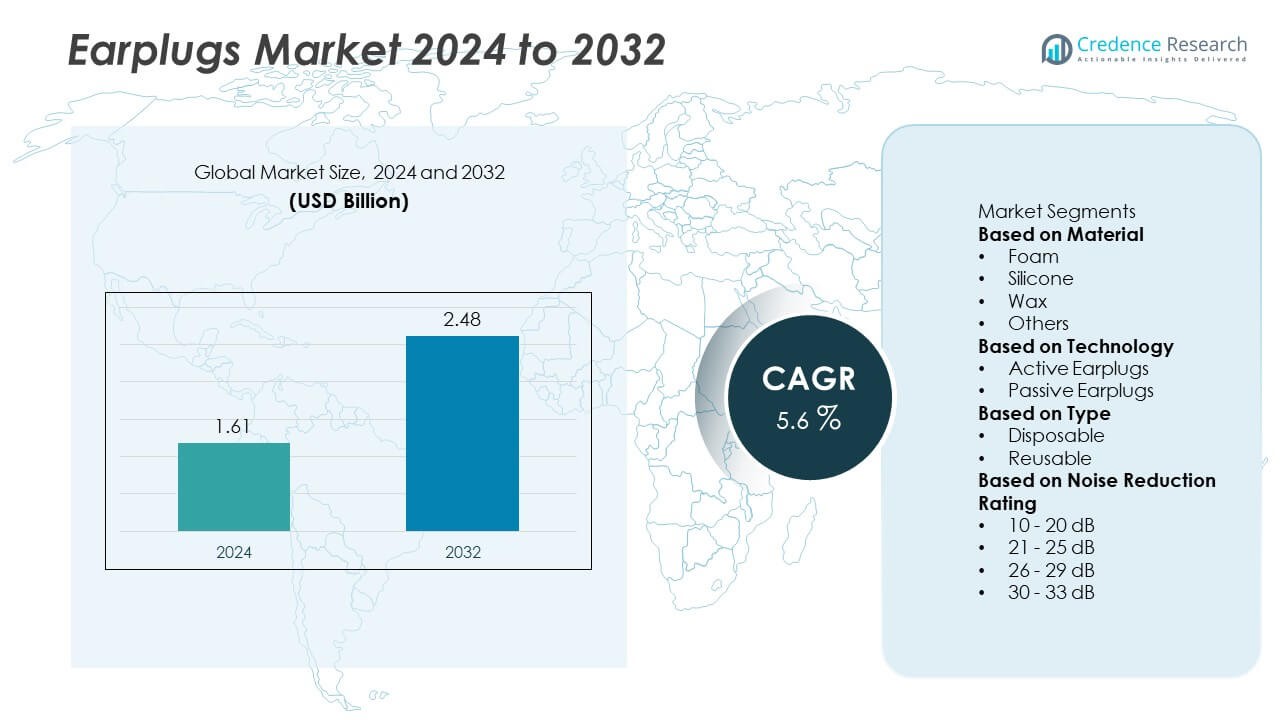
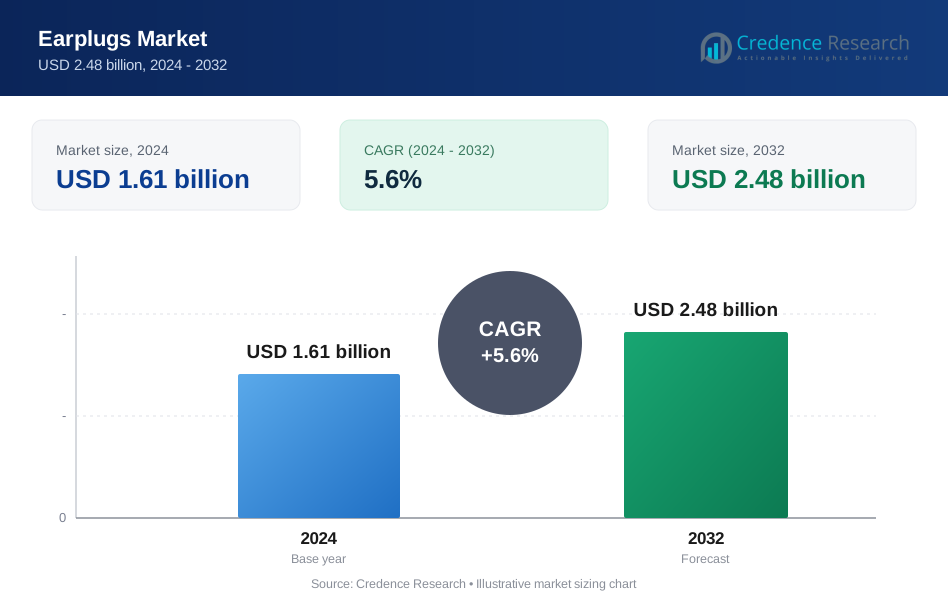
The Earplugs market was valued at USD 1.61 billion in 2024 and is anticipated to reach USD 2.48 billion by 2032, growing at a CAGR of 5.6% during the forecast period.
| REPORT ATTRIBUTE | DETAILS |
|---|---|
| Historical Period | 2020-2023 |
| Base Year | 2024 |
| Forecast Period | 2025-2032 |
| Earplugs Market Size 2024 | USD 1.61 Billion |
| Earplugs Market, CAGR | 5.6% |
| Earplugs Market Size 2032 | USD 2.48 Billion |
The top players in the earplugs market include 3M, Honeywell International Inc., Moldex-Metric, and UVEX SAFETY GROUP, who collectively hold a significant share of the market. 3M leads the market with its wide range of earplugs for both industrial and consumer use, supported by its strong distribution network and brand recognition. Honeywell International Inc. focuses on advanced ear protection solutions, including smart earplugs, gaining traction in industrial and professional markets. Moldex-Metric and UVEX SAFETY GROUP remain key players in industrial applications, known for their durable and high-performance products. North America dominates the global market, with a market share of 35.2%, driven by stringent safety regulations and growing consumer awareness. Europe follows closely with 28.7% market share, fueled by regulatory standards and a focus on eco-friendly products. Asia-Pacific, with 24.9% market share, is rapidly growing due to industrialisation and urbanisation.
Market Insights
- The global earplugs market was valued at USD 1.61 billion in 2024 and is projected to reach USD 2.48 billion by 2032, growing at a CAGR of 5.6% during the forecast period.
- Key drivers include increasing awareness of noise-induced hearing loss, stringent occupational safety regulations, and rising urbanisation, contributing to higher demand across both industrial and consumer segments.
- Market trends highlight a growing shift towards reusable and comfort-oriented earplugs, with materials like silicone and wax gaining popularity, while technological innovations in smart earplugs provide new opportunities.
- The competitive landscape is marked by strong players such as 3M, Honeywell International, and Moldex-Metric, who leverage product innovation, brand recognition, and robust distribution channels to maintain market dominance.
- Regionally, North America leads with 35.2% market share, followed by Europe at 28.7%, and Asia-Pacific with 24.9%, driven by industrialisation, regulatory frameworks, and urbanisation in key markets.
Market Segmentation Analysis:
By Material
The foam sub‑segment held the largest share in the earplugs market, accounting for 43.0% of the total market in 2024. Foam earplugs continue to dominate due to their cost-effectiveness, ease of use, and superior noise reduction capabilities, particularly in industrial environments and loud workplaces. Additionally, foam’s soft and moldable nature offers increased comfort for extended wear. Silicone and wax materials, however, are gaining popularity, driven by the growing preference for reusable products. These materials are valued for their water-resistant properties, hygienic benefits, and comfort, making them ideal for travel and personal use. The shift towards eco-friendly alternatives also supports their growth.
- For instance, 3M, a leader in the earplug industry, has developed the 3M™ E-A-R™ Classic earplug, which is designed for high noise environments.
By Technology
The passive earplugs segment led the earplugs market, capturing 62.3% of the market share in 2024. Passive earplugs are favored for their simplicity, affordability, and broad application, especially in industrial and noisy environments where basic noise blocking is required. Their widespread use in occupational safety continues to support their dominance. However, the active earplugs segment is witnessing a higher growth rate. These earplugs, which feature adaptive noise-canceling technology, are gaining traction in professional and recreational sectors. Their popularity is rising among military personnel, athletes, and travelers seeking enhanced sound control, driving demand for more advanced and customizable solutions.
- For instance, Moldex has pioneered the development of the Moldex Pura-Fit earplugs, which provide consistent and reliable noise reduction for industrial environments.
By Type
The disposable earplugs segment dominated the market in 2024, owing to their high demand in industrial, construction, and manufacturing environments. Disposable earplugs are favored for their hygiene, single-use convenience, and ease of mass distribution, making them ideal for high-risk environments where safety and cleanliness are paramount. This segment’s growth is bolstered by regulations mandating hearing protection in certain workplaces. On the other hand, reusable earplugs are rapidly growing in popularity as consumers seek more sustainable and cost-effective solutions for personal use. Their increasing use in sleep, travel, and recreational activities reflects a shift towards more durable, eco-friendly options.
Key Growth Drivers
Increasing Awareness of Hearing Protection
Heightened awareness of noise‑induced hearing loss is fueling demand in the earplug market. Industrial workers and recreational consumers alike recognise the risk of prolonged exposure to loud environments and are increasingly choosing ear protection. This awareness translates into stronger uptake of earplugs across both workplace and leisure segments. In industrial sectors, safety programmes emphasise hearing conservation, while in consumer markets travel, entertainment and urban noise drive personal usage. As a result, manufacturers can expand their reach beyond traditional occupational applications and capture growth in everyday settings.
- For instance, Peltor, a division of 3M, has designed the Peltor™ ProTac™ III, a line of earmuffs/headsets that combine hearing protection with active listening (level-dependent function), making them popular in environments like shooting ranges, where both noise protection and clear communication are crucial.
Stringent Occupational Safety Regulations
Regulatory frameworks around occupational noise exposure are prompting companies to invest in hearing protection devices, advancing the earplug market. Governments and industries enforce standards requiring protective equipment in construction, manufacturing, mining and oil & gas. Employers increasingly adopt earplugs to comply with mandates, reduce liability and boost worker welfare. This regulatory push generates consistent demand for industrial‑grade earplugs and fosters market stability. Manufacturers benefit from predictable procurement cycles and scale efficiencies, enabling expanded distribution and innovation within regulated industries globally.
- For instance, Honeywell’s Howard Leight brand produces a variety of earplugs that meet OSHA standards for noise reduction, which are used extensively in the manufacturing and construction industries.
Rising Urbanisation and Noise Pollution
Rapid urban growth, greater infrastructure development and workplace mechanisation elevate ambient noise levels in cities and industrial zones, expanding earplug usage beyond traditional settings. Consumers now seek ear protection for sleep, travel, social events and noisy public spaces, broadening market demand. Urbanites value earplugs not just for hearing safety but for comfort and wellness, which drives product diversification. Manufacturers respond with consumer‑friendly designs and reusable solutions tailored for lifestyle use, enabling penetration into non‑industrial segments and unlocking additional growth avenues.
Key Trends & Opportunities
Growth of Reusable and Comfort‑Focused Products
As consumers shift toward reusable earplugs for lifestyle and travel applications, the market sees rising demand for comfort‑oriented, premium materials and ergonomic designs. Silicone and wax materials gain traction because they offer better fit, hygiene and durability compared to traditional foam. This trend opens opportunities for brands to differentiate via premium pricing, sustainability credentials and direct‑to‑consumer channels. Innovations in comfort, custom‑fit capabilities and aesthetics appeal to leisure users and professionals alike, creating new segments and enhancing margin potential in a historically commoditised market.
- For instance, Alpine Hearing Protection’s “Alpine SleepSoft” earplugs are made from a soft, silicone-free thermoplastic material called AlpineThermoShape™ (ATS), designed to use body heat to mold to the shape of the ear for comfort during sleep, catering to consumers seeking noise reduction for a better rest.
Technological Innovation and Smart Earplugs
Technological advancement in earplug design, including active noise‑control, connectivity and acoustic filtering, presents a significant opportunity for market differentiation and value‑added products. Brands target premium users in areas like live events, travel, professional audio and military applications by offering smart earplugs that combine hearing protection with enhanced sound control. Such innovations support greater consumer engagement and justify premium pricing. For manufacturers, this opens new product categories, creates higher barriers to entry for competitors and enables strategic positioning in evolving hearing‑protection ecosystems.
- For instance, Bose has developed the Bose Noise-Masking Sleepbuds, a pair of smart earplugs that combine passive noise blocking with pre-loaded sound masking technology, helping users block disruptive sounds while traveling or sleeping.
Key Challenges
User Compliance and Comfort Issues
A persistent challenge in the earplug market is ensuring consistent usage among end‑users, especially in industrial environments where comfort, fit and convenience matter. If earplugs feel uncomfortable or interfere with communication, users may neglect or avoid them, reducing effectiveness and limiting market penetration. Manufacturers must address ergonomics, sound clarity and user behaviour to overcome this barrier. Failure to deliver comfortable, easy‑to‑use products can hinder uptake in both occupational and consumer settings, particularly where alternative protective solutions exist.
Price Sensitivity and Competitive Pressure
The earplug market faces strong competition from low‑cost alternatives and substitutes, placing pressure on margins and restricting differentiation for basic product lines. Especially in price‑sensitive regions and among commodity disposable offerings, manufacturers struggle to balance cost control with innovation. The abundance of low‑cost players makes it difficult to generate premium pricing or build brand loyalty. To thrive, companies must invest in value‑added features, branding or premium segments, as competing solely on price risks margin erosion and commoditisation.
Regional Analysis
North America
North America holds a significant share of the earplugs market, accounting for 35.2% in 2024. The region benefits from stringent occupational safety regulations, which drive demand for hearing protection devices, particularly in manufacturing, construction, and mining sectors. Additionally, increasing awareness of noise-induced hearing loss in both industrial and recreational environments fuels market growth. Consumer adoption of earplugs for travel and sleep further contributes to the market expansion. The presence of major manufacturers and a strong focus on product innovation and smart earplug technologies support North America's dominant position in the market.
Europe
Europe is another leading market for earplugs, capturing 28.7% of the global market share in 2024. The region’s strong industrial base and rigorous health and safety standards propel demand for earplugs in occupational settings. Additionally, Europe’s focus on sustainability and environmental concerns drives the demand for reusable and eco-friendly earplugs. Rising urbanisation and noise pollution in cities also contribute to increased adoption of earplugs for personal use. The growing trend of active noise-cancelling earplugs in professional environments, particularly in music and entertainment sectors, creates new opportunities for growth in this region.
Asia-Pacific
Asia-Pacific holds a prominent position in the earplugs market, with a market share of 24.9% in 2024. The region’s rapid industrialisation, coupled with rising noise levels in urban areas, increases the demand for earplugs. Countries like China, India, and Japan experience high growth in both industrial and consumer segments. The expanding middle-class population, increased disposable income, and growing awareness of hearing protection contribute to market growth. The adoption of hearing protection devices in the manufacturing, construction, and transportation industries further supports the market’s expansion in Asia-Pacific, alongside rising interest in personal-use earplugs.
Latin America
Latin America accounts for 6.3% of the global earplugs market in 2024. The market growth in this region is primarily driven by expanding industries in countries like Brazil and Mexico, where industrial activities and noise exposure are prevalent. Occupational safety regulations in these countries are improving, which further boosts the demand for earplugs. Additionally, the rising urbanisation and increased awareness of hearing loss risks are encouraging more consumers to use earplugs for personal use in noisy environments. Growth in recreational activities such as concerts and travel also contributes to the market's expansion in the region.
Middle East & Africa
The Middle East & Africa region holds a smaller share of the earplugs market, accounting for 5.0% in 2024. However, the region is witnessing steady growth, driven by increased industrial activities, particularly in oil, gas, and construction sectors. The demand for earplugs is rising as health and safety regulations improve in these industries. In addition, growing urbanisation and higher noise levels in cities such as Dubai and Johannesburg are pushing demand for consumer earplugs for sleep, travel, and entertainment. Market expansion in this region is also supported by rising awareness about the importance of hearing protection.
Market Segmentations:
By Material
- Foam
- Silicone
- Wax
- Others
By Technology
- Active Earplugs
- Passive Earplugs
By Type
- Disposable
- Reusable
By Noise Reduction Rating
- 10 - 20 dB
- 21 - 25 dB
- 26 - 29 dB
- 30 - 33 dB
By Geography
- North America
- U.S.
- Canada
- Mexico
- Europe
- Germany
- France
- U.K.
- Italy
- Spain
- Rest of Europe
- Asia Pacific
- China
- Japan
- India
- South Korea
- South-east Asia
- Rest of Asia Pacific
- Latin America
- Brazil
- Argentina
- Rest of Latin America
- Middle East & Africa
- GCC Countries
- South Africa
- Rest of the Middle East and Africa
Competitive Landscape
The earplugs market is highly competitive, with key players such as 3M, Honeywell International Inc., Moldex-Metric, and UVEX SAFETY GROUP leading the way. These companies dominate the market through strong product portfolios, innovation, and strategic partnerships. 3M, for instance, is known for its wide range of earplugs catering to both industrial and consumer segments, leveraging its well-established brand and extensive distribution networks. Honeywell International Inc. focuses on offering advanced hearing protection solutions, including smart earplugs with noise-canceling capabilities, catering to professional and industrial users. Moldex-Metric and UVEX SAFETY GROUP also remain significant players, known for their high-quality, durable products in industrial settings. Moreover, smaller players such as Loop Earplugs and Hearos are gaining market share by focusing on specialized consumer products, offering comfort and noise reduction for personal use. Competitive strategies include product innovation, mergers, acquisitions, and expanding distribution channels to strengthen market presence.
Key Player Analysis
- Lucid Hearing Holding Company, LLC
- Honeywell International Inc
- UVEX SAFETY GROUP
- Moldex-Metric
- Radians, Inc.
- Allens Industrial Products
- 3M
- Hearos
- Magid Glove & Safety Manufacturing Company LLC
- Loop Earplugs
Recent Developments
- In October 2024, Loop Earplugs introduced the “Switch 2” model, with enhanced comfort, design improvements and multiple adjustable noise‑cut modes for different environments.
- In October 2023, Loop Earplugs launched its “Switch” 3‑in‑1 earplug product, enabling seamless transitions between social, active and focused noise‑settings.
Report Coverage
The research report offers an in-depth analysis based on Material, Technology, Type, Noise Reduction Rating and Geography. It details leading market players, providing an overview of their business, product offerings, investments, revenue streams, and key applications. Additionally, the report includes insights into the competitive environment, SWOT analysis, current market trends, as well as the primary drivers and constraints. Furthermore, it discusses various factors that have driven market expansion in recent years. The report also explores market dynamics, regulatory scenarios, and technological advancements that are shaping the industry. It assesses the impact of external factors and global economic changes on market growth. Lastly, it provides strategic recommendations for new entrants and established companies to navigate the complexities of the market.
Future Outlook
- The earplugs market will expand as industrial noise regulations tighten and personal awareness of hearing health grows.
- Manufacturers will invest heavily in material innovation, improving comfort and custom fit to drive higher consumer adoption.
- Smart earplug technology will become more prevalent, offering active noise reduction and connectivity features to attract premium users.
- Reusable and eco‑friendly earplugs will capture a growing share, responding to sustainability concerns and shifting consumer preferences.
- Emerging markets in Asia‑Pacific and Latin America will experience strong growth due to rapid urbanisation and rising industrial activity.
- Brands will expand online and direct‑to‑consumer channels, improving reach and enabling personalised marketing strategies.
- Industrial applications will remain robust, with construction, manufacturing and oil & gas sectors continuing to demand earplug solutions.
- Lifestyle segments such as travel, concerts and sleep will present new opportunities for earplug usage and marketing.
- Price pressure from low‑cost competitors will force differentiation via premium features and branding rather than cost alone.
- Fit, comfort and user compliance will become critical success factors as manufacturers aim to improve retention and effectiveness.
Request a Free Sample
Fill in your details and we'll send you a free sample report.
- Sample data tables & charts
- Research methodology
Need a Custom Version of This Report?
Tailor the scope, geography, or segments to your exact requirements.
- Custom geography or segment scope
- Direct access to our analyst team
Frequently Asked Questions
What is the current market size for the Earplugs market, and what is its projected size in 2032?
At what Compound Annual Growth Rate is the Earplugs market projected to grow between 2025 and 2032?
Which Earplugs market segment held the largest share in 2024?
What are the primary factors fueling the growth of the Earplugs market?
Who are the leading companies in the Earplugs market?
Which region commanded the largest share of the Earplugs market in 2024?
Table of Content
Chapter 1. Report Introduction
- 1.1 Report Description & Purpose
- 1.1.1 Report Title & Market Definition
- 1.1.2 Unique Selling Propositions (USP) & Key Differentiators
- 1.1.3 Value Proposition for Stakeholders
- 1.2 Research Objectives
- 1.2.1 Market Sizing Objectives (Volume & Revenue)
- 1.2.2 Segmentation Objectives
- 1.2.3 Competitive Intelligence Objectives
- 1.2.4 Forecast & Scenario Objectives
- 1.3 Report Scope
- 1.3.1 Earplugs Scope – Types & Subtypes Covered
- 1.3.2 Geographic Scope – Regions & Countries Covered
- 1.3.3 Historical Period, Base Year & Forecast Period (2024; forecast to 2032)
- 1.3.4 Inclusions & Exclusions
- 1.4 HS Code & Classification Framework
- 1.5 Currency, Units & Pricing Basis
- 1.6 Target Stakeholders
- 1.7 Limitations & Assumptions
Chapter 2. Executive Summary
- 2.1 Global Earplugs Market Snapshot
- 2.1.1 Market Size – Historical (2024) & Forecast (2024-2032) (2024: USD 1.61 billion → 2032: USD 2.48 billion)
- 2.1.2 Volume & Revenue – Global Totals
- 2.1.3 Key Market Highlights – Top Five Facts
- 2.2 Earplugs Market Segmentation Snapshot
- 2.2.1 Market Split by Region – 2024 vs. 2032
- 2.3 Competitive Snapshot
- 2.3.1 Top 10 Players by Revenue Share – 2024
- 2.3.2 Top 10 Players by Volume Share – 2024
- 2.3.3 Recent Strategic Developments (18-Month Summary)
- 2.4 Key Investment Highlights & Strategic Conclusions
Chapter 3. Earplugs Market Dynamics & Industry Analysis
- 3.1 Market Overview & Context
- 3.1.1 Earplugs Market Position in the Broader Automotive Value Chain
- 3.1.2 OEM vs. Replacement Market Dynamics
- 3.1.3 Market Maturity & Development Stage by Region
- 3.2 Earplugs Market Drivers
- 3.3 Earplugs Market Restraints & Challenges
- 3.4 Earplugs Market Opportunities
- 3.5 Porter's Five Forces Analysis
- 3.5.1 Threat of New Entrants
- 3.5.2 Bargaining Power of Suppliers
- 3.5.3 Bargaining Power of Buyers
- 3.5.4 Threat of Substitutes
- 3.5.5 Competitive Rivalry – Intensity Assessment
- 3.6 Earplugs Value Chain Analysis
- 3.6.1 Upstream – Raw Material/Input Suppliers
- 3.6.1.1 Raw Material/Input 1
- 3.6.1.2 Raw Material/Input 2
- 3.6.1.3 Raw Material/Input 3
- 3.6.2 Midstream – Production/Manufacturing/Service Delivery
- 3.6.2.1 Production/Process Overview
- 3.6.2.2 Key Facility Locations & Capacity by Manufacturer
- 3.6.3 Downstream – Distribution & End Consumer
- 3.6.3.1 Primary Channel – B2B/OEM
- 3.6.3.2 Secondary Channels – Dealer, Retail, Online, Direct
- 3.6.4 Value Chain Profitability Analysis
- 3.6.1 Upstream – Raw Material/Input Suppliers
- 3.7 PESTEL Analysis
- 3.7.1 Political Factors
- 3.7.2 Economic Factors
- 3.7.3 Social Factors
- 3.7.4 Technological Factors
- 3.7.5 Environmental Factors
- 3.7.6 Legal Factors
- 3.8 Earplugs Supply Chain Analysis
- 3.8.1 Raw Material/Input Supply Risk Assessment
- 3.8.2 Manufacturing Concentration Risk (Geographic Exposure)
- 3.8.3 Trade Disruption Impact Analysis
- 3.9 Regulatory & Policy Landscape
Note: The regulatory and policy landscape section covers regulations based on their applicability to the market, Earplugs category, geography, and scope of the study. Only regulatory frameworks with a material impact on operations, compliance, trade, sustainability, or market access are analyzed in detail.
Chapter 4. Key Investment Pockets & Opportunity Analysis
- 4.1 Earplugs Market Attractiveness Analysis
- 4.1.1 By Region – Investment Attractiveness Matrix (Volume × CAGR)
- 4.2 Absolute Revenue Growth Opportunity
- 4.2.1 By Region – Absolute USD Growth Through 2032
- 4.3 Incremental Volume Opportunity
- 4.3.1 By Region – Incremental Volume Through 2032
- 4.3.2 Segment – Incremental Volume
- 4.4 Emerging Submarket Opportunity Deep Dive (Subject to Applicability)
- 4.5 Emerging Market Opportunity Scorecards
- 4.5.1 United States
- 4.5.2 Europe
- 4.5.3 Asia
- 4.5.4 Middle East & Africa
Note: Emerging Market Opportunity Scorecards will be included based on relevance and strategic importance. Regions listed are indicative and may vary depending on data availability and market dynamics.
Chapter 5. Earplugs Import-Export Analysis & Trade Flows
- 5.1 Global Trade Overview
- 5.1.1 Global Export Value by Country (2024)
- 5.1.2 Global Export Volume by Country (2024)
- 5.1.3 Global Import Value by Country (2024)
- 5.1.4 Global Import Volume by Country (2024)
- 5.1.5 Net Trade Balance by Country (2024)
- 5.2 Export Analysis – Segment
- 5.2.1 Type 1 (HS Code)
- 5.2.2 Type 2 (HS Code)
- 5.2.3 Type 3 (HS Code)
- 5.2.4 Type 4 (HS Code)
- 5.2.5 Type 5 (HS Code)
- 5.3 Import Analysis – Segment
- 5.3.1 Type 1 (HS Code)
- 5.3.2 Type 2 (HS Code)
- 5.3.3 Type 3 (HS Code)
- 5.3.4 Type 4 (HS Code)
- 5.3.5 Type 5 (HS Code)
- 5.4 Average Unit Trade Prices
- 5.4.1 Average Export Price – Segment & Country
- 5.4.2 Average Import Price – Segment & Source Country
- 5.4.3 Price Trends (2024)
- 5.5 Key Trade Route Analysis
- 5.5.1 Trade Route 1
- 5.5.2 Trade Route 2
- 5.5.3 Trade Route 3
- 5.5.4 Trade Route 4
- 5.5.5 Trade Route 5
- 5.6 Trade Policy Impact Assessment
- 5.6.1 US Anti-Dumping & Section 301 Tariffs
- 5.6.2 EU Customs Union Impact
- 5.6.3 Major Free Trade Agreements
- 5.6.4 USMCA Rules of Origin
Note: Trade policy analysis will be included only where relevant to the Earplugs market.
Chapter 6. Competitive Landscape & Company Benchmarking
- 6.1 Earplugs Market Concentration & Structure
- 6.1.1 Herfindahl-Hirschman Index (HHI) – vs. 2024
- 6.1.2 Tier 1, Tier 2 & Tier 3 Market Structure
- 6.1.3 Global, Regional & Local Player Dynamics
- 6.2 Earplugs Market Share Analysis – 2024
- 6.2.1 Global Revenue Share by Company
- 6.2.2 Global Volume Share by Company
- 6.2.3 Regional Revenue Share
- 6.2.4 Market Share Evolution ( vs. 2024)
- 6.2.5 OEM Segment Share by Company
- 6.2.6 Replacement Segment Share by Company
- 6.3 Production/Delivery Capacity & Facility Analysis
- 6.3.1 Global Installed Capacity
- 6.3.2 Capacity Utilization Rates
- 6.3.3 Production/Output Volume
- 6.3.4 Facility Locations & Capacity Map
- 6.3.5 Planned Capacity Additions
- 6.4 Earplugs Competitive Benchmarking Matrix
- 6.4.1 Revenue, Volume, CAGR & Profitability Comparison
- 6.4.2 Channel Revenue Mix
- 6.4.3 Geographic Revenue Exposure
- 6.4.4 R&D Intensity
- 6.4.5 Sustainability Maturity
- 6.5 Strategic Developments in Earplugs (Last 24 Months)
- 6.5.1 Mergers, Acquisitions & Divestments
- 6.5.2 New Earplugs Launches
- 6.5.3 Facility Expansions
- 6.5.4 Strategic Alliances, Joint Ventures & Partnerships
- 6.5.5 Distribution Expansion & Market Entry
- 6.5.6 Sustainability & ESG Initiatives
- 6.6 Competitive Strategy Mapping
- 6.6.1 Leader, Challenger, Follower & Niche Classification
- 6.6.2 Pricing Strategy Comparison
- 6.6.3 Channel Strategy Matrix
Note: Strategic developments are included based on their materiality and the availability of reliable information.
Chapter 7. Global Earplugs Market – By Distribution Channel
- 7.1 Segment Overview
- 7.1.1 Volume & Revenue Split by Channel (2024 & 2032)
- 7.1.2 Channel Mix Evolution (2024-2032)
Chapter 8. Regional Market Analysis – Global Overview
- 8.1 Global Regional Overview
- 8.1.1 Regional Volume Share
- 8.1.2 Regional Revenue Share
- 8.1.3 Regional Volume by Region
- 8.1.4 Regional Revenue by Region
- 8.1.5 Regional Forecast Through 2032
- 8.2 Cross-Regional Segment Analysis
- 8.2.1 By Distribution Channel
- 8.2.2 By Brand/Price Tier
Chapter 9. North America Earplugs Market
- 9.1 United States
- 9.2 Canada
- 9.3 Mexico
Chapter 10. Europe Earplugs Market
- 10.1 Germany
- 10.2 France
- 10.3 Italy
- 10.4 United Kingdom
- 10.5 Spain
- 10.6 Poland
- 10.7 Russia
- 10.8 Netherlands
- 10.9 Belgium
- 10.10 Sweden
- 10.11 Denmark
- 10.12 Norway
- 10.13 Rest of Europe
Chapter 11. Asia Pacific Earplugs Market
- 11.1 China
- 11.2 India
- 11.3 Japan
- 11.4 South Korea
- 11.5 Thailand
- 11.6 Indonesia
- 11.7 Vietnam
- 11.8 Malaysia
- 11.9 Australia
- 11.10 Rest of Asia Pacific
Chapter 12. Latin America Earplugs Market
- 12.1 Brazil
- 12.2 Argentina
- 12.3 Colombia
- 12.4 Chile
- 12.5 Rest of Latin America
Chapter 13. Middle East Earplugs Market
- 13.1 Saudi Arabia
- 13.2 United Arab Emirates
- 13.3 Turkey
- 13.4 Israel
- 13.5 Iran
- 13.6 Rest of the Middle East
Chapter 14. Africa Earplugs Market
- 14.1 South Africa
- 14.2 Egypt
- 14.3 Nigeria
- 14.4 Morocco
- 14.5 Rest of Africa
Chapter 15. Earplugs Company Profiles
- 15.1 [Company 01]
- 15.1.1 Company Overview
- 15.1.2 Key Management Personnel
- 15.1.3 Products & Services Portfolio
- 15.1.4 Financial Performance
- 15.1.5 Key Market Focus & Geographic Presence
- 15.1.6 Recent Developments & Strategic Initiatives
Note: The company profile list is preliminary and may change based on research findings, market developments, data availability, and client requirements.
Chapter 16. Appendices
- Appendix A – List of Abbreviations & Acronyms
- Appendix B – Industry Classification Code Reference – Full Series
- Appendix C – Production & Capacity Data Tables
- Appendix D – End-Use & Demand Base Tables
- Appendix E – Consumption & Replacement Rate Assumptions
- Appendix F – ASP Reference Tables
- Appendix G – Manufacturing & Facility Database
- Appendix H – Import-Export Data Tables
- Appendix I – Regulatory Summary Tables
- Appendix J – Primary Research Participant List (Anonymized)
- Appendix K – Primary Research Questionnaire Framework
- Appendix L – Data Sources & Bibliography
- Appendix M – Market Size Divergence & Source Comparison
Chapter 17. Research Methodology
- 17.1 Research Framework & Philosophy
- 17.2 Secondary Research – Sources, Hierarchy & Data Extraction
- 17.3 Data Modeling – Bottom-Up & Top-Down Market Sizing
- 17.4 Primary Research – Stakeholder Framework, LOI & Sample Sizes
- 17.5 Forecast Methodology – Regression, Scenario & Sensitivity Analysis
- 17.6 Quality Control – Four-Layer Validation Framework
- 17.7 Limitations & Standard Assumptions
- 17.8 Disclaimer
