
Market Overview:
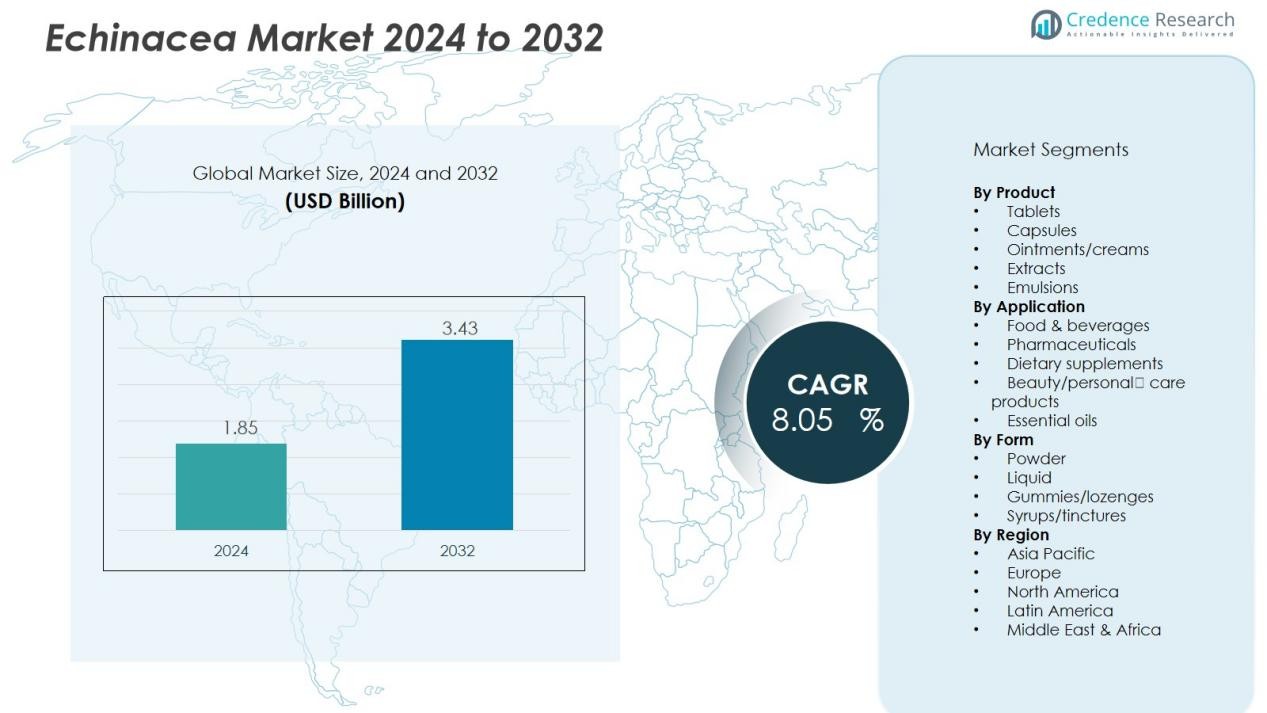
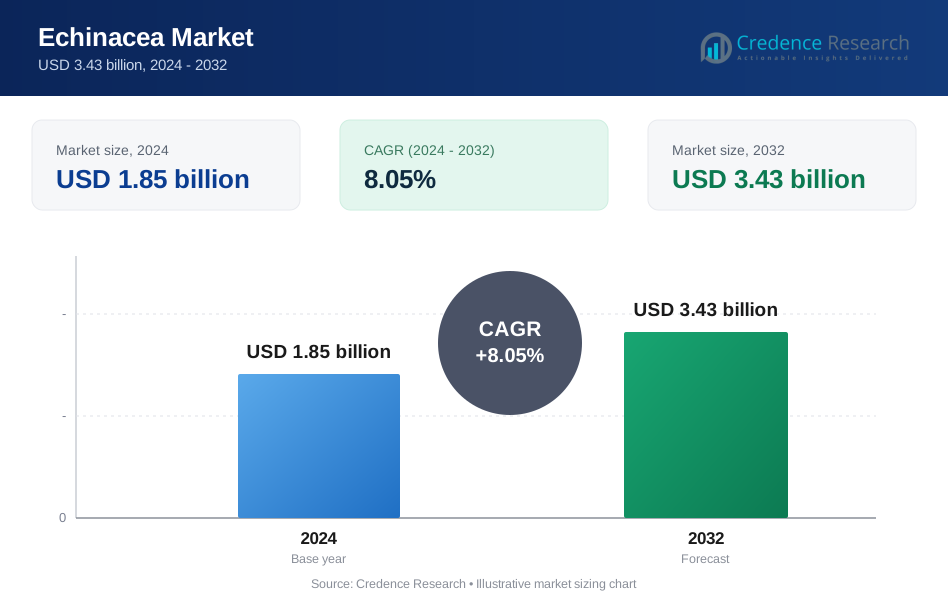
The Echinacea Market size was valued at USD 1.85 billion in 2024 and is anticipated to reach USD 3.43 billion by 2032, at a CAGR of 8.05 % during the forecast period.
| REPORT ATTRIBUTE | DETAILS |
|---|---|
| Historical Period | 2020-2023 |
| Base Year | 2024 |
| Forecast Period | 2025-2032 |
| Echinacea Market Size 2024 | USD 1.85 Billion |
| Echinacea Market, CAGR | 8.05 % |
| Echinacea Market Size 2032 | USD 3.43 Billion |
Key drivers of this market include increased consumer awareness of immune health and preventive wellness, which has boosted uptake of echinacea-based dietary supplements and herbal remedies. Additionally, innovation in formulation (including beauty and skin-care applications) and rising disposable incomes in emerging markets are motivating broader adoption. The expanding herbal medicine segment and favourable regulatory perception of plant-based therapeutics further fuel growth.
Regionally, North America currently dominates the echinacea market, owing to strong herbal supplement consumption, high health-consciousness, and the product’s historical roots in the U.S. market. Europe follows, with steady adoption in wellness and natural-health segments. The Asia-Pacific region is anticipated to register fastest growth over the forecast period, driven by increasing herbal remedy usage, rising middle-class incomes, and expanding distribution channels across China, India, and Southeast Asia.
Market Insights:
- The Echinacea Market was valued at USD 1.85 billion in 2024 and is projected to reach USD 3.43 billion by 2032, with a CAGR of 8.05% during the forecast period.
- North America dominates the Echinacea Market with a share of 38%, driven by high consumer awareness of herbal supplements, strong demand for immune-support products, and a well-established nutraceutical supply chain.
- Europe holds 27% of the market share, benefiting from mature herbal medicine industries and a strong preference for natural and organic health solutions, particularly in countries like Germany, France, and the UK.
- The Asia-Pacific region, with a market share in the mid-teens, is the fastest-growing due to rising disposable incomes, growing middle-class populations, and increasing interest in herbal wellness, particularly in China, India, and Southeast Asia.
- In terms of product segmentation, tablets and capsules hold the largest share, while the application for dietary supplements leads the market, followed by pharmaceuticals and beauty/personal-care products.
Market Drivers:
Rising Demand for Immune-Boosting Products
The growing consumer focus on immune health plays a pivotal role in driving the Echinacea market. Echinacea is widely recognized for its potential to enhance the body’s immune response, making it a sought-after ingredient in dietary supplements and herbal remedies. As awareness about preventive healthcare rises, consumers are increasingly turning to natural products like echinacea to support immune function and combat seasonal illnesses. The shift towards proactive wellness further propels demand for echinacea-based formulations, particularly in North America and Europe.
Expansion of the Herbal Supplement Industry
The Echinacea market benefits from the expansion of the global herbal supplement industry. With consumers seeking alternative therapies to pharmaceutical treatments, herbal products like echinacea are gaining significant market traction. Growing interest in natural remedies, driven by the increasing preference for plant-based wellness options, supports market growth. The demand for holistic health products, which emphasize long-term well-being, continues to increase, positioning echinacea as a key ingredient in the wellness sector.
- For Instance, Gaia Herbs sells a range of organic echinacea supplements that are widely available at major retailers, including Whole Foods and CVS. Echinacea is a popular traditional herbal medicine used for immune system support, and research on its efficacy is ongoing.
Product Innovation and New Applications
Ongoing innovation in echinacea-based products contributes to its market expansion. Manufacturers are continuously developing new formulations, including topical creams, beauty products, and tinctures, that appeal to a broader consumer base. Echinacea’s versatility in addressing various health concerns, from skincare to immune support, boosts its market presence. The introduction of innovative products in response to shifting consumer preferences enhances its appeal, expanding its reach in both health and beauty industries.
- For instance, Biocogent LLC launched Volpura EPO in March 2024, a proprietary echinacea purpurea-derived botanical extract for anti-aging skincare that stimulates adipocytes and boosts fat production by up to 5 times through PPAR-γ activation, delivering significant skin plumping and firming effects.
Growing Adoption in Emerging Markets
Emerging markets are increasingly contributing to the growth of the Echinacea market. Countries in Asia-Pacific, particularly China, India, and Southeast Asia, are witnessing a surge in herbal remedy use due to growing middle-class populations and higher disposable incomes. As consumers in these regions become more aware of the benefits of natural health products, demand for echinacea supplements and extracts is expected to increase significantly. Enhanced distribution networks and greater availability further drive market adoption in these fast-developing regions.
Market Trends:
Expansion into Functional Foods and Beauty Applications
The “Echinacea Market” now moves beyond traditional supplements and extracts into functional foods, beverages, lozenges and gummies. It also enters the skincare segment through creams and serums that carry immune‑support or anti‑inflammatory claims. Brands introduce formulations that make echinacea accessible during daily routines, encouraging trial among non‑herbal users. Suppliers invest in extraction technologies and standardized bioactive content to satisfy quality‑conscious consumers. The emphasis on clean labels and plant‑based ingredients further promotes inclusion of echinacea in wellness and beauty portfolios. The shift from single‑use supplements to integrative wellness formats highlights its broader market potential.
- For Instance, Nature's Way offers a range of echinacea products for immune support, including capsules of Echinacea Purpurea Herb and a combined Sambucus Immune Gummy product that includes black elderberry extract, vitamin C, and zinc.
Growth of Online Channels and Emerging Market Penetration
E‑commerce and digital channels drive visibility and direct‑to‑consumer access for echinacea‑based products, enabling brands to reach regional markets more efficiently. It now reaches consumers in Asia‑Pacific and Latin America via global platforms, supported by rising health awareness and income levels in those regions. Localisation of product offerings—including smaller pack sizes and regional certifications—helps companies to adapt to diverse regulatory and cultural environments. Supply‑chain improvements and digital marketing accelerate market access and consumer education. The elevated role of online reviews and influencer endorsements amplifies interest in echinacea‑rich wellness items. Such trend migration from developed to emerging markets strengthens growth momentum.
- For instance, NOW Foods implemented a custom Magento e-commerce platform managing over 1,400 dietary supplements, including echinacea products, with more than 50% of its B2B business processed through digital ordering tools, demonstrating significant penetration of online distribution channels across North American and emerging markets.
Market Challenges Analysis:
Regulatory and Quality‑Assurance Constraints impacting the Echinacea Market
The Echinacea Market faces significant regulatory and quality‑assurance constraints that limit growth. Compliance with stringent national and international regulations for herbal supplements demands substantial investment in validation, documentation and manufacturing controls. Variability in species identification and extraction processes leads to inconsistent product efficacy and undermines consumer confidence. Reports flag instances of adulteration or mislabelling of echinacea products, which can trigger regulatory scrutiny and reputational damage. Supply‑chain traceability and certifications add further complexity for market entrants and increase operational cost burdens. It remains challenging for smaller firms to maintain cost‑effective compliance while scaling their product offerings.
Cultivation, Supply‑Chain and Market Saturation Obstacles
Cultivation and supply‑chain obstacles pose a second major challenge to the Echinacea Market. Farming of echinacea entails seed dormancy, low germination rates and vulnerability to pathogens, which elevates production risk and cost. Supply‑chain disruptions—from raw‑material sourcing through processing to distribution—undermine timely product availability and margin stability. Growing competition within herbal‑remedy segments drives price pressure and reduces differentiation, which restrains profit potential. Market participants must adopt advanced agronomy, standardized extraction and efficient logistics to mitigate these restraints and sustain competitive positioning.
Market Opportunities:
Expansion into Adjacent Wellness and Personal‑Care Segments
The Echinacea Market can capture growth by branching into wellness and personal‑care areas traditionally dominated by synthetic chemicals. It can serve formulators who integrate plant‑based extracts into skin‑care, hair‑care and lifestyling products. That expansion allows brands to target beyond immune‑support supplements and reach broader demographics including beauty‑ and self‑care‑focused consumers. It supports positioning of echinacea in premium, clean‑label collections that align with sustainable and natural‑ingredient narratives. Manufacturers that invest in standardized extraction, high bioavailability formulations and novel delivery mechanisms can gain competitive advantage. Market players who communicate credibility through certifications and transparent sourcing will win trust and stimulate uptake across new categories.
Emerging‑Market Penetration and Digital Channel Leveraging
Emerging economies offer the Echinacea Market notable opportunities through increasing disposable income, rising health‑consciousness and mobile‑commerce adoption. It can leverage online platforms to reach consumers in regions where conventional retail access remains limited but digital penetration is high. Tailored offerings—such as smaller pack sizes, affordable entry‑level formats and regionally adapted formulations—can resonate in these markets. Local partnerships, region‑specific regulatory adaptation and culturally relevant communication will enhance market entry success. Brands that enhance digital marketing, influencer engagement and direct‑to‑consumer logistics will build strong footholds. Sustained investment in localised supply‑chain efficiency will support margin stability and consistent availability.
Market Segmentation Analysis:
By Product
The Echinacea Market segments product types into tablets, capsules, ointments/creams and extracts. Capsules currently lead in share because consumers favour convenient dosage forms in the nutraceutical sector. Tablets follow for their cost‑effectiveness and established use in pharmaceutical‑style supplements. Extracts carry significant weight because many manufacturers use them as intermediaries for formulations in food, beauty and health categories. Ointments and creams gain traction within the cosmetic and topical therapy sphere owing to consumer demand for natural skin‑care solutions. Each product category demands distinct formulation, packaging and regulatory pathways.
- For Instance, Gaia Herbs operates an in-house laboratory that is certified by the International Organization for Standardization (ISO 17025) for 24 testing methods, including microbial contamination and heavy metals.
By Application
The application segmentation spans dietary supplements/immune‑support, pharmaceuticals (cold/flu and anti‑inflammatory treatments), functional foods/beverages and beauty/personal‑care uses. Immune support remains the largest use‑case given broad consumer awareness of plant‑based health boosters. Pharmaceutical applications capture another strong share by integrating Echinacea in treatments for upper respiratory and inflammation‑related conditions. Functional foods and beverages represent a rising sub‑segment, where manufacturers embed Echinacea into drinks and snacks to reach wellness‑seeking consumers. Beauty and personal‑care applications exploit its soothing and antioxidant properties, thereby extending its appeal into skincare and natural cosmetics.
- For instance, Life Extension has developed Echinacea Elite, a dual-species formulation combining Echinacea purpurea (aerial parts extract standardized to 4% phenolic compounds) and Echinacea angustifolia (root extract standardized to 4% echinacosides) in 125 mg concentrations per serving.
By Form
The market divides primarily into powder, liquid (including tinctures and syrups) and other delivery formats (e.g., gummies, lozenges). Powder form dominates due to its cost‑efficiency, longer shelf life and suitability for capsules, tablets and bulk blends. Liquid form attracts users who seek rapid absorption or convenient consumption formats, particularly in children’s or wellness drink applications. Other delivery formats grow as brands innovate to improve consumer experience and expand reach into everyday‑wellness and snack‑type applications. Diverse form factors allow market players to tailor products for demographic segments, distribution channels and use‑cases.
Segmentations:
By Product
- Tablets
- Capsules
- Ointments/creams
- Extracts
- Emulsions
By Application
- Food & beverages
- Pharmaceuticals
- Dietary supplements
- Beauty/personal‑care products
- Essential oils
By Form
- Powder
- Liquid
- Gummies/lozenges
- Syrups/tinctures
By Region
- North America
- U.S.
- Canada
- Mexico
- Europe
- Germany
- France
- U.K.
- Italy
- Spain
- Rest of Europe
- Asia Pacific
- China
- Japan
- India
- South Korea
- South-east Asia
- Rest of Asia Pacific
- Latin America
- Brazil
- Argentina
- Rest of Latin America
- Middle East & Africa
- GCC Countries
- South Africa
- Rest of the Middle East and Africa
Regional Analysis:
North America Region
The market share of the Echinacea Market in North America stands at approximately 38 %. Strong consumer awareness of herbal supplements and a well‑established nutraceutical supply chain underlie this dominance. Consumers in the U.S. and Canada place high value on immune‑support products, and echinacea benefits from that trend. Manufacturers maintain advanced extraction facilities and rigorous quality‑control standards to meet regulatory expectations. Distribution spans health‑food outlets, large retail chains and online platforms, ensuring widespread availability. It faces competitive pressures but leverages early‑adopter wellness culture to maintain leadership.
Europe Region
Europe holds close to 27 % of the market share. Nationally mature herbal‑medicine industries, coupled with regulatory acceptance of botanical supplements, support its position. Consumers in Germany, France and the UK demonstrate preference for natural and organic health solutions, which helps uptake of echinacea‑based products. Supply‑chain transparency and product standardisation remain critical for market entrants. Brands that secure certifications and conform to EU health‑claims frameworks gain stronger trust. It faces fragmentation across countries, however consistent pan‑regional demand offers scale‑up potential.
Asia‑Pacific and Other Regions
In the Asia‑Pacific region, the market share is smaller—estimated in the mid‑teens—but growth momentum leads here. Rising disposable incomes, expanding digital‑commerce infrastructure and increasing interest in herbal wellness create favourable conditions. Brands tailor formulations and packs to local preferences and regulatory environments in China, India and Southeast Asia. Latin America and the Middle East & Africa account for lower single‑digit shares but present white‑space opportunities with improving herb‑supplement awareness. Across these regions, the Echinacea Market must navigate import regulations, localisation of marketing and channel fragmentation to capture growth.
Key Player Analysis:
- Adept Impex
- Swiss Natural
- Zebrago Industrial CoHilverdaKooij B.V. Mijnsherenweg
- Greenwoods Herbal Extract Co. Limited
- Nutra Green Biotechnology
- Sundown
- KingherbsEUSA COLORS
- Bio-Botanica, Inc
- Maat Nutritionals
- Manitoba
- Jarrow Formulas
Competitive Analysis:
The competitive landscape of the Echinacea Market features several established players with diverse geographic reach and product portfolios. In particular, companies such as Adept Impex, Swiss Natural, Zebrago Industrial Co, HilverdaKooij B.V. and Mijnsherenweg play significant roles in supplying raw materials, standardized extracts and finished‑goods across herbal supplement channels. It demands that firms differentiate via quality, certification and traceability to sustain market position. Many competitors pursue vertical integration—from cultivation to extraction—to control cost and enhance transparency. In this context, smaller niche brands find opportunity by targeting premium, clean‑label or regionally focused segments. The leadership of major players forces new entrants to invest in R&D, regulatory compliance and effective go‑to‑market strategies. It remains critical to monitor pricing pressures, ingredient supply constraints and evolving consumer preferences to maintain competitive strength in this market.
Recent Developments:
- In September 2025, HilverdaFlorist emphasized ongoing product innovation and expanded partnership support, highlighted in global communications about breeding advancements and international service extensions throughout the year.
- In April 2025, Sundown Solutions was acquired by Ancoris to create a new technology brand called Telana, expanding both companies’ capabilities in cloud and AI consulting after this strategic merger.
Report Coverage:
The research report offers an in-depth analysis based on Product, Application, Form and Region. It details leading Market players, providing an overview of their business, product offerings, investments, revenue streams, and key applications. Additionally, the report includes insights into the competitive environment, SWOT analysis, current Market trends, as well as the primary drivers and constraints. Furthermore, it discusses various factors that have driven Market expansion in recent years. The report also explores Market dynamics, regulatory scenarios, and technological advancements that are shaping the industry. It assesses the impact of external factors and global economic changes on Market growth. Lastly, it provides strategic recommendations for new entrants and established companies to navigate the complexities of the Market.
Future Outlook:
- The Echinacea Market will expand into functional food and beverage formats, which offer new application routes beyond traditional supplement use.
- It will increase penetration through online retail channels, giving smaller brands direct access to global consumers and strengthening omnichannel distribution.
- The market will benefit when product innovation delivers novel delivery formats—such as gummies, lozenges, and fortified beverages—that attract younger and convenience‑focused consumers.
- It will grow through rising demand in emerging regions where middle‑class income, health‑consciousness, and herbal‑wellness adoption converge.
- The market will strengthen when extraction and standardisation technologies mature, enabling higher bioavailability, improved efficacy, and enhanced quality assurance of echinacea‑based products.
- It will face pressure to adopt transparent supply chains and certification protocols, which brands can turn into differentiators to build consumer trust and brand loyalty.
- The market will leverage cross‑sector collaborations—between nutraceuticals, cosmetics, and pharmaceuticals—to embed echinacea into new wellness categories, including skin‑care and beauty regimes.
- It will navigate regulation and botanical‑supply challenges by forming strategic partnerships with growers, establishing traceable sourcing and scaling cultivation efficiencies.
- The market will benefit when data and clinical evidence support echinacea’s health‑claims, enabling brands to move from general wellness messaging to targeted therapeutic positioning.
- It will face competitive pressure from other botanical ingredients, which will prompt differentiation through premiumisation, clean‑label credentials, and brand storytelling around origin and heritage.
Request a Free Sample
Fill in your details and we'll send you a free sample report.
- Sample data tables & charts
- Research methodology
Need a Custom Version of This Report?
Tailor the scope, geography, or segments to your exact requirements.
- Custom geography or segment scope
- Direct access to our analyst team
Frequently Asked Questions
What is the current market size for the Echinacea Market, and what is its projected size in 2032?
At what Compound Annual Growth Rate is the Echinacea Market projected to grow between 2024 and 2032?
Which Echinacea Market segment held the largest share in 2024?
What are the primary factors fueling the growth of the Echinacea Market?
Who are the leading companies in the Echinacea Market?
Which region commanded the largest share of the Echinacea Market in 2024?
Table of Content
Chapter 1. Report Introduction
- 1.1 Report Description & Purpose
- 1.1.1 Report Title & Market Definition
- 1.1.2 Unique Selling Propositions (USP) & Key Differentiators
- 1.1.3 Value Proposition for Stakeholders
- 1.2 Research Objectives
- 1.2.1 Market Sizing Objectives (Volume & Revenue)
- 1.2.2 Segmentation Objectives
- 1.2.3 Competitive Intelligence Objectives
- 1.2.4 Forecast & Scenario Objectives
- 1.3 Report Scope
- 1.3.1 Echinacea Scope – Types & Subtypes Covered
- 1.3.2 Geographic Scope – Regions & Countries Covered
- 1.3.3 Historical Period, Base Year & Forecast Period (2024; forecast to 2032)
- 1.3.4 Inclusions & Exclusions
- 1.4 HS Code & Classification Framework
- 1.5 Currency, Units & Pricing Basis
- 1.6 Target Stakeholders
- 1.7 Limitations & Assumptions
Chapter 2. Executive Summary
- 2.1 Global Echinacea Market Snapshot
- 2.1.1 Market Size – Historical (2024) & Forecast (2024-2032) (2024: USD 1.85 billion → 2032: USD 3.43 billion)
- 2.1.2 Volume & Revenue – Global Totals
- 2.1.3 Key Market Highlights – Top Five Facts
- 2.2 Echinacea Market Segmentation Snapshot
- 2.2.1 Market Split by Region – 2024 vs. 2032
- 2.3 Competitive Snapshot
- 2.3.1 Top 10 Players by Revenue Share – 2024
- 2.3.2 Top 10 Players by Volume Share – 2024
- 2.3.3 Recent Strategic Developments (18-Month Summary)
- 2.4 Key Investment Highlights & Strategic Conclusions
Chapter 3. Echinacea Market Dynamics & Industry Analysis
- 3.1 Market Overview & Context
- 3.1.1 Echinacea Market Position in the Broader Automotive Value Chain
- 3.1.2 OEM vs. Replacement Market Dynamics
- 3.1.3 Market Maturity & Development Stage by Region
- 3.2 Echinacea Market Drivers
- 3.3 Echinacea Market Restraints & Challenges
- 3.4 Echinacea Market Opportunities
- 3.5 Porter's Five Forces Analysis
- 3.5.1 Threat of New Entrants
- 3.5.2 Bargaining Power of Suppliers
- 3.5.3 Bargaining Power of Buyers
- 3.5.4 Threat of Substitutes
- 3.5.5 Competitive Rivalry – Intensity Assessment
- 3.6 Echinacea Value Chain Analysis
- 3.6.1 Upstream – Raw Material/Input Suppliers
- 3.6.1.1 Raw Material/Input 1
- 3.6.1.2 Raw Material/Input 2
- 3.6.1.3 Raw Material/Input 3
- 3.6.2 Midstream – Production/Manufacturing/Service Delivery
- 3.6.2.1 Production/Process Overview
- 3.6.2.2 Key Facility Locations & Capacity by Manufacturer
- 3.6.3 Downstream – Distribution & End Consumer
- 3.6.3.1 Primary Channel – B2B/OEM
- 3.6.3.2 Secondary Channels – Dealer, Retail, Online, Direct
- 3.6.4 Value Chain Profitability Analysis
- 3.6.1 Upstream – Raw Material/Input Suppliers
- 3.7 PESTEL Analysis
- 3.7.1 Political Factors
- 3.7.2 Economic Factors
- 3.7.3 Social Factors
- 3.7.4 Technological Factors
- 3.7.5 Environmental Factors
- 3.7.6 Legal Factors
- 3.8 Echinacea Supply Chain Analysis
- 3.8.1 Raw Material/Input Supply Risk Assessment
- 3.8.2 Manufacturing Concentration Risk (Geographic Exposure)
- 3.8.3 Trade Disruption Impact Analysis
- 3.9 Regulatory & Policy Landscape
Note: The regulatory and policy landscape section covers regulations based on their applicability to the market, Echinacea category, geography, and scope of the study. Only regulatory frameworks with a material impact on operations, compliance, trade, sustainability, or market access are analyzed in detail.
Chapter 4. Key Investment Pockets & Opportunity Analysis
- 4.1 Echinacea Market Attractiveness Analysis
- 4.1.1 By Region – Investment Attractiveness Matrix (Volume × CAGR)
- 4.2 Absolute Revenue Growth Opportunity
- 4.2.1 By Region – Absolute USD Growth Through 2032
- 4.3 Incremental Volume Opportunity
- 4.3.1 By Region – Incremental Volume Through 2032
- 4.3.2 Segment – Incremental Volume
- 4.4 Emerging Submarket Opportunity Deep Dive (Subject to Applicability)
- 4.5 Emerging Market Opportunity Scorecards
- 4.5.1 United States
- 4.5.2 Europe
- 4.5.3 Asia
- 4.5.4 Middle East & Africa
Note: Emerging Market Opportunity Scorecards will be included based on relevance and strategic importance. Regions listed are indicative and may vary depending on data availability and market dynamics.
Chapter 5. Echinacea Import-Export Analysis & Trade Flows
- 5.1 Global Trade Overview
- 5.1.1 Global Export Value by Country (2024)
- 5.1.2 Global Export Volume by Country (2024)
- 5.1.3 Global Import Value by Country (2024)
- 5.1.4 Global Import Volume by Country (2024)
- 5.1.5 Net Trade Balance by Country (2024)
- 5.2 Export Analysis – Segment
- 5.2.1 Type 1 (HS Code)
- 5.2.2 Type 2 (HS Code)
- 5.2.3 Type 3 (HS Code)
- 5.2.4 Type 4 (HS Code)
- 5.2.5 Type 5 (HS Code)
- 5.3 Import Analysis – Segment
- 5.3.1 Type 1 (HS Code)
- 5.3.2 Type 2 (HS Code)
- 5.3.3 Type 3 (HS Code)
- 5.3.4 Type 4 (HS Code)
- 5.3.5 Type 5 (HS Code)
- 5.4 Average Unit Trade Prices
- 5.4.1 Average Export Price – Segment & Country
- 5.4.2 Average Import Price – Segment & Source Country
- 5.4.3 Price Trends (2024)
- 5.5 Key Trade Route Analysis
- 5.5.1 Trade Route 1
- 5.5.2 Trade Route 2
- 5.5.3 Trade Route 3
- 5.5.4 Trade Route 4
- 5.5.5 Trade Route 5
- 5.6 Trade Policy Impact Assessment
- 5.6.1 US Anti-Dumping & Section 301 Tariffs
- 5.6.2 EU Customs Union Impact
- 5.6.3 Major Free Trade Agreements
- 5.6.4 USMCA Rules of Origin
Note: Trade policy analysis will be included only where relevant to the Echinacea market.
Chapter 6. Competitive Landscape & Company Benchmarking
- 6.1 Echinacea Market Concentration & Structure
- 6.1.1 Herfindahl-Hirschman Index (HHI) – vs. 2024
- 6.1.2 Tier 1, Tier 2 & Tier 3 Market Structure
- 6.1.3 Global, Regional & Local Player Dynamics
- 6.2 Echinacea Market Share Analysis – 2024
- 6.2.1 Global Revenue Share by Company
- 6.2.2 Global Volume Share by Company
- 6.2.3 Regional Revenue Share
- 6.2.4 Market Share Evolution ( vs. 2024)
- 6.2.5 OEM Segment Share by Company
- 6.2.6 Replacement Segment Share by Company
- 6.3 Production/Delivery Capacity & Facility Analysis
- 6.3.1 Global Installed Capacity
- 6.3.2 Capacity Utilization Rates
- 6.3.3 Production/Output Volume
- 6.3.4 Facility Locations & Capacity Map
- 6.3.5 Planned Capacity Additions
- 6.4 Echinacea Competitive Benchmarking Matrix
- 6.4.1 Revenue, Volume, CAGR & Profitability Comparison
- 6.4.2 Channel Revenue Mix
- 6.4.3 Geographic Revenue Exposure
- 6.4.4 R&D Intensity
- 6.4.5 Sustainability Maturity
- 6.5 Strategic Developments in Echinacea (Last 24 Months)
- 6.5.1 Mergers, Acquisitions & Divestments
- 6.5.2 New Echinacea Launches
- 6.5.3 Facility Expansions
- 6.5.4 Strategic Alliances, Joint Ventures & Partnerships
- 6.5.5 Distribution Expansion & Market Entry
- 6.5.6 Sustainability & ESG Initiatives
- 6.6 Competitive Strategy Mapping
- 6.6.1 Leader, Challenger, Follower & Niche Classification
- 6.6.2 Pricing Strategy Comparison
- 6.6.3 Channel Strategy Matrix
Note: Strategic developments are included based on their materiality and the availability of reliable information.
Chapter 7. Global Echinacea Market – By Distribution Channel
- 7.1 Segment Overview
- 7.1.1 Volume & Revenue Split by Channel (2024 & 2032)
- 7.1.2 Channel Mix Evolution (2024-2032)
Chapter 8. Regional Market Analysis – Global Overview
- 8.1 Global Regional Overview
- 8.1.1 Regional Volume Share
- 8.1.2 Regional Revenue Share
- 8.1.3 Regional Volume by Region
- 8.1.4 Regional Revenue by Region
- 8.1.5 Regional Forecast Through 2032
- 8.2 Cross-Regional Segment Analysis
- 8.2.1 By Distribution Channel
- 8.2.2 By Brand/Price Tier
Chapter 9. North America Echinacea Market
- 9.1 United States
- 9.2 Canada
- 9.3 Mexico
Chapter 10. Europe Echinacea Market
- 10.1 Germany
- 10.2 France
- 10.3 Italy
- 10.4 United Kingdom
- 10.5 Spain
- 10.6 Poland
- 10.7 Russia
- 10.8 Netherlands
- 10.9 Belgium
- 10.10 Sweden
- 10.11 Denmark
- 10.12 Norway
- 10.13 Rest of Europe
Chapter 11. Asia Pacific Echinacea Market
- 11.1 China
- 11.2 India
- 11.3 Japan
- 11.4 South Korea
- 11.5 Thailand
- 11.6 Indonesia
- 11.7 Vietnam
- 11.8 Malaysia
- 11.9 Australia
- 11.10 Rest of Asia Pacific
Chapter 12. Latin America Echinacea Market
- 12.1 Brazil
- 12.2 Argentina
- 12.3 Colombia
- 12.4 Chile
- 12.5 Rest of Latin America
Chapter 13. Middle East Echinacea Market
- 13.1 Saudi Arabia
- 13.2 United Arab Emirates
- 13.3 Turkey
- 13.4 Israel
- 13.5 Iran
- 13.6 Rest of the Middle East
Chapter 14. Africa Echinacea Market
- 14.1 South Africa
- 14.2 Egypt
- 14.3 Nigeria
- 14.4 Morocco
- 14.5 Rest of Africa
Chapter 15. Echinacea Company Profiles
- 15.1 [Company 01]
- 15.1.1 Company Overview
- 15.1.2 Key Management Personnel
- 15.1.3 Products & Services Portfolio
- 15.1.4 Financial Performance
- 15.1.5 Key Market Focus & Geographic Presence
- 15.1.6 Recent Developments & Strategic Initiatives
Note: The company profile list is preliminary and may change based on research findings, market developments, data availability, and client requirements.
Chapter 16. Appendices
- Appendix A – List of Abbreviations & Acronyms
- Appendix B – Industry Classification Code Reference – Full Series
- Appendix C – Production & Capacity Data Tables
- Appendix D – End-Use & Demand Base Tables
- Appendix E – Consumption & Replacement Rate Assumptions
- Appendix F – ASP Reference Tables
- Appendix G – Manufacturing & Facility Database
- Appendix H – Import-Export Data Tables
- Appendix I – Regulatory Summary Tables
- Appendix J – Primary Research Participant List (Anonymized)
- Appendix K – Primary Research Questionnaire Framework
- Appendix L – Data Sources & Bibliography
- Appendix M – Market Size Divergence & Source Comparison
Chapter 17. Research Methodology
- 17.1 Research Framework & Philosophy
- 17.2 Secondary Research – Sources, Hierarchy & Data Extraction
- 17.3 Data Modeling – Bottom-Up & Top-Down Market Sizing
- 17.4 Primary Research – Stakeholder Framework, LOI & Sample Sizes
- 17.5 Forecast Methodology – Regression, Scenario & Sensitivity Analysis
- 17.6 Quality Control – Four-Layer Validation Framework
- 17.7 Limitations & Standard Assumptions
- 17.8 Disclaimer
