
Monk Fruit Sweetener Market Overview:
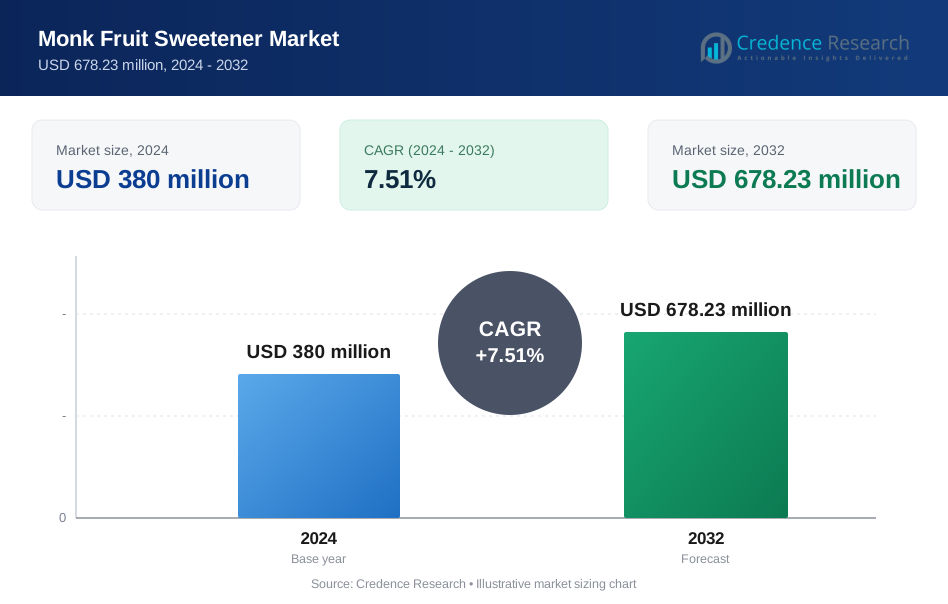
Monk Fruit Sweetener Market size was valued USD 380 million in 2024 and is anticipated to reach USD 678.23 million by 2032, at a CAGR of 7.51% during the forecast period.
| REPORT ATTRIBUTE | DETAILS |
|---|---|
| Historical Period | 2020-2023 |
| Base Year | 2024 |
| Forecast Period | 2025-2032 |
| Monk Fruit Sweetener Market Size 2024 | USD 380 million |
| Monk Fruit Sweetener Market, CAGR | 7.51% |
| Monk Fruit Sweetener Market Size 2032 | USD 678.23 million |
Monk Fruit Sweetener Market Insights
- Market growth is driven by rising sugar-reduction initiatives, increasing diabetic and obesity prevalence, and strong demand from beverages, nutraceuticals, and tabletop sweeteners, with food and beverage applications representing the dominant segment share.
- Key market trends include improved mogroside purification, blended formulations with other natural sweeteners, and increasing clean-label reformulations across bakery, dairy alternatives, and functional drinks.
- Competitive dynamics focus on securing raw material supply, enhancing taste consistency, and expanding application-specific solutions, while high production costs and limited large-scale cultivation act as key market restraints.
- Regionally, North America leads with an exact 38% market share, supported by high consumer awareness and mature health-focused industries, while Asia-Pacific remains the primary supply hub and fastest-growing consumption region.
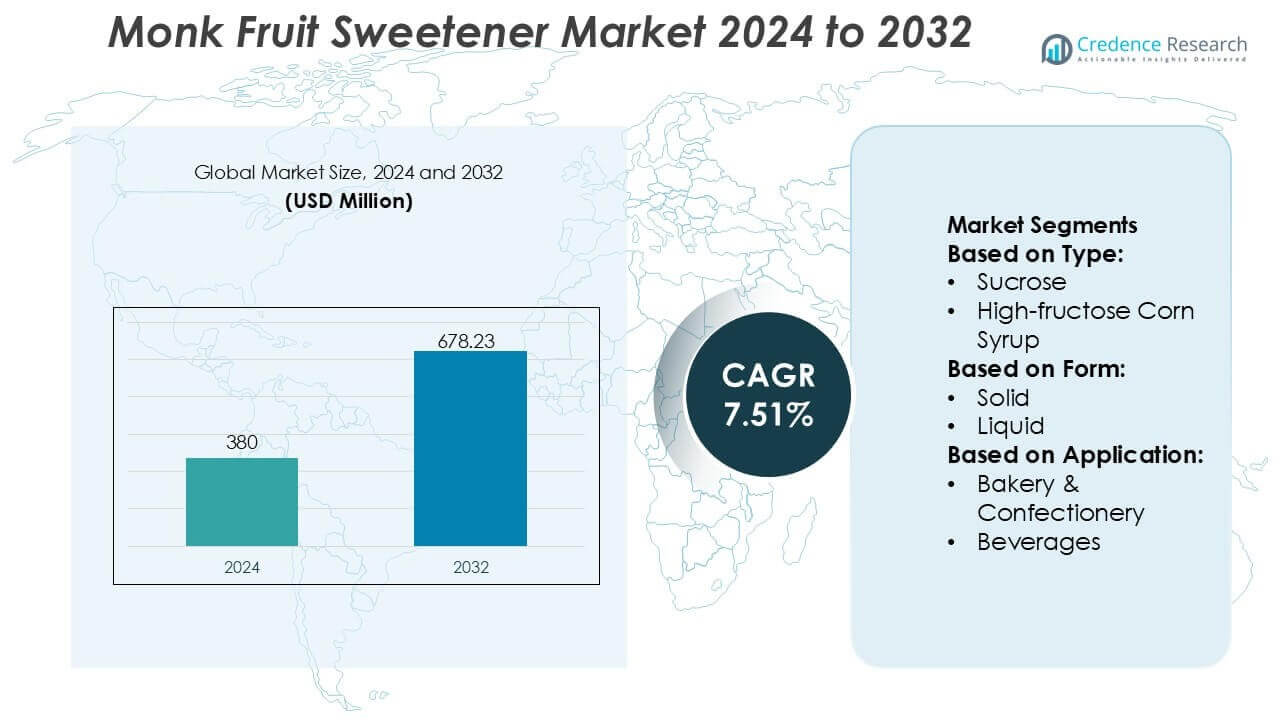
Monk Fruit Sweetener Market Segmentation Analysis:
By Type
Within the Monk Fruit Sweetener Market, high-intensity sweeteners form the dominant type segment, accounting for an estimated 42% market share. This leadership is driven by rising demand for zero-calorie, plant-derived sugar alternatives with high sweetness potency. Monk fruit (Luo Han Guo) stands out within this category due to its natural origin, clean-label appeal, and thermal stability, making it suitable for processed foods and beverages. Growth is further supported by increasing consumer avoidance of artificial sweeteners such as aspartame and saccharin, alongside regulatory acceptance of monk fruit extracts in major food markets.
- For instance, Tate & Lyle’s PUREFRUIT™ Monk Fruit Extract is positioned at ~200× the sweetness of sugar, enabling significant sugar replacement while maintaining a “clean” sweetness profile for product developers.
By Form
The solid form segment leads the Monk Fruit Sweetener Market with approximately 58% market share, supported by its versatility in dry blending, longer shelf stability, and ease of integration into powdered food formulations. Solid monk fruit sweeteners are widely used in tabletop sweeteners, bakery premixes, and nutraceutical applications due to precise dosing and compatibility with bulking agents like erythritol. Manufacturers favor solid formats for cost-effective transportation and standardized packaging. Meanwhile, liquid forms are gaining traction in beverages and syrups, but adoption remains secondary due to stability and handling constraints.
- For instance, Pyure lists on its product label that its Organic Monk Fruit Sweetener granular blend delivers approximately *2× the sweetness per scoop compared to sucrose (table sugar), while maintaining a zero glycemic index and zero available carbohydrates per serving as specified in the Nutrition Facts panel on its USDA Organic product pages.
By Application
Beverages represent the dominant application segment, holding close to 36% market share, driven by rapid reformulation of soft drinks, flavored waters, and functional beverages toward low- and zero-sugar profiles. Monk fruit sweeteners enable beverage producers to reduce sugar content without compromising sweetness intensity or mouthfeel. Strong growth in ready-to-drink teas, energy drinks, and wellness beverages accelerates adoption. Bakery & confectionery and dairy applications follow, supported by monk fruit’s heat stability and synergistic blending with other natural sweeteners to optimize taste and texture.
Key Growth Drivers
Rising Demand for Natural, Clean-Label Sweeteners
The monk fruit sweetener market is strongly driven by increasing consumer preference for natural, plant-based, and clean-label ingredients. Shoppers are actively avoiding artificial sweeteners due to perceived health risks, pushing food and beverage manufacturers to reformulate products with naturally derived alternatives. Monk fruit extract, sourced from Siraitia grosvenorii, aligns well with clean-label positioning as it delivers sweetness without synthetic additives. Its botanical origin and minimal processing requirements enhance brand transparency, supporting adoption across beverages, dairy alternatives, bakery items, and nutritional products.
- For instance, Beeyond the Hive’s Raw Wildflower Honey is offered in standardized 16 oz (453.6 g) glass jars, providing consistent dosing and consumer handling metrics across its retail portfolio.
Growing Focus on Sugar Reduction and Metabolic Health
Heightened awareness of obesity, diabetes, and metabolic disorders continues to accelerate demand for sugar-reduction solutions. Monk fruit sweeteners provide high-intensity sweetness without contributing calories or glycemic load, making them suitable for diabetic-friendly and low-carbohydrate formulations. Regulatory and public-health initiatives encouraging reduced sugar intake further reinforce adoption. As manufacturers seek to maintain taste profiles while lowering sugar content, monk fruit offers a functional solution that supports reformulation strategies in functional foods, sports nutrition, and better-for-you packaged products.
- For instance, Cargill’s agricultural stevia program has been benchmarked at the Silver level under the SAI Platform Farm Sustainability Assessment (FSA) 3.0, reflecting rigorous criteria for environmental and social practices across stevia supply chains.
Expanding Application Scope Across Food and Beverage Segments
The versatility of monk fruit sweeteners across multiple applications is another major growth driver. Improved extraction and purification technologies have enhanced flavor profiles, reducing bitterness and enabling broader use in beverages, confectionery, sauces, and tabletop sweeteners. Compatibility with other natural sweeteners also supports blended formulations, improving taste balance and cost efficiency. This expanding applicability allows manufacturers to integrate monk fruit across diverse product portfolios, supporting sustained demand growth in both mainstream and specialty food segments.
Key Trends & Opportunities
Innovation in Blended and Taste-Optimized Formulations
A key trend shaping the monk fruit sweetener market is the development of blended sweetener systems that combine monk fruit with stevia, erythritol, or allulose. These blends address taste challenges such as lingering aftertaste while optimizing sweetness intensity and mouthfeel. This trend creates opportunities for product differentiation and broader consumer acceptance, particularly in beverages and baked goods. Continuous innovation in flavor-masking and formulation science is expected to unlock new use cases and support premium positioning.
Growth of Functional and Personalized Nutrition Products
The rapid expansion of functional foods and personalized nutrition presents a significant opportunity for monk fruit sweeteners. Products targeting weight management, gut health, and sports performance increasingly require non-glycemic sweetening solutions. Monk fruit aligns well with these formulations due to its natural origin and metabolic neutrality. As consumers seek customized health solutions, demand for clean, functional sweeteners in nutraceuticals, meal replacements, and fortified foods is expected to rise steadily.
- For instance, according to ADM’s official technical documentation, SweetRight® Stevia Edge-M demonstrates approximately *5× greater solubility in water at room temperature (around 8.42 g/kg versus 1.56 g/kg for standard Reb M extracts), enabling faster dissolution in beverage and aqueous systems without residual undissolved particles.
Key Challenges
Supply Chain Constraints and Agricultural Dependency
The monk fruit sweetener market faces challenges related to supply chain concentration and agricultural dependency. Monk fruit cultivation is geographically limited, making supply vulnerable to climate variability, crop yield fluctuations, and logistical disruptions. Limited farming regions also constrain rapid scalability, which can affect consistent availability for large-scale food manufacturers. These factors create supply risk and can restrict long-term production planning, particularly as global demand continues to expand.
Cost Pressures and Formulation Complexity
Higher production and extraction costs remain a key challenge for monk fruit sweeteners compared to conventional sugar and some alternative sweeteners. Advanced purification processes are required to achieve desirable taste profiles, increasing formulation complexity and development timelines. Cost sensitivity among mass-market food producers can limit adoption, especially in price-competitive categories. Addressing these challenges will require continued process optimization, yield improvement, and economies of scale to enhance commercial viability.
Regional Analysis
North America
North America leads the monk fruit sweetener market with an estimated 38% market share, driven by strong consumer awareness of sugar reduction, widespread adoption of clean-label ingredients, and a mature health & wellness food ecosystem. Beverage manufacturers, nutraceutical brands, and tabletop sweetener producers actively integrate monk fruit to replace artificial sweeteners and high-calorie sugars. Robust regulatory clarity, advanced extraction technologies, and strong distribution through natural food retail chains further support penetration. Demand is particularly strong in the United States, where keto, diabetic-friendly, and zero-calorie product formulations continue to gain mainstream acceptance across foodservice and packaged food categories.
Europe
Europe accounts for approximately 27% of the global monk fruit sweetener market, supported by rising regulatory pressure to reduce sugar content and growing consumer preference for natural, plant-based ingredients. Adoption is strongest in Western Europe, where food and beverage manufacturers reformulate products to comply with sugar taxation policies and clean-label standards. Monk fruit is increasingly used in dairy alternatives, functional beverages, and bakery products to balance sweetness without artificial additives. While regulatory approvals vary across countries, ongoing harmonization and clean-label momentum continue to improve market accessibility and long-term growth prospects across the region.
Asia-Pacific
Asia-Pacific holds nearly 25% market share, driven by its role as the primary production hub for monk fruit and expanding regional consumption of natural sweeteners. China dominates supply due to favorable agricultural conditions, established cultivation practices, and cost-efficient extraction infrastructure. Beyond supply leadership, rising health awareness in Japan, South Korea, India, and Southeast Asia is accelerating demand in functional foods, herbal beverages, and traditional health products. Increasing urbanization, growth of middle-income populations, and expanding nutraceutical manufacturing capacity position Asia-Pacific as the fastest-growing regional market over the forecast period.
Latin America
Latin America represents around 6% of the monk fruit sweetener market, with growth supported by rising obesity concerns, increasing diabetic populations, and gradual shifts toward natural sugar substitutes. Adoption is most visible in Brazil, Mexico, and Chile, where beverage and processed food manufacturers are reformulating products to meet evolving nutritional guidelines. While monk fruit awareness remains lower than stevia, premium positioning and improved import availability are supporting steady uptake. Expanding health-focused retail channels and growing investment in clean-label product development are expected to strengthen regional demand over the coming years.
Middle East & Africa
The Middle East & Africa accounts for roughly 4% of global market share, reflecting an early-stage but steadily developing market for monk fruit sweeteners. Demand is driven by increasing incidence of lifestyle-related diseases and rising interest in sugar-free functional foods, particularly in Gulf Cooperation Council countries. Import-based supply dominates, with usage concentrated in premium beverages, supplements, and specialty food products. Limited consumer awareness and higher pricing currently constrain adoption; however, expanding health campaigns, growing expatriate populations, and diversification of food manufacturing are expected to support gradual market expansion.
Monk Fruit Sweetener Market Segmentations:
By Type:
- Sucrose
- High-fructose Corn Syrup
By Form:
- Solid
- Liquid
By Application:
- Bakery & Confectionery
- Beverages
By Geography
- North America
- U.S.
- Canada
- Mexico
- Europe
- Germany
- France
- U.K.
- Italy
- Spain
- Rest of Europe
- Asia Pacific
- China
- Japan
- India
- South Korea
- South-east Asia
- Rest of Asia Pacific
- Latin America
- Brazil
- Argentina
- Rest of Latin America
- Middle East & Africa
- GCC Countries
- South Africa
- Rest of the Middle East and Africa
Key Player Analysis
The Truvía Company, LLC Pyure Brands LLC Whole Earth BetterBody Foods® Sweetleaf dsm-firmenich Monk Fruit Corp Lakanto ADM NOW® Foods GLG Life Tech Corporation Tate & Lyle HealthGarden Heartland Consumer Products LLCRecent Developments
- In February 2025, Oobli, a pioneer in sweet protein technology, teamed up with Ingredion to introduce innovative sweetener solutions. Oobli and ingredients maker Ingredion will soon unveil new finished products that are a result of the companies' partnership.
- In October 2024, Tate & Lyle has partnered with Manus, a bio-alternatives scale-up platform, to expand access to natural sugar reduction solutions. Tate & Lyle and Manus announced a strategic partnership, The Natural Sweetener Alliance, to widen access to natural sugar reduction solutions.
Report Coverage
The research report offers an in-depth analysis based on Type, Form, Application and Geography. It details leading market players, providing an overview of their business, product offerings, investments, revenue streams, and key applications. Additionally, the report includes insights into the competitive environment, SWOT analysis, current market trends, as well as the primary drivers and constraints. Furthermore, it discusses various factors that have driven market expansion in recent years. The report also explores market dynamics, regulatory scenarios, and technological advancements that are shaping the industry. It assesses the impact of external factors and global economic changes on market growth. Lastly, it provides strategic recommendations for new entrants and established companies to navigate the complexities of the market.
Future Outlook
- Rising global emphasis on sugar reduction will continue to accelerate adoption of monk fruit sweeteners across food, beverage, and nutraceutical formulations.
- Advancements in extraction and purification technologies will improve taste consistency and reduce bitterness, supporting broader application use.
- Blended sweetener systems combining monk fruit with other natural alternatives will gain traction to optimize sweetness profiles and cost efficiency.
- Expansion of clean-label and plant-based product portfolios will reinforce long-term demand across mainstream and premium categories.
- Increased regulatory acceptance across emerging markets will enhance commercialization opportunities and geographic reach.
- Growth of diabetic-friendly, keto, and low-glycemic diets will sustain steady consumer-driven demand.
- Strengthening supply chains and contract farming initiatives will improve raw material availability and quality stability.
- Rising use in functional beverages and dietary supplements will support volume growth beyond tabletop sweeteners.
- E-commerce and direct-to-consumer channels will play a larger role in market penetration and brand visibility.
- Sustainability-focused cultivation and processing practices will increasingly influence sourcing strategies and buyer preferences.
Request a Free Sample
Fill in your details and we'll send you a free sample report.
- Sample data tables & charts
- Research methodology
Need a Custom Version of This Report?
Tailor the scope, geography, or segments to your exact requirements.
- Custom geography or segment scope
- Direct access to our analyst team
Frequently Asked Questions
What is the current market size for the Monk Fruit Sweetener Market, and what is its projected size in 2032?
At what Compound Annual Growth Rate is the Monk Fruit Sweetener Market projected to grow between 2024 and 2032?
Which Monk Fruit Sweetener Market segment held the largest share in 2024?
What are the primary factors fueling the growth of the Monk Fruit Sweetener Market?
Who are the leading companies in the Monk Fruit Sweetener Market?
Which region commanded the largest share of the Monk Fruit Sweetener Market in 2024?
Table of Content
Chapter 1. Report Introduction
- 1.1 Report Description & Purpose
- 1.1.1 Report Title & Market Definition
- 1.1.2 Unique Selling Propositions (USP) & Key Differentiators
- 1.1.3 Value Proposition for Stakeholders
- 1.2 Research Objectives
- 1.2.1 Market Sizing Objectives (Volume & Revenue) (Volume Where Applicable)
- 1.2.2 Segmentation Objectives
- 1.2.3 Competitive Intelligence Objectives
- 1.2.4 Forecast & Scenario Objectives
- 1.3 Report Scope
- 1.3.1 Monk Fruit Sweetener Scope – Segments & Subsegments Covered
- 1.3.2 Geographic Scope – Regions & Countries Covered
- 1.3.3 Historical Period, Base Year & Forecast Period (2024; forecast to 2032)
- 1.3.4 Inclusions & Exclusions
- 1.4 Industry Classification & Applicable Codes
- 1.5 Currency, Measurement Units & Valuation Basis
- 1.6 Target Stakeholders
- 1.7 Limitations & Assumptions
Chapter 2. Executive Summary
- 2.1 Global Monk Fruit Sweetener Market Snapshot
- 2.1.1 Market Size – Historical (2024) & Forecast (2024-2032) (2024: USD 380 million → 2032: USD 678.23 million)
- 2.1.2 Volume & Revenue – Global Totals (Volume Where Applicable)
- 2.1.3 Key Market Highlights – Top Five Facts
- 2.2 Monk Fruit Sweetener Market Segmentation Snapshot
- 2.2.1 Market Split by Region – 2024 vs. 2032
- 2.3 Competitive Snapshot
- 2.3.1 Top 10 Players by Revenue Share – 2024
- 2.3.2 Top 10 Players by Volume Share – 2024 (Volume Where Applicable)
- 2.3.3 Recent Strategic Developments (18-Month Summary)
- 2.4 Key Investment Highlights & Strategic Conclusions
Chapter 3. Monk Fruit Sweetener Market Dynamics & Industry Analysis
- 3.1 Market Overview & Context
- 3.1.1 Monk Fruit Sweetener Market Position in the Broader Industry Value Chain
- 3.1.2 Demand Structure & Purchasing Dynamics
- 3.1.3 Market Maturity & Development Stage by Region
- 3.2 Monk Fruit Sweetener Market Drivers
- 3.3 Monk Fruit Sweetener Market Restraints & Challenges
- 3.4 Monk Fruit Sweetener Market Opportunities
- 3.5 Porter's Five Forces Analysis
- 3.5.1 Threat of New Entrants
- 3.5.2 Bargaining Power of Suppliers
- 3.5.3 Bargaining Power of Buyers
- 3.5.4 Threat of Substitutes
- 3.5.5 Competitive Rivalry – Intensity Assessment
- 3.6 Monk Fruit Sweetener Value Chain Analysis
- 3.6.1 Upstream – Key Inputs, Resources & Suppliers
- 3.6.1.1 Key Input/Resource 1
- 3.6.1.2 Key Input/Resource 2
- 3.6.1.3 Key Input/Resource 3
- 3.6.2 Midstream – Core Operations & Value Creation
- 3.6.2.1 Operating Model & Process Overview
- 3.6.2.2 Key Operating Locations & Capabilities by Company
- 3.6.3 Downstream – Market Channels & End Users
- 3.6.3.1 Direct Sales & Customer Engagement Channels
- 3.6.3.2 Indirect Sales, Intermediaries & Partner Channels
- 3.6.4 Value Chain Profitability Analysis
- 3.6.1 Upstream – Key Inputs, Resources & Suppliers
- 3.7 PESTEL Analysis
- 3.7.1 Political Factors
- 3.7.2 Economic Factors
- 3.7.3 Social Factors
- 3.7.4 Technological Factors
- 3.7.5 Environmental Factors
- 3.7.6 Legal Factors
- 3.8 Monk Fruit Sweetener Supply Chain Analysis
- 3.8.1 Critical Input & Resource Availability Risk Assessment
- 3.8.2 Supplier & Operational Concentration Risk (Geographic Exposure)
- 3.8.3 Supply & Service Disruption Impact Analysis
- 3.9 Regulatory & Policy Landscape
Note: The regulatory and policy landscape section covers regulations based on their applicability to the market, Monk Fruit Sweetener category, geography, and scope of the study. Only regulatory frameworks with a material impact on operations, compliance, trade, sustainability, or market access are analyzed in detail.
Chapter 4. Key Investment Pockets & Opportunity Analysis
- 4.1 Monk Fruit Sweetener Market Attractiveness Analysis
- 4.1.1 By Region – Investment Attractiveness Matrix (Market Size × CAGR)
- 4.2 Absolute Revenue Growth Opportunity
- 4.2.1 By Region – Absolute Revenue Growth Through 2032
- 4.3 Incremental Demand Opportunity
- 4.3.1 By Region – Incremental Demand Through 2032
- 4.3.2 Segment – Incremental Demand
- 4.4 Emerging Submarket Opportunity Deep Dive (Subject to Applicability)
- 4.5 Priority Market Opportunity Scorecards
- 4.5.1 United States
- 4.5.2 Europe
- 4.5.3 Asia
- 4.5.4 Middle East & Africa
Note: Priority market opportunity scorecards reflect the geographic scope and strategic relevance of the study. Listed markets are indicative and may be adapted to the industry.
Chapter 5. Monk Fruit Sweetener Cross-Border Trade & Market Access Analysis
- 5.1 International Trade & Cross-Border Activity Overview
- 5.1.1 Global Export Value by Country (2024)
- 5.1.2 Global Export Volume by Country (2024) (Volume Where Applicable)
- 5.1.3 Global Import Value by Country (2024)
- 5.1.4 Global Import Volume by Country (2024) (Volume Where Applicable)
- 5.1.5 Net Trade Balance by Country (2024)
- 5.2 Export Analysis – Segment
- 5.2.1 Category 1 (Applicable Classification Code)
- 5.2.2 Category 2 (Applicable Classification Code)
- 5.2.3 Category 3 (Applicable Classification Code)
- 5.2.4 Category 4 (Applicable Classification Code)
- 5.2.5 Category 5 (Applicable Classification Code)
- 5.3 Import Analysis – Segment
- 5.3.1 Category 1 (Applicable Classification Code)
- 5.3.2 Category 2 (Applicable Classification Code)
- 5.3.3 Category 3 (Applicable Classification Code)
- 5.3.4 Category 4 (Applicable Classification Code)
- 5.3.5 Category 5 (Applicable Classification Code)
- 5.4 Cross-Border Pricing & Transaction Benchmarks
- 5.4.1 Export Pricing – Segment & Country
- 5.4.2 Import Pricing – Segment & Source Country
- 5.4.3 Price Trends (2024)
- 5.5 Key Cross-Border Trade & Delivery Routes
- 5.5.1 Cross-Border Trade/Delivery Route 1
- 5.5.2 Cross-Border Trade/Delivery Route 2
- 5.5.3 Cross-Border Trade/Delivery Route 3
- 5.5.4 Cross-Border Trade/Delivery Route 4
- 5.5.5 Cross-Border Trade/Delivery Route 5
- 5.6 Trade Policy & Market Access Impact Assessment
- 5.6.1 Tariff & Non-Tariff Barriers
- 5.6.2 Regional Trade & Economic Integration Frameworks
- 5.6.3 Bilateral & Multilateral Trade Agreements
- 5.6.4 Cross-Border Operating, Licensing & Localization Requirements
Note: This chapter applies where cross-border trade or delivery is relevant to Monk Fruit Sweetener. Goods, services, and digital offerings are assessed using applicable classifications and transaction measures. Import-export volumes, trade balances, and route analyses are included only where meaningful to the market.
Chapter 6. Competitive Landscape & Company Benchmarking
- 6.1 Monk Fruit Sweetener Market Concentration & Structure
- 6.1.1 Herfindahl-Hirschman Index (HHI) – vs. 2024
- 6.1.2 Leading, Mid-Sized & Emerging Player Structure
- 6.1.3 Global, Regional & Local Player Dynamics
- 6.2 Monk Fruit Sweetener Market Share Analysis – 2024
- 6.2.1 Global Revenue Share by Company
- 6.2.2 Global Volume Share by Company (Volume Where Applicable)
- 6.2.3 Regional Revenue Share
- 6.2.4 Market Share Evolution ( vs. 2024)
- 6.2.5 Company Market Share by Key Segment
- 6.2.6 Company Market Share by Customer Group
- 6.3 Operating Scale, Capacity & Infrastructure Analysis
- 6.3.1 Global Operating Scale & Supply Capacity
- 6.3.2 Resource Utilization & Operating Efficiency
- 6.3.3 Output, Service Delivery & Activity Metrics
- 6.3.4 Operating Footprint & Infrastructure Map
- 6.3.5 Planned Operational & Capacity Expansion
- 6.4 Monk Fruit Sweetener Competitive Benchmarking Matrix
- 6.4.1 Revenue, Growth, Profitability & Operating Metric Comparison
- 6.4.2 Channel Revenue Mix
- 6.4.3 Geographic Revenue Exposure
- 6.4.4 R&D Intensity
- 6.4.5 Sustainability Maturity
- 6.5 Strategic Developments in Monk Fruit Sweetener (Last 24 Months)
- 6.5.1 Mergers, Acquisitions & Divestments
- 6.5.2 New Products, Services & Solutions in Monk Fruit Sweetener
- 6.5.3 Operational & Infrastructure Expansions
- 6.5.4 Strategic Alliances, Joint Ventures & Partnerships
- 6.5.5 Distribution Expansion & Market Entry
- 6.5.6 Sustainability & ESG Initiatives
- 6.6 Competitive Strategy Mapping
- 6.6.1 Leader, Challenger, Follower & Niche Classification
- 6.6.2 Pricing Strategy Comparison
- 6.6.3 Channel Strategy Matrix
Note: Strategic developments are included based on their materiality and the availability of reliable information.
Chapter 7. Global Monk Fruit Sweetener Market – By Sales & Delivery Channel
- 7.1 Segment Overview
- 7.1.1 Volume & Revenue Split by Channel (2024 & 2032) (Volume Where Applicable)
- 7.1.2 Channel Mix Evolution (2024-2032)
Chapter 8. Regional Market Analysis – Global Overview
- 8.1 Global Regional Overview
- 8.1.1 Regional Volume Share (Volume Where Applicable)
- 8.1.2 Regional Revenue Share
- 8.1.3 Regional Volume by Region (Volume Where Applicable)
- 8.1.4 Regional Revenue by Region
- 8.1.5 Regional Forecast Through 2032
- 8.2 Cross-Regional Segment Analysis
- 8.2.1 By Sales & Delivery Channel
- 8.2.2 By Competitive Positioning & Price Tier
Chapter 9. North America Monk Fruit Sweetener Market
- 9.1 United States
- 9.2 Canada
- 9.3 Mexico
Chapter 10. Europe Monk Fruit Sweetener Market
- 10.1 Germany
- 10.2 France
- 10.3 Italy
- 10.4 United Kingdom
- 10.5 Spain
- 10.6 Poland
- 10.7 Russia
- 10.8 Netherlands
- 10.9 Belgium
- 10.10 Sweden
- 10.11 Denmark
- 10.12 Norway
- 10.13 Rest of Europe
Chapter 11. Asia Pacific Monk Fruit Sweetener Market
- 11.1 China
- 11.2 India
- 11.3 Japan
- 11.4 South Korea
- 11.5 Thailand
- 11.6 Indonesia
- 11.7 Vietnam
- 11.8 Malaysia
- 11.9 Australia
- 11.10 Rest of Asia Pacific
Chapter 12. Latin America Monk Fruit Sweetener Market
- 12.1 Brazil
- 12.2 Argentina
- 12.3 Colombia
- 12.4 Chile
- 12.5 Rest of Latin America
Chapter 13. Middle East Monk Fruit Sweetener Market
- 13.1 Saudi Arabia
- 13.2 United Arab Emirates
- 13.3 Turkey
- 13.4 Israel
- 13.5 Iran
- 13.6 Rest of the Middle East
Chapter 14. Africa Monk Fruit Sweetener Market
- 14.1 South Africa
- 14.2 Egypt
- 14.3 Nigeria
- 14.4 Morocco
- 14.5 Rest of Africa
Chapter 15. Monk Fruit Sweetener Company Profiles
- 15.1 [Company 01]
- 15.1.1 Company Overview
- 15.1.2 Key Management Personnel
- 15.1.3 Products & Services Portfolio
- 15.1.4 Financial Performance
- 15.1.5 Key Market Focus & Geographic Presence
- 15.1.6 Recent Developments & Strategic Initiatives
Note: The company profile list is preliminary and may change based on research findings, market developments, data availability, and client requirements.
Chapter 16. Appendices
- Appendix A – List of Abbreviations & Acronyms
- Appendix B – Industry Classification Code Reference – Full Series
- Appendix C – Supply, Output & Operating Capacity Data Tables
- Appendix D – End-Use & Demand Base Tables
- Appendix E – Demand, Adoption & Usage Assumptions
- Appendix F – Pricing & Revenue Metric Reference Tables
- Appendix G – Company Operations & Infrastructure Database
- Appendix H – Cross-Border Trade & Activity Data Tables (Where Applicable)
- Appendix I – Regulatory Summary Tables
- Appendix J – Primary Research Participant List (Anonymized)
- Appendix K – Primary Research Questionnaire Framework
- Appendix L – Data Sources & Bibliography
- Appendix M – Market Size Divergence & Source Comparison
Chapter 17. Research Methodology
- 17.1 Research Framework & Philosophy
- 17.2 Secondary Research – Sources, Hierarchy & Data Extraction
- 17.3 Data Modeling – Bottom-Up & Top-Down Market Sizing
- 17.4 Primary Research – Stakeholder Framework, LOI & Sample Sizes
- 17.5 Forecast Methodology – Regression, Scenario & Sensitivity Analysis
- 17.6 Quality Control – Four-Layer Validation Framework
- 17.7 Limitations & Standard Assumptions
- 17.8 Disclaimer
