
Market Overview:
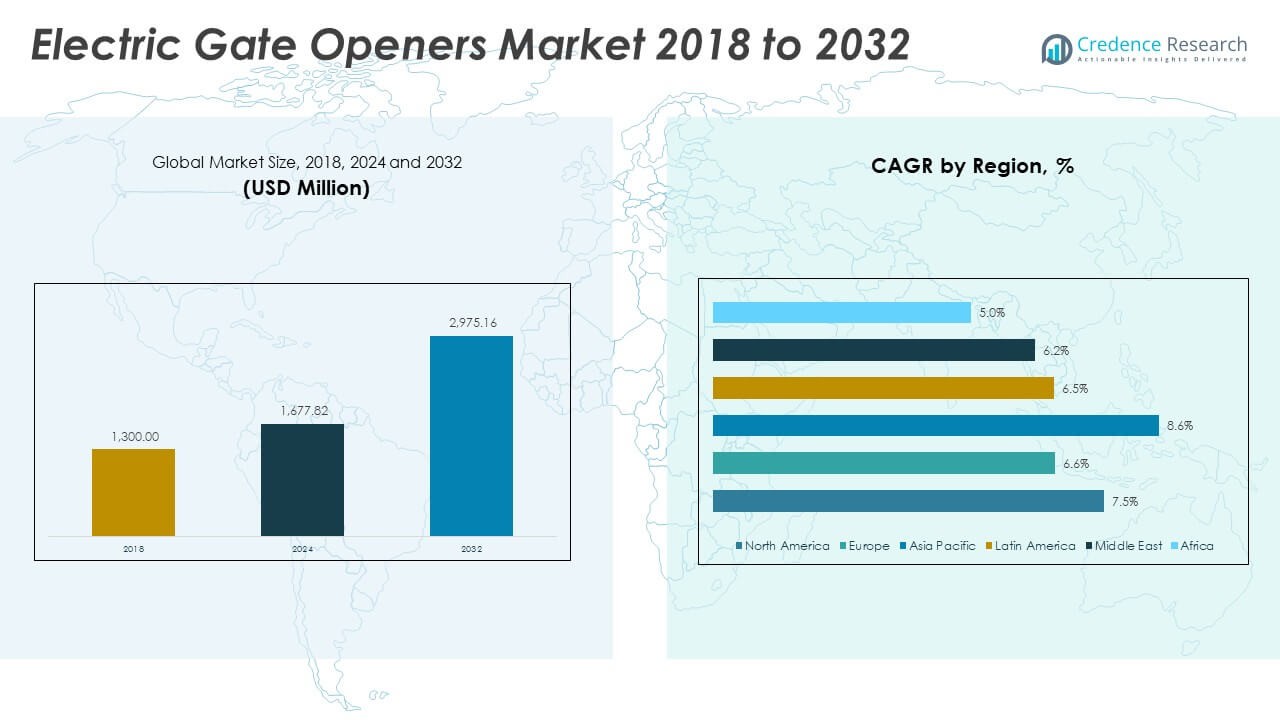
The Global Electric Gate Openers Market size was valued at USD 1,300.00 million in 2018 to USD 1,677.82 million in 2024 and is anticipated to reach USD 2,975.16 million by 2032, at a CAGR of 7.50% during the forecast period.
| REPORT ATTRIBUTE | DETAILS |
|---|---|
| Historical Period | 2020-2023 |
| Base Year | 2024 |
| Forecast Period | 2025-2032 |
| Electric Gate Openers Market Size 2024 | USD 1,677.82 Million |
| Electric Gate Openers Market, CAGR | 7.50% |
| Electric Gate Openers Market Size 2032 | USD 2,975.16 Million |
Growth in this market is driven by rising demand for enhanced security in residential and commercial properties. Smart home adoption, supported by increasing urbanization, boosts the use of automated entry solutions. Integration of advanced technologies like IoT and remote access enhances convenience and safety, while growing consumer preference for contactless operations further accelerates adoption. Rising disposable incomes and expanding construction activities worldwide also contribute to the market’s expansion.
Regionally, North America leads the market due to strong infrastructure, high adoption of smart technologies, and consumer focus on security. Europe follows with increasing modernization of residential complexes and commercial facilities. Asia-Pacific is emerging as the fastest-growing region, driven by rapid urban development, rising middle-class populations, and government initiatives supporting smart cities. Latin America and the Middle East & Africa are witnessing gradual adoption, mainly fueled by infrastructure development and heightened security needs.
Market Insights:
- The Global Electric Gate Openers Market was valued at USD 1,300.00 million in 2018, reached USD 1,677.82 million in 2024, and is anticipated to hit USD 2,975.16 million by 2032, growing at a CAGR of 7.5% during the forecast period.
- North America (34.9%), Asia Pacific (31.6%), and Europe (20.6%) accounted for the largest market shares in 2024. These regions dominate due to advanced infrastructure, high adoption of automation, and strong presence of leading manufacturers.
- Asia Pacific is the fastest-growing region, with a 31.6% share in 2024. Its growth is fueled by urbanization, smart city initiatives, and rising middle-class income levels supporting adoption of advanced gate automation.
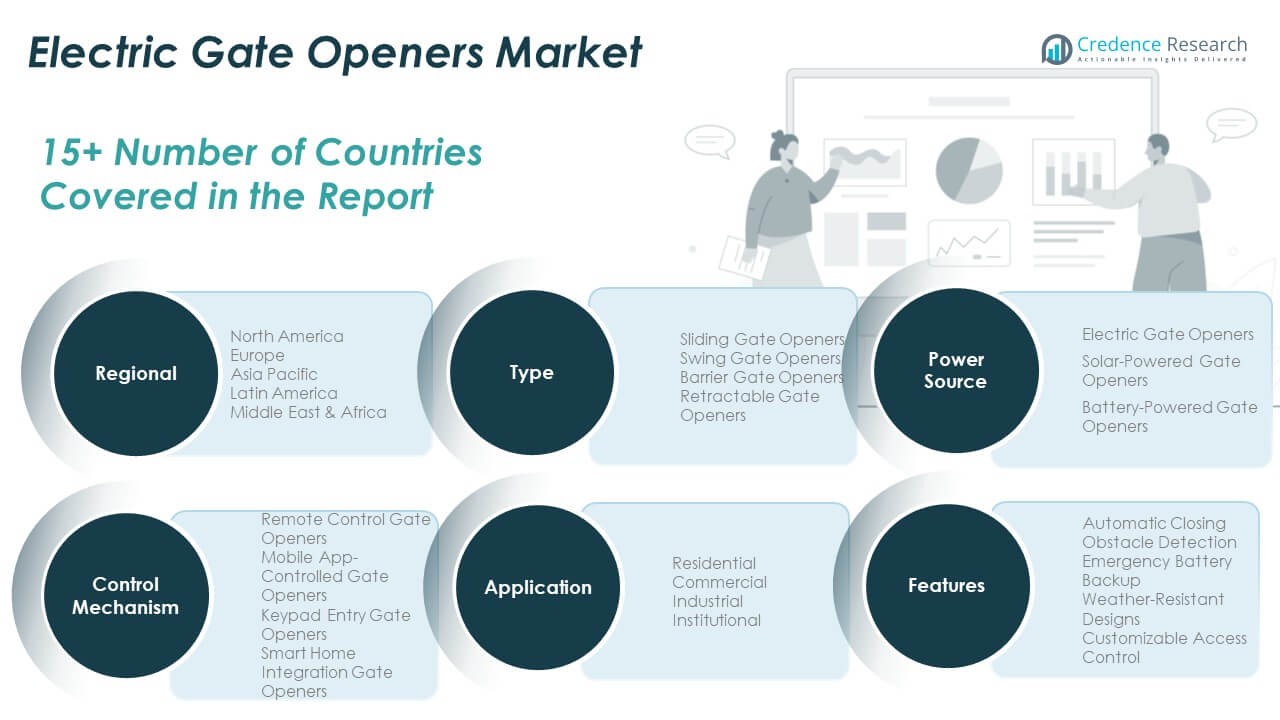
- By type, sliding gate openers contributed around 38% of the market in 2024, leading the segment due to their suitability for space-efficient residential and commercial installations.
- Swing gate openers accounted for nearly 28% in 2024, maintaining strong demand across residential properties, while barrier and retractable systems captured the remaining share through industrial and modern infrastructure adoption.
Market Drivers:
Rising Need For Security And Controlled Access In Residential And Commercial Properties:
Security remains the leading driver shaping demand for automated entry solutions. Consumers increasingly seek reliable systems that prevent unauthorized access to homes and businesses. The Global Electric Gate Openers Market benefits from urbanization, which raises demand for secure living spaces. Property owners adopt these systems to add both safety and convenience to everyday life. The rising awareness of theft and intrusion risks accelerates installations across urban and semi-urban areas. It also supports the growth of smart communities where access is tightly managed. Growing use of video surveillance and alarm systems complements gate opener adoption. These combined factors strengthen long-term growth momentum for this market.
- For instance, FAAC's C4000I gate operator simplifies installation with its four movable anchoring points and rack and pinion meshing adjustment system, enhancing ease for residential and commercial users. Property owners adopt these systems to add both safety and convenience to everyday life. The rising awareness of theft and intrusion risks accelerates installations across urban and semi-urban areas.
Adoption Of Smart Home Systems And Growing Preference For Automation:
The steady expansion of smart homes drives strong adoption of automated gate solutions. Consumers prefer technology that integrates seamlessly with existing home automation ecosystems. It is no longer limited to luxury households but increasingly reaches mid-range housing projects. The Global Electric Gate Openers Market gains from growing consumer expectations for modern living standards. Devices with Wi-Fi, Bluetooth, and mobile app integration enhance user experience. Convenience is central, allowing remote operation and real-time monitoring. Growing middle-class income levels accelerate the willingness to invest in such products. This shift creates stable demand for technologically advanced gate openers across developed and developing economies.
- For instance, electric gate systems integrated with Amazon Alexa, Google Assistant, or Apple HomeKit allow real-time monitoring, remote access, and voice commands, significantly enhancing user convenience. Devices with Wi-Fi, Bluetooth, and mobile app integration enhance user experience. Convenience is central, allowing remote operation and real-time monitoring. Growing middle-class income levels accelerate the willingness to invest in such products.
Technological Innovations And Integration Of IoT For Enhanced User Experience:
Continuous advancements in electronics and connectivity improve gate opener performance. Manufacturers introduce products with IoT compatibility, voice control, and cloud monitoring. Consumers appreciate the ease of linking gate openers with smart assistants and smartphones. The Global Electric Gate Openers Market benefits from innovation that prioritizes safety and personalization. Energy-efficient motors and backup battery systems ensure reliable use during power outages. Predictive maintenance features supported by IoT reduce system failures and enhance durability. Integration of AI supports pattern recognition for access control and energy management. These innovations raise consumer confidence and expand adoption across diverse property types.
Expansion Of Urban Infrastructure And Growth In Real Estate Development Projects:
Rising investment in urban infrastructure supports market expansion worldwide. Residential complexes, gated communities, and commercial spaces increasingly demand automated entry solutions. The Global Electric Gate Openers Market benefits from large-scale construction projects in urban centers. Developers integrate smart gate systems to add value and appeal for potential buyers. It also reflects consumer preference for properties that prioritize convenience and safety. Rising disposable incomes enable higher spending on premium real estate features. Governments in emerging economies promote smart city development, boosting adoption of automation technologies. This structural expansion creates long-term opportunities for gate opener manufacturers and service providers.
Market Trends:
Integration Of Renewable Energy And Solar-Powered Gate Opener Solutions:
Sustainability is becoming a defining trend in modern access control solutions. Solar-powered gate openers gain traction as consumers seek energy-efficient products. The Global Electric Gate Openers Market benefits from this shift toward eco-friendly alternatives. These systems reduce electricity consumption while supporting uninterrupted operations during power outages. Manufacturers promote models with easy installation and minimal wiring to attract eco-conscious buyers. Rising awareness of environmental responsibility drives adoption across residential and commercial segments. Solar-powered solutions are particularly appealing in regions with strong government support for renewable technologies. This trend positions energy-efficient gate openers as a preferred choice in future developments.
- For example, solar-powered gate opener installations surged in recent years, fueled by improvements in photovoltaic cell efficiency and battery storage, supporting continuous operation even during power outages.
Customization Of Gate Openers To Meet Diverse Property And Design Requirements:
Consumers increasingly demand products tailored to their property needs and aesthetic preferences. Manufacturers respond by offering gate openers compatible with sliding, swing, and overhead gates. The Global Electric Gate Openers Market reflects this diversification across residential, industrial, and commercial sectors. A focus on durability and silent operation adds appeal for urban households. Advanced customization enables features such as adjustable speed, weight capacity, and finish options. This approach enhances customer satisfaction by matching specific design and usage requirements. Premium models combine sleek design with compact structures, fitting modern architecture. Growing demand for tailored products strengthens brand positioning and broadens customer reach.
- For instance, the FAAC 750 CBAC 230V in-ground hydraulic swing gate operator is intended for both residential and light commercial applications. While the maximum weight it can handle is consistently 800 kg (approx. 1,763 lbs) per leaf, the maximum gate leaf width is dependent on the specific variant of the operator, ranging from 1.8m to 3.5m (approx. 5.9 feet to 11.5 feet). It is known for its durable and quiet hydraulic operation, making it a good choice for urban households where noise is a concern.
Growing Adoption Of Wireless Connectivity And Cloud-Based Access Control:
Wireless communication transforms the way consumers interact with gate openers. Cloud-based access solutions allow remote monitoring and multiple user control. The Global Electric Gate Openers Market benefits from integration with smartphones and connected devices. Users can manage entry points from anywhere, improving convenience and safety. Wireless technologies eliminate complex wiring, lowering installation costs and time. Cloud integration also supports data logging, helping track access history. Security features such as real-time alerts enhance consumer trust. Growing reliance on mobile devices ensures strong adoption of wireless-enabled gate openers across regions.
Expansion Of Aftermarket Services And Maintenance-Based Business Models:
Manufacturers emphasize service offerings to strengthen long-term customer relationships. The Global Electric Gate Openers Market shows rising focus on aftermarket sales and upgrades. Regular maintenance, software updates, and extended warranties create recurring revenue streams. Service-based models appeal to commercial clients seeking reliable system performance. Predictive maintenance powered by IoT reduces downtime and improves customer satisfaction. Remote diagnostics further optimize support and minimize on-site service requirements. Companies leverage this trend to differentiate from competitors with strong value-added services. Expansion of aftermarket solutions ensures consistent engagement beyond the initial product purchase.
Market Challenges Analysis:
High Installation Costs And Maintenance Requirements Impacting Affordability:
The Global Electric Gate Openers Market faces challenges linked to high initial investment costs. Installation often requires professional expertise, adding to the overall expense for consumers. It is particularly restrictive in price-sensitive regions where affordability remains critical. Ongoing maintenance requirements further increase the total cost of ownership. Batteries, motors, and electronic components demand periodic servicing to ensure performance. Lack of standardized pricing across service providers also creates uncertainty for end users. Consumers sometimes hesitate to adopt these systems due to perceived long-term costs. Addressing these concerns is essential for improving adoption rates in developing economies.
Limited Awareness And Infrastructure Barriers In Emerging Markets:
Emerging economies present strong growth potential but face awareness and infrastructure gaps. The Global Electric Gate Openers Market struggles with low consumer knowledge of advanced automation solutions. Many households still rely on traditional manual gates due to limited exposure. Unreliable electricity supply in rural and semi-urban areas restricts system performance. Infrastructure limitations make installation complex, reducing attractiveness in certain markets. It is also challenging for manufacturers to establish distribution networks in these regions. Limited training among service providers affects maintenance quality and customer experience. Overcoming these barriers will require awareness campaigns, local partnerships, and affordable product models.
Market Opportunities:
Rising Demand From Smart City Initiatives And Modern Infrastructure Development:
Smart city projects worldwide create opportunities for advanced gate automation systems. Governments invest heavily in modern infrastructure where automated access control is vital. The Global Electric Gate Openers Market aligns with these initiatives by providing secure, efficient solutions. Developers adopt gate openers in residential complexes, commercial centers, and industrial parks. Rising preference for connected, technology-enabled living boosts adoption rates. Smart communities demand integration with surveillance and access systems, further supporting market growth. Manufacturers can partner with real estate developers to capture large-scale projects. Expanding urbanization ensures sustained demand for advanced gate opener installations.
Expansion Into Untapped Markets With Affordable And Scalable Solutions:
Emerging regions represent significant growth opportunities for manufacturers offering cost-effective models. The Global Electric Gate Openers Market benefits from growing middle-class income levels in these economies. Affordable, scalable solutions attract consumers previously dependent on manual systems. Compact and solar-powered designs offer practical alternatives in infrastructure-limited areas. Manufacturers can target rural and semi-urban areas with easy-to-install products. Local partnerships and distribution channels help address market accessibility challenges. Consumer education campaigns also improve awareness of safety and convenience benefits. Expanding into these regions secures long-term growth while diversifying market presence.
Market Segmentation Analysis:
By Type
Sliding gate openers dominate demand due to their suitability for residential and commercial settings with limited space. Swing gate openers remain popular in residential areas for their ease of use and traditional appeal. Barrier gate openers hold strong relevance in industrial and high-traffic zones, particularly for parking facilities and toll stations. Retractable gate openers cater to modern infrastructure where compact and automated designs are prioritized. The Global Electric Gate Openers Market reflects balanced adoption across all segments, with sliding models leading growth due to widespread urban application.
- For example, the Nice Apollo Juno 310 AC residential slide gate opener supports gates weighing up to 800 lbs and 40 feet long, offering continuous duty operation with battery backup for reliability. Sliding models lead growth due to widespread urban application.
By Power Source
Electric gate openers remain the primary choice for most installations, supported by reliable performance and easy availability. Solar-powered variants are expanding rapidly in regions with high renewable energy adoption and government incentives. Battery-powered models appeal to consumers seeking uninterrupted operation during outages and in areas with unstable grids. Each power source segment offers distinct advantages, ensuring diverse demand across markets.
- For example, Battery-powered models appeal to consumers seeking uninterrupted operation during outages and in areas with unstable grids. Each power source segment offers distinct advantages-electric models like the widely used 110/220V AC types provide dependable power, solar-powered openers leverage improved photovolatic technologies to enable off-grid use, and battery-backed systems ensure operation during power cuts.
By Control Mechanism
Remote control gate openers remain standard, but mobile app-controlled systems are gaining momentum due to smartphone integration. Keypad entry systems continue to serve institutional and commercial properties requiring multiple user access. Smart home integration gate openers attract consumers prioritizing automation and connected living. It is evident that advanced connectivity features define the next wave of growth in this category.
By Application and Features
Residential use drives market expansion, followed by commercial and industrial applications requiring higher durability. Institutional demand rises steadily for secure access control. Features such as automatic closing, obstacle detection, and customizable access enhance safety and user experience. Weather-resistant designs and emergency battery backup further strengthen system reliability across diverse environments.
Segmentation:
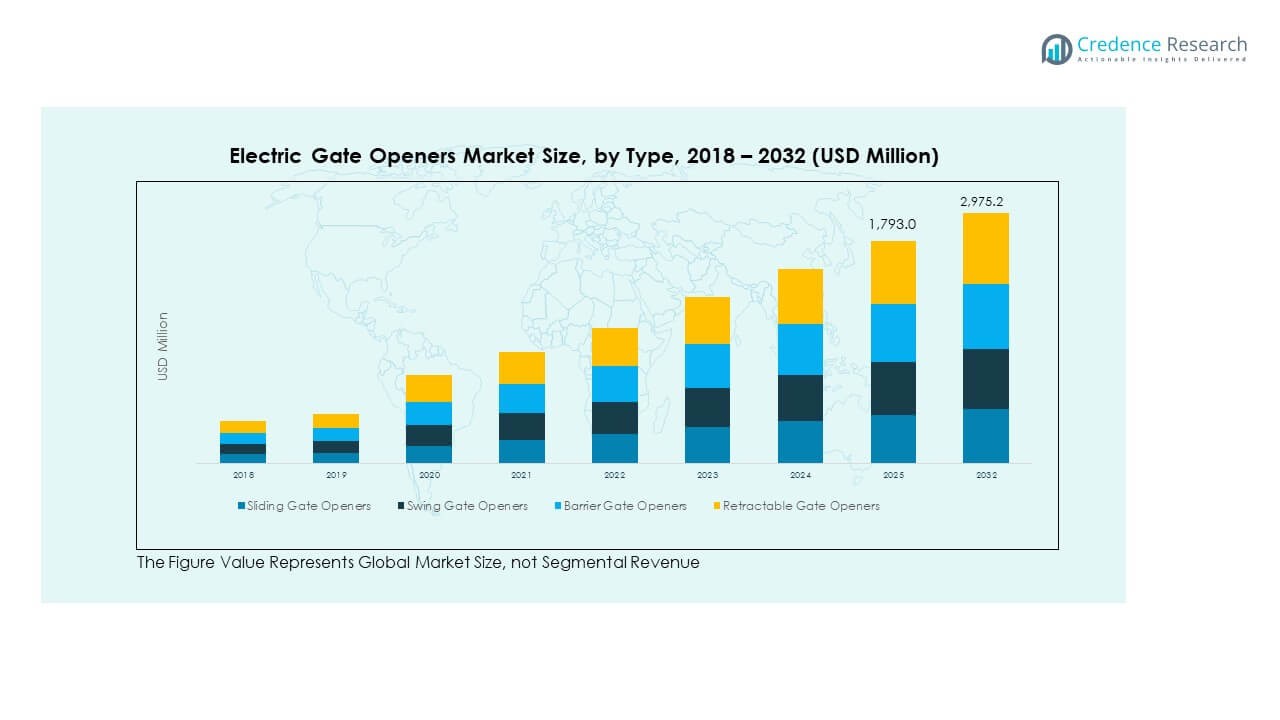
By Type
- Sliding Gate Openers
- Swing Gate Openers
- Barrier Gate Openers
- Retractable Gate Openers
By Power Source
- Electric Gate Openers
- Solar-Powered Gate Openers
- Battery-Powered Gate Openers
By Control Mechanism
- Remote Control Gate Openers
- Mobile App-Controlled Gate Openers
- Keypad Entry Gate Openers
- Smart Home Integration Gate Openers
By Application
- Residential
- Commercial
- Industrial
- Institutional
By Features
- Automatic Closing
- Obstacle Detection
- Emergency Battery Backup
- Weather-Resistant Designs
- Customizable Access Control
By Region
- North America (U.S., Canada, Mexico)
- Europe (UK, France, Germany, Italy, Spain, Russia, Rest of Europe)
- Asia Pacific (China, Japan, South Korea, India, Australia, Southeast Asia, Rest of Asia Pacific)
- Latin America (Brazil, Argentina, Rest of Latin America)
- Middle East (GCC Countries, Israel, Turkey, Rest of Middle East)
- Africa (South Africa, Egypt, Rest of Africa)
Regional Analysis:
North America
The North America Global Electric Gate Openers Market size was valued at USD 460.20 million in 2018 to USD 586.56 million in 2024 and is anticipated to reach USD 1,038.64 million by 2032, at a CAGR of 7.5% during the forecast period. North America accounts for 34.9% of the global market share in 2024. Strong adoption of smart home technologies and a mature construction sector support growth. Consumers prefer advanced access systems integrated with home automation and security features. The Global Electric Gate Openers Market in this region benefits from rising investments in residential communities and commercial facilities. Real estate developers increasingly embed automated solutions to meet consumer expectations. It is also driven by growing demand in industrial facilities requiring reliable access control. Strong presence of leading manufacturers enhances innovation and product availability.
Europe
The Europe Global Electric Gate Openers Market size was valued at USD 281.84 million in 2018 to USD 346.59 million in 2024 and is anticipated to reach USD 572.87 million by 2032, at a CAGR of 6.6% during the forecast period. Europe holds a 20.6% share of the global market in 2024. Demand is influenced by urban modernization and renovation of residential properties. Security concerns in commercial and industrial facilities also stimulate adoption. The Global Electric Gate Openers Market gains from high consumer preference for energy-efficient and durable designs. Countries such as Germany, the UK, and France dominate due to advanced infrastructure and rising smart city investments. Product demand is supported by strict regulatory standards on safety and automation. It is also enhanced by rising e-commerce activity, driving the use of automated access systems in warehouses and logistics hubs.
Asia Pacific
The Asia Pacific Global Electric Gate Openers Market size was valued at USD 396.50 million in 2018 to USD 529.93 million in 2024 and is anticipated to reach USD 1,018.40 million by 2032, at a CAGR of 8.6% during the forecast period. Asia Pacific represents 31.6% of the market share in 2024. Rapid urbanization, infrastructure development, and rising middle-class income levels fuel demand. The Global Electric Gate Openers Market benefits from smart city initiatives in China, India, and Southeast Asia. Growing adoption of solar-powered solutions reflects regional focus on sustainability. Residential demand rises in metropolitan centers, while industrial expansion supports large-scale installations. Japan and South Korea lead adoption of high-tech smart home integrations. It is further supported by rising construction of gated communities and commercial complexes across emerging economies. Local manufacturing strength enhances affordability and availability of products.
Latin America
The Latin America Global Electric Gate Openers Market size was valued at USD 84.50 million in 2018 to USD 108.03 million in 2024 and is anticipated to reach USD 178.12 million by 2032, at a CAGR of 6.5% during the forecast period. Latin America contributes 6.4% of the global share in 2024. Growth is driven by rising urban development in Brazil, Mexico, and Argentina. The Global Electric Gate Openers Market benefits from consumer demand for secure residential and commercial properties. Expanding middle-class income groups invest in convenience-driven technologies. Industrial facilities adopt automated gate systems for safety and efficiency. It is supported by gradual expansion of retail and logistics hubs requiring modern access solutions. Security concerns in urban areas accelerate adoption of smart gate openers. Government-backed housing initiatives also create favorable conditions for steady growth.
Middle East
The Middle East Global Electric Gate Openers Market size was valued at USD 50.57 million in 2018 to USD 61.23 million in 2024 and is anticipated to reach USD 98.20 million by 2032, at a CAGR of 6.2% during the forecast period. The region accounts for 3.6% of the global share in 2024. Rising construction of luxury residential complexes and commercial projects drives demand. The Global Electric Gate Openers Market in this region benefits from strong real estate investments in GCC countries. Consumers favor advanced access systems integrated with premium design. Institutional demand grows in airports, educational centers, and government facilities. It is also fueled by the hospitality sector, where secure and convenient entry systems are vital. Expanding smart city projects in the UAE and Saudi Arabia accelerate technology adoption. Rising awareness of modern security systems creates opportunities for market players.
Africa
The Africa Global Electric Gate Openers Market size was valued at USD 26.39 million in 2018 to USD 45.48 million in 2024 and is anticipated to reach USD 68.93 million by 2032, at a CAGR of 5.0% during the forecast period. Africa holds 2.7% of the global share in 2024. Growth is slower compared to other regions due to infrastructure limitations. The Global Electric Gate Openers Market benefits from gradual urban development in South Africa, Nigeria, and Egypt. Rising demand for secure housing in urban centers supports adoption. Solar-powered solutions gain traction in regions with unstable electricity supply. Industrial projects in mining and energy sectors create demand for automated gate systems. It is also supported by expanding retail and commercial infrastructure in select cities. Market growth remains steady but requires strategic partnerships to overcome distribution challenges.
Key Player Analysis:
- FAAC Group
- The Nice Group
- Chamberlain Group
- Nortek Security & Control
- DoorKing
- ELKA-Torantriebe GmbH
- Novoferm Group
- Bisen Smart
- Xianfeng Machinery
- PROTECO
- ASSA ABLOY
- Dalian Master Door
- VMAG
- Shinsei Seiki
Competitive Analysis:
The Global Electric Gate Openers Market is characterized by strong competition among multinational and regional players. Leading companies such as FAAC Group, The Nice Group, Chamberlain Group, and ASSA ABLOY focus on product innovation, technology integration, and strategic partnerships to expand their footprint. It is defined by constant advancements in IoT-enabled solutions and energy-efficient models. Companies differentiate through service offerings, durability, and compatibility with smart ecosystems. Regional firms compete by offering affordable solutions tailored to local needs. Established brands hold significant shares through diversified portfolios, strong distribution, and brand loyalty.
Recent Developments:
- In 2025, FAAC Group launched innovative automatic doors showcased at BAU 2025 in Munich, including the AG4000 revolving door with electromechanical brushless automation compliant with EN16005, and new sliding doors with integrated air curtains and anti-panic breakout systems, designed for enhanced safety and energy efficiency .
- In May 2025, The Nice Group announced its Interactions 2025 event showcasing real AI outcomes in customer service, featuring over 50 live demonstrations of its CXone Mpower innovations, enhancing customer experience automation and AI-powered engagement solutions
- Chamberlain Group entered into a definitive agreement to acquire Arrow Tru-Line, a leading North American manufacturer of metal garage door components and hardware, expanding its product line to garage door hardware. The acquisition was announced in July 2025 and aims to broaden Chamberlain’s manufacturing footprint and product offering
- Bisen Smart focuses on access control and IoT management solutions for smart parking and car charging management, with updated trade data available until January 2025, highlighting its continuous commitment to smart access technology innovation.
Report Coverage:
The research report offers an in-depth analysis based on Type, Power Source, Control Mechanism, Application, and Features. It details leading market players, providing an overview of their business, product offerings, investments, revenue streams, and key applications. Additionally, the report includes insights into the competitive environment, SWOT analysis, current market trends, as well as the primary drivers and constraints. Furthermore, it discusses various factors that have driven market expansion in recent years. The report also explores market dynamics, regulatory scenarios, and technological advancements that are shaping the industry. It assesses the impact of external factors and global economic changes on market growth. Lastly, it provides strategic recommendations for new entrants and established companies to navigate the complexities of the market.
Future Outlook:
- Growing adoption of smart home integration will drive demand for connected solutions.
- Solar-powered openers will expand in regions emphasizing renewable energy use.
- Mobile app-controlled systems will gain preference among younger, tech-driven consumers.
- Rising construction of gated communities will create strong residential demand.
- Industrial facilities will increase use of durable and automated gate systems.
- Aftermarket services and predictive maintenance will become a key revenue stream.
- Partnerships with real estate developers will shape adoption in urban projects.
- Compact, customizable designs will enhance appeal in space-constrained environments.
- Emerging economies will fuel expansion through affordable product offerings.
- Continued mergers and acquisitions will strengthen global distribution networks.

Request a Free Sample
Fill in your details and we'll send you a free sample report.
- Sample data tables & charts
- Research methodology
Market Dynamics
Heightened Security and Controlled Access Needs
Increasing concerns over unauthorized access and property crime are driving adoption of electric gate openers in both residential and commercial settings. Automated gate systems provide reliable, convenient, and secure entry management, making them a preferred choice for property owners seeking enhanced safety.
Smart Home Adoption and Automation Integration
The proliferation of smart home technologies and rising consumer expectations for connected living are fueling demand for gate openers that integrate with home automation systems. Features such as mobile app control, voice assistant compatibility, and remote monitoring are becoming standard, boosting market growth.
Urbanization and Infrastructure Development
Rapid urbanization and the expansion of residential complexes, commercial centers, and gated communities are increasing the need for automated entry solutions. Real estate developers and property managers are incorporating electric gate openers to add value and convenience to new projects.
Technological Advancements and IoT Integration
Continuous innovation in IoT, wireless connectivity, and energy-efficient motors is enhancing the functionality and reliability of electric gate openers. Predictive maintenance, cloud-based access control, and integration with security systems are making these solutions more attractive to a broader customer base.
Rising Demand for Sustainable and Solar-Powered Solutions
Growing environmental awareness and government incentives for renewable energy are accelerating the adoption of solar-powered gate openers. These systems offer energy savings and uninterrupted operation during power outages, appealing to eco-conscious consumers and regions with unstable electricity supply.
Need a Custom Version of This Report?
Tailor the scope, geography, or segments to your exact requirements.
- Custom geography or segment scope
- Direct access to our analyst team
Frequently Asked Questions
What is the current market size for Global Electric Gate Openers Market, and what is its projected size in 2032?
At what Compound Annual Growth Rate is the Global Electric Gate Openers Market projected to grow between 2025 and 2032?
Which Global Electric Gate Openers Market segment held the largest share in 2024?
What are the primary factors fueling the growth of the Global Electric Gate Openers Market?
Who are the leading companies in the Global Electric Gate Openers Market?
Which region commanded the largest share of the Global Electric Gate Openers Market in 2024?
Table of Content
Chapter 1 Market Segmentation
- 1.1 Segmentation Framework
- 1.1.1 Product and Service Classification
- 1.1.2 Application and End-Use Classification
- 1.1.3 Technology and Solution Classification
- 1.1.4 Customer and Distribution Channel Classification
- 1.1.5 Geographic Segmentation
- 1.1.6 Market Segment Definitions and Boundaries
- 1.2 By Type
- 1.2.1 Sliding Gate Openers
- 1.2.2 Swing Gate Openers
- 1.2.3 Barrier Gate Openers
- 1.2.4 Retractable Gate Openers
- 1.3 By Application
- 1.3.1 Residential
- 1.3.2 Commercial
- 1.3.3 Industrial
- 1.3.4 Institutional
- 1.4 By Power Source
- 1.4.1 Electric Gate Openers
- 1.4.2 Solar-Powered Gate Openers
- 1.4.3 Battery-Powered Gate Openers
- 1.5 By Control Mechanism
- 1.5.1 Remote Control Gate Openers
- 1.5.2 Mobile App-Controlled Gate Openers
- 1.5.3 Keypad Entry Gate Openers
- 1.5.4 Smart Home Integration Gate Openers
Chapter 2 Introduction
- 2.1 Report Objectives and Scope
- 2.2 Product Definition and Industry Terminology
- 2.3 Market Inclusions and Exclusions
- 2.4 Research Process
- 2.4.1 Primary Research and Expert Interviews
- 2.4.2 Secondary Research and Source Review
- 2.4.3 Top-Down and Bottom-Up Estimation
- 2.4.4 Data Triangulation and Verification
- 2.5 Market Size Measurement Basis
- 2.5.1 2024: USD 1,677.82 million → 2032: USD 2,975.16 million
- 2.6 Historical and Forecast Reference Periods
- 2.6.1 Base Year: 2024
- 2.6.2 Forecast Period: 2024-2032
- 2.7 Research Assumptions and Limitations
Chapter 3 Executive Summary
- 3.1 Market Snapshot and Key Findings
- 3.2 Base-Year Market Size, 2024
- 3.3 Forecast Market Size, 2032
- 3.4 Revenue and Volume Growth Outlook
- 3.5 Key Demand and Supply Indicators
- 3.6 Leading Market Segments
- 3.7 Fastest-Growing Market Opportunities
- 3.8 Regional Performance Highlights
- 3.9 Technology and Industry Transformation
- 3.10 Competitive Landscape Summary
- 3.11 Analyst View and Strategic Implications
Chapter 4 Global Electric Gate Openers Market Trends and Developments
- 4.1 Historical Industry Development
- 4.2 Recent Market Trends and Developments
- 4.3 Demand and Customer Behavior Trends
- 4.4 Technology and Product Innovation
- 4.5 Artificial Intelligence, Automation and Digitalization
- 4.6 Local Manufacturing and Supply Chain Realignment
- 4.7 Industry Partnerships, Mergers and Acquisitions
- 4.8 Sustainability and Circular Economy Developments
- 4.9 Government and Private Sector Investment Trends
- 4.10 Emerging Business Models and Commercialization
- 4.11 Industry Developments and Announcements
Chapter 5 Global Electric Gate Openers Market Production, Supply and Demand Analysis
- 5.1 Demand Trend and Consumption Analysis
- 5.2 Demand Forecast, 2024-2032
- 5.3 Production and Output Trend
- 5.4 Production and Output Forecast, 2024-2032
- 5.5 Installed Capacity and Capacity Utilization
- 5.6 Company-Wise Production Plants and Statistics
- 5.6.1 Installed Production Capacity
- 5.6.2 Actual Production
- 5.6.3 Planned Capacity and Expansion Targets
- 5.7 Supply Chain Structure and Procurement Trends
- 5.8 Supply-Demand Gap and Bottlenecks
- 5.9 Import Dependence and Sourcing Structure
- 5.10 Contract Manufacturing and Outsourcing
- 5.11 Regional Supply and Demand Concentration
Chapter 6 Global Electric Gate Openers Market Pricing Analysis
- 6.1 Pricing Structure and Measurement
- 6.2 Historical Pricing Trends
- 6.3 Pricing Outlook, 2024-2032
- 6.4 Average Selling Price and Unit Economics
- 6.5 Pricing by Product and Market Segment
- 6.6 Geographic Pricing Differences
- 6.7 Key Input, Energy, Labor and Logistics Costs
- 6.8 Contract Pricing and Purchasing Models
- 6.9 Pricing Sensitivity and Competitive Positioning
- 6.10 Price, Margin and Profitability Implications
Chapter 7 Global Electric Gate Openers Market Dynamics
- 7.1 Market Growth Drivers
- 7.1.1 Demand-Side Drivers
- 7.1.2 Technology and Innovation Drivers
- 7.1.3 Infrastructure and Investment Drivers
- 7.1.4 Regulatory and Policy Drivers
- 7.2 Market Restraints
- 7.2.1 Cost and Affordability Constraints
- 7.2.2 Technology and Adoption Barriers
- 7.2.3 Supply Chain and Operational Constraints
- 7.3 Market Challenges
- 7.3.1 Competitive Pressure and Margin Erosion
- 7.3.2 Skills, Infrastructure and Implementation Gaps
- 7.4 Emerging Market Opportunities
- 7.5 Market Dynamics Impact and Time-Horizon Assessment
Chapter 8 Global Electric Gate Openers Value Chain Analysis
- 8.1 Industry Value Chain Overview
- 8.2 Upstream Suppliers and Critical Inputs
- 8.3 Technology and Component Providers
- 8.4 Manufacturing or Service Delivery
- 8.5 Distribution, Channel Partners and Integrators
- 8.6 Downstream Applications and End Users
- 8.7 Value Addition and Profit Pools
- 8.8 Vertical Integration and Outsourcing
- 8.9 Supplier Concentration and Risk
- 8.10 Supply Chain Localization and Resilience
Chapter 9 Global Electric Gate Openers Market Regulations and Policies
- 9.1 Relevant Laws, Standards and Compliance Frameworks
- 9.2 Product, Service, Safety and Quality Requirements
- 9.3 Government Policies, Incentives and Subsidies
- 9.4 Imports, Exports and Trade Barriers
- 9.5 Public Procurement and Local Content Requirements
- 9.6 Environmental and Sustainability Compliance
- 9.7 Upcoming Policy Changes and Market Implications
Chapter 10 Global Electric Gate Openers Market Hotspots and Opportunities
- 10.1 Market Opportunity Mapping and Growth Hotspots
- 10.2 High-Growth Applications and Customer Groups
- 10.3 Underserved Markets and White-Space Opportunities
- 10.4 Emerging Technology and Product Opportunities
- 10.5 New Capacity and Investment Hotspots
- 10.6 Market Entry and Expansion Opportunities
- 10.7 Distribution and Partnership Opportunities
- 10.8 Near-Term and Long-Term Commercial Potential
- 10.9 Opportunity Attractiveness and Execution Risks
Chapter 11 Global Electric Gate Openers Market Outlook, 2024-2032
- 11.1 Market Size and Analysis
- 11.1.1 Revenue (Market Measurement: 2024: USD 1,677.82 million → 2032: USD 2,975.16 million)
- 11.1.2 Market Volume and Quantity Sold
- 11.1.3 Historical Market Size
- 11.1.4 Base-Year Market Size, 2024
- 11.2 Market Forecast, 2024-2032
- 11.2.1 Revenue Forecast to 2032
- 11.2.2 Volume Forecast to 2032
- 11.2.3 CAGR and Year-on-Year Growth
- 11.2.4 Incremental Revenue Opportunity
- 11.3 Forecast Assumptions and Scenario Analysis
- 11.3.1 Base-Case Forecast
- 11.3.2 Optimistic and Conservative Scenarios
- 11.3.3 Technology, Pricing and Policy Sensitivities
- 11.4 Market Attractiveness and Growth Outlook
Chapter 12 Global Electric Gate Openers Market Segmentation and Outlook
- 12.1 Segmentation Summary and Market Shares, 2024
- 12.2 Largest and Fastest-Growing Segments
- 12.3 By Type - Market Size and Forecast, 2024-2032
- 12.3.1 Segment Definition and Scope
- 12.3.2 Historical Market Size
- 12.3.3 Revenue Forecast, 2024-2032
- 12.3.4 Volume Forecast, 2024-2032
- 12.3.5 Base-Year Market Share, 2024
- 12.3.6 Segment CAGR and Growth Drivers
- 12.3.7 Subsegment Market Size and Forecast
- 12.3.7.1 Sliding Gate Openers
- 12.3.7.2 Swing Gate Openers
- 12.3.7.3 Barrier Gate Openers
- 12.3.7.4 Retractable Gate Openers
- 12.3.8 Subsegment Pricing and Adoption Trends
- 12.3.9 Leading Suppliers and Competition
- 12.3.10 Regional Demand and Opportunities
- 12.4 By Application - Market Size and Forecast, 2024-2032
- 12.4.1 Segment Definition and Scope
- 12.4.2 Historical Market Size
- 12.4.3 Revenue Forecast, 2024-2032
- 12.4.4 Volume Forecast, 2024-2032
- 12.4.5 Base-Year Market Share, 2024
- 12.4.6 Segment CAGR and Growth Drivers
- 12.4.7 Subsegment Market Size and Forecast
- 12.4.7.1 Residential
- 12.4.7.2 Commercial
- 12.4.7.3 Industrial
- 12.4.7.4 Institutional
- 12.4.8 Subsegment Pricing and Adoption Trends
- 12.4.9 Leading Suppliers and Competition
- 12.4.10 Regional Demand and Opportunities
- 12.5 By Power Source - Market Size and Forecast, 2024-2032
- 12.5.1 Segment Definition and Scope
- 12.5.2 Historical Market Size
- 12.5.3 Revenue Forecast, 2024-2032
- 12.5.4 Volume Forecast, 2024-2032
- 12.5.5 Base-Year Market Share, 2024
- 12.5.6 Segment CAGR and Growth Drivers
- 12.5.7 Subsegment Market Size and Forecast
- 12.5.7.1 Electric Gate Openers
- 12.5.7.2 Solar-Powered Gate Openers
- 12.5.7.3 Battery-Powered Gate Openers
- 12.5.8 Subsegment Pricing and Adoption Trends
- 12.5.9 Leading Suppliers and Competition
- 12.5.10 Regional Demand and Opportunities
- 12.6 By Control Mechanism - Market Size and Forecast, 2024-2032
- 12.6.1 Segment Definition and Scope
- 12.6.2 Historical Market Size
- 12.6.3 Revenue Forecast, 2024-2032
- 12.6.4 Volume Forecast, 2024-2032
- 12.6.5 Base-Year Market Share, 2024
- 12.6.6 Segment CAGR and Growth Drivers
- 12.6.7 Subsegment Market Size and Forecast
- 12.6.7.1 Remote Control Gate Openers
- 12.6.7.2 Mobile App-Controlled Gate Openers
- 12.6.7.3 Keypad Entry Gate Openers
- 12.6.7.4 Smart Home Integration Gate Openers
- 12.6.8 Subsegment Pricing and Adoption Trends
- 12.6.9 Leading Suppliers and Competition
- 12.6.10 Regional Demand and Opportunities
- 12.7 Segment Growth Comparison
- 12.8 Segment Attractiveness and Priority Matrix
Chapter 13 Global Electric Gate Openers End-Use and Application Market Outlook
- 13.1 End-Use Industry and Customer Demand Structure
- 13.2 Leading Applications and Customer Groups
- 13.3 End-Use Market Size, Share and Forecast
- 13.4 Major End-Use Industry Deep Dives
- 13.4.1 Customer Requirements and Use Cases
- 13.4.2 Demand and Replacement Cycles
- 13.4.3 Technical and Regulatory Considerations
- 13.4.4 Purchasing and Procurement Models
- 13.4.5 Leading Vendors and Distribution Channels
- 13.4.6 Forecast and Commercial Opportunities
- 13.5 Emerging Applications and Cross-Segment Demand
- 13.6 End-Use Industry Investment Priorities
Chapter 14 Global Electric Gate Openers Geographic Market Outlook, 2024-2032
- 14.1 Regional Market Size and Share, 2024
- 14.2 Regional Market Forecast, 2024-2032
- 14.3 Regional Pricing, Production and Demand Differences
- 14.4 North America
- 14.4.1 United States
- 14.4.2 Canada
- 14.4.3 Mexico
- 14.5 Europe
- 14.5.1 Germany
- 14.5.2 France
- 14.5.3 Italy
- 14.5.4 United Kingdom
- 14.5.5 Spain
- 14.5.6 Poland
- 14.5.7 Russia
- 14.5.8 Netherlands
- 14.5.9 Belgium
- 14.5.10 Sweden
- 14.5.11 Denmark
- 14.5.12 Norway
- 14.5.13 Rest of Europe
- 14.6 Asia Pacific
- 14.6.1 China
- 14.6.2 India
- 14.6.3 Japan
- 14.6.4 South Korea
- 14.6.5 Thailand
- 14.6.6 Indonesia
- 14.6.7 Vietnam
- 14.6.8 Malaysia
- 14.6.9 Australia
- 14.6.10 Rest of Asia Pacific
- 14.7 Latin America
- 14.7.1 Brazil
- 14.7.2 Argentina
- 14.7.3 Colombia
- 14.7.4 Chile
- 14.7.5 Rest of Latin America
- 14.8 Middle East
- 14.8.1 Saudi Arabia
- 14.8.2 United Arab Emirates
- 14.8.3 Turkey
- 14.8.4 Israel
- 14.8.5 Iran
- 14.8.6 Rest of the Middle East
- 14.9 Africa
- 14.9.1 South Africa
- 14.9.2 Egypt
- 14.9.3 Nigeria
- 14.9.4 Morocco
- 14.9.5 Rest of Africa
- 14.10 Regional Investment, Policy and Supply Chain Differences
- 14.11 Regional Competitive Landscape
- 14.12 Geographic Growth Hotspots
Chapter 15 Global Electric Gate Openers Technology, Innovation and Sustainability Outlook
- 15.1 Technology Landscape and Maturity
- 15.2 Product, Process and Service Innovation
- 15.3 AI, Automation and Digital Tools in the Industry
- 15.4 Technology Adoption and Performance Benchmarking
- 15.5 Innovation Pipeline and R&D Investment
- 15.6 Patent and Intellectual Property Trends
- 15.7 Energy Efficiency and Resource Management
- 15.8 Sustainability, Recycling and Circularity
- 15.9 Technology Roadmap, 2024-2032
- 15.10 Risks of Obsolescence and Technology Substitution
Chapter 16 Global Electric Gate Openers Market Key Strategic Imperatives
- 16.1 Growth and Market Entry Priorities
- 16.2 High-Return Products and Segments
- 16.3 Pricing, Profitability and Cost Optimization
- 16.4 Technology Investment and Product Differentiation
- 16.5 Supply Chain Localization and Resilience
- 16.6 Distribution and Customer Acquisition
- 16.7 Partnership, Acquisition and Capacity Strategy
- 16.8 Regional Expansion Priorities
- 16.9 Short-, Medium- and Long-Term Actions
Chapter 17 Competition Outlook
- 17.1 Industry Competition Characteristics
- 17.2 Market Structure and Concentration
- 17.3 Market Share and Competitive Positioning, 2024
- 17.4 Company-Wise Revenue and Product Benchmarking
- 17.5 Production and Service Capacity Benchmarking
- 17.6 Technology, Pricing and Differentiation
- 17.7 Regional Footprint and Distribution Strength
- 17.8 Mergers, Acquisitions and Strategic Alliances
- 17.9 New Entrants and Competitive Threats
- 17.10 Porter's Five Forces and Industry Attractiveness
- 17.11 Competitive Outlook, 2024-2032
Chapter 18 Company Profiles
- 18.1 Company Coverage and Selection Criteria
- 18.2 FAAC Group
- 18.2.1 Business Description
- 18.2.2 Company Ownership and Geographic Presence
- 18.2.3 Product and Service Portfolio
- 18.2.4 Manufacturing and Operating Footprint
- 18.2.5 Production Capacity and Expansion Plans
- 18.2.6 Financial Performance and Investment
- 18.2.7 Market Share and Competitive Position
- 18.2.8 Technology and Innovation Capabilities
- 18.2.9 Strategic Alliances or Partnerships
- 18.2.10 Recent Developments
- 18.2.11 Growth Strategy and Outlook
- 18.3 The Nice Group
- 18.4 Chamberlain Group
- 18.5 Nortek Security & Control
- 18.6 DoorKing
- 18.7 ELKA-Torantriebe GmbH
- 18.8 Novoferm Group
- 18.9 ASSA ABLOY
- 18.10 Bisen Smart
- 18.11 Xianfeng Machinery
- 18.12 Other Relevant Market Participants
Note: Every listed company is profiled on the structure shown under the first company. The company list is preliminary and may change based on research findings, market developments, data availability and client requirements.
Chapter 19 Disclaimer
- 19.1 Research and Forecast Disclaimer
- 19.2 Data Source and Estimation Limitations
Note: The depth of individual sections depends on data availability for this market. Volume, capacity, trade and other unit-based metrics are included where applicable.

