
Market Overview:
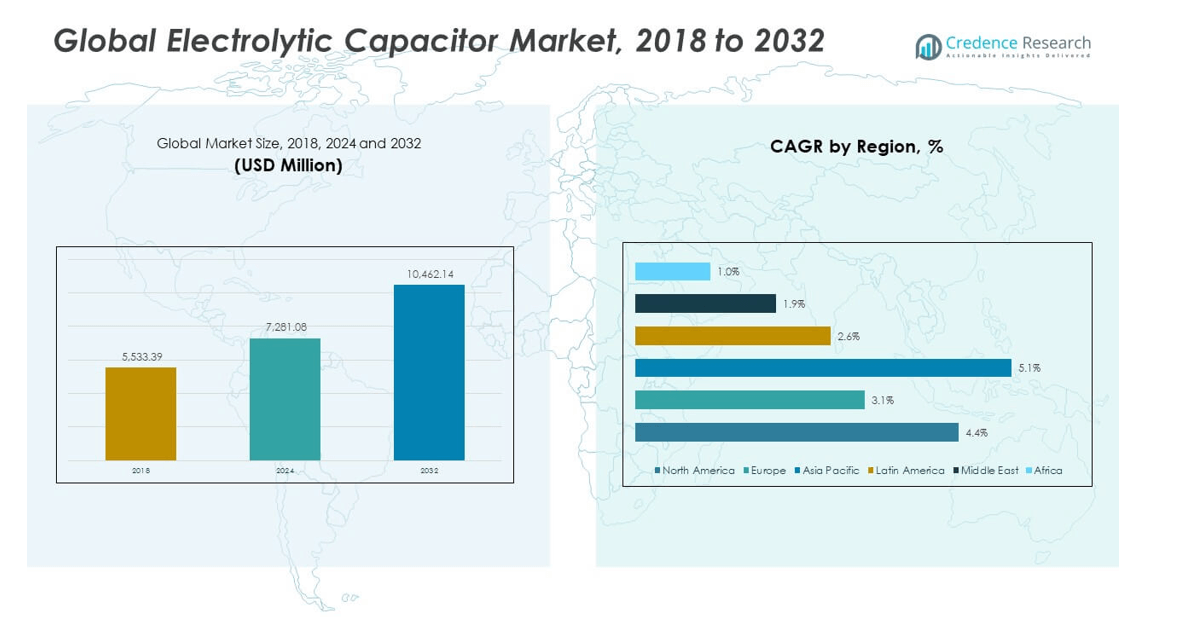
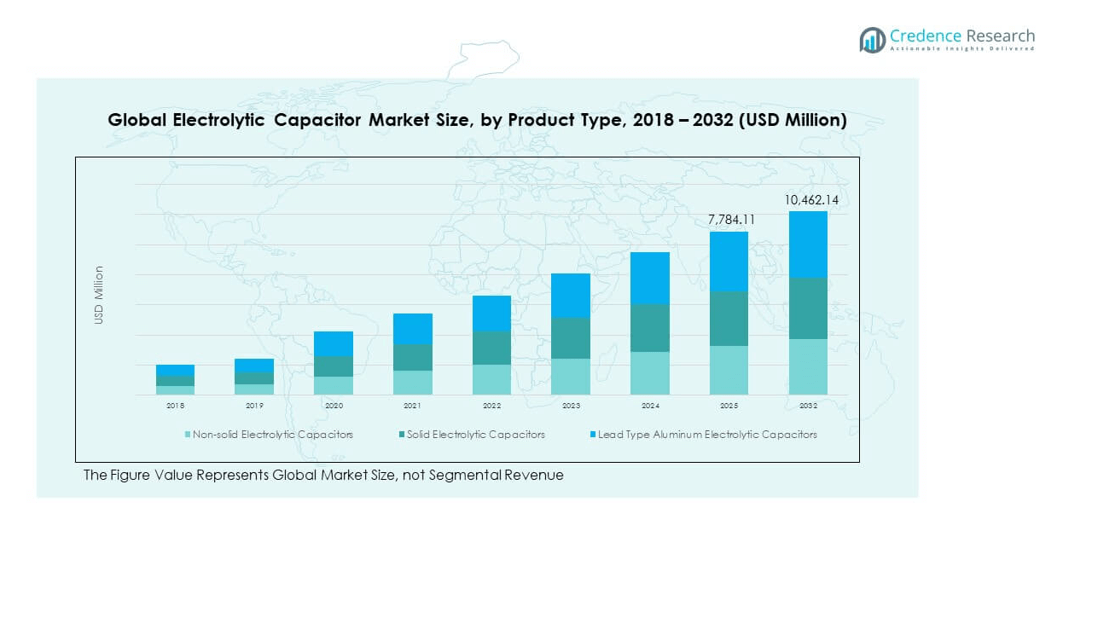
The Global Electrolytic Capacitor Market size was valued at USD 5,533.39 million in 2018 to USD 7,281.08 million in 2024 and is anticipated to reach USD 10,462.14 million by 2032, at a CAGR of 4.31% during the forecast period.
| REPORT ATTRIBUTE | DETAILS |
|---|---|
| Historical Period | 2020-2023 |
| Base Year | 2024 |
| Forecast Period | 2025-2032 |
| Electrolytic Capacitor Market Size 2024 | USD 7,281.08 million |
| Electrolytic Capacitor Market, CAGR | 4.31% |
| Electrolytic Capacitor Market Size 2032 | USD 10,462.14 million |
Growth in the Global Electrolytic Capacitor Market is fueled by expanding adoption in consumer electronics, electric vehicles, industrial automation, and renewable energy systems. It benefits from increasing demand for high-capacitance, long-life, and compact designs that meet the performance needs of modern applications. Rising integration of smart technologies, coupled with a shift toward energy-efficient solutions, strengthens capacitor usage across diverse sectors. The automotive industry and renewable projects, particularly solar and wind, remain key demand contributors.
Regionally, the Global Electrolytic Capacitor Market is led by Asia Pacific, supported by a strong manufacturing base in China, Japan, South Korea, and Taiwan. North America and Europe record significant growth, driven by innovation in automotive electrification, aerospace, and energy storage. Latin America and the Middle East show steady demand through industrial projects and infrastructure development. Africa, while smaller in scale, presents potential through rising consumer electronics adoption and renewable energy initiatives in emerging
Market Insights:
- The Global Electrolytic Capacitor Market size was USD 5,533.39 million in 2018, USD 7,281.08 million in 2024, and is projected to reach USD 10,462.14 million by 2032, at a CAGR of 4.31%.
- Asia Pacific holds 45% share, leading due to its strong electronics and automotive manufacturing hubs in China, Japan, and South Korea.
- North America accounts for 28% share, supported by electric vehicle adoption, aerospace, and renewable energy projects.
- Europe represents 18% share, with demand driven by automotive electrification, industrial automation, and sustainable energy integration.
- Non-solid electrolytic capacitors account for 42% share, followed by solid electrolytic capacitors at 36%, with lead type aluminum capacitors making up 22% of the market distribution.
Market drivers
Rising Demand from Consumer Electronics and Portable Devices
The demand for consumer electronics continues to surge, driven by smartphones, laptops, and wearable devices. Electrolytic capacitors provide essential energy storage and filtering functions in these products. Manufacturers emphasize higher capacitance and smaller form factors to match portable device requirements. The Global Electrolytic Capacitor Market benefits from the constant cycle of device upgrades. It sees growth supported by consumer preferences for advanced features and compact designs. Increased integration of smart functions in electronics amplifies capacitor adoption. Emerging economies experience higher disposable incomes, boosting purchases of digital devices. This consumer-driven demand ensures a stable long-term market foundation.
- For instance, Nichicon’s UTH series miniature aluminum electrolytic capacitors deliver up to 5,000 hours of guaranteed life at 105°C, and based on official 2023–2024 press releases, achieve up to 50% reduction in height and over 52% reduction in volume compared to previous generation UPT series, directly supporting space-saving in digital devices.
Expansion of Electric Vehicles and Hybrid Automotive Systems
The automotive industry accelerates adoption of electrolytic capacitors for advanced vehicle systems. These components support powertrain electrification, regenerative braking, and in-vehicle infotainment technologies. The Global Electrolytic Capacitor Market experiences growth due to rising EV sales worldwide. It gains momentum from government incentives promoting electric mobility. Automakers demand capacitors with improved voltage ratings and longer lifespans. Electrolytic capacitors play a crucial role in energy management across charging and propulsion systems. Suppliers develop high-temperature-resistant designs to withstand vehicle environments. Increasing EV infrastructure deployment further amplifies the demand for capacitors.
- For instance, Panasonic’s EEH-ZS Series Hybrid Capacitors are AEC-Q200 qualified, rated up to 63V, and guarantee 4,000 hours of endurance at 125 °C, with high ripple current handling and vibration-proof variants for automotive applications.
Integration into Renewable Energy and Power Infrastructure
Electrolytic capacitors serve as vital components in renewable energy systems. They are integrated into solar inverters, wind turbines, and grid stabilization equipment. The Global Electrolytic Capacitor Market is supported by growing renewable energy investments. It benefits from government targets promoting sustainable power sources. Capacitors ensure efficient energy conversion and stable power supply. Demand rises in both utility-scale projects and residential solar installations. Technological advancements increase reliability, extending operational lifespans in harsh conditions. Rising urbanization drives power infrastructure upgrades, fueling steady capacitor adoption.
Industrial Automation and Advanced Manufacturing Applications
Industries expand automation to increase efficiency and reduce labor costs. Electrolytic capacitors are integral in drives, controllers, and robotic systems. The Global Electrolytic Capacitor Market gains growth from factories adopting smart manufacturing practices. It supports production stability by ensuring reliable power delivery. Capacitors help manage voltage fluctuations in precision machinery. Growing investments in Industry 4.0 technologies amplify adoption across industrial applications. Suppliers design robust capacitors capable of continuous operation under high stress. Expanding use in medical equipment and aerospace systems strengthens market relevance.
Market Trends
Shift Toward Miniaturization and High-Capacitance Designs
Electronics manufacturers prioritize smaller components with higher performance outputs. Electrolytic capacitors evolve to provide compact yet powerful energy storage. The Global Electrolytic Capacitor Market reflects this shift through advanced product portfolios. It responds to rising demand for portable consumer electronics and compact automotive systems. Miniaturization drives innovation in electrolytic capacitor architecture. High-capacitance designs maintain efficiency while reducing physical footprint. Suppliers invest heavily in R&D to align with device miniaturization trends. Growing use in IoT devices accelerates adoption of these advanced capacitor solutions.
- For instance, KEMET’s T597 Series polymer SMD capacitors deliver automotive-grade reliability in ultra-small 3.2 x 1.6 mm case sizes (EIA 1206), support capacitance ratings up to 22 µF, and operate at temperatures up to 125 °C, as confirmed in official product releases and datasheets.
Focus on Long-Life and High-Temperature Capacitor Development
Reliability becomes a critical purchasing factor across end-user industries. Electrolytic capacitors are designed to withstand higher temperatures and longer operational lifespans. The Global Electrolytic Capacitor Market responds with improved materials and sealing technologies. It delivers solutions for automotive and aerospace systems operating in demanding conditions. Long-life capacitors reduce maintenance costs, appealing to industrial buyers. These designs enhance system performance stability over extended periods. Innovation centers focus on extending product durability in harsh climates. Expanding applications in renewable energy also reinforce this trend.
- For instance, AIC Tech introduced its VFH and VFHR aluminum electrolytic capacitor series, rated for 20,000 hours of operational life at 85 °C, as verified in official product catalogues and datasheets released in December 2023 for industrial power electronics and motor drive applications.
Integration with Smart Grids and Advanced Energy Systems
Energy infrastructure modernization creates opportunities for advanced capacitor technologies. Electrolytic capacitors support voltage regulation and power balancing in smart grids. The Global Electrolytic Capacitor Market benefits from global grid digitalization initiatives. It adapts to increasing use of renewable energy sources with fluctuating supply. Capacitors ensure uninterrupted electricity flow to meet modern consumption patterns. Governments push investments in smart energy systems worldwide. Manufacturers tailor capacitors for utility-scale applications with enhanced efficiency. The trend strengthens the role of capacitors in future-ready power networks.
Increased Emphasis on Environmentally Sustainable Capacitors
Environmental regulations influence material selection and design innovation. Electrolytic capacitor producers adopt eco-friendly processes to reduce environmental impact. The Global Electrolytic Capacitor Market aligns with global sustainability standards. It integrates recyclable materials and safer electrolytes to lower waste. Eco-conscious buyers influence purchasing decisions across industries. Manufacturers highlight sustainable designs as a market differentiator. Green product portfolios improve brand positioning in competitive markets. Regulatory pressures accelerate the transition toward environmentally responsible capacitor production.
Market Challenges Analysis
Price Volatility of Raw Materials and Supply Chain Constraints
The industry faces challenges from fluctuating prices of aluminum and other raw materials. Production costs become unpredictable, affecting profitability for manufacturers. The Global Electrolytic Capacitor Market experiences pressure from disruptions in global supply chains. It struggles with transportation delays and geopolitical tensions that restrict availability. These factors increase lead times and reduce operational efficiency. Manufacturers implement strategies to diversify sourcing, yet remain vulnerable to global market shifts. Balancing affordability with product quality becomes increasingly difficult. Such issues can weaken growth momentum in competitive segments.
Technological Limitations Compared to Alternative Capacitor Types
Electrolytic capacitors face competition from ceramic and film capacitors. These alternatives offer higher reliability and reduced leakage in specific applications. The Global Electrolytic Capacitor Market must address technical shortcomings. It struggles with limited frequency response and shorter lifespans in high-stress uses. Manufacturers invest in R&D to improve performance metrics, yet challenges persist. Customer preference often shifts toward alternatives for sensitive electronics. This competitive disadvantage slows adoption in premium markets. Bridging the technological gap remains essential for sustaining relevance in diverse industries.
Market Opportunities
Expansion Across Emerging Economies and Growing Energy Needs
Emerging economies provide strong growth prospects for electrolytic capacitor adoption. Expanding industrial bases and rising energy demands create significant opportunities. The Global Electrolytic Capacitor Market benefits from investments in power infrastructure. It gains traction with increasing penetration of consumer electronics in developing regions. Local manufacturing incentives further encourage market expansion. Rising demand in automotive and renewable projects amplifies adoption. Regional suppliers seize opportunities by offering affordable, localized products. Growth in emerging economies ensures long-term revenue potential for global players.
Advancements in Capacitor Materials and Performance Technologies
Research efforts focus on developing advanced electrolytes and improved anode materials. These innovations enhance energy density and reliability across applications. The Global Electrolytic Capacitor Market evolves with the adoption of nanomaterials and hybrid technologies. It benefits from better voltage stability and reduced leakage. Suppliers capture opportunities by addressing evolving requirements of EVs, aerospace, and industrial systems. Cutting-edge materials improve product lifecycles and expand new application scopes. Enhanced performance features position electrolytic capacitors competitively against alternatives. Continuous innovation in design and material science drives future opportunities.
Market Segmentation Analysis:
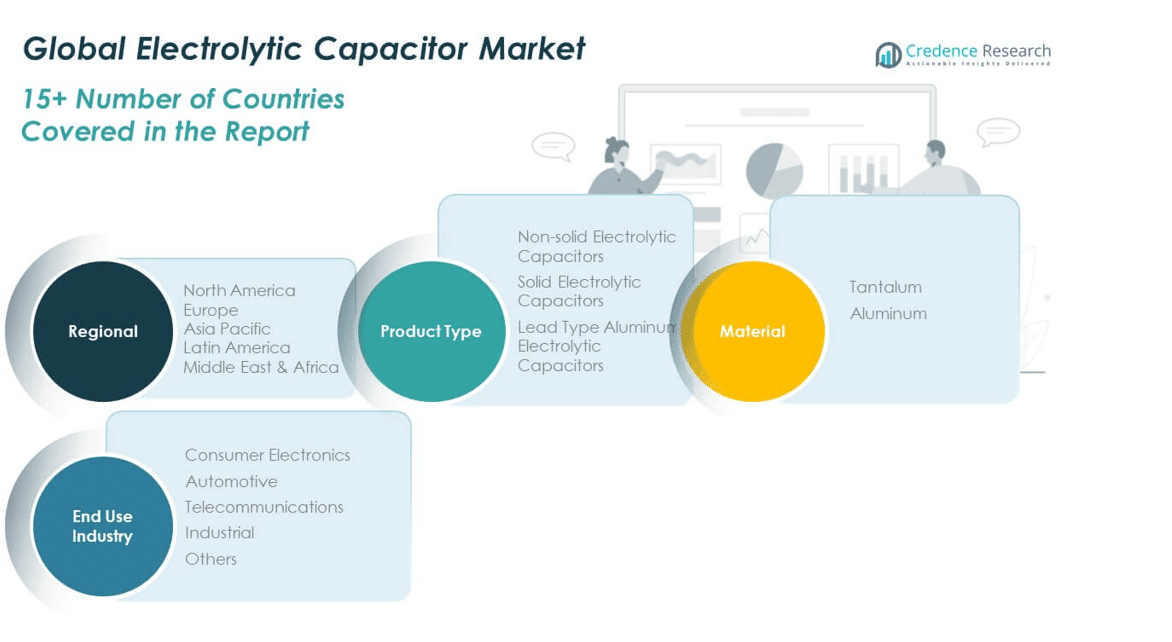
By product type, the Global Electrolytic Capacitor Market is divided into non-solid electrolytic capacitors, solid electrolytic capacitors, and lead type aluminum electrolytic capacitors. Non-solid variants dominate due to their cost-effectiveness and broad use in consumer electronics and industrial systems. Solid electrolytic capacitors gain traction in applications requiring high reliability and stable performance, particularly in automotive and telecom sectors. Lead type aluminum electrolytic capacitors remain critical for power supply and energy storage functions across multiple industries. It demonstrates steady growth by meeting diverse performance requirements across segments.
- For instance, Panasonic’s SEPG Series OS-CON aluminum polymer capacitors achieve a maximum ESR of 8 mΩ, deliver a rated ripple current up to 5,800 mA, and guarantee a lifetime of 5,000 hours at 105 °C.
By material, the Global Electrolytic Capacitor Market is segmented into tantalum and aluminum. Aluminum holds a larger share due to wide availability, lower costs, and adaptability in high-volume electronics production. Tantalum capacitors, though more expensive, are valued for their high capacitance in compact sizes and superior reliability, driving adoption in medical, aerospace, and advanced electronics applications.
By end use industry, the Global Electrolytic Capacitor Market includes consumer electronics, automotive, telecommunications, industrial, and others. Consumer electronics lead due to high penetration of smartphones, laptops, and portable devices. Automotive applications expand rapidly with electric vehicles and advanced driver-assistance systems requiring durable capacitors. Telecommunications leverage capacitors in network infrastructure and data systems. Industrial uses span automation, robotics, and renewable energy integration. Other sectors, including aerospace and medical devices, contribute through niche but high-value demand. This diversity of applications ensures stable market growth across industries.
- For instance, Nichicon launched the LGA Series high ripple current aluminum electrolytic capacitors in December 2024, designed for automotive on-board chargers, delivering 5,000 hours of rated ripple current capability at 105 °C and targeting EV and PHEV applications.
Segmentation:
By Product Type
- Non-solid Electrolytic Capacitors
- Solid Electrolytic Capacitors
- Lead Type Aluminum Electrolytic Capacitors
By Material
- Tantalum
- Aluminum
By End Use Industry
- Consumer Electronics
- Automotive
- Telecommunications
- Industrial
- Others
By Region
- North America
- U.S.
- Canada
- Mexico
- Europe
- Germany
- France
- U.K.
- Italy
- Spain
- Rest of Europe
- Asia Pacific
- China
- Japan
- India
- South Korea
- South-east Asia
- Rest of Asia Pacific
- Latin America
- Brazil
- Argentina
- Rest of Latin America
- Middle East & Africa
- GCC Countries
- South Africa
- Rest of the Middle East and Africa
Regional Analysis:
North America
The North America Global Electrolytic Capacitor Market size was valued at USD 1,583.85 million in 2018 to USD 2,051.08 million in 2024 and is anticipated to reach USD 2,959.73 million by 2032, at a CAGR of 4.4% during the forecast period. North America holds 28% share of the Global Electrolytic Capacitor Market in 2024. It benefits from strong adoption in automotive, aerospace, and renewable energy systems. The region emphasizes energy-efficient technologies supported by favorable regulations. Manufacturers expand advanced capacitor solutions tailored to electric vehicles and smart grid infrastructure. Consumer electronics demand remains steady with innovation driving replacement cycles. The U.S. dominates the regional market due to its technology leadership. Canada and Mexico also experience steady growth from industrial and telecom sectors. This balanced demand sustains North America’s competitive presence.
Europe
The Europe Global Electrolytic Capacitor Market size was valued at USD 1,058.17 million in 2018 to USD 1,317.93 million in 2024 and is anticipated to reach USD 1,726.33 million by 2032, at a CAGR of 3.1% during the forecast period. Europe represents 18% share of the Global Electrolytic Capacitor Market in 2024. It benefits from regulatory initiatives focusing on sustainability and low-carbon technologies. Automotive electrification across Germany, France, and the UK drives significant capacitor demand. Industrial applications remain strong, particularly in renewable integration and energy storage projects. The region invests in research and development to enhance capacitor reliability. Telecommunications infrastructure expansion also provides new opportunities. Eastern Europe sees gradual growth as manufacturing bases expand. Overall, Europe maintains steady demand despite slower growth compared to Asia.
Asia Pacific
The Asia Pacific Global Electrolytic Capacitor Market size was valued at USD 2,420.00 million in 2018 to USD 3,301.82 million in 2024 and is anticipated to reach USD 5,033.54 million by 2032, at a CAGR of 5.1% during the forecast period. Asia Pacific accounts for 45% share of the Global Electrolytic Capacitor Market in 2024. It dominates due to its robust electronics manufacturing ecosystem across China, Japan, South Korea, and Taiwan. Consumer electronics, industrial automation, and telecommunication infrastructure drive significant demand. Rapid expansion of electric vehicles across China and Japan strengthens adoption further. The region also leads in renewable energy integration with capacitors ensuring stable output. India shows strong growth driven by rising industrial and automotive demand. Southeast Asia emerges as a hub for low-cost manufacturing. Asia Pacific remains the global growth leader due to scale and innovation.
Latin America
The Latin America Global Electrolytic Capacitor Market size was valued at USD 249.69 million in 2018 to USD 324.27 million in 2024 and is anticipated to reach USD 409.87 million by 2032, at a CAGR of 2.6% during the forecast period. Latin America represents 4% share of the Global Electrolytic Capacitor Market in 2024. It experiences demand led by Brazil’s automotive and industrial sectors. Mexico supports growth through its electronics assembly base. Telecommunications expansion across several countries also creates opportunities. Limited manufacturing capacity in the region increases reliance on imports. Capacitors play a critical role in energy projects, especially renewables. Rising consumer electronics adoption among middle-class populations strengthens regional demand. Argentina and Chile also contribute with growing industrial modernization. Overall, growth is stable but slower compared to larger regions.
Middle East
The Middle East Global Electrolytic Capacitor Market size was valued at USD 144.55 million in 2018 to USD 172.68 million in 2024 and is anticipated to reach USD 206.28 million by 2032, at a CAGR of 1.9% during the forecast period. The Middle East accounts for 2% share of the Global Electrolytic Capacitor Market in 2024. Growth is driven by industrial and energy projects across GCC countries. Capacitors find strong applications in oil and gas infrastructure modernization. Regional governments invest in renewable energy projects such as solar farms. Demand rises from consumer electronics, though it remains limited in scale. Israel and Turkey show stronger adoption in advanced industries. Supply constraints create reliance on imports from Asia and Europe. Despite slower growth, energy diversification initiatives create consistent opportunities.
Africa
The Africa Global Electrolytic Capacitor Market size was valued at USD 77.13 million in 2018 to USD 113.30 million in 2024 and is anticipated to reach USD 126.39 million by 2032, at a CAGR of 1.0% during the forecast period. Africa holds 2% share of the Global Electrolytic Capacitor Market in 2024. Growth is concentrated in South Africa, Egypt, and Nigeria, where industrial and telecom sectors expand. The region witnesses rising demand for consumer electronics and automotive components. Capacitors support renewable energy initiatives, particularly solar power installations. Infrastructure development projects increase reliance on imported capacitors. Limited local manufacturing capability constrains supply chains. Governments encourage energy diversification, which boosts power electronics applications. Overall growth is slow, but emerging economies show long-term potential for market expansion.
Key Player Analysis:
- Nichicon Corporation
- Panasonic Corporation
- Rubycon Corporation
- KEMET Corporation
- Vishay Intertechnology, Inc.
- Samwha Capacitor Group
- Taiwan Chemi-Con Corporation
- United Chemi-Con, Inc.
- EPCOS AG (TDK Corporation)
Competitive Analysis:
The Global Electrolytic Capacitor Market is highly competitive, with leading players focusing on technology advancements, capacity expansion, and product reliability. It features strong participation from established companies such as Nichicon Corporation, Panasonic Corporation, Rubycon Corporation, KEMET Corporation, Vishay Intertechnology, Samwha Capacitor Group, Taiwan Chemi-Con Corporation, United Chemi-Con, and EPCOS AG (TDK Corporation). These companies invest in research to deliver higher capacitance, longer lifespans, and miniaturized solutions tailored for consumer electronics, automotive, and industrial applications. It also experiences competition from regional suppliers offering cost-effective products for emerging economies. Strategic initiatives including mergers, acquisitions, and regional expansions strengthen global reach. Companies emphasize partnerships with automotive and renewable energy industries to secure demand for next-generation capacitors. Strong innovation pipelines and diversified portfolios enable market leaders to maintain dominance while mid-tier players focus on niche applications and affordable alternatives to capture market share.
Recent Developments:
- In September 2025, TDK also unveiled the B41699 and B41799 series of ultra-compact aluminum electrolytic capacitors with axial-lead and soldering star designs. These new product lines offer high-capacitance and high-ripple current capacity, tailored specifically for challenging environments including automotive powertrains, withstanding operating temperatures up to +140 °C.
- In January 2024, Nichicon Corporation garnered attention at CES for its disruptive collaboration with Epishine, showcasing a self-charging battery concept combining organic photovoltaic cells and Nichicon's SLB rechargeable battery, aiming to power IoT devices efficiently and sustainably.
Report Coverage:
The research report offers an in-depth analysis based on Product Type, Material and End Use Industry. It details leading market players, providing an overview of their business, product offerings, investments, revenue streams, and key applications. Additionally, the report includes insights into the competitive environment, SWOT analysis, current market trends, as well as the primary drivers and constraints. Furthermore, it discusses various factors that have driven market expansion in recent years. The report also explores market dynamics, regulatory scenarios, and technological advancements that are shaping the industry. It assesses the impact of external factors and global economic changes on market growth. Lastly, it provides strategic recommendations for new entrants and established companies to navigate the complexities of the market.
Future Outlook:
- The Global Electrolytic Capacitor Market will expand with increasing adoption in electric vehicles and hybrid systems.
- Demand will strengthen in consumer electronics as manufacturers prioritize compact, high-capacitance designs.
- Industrial automation and robotics will drive new opportunities requiring long-life, high-reliability capacitors.
- Renewable energy projects, particularly solar and wind, will sustain consistent capacitor integration.
- Smart grid modernization will increase reliance on advanced capacitors for power stabilization.
- Asia Pacific will continue to dominate due to its large electronics manufacturing ecosystem.
- North America and Europe will prioritize innovation in automotive and aerospace applications.
- Emerging economies in Latin America, the Middle East, and Africa will present incremental growth potential.
- Competitive intensity will rise as global players invest in material science and miniaturization.
- Strategic alliances, product innovation, and regional expansions will remain central to long-term competitiveness.

Request a Free Sample
Fill in your details and we'll send you a free sample report.
- Sample data tables & charts
- Research methodology
Market Dynamics
Rising Demand from Consumer Electronics and Portable Devices
The proliferation of smartphones, laptops, and wearable devices is driving the need for compact, high-capacitance electrolytic capacitors for energy storage and filtering. Continuous upgrades and integration of smart features in consumer electronics ensure stable, long-term demand for advanced capacitor solutions.
Expansion of Electric Vehicles and Hybrid Automotive Systems
Electrolytic capacitors are increasingly used in electric and hybrid vehicles for powertrain electrification, regenerative braking, and infotainment systems. The global push for electric mobility and government incentives are accelerating adoption, with automakers seeking capacitors that offer higher voltage ratings and longer lifespans.
Integration into Renewable Energy and Power Infrastructure
The growth of solar, wind, and smart grid projects is boosting demand for electrolytic capacitors, which are essential for energy conversion, grid stabilization, and reliable power supply. Investments in renewable energy and modernization of power infrastructure are expanding the market’s application scope.
Industrial Automation and Advanced Manufacturing
The adoption of Industry 4.0 technologies and automation in manufacturing increases the need for reliable capacitors in drives, controllers, and robotics. Electrolytic capacitors help manage voltage fluctuations and ensure operational stability in precision industrial equipment.
Shift Toward Miniaturization and High-Capacitance Designs
Manufacturers are innovating to deliver smaller, higher-performance electrolytic capacitors that meet the requirements of portable electronics and compact automotive systems. The trend toward miniaturization and high-capacitance designs is fueling R&D and expanding the use of advanced capacitor architectures.
Need a Custom Version of This Report?
Tailor the scope, geography, or segments to your exact requirements.
- Custom geography or segment scope
- Direct access to our analyst team
Frequently Asked Questions
What is the current market size for Global Electrolytic Capacitor Market, and what is its projected size in 2032?
At what Compound Annual Growth Rate is the Global Electrolytic Capacitor Market projected to grow between 2024 and 2032?
Which Global Electrolytic Capacitor Market segment held the largest share in 2024?
What are the primary factors fueling the growth of the Global Electrolytic Capacitor Market?
Who are the leading companies in the Global Electrolytic Capacitor Market?
Table of Content
Chapter 1 Market Segmentation
- 1.1 Segmentation Framework
- 1.1.1 Product and Service Classification
- 1.1.2 Application and End-Use Classification
- 1.1.3 Technology and Solution Classification
- 1.1.4 Customer and Distribution Channel Classification
- 1.1.5 Geographic Segmentation
- 1.1.6 Market Segment Definitions and Boundaries
- 1.2 By Material
- 1.2.1 Aluminum
- 1.2.2 Tantalum
- 1.3 By Product Type
- 1.3.1 Non-solid Electrolytic Capacitors
- 1.3.2 Solid Electrolytic Capacitors
- 1.3.3 Lead Type Aluminum Electrolytic Capacitors
- 1.4 By End Use Industry
- 1.4.1 Consumer Electronics
- 1.4.2 Automotive
- 1.4.3 Telecommunications
- 1.4.4 Industrial
- 1.4.5 Others
Chapter 2 Introduction
- 2.1 Report Objectives and Scope
- 2.2 Product Definition and Industry Terminology
- 2.3 Market Inclusions and Exclusions
- 2.4 Research Process
- 2.4.1 Primary Research and Expert Interviews
- 2.4.2 Secondary Research and Source Review
- 2.4.3 Top-Down and Bottom-Up Estimation
- 2.4.4 Data Triangulation and Verification
- 2.5 Market Size Measurement Basis
- 2.5.1 2024: USD 7,281.08 million → 2032: USD 10,462.14 million
- 2.6 Historical and Forecast Reference Periods
- 2.6.1 Base Year: 2024
- 2.6.2 Forecast Period: 2024-2032
- 2.7 Research Assumptions and Limitations
Chapter 3 Executive Summary
- 3.1 Market Snapshot and Key Findings
- 3.2 Base-Year Market Size, 2024
- 3.3 Forecast Market Size, 2032
- 3.4 Revenue and Volume Growth Outlook
- 3.5 Key Demand and Supply Indicators
- 3.6 Leading Market Segments
- 3.7 Fastest-Growing Market Opportunities
- 3.8 Regional Performance Highlights
- 3.9 Technology and Industry Transformation
- 3.10 Competitive Landscape Summary
- 3.11 Analyst View and Strategic Implications
Chapter 4 Global Electrolytic Capacitor Market Trends and Developments
- 4.1 Historical Industry Development
- 4.2 Recent Market Trends and Developments
- 4.3 Demand and Customer Behavior Trends
- 4.4 Technology and Product Innovation
- 4.5 Artificial Intelligence, Automation and Digitalization
- 4.6 Local Manufacturing and Supply Chain Realignment
- 4.7 Industry Partnerships, Mergers and Acquisitions
- 4.8 Sustainability and Circular Economy Developments
- 4.9 Government and Private Sector Investment Trends
- 4.10 Emerging Business Models and Commercialization
- 4.11 Industry Developments and Announcements
Chapter 5 Global Electrolytic Capacitor Market Production, Supply and Demand Analysis
- 5.1 Demand Trend and Consumption Analysis
- 5.2 Demand Forecast, 2024-2032
- 5.3 Production and Output Trend
- 5.4 Production and Output Forecast, 2024-2032
- 5.5 Installed Capacity and Capacity Utilization
- 5.6 Company-Wise Production Plants and Statistics
- 5.6.1 Installed Production Capacity
- 5.6.2 Actual Production
- 5.6.3 Planned Capacity and Expansion Targets
- 5.7 Supply Chain Structure and Procurement Trends
- 5.8 Supply-Demand Gap and Bottlenecks
- 5.9 Import Dependence and Sourcing Structure
- 5.10 Contract Manufacturing and Outsourcing
- 5.11 Regional Supply and Demand Concentration
Chapter 6 Global Electrolytic Capacitor Market Pricing Analysis
- 6.1 Pricing Structure and Measurement
- 6.2 Historical Pricing Trends
- 6.3 Pricing Outlook, 2024-2032
- 6.4 Average Selling Price and Unit Economics
- 6.5 Pricing by Product and Market Segment
- 6.6 Geographic Pricing Differences
- 6.7 Key Input, Energy, Labor and Logistics Costs
- 6.8 Contract Pricing and Purchasing Models
- 6.9 Pricing Sensitivity and Competitive Positioning
- 6.10 Price, Margin and Profitability Implications
Chapter 7 Global Electrolytic Capacitor Market Dynamics
- 7.1 Market Growth Drivers
- 7.1.1 Demand-Side Drivers
- 7.1.2 Technology and Innovation Drivers
- 7.1.3 Infrastructure and Investment Drivers
- 7.1.4 Regulatory and Policy Drivers
- 7.2 Market Restraints
- 7.2.1 Cost and Affordability Constraints
- 7.2.2 Technology and Adoption Barriers
- 7.2.3 Supply Chain and Operational Constraints
- 7.3 Market Challenges
- 7.3.1 Competitive Pressure and Margin Erosion
- 7.3.2 Skills, Infrastructure and Implementation Gaps
- 7.4 Emerging Market Opportunities
- 7.5 Market Dynamics Impact and Time-Horizon Assessment
Chapter 8 Global Electrolytic Capacitor Value Chain Analysis
- 8.1 Industry Value Chain Overview
- 8.2 Upstream Suppliers and Critical Inputs
- 8.3 Technology and Component Providers
- 8.4 Manufacturing or Service Delivery
- 8.5 Distribution, Channel Partners and Integrators
- 8.6 Downstream Applications and End Users
- 8.7 Value Addition and Profit Pools
- 8.8 Vertical Integration and Outsourcing
- 8.9 Supplier Concentration and Risk
- 8.10 Supply Chain Localization and Resilience
Chapter 9 Global Electrolytic Capacitor Market Regulations and Policies
- 9.1 Relevant Laws, Standards and Compliance Frameworks
- 9.2 Product, Service, Safety and Quality Requirements
- 9.3 Government Policies, Incentives and Subsidies
- 9.4 Imports, Exports and Trade Barriers
- 9.5 Public Procurement and Local Content Requirements
- 9.6 Environmental and Sustainability Compliance
- 9.7 Upcoming Policy Changes and Market Implications
Chapter 10 Global Electrolytic Capacitor Market Hotspots and Opportunities
- 10.1 Market Opportunity Mapping and Growth Hotspots
- 10.2 High-Growth Applications and Customer Groups
- 10.3 Underserved Markets and White-Space Opportunities
- 10.4 Emerging Technology and Product Opportunities
- 10.5 New Capacity and Investment Hotspots
- 10.6 Market Entry and Expansion Opportunities
- 10.7 Distribution and Partnership Opportunities
- 10.8 Near-Term and Long-Term Commercial Potential
- 10.9 Opportunity Attractiveness and Execution Risks
Chapter 11 Global Electrolytic Capacitor Market Outlook, 2024-2032
- 11.1 Market Size and Analysis
- 11.1.1 Revenue (Market Measurement: 2024: USD 7,281.08 million → 2032: USD 10,462.14 million)
- 11.1.2 Market Volume and Quantity Sold
- 11.1.3 Historical Market Size
- 11.1.4 Base-Year Market Size, 2024
- 11.2 Market Forecast, 2024-2032
- 11.2.1 Revenue Forecast to 2032
- 11.2.2 Volume Forecast to 2032
- 11.2.3 CAGR and Year-on-Year Growth
- 11.2.4 Incremental Revenue Opportunity
- 11.3 Forecast Assumptions and Scenario Analysis
- 11.3.1 Base-Case Forecast
- 11.3.2 Optimistic and Conservative Scenarios
- 11.3.3 Technology, Pricing and Policy Sensitivities
- 11.4 Market Attractiveness and Growth Outlook
Chapter 12 Global Electrolytic Capacitor Market Segmentation and Outlook
- 12.1 Segmentation Summary and Market Shares, 2024
- 12.2 Largest and Fastest-Growing Segments
- 12.3 By Material - Market Size and Forecast, 2024-2032
- 12.3.1 Segment Definition and Scope
- 12.3.2 Historical Market Size
- 12.3.3 Revenue Forecast, 2024-2032
- 12.3.4 Volume Forecast, 2024-2032
- 12.3.5 Base-Year Market Share, 2024
- 12.3.6 Segment CAGR and Growth Drivers
- 12.3.7 Subsegment Market Size and Forecast
- 12.3.7.1 Aluminum
- 12.3.7.2 Tantalum
- 12.3.8 Subsegment Pricing and Adoption Trends
- 12.3.9 Leading Suppliers and Competition
- 12.3.10 Regional Demand and Opportunities
- 12.4 By Product Type - Market Size and Forecast, 2024-2032
- 12.4.1 Segment Definition and Scope
- 12.4.2 Historical Market Size
- 12.4.3 Revenue Forecast, 2024-2032
- 12.4.4 Volume Forecast, 2024-2032
- 12.4.5 Base-Year Market Share, 2024
- 12.4.6 Segment CAGR and Growth Drivers
- 12.4.7 Subsegment Market Size and Forecast
- 12.4.7.1 Non-solid Electrolytic Capacitors
- 12.4.7.2 Solid Electrolytic Capacitors
- 12.4.7.3 Lead Type Aluminum Electrolytic Capacitors
- 12.4.8 Subsegment Pricing and Adoption Trends
- 12.4.9 Leading Suppliers and Competition
- 12.4.10 Regional Demand and Opportunities
- 12.5 By End Use Industry - Market Size and Forecast, 2024-2032
- 12.5.1 Segment Definition and Scope
- 12.5.2 Historical Market Size
- 12.5.3 Revenue Forecast, 2024-2032
- 12.5.4 Volume Forecast, 2024-2032
- 12.5.5 Base-Year Market Share, 2024
- 12.5.6 Segment CAGR and Growth Drivers
- 12.5.7 Subsegment Market Size and Forecast
- 12.5.7.1 Consumer Electronics
- 12.5.7.2 Automotive
- 12.5.7.3 Telecommunications
- 12.5.7.4 Industrial
- 12.5.7.5 Others
- 12.5.8 Subsegment Pricing and Adoption Trends
- 12.5.9 Leading Suppliers and Competition
- 12.5.10 Regional Demand and Opportunities
- 12.6 Segment Growth Comparison
- 12.7 Segment Attractiveness and Priority Matrix
Chapter 13 Global Electrolytic Capacitor End-Use and Application Market Outlook
- 13.1 End-Use Industry and Customer Demand Structure
- 13.2 Leading Applications and Customer Groups
- 13.3 End-Use Market Size, Share and Forecast
- 13.4 Major End-Use Industry Deep Dives
- 13.4.1 Customer Requirements and Use Cases
- 13.4.2 Demand and Replacement Cycles
- 13.4.3 Technical and Regulatory Considerations
- 13.4.4 Purchasing and Procurement Models
- 13.4.5 Leading Vendors and Distribution Channels
- 13.4.6 Forecast and Commercial Opportunities
- 13.5 Emerging Applications and Cross-Segment Demand
- 13.6 End-Use Industry Investment Priorities
Chapter 14 Global Electrolytic Capacitor Geographic Market Outlook, 2024-2032
- 14.1 Regional Market Size and Share, 2024
- 14.2 Regional Market Forecast, 2024-2032
- 14.3 Regional Pricing, Production and Demand Differences
- 14.4 North America
- 14.4.1 United States
- 14.4.2 Canada
- 14.4.3 Mexico
- 14.5 Europe
- 14.5.1 Germany
- 14.5.2 France
- 14.5.3 Italy
- 14.5.4 United Kingdom
- 14.5.5 Spain
- 14.5.6 Poland
- 14.5.7 Russia
- 14.5.8 Netherlands
- 14.5.9 Belgium
- 14.5.10 Sweden
- 14.5.11 Denmark
- 14.5.12 Norway
- 14.5.13 Rest of Europe
- 14.6 Asia Pacific
- 14.6.1 China
- 14.6.2 India
- 14.6.3 Japan
- 14.6.4 South Korea
- 14.6.5 Thailand
- 14.6.6 Indonesia
- 14.6.7 Vietnam
- 14.6.8 Malaysia
- 14.6.9 Australia
- 14.6.10 Rest of Asia Pacific
- 14.7 Latin America
- 14.7.1 Brazil
- 14.7.2 Argentina
- 14.7.3 Colombia
- 14.7.4 Chile
- 14.7.5 Rest of Latin America
- 14.8 Middle East
- 14.8.1 Saudi Arabia
- 14.8.2 United Arab Emirates
- 14.8.3 Turkey
- 14.8.4 Israel
- 14.8.5 Iran
- 14.8.6 Rest of the Middle East
- 14.9 Africa
- 14.9.1 South Africa
- 14.9.2 Egypt
- 14.9.3 Nigeria
- 14.9.4 Morocco
- 14.9.5 Rest of Africa
- 14.10 Regional Investment, Policy and Supply Chain Differences
- 14.11 Regional Competitive Landscape
- 14.12 Geographic Growth Hotspots
Chapter 15 Global Electrolytic Capacitor Technology, Innovation and Sustainability Outlook
- 15.1 Technology Landscape and Maturity
- 15.2 Product, Process and Service Innovation
- 15.3 AI, Automation and Digital Tools in the Industry
- 15.4 Technology Adoption and Performance Benchmarking
- 15.5 Innovation Pipeline and R&D Investment
- 15.6 Patent and Intellectual Property Trends
- 15.7 Energy Efficiency and Resource Management
- 15.8 Sustainability, Recycling and Circularity
- 15.9 Technology Roadmap, 2024-2032
- 15.10 Risks of Obsolescence and Technology Substitution
Chapter 16 Global Electrolytic Capacitor Market Key Strategic Imperatives
- 16.1 Growth and Market Entry Priorities
- 16.2 High-Return Products and Segments
- 16.3 Pricing, Profitability and Cost Optimization
- 16.4 Technology Investment and Product Differentiation
- 16.5 Supply Chain Localization and Resilience
- 16.6 Distribution and Customer Acquisition
- 16.7 Partnership, Acquisition and Capacity Strategy
- 16.8 Regional Expansion Priorities
- 16.9 Short-, Medium- and Long-Term Actions
Chapter 17 Competition Outlook
- 17.1 Industry Competition Characteristics
- 17.2 Market Structure and Concentration
- 17.3 Market Share and Competitive Positioning, 2024
- 17.4 Company-Wise Revenue and Product Benchmarking
- 17.5 Production and Service Capacity Benchmarking
- 17.6 Technology, Pricing and Differentiation
- 17.7 Regional Footprint and Distribution Strength
- 17.8 Mergers, Acquisitions and Strategic Alliances
- 17.9 New Entrants and Competitive Threats
- 17.10 Porter's Five Forces and Industry Attractiveness
- 17.11 Competitive Outlook, 2024-2032
Chapter 18 Company Profiles
- 18.1 Company Coverage and Selection Criteria
- 18.2 Nichicon Corporation
- 18.2.1 Business Description
- 18.2.2 Company Ownership and Geographic Presence
- 18.2.3 Product and Service Portfolio
- 18.2.4 Manufacturing and Operating Footprint
- 18.2.5 Production Capacity and Expansion Plans
- 18.2.6 Financial Performance and Investment
- 18.2.7 Market Share and Competitive Position
- 18.2.8 Technology and Innovation Capabilities
- 18.2.9 Strategic Alliances or Partnerships
- 18.2.10 Recent Developments
- 18.2.11 Growth Strategy and Outlook
- 18.3 Panasonic Corporation
- 18.4 Rubycon Corporation
- 18.5 KEMET Corporation
- 18.6 Vishay Intertechnology, Inc.
- 18.7 Samwha Capacitor Group
- 18.8 Taiwan Chemi-Con Corporation
- 18.9 United Chemi-Con, Inc.
- 18.10 EPCOS AG (TDK Corporation)
- 18.11 Other Relevant Market Participants
Note: Every listed company is profiled on the structure shown under the first company. The company list is preliminary and may change based on research findings, market developments, data availability and client requirements.
Chapter 19 Disclaimer
- 19.1 Research and Forecast Disclaimer
- 19.2 Data Source and Estimation Limitations
Note: The depth of individual sections depends on data availability for this market. Volume, capacity, trade and other unit-based metrics are included where applicable.

