
Market Overview:
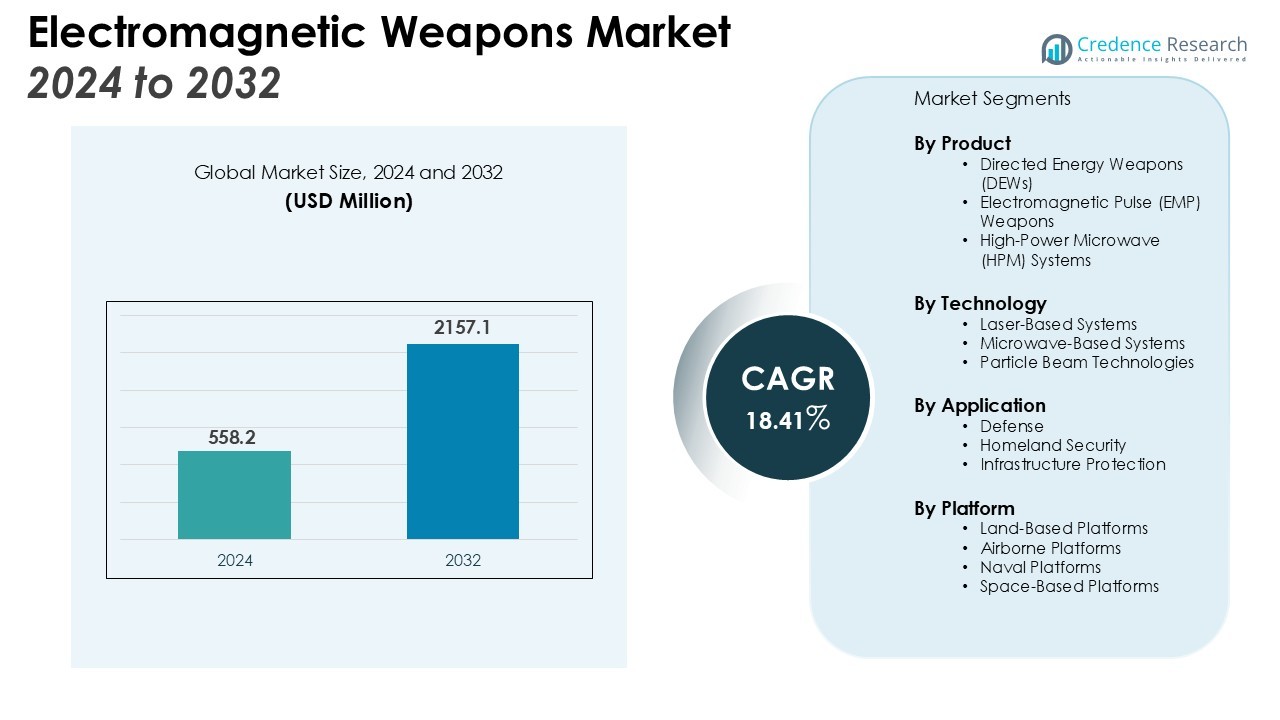
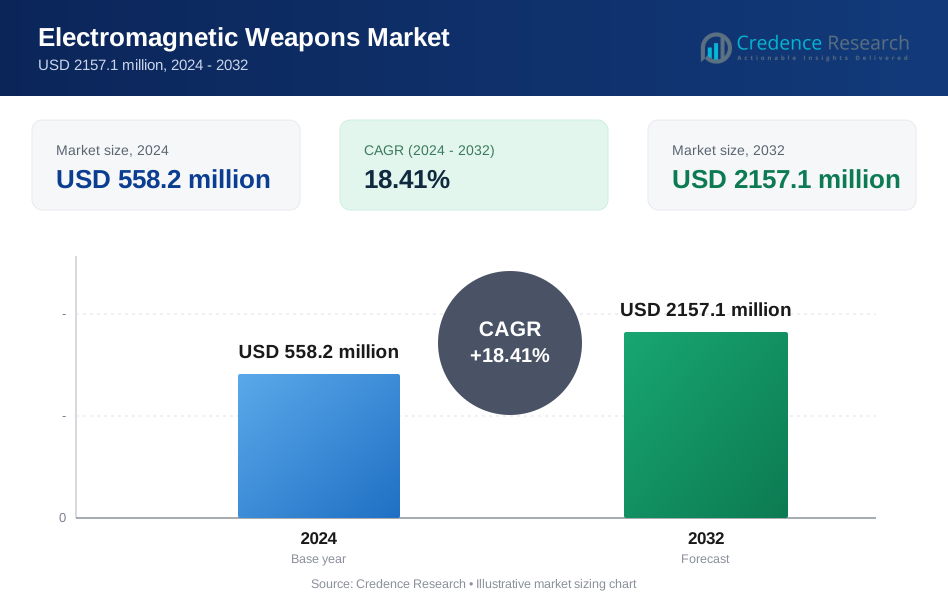
The Electromagnetic Weapons Market size was valued at USD 558.2 million in 2024 and is anticipated to reach USD 2157.1 million by 2032, at a CAGR of 18.41% during the forecast period (2024-2032).
| REPORT ATTRIBUTE | DETAILS |
|---|---|
| Historical Period | 2020-2023 |
| Base Year | 2024 |
| Forecast Period | 2025-2032 |
| Electromagnetic Weapons Market Size 2024 | USD 558.2 Million |
| Electromagnetic Weapons Market, CAGR | 18.41% |
| Electromagnetic Weapons Market Size 2032 | USD 2157.1 Million |
Key drivers of market growth include technological advancements in electromagnetic pulse (EMP) technology, the rising adoption of directed energy weapons, and the growing focus on enhancing defense capabilities. The increasing need for cost-effective, non-lethal weapon systems, especially in urban warfare scenarios, has led to the development of more efficient electromagnetic weapons. Additionally, governments worldwide are investing in electromagnetic weaponry to counter emerging threats and safeguard critical infrastructures from cyberattacks and EMP-related disruptions. The growing threat of electromagnetic attacks on critical infrastructure further accelerates the demand for these advanced defense systems.
Regionally, North America holds the largest market share, primarily due to strong defense spending and the presence of leading market players such as Lockheed Martin and Raytheon Technologies. Europe follows closely, with countries like the U.K. and Russia advancing their electromagnetic weapon programs. The Asia-Pacific region is expected to witness the highest growth during the forecast period, driven by military modernization efforts in China, India, and Japan, coupled with regional geopolitical tensions. Additionally, increasing defense budgets and growing concerns over security in the region are likely to boost the adoption of electromagnetic weapon systems.
Market Insights:
- The Electromagnetic Weapons Market is valued at USD 558.2 million in 2024 and is projected to reach USD 2157.1 million by 2032, growing at a CAGR of 18.41%.
- Technological advancements in EMP technology enhance the effectiveness of electromagnetic weapons, driving growth in military capabilities.
- The increasing adoption of directed energy weapons (DEWs) provides a strategic advantage by neutralizing enemy technology and drones.
- Growing cybersecurity concerns and electromagnetic threats to critical infrastructure accelerate the demand for electromagnetic weapons.
- Government investments in military modernization programs are driving the development and deployment of electromagnetic weapons globally.
- High development and maintenance costs challenge widespread adoption, requiring significant investment in research, development, and training.
- North America holds 40% of the market share, with strong defense spending, while Asia-Pacific’s rapid growth is driven by military modernization efforts.
Market Drivers:
Technological Advancements in Electromagnetic Pulse (EMP) Technology
The continuous evolution of electromagnetic pulse (EMP) technology significantly drives the growth of the Electromagnetic Weapons Market. Breakthroughs in EMP weaponry have enhanced its effectiveness, making it a critical tool for both offensive and defensive strategies. Military agencies are prioritizing EMP technology for its ability to disable electronic systems without causing physical harm to personnel or infrastructure. The growing need for precise and controlled non-lethal weapons further pushes the development of EMP-based systems in defense applications.
- For Instance, In 2012, Boeing successfully tested its CHAMP (Counter-electronics High-powered Microwave Advanced Missile Project) missile, which achieved non-destructive immobilization of seven mock targets in the Utah desert.
Increased Adoption of Directed Energy Weapons
Directed energy weapons (DEWs) are increasingly adopted across military forces, contributing to the market's expansion. These weapons use focused energy, such as electromagnetic waves, to damage or destroy targets. DEWs offer a strategic advantage in various combat scenarios, offering precise control over attacks. Their potential to neutralize enemy technology, disable drones, and counter cyberattacks makes them essential in modern warfare, driving demand within the Electromagnetic Weapons Market.
- For Instance, In August 2022, Lockheed Martin delivered a 300-kilowatt high-energy laser system to the U.S. Army for integration on a military vehicle for field testing. At the time, it was the most powerful solid-state laser the company had delivered to the Department of Defense.
Emerging Threats and Cybersecurity Concerns
Growing concerns about electromagnetic attacks on critical infrastructure fuel the demand for electromagnetic weapons. The increasing frequency of cyberattacks targeting power grids, communication networks, and military assets highlights vulnerabilities that these weapons can address. With cyber threats becoming more sophisticated, governments are investing heavily in electromagnetic weaponry to protect against such attacks, reinforcing the need for advanced defense systems. This drive for enhanced cybersecurity capabilities continues to support the market's growth.
Government Investments and Military Modernization
Governments worldwide are investing in cutting-edge electromagnetic weapons to strengthen national defense. Military modernization programs focus on adopting new technologies to maintain strategic advantages, particularly in countering unconventional threats. This focus on defense innovation encourages the development and deployment of electromagnetic weapons, with countries like the United States and China leading the charge. The increased defense budgets in many nations further propel market demand, especially as geopolitical tensions continue to rise globally.
Market Trends:
Growing Integration of Electromagnetic Weapons with Advanced Defense Systems
A significant trend in the Electromagnetic Weapons Market is the growing integration of these weapons with advanced defense systems, particularly within military and naval forces. Electromagnetic weapons are being combined with existing technologies, such as radar systems and drones, to create multi-layered defense mechanisms capable of targeting both physical and electronic threats. This integration enables a higher level of operational efficiency and adaptability in complex combat environments. By complementing traditional weapons with electromagnetic capabilities, militaries can enhance their deterrence and protection strategies. As defense forces adopt more advanced technologies, the use of electromagnetic weapons is becoming central to achieving superior tactical advantages in modern warfare scenarios.
- For Instance, U.S. Navy test, likely involving a BAE Systems launcher, fired a projectile at a muzzle velocity of 2,520 m/s (8,268 ft/s) using a 10.64 MJ energy pulse. BAE Systems delivered a more powerful 32 MJ prototype demonstrator to the Naval Surface Warfare Center in Dahlgren, Virginia, in January 2012.
Development of Compact and Mobile Electromagnetic Weapons
The demand for compact and mobile electromagnetic weapons is rising in response to the need for more flexible and deployable defense solutions. Smaller, more portable systems are gaining traction, particularly for use in tactical military operations and on-the-go defense applications. These compact systems provide an advantage in scenarios where space and weight limitations exist, such as on vehicles or naval vessels. The shift toward mobility is also seen in the increasing development of electromagnetic weapons that can be quickly deployed and operated by smaller units in conflict zones. This trend reflects a broader move towards more agile, responsive, and versatile defense technologies that can be easily adapted to meet the needs of modern security challenges.
- For instance, Lockheed Martin’s HELIOS system delivered 60 kW output in a field test.
Market Challenges Analysis:
High Development and Maintenance Costs
One of the key challenges facing the Electromagnetic Weapons Market is the high cost of developing and maintaining these advanced systems. The complex technology behind electromagnetic weapons requires significant investment in research, development, and testing. Manufacturing these weapons involves specialized components and materials that can drive up costs, making them expensive to deploy on a large scale. Many defense organizations face budget constraints, limiting their ability to invest in these cutting-edge systems. Continuous maintenance, technical upgrades, and operational training further add to the financial burden, making it a major challenge for widespread adoption across all defense sectors.
Regulatory and Ethical Concerns
The deployment of electromagnetic weapons also faces significant regulatory and ethical challenges. Various international treaties and regulations limit the use of certain types of electromagnetic technology, especially concerning non-lethal and non-traditional weaponry. Governments and defense organizations must navigate these legal frameworks while ensuring compliance with global standards. Ethical concerns over the potential misuse of electromagnetic weapons, especially in civilian areas or conflict zones, add another layer of complexity. As such, ensuring these weapons are used appropriately and responsibly remains a critical challenge for the market.
Market Opportunities:
Expansion of Civilian and Critical Infrastructure Protection Applications
The Electromagnetic Weapons Market holds significant opportunities in the protection of civilian infrastructure and critical assets. As global reliance on electronic systems grows, the vulnerability to cyberattacks and electromagnetic disruptions increases. Electromagnetic weapons offer an effective solution to safeguard power grids, communication networks, and other vital sectors from electromagnetic interference or attacks. Governments and private organizations are investing in these technologies to ensure the resilience of critical infrastructure against potential threats. This growing focus on cybersecurity and infrastructure protection creates new avenues for the market to expand.
Adoption of Non-Lethal Technologies in Modern Military Operations
Non-lethal technologies, including electromagnetic weapons, present a unique opportunity for the Electromagnetic Weapons Market. These systems allow military forces to incapacitate targets without causing permanent harm, making them highly suitable for conflict scenarios where minimizing casualties is crucial. The increasing demand for non-lethal force in urban warfare and peacekeeping missions drives market growth. Electromagnetic weapons, with their ability to disable electronic systems, provide a strategic advantage in such operations. Their ability to neutralize drones, communication systems, and other critical technologies further enhances their appeal within modern military strategies.
Market Segmentation Analysis:
By Product
The Electromagnetic Weapons Market is segmented by product into directed energy weapons (DEWs), electromagnetic pulse (EMP) weapons, and high-power microwave (HPM) systems. Directed energy weapons are gaining significant traction due to their precision and non-lethal capabilities. EMP weapons are crucial for disabling enemy electronics, while HPM systems are increasingly used for their ability to damage or disrupt electronic equipment. These products are essential for modern military operations, providing a strategic advantage in combat scenarios.
- For instance, Lockheed Martin’s Advanced Test High Energy Asset (ATHENA) laser weapon system successfully disabled the engine of a truck at a distance of more than 1 mile during tests in 2023, demonstrating precise targeting capabilities.
By Technology
The market is divided by technology into laser-based, microwave-based, and particle beam technologies. Laser-based systems are widely adopted for their high precision and minimal collateral damage. Microwave-based technologies, particularly HPM systems, are advancing rapidly for their ability to disable enemy electronics. Particle beam systems are still in early stages but are expected to play a significant role in future defense strategies due to their potential to deliver powerful and focused energy.
- For instance, Lockheed Martin’s Advanced Test High Energy Asset (ATHENA) deployed a 30 kW fiber-laser beam to burn through the engine manifold of a moving truck at 1.5 km distance in under 5 seconds.
By Application
The Electromagnetic Weapons Market is applied in defense, homeland security, and infrastructure protection. In defense, these weapons are used for countering electronic warfare, disabling drones, and protecting critical military assets. Homeland security applications focus on protecting communication networks and transportation systems from electromagnetic attacks. Infrastructure protection involves safeguarding power grids, satellites, and other vital systems from EMP-related disruptions. The increasing importance of cybersecurity and defense capabilities in these areas continues to drive the market's growth.
Segmentations:
- By Product:
- Directed Energy Weapons (DEWs)
- Electromagnetic Pulse (EMP) Weapons
- High-Power Microwave (HPM) Systems
- By Technology:
- Laser-Based Systems
- Microwave-Based Systems
- Particle Beam Technologies
- By Application:
- Defense
- Homeland Security
- Infrastructure Protection
- By Platform:
- Land-Based Platforms
- Airborne Platforms
- Naval Platforms
- Space-Based Platforms
- By Region:
- North America
- Asia-Pacific
- Europe
- Latin America
- Middle East & Africa
Regional Analysis:
North America
North America holds the largest share of the Electromagnetic Weapons Market, capturing 40% of global demand. The region benefits from robust defense spending and advanced technological infrastructure, with the U.S. leading in the development and integration of electromagnetic weapon systems. The U.S. Department of Defense is prioritizing high-energy lasers and high-power microwave technologies to enhance its defense capabilities. This focus on technological innovation and modernization is expected to continue driving the market's growth in the region.
Asia-Pacific
The Asia-Pacific region is the fastest-growing market, contributing 30% of the global Electromagnetic Weapons Market. The increasing defense budgets and strategic focus on modernizing military capabilities are key drivers in countries like China, India, Japan, and South Korea. China’s advancements in railgun technology and India’s successful testing of electromagnetic railguns highlight the region’s commitment to strengthening defense capabilities. The growing security concerns and regional geopolitical tensions further enhance the demand for electromagnetic weapons in Asia-Pacific.
Europe
Europe holds a significant portion of the Electromagnetic Weapons Market, accounting for 20% of the total market share. Nations like the UK, France, and Germany are actively investing in electromagnetic weaponry to enhance their military capabilities. The region's increasing defense budgets, along with the growing need to protect critical infrastructure from electronic attacks, are key factors driving market expansion. Europe’s defense initiatives aim to integrate electromagnetic weapons into existing systems to maintain strategic advantages in an evolving security landscape.
Key Player Analysis:
- Honeywell
- BAE Systems
- Boeing
- QinetiQ
- Rheinmetall
- Elbit Systems
- General Atomics
- L3Harris Technologies
- Northrop Grumman
- Raytheon Technologies
- Lockheed Martin
- Rafael Advanced Defense Systems
Competitive Analysis:
The Electromagnetic Weapons Market is competitive, with key players such as Lockheed Martin, Raytheon Technologies, and Northrop Grumman leading in the development of high-power microwave systems and directed energy weapons. These companies focus on technological advancements and substantial investments in research and development to enhance product capabilities. Smaller firms like BAE Systems and Boeing also play a role by offering specialized electromagnetic weapon systems, often through government collaborations. Geopolitical tensions and increased defense spending worldwide intensify competition, driving companies to innovate and expand their product offerings. The growing demand for advanced defense solutions further strengthens the market's competitive landscape, encouraging both established players and new entrants to innovate and enhance their portfolios.
Recent Developments:
- In August 2025, BAE Systems announced it had delivered its 1,000th infrared seeker to Lockheed Martin for integration into the Terminal High Altitude Area Defense (THAAD) weapon system.
- In May 2025, Boeing and Qatar Airways announced a historic order for up to 210 widebody aircraft, which stands as the largest widebody order for Boeing and the largest-ever order for the airline.
- In April 2025, Boeing entered into an agreement to sell parts of its Digital Aviation Solutions business, including Jeppesen and ForeFlight, to the software investment firm Thoma Bravo for a sum of $10.55 billion.
Report Coverage:
The research report offers an in-depth analysis based on product, Technology, Application, Platform and Region. It details leading market players, providing an overview of their business, product offerings, investments, revenue streams, and key applications. Additionally, the report includes insights into the competitive environment, SWOT analysis, current market trends, as well as the primary drivers and constraints. Furthermore, it discusses various factors that have driven market expansion in recent years. The report also explores market dynamics, regulatory scenarios, and technological advancements that are shaping the industry. It assesses the impact of external factors and global economic changes on market growth. Lastly, it provides strategic recommendations for new entrants and established companies to navigate the complexities of the market.
Future Outlook:
- The demand for non-lethal, cost-effective defense solutions will continue to drive the growth of electromagnetic weapons.
- Increasing global military modernization efforts will propel the development of advanced directed energy weapons and EMP systems.
- The adoption of electromagnetic weapons for infrastructure protection will expand as concerns over cybersecurity and electromagnetic attacks grow.
- Geopolitical tensions, especially in Asia-Pacific, will result in heightened investments in electromagnetic weapon systems.
- Governments will focus on enhancing homeland security by incorporating electromagnetic technologies into defense and civilian protection strategies.
- Innovations in high-power microwave (HPM) and laser-based systems will lead to improved weapon efficiency and reduced operational costs.
- The growing need to counter emerging threats such as drones and electronic warfare will stimulate market growth.
- Integration of electromagnetic weaponry into space and naval platforms will open new applications and boost defense capabilities.
- Strategic defense partnerships between countries will enhance the research and development of next-generation electromagnetic weapons.
- Ethical and regulatory concerns around the use of electromagnetic weapons will lead to more stringent international agreements and compliance standards.
Request a Free Sample
Fill in your details and we'll send you a free sample report.
- Sample data tables & charts
- Research methodology
Need a Custom Version of This Report?
Tailor the scope, geography, or segments to your exact requirements.
- Custom geography or segment scope
- Direct access to our analyst team
Frequently Asked Questions
What is the current market size for Electromagnetic Weapons, and what is its projected size in 2032?
At what Compound Annual Growth Rate is the Electromagnetic Weapons market projected to grow between 2024 and 2032?
Which Electromagnetic Weapons market segment held the largest share in 2024?
What are the primary factors fueling the growth of the Electromagnetic Weapons market?
Who are the leading companies in the Electromagnetic Weapons market?
Which region commanded the largest share of the Electromagnetic Weapons market in 2024?
Table of Content
Chapter 1. Report Introduction
- 1.1 Report Description & Purpose
- 1.1.1 Report Title & Market Definition
- 1.1.2 Unique Selling Propositions (USP) & Key Differentiators
- 1.1.3 Value Proposition for Stakeholders
- 1.2 Research Objectives
- 1.2.1 Market Sizing Objectives (Volume & Revenue)
- 1.2.2 Segmentation Objectives
- 1.2.3 Competitive Intelligence Objectives
- 1.2.4 Forecast & Scenario Objectives
- 1.3 Report Scope
- 1.3.1 Electromagnetic Weapons Scope – Types & Subtypes Covered
- 1.3.2 Geographic Scope – Regions & Countries Covered
- 1.3.3 Historical Period, Base Year & Forecast Period (2024; forecast to 2032)
- 1.3.4 Inclusions & Exclusions
- 1.4 HS Code & Classification Framework
- 1.5 Currency, Units & Pricing Basis
- 1.6 Target Stakeholders
- 1.7 Limitations & Assumptions
Chapter 2. Executive Summary
- 2.1 Global Electromagnetic Weapons Market Snapshot
- 2.1.1 Market Size – Historical (2024) & Forecast (2024-2032) (2024: USD 558.2 million → 2032: USD 2157.1 million)
- 2.1.2 Volume & Revenue – Global Totals
- 2.1.3 Key Market Highlights – Top Five Facts
- 2.2 Electromagnetic Weapons Market Segmentation Snapshot
- 2.2.1 Market Split by Region – 2024 vs. 2032
- 2.3 Competitive Snapshot
- 2.3.1 Top 10 Players by Revenue Share – 2024
- 2.3.2 Top 10 Players by Volume Share – 2024
- 2.3.3 Recent Strategic Developments (18-Month Summary)
- 2.4 Key Investment Highlights & Strategic Conclusions
Chapter 3. Electromagnetic Weapons Market Dynamics & Industry Analysis
- 3.1 Market Overview & Context
- 3.1.1 Electromagnetic Weapons Market Position in the Broader Automotive Value Chain
- 3.1.2 OEM vs. Replacement Market Dynamics
- 3.1.3 Market Maturity & Development Stage by Region
- 3.2 Electromagnetic Weapons Market Drivers
- 3.3 Electromagnetic Weapons Market Restraints & Challenges
- 3.4 Electromagnetic Weapons Market Opportunities
- 3.5 Porter's Five Forces Analysis
- 3.5.1 Threat of New Entrants
- 3.5.2 Bargaining Power of Suppliers
- 3.5.3 Bargaining Power of Buyers
- 3.5.4 Threat of Substitutes
- 3.5.5 Competitive Rivalry – Intensity Assessment
- 3.6 Electromagnetic Weapons Value Chain Analysis
- 3.6.1 Upstream – Raw Material/Input Suppliers
- 3.6.1.1 Raw Material/Input 1
- 3.6.1.2 Raw Material/Input 2
- 3.6.1.3 Raw Material/Input 3
- 3.6.2 Midstream – Production/Manufacturing/Service Delivery
- 3.6.2.1 Production/Process Overview
- 3.6.2.2 Key Facility Locations & Capacity by Manufacturer
- 3.6.3 Downstream – Distribution & End Consumer
- 3.6.3.1 Primary Channel – B2B/OEM
- 3.6.3.2 Secondary Channels – Dealer, Retail, Online, Direct
- 3.6.4 Value Chain Profitability Analysis
- 3.6.1 Upstream – Raw Material/Input Suppliers
- 3.7 PESTEL Analysis
- 3.7.1 Political Factors
- 3.7.2 Economic Factors
- 3.7.3 Social Factors
- 3.7.4 Technological Factors
- 3.7.5 Environmental Factors
- 3.7.6 Legal Factors
- 3.8 Electromagnetic Weapons Supply Chain Analysis
- 3.8.1 Raw Material/Input Supply Risk Assessment
- 3.8.2 Manufacturing Concentration Risk (Geographic Exposure)
- 3.8.3 Trade Disruption Impact Analysis
- 3.9 Regulatory & Policy Landscape
Note: The regulatory and policy landscape section covers regulations based on their applicability to the market, Electromagnetic Weapons category, geography, and scope of the study. Only regulatory frameworks with a material impact on operations, compliance, trade, sustainability, or market access are analyzed in detail.
Chapter 4. Key Investment Pockets & Opportunity Analysis
- 4.1 Electromagnetic Weapons Market Attractiveness Analysis
- 4.1.1 By Region – Investment Attractiveness Matrix (Volume × CAGR)
- 4.2 Absolute Revenue Growth Opportunity
- 4.2.1 By Region – Absolute USD Growth Through 2032
- 4.3 Incremental Volume Opportunity
- 4.3.1 By Region – Incremental Volume Through 2032
- 4.3.2 Segment – Incremental Volume
- 4.4 Emerging Submarket Opportunity Deep Dive (Subject to Applicability)
- 4.5 Emerging Market Opportunity Scorecards
- 4.5.1 United States
- 4.5.2 Europe
- 4.5.3 Asia
- 4.5.4 Middle East & Africa
Note: Emerging Market Opportunity Scorecards will be included based on relevance and strategic importance. Regions listed are indicative and may vary depending on data availability and market dynamics.
Chapter 5. Electromagnetic Weapons Import-Export Analysis & Trade Flows
- 5.1 Global Trade Overview
- 5.1.1 Global Export Value by Country (2024)
- 5.1.2 Global Export Volume by Country (2024)
- 5.1.3 Global Import Value by Country (2024)
- 5.1.4 Global Import Volume by Country (2024)
- 5.1.5 Net Trade Balance by Country (2024)
- 5.2 Export Analysis – Segment
- 5.2.1 Type 1 (HS Code)
- 5.2.2 Type 2 (HS Code)
- 5.2.3 Type 3 (HS Code)
- 5.2.4 Type 4 (HS Code)
- 5.2.5 Type 5 (HS Code)
- 5.3 Import Analysis – Segment
- 5.3.1 Type 1 (HS Code)
- 5.3.2 Type 2 (HS Code)
- 5.3.3 Type 3 (HS Code)
- 5.3.4 Type 4 (HS Code)
- 5.3.5 Type 5 (HS Code)
- 5.4 Average Unit Trade Prices
- 5.4.1 Average Export Price – Segment & Country
- 5.4.2 Average Import Price – Segment & Source Country
- 5.4.3 Price Trends (2024)
- 5.5 Key Trade Route Analysis
- 5.5.1 Trade Route 1
- 5.5.2 Trade Route 2
- 5.5.3 Trade Route 3
- 5.5.4 Trade Route 4
- 5.5.5 Trade Route 5
- 5.6 Trade Policy Impact Assessment
- 5.6.1 US Anti-Dumping & Section 301 Tariffs
- 5.6.2 EU Customs Union Impact
- 5.6.3 Major Free Trade Agreements
- 5.6.4 USMCA Rules of Origin
Note: Trade policy analysis will be included only where relevant to the Electromagnetic Weapons market.
Chapter 6. Competitive Landscape & Company Benchmarking
- 6.1 Electromagnetic Weapons Market Concentration & Structure
- 6.1.1 Herfindahl-Hirschman Index (HHI) – vs. 2024
- 6.1.2 Tier 1, Tier 2 & Tier 3 Market Structure
- 6.1.3 Global, Regional & Local Player Dynamics
- 6.2 Electromagnetic Weapons Market Share Analysis – 2024
- 6.2.1 Global Revenue Share by Company
- 6.2.2 Global Volume Share by Company
- 6.2.3 Regional Revenue Share
- 6.2.4 Market Share Evolution ( vs. 2024)
- 6.2.5 OEM Segment Share by Company
- 6.2.6 Replacement Segment Share by Company
- 6.3 Production/Delivery Capacity & Facility Analysis
- 6.3.1 Global Installed Capacity
- 6.3.2 Capacity Utilization Rates
- 6.3.3 Production/Output Volume
- 6.3.4 Facility Locations & Capacity Map
- 6.3.5 Planned Capacity Additions
- 6.4 Electromagnetic Weapons Competitive Benchmarking Matrix
- 6.4.1 Revenue, Volume, CAGR & Profitability Comparison
- 6.4.2 Channel Revenue Mix
- 6.4.3 Geographic Revenue Exposure
- 6.4.4 R&D Intensity
- 6.4.5 Sustainability Maturity
- 6.5 Strategic Developments in Electromagnetic Weapons (Last 24 Months)
- 6.5.1 Mergers, Acquisitions & Divestments
- 6.5.2 New Electromagnetic Weapons Launches
- 6.5.3 Facility Expansions
- 6.5.4 Strategic Alliances, Joint Ventures & Partnerships
- 6.5.5 Distribution Expansion & Market Entry
- 6.5.6 Sustainability & ESG Initiatives
- 6.6 Competitive Strategy Mapping
- 6.6.1 Leader, Challenger, Follower & Niche Classification
- 6.6.2 Pricing Strategy Comparison
- 6.6.3 Channel Strategy Matrix
Note: Strategic developments are included based on their materiality and the availability of reliable information.
Chapter 7. Global Electromagnetic Weapons Market – By Distribution Channel
- 7.1 Segment Overview
- 7.1.1 Volume & Revenue Split by Channel (2024 & 2032)
- 7.1.2 Channel Mix Evolution (2024-2032)
Chapter 8. Regional Market Analysis – Global Overview
- 8.1 Global Regional Overview
- 8.1.1 Regional Volume Share
- 8.1.2 Regional Revenue Share
- 8.1.3 Regional Volume by Region
- 8.1.4 Regional Revenue by Region
- 8.1.5 Regional Forecast Through 2032
- 8.2 Cross-Regional Segment Analysis
- 8.2.1 By Distribution Channel
- 8.2.2 By Brand/Price Tier
Chapter 9. North America Electromagnetic Weapons Market
- 9.1 United States
- 9.2 Canada
- 9.3 Mexico
Chapter 10. Europe Electromagnetic Weapons Market
- 10.1 Germany
- 10.2 France
- 10.3 Italy
- 10.4 United Kingdom
- 10.5 Spain
- 10.6 Poland
- 10.7 Russia
- 10.8 Netherlands
- 10.9 Belgium
- 10.10 Sweden
- 10.11 Denmark
- 10.12 Norway
- 10.13 Rest of Europe
Chapter 11. Asia Pacific Electromagnetic Weapons Market
- 11.1 China
- 11.2 India
- 11.3 Japan
- 11.4 South Korea
- 11.5 Thailand
- 11.6 Indonesia
- 11.7 Vietnam
- 11.8 Malaysia
- 11.9 Australia
- 11.10 Rest of Asia Pacific
Chapter 12. Latin America Electromagnetic Weapons Market
- 12.1 Brazil
- 12.2 Argentina
- 12.3 Colombia
- 12.4 Chile
- 12.5 Rest of Latin America
Chapter 13. Middle East Electromagnetic Weapons Market
- 13.1 Saudi Arabia
- 13.2 United Arab Emirates
- 13.3 Turkey
- 13.4 Israel
- 13.5 Iran
- 13.6 Rest of the Middle East
Chapter 14. Africa Electromagnetic Weapons Market
- 14.1 South Africa
- 14.2 Egypt
- 14.3 Nigeria
- 14.4 Morocco
- 14.5 Rest of Africa
Chapter 15. Electromagnetic Weapons Company Profiles
- 15.1 [Company 01]
- 15.1.1 Company Overview
- 15.1.2 Key Management Personnel
- 15.1.3 Products & Services Portfolio
- 15.1.4 Financial Performance
- 15.1.5 Key Market Focus & Geographic Presence
- 15.1.6 Recent Developments & Strategic Initiatives
Note: The company profile list is preliminary and may change based on research findings, market developments, data availability, and client requirements.
Chapter 16. Appendices
- Appendix A – List of Abbreviations & Acronyms
- Appendix B – Industry Classification Code Reference – Full Series
- Appendix C – Production & Capacity Data Tables
- Appendix D – End-Use & Demand Base Tables
- Appendix E – Consumption & Replacement Rate Assumptions
- Appendix F – ASP Reference Tables
- Appendix G – Manufacturing & Facility Database
- Appendix H – Import-Export Data Tables
- Appendix I – Regulatory Summary Tables
- Appendix J – Primary Research Participant List (Anonymized)
- Appendix K – Primary Research Questionnaire Framework
- Appendix L – Data Sources & Bibliography
- Appendix M – Market Size Divergence & Source Comparison
Chapter 17. Research Methodology
- 17.1 Research Framework & Philosophy
- 17.2 Secondary Research – Sources, Hierarchy & Data Extraction
- 17.3 Data Modeling – Bottom-Up & Top-Down Market Sizing
- 17.4 Primary Research – Stakeholder Framework, LOI & Sample Sizes
- 17.5 Forecast Methodology – Regression, Scenario & Sensitivity Analysis
- 17.6 Quality Control – Four-Layer Validation Framework
- 17.7 Limitations & Standard Assumptions
- 17.8 Disclaimer
