
Market Overview:
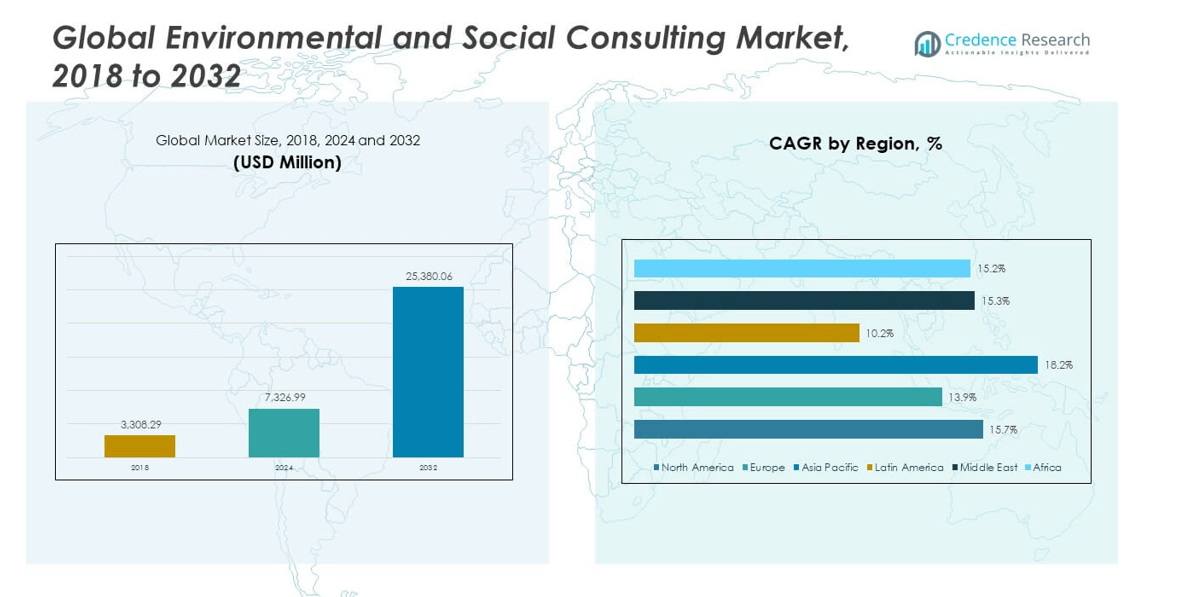
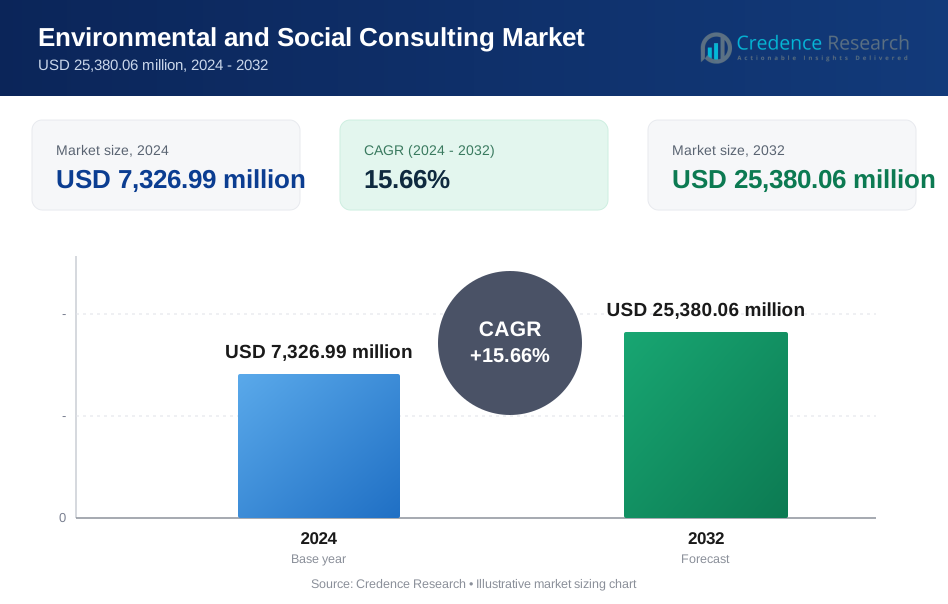
The Global Environmental and Social Consulting Market size was valued at USD 3,308.29 million in 2018 to USD 7,326.99 million in 2024 and is anticipated to reach USD 25,380.06 million by 2032, at a CAGR of 15.66% during the forecast period.
| REPORT ATTRIBUTE | DETAILS |
|---|---|
| Historical Period | 2020-2023 |
| Base Year | 2024 |
| Forecast Period | 2025-2032 |
| Environmental and Social Consulting Market Size 2024 | USD 7,326.99 million |
| Environmental and Social Consulting Market, CAGR | 15.66% |
| Environmental and Social Consulting Market Size 2032 | USD 25,380.06 million |
Market growth is driven by stronger ESG commitments, rising regulatory pressure, and sustainable infrastructure investments. Corporations increase their reliance on consulting firms to meet environmental compliance, manage climate-related risks, and enhance sustainability reporting. Governments and international bodies tighten environmental policies, driving companies to adopt proactive strategies. It benefits from growing demand for impact assessments, resource management solutions, and strategic risk advisory across industries.
North America leads the market due to well-established regulatory systems and high ESG adoption rates. Europe follows with strong sustainability policies and energy transition strategies. Asia Pacific is emerging rapidly, supported by industrial expansion, evolving regulations, and infrastructure development. The Middle East, Latin America, and Africa show rising interest in ESG integration, driven by policy modernization and climate resilience goals.
Market Insights:
- The Global Environmental and Social Consulting Market was valued at USD 3,308.29 million in 2018, USD 7,326.99 million in 2024, and is projected to reach USD 25,380.06 million by 2032, growing at a CAGR of 15.66%.
- North America holds the highest share at 34.4%, driven by strict regulatory frameworks and high ESG adoption. Europe follows with 10% supported by strong environmental policies, while the Middle East accounts for 15.9% due to its sustainability-focused infrastructure push.
- Asia Pacific, with a 14.6% share, is the fastest-growing region. Industrial expansion, evolving regulations, and rapid ESG integration drive this growth.
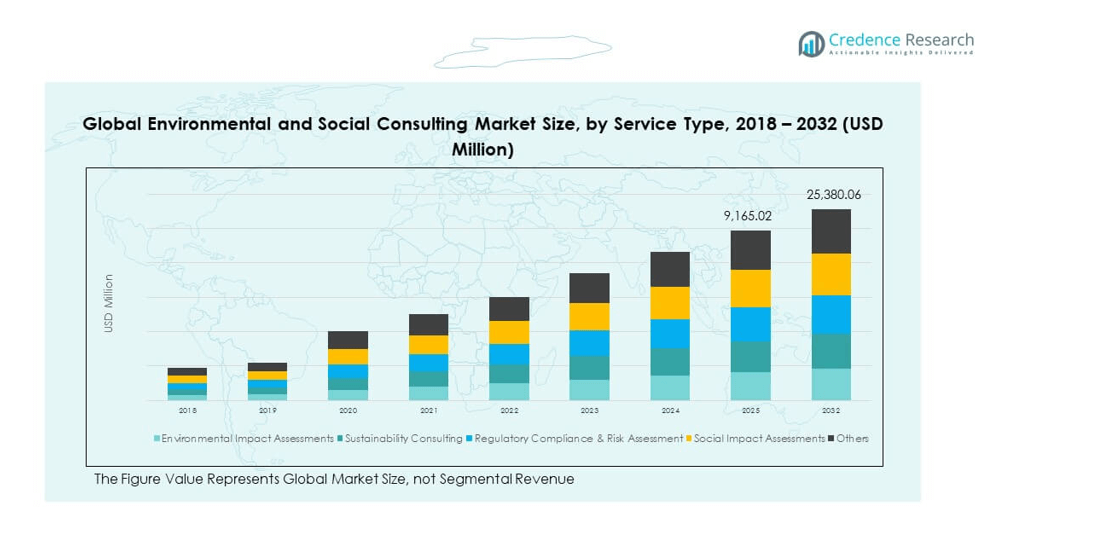
- Environmental Impact Assessments contribute the largest segment share at 33.2%, reflecting rising regulatory requirements and infrastructure projects.
- Sustainability Consulting accounts for 26.4% of the segment share, driven by growing corporate net-zero commitments and ESG strategy adoption.
Market Drivers
Rising Global ESG Mandates and Strengthened Regulatory Frameworks
Governments across major economies are enforcing strict climate and sustainability regulations. Companies increase their investment in compliance to meet carbon emission targets. Many industries face pressure to adopt sustainable operations and ensure transparent ESG reporting. The Global Environmental and Social Consulting Market benefits from this regulatory shift. Service providers support organizations in risk management, compliance audits, and green strategy implementation. It drives demand for expertise in environmental impact assessments and social responsibility programs. International standards push corporations to improve accountability. This structural change fuels consistent market expansion.
- For instance, Schneider Electric achieved a Sustainability Impact score of 55 out of 10 in 2024, surpassing its target of 7.40. The company enabled its partners to avoid 679 million tonnes of CO₂ through EcoStruxure solutions and recorded a 40% supplier emissions reduction under its Zero Carbon Project.
Rapid Corporate Transition Toward Low-Carbon Business Models
Corporations actively invest in cleaner production methods and sustainable sourcing. Many companies align their operational strategies with net-zero commitments. The market supports businesses with decarbonization planning, reporting frameworks, and impact assessments. It plays a vital role in guiding large enterprises toward climate-resilient models. Financial institutions increase ESG-linked investments, accelerating the shift. This creates strong demand for expert consulting in energy transition and emission reduction. Organizations prioritize renewable integration, waste minimization, and circular economy solutions. This transformation amplifies the role of consulting services.
- For instance, Ørsted achieved a 99% share of green energy generation in 2025 and shut down its last coal-fired power plant. The company reduced its scope 1–2 emissions intensity by 98% from 2006 levels and was ranked the world’s most sustainable energy company in Corporate Knights’ 2025 Global 100 index.
Rising Demand for Strategic Risk Management and Resilience Planning
Businesses face growing environmental and social risks linked to climate volatility. Companies seek consultants to develop adaptive strategies for operational continuity. The Global Environmental and Social Consulting Market supports risk mapping, mitigation, and policy alignment. Industries require precise data and scenario planning to manage uncertainty. It offers value in ensuring legal compliance and business resilience. Corporations focus on strengthening internal governance for long-term protection. This creates sustained demand across sectors, including energy, manufacturing, and construction. Risk reduction strategies become a core part of sustainability planning.
Accelerating Investments in Sustainable Infrastructure and Energy Transition
Public and private sectors are expanding green infrastructure projects. Governments launch climate-focused funds to support low-carbon growth. The market plays a central role in environmental assessments and project compliance. It helps investors ensure financial returns align with sustainability objectives. Energy transition strategies increase demand for specialized consulting services. Consultants support project developers in meeting international standards. Infrastructure investments attract ESG-conscious capital from institutional investors. This investment flow strengthens the industry’s global growth momentum.
Market Trends
Integration of Advanced Digital Technologies into Environmental Consulting Services
Companies adopt digital platforms to improve monitoring, reporting, and compliance tracking. AI, blockchain, and IoT enable faster data processing and enhanced transparency. The Global Environmental and Social Consulting Market incorporates these technologies into service delivery. It improves accuracy in environmental impact analysis and reporting. Organizations adopt predictive analytics for better climate risk forecasting. Smart tools enable consultants to provide real-time performance insights. This integration strengthens operational efficiency and drives adoption across industries. Digital transformation makes environmental services more scalable and effective.
Growing Role of ESG Ratings and Sustainability Benchmarks in Investment Decisions
Investors increasingly rely on ESG ratings to guide capital allocation. Companies work to enhance scores and strengthen sustainability performance. The market supports firms in aligning with global reporting standards. It helps clients improve ESG disclosures and build stakeholder trust. Regulatory bodies encourage more standardized reporting systems. This shift strengthens demand for ESG advisory services worldwide. Investment trends create incentives for companies to adopt structured environmental strategies. Stronger ESG performance becomes a key factor in capital market decisions.
- For instance, BNP Paribas set a target to reduce carbon emission intensity of its financed power generation portfolio by at least 30% by 2025 compared to 2020 levels. The bank also reported that 90% of its open-ended funds distributed in Europe are classified under sustainability-linked frameworks.
Expansion of Circular Economy Models and Resource Efficiency Strategies
Corporations redesign production processes to reduce waste and extend resource life cycles. The Global Environmental and Social Consulting Market supports organizations in adopting circular models. It provides expertise in waste reduction, sustainable sourcing, and product redesign. Demand grows for lifecycle assessments and eco-efficiency solutions. Governments promote policies encouraging resource optimization. Industries adopt innovative reuse and recycling methods to meet compliance targets. Consultants help align circular strategies with global sustainability goals. This evolution reshapes how industries manage resources and production.
- For instance, Aramco in 2024–2025 scaled over 300 circular economy initiatives across its value chain including material reuse, procurement redesign, and waste management systems integrating circularity principles into its project execution framework to enhance operational efficiency and reduce waste output significantly across its drilling and construction divisions.
Rise of Stakeholder-Centric Social Impact and Community Engagement Programs
Organizations prioritize social responsibility and community engagement. Businesses invest in programs that enhance local well-being and trust. The market provides consulting support for stakeholder mapping, social impact evaluation, and community planning. It drives stronger alignment between corporate goals and community expectations. Companies address labor rights, diversity, and ethical practices. Investors and regulators demand measurable social outcomes. Consultants help design frameworks for transparent social reporting. This emphasis on social value creation strengthens industry relevance.
Market Challenges Analysis
Lack of Standardized Frameworks and Fragmented Regulatory Environments
Multiple ESG frameworks create complexity for global corporations. Different reporting standards make compliance challenging across regions. The Global Environmental and Social Consulting Market faces hurdles in aligning diverse regulatory expectations. Consultants must navigate varying disclosure requirements and inconsistent enforcement levels. This lack of standardization limits scalability of solutions. Companies often struggle to balance cost with compliance obligations. It creates delays in implementation and weakens overall impact. The market experiences friction in achieving unified sustainability reporting.
Limited Availability of Skilled Workforce and High Service Delivery Costs
The industry requires expertise in environmental science, regulatory policy, and social governance. There is a shortage of qualified professionals with cross-disciplinary skills. It limits the capacity of consulting firms to scale operations globally. High training costs and talent retention challenges increase operational expenses. The Global Environmental and Social Consulting Market faces rising competition for top talent. It creates service delivery bottlenecks for large-scale projects. Companies often hesitate to adopt comprehensive ESG solutions due to high fees. This imbalance between demand and capacity constrains industry growth potential.
Market Opportunities
Expansion of ESG Integration Across Emerging Economies and New Industry Verticals
Emerging markets are accelerating adoption of sustainable development policies. Governments support private-sector participation in ESG-led infrastructure and industry growth. The Global Environmental and Social Consulting Market can tap into this expansion. It provides advisory support to industries modernizing their operations for compliance. New verticals like logistics, e-commerce, and urban mobility require tailored ESG strategies. Consultants have the opportunity to build scalable solutions for these sectors. Rapid policy evolution increases the need for expert advisory services. This creates significant market expansion potential.
Development of New Climate Finance Instruments and Carbon Markets
Climate finance solutions gain momentum across global capital markets. Governments and institutions promote green bonds and carbon credit trading. The market plays a key role in guiding companies through these mechanisms. It helps structure strategies that align with financial and sustainability goals. Organizations require expert guidance on carbon pricing, offsets, and trading mechanisms. Consulting firms can expand service portfolios around these opportunities. Strong growth in climate finance creates stable revenue streams. This evolution opens new pathways for industry development
Market Segmentation Analysis:
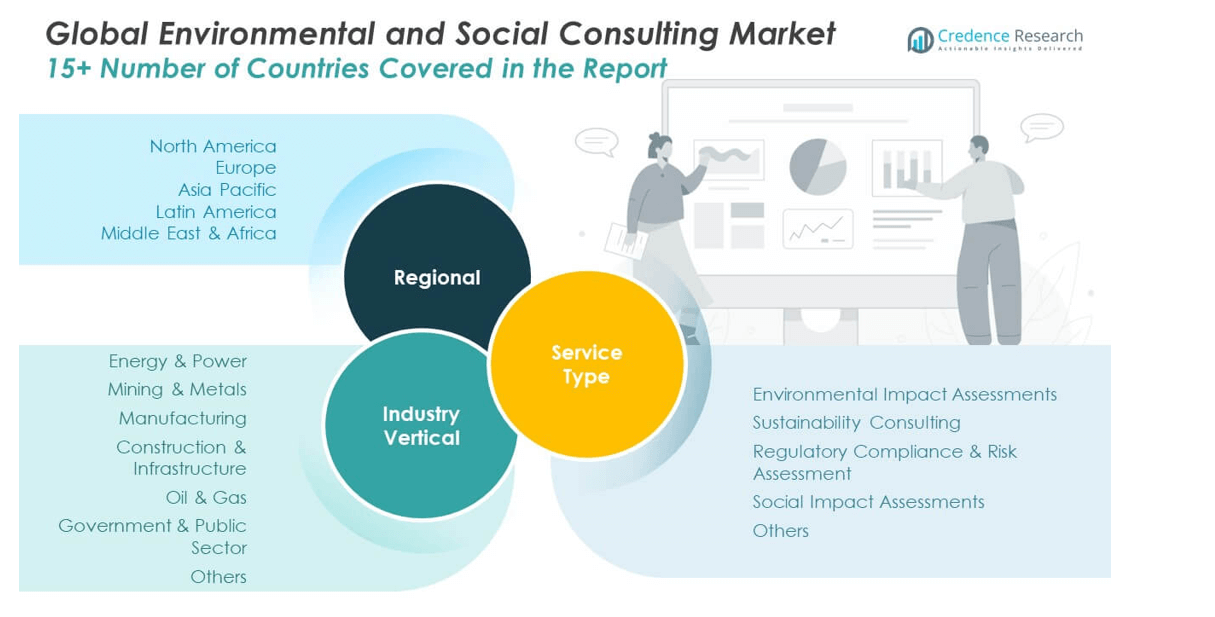
The Global Environmental and Social Consulting Market is structured across diverse service segments that address complex sustainability and compliance requirements.
By Service type, Environmental Impact Assessments hold a strong position due to rising regulatory enforcement and infrastructure expansion. Sustainability Consulting gains momentum with businesses aligning operations to net-zero targets and ESG commitments. Regulatory Compliance & Risk Assessment drives steady growth through demand for audit support and legal alignment across industries. Social Impact Assessments expand rapidly with companies integrating community engagement and social performance goals. Other specialized services, including biodiversity and waste management consulting, support project-specific environmental goals.
- For instance, NUS Consulting Group offers the NUSdirect Energy Information System, which provides 24/7 energy data analytics and carbon tracking. The platform helps organizations monitor energy performance and support their sustainability strategies.
By Industry verticals, display varied demand patterns driven by sector-specific sustainability goals. Energy & Power leads the market due to large-scale renewable projects and emission-reduction strategies. Mining & Metals shows strong engagement in compliance programs and community impact assessments. Manufacturing emphasizes cleaner production and resource efficiency. Construction & Infrastructure invests heavily in environmental assessments and sustainable project certifications. Oil & Gas remains a key segment due to regulatory pressure and decarbonization efforts. Government & Public Sector fosters policy-driven consulting demand. Other industries create emerging opportunities through operational transformation and climate risk planning.
- For instance, Rio Tinto committed A$75 million over 10 years to support community infrastructure and services in the Pilbara region. The investment was made under renewed local government partnership agreements to strengthen community development initiatives.
Segmentation:
By Service Type
- Environmental Impact Assessments
- Sustainability Consulting
- Regulatory Compliance & Risk Assessment
- Social Impact Assessments
- Others
By Industry Vertical
- Energy & Power
- Mining & Metals
- Manufacturing
- Construction & Infrastructure
- Oil & Gas
- Government & Public Sector
- Others
By Region
- North America
- U.S.
- Canada
- Europe
- Germany
- France
- Italy
- U.K.
- Russia
- Rest of Europe
- Asia-Pacific
- India
- China
- Japan
- Rest of Asia-Pacific
- Latin America
- Brazil
- Mexico
- Rest of Latin America
- Middle East and Africa
- GCC Countries
- South Africa
- Rest of Middle East and Africa
Regional Analysis:
North America
The North America Global Environmental and Social Consulting Market size was valued at USD 1,393.93 million in 2018 to USD 3,053.96 million in 2024 and is anticipated to reach USD 10,609.12 million by 2032, at a CAGR of 15.7% during the forecast period. North America holds a market share of 34.4%. The region benefits from strong regulatory frameworks, advanced environmental policies, and early adoption of ESG standards. It demonstrates high demand for environmental impact assessments and compliance-driven consulting services. Large enterprises invest in sustainability programs to meet emission targets and climate disclosure norms. Government initiatives promote cleaner energy transitions, creating opportunities for specialized consulting firms. It experiences strong project activity in renewable energy, construction, and manufacturing sectors. Corporations prioritize net-zero commitments, driving service diversification. Strong investment flows strengthen the region’s leadership position in the global landscape.
Europe
The Europe Global Environmental and Social Consulting Market size was valued at USD 487.46 million in 2018 to USD 1,004.66 million in 2024 and is anticipated to reach USD 3,073.97 million by 2032, at a CAGR of 13.9% during the forecast period. Europe holds a market share of 10%. The region advances its sustainability leadership through strict EU climate directives and environmental protection laws. It focuses on energy transition, circular economy practices, and net-zero strategies. Large corporations collaborate with consulting firms to achieve carbon neutrality goals. ESG reporting requirements drive high demand for regulatory compliance and sustainability assessments. It experiences rapid adoption of green infrastructure projects. Regional governments encourage innovation in energy, manufacturing, and mobility. Strong public-private collaboration enhances ESG maturity and consulting service integration.
Asia Pacific
The Asia Pacific Global Environmental and Social Consulting Market size was valued at USD 424.97 million in 2018 to USD 1,059.42 million in 2024 and is anticipated to reach USD 4,371.23 million by 2032, at a CAGR of 18.2% during the forecast period. Asia Pacific holds a market share of 14.6%. The region shows strong growth due to rapid industrial expansion and evolving regulatory landscapes. Governments are tightening environmental policies and encouraging sustainable investments. It benefits from increasing corporate ESG adoption in China, India, Japan, and South Korea. Renewable energy and infrastructure development drive consulting demand. Local and international firms compete to offer environmental and social assessment services. Large-scale manufacturing hubs increase focus on compliance, sustainability reporting, and climate adaptation strategies. Digital transformation supports faster implementation of ESG solutions. This growth positions Asia Pacific as a high-potential region.
Latin America
The Latin America Global Environmental and Social Consulting Market size was valued at USD 57.75 million in 2018 to USD 123.60 million in 2024 and is anticipated to reach USD 292.09 million by 2032, at a CAGR of 10.2% during the forecast period. Latin America holds a market share of 1%. The region shows gradual adoption of ESG consulting practices. Resource-based industries like mining, agriculture, and oil extraction drive environmental assessments. Governments strengthen environmental enforcement to align with global standards. It experiences increasing demand for sustainability programs focused on deforestation, water management, and biodiversity. International partnerships support capacity building for ESG compliance. Infrastructure development accelerates environmental planning efforts. Companies seek consulting expertise to meet international investor expectations. Regulatory modernization enhances the market’s potential growth.
Middle East
The Middle East Global Environmental and Social Consulting Market size was valued at USD 613.16 million in 2018 to USD 1,340.35 million in 2024 and is anticipated to reach USD 4,541.34 million by 2032, at a CAGR of 15.3% during the forecast period. The Middle East holds a market share of 15.9%. The region accelerates its transition toward sustainable energy and green infrastructure. National strategies emphasize climate resilience, water security, and renewable energy investments. It attracts large consulting engagements in oil, gas, and construction. ESG frameworks are gaining stronger regulatory support, driving corporate adoption. Governments implement ambitious environmental targets to diversify economies. International consulting firms expand regional presence to meet rising demand. It focuses on integrating sustainable practices into national development plans. Regional diversification strengthens market opportunities.
Africa
The Africa Global Environmental and Social Consulting Market size was valued at USD 331.02 million in 2018 to USD 745.00 million in 2024 and is anticipated to reach USD 2,492.30 million by 2032, at a CAGR of 15.2% during the forecast period. Africa holds a market share of 8.1%. The region demonstrates steady growth supported by infrastructure development and environmental policy reforms. Governments enhance enforcement of environmental regulations across energy, mining, and agriculture. It benefits from rising demand for climate resilience and natural resource protection. International organizations play a key role in capacity building and funding. Local industries increase ESG compliance to access global supply chains. Renewable energy projects strengthen environmental consulting opportunities. Social impact assessments become integral to large-scale developments. This regional momentum supports long-term market expansion.
Key Player Analysis:
- WSP Global Inc.
- Jacobs Engineering Group
- AECOM
- Stantec Inc.
- Arcadis N.V.
- Environmental Resources Management (ERM)
- Ramboll Group
- TRC Companies Inc.
- RSK Group
- GHD Group
Competitive Analysis:
The Global Environmental and Social Consulting Market is characterized by strong competition among global and regional players. Leading companies such as WSP Global Inc., Jacobs Engineering Group, AECOM, Stantec Inc., Arcadis N.V., Environmental Resources Management (ERM), Ramboll Group, TRC Companies Inc., RSK Group, and GHD Group drive the competitive landscape through service innovation and strategic expansion. It focuses on strengthening ESG advisory, regulatory compliance solutions, and environmental impact services. Key players expand through mergers, acquisitions, and regional diversification to increase market presence. Specialized expertise in renewable energy, infrastructure, and sustainability consulting enhances their competitive advantage. Companies invest in digital tools to improve reporting and monitoring efficiency. The industry remains highly dynamic with increasing demand for integrated environmental and social solutions. Strong branding, strategic partnerships, and technological capabilities define competitive positioning across global markets.
Recent Developments:
- In October 2025, AECOM recommitted to a partnership with the Great Barrier Reef Foundation for another four years. Announced on October 15, 2025, this collaboration continues AECOM’s advisory and technical consulting efforts to support reef restoration and resilience. The initiative builds upon AECOM’s long-term involvement with the foundation, emphasizing sustainable ecosystem management through projects like the Blue Carbon Program and Resilient Reefs Initiative.
- In October 2025, Stantec announced a partnership with InnSure, a nonprofit climate innovation organization, to help communities assess and mitigate the financial impacts of catastrophic weather events.
- In May 2025, Ramboll Group expanded its environmental and health consulting capabilities through the acquisition of Temple, a UK-based sustainable development consultancy. The move added 150 professionals to Ramboll’s team, significantly enhancing its biodiversity, impact assessment, and sustainability advisory capabilities, aligning with its long-term strategic goals.
Report Coverage:
The research report offers an in-depth analysis based on Service Type and Industry Vertical. It details leading market players, providing an overview of their business, product offerings, investments, revenue streams, and key applications. Additionally, the report includes insights into the competitive environment, SWOT analysis, current market trends, as well as the primary drivers and constraints. Furthermore, it discusses various factors that have driven market expansion in recent years. The report also explores market dynamics, regulatory scenarios, and technological advancements that are shaping the industry. It assesses the impact of external factors and global economic changes on market growth. Lastly, it provides strategic recommendations for new entrants and established companies to navigate the complexities of the market.
Future Outlook:
- The Global Environmental and Social Consulting Market will expand with rising demand for ESG integration and climate action strategies.
- Companies will prioritize sustainability consulting to align business models with global net-zero targets.
- Regulatory tightening will create sustained demand for environmental impact assessments and compliance services.
- Digital technologies such as AI, IoT, and blockchain will enhance real-time monitoring and reporting capabilities.
- Infrastructure, energy, and manufacturing will remain key verticals for high-value consulting engagements.
- Investors will focus on ESG performance, increasing the role of consulting firms in capital allocation decisions.
- Social impact assessments will grow as community engagement becomes a core corporate strategy.
- Emerging markets will drive strong growth supported by rapid industrialization and policy reforms.
- Strategic alliances and M&A will shape competitive dynamics and service diversification.
- Governments and international agencies will accelerate funding for environmental and climate programs, boosting consulting opportunities.
Request a Free Sample
Fill in your details and we'll send you a free sample report.
- Sample data tables & charts
- Research methodology
Need a Custom Version of This Report?
Tailor the scope, geography, or segments to your exact requirements.
- Custom geography or segment scope
- Direct access to our analyst team
Frequently Asked Questions
What is the current market size for the Global Environmental and Social Consulting Market, and what is its projected size in 2032?
At what Compound Annual Growth Rate is the Global Environmental and Social Consulting Market projected to grow between 2024 and 2032?
Which Global Environmental and Social Consulting Market segment held the largest share in 2024?
What are the primary factors fueling the growth of the Global Environmental and Social Consulting Market?
Who are the leading companies in the Global Environmental and Social Consulting Market?
Which region commanded the largest share of the Global Environmental and Social Consulting Market in 2024?
Table of Content
Chapter 1. Report Introduction
- 1.1 Report Description & Purpose
- 1.1.1 Report Title & Market Definition
- 1.1.2 Unique Selling Propositions (USP) & Key Differentiators
- 1.1.3 Value Proposition for Stakeholders
- 1.2 Research Objectives
- 1.2.1 Market Sizing Objectives (Volume & Revenue)
- 1.2.2 Segmentation Objectives
- 1.2.3 Competitive Intelligence Objectives
- 1.2.4 Forecast & Scenario Objectives
- 1.3 Report Scope
- 1.3.1 Environmental and Social Consulting Scope – Types & Subtypes Covered
- 1.3.2 Geographic Scope – Regions & Countries Covered
- 1.3.3 Historical Period, Base Year & Forecast Period (2024; forecast to 2032)
- 1.3.4 Inclusions & Exclusions
- 1.4 HS Code & Classification Framework
- 1.5 Currency, Units & Pricing Basis
- 1.6 Target Stakeholders
- 1.7 Limitations & Assumptions
Chapter 2. Executive Summary
- 2.1 Global Environmental and Social Consulting Market Snapshot
- 2.1.1 Market Size – Historical (2024) & Forecast (2024-2032) (2024: USD 7,326.99 million → 2032: USD 25,380.06 million)
- 2.1.2 Volume & Revenue – Global Totals
- 2.1.3 Key Market Highlights – Top Five Facts
- 2.2 Environmental and Social Consulting Market Segmentation Snapshot
- 2.2.1 Market Split by Region – 2024 vs. 2032
- 2.3 Competitive Snapshot
- 2.3.1 Top 10 Players by Revenue Share – 2024
- 2.3.2 Top 10 Players by Volume Share – 2024
- 2.3.3 Recent Strategic Developments (18-Month Summary)
- 2.4 Key Investment Highlights & Strategic Conclusions
Chapter 3. Environmental and Social Consulting Market Dynamics & Industry Analysis
- 3.1 Market Overview & Context
- 3.1.1 Environmental and Social Consulting Market Position in the Broader Automotive Value Chain
- 3.1.2 OEM vs. Replacement Market Dynamics
- 3.1.3 Market Maturity & Development Stage by Region
- 3.2 Environmental and Social Consulting Market Drivers
- 3.3 Environmental and Social Consulting Market Restraints & Challenges
- 3.4 Environmental and Social Consulting Market Opportunities
- 3.5 Porter's Five Forces Analysis
- 3.5.1 Threat of New Entrants
- 3.5.2 Bargaining Power of Suppliers
- 3.5.3 Bargaining Power of Buyers
- 3.5.4 Threat of Substitutes
- 3.5.5 Competitive Rivalry – Intensity Assessment
- 3.6 Environmental and Social Consulting Value Chain Analysis
- 3.6.1 Upstream – Raw Material/Input Suppliers
- 3.6.1.1 Raw Material/Input 1
- 3.6.1.2 Raw Material/Input 2
- 3.6.1.3 Raw Material/Input 3
- 3.6.2 Midstream – Production/Manufacturing/Service Delivery
- 3.6.2.1 Production/Process Overview
- 3.6.2.2 Key Facility Locations & Capacity by Manufacturer
- 3.6.3 Downstream – Distribution & End Consumer
- 3.6.3.1 Primary Channel – B2B/OEM
- 3.6.3.2 Secondary Channels – Dealer, Retail, Online, Direct
- 3.6.4 Value Chain Profitability Analysis
- 3.6.1 Upstream – Raw Material/Input Suppliers
- 3.7 PESTEL Analysis
- 3.7.1 Political Factors
- 3.7.2 Economic Factors
- 3.7.3 Social Factors
- 3.7.4 Technological Factors
- 3.7.5 Environmental Factors
- 3.7.6 Legal Factors
- 3.8 Environmental and Social Consulting Supply Chain Analysis
- 3.8.1 Raw Material/Input Supply Risk Assessment
- 3.8.2 Manufacturing Concentration Risk (Geographic Exposure)
- 3.8.3 Trade Disruption Impact Analysis
- 3.9 Regulatory & Policy Landscape
Note: The regulatory and policy landscape section covers regulations based on their applicability to the market, Environmental and Social Consulting category, geography, and scope of the study. Only regulatory frameworks with a material impact on operations, compliance, trade, sustainability, or market access are analyzed in detail.
Chapter 4. Key Investment Pockets & Opportunity Analysis
- 4.1 Environmental and Social Consulting Market Attractiveness Analysis
- 4.1.1 By Region – Investment Attractiveness Matrix (Volume × CAGR)
- 4.2 Absolute Revenue Growth Opportunity
- 4.2.1 By Region – Absolute USD Growth Through 2032
- 4.3 Incremental Volume Opportunity
- 4.3.1 By Region – Incremental Volume Through 2032
- 4.3.2 Segment – Incremental Volume
- 4.4 Emerging Submarket Opportunity Deep Dive (Subject to Applicability)
- 4.5 Emerging Market Opportunity Scorecards
- 4.5.1 United States
- 4.5.2 Europe
- 4.5.3 Asia
- 4.5.4 Middle East & Africa
Note: Emerging Market Opportunity Scorecards will be included based on relevance and strategic importance. Regions listed are indicative and may vary depending on data availability and market dynamics.
Chapter 5. Environmental and Social Consulting Import-Export Analysis & Trade Flows
- 5.1 Global Trade Overview
- 5.1.1 Global Export Value by Country (2024)
- 5.1.2 Global Export Volume by Country (2024)
- 5.1.3 Global Import Value by Country (2024)
- 5.1.4 Global Import Volume by Country (2024)
- 5.1.5 Net Trade Balance by Country (2024)
- 5.2 Export Analysis – Segment
- 5.2.1 Type 1 (HS Code)
- 5.2.2 Type 2 (HS Code)
- 5.2.3 Type 3 (HS Code)
- 5.2.4 Type 4 (HS Code)
- 5.2.5 Type 5 (HS Code)
- 5.3 Import Analysis – Segment
- 5.3.1 Type 1 (HS Code)
- 5.3.2 Type 2 (HS Code)
- 5.3.3 Type 3 (HS Code)
- 5.3.4 Type 4 (HS Code)
- 5.3.5 Type 5 (HS Code)
- 5.4 Average Unit Trade Prices
- 5.4.1 Average Export Price – Segment & Country
- 5.4.2 Average Import Price – Segment & Source Country
- 5.4.3 Price Trends (2024)
- 5.5 Key Trade Route Analysis
- 5.5.1 Trade Route 1
- 5.5.2 Trade Route 2
- 5.5.3 Trade Route 3
- 5.5.4 Trade Route 4
- 5.5.5 Trade Route 5
- 5.6 Trade Policy Impact Assessment
- 5.6.1 US Anti-Dumping & Section 301 Tariffs
- 5.6.2 EU Customs Union Impact
- 5.6.3 Major Free Trade Agreements
- 5.6.4 USMCA Rules of Origin
Note: Trade policy analysis will be included only where relevant to the Environmental and Social Consulting market.
Chapter 6. Competitive Landscape & Company Benchmarking
- 6.1 Environmental and Social Consulting Market Concentration & Structure
- 6.1.1 Herfindahl-Hirschman Index (HHI) – vs. 2024
- 6.1.2 Tier 1, Tier 2 & Tier 3 Market Structure
- 6.1.3 Global, Regional & Local Player Dynamics
- 6.2 Environmental and Social Consulting Market Share Analysis – 2024
- 6.2.1 Global Revenue Share by Company
- 6.2.2 Global Volume Share by Company
- 6.2.3 Regional Revenue Share
- 6.2.4 Market Share Evolution ( vs. 2024)
- 6.2.5 OEM Segment Share by Company
- 6.2.6 Replacement Segment Share by Company
- 6.3 Production/Delivery Capacity & Facility Analysis
- 6.3.1 Global Installed Capacity
- 6.3.2 Capacity Utilization Rates
- 6.3.3 Production/Output Volume
- 6.3.4 Facility Locations & Capacity Map
- 6.3.5 Planned Capacity Additions
- 6.4 Environmental and Social Consulting Competitive Benchmarking Matrix
- 6.4.1 Revenue, Volume, CAGR & Profitability Comparison
- 6.4.2 Channel Revenue Mix
- 6.4.3 Geographic Revenue Exposure
- 6.4.4 R&D Intensity
- 6.4.5 Sustainability Maturity
- 6.5 Strategic Developments in Environmental and Social Consulting (Last 24 Months)
- 6.5.1 Mergers, Acquisitions & Divestments
- 6.5.2 New Environmental and Social Consulting Launches
- 6.5.3 Facility Expansions
- 6.5.4 Strategic Alliances, Joint Ventures & Partnerships
- 6.5.5 Distribution Expansion & Market Entry
- 6.5.6 Sustainability & ESG Initiatives
- 6.6 Competitive Strategy Mapping
- 6.6.1 Leader, Challenger, Follower & Niche Classification
- 6.6.2 Pricing Strategy Comparison
- 6.6.3 Channel Strategy Matrix
Note: Strategic developments are included based on their materiality and the availability of reliable information.
Chapter 7. Global Environmental and Social Consulting Market – By Distribution Channel
- 7.1 Segment Overview
- 7.1.1 Volume & Revenue Split by Channel (2024 & 2032)
- 7.1.2 Channel Mix Evolution (2024-2032)
Chapter 8. Regional Market Analysis – Global Overview
- 8.1 Global Regional Overview
- 8.1.1 Regional Volume Share
- 8.1.2 Regional Revenue Share
- 8.1.3 Regional Volume by Region
- 8.1.4 Regional Revenue by Region
- 8.1.5 Regional Forecast Through 2032
- 8.2 Cross-Regional Segment Analysis
- 8.2.1 By Distribution Channel
- 8.2.2 By Brand/Price Tier
Chapter 9. North America Environmental and Social Consulting Market
- 9.1 United States
- 9.2 Canada
- 9.3 Mexico
Chapter 10. Europe Environmental and Social Consulting Market
- 10.1 Germany
- 10.2 France
- 10.3 Italy
- 10.4 United Kingdom
- 10.5 Spain
- 10.6 Poland
- 10.7 Russia
- 10.8 Netherlands
- 10.9 Belgium
- 10.10 Sweden
- 10.11 Denmark
- 10.12 Norway
- 10.13 Rest of Europe
Chapter 11. Asia Pacific Environmental and Social Consulting Market
- 11.1 China
- 11.2 India
- 11.3 Japan
- 11.4 South Korea
- 11.5 Thailand
- 11.6 Indonesia
- 11.7 Vietnam
- 11.8 Malaysia
- 11.9 Australia
- 11.10 Rest of Asia Pacific
Chapter 12. Latin America Environmental and Social Consulting Market
- 12.1 Brazil
- 12.2 Argentina
- 12.3 Colombia
- 12.4 Chile
- 12.5 Rest of Latin America
Chapter 13. Middle East Environmental and Social Consulting Market
- 13.1 Saudi Arabia
- 13.2 United Arab Emirates
- 13.3 Turkey
- 13.4 Israel
- 13.5 Iran
- 13.6 Rest of the Middle East
Chapter 14. Africa Environmental and Social Consulting Market
- 14.1 South Africa
- 14.2 Egypt
- 14.3 Nigeria
- 14.4 Morocco
- 14.5 Rest of Africa
Chapter 15. Environmental and Social Consulting Company Profiles
- 15.1 [Company 01]
- 15.1.1 Company Overview
- 15.1.2 Key Management Personnel
- 15.1.3 Products & Services Portfolio
- 15.1.4 Financial Performance
- 15.1.5 Key Market Focus & Geographic Presence
- 15.1.6 Recent Developments & Strategic Initiatives
Note: The company profile list is preliminary and may change based on research findings, market developments, data availability, and client requirements.
Chapter 16. Appendices
- Appendix A – List of Abbreviations & Acronyms
- Appendix B – Industry Classification Code Reference – Full Series
- Appendix C – Production & Capacity Data Tables
- Appendix D – End-Use & Demand Base Tables
- Appendix E – Consumption & Replacement Rate Assumptions
- Appendix F – ASP Reference Tables
- Appendix G – Manufacturing & Facility Database
- Appendix H – Import-Export Data Tables
- Appendix I – Regulatory Summary Tables
- Appendix J – Primary Research Participant List (Anonymized)
- Appendix K – Primary Research Questionnaire Framework
- Appendix L – Data Sources & Bibliography
- Appendix M – Market Size Divergence & Source Comparison
Chapter 17. Research Methodology
- 17.1 Research Framework & Philosophy
- 17.2 Secondary Research – Sources, Hierarchy & Data Extraction
- 17.3 Data Modeling – Bottom-Up & Top-Down Market Sizing
- 17.4 Primary Research – Stakeholder Framework, LOI & Sample Sizes
- 17.5 Forecast Methodology – Regression, Scenario & Sensitivity Analysis
- 17.6 Quality Control – Four-Layer Validation Framework
- 17.7 Limitations & Standard Assumptions
- 17.8 Disclaimer
