
| REPORT ATTRIBUTE | DETAILS |
|---|---|
| Historical Period | 2020-2023 |
| Base Year | 2024 |
| Forecast Period | 2025-2032 |
| Environmental Technological Solutions Market Size 2023 | USD 676,105 Million |
| Environmental Technological Solutions Market, CAGR | 4.75% |
| Environmental Technological Solutions Market Size 2032 | USD 980,045 Million |
Market Overview
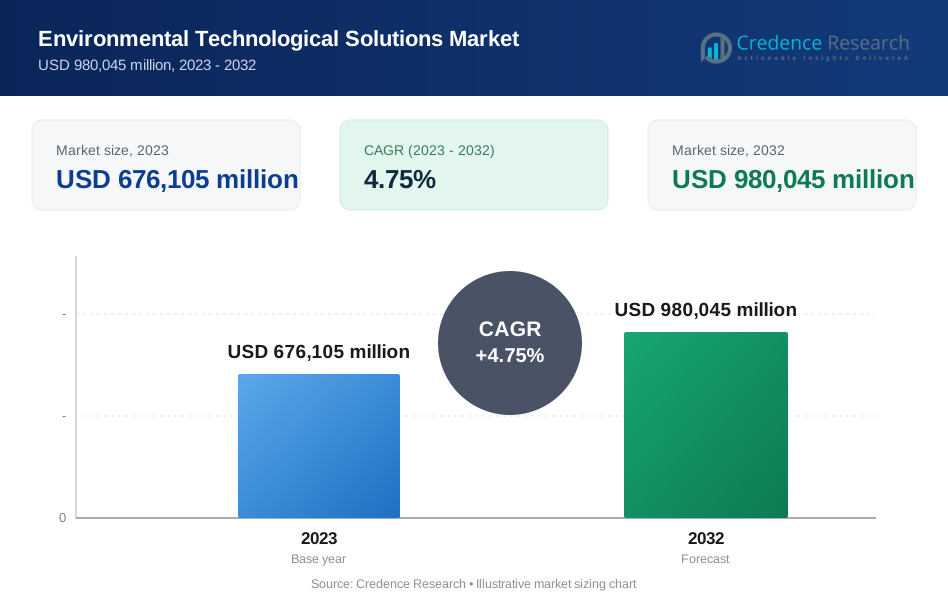
The global Environmental Technological Solutions Market is projected to grow from USD 676,105 million in 2023 to an estimated USD 980,045 million by 2032, with a compound annual growth rate (CAGR) of 4.75% from 2024 to 2032. The increasing adoption of advanced environmental technologies to address the rising concerns over pollution, resource depletion, and climate change is driving market growth.
Key drivers of the Environmental Technological Solutions Market include the growing emphasis on sustainable practices, government regulations promoting environmental conservation, and technological advancements in waste management, water treatment, and energy efficiency. The market is witnessing trends such as the integration of IoT and AI to optimize environmental monitoring, and the increasing popularity of green technologies in both urban and industrial sectors. These factors are shaping the development of the market, with a shift toward smart solutions that offer efficiency and reduced environmental impact.
Geographically, North America and Europe lead the market, driven by stringent environmental policies and high investment in green technologies. However, the Asia Pacific region is expected to witness significant growth due to the increasing industrialization, population growth, and rising environmental concerns. Key players in the global market include companies like Siemens AG, Honeywell International Inc., Veolia Environnement S.A., and Schneider Electric, which are continually advancing their offerings to support global environmental sustainability goals.
Market Insights
- The global Environmental Technological Solutions Market is expected to grow from USD 676,105 million in 2023 to USD 980,045 million by 2032, driven by increasing environmental concerns and sustainable technology adoption.
- Key drivers include rising pollution, resource depletion, and climate change, prompting the need for advanced solutions in waste management, water treatment, and energy efficiency.
- Stricter environmental policies and regulations worldwide are pushing industries to adopt green technologies and sustainable practices, further driving market demand.
- The integration of AI and IoT in environmental monitoring systems enhances data collection, optimizing energy consumption and improving resource management.
- High initial investment and operational costs remain a challenge, especially for small to medium-sized enterprises, hindering the adoption of advanced environmental solutions.
- North America holds the largest market share, driven by stringent environmental policies and a high level of investment in green technologies.
- The Asia-Pacific region is expected to grow the fastest, fueled by rapid industrialization, urbanization, and increased environmental awareness, especially in countries like China and India.
Market Drivers
Increasing Environmental Regulations and Government Initiatives
One of the most significant drivers of the global Environmental Technological Solutions Market is the increasing stringency of environmental regulations and the growing number of government initiatives aimed at environmental protection. Governments worldwide are introducing regulations to curb pollution, conserve resources, and mitigate the effects of climate change. For example, carbon emission reduction targets, waste management mandates, and sustainable energy goals have compelled industries to adopt environmentally friendly solutions. The introduction of these regulations has created a high demand for technologies such as carbon capture and storage (CCS), renewable energy solutions, and water treatment technologies, all of which help companies meet regulatory standards. For instance, the UK's "Clean Green Initiative" has committed to investing $3.7 billion in environmental technologies in developing countries. Additionally, several governments offer incentives, grants, and tax benefits for companies that invest in green technologies, providing further motivation for businesses to adopt these solutions. This ongoing regulatory pressure is anticipated to drive market growth and encourage innovations in environmental technology to meet these evolving standards.
Technological Advancements and Innovations
Technological advancements play a critical role in driving the global Environmental Technological Solutions Market. Breakthroughs in technologies such as Artificial Intelligence (AI), Internet of Things (IoT), and machine learning are transforming how environmental monitoring and management systems operate. These technologies enable real-time data collection, analysis, and optimization of environmental processes, allowing industries to operate more efficiently while reducing their environmental impact. For instance, IoT-enabled sensors in air and water quality monitoring systems can help detect pollution levels more accurately and in real time. Moreover, AI-driven analytics can help identify patterns in environmental data, leading to improved decision-making regarding resource allocation, waste management, and energy consumption. These advancements have created smarter, more cost-effective solutions that can address complex environmental challenges in diverse sectors, such as agriculture, manufacturing, and energy. As these technologies continue to evolve, they will drive further demand for innovative environmental solutions, thus accelerating market growth.
Growing Awareness and Demand for Sustainability
The increasing global focus on sustainability is another key driver of the Environmental Technological Solutions Market. As climate change and environmental degradation become more pressing concerns, businesses, governments, and consumers are all recognizing the importance of adopting sustainable practices. This growing awareness has led to a rise in demand for environmental technologies that promote sustainability and help reduce environmental footprints. Businesses across industries are being urged to adopt green technologies to enhance their sustainability profiles, lower operational costs, and mitigate environmental impact. For example, renewable energy solutions such as solar, wind, and hydroelectric power are seeing increased adoption as companies look to reduce their reliance on fossil fuels. Additionally, industries are increasingly investing in waste-to-energy technologies, water recycling systems, and energy-efficient building solutions. The increasing demand for products and services that meet sustainability criteria is also driving innovation in the market, as companies seek to develop new technologies that can cater to consumer preferences for eco-friendly and responsible products.
Rising Environmental Concerns and Climate Change
The growing concern over climate change and its associated effects is a powerful driver of the global Environmental Technological Solutions Market. The impact of global warming, such as rising sea levels, extreme weather conditions, and biodiversity loss, has heightened the urgency for addressing environmental issues. This has spurred governments, businesses, and non-governmental organizations (NGOs) to adopt technologies that can mitigate environmental degradation and enhance resilience to climate change. For instance, renewable energy technologies, energy storage systems, and carbon emission reduction solutions are gaining traction as methods to combat climate change. Furthermore, climate change has led to increased pressure on industries to reduce carbon emissions and adopt practices that protect natural resources, leading to an uptick in demand for environmental technologies that can help meet these objectives. Solutions that promote resource conservation, such as water treatment and waste management technologies, are also crucial in helping industries adapt to climate-related challenges. As the effects of climate change become more pronounced, the need for environmental technologies that can minimize adverse environmental impacts is expected to grow, further driving market demand in the coming years.
Market Trends
Integration of Artificial Intelligence (AI) and Internet of Things (IoT) for Environmental Monitoring
The integration of AI and IoT technologies is revolutionizing the global Environmental Technological Solutions Market. IoT-enabled devices like smart sensors and meters allow for real-time monitoring of environmental conditions, continuously collecting data from multiple sources. AI algorithms then process and analyze this data to predict trends, identify risks, and optimize resource management. For instance, AI is being used in smart grids to optimize energy distribution based on real-time demand, reducing both costs and carbon footprints. In water management, AI and IoT are employed to detect leaks and inefficiencies, helping utilities optimize water distribution systems. This integration enhances environmental monitoring capabilities, reduces operational costs, and promotes sustainability across industries. The increasing adoption of these technologies is driving market growth, as they provide detailed insights into environmental conditions and enable more efficient resource management. As a result, industries are better equipped to address environmental challenges and implement sustainable practices, furthering the development and adoption of environmental technological solutions.
Shift Toward Renewable Energy and Clean Technologies
A significant trend in the Environmental Technological Solutions Market is the growing shift toward renewable energy and clean technologies. Governments and industries are focusing on reducing reliance on fossil fuels to combat climate change and reduce carbon emissions. Solar, wind, and hydroelectric power are at the forefront of this transition, with renewable energy accounting for an increasing share of the global energy mix. For example, countries like Costa Rica generate nearly all their electricity from renewable sources such as hydropower, wind, and geothermal energy, showcasing successful renewable energy adoption. Additionally, solar power projects in remote regions like the Sunderbans in India provide essential electricity for daily tasks, highlighting the potential of renewable energy in improving access to electricity. Energy storage technologies are advancing rapidly, addressing intermittency challenges associated with renewable sources. This shift extends to transportation, with electric vehicles gaining popularity. The global push for sustainability has led to a surge in demand for technologies that harness renewable resources, improve energy efficiency, and reduce environmental impact, driving market growth and innovation.
Advancements in Waste Management and Circular Economy Solutions
Waste management technologies and circular economy solutions are rapidly evolving in the Environmental Technological Solutions Market. The shift toward a circular economy, where resources are reused and recycled, is driving this trend. Companies are creating closed-loop systems to minimize waste, extend product lifecycles, and reduce environmental impact. For instance, waste-to-energy technologies and advanced recycling systems are gaining traction as businesses strive to minimize landfill waste and recover valuable resources. The development of chemical recycling allows for the breakdown of materials like plastics into their raw components, which can then be reused to create new products. These innovations help close the loop on waste and reduce overall environmental burden. The growing trend of sustainable packaging, including biodegradable and recyclable materials, is further driving demand for waste management solutions. Governments are implementing stricter regulations around waste disposal, encouraging the adoption of sustainable practices across industries. As the circular economy gains momentum, the market for waste management and recycling technologies is expected to experience significant growth, driving innovation and sustainability efforts.
Focus on Energy Efficiency and Sustainable Infrastructure
Energy efficiency and sustainable infrastructure development are leading trends in the Environmental Technological Solutions Market. The demand for smarter buildings, green construction materials, and energy-efficient systems is shaping the market as industries seek to reduce energy consumption and minimize environmental footprints. For example, smart city solutions integrate renewable energy, energy storage, and IoT-based monitoring systems to create sustainable urban environments. In the construction sector, technologies such as smart thermostats and energy-efficient lighting are being adopted to reduce energy consumption and improve operational efficiency. Green building materials like low-carbon concrete and sustainable insulation are being used to meet environmental standards and reduce carbon footprints. The trend toward green cities and sustainable urban planning is gaining traction, with municipalities investing in energy-efficient transportation systems, sustainable waste management infrastructure, and eco-friendly urban spaces. These technologies are helping cities reduce energy consumption, minimize waste, and improve quality of life for residents. The ongoing focus on energy efficiency and sustainable infrastructure continues to drive demand for environmental technologies, as industries and governments prioritize environmental sustainability.
Market Challenges
High Initial Investment and Operational Costs
One of the significant challenges faced by the global Environmental Technological Solutions Market is the high initial investment and operational costs associated with adopting advanced environmental technologies. While the long-term benefits, such as reduced energy consumption, lower operational costs, and enhanced sustainability, can be substantial, the upfront expenses required to implement these technologies often pose a barrier, especially for small and medium-sized enterprises (SMEs). Technologies such as renewable energy systems, waste-to-energy solutions, and advanced water treatment facilities require significant capital investment, which can deter potential adopters. Furthermore, ongoing operational and maintenance costs for some of these systems can be high, particularly for complex infrastructure like smart grids or IoT-enabled environmental monitoring systems. Although governments and regulatory bodies are offering incentives and subsidies to ease the financial burden, the initial capital required can still be a substantial challenge for many companies, limiting the widespread adoption of these technologies.
Technological Integration and Standardization Issues
Another key challenge in the Environmental Technological Solutions Market is the complexity of integrating new technologies into existing systems and the lack of standardization across platforms. Many organizations are still relying on legacy systems that may not be compatible with the latest environmental technologies, such as AI-driven solutions, smart sensors, or renewable energy systems. This makes it difficult to seamlessly integrate these solutions without significant adjustments to infrastructure, leading to increased implementation time and costs. Additionally, the lack of industry-wide standards for environmental technologies can create interoperability issues between different systems, hindering their efficiency and effectiveness. For example, the absence of common protocols for data sharing across IoT devices used in environmental monitoring can limit the ability to gather comprehensive, real-time data across different regions or sectors. The challenge of technological integration and the need for standardization are critical barriers that need to be addressed to unlock the full potential of environmental technologies and drive market growth.
Market Opportunities
Growing Demand for Sustainable Solutions in Emerging Economies
One of the most significant opportunities in the global Environmental Technological Solutions Market lies in the growing demand for sustainable solutions in emerging economies. As developing nations experience rapid urbanization and industrialization, the need for effective environmental management systems is becoming increasingly urgent. These countries face challenges such as air and water pollution, waste management issues, and energy inefficiency. Governments in these regions are starting to implement stricter environmental regulations and are prioritizing sustainable development. This opens up substantial opportunities for environmental technology providers to offer solutions tailored to the needs of emerging markets. Technologies such as renewable energy systems, efficient waste management solutions, and water purification technologies are in high demand in these regions. Companies that can provide cost-effective, scalable, and adaptable solutions will be well-positioned to capitalize on this growing market segment.
Technological Advancements in Carbon Capture and Climate Change Mitigation
Another promising opportunity in the Environmental Technological Solutions Market lies in the technological advancements in carbon capture, utilization, and storage (CCUS) technologies and climate change mitigation solutions. With the global focus on reducing carbon emissions and mitigating the impact of climate change, there is an increasing demand for advanced solutions that can capture and repurpose carbon dioxide from industrial processes. As companies and governments commit to achieving net-zero emissions, investment in CCUS technologies is expected to grow significantly. Additionally, innovations in carbon-neutral technologies, such as bioenergy with carbon capture and storage (BECCS), are opening new avenues for companies to explore. As these technologies continue to evolve and become more commercially viable, they present significant growth opportunities for companies specializing in carbon management solutions and climate change mitigation strategies.
Market Segmentation Analysis
By Component
The market is divided into solutions and services, with services further segmented into water services, waste management services, energy services, and industrial services. Solutions account for the majority of market demand, as companies seek technological products that support environmental sustainability. Waste management services, in particular, are experiencing high growth due to the increasing focus on reducing waste generation and improving recycling processes. Water services are also gaining traction, as governments and industries prioritize efficient water use and treatment to combat water scarcity. Energy services, driven by the shift toward renewable sources, continue to expand as companies aim to reduce their carbon footprints. Industrial services, including energy efficiency and pollution control, are crucial in sectors like manufacturing, where operational optimization is necessary for compliance with environmental standards.
By Application
The application segment includes power generation & fuel, solid waste treatment, wastewater treatment, water purification management, sewage treatment, precision cooling, gas dissolution, and others. Wastewater and solid waste treatment applications are growing rapidly, driven by urbanization and industrialization, which increase pollution levels. Power generation applications, particularly those related to renewable energy sources such as wind and solar, are gaining momentum as countries shift toward cleaner energy. Precision cooling and gas dissolution technologies are gaining importance in industries like data centers and industrial plants where maintaining optimal conditions is critical for reducing energy consumption.
Segments
Based on Component
- Solution
- Services
- Water Services
- Waste Management Services
- Energy Services
- Industrial Services
Based on Application
- Power Generation & Fuel
- Solid Waste Treatment
- Wastewater Treatment
- Water Purification Management
- Sewage Treatment
- Precision Cooling
- Gas Dissolution
- Others
Based on Vertical
- Residential/Municipal
- Industrial
- Energy & Utilities
- Transportation & Logistics
- Oil & Gas
- Food & Beverages
- Construction & Building Materials
- Retail & Consumer Goods
- Government
- Others
Based on Technology
- Waste Valorization/Recycling & Composting
- Nuclear Energy
- Data Center Cooling
- Desalination
- Greentech/Renewable Energy
- Photovoltaic
- Wind Energy
- Geothermal Power
- Carbon Capture (CCUS)
- Bioremediation
- Others
Based on Region
- North America
- U.S.
- Canada
- Mexico
- Europe
- Germany
- France
- U.K.
- Italy
- Spain
- Rest of Europe
- Asia Pacific
- China
- Japan
- India
- South Korea
- South-east Asia
- Rest of Asia Pacific
- Latin America
- Brazil
- Argentina
- Rest of Latin America
- Middle East & Africa
- GCC Countries
- South Africa
- Rest of the Middle East and Africa
Regional Analysis
North America (35%)
North America holds a dominant position in the global Environmental Technological Solutions Market, accounting for approximately 35% of the market share. The region's growth is primarily driven by the United States and Canada, where stringent environmental regulations, government policies promoting green technologies, and a high level of investment in sustainable infrastructure are significant factors. The demand for renewable energy solutions, waste management technologies, and water treatment systems is increasing across both public and private sectors. North America's strong focus on innovation and the adoption of technologies like carbon capture, utilization, and storage (CCUS) and smart grids are further contributing to the market's growth. The presence of major companies in environmental technology and energy solutions also boosts the region’s market share.
Europe (30%)
Europe follows closely with a market share of around 30%. The region has been a leader in environmental sustainability, with countries like Germany, the United Kingdom, and France adopting aggressive policies to reduce carbon emissions and promote the use of renewable energy. The European Union’s Green Deal and stringent environmental regulations have further accelerated investments in environmental technologies such as renewable energy, waste-to-energy solutions, and energy-efficient systems. European nations are also focusing heavily on smart city technologies, sustainable transportation, and circular economy solutions, making the region an attractive market for environmental technological solutions.
Key players
- AECOM
- Lennox International
- Teledyne Technologies Incorporated
- Thermo Fisher Scientific Inc.
- Abatement Technologies
- Veolia
- Waste Connections
- Total S.A.
- Covanta Holding Corporation
- SUEZ
- Biffa
- Hitachi Zosen Corporation
- Svante Inc.
- CarbonCure Technologies Inc.
- Sunfire GmbH
- BacTech Inc.
- TRC Companies, Inc.
- Arcadis N.V.
- C-Capture
- Intelex
- REMONDIS SE & Co. KG
- Climeworks
- Pycno
Competitive Analysis
The competitive landscape of the global Environmental Technological Solutions Market is characterized by the presence of both established players and emerging innovators. Leading companies like Veolia, SUEZ, and AECOM hold a significant share of the market due to their extensive product portfolios and long-standing experience in environmental management. These companies benefit from global reach, strong research and development capabilities, and a diverse range of solutions across water treatment, waste management, and energy efficiency. Emerging players such as CarbonCure Technologies Inc. and Svante Inc. are gaining traction with their innovative technologies in carbon capture and utilization, offering distinct advantages in reducing greenhouse gas emissions. The market is also seeing competition from smaller, niche companies like Climeworks, which specializes in direct air capture technologies. Overall, the competition is intensifying as companies focus on technological advancements, sustainability, and expanding their service offerings to address the growing environmental challenges across regions.
Recent Developments
In February 2025, AECOM was selected to provide environmental services for the U.S. Department of Energy's Pacific Northwest Hydrogen Hub, focusing on industrial decarbonization and clean hydrogen production.Market Concentration and Characteristics
The Global Environmental Technological Solutions Market exhibits a moderate level of concentration, with a mix of large multinational corporations and emerging specialized players. Major companies such as Veolia, SUEZ, AECOM, and Total S.A. dominate the market, leveraging their extensive resources, global presence, and diversified product offerings across water treatment, waste management, and renewable energy solutions. These players hold significant market share due to their established customer base and continuous investments in innovation and sustainability. However, the market also sees growing competition from smaller, specialized companies like Climeworks and Svante Inc., which focus on cutting-edge technologies such as carbon capture and waste-to-energy solutions. This competitive landscape fosters innovation, with companies striving to differentiate themselves through technological advancements, sustainability initiatives, and expanding their geographic reach to meet the increasing demand for environmental solutions globally.
Report Coverage
The research report offers an in-depth analysis based on Component, Application, Vertical, Technology and Region. It details leading market players, providing an overview of their business, product offerings, investments, revenue streams, and key applications. Additionally, the report includes insights into the competitive environment, SWOT analysis, current market trends, as well as the primary drivers and constraints. Furthermore, it discusses various factors that have driven market expansion in recent years. The report also explores market dynamics, regulatory scenarios, and technological advancements that are shaping the industry. It assesses the impact of external factors and global economic changes on market growth. Lastly, it provides strategic recommendations for new entrants and established companies to navigate the complexities of the market.
Future Outlook
- Governments and private sectors will continue to invest heavily in renewable energy and sustainable technologies to meet global climate goals. This trend will drive the adoption of green solutions, including energy-efficient systems and carbon capture technologies.
- Technological advancements in carbon capture, utilization, and storage (CCUS) will lead to greater efficiencies in reducing carbon emissions. As climate change concerns grow, industries will adopt these technologies to meet sustainability targets.
- The shift towards circular economy models, focusing on recycling, waste reduction, and resource reuse, will accelerate the adoption of environmental technologies. This transformation will drive demand for waste-to-energy and advanced recycling solutions.
- The market for solar, wind, and geothermal power technologies will expand significantly as countries move toward cleaner energy sources. This growth will be supported by technological advancements and declining costs for renewable energy production.
- The integration of Internet of Things (IoT) and Artificial Intelligence (AI) will enhance environmental monitoring and resource management. Real-time data and predictive analytics will optimize energy consumption, waste management, and water conservation.
- Stricter environmental regulations will push industries to adopt sustainable practices and technologies. Governments will continue implementing policies that promote the reduction of emissions, waste, and pollution, driving the market forward.
- The demand for smart city technologies will grow as urban areas seek solutions to energy efficiency, waste management, and sustainable infrastructure. Smart grids, green buildings, and urban mobility technologies will become integral to city planning.
- Emerging economies, particularly in Asia-Pacific and Latin America, will increasingly adopt environmental technologies due to rapid industrialization and growing environmental concerns. These regions will see significant growth in demand for sustainable solutions.
- With global water scarcity becoming a more pressing issue, technologies related to water purification, desalination, and wastewater treatment will witness substantial growth. Innovations in these sectors will be critical in addressing supply challenges.
- Increased collaborations between private companies, governments, and NGOs will drive innovation and speed up the development of environmental solutions. Strategic partnerships will enable the scaling of clean technologies and broaden their impact globally.
Request a Free Sample
Fill in your details and we'll send you a free sample report.
- Sample data tables & charts
- Research methodology
Need a Custom Version of This Report?
Tailor the scope, geography, or segments to your exact requirements.
- Custom geography or segment scope
- Direct access to our analyst team
Frequently Asked Questions
What is the market size of the global Environmental Technological Solutions Market in 2023 and 2032?
What are the key drivers of the Environmental Technological Solutions Market?
Which regions are leading the Environmental Technological Solutions Market?
How are AI and IoT contributing to market growth?
Who are the key players in the Environmental Technological Solutions Market?
Table of Content
Chapter 1. Report Introduction
- 1.1 Report Description & Purpose
- 1.1.1 Report Title & Market Definition
- 1.1.2 Unique Selling Propositions (USP) & Key Differentiators
- 1.1.3 Value Proposition for Stakeholders
- 1.2 Research Objectives
- 1.2.1 Market Sizing Objectives (Volume & Revenue)
- 1.2.2 Segmentation Objectives
- 1.2.3 Competitive Intelligence Objectives
- 1.2.4 Forecast & Scenario Objectives
- 1.3 Report Scope
- 1.3.1 Environmental Technological Solutions Scope – Types & Subtypes Covered
- 1.3.2 Geographic Scope – Regions & Countries Covered
- 1.3.3 Historical Period, Base Year & Forecast Period (2023; forecast to 2032)
- 1.3.4 Inclusions & Exclusions
- 1.4 HS Code & Classification Framework
- 1.5 Currency, Units & Pricing Basis
- 1.6 Target Stakeholders
- 1.7 Limitations & Assumptions
Chapter 2. Executive Summary
- 2.1 Global Environmental Technological Solutions Market Snapshot
- 2.1.1 Market Size – Historical (2023) & Forecast (2023-2032) (2023: USD 676,105 million → 2032: USD 980,045 million)
- 2.1.2 Volume & Revenue – Global Totals
- 2.1.3 Key Market Highlights – Top Five Facts
- 2.2 Environmental Technological Solutions Market Segmentation Snapshot
- 2.2.1 Market Split by Region – 2023 vs. 2032
- 2.3 Competitive Snapshot
- 2.3.1 Top 10 Players by Revenue Share – 2023
- 2.3.2 Top 10 Players by Volume Share – 2023
- 2.3.3 Recent Strategic Developments (18-Month Summary)
- 2.4 Key Investment Highlights & Strategic Conclusions
Chapter 3. Environmental Technological Solutions Market Dynamics & Industry Analysis
- 3.1 Market Overview & Context
- 3.1.1 Environmental Technological Solutions Market Position in the Broader Automotive Value Chain
- 3.1.2 OEM vs. Replacement Market Dynamics
- 3.1.3 Market Maturity & Development Stage by Region
- 3.2 Environmental Technological Solutions Market Drivers
- 3.3 Environmental Technological Solutions Market Restraints & Challenges
- 3.4 Environmental Technological Solutions Market Opportunities
- 3.5 Porter's Five Forces Analysis
- 3.5.1 Threat of New Entrants
- 3.5.2 Bargaining Power of Suppliers
- 3.5.3 Bargaining Power of Buyers
- 3.5.4 Threat of Substitutes
- 3.5.5 Competitive Rivalry – Intensity Assessment
- 3.6 Environmental Technological Solutions Value Chain Analysis
- 3.6.1 Upstream – Raw Material/Input Suppliers
- 3.6.1.1 Raw Material/Input 1
- 3.6.1.2 Raw Material/Input 2
- 3.6.1.3 Raw Material/Input 3
- 3.6.2 Midstream – Production/Manufacturing/Service Delivery
- 3.6.2.1 Production/Process Overview
- 3.6.2.2 Key Facility Locations & Capacity by Manufacturer
- 3.6.3 Downstream – Distribution & End Consumer
- 3.6.3.1 Primary Channel – B2B/OEM
- 3.6.3.2 Secondary Channels – Dealer, Retail, Online, Direct
- 3.6.4 Value Chain Profitability Analysis
- 3.6.1 Upstream – Raw Material/Input Suppliers
- 3.7 PESTEL Analysis
- 3.7.1 Political Factors
- 3.7.2 Economic Factors
- 3.7.3 Social Factors
- 3.7.4 Technological Factors
- 3.7.5 Environmental Factors
- 3.7.6 Legal Factors
- 3.8 Environmental Technological Solutions Supply Chain Analysis
- 3.8.1 Raw Material/Input Supply Risk Assessment
- 3.8.2 Manufacturing Concentration Risk (Geographic Exposure)
- 3.8.3 Trade Disruption Impact Analysis
- 3.9 Regulatory & Policy Landscape
Note: The regulatory and policy landscape section covers regulations based on their applicability to the market, Environmental Technological Solutions category, geography, and scope of the study. Only regulatory frameworks with a material impact on operations, compliance, trade, sustainability, or market access are analyzed in detail.
Chapter 4. Key Investment Pockets & Opportunity Analysis
- 4.1 Environmental Technological Solutions Market Attractiveness Analysis
- 4.1.1 By Region – Investment Attractiveness Matrix (Volume × CAGR)
- 4.2 Absolute Revenue Growth Opportunity
- 4.2.1 By Region – Absolute USD Growth Through 2032
- 4.3 Incremental Volume Opportunity
- 4.3.1 By Region – Incremental Volume Through 2032
- 4.3.2 Segment – Incremental Volume
- 4.4 Emerging Submarket Opportunity Deep Dive (Subject to Applicability)
- 4.5 Emerging Market Opportunity Scorecards
- 4.5.1 United States
- 4.5.2 Europe
- 4.5.3 Asia
- 4.5.4 Middle East & Africa
Note: Emerging Market Opportunity Scorecards will be included based on relevance and strategic importance. Regions listed are indicative and may vary depending on data availability and market dynamics.
Chapter 5. Environmental Technological Solutions Import-Export Analysis & Trade Flows
- 5.1 Global Trade Overview
- 5.1.1 Global Export Value by Country (2023)
- 5.1.2 Global Export Volume by Country (2023)
- 5.1.3 Global Import Value by Country (2023)
- 5.1.4 Global Import Volume by Country (2023)
- 5.1.5 Net Trade Balance by Country (2023)
- 5.2 Export Analysis – Segment
- 5.2.1 Type 1 (HS Code)
- 5.2.2 Type 2 (HS Code)
- 5.2.3 Type 3 (HS Code)
- 5.2.4 Type 4 (HS Code)
- 5.2.5 Type 5 (HS Code)
- 5.3 Import Analysis – Segment
- 5.3.1 Type 1 (HS Code)
- 5.3.2 Type 2 (HS Code)
- 5.3.3 Type 3 (HS Code)
- 5.3.4 Type 4 (HS Code)
- 5.3.5 Type 5 (HS Code)
- 5.4 Average Unit Trade Prices
- 5.4.1 Average Export Price – Segment & Country
- 5.4.2 Average Import Price – Segment & Source Country
- 5.4.3 Price Trends (2023)
- 5.5 Key Trade Route Analysis
- 5.5.1 Trade Route 1
- 5.5.2 Trade Route 2
- 5.5.3 Trade Route 3
- 5.5.4 Trade Route 4
- 5.5.5 Trade Route 5
- 5.6 Trade Policy Impact Assessment
- 5.6.1 US Anti-Dumping & Section 301 Tariffs
- 5.6.2 EU Customs Union Impact
- 5.6.3 Major Free Trade Agreements
- 5.6.4 USMCA Rules of Origin
Note: Trade policy analysis will be included only where relevant to the Environmental Technological Solutions market.
Chapter 6. Competitive Landscape & Company Benchmarking
- 6.1 Environmental Technological Solutions Market Concentration & Structure
- 6.1.1 Herfindahl-Hirschman Index (HHI) – vs. 2023
- 6.1.2 Tier 1, Tier 2 & Tier 3 Market Structure
- 6.1.3 Global, Regional & Local Player Dynamics
- 6.2 Environmental Technological Solutions Market Share Analysis – 2023
- 6.2.1 Global Revenue Share by Company
- 6.2.2 Global Volume Share by Company
- 6.2.3 Regional Revenue Share
- 6.2.4 Market Share Evolution ( vs. 2023)
- 6.2.5 OEM Segment Share by Company
- 6.2.6 Replacement Segment Share by Company
- 6.3 Production/Delivery Capacity & Facility Analysis
- 6.3.1 Global Installed Capacity
- 6.3.2 Capacity Utilization Rates
- 6.3.3 Production/Output Volume
- 6.3.4 Facility Locations & Capacity Map
- 6.3.5 Planned Capacity Additions
- 6.4 Environmental Technological Solutions Competitive Benchmarking Matrix
- 6.4.1 Revenue, Volume, CAGR & Profitability Comparison
- 6.4.2 Channel Revenue Mix
- 6.4.3 Geographic Revenue Exposure
- 6.4.4 R&D Intensity
- 6.4.5 Sustainability Maturity
- 6.5 Strategic Developments in Environmental Technological Solutions (Last 24 Months)
- 6.5.1 Mergers, Acquisitions & Divestments
- 6.5.2 New Environmental Technological Solutions Launches
- 6.5.3 Facility Expansions
- 6.5.4 Strategic Alliances, Joint Ventures & Partnerships
- 6.5.5 Distribution Expansion & Market Entry
- 6.5.6 Sustainability & ESG Initiatives
- 6.6 Competitive Strategy Mapping
- 6.6.1 Leader, Challenger, Follower & Niche Classification
- 6.6.2 Pricing Strategy Comparison
- 6.6.3 Channel Strategy Matrix
Note: Strategic developments are included based on their materiality and the availability of reliable information.
Chapter 7. Global Environmental Technological Solutions Market – By Distribution Channel
- 7.1 Segment Overview
- 7.1.1 Volume & Revenue Split by Channel (2023 & 2032)
- 7.1.2 Channel Mix Evolution (2023-2032)
Chapter 8. Regional Market Analysis – Global Overview
- 8.1 Global Regional Overview
- 8.1.1 Regional Volume Share
- 8.1.2 Regional Revenue Share
- 8.1.3 Regional Volume by Region
- 8.1.4 Regional Revenue by Region
- 8.1.5 Regional Forecast Through 2032
- 8.2 Cross-Regional Segment Analysis
- 8.2.1 By Distribution Channel
- 8.2.2 By Brand/Price Tier
Chapter 9. North America Environmental Technological Solutions Market
- 9.1 United States
- 9.2 Canada
- 9.3 Mexico
Chapter 10. Europe Environmental Technological Solutions Market
- 10.1 Germany
- 10.2 France
- 10.3 Italy
- 10.4 United Kingdom
- 10.5 Spain
- 10.6 Poland
- 10.7 Russia
- 10.8 Netherlands
- 10.9 Belgium
- 10.10 Sweden
- 10.11 Denmark
- 10.12 Norway
- 10.13 Rest of Europe
Chapter 11. Asia Pacific Environmental Technological Solutions Market
- 11.1 China
- 11.2 India
- 11.3 Japan
- 11.4 South Korea
- 11.5 Thailand
- 11.6 Indonesia
- 11.7 Vietnam
- 11.8 Malaysia
- 11.9 Australia
- 11.10 Rest of Asia Pacific
Chapter 12. Latin America Environmental Technological Solutions Market
- 12.1 Brazil
- 12.2 Argentina
- 12.3 Colombia
- 12.4 Chile
- 12.5 Rest of Latin America
Chapter 13. Middle East Environmental Technological Solutions Market
- 13.1 Saudi Arabia
- 13.2 United Arab Emirates
- 13.3 Turkey
- 13.4 Israel
- 13.5 Iran
- 13.6 Rest of the Middle East
Chapter 14. Africa Environmental Technological Solutions Market
- 14.1 South Africa
- 14.2 Egypt
- 14.3 Nigeria
- 14.4 Morocco
- 14.5 Rest of Africa
Chapter 15. Environmental Technological Solutions Company Profiles
- 15.1 [Company 01]
- 15.1.1 Company Overview
- 15.1.2 Key Management Personnel
- 15.1.3 Products & Services Portfolio
- 15.1.4 Financial Performance
- 15.1.5 Key Market Focus & Geographic Presence
- 15.1.6 Recent Developments & Strategic Initiatives
Note: The company profile list is preliminary and may change based on research findings, market developments, data availability, and client requirements.
Chapter 16. Appendices
- Appendix A – List of Abbreviations & Acronyms
- Appendix B – Industry Classification Code Reference – Full Series
- Appendix C – Production & Capacity Data Tables
- Appendix D – End-Use & Demand Base Tables
- Appendix E – Consumption & Replacement Rate Assumptions
- Appendix F – ASP Reference Tables
- Appendix G – Manufacturing & Facility Database
- Appendix H – Import-Export Data Tables
- Appendix I – Regulatory Summary Tables
- Appendix J – Primary Research Participant List (Anonymized)
- Appendix K – Primary Research Questionnaire Framework
- Appendix L – Data Sources & Bibliography
- Appendix M – Market Size Divergence & Source Comparison
Chapter 17. Research Methodology
- 17.1 Research Framework & Philosophy
- 17.2 Secondary Research – Sources, Hierarchy & Data Extraction
- 17.3 Data Modeling – Bottom-Up & Top-Down Market Sizing
- 17.4 Primary Research – Stakeholder Framework, LOI & Sample Sizes
- 17.5 Forecast Methodology – Regression, Scenario & Sensitivity Analysis
- 17.6 Quality Control – Four-Layer Validation Framework
- 17.7 Limitations & Standard Assumptions
- 17.8 Disclaimer
