Executive Summary & Core Metrics
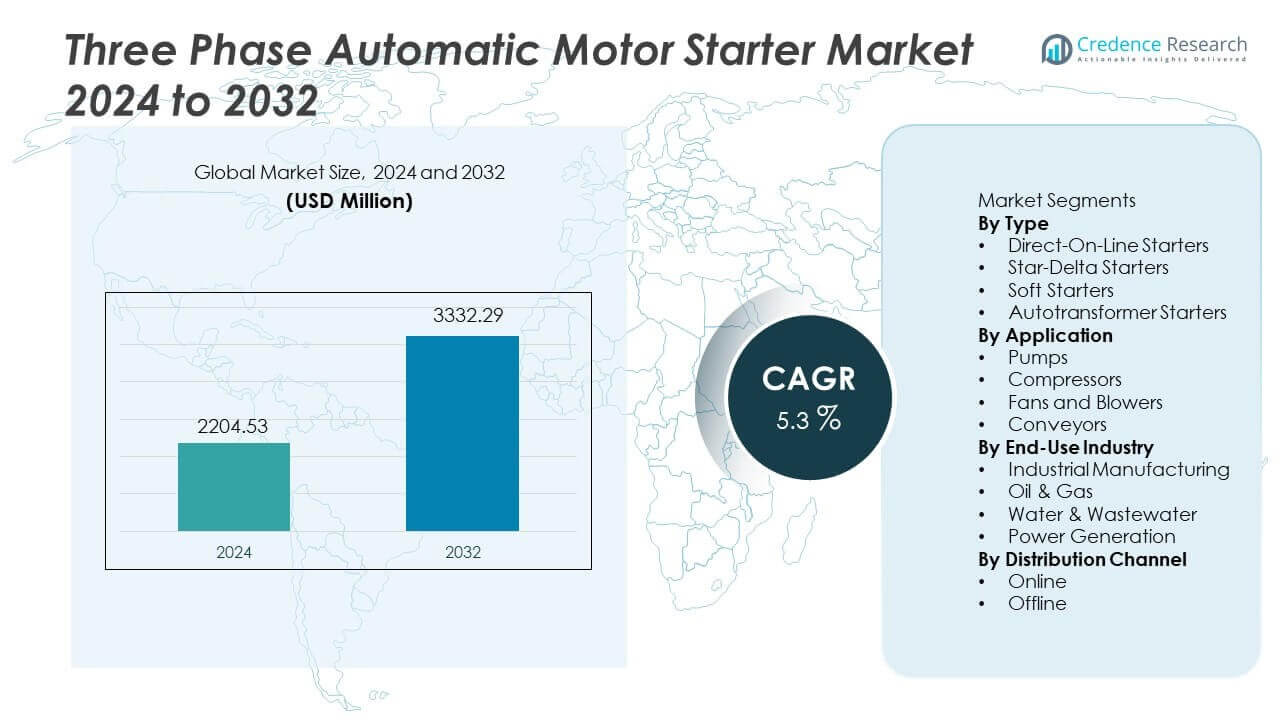
The global three phase automatic motor starter market was valued at USD 2,204.53 million in 2024 and is projected to reach USD 3,332.29 million by 2032, expanding at a compound annual growth rate (CAGR) of 5.3% during the forecast period, according to Credence Research. This growth reflects rising adoption of reliable motor control systems across industrial manufacturing, water and wastewater infrastructure, oil and gas operations, power generation, HVAC systems and commercial building applications.
| REPORT ATTRIBUTE | DETAILS |
|---|---|
| Historical Period | 2020-2023 |
| Base Year | 2024 |
| Forecast Period | 2025-2032 |
| Three Phase Automatic Motor Starter Market Size 2024 | USD 2,204.53 million |
| Three Phase Automatic Motor Starter Market, CAGR | 5.3% |
| Three Phase Automatic Motor Starter Market Size 2032 | USD 3,332.29 million |
The global three phase automatic motor starter market is characterized by the presence of major electrical equipment manufacturers, industrial automation companies and motor control specialists competing on energy efficiency, protection features, digital monitoring, durability and application support. Leading players focus on direct-on-line starters, star-delta starters, soft starters and autotransformer starters designed to protect motors from overload, voltage fluctuation and electrical faults. Strategic priorities across the sector include smart diagnostics, IoT-enabled monitoring, compact starter designs, energy-efficient soft-start technologies, predictive maintenance features and integration with automation platforms.
Strategic Market Insights
- Market growth is primarily driven by rising industrial automation, expanding motor deployment across manufacturing and process industries and increasing demand for reliable overload protection in motor-driven systems.
- Dominant industry trends highlight growing adoption of smart monitoring, IoT-enabled diagnostics, real-time fault detection and energy-efficient soft-start technologies as industries modernize electrical control infrastructure.
- The competitive landscape is defined by global electrical and automation companies expanding digital control features, durable starter designs, compact systems and application-specific solutions for pumps, compressors, fans, blowers and conveyors.
- According to Credence Research regional mapping, North America represents the largest market, accounting for a definitive 32% share due to strong industrial automation, advanced manufacturing facilities and ongoing upgrades in water, wastewater and commercial infrastructure.
Market Segmentation Analysis
By Type
- Direct-On-Line Starters
- Star-Delta Starters
- Soft Starters
- Autotransformer Starters
Data compiled by Credence Research confirms that direct-on-line starters constitute the dominant type segment, holding an estimated 46% market share. Their leadership is supported by simple operation, low installation cost and suitability for small to medium motor loads. Industries prefer direct-on-line starters for applications requiring quick motor acceleration, basic motor protection and minimal setup complexity. Their lower cost and straightforward design make them widely used across pumps, conveyors, fans and general industrial machinery.
Star-delta starters follow as an important segment because they reduce starting current and support smoother startup in higher-load applications. Soft starters are gaining traction among facilities seeking reduced mechanical stress, controlled acceleration and improved equipment life. Autotransformer starters serve heavy-duty applications that require controlled starting for large motors but hold a smaller share due to higher cost and technical complexity.
Siemens offers the SIRIUS 3RW55 soft starter range for motors rated up to 1,200 kW at 400 V in inside-delta circuit configuration. The system supports line voltages up to 690 V and adjustable starting currents between 20% and 200% of rated current.
By Application
- Pumps
- Compressors
- Fans and Blowers
- Conveyors
Credence Research identifies pumps as the leading application segment, accounting for approximately 52% of global market share. Pumps dominate because they are widely used across water treatment, irrigation, industrial processing, HVAC systems, oil and gas operations and commercial infrastructure. Three phase automatic motor starters ensure smooth pump operation, protect motors from overload and voltage fluctuation and support consistent flow control. Their role in improving operating reliability makes them essential in continuous-duty pumping applications.
Compressors follow as industries expand pneumatic systems and process equipment. Fans and blowers show steady growth in ventilation, cooling, industrial air movement and HVAC systems. Conveyors maintain stable demand across manufacturing, logistics, mining and packaging operations. Growth across application categories reflects increasing automation, energy optimization needs and continuous infrastructure development.
ABB supplies motor starters for pump systems handling motors up to 560 kW. Its soft starter models limit inrush current during startup and include embedded motor protection functions that monitor thermal load in real time.
By End-Use Industry
- Industrial Manufacturing
- Oil & Gas
- Water & Wastewater
- Power Generation
Industrial manufacturing leads end-use demand with an estimated 44% market share. This leadership is supported by widespread use of automated machinery, conveyors, pumps, compressors and process equipment that require reliable motor control. Manufacturers use three phase automatic motor starters to reduce downtime, improve safety and protect critical assets from electrical faults. Strong adoption across food processing, chemicals, automotive, metals, packaging and general manufacturing reinforces the segment’s dominant position.
Water and wastewater facilities follow due to continuous pump operations in treatment plants, sewage systems, irrigation networks and municipal water supply infrastructure. Oil and gas operations adopt motor starters for demanding field applications involving pumps, compressors and auxiliary equipment. Power generation adds further demand through motor protection in turbines, cooling systems and plant support units. Across all industries, rising industrialization and investment in processing plants continue to support long-term market growth.
Key Market Dynamics
Primary Market Drivers
Rising Industrial Automation and Motor Deployment
Industrial automation remains a core commercial driver for the three phase automatic motor starter market. Manufacturers are expanding automated machinery, production lines, material handling systems and process equipment to improve productivity and operating efficiency. These systems rely heavily on motors that require stable starting, overload protection and fault control. Three phase automatic motor starters help reduce downtime, protect equipment and maintain reliable performance under variable load conditions. Growth in food processing, chemicals, automotive and general manufacturing accelerates starter installations. Credence Research identifies industrial modernization as a key long-term driver of demand for advanced motor starter technologies. Rockwell Automation integrates Allen-Bradley SMC Flex smart motor controllers in automated lines, with support for motors up to 1,250 A at 690 V.
Growing Demand in Water and Wastewater Infrastructure
Water supply networks, sewage treatment plants, desalination facilities and irrigation systems rely on pumps that require secure and efficient motor starting mechanisms. Three phase automatic motor starters enable safe pump operation, protect motors from voltage fluctuations and support long-duration duty cycles. Rapid urbanization, infrastructure expansion and municipal water treatment upgrades are increasing pump station deployment worldwide. Government investment in water sustainability and wastewater modernization further supports market growth. Schneider Electric deploys its TeSys island motor control systems in water treatment plants, with the platform managing up to 20 motor starters within one control node and integrated protection responding rapidly to electrical faults.
Expansion of Energy-Efficient Motor Control Solutions
Industries are increasingly adopting energy-efficient motor control systems to meet regulatory standards and reduce operating costs. Three phase automatic motor starters support controlled acceleration, lower mechanical stress and improved energy management across motor-driven applications. Soft starters are gaining adoption because they extend equipment life, reduce inrush current and minimize wear on pumps, compressors and conveyors. Companies also integrate advanced starters with monitoring systems to detect faults early and optimize energy use. Credence Research indicates that sustainability and operational efficiency goals will continue supporting the adoption of modern starter technologies.
Key Trends & Structural Opportunities
Integration of Digital Monitoring and Smart Control Features
Digital monitoring is becoming an important trend in the three phase automatic motor starter market. IoT-enabled sensors, real-time diagnostics, load analysis and predictive maintenance tools enhance starter value beyond basic motor protection. Smart starters allow remote monitoring, early fault detection and improved energy management. These capabilities help reduce downtime and maintenance costs across automated production lines, water facilities and smart factories. Eaton offers the PowerXL DG1 variable frequency drive with integrated diagnostics for motors up to 900 A and operating voltages up to 600 V, with some models supporting 690 V across industrial networks.
Rising Adoption in HVAC and Building Infrastructure Projects
New commercial buildings, data centers, hospitals, airports and residential complexes require reliable motor control for HVAC systems, ventilation units, water circulation pumps and auxiliary equipment. Three phase automatic motor starters support these systems by enabling stable startup, overload protection and safe operation under continuous usage. Growth in construction activity and sustainable building technologies is expanding opportunities for starter installations. Energy-efficient HVAC systems further strengthen demand as facilities seek optimized motor performance. Mitsubishi Electric supplies MS-T series motor starters for HVAC motors typically rated up to 55 kW, with support for operational voltages of 690 V in commercial installations.
Growing Preference for Soft Starters in Heavy-Duty Applications
Soft starters are gaining stronger adoption in applications requiring smoother startup, reduced mechanical stress and longer equipment life. Industries using pumps, compressors, conveyors and fans increasingly prefer controlled acceleration to reduce belt wear, pressure surges and motor stress. Soft starters also help improve energy efficiency and reduce electrical disturbance during startup. This trend creates opportunities for manufacturers offering compact, programmable and digitally connected starter systems. Credence Research identifies advanced soft-start technology as a key opportunity as industries upgrade from basic motor control to intelligent and energy-efficient systems.
Industry Challenges
High Initial Investment for Advanced Starter Technologies
Advanced soft starters and smart motor control systems require higher upfront investment than conventional starter solutions. Small and medium enterprises may hesitate to adopt these systems due to budget constraints, especially in cost-sensitive markets. Installation, commissioning, software integration and training costs further increase total project expenditure. While advanced starters offer long-term operational benefits, immediate cost pressure can slow adoption. Manufacturers must balance performance, digital capability and affordability to expand penetration across broader industrial markets.
Complexity in Integration with Legacy Industrial Systems
Many older industrial facilities operate with outdated electrical infrastructure, creating challenges when integrating advanced motor starters. Compatibility issues may arise during upgrades, increasing engineering time and installation complexity. Legacy control panels, wiring systems and automation platforms often require modification before modern starters can be fully deployed. Limited availability of skilled technicians further complicates installation and maintenance. These factors delay modernization in mature industries and create demand for flexible starter solutions that can operate across mixed-generation equipment environments.
Detailed Regional Analysis
| Region | Market Share (%) | Strategic Regional Catalysts & Insights |
| North America | 32.0% | Global leader. Driven by strong industrial automation, advanced manufacturing facilities, water and wastewater upgrades, HVAC growth and investment in digital monitoring technologies. |
| Asia Pacific | 30.0% | High-growth regional market. Supported by rapid industrialization, manufacturing expansion, infrastructure development and rising motor-driven systems across China, India, Japan and Southeast Asia. |
| Europe | 28.0% | Mature regional market. Driven by strict energy efficiency regulations, established manufacturing sectors, automated machinery adoption and sustainable industrial operations. |
| Latin America | 6.0% | Developing regional market. Supported by manufacturing activity, agricultural expansion, mining, oil operations and water infrastructure development. |
| Middle East & Africa | 4.0% | Emerging territory. Driven by infrastructure projects, water desalination, oil and gas operations, mining and commercial construction. |
North America leads the global three phase automatic motor starter market with a 32% share, according to Credence Research. The region benefits from strong industrial automation, advanced manufacturing facilities and ongoing upgrades in water and wastewater infrastructure. Industries in the United States and Canada adopt motor starters to improve operational reliability, reduce downtime and protect equipment from electrical faults. Growth in HVAC systems, oil and gas processing and large commercial buildings further strengthens demand. High awareness of energy-efficient motor control solutions and strong investment in digital monitoring technologies reinforce long-term market growth.
Asia Pacific holds a 30% market share and remains the strongest long-term growth region. China, India, Japan and Southeast Asian countries continue investing in large-scale manufacturing, industrial production, water supply systems and commercial construction. Rising deployment of pumps, compressors and HVAC systems supports strong demand for three phase automatic motor starters. The region benefits from growing automation adoption, increasing energy efficiency focus and expanding smart factory projects. Continuous investment in utilities, wastewater management and infrastructure modernization is expected to strengthen market momentum.
Europe accounts for 28% of the global market, driven by established manufacturing sectors, strict energy efficiency regulations and widespread adoption of automated machinery. Germany, France, the United Kingdom and other major economies invest in advanced motor control systems to enhance productivity and support sustainable operations. Water treatment facilities across the region deploy motor starters to manage continuous pump operations. Growth in renewable energy, process industries and smart industrial systems further supports adoption. Strong regulatory emphasis on safety, reliability and equipment optimization sustains steady demand.
Latin America holds a 6% market share, supported by growing manufacturing activity, agricultural expansion and water infrastructure development. Brazil, Mexico and Chile deploy three phase automatic motor starters for pumps, irrigation systems, industrial machinery and mining operations. Expansion of food processing, oil operations and commercial HVAC systems contributes to stable demand. Limited budgets and slower modernization rates restrict faster adoption, but rising investments in utilities and industrial upgrades support gradual growth across the region.
The Middle East & Africa region accounts for a 4% market share, driven by infrastructure projects, expanding water desalination plants and industrial growth in Gulf countries. Oil and gas operations rely heavily on motor-driven systems that require reliable starter solutions. Water and wastewater facilities use three phase automatic motor starters to support continuous pump operation. Africa shows growing demand in mining, utilities and commercial construction, although adoption remains constrained by resource limitations. Ongoing modernization programs and building infrastructure investments support stable market expansion.
Competitive Landscape & Recent Developments
The three phase automatic motor starter market is highly competitive, with major global electrical equipment and automation companies leading product development and distribution. Key players include Siemens AG, Schneider Electric, ABB Ltd., Eaton Corporation, Rockwell Automation, Mitsubishi Electric Corporation, Larsen & Toubro, Danfoss Group, Fuji Electric Co. Ltd. and CG Power and Industrial Solutions Ltd. These companies compete through advanced motor control systems, energy-efficient designs, digital monitoring, overload protection, product reliability and strong service networks.
Market leaders enhance their portfolios with intelligent soft starters, compact designs, IoT-enabled diagnostics and starter systems that support predictive maintenance and stable motor performance. Vendors expand market reach through strategic partnerships, local manufacturing and tailored solutions for industrial automation, water infrastructure and commercial building projects. Increasing investment in energy-efficient motor control and smart factory integration continues to shape competitive positioning. Reliable technical support, application-specific customization and compatibility with automation platforms remain key differentiators.
Recent Industry Developments (2024–2025)
- In 2025, Schneider Electric expanded its motor control portfolio with the new TeSys Deca Advanced contactors, featuring enhanced energy efficiency and simplified wiring systems.
- In November 2024, Siemens AG launched the SIMATIC ET 200SP e-Starter, an electronic motor starter offering ultra-fast short-circuit reaction, real-time diagnostics and automation platform integration.

Request a Free Sample
Fill in your details and we'll send you a free sample report.
- Sample data tables & charts
- Research methodology
Need a Custom Version of This Report?
Tailor the scope, geography, or segments to your exact requirements.
- Custom geography or segment scope
- Direct access to our analyst team
Frequently Asked Questions
What is the current and projected size of the global three phase automatic motor starter market?
What is the projected growth rate of the three phase automatic motor starter industry over the forecast period?
Which type segment holds the maximum market share within the three phase automatic motor starter industry?
Which application segment dominates the three phase automatic motor starter market?
Which end-use industry leads the three phase automatic motor starter market?
Which region commands the highest market share in the global three phase automatic motor starter space?
Table of Content
Chapter 1 Market Segmentation
- 1.1 Segmentation Framework
- 1.1.1 Product and Service Classification
- 1.1.2 Application and End-Use Classification
- 1.1.3 Technology and Solution Classification
- 1.1.4 Customer and Distribution Channel Classification
- 1.1.5 Geographic Segmentation
- 1.1.6 Market Segment Definitions and Boundaries
Chapter 2 Introduction
- 2.1 Report Objectives and Scope
- 2.2 Product Definition and Industry Terminology
- 2.3 Market Inclusions and Exclusions
- 2.4 Research Process
- 2.4.1 Primary Research and Expert Interviews
- 2.4.2 Secondary Research and Source Review
- 2.4.3 Top-Down and Bottom-Up Estimation
- 2.4.4 Data Triangulation and Verification
- 2.5 Market Size Measurement Basis
- 2.5.1 2024: USD 2,204.53 million → 2032: USD 3,332.29 million
- 2.6 Historical and Forecast Reference Periods
- 2.6.1 Base Year: 2024
- 2.6.2 Forecast Period: 2024-2032
- 2.7 Research Assumptions and Limitations
Chapter 3 Executive Summary
- 3.1 Market Snapshot and Key Findings
- 3.2 Base-Year Market Size, 2024
- 3.3 Forecast Market Size, 2032
- 3.4 Revenue and Volume Growth Outlook
- 3.5 Key Demand and Supply Indicators
- 3.6 Leading Market Segments
- 3.7 Fastest-Growing Market Opportunities
- 3.8 Regional Performance Highlights
- 3.9 Technology and Industry Transformation
- 3.10 Competitive Landscape Summary
- 3.11 Analyst View and Strategic Implications
Chapter 4 Global Three Phase Automatic Motor Starter Market Trends and Developments
- 4.1 Historical Industry Development
- 4.2 Recent Market Trends and Developments
- 4.3 Demand and Customer Behavior Trends
- 4.4 Technology and Product Innovation
- 4.5 Artificial Intelligence, Automation and Digitalization
- 4.6 Local Manufacturing and Supply Chain Realignment
- 4.7 Industry Partnerships, Mergers and Acquisitions
- 4.8 Sustainability and Circular Economy Developments
- 4.9 Government and Private Sector Investment Trends
- 4.10 Emerging Business Models and Commercialization
- 4.11 Industry Developments and Announcements
Chapter 5 Global Three Phase Automatic Motor Starter Market Production, Supply and Demand Analysis
- 5.1 Demand Trend and Consumption Analysis
- 5.2 Demand Forecast, 2024-2032
- 5.3 Production and Output Trend
- 5.4 Production and Output Forecast, 2024-2032
- 5.5 Installed Capacity and Capacity Utilization
- 5.6 Company-Wise Production Plants and Statistics
- 5.6.1 Installed Production Capacity
- 5.6.2 Actual Production
- 5.6.3 Planned Capacity and Expansion Targets
- 5.7 Supply Chain Structure and Procurement Trends
- 5.8 Supply-Demand Gap and Bottlenecks
- 5.9 Import Dependence and Sourcing Structure
- 5.10 Contract Manufacturing and Outsourcing
- 5.11 Regional Supply and Demand Concentration
Chapter 6 Global Three Phase Automatic Motor Starter Market Pricing Analysis
- 6.1 Pricing Structure and Measurement
- 6.2 Historical Pricing Trends
- 6.3 Pricing Outlook, 2024-2032
- 6.4 Average Selling Price and Unit Economics
- 6.5 Pricing by Product and Market Segment
- 6.6 Geographic Pricing Differences
- 6.7 Key Input, Energy, Labor and Logistics Costs
- 6.8 Contract Pricing and Purchasing Models
- 6.9 Pricing Sensitivity and Competitive Positioning
- 6.10 Price, Margin and Profitability Implications
Chapter 7 Global Three Phase Automatic Motor Starter Market Dynamics
- 7.1 Market Growth Drivers
- 7.1.1 Demand-Side Drivers
- 7.1.2 Technology and Innovation Drivers
- 7.1.3 Infrastructure and Investment Drivers
- 7.1.4 Regulatory and Policy Drivers
- 7.2 Market Restraints
- 7.2.1 Cost and Affordability Constraints
- 7.2.2 Technology and Adoption Barriers
- 7.2.3 Supply Chain and Operational Constraints
- 7.3 Market Challenges
- 7.3.1 Competitive Pressure and Margin Erosion
- 7.3.2 Skills, Infrastructure and Implementation Gaps
- 7.4 Emerging Market Opportunities
- 7.5 Market Dynamics Impact and Time-Horizon Assessment
Chapter 8 Global Three Phase Automatic Motor Starter Value Chain Analysis
- 8.1 Industry Value Chain Overview
- 8.2 Upstream Suppliers and Critical Inputs
- 8.3 Technology and Component Providers
- 8.4 Manufacturing or Service Delivery
- 8.5 Distribution, Channel Partners and Integrators
- 8.6 Downstream Applications and End Users
- 8.7 Value Addition and Profit Pools
- 8.8 Vertical Integration and Outsourcing
- 8.9 Supplier Concentration and Risk
- 8.10 Supply Chain Localization and Resilience
Chapter 9 Global Three Phase Automatic Motor Starter Market Regulations and Policies
- 9.1 Relevant Laws, Standards and Compliance Frameworks
- 9.2 Product, Service, Safety and Quality Requirements
- 9.3 Government Policies, Incentives and Subsidies
- 9.4 Imports, Exports and Trade Barriers
- 9.5 Public Procurement and Local Content Requirements
- 9.6 Environmental and Sustainability Compliance
- 9.7 Upcoming Policy Changes and Market Implications
Chapter 10 Global Three Phase Automatic Motor Starter Market Hotspots and Opportunities
- 10.1 Market Opportunity Mapping and Growth Hotspots
- 10.2 High-Growth Applications and Customer Groups
- 10.3 Underserved Markets and White-Space Opportunities
- 10.4 Emerging Technology and Product Opportunities
- 10.5 New Capacity and Investment Hotspots
- 10.6 Market Entry and Expansion Opportunities
- 10.7 Distribution and Partnership Opportunities
- 10.8 Near-Term and Long-Term Commercial Potential
- 10.9 Opportunity Attractiveness and Execution Risks
Chapter 11 Global Three Phase Automatic Motor Starter Market Outlook, 2024-2032
- 11.1 Market Size and Analysis
- 11.1.1 Revenue (Market Measurement: 2024: USD 2,204.53 million → 2032: USD 3,332.29 million)
- 11.1.2 Market Volume and Quantity Sold
- 11.1.3 Historical Market Size
- 11.1.4 Base-Year Market Size, 2024
- 11.2 Market Forecast, 2024-2032
- 11.2.1 Revenue Forecast to 2032
- 11.2.2 Volume Forecast to 2032
- 11.2.3 CAGR and Year-on-Year Growth
- 11.2.4 Incremental Revenue Opportunity
- 11.3 Forecast Assumptions and Scenario Analysis
- 11.3.1 Base-Case Forecast
- 11.3.2 Optimistic and Conservative Scenarios
- 11.3.3 Technology, Pricing and Policy Sensitivities
- 11.4 Market Attractiveness and Growth Outlook
Chapter 12 Global Three Phase Automatic Motor Starter Market Segmentation and Outlook
- 12.1 Segmentation Summary and Market Shares, 2024
- 12.2 Largest and Fastest-Growing Segments
- 12.3 Segment Growth Comparison
- 12.4 Segment Attractiveness and Priority Matrix
Chapter 13 Global Three Phase Automatic Motor Starter Geographic Market Outlook, 2024-2032
- 13.1 Regional Market Size and Share, 2024
- 13.2 Regional Market Forecast, 2024-2032
- 13.3 Regional Pricing, Production and Demand Differences
- 13.4 North America
- 13.4.1 United States
- 13.4.2 Canada
- 13.4.3 Mexico
- 13.5 Europe
- 13.5.1 Germany
- 13.5.2 France
- 13.5.3 Italy
- 13.5.4 United Kingdom
- 13.5.5 Spain
- 13.5.6 Poland
- 13.5.7 Russia
- 13.5.8 Netherlands
- 13.5.9 Belgium
- 13.5.10 Sweden
- 13.5.11 Denmark
- 13.5.12 Norway
- 13.5.13 Rest of Europe
- 13.6 Asia Pacific
- 13.6.1 China
- 13.6.2 India
- 13.6.3 Japan
- 13.6.4 South Korea
- 13.6.5 Thailand
- 13.6.6 Indonesia
- 13.6.7 Vietnam
- 13.6.8 Malaysia
- 13.6.9 Australia
- 13.6.10 Rest of Asia Pacific
- 13.7 Latin America
- 13.7.1 Brazil
- 13.7.2 Argentina
- 13.7.3 Colombia
- 13.7.4 Chile
- 13.7.5 Rest of Latin America
- 13.8 Middle East
- 13.8.1 Saudi Arabia
- 13.8.2 United Arab Emirates
- 13.8.3 Turkey
- 13.8.4 Israel
- 13.8.5 Iran
- 13.8.6 Rest of the Middle East
- 13.9 Africa
- 13.9.1 South Africa
- 13.9.2 Egypt
- 13.9.3 Nigeria
- 13.9.4 Morocco
- 13.9.5 Rest of Africa
- 13.10 Regional Investment, Policy and Supply Chain Differences
- 13.11 Regional Competitive Landscape
- 13.12 Geographic Growth Hotspots
Chapter 14 Global Three Phase Automatic Motor Starter Technology, Innovation and Sustainability Outlook
- 14.1 Technology Landscape and Maturity
- 14.2 Product, Process and Service Innovation
- 14.3 AI, Automation and Digital Tools in the Industry
- 14.4 Technology Adoption and Performance Benchmarking
- 14.5 Innovation Pipeline and R&D Investment
- 14.6 Patent and Intellectual Property Trends
- 14.7 Energy Efficiency and Resource Management
- 14.8 Sustainability, Recycling and Circularity
- 14.9 Technology Roadmap, 2024-2032
- 14.10 Risks of Obsolescence and Technology Substitution
Chapter 15 Global Three Phase Automatic Motor Starter Market Key Strategic Imperatives
- 15.1 Growth and Market Entry Priorities
- 15.2 High-Return Products and Segments
- 15.3 Pricing, Profitability and Cost Optimization
- 15.4 Technology Investment and Product Differentiation
- 15.5 Supply Chain Localization and Resilience
- 15.6 Distribution and Customer Acquisition
- 15.7 Partnership, Acquisition and Capacity Strategy
- 15.8 Regional Expansion Priorities
- 15.9 Short-, Medium- and Long-Term Actions
Chapter 16 Competition Outlook
- 16.1 Industry Competition Characteristics
- 16.2 Market Structure and Concentration
- 16.3 Market Share and Competitive Positioning, 2024
- 16.4 Company-Wise Revenue and Product Benchmarking
- 16.5 Production and Service Capacity Benchmarking
- 16.6 Technology, Pricing and Differentiation
- 16.7 Regional Footprint and Distribution Strength
- 16.8 Mergers, Acquisitions and Strategic Alliances
- 16.9 New Entrants and Competitive Threats
- 16.10 Porter's Five Forces and Industry Attractiveness
- 16.11 Competitive Outlook, 2024-2032
Chapter 17 Company Profiles
- 17.1 Company Coverage and Selection Criteria
- 17.2 Leading Market Participants – Standard Profile Structure
- 17.2.1 Business Description
- 17.2.2 Company Ownership and Geographic Presence
- 17.2.3 Product and Service Portfolio
- 17.2.4 Manufacturing and Operating Footprint
- 17.2.5 Production Capacity and Expansion Plans
- 17.2.6 Financial Performance and Investment
- 17.2.7 Market Share and Competitive Position
- 17.2.8 Technology and Innovation Capabilities
- 17.2.9 Strategic Alliances or Partnerships
- 17.2.10 Recent Developments
- 17.2.11 Growth Strategy and Outlook
- 17.3 Other Relevant Market Participants
Note: Every listed company is profiled on the structure shown under the first company. The company list is preliminary and may change based on research findings, market developments, data availability and client requirements.
Chapter 18 Disclaimer
- 18.1 Research and Forecast Disclaimer
- 18.2 Data Source and Estimation Limitations
Note: The depth of individual sections depends on data availability for this market. Volume, capacity, trade and other unit-based metrics are included where applicable.