Executive Summary & Core Metrics
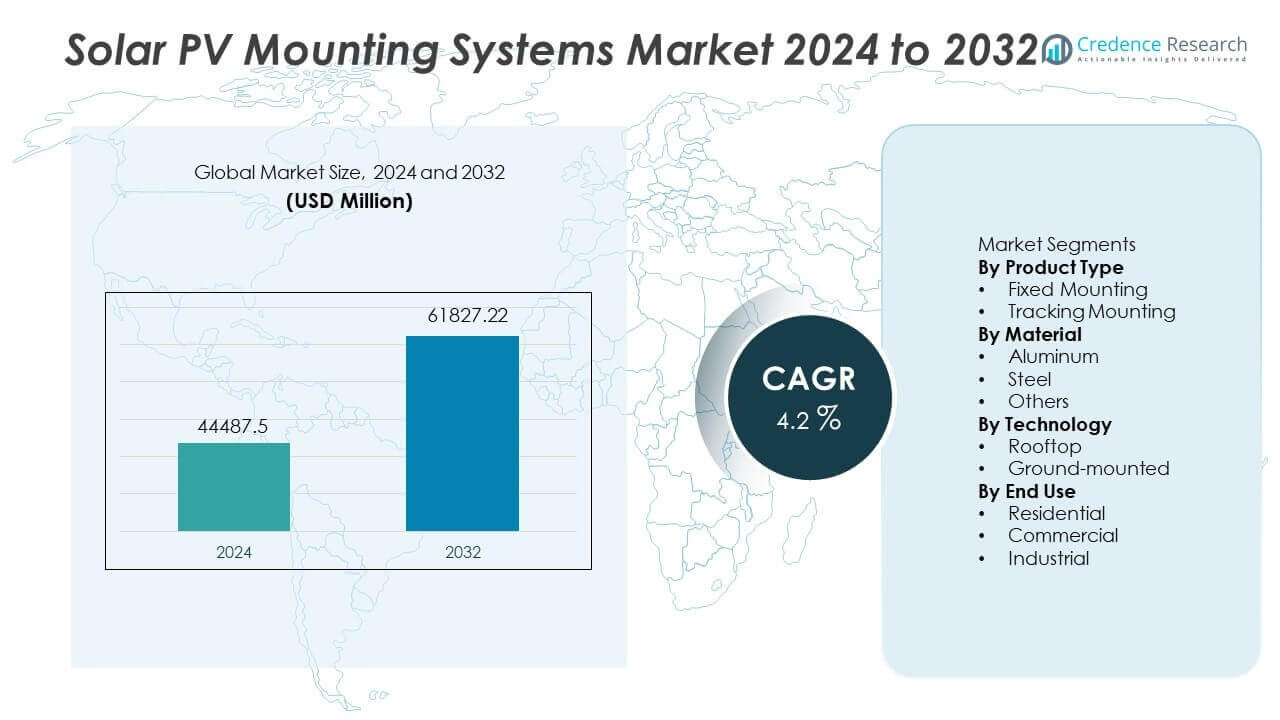
The global solar PV mounting systems market was valued at USD 44,487.5 million in 2024 and is projected to reach USD 61,827.22 million by 2032, expanding at a compound annual growth rate (CAGR) of 4.2% during the forecast period, according to Credence Research. This growth reflects rising utility-scale solar development, increasing rooftop solar installations, supportive renewable energy policies and wider adoption of durable mounting structures across residential, commercial, industrial and utility solar projects.
| REPORT ATTRIBUTE | DETAILS |
|---|---|
| Historical Period | 2020-2023 |
| Base Year | 2024 |
| Forecast Period | 2025-2032 |
| Solar PV Mounting Systems Market Size 2024 | USD 44,487.5 million |
| Solar PV Mounting Systems Market, CAGR | 4.2% |
| Solar PV Mounting Systems Market Size 2032 | USD 61,827.22 million |
The global solar PV mounting systems market is characterized by the presence of solar racking providers, tracker manufacturers, engineering solution companies and mounting structure suppliers competing on durability, installation speed, corrosion resistance, structural efficiency and compatibility with diverse PV modules. Leading players focus on fixed mounting, tracking mounting, aluminum structures, steel structures, rooftop systems and ground-mounted platforms. Strategic priorities across the sector include lightweight design, corrosion-resistant materials, single-axis and dual-axis tracking, digital design tools, modular engineering, EPC partnerships and cost-efficient systems for large-scale and distributed solar deployment.
Strategic Market Insights
- Market growth is primarily driven by rising utility-scale solar investments, supportive renewable energy policies, expanding rooftop installations and increasing demand for cost-efficient mounting structures across distributed and large-scale solar projects.
- Dominant industry trends highlight wider adoption of single-axis and dual-axis tracking systems, lightweight aluminum structures and digital design tools that improve installation speed, engineering accuracy and system efficiency.
- The competitive landscape is defined by leading vendors developing corrosion-resistant structures, expanding engineering services and improving compatibility with diverse solar modules across rooftop and ground-mounted applications.
- According to Credence Research regional mapping, Asia Pacific represents the largest market, accounting for a definitive 33.8% share due to strong utility-scale installations, national renewable programs, competitive equipment pricing and growing rooftop solar deployment.
Solar PV Mounting Systems Market Segmentation Analysis
By Product Type
Data compiled by Credence Research confirms that fixed mounting dominates the solar PV mounting systems market with near 69% share in 2024. Fixed mounting systems lead due to lower installation cost, simpler engineering and strong suitability for residential and commercial rooftop projects. These structures offer durability, limited maintenance requirements and long asset life across varied weather conditions. Many distributed solar systems and utility projects continue to rely on fixed mounting because it provides reliable module support with predictable project economics.
Tracking mounting accounts for near 31% share and continues to gain adoption across utility-scale solar farms that require higher energy yield. Single-axis and dual-axis tracking solutions improve solar capture by adjusting panel orientation throughout the day. These systems are especially attractive in high-irradiation regions where higher output improves project returns. However, fixed mounting remains the dominant product type due to simplicity, lower upfront cost and strong adoption across rooftop and distributed solar applications.
Unirac introduced its NXT U-Mount system with a heavy-duty rail option, supporting heavy snow regions and faster installation through pre-assembled clamps.
By Material
Aluminum leads the material segment with near 53% share of the market in 2024. Aluminum structures are preferred due to lightweight properties, corrosion resistance and suitability for rooftop installations that require lower structural load. These systems support easy handling, faster installation and improved lifecycle performance, especially in coastal, humid and urban environments. Residential and commercial rooftop projects often use aluminum-based mounting systems because they reduce installation effort and protect building structures from excess load.
Steel accounts for near 39% share and remains widely used in utility-scale and ground-mounted solar projects due to high structural strength and cost advantages. Steel structures are suitable for large land-based solar farms, high-wind areas and projects requiring strong foundation support. Other materials represent near 8% share, including composite and galvanized structures used in industrial or specialty installations where durability, environmental resistance or site-specific engineering requirements are important.
Mounting Systems GmbH manufactures aluminum racks using alloys with high tensile strength ratings, supporting deployment across large numbers of rooftop sites.
By Technology
Ground-mounted systems lead the technology segment with near 61% share in 2024. This dominance is driven by extensive utility-scale deployment, greater land availability and favorable economics of large solar plants. Ground-mounted systems support larger arrays, easier maintenance access and stronger integration with tracking structures. Governments and utilities continue supporting land-based solar capacity through power purchase agreements, renewable tenders and clean energy development programs.
Rooftop technology accounts for near 39% share, supported by adoption across residential, commercial and industrial buildings. Rising electricity prices, net-metering policies, self-consumption programs and urban renewable energy targets encourage rooftop solar installations. Lightweight mounting systems improve rooftop viability, especially in dense urban regions where available land is limited. While rooftop solar remains a strong growth segment, ground-mounted systems continue to dominate due to utility-scale solar expansion and rising investments in large solar farms.
By End Use
Residential solar PV mounting systems are gaining demand as homeowners adopt rooftop solar to lower electricity bills and improve energy independence. Lightweight, modular and easy-to-install mounting structures are especially important in this segment because residential roofs require safe load distribution and weather-resistant designs.
Commercial users deploy mounting systems across warehouses, offices, retail buildings and institutional facilities to reduce operating costs and meet sustainability goals. Industrial users adopt rooftop and ground-mounted systems for onsite renewable power generation, especially where large roof areas or open land are available. Utility-scale projects remain the strongest volume driver due to large ground-mounted installations, tracking adoption and national renewable capacity targets.
Key Market Dynamics
Primary Market Drivers
Rising Adoption of Utility-Scale Solar Projects
Growing investment in large solar farms is increasing demand for ground-mounted and tracking mounting structures. Governments support utility-scale solar expansion through long-term clean energy policies, renewable targets and competitive bidding programs. These projects require durable structures that can support high power output, reduce long-term installation cost and withstand harsh environmental conditions. Rising solar capacity additions across emerging markets further strengthen traction for utility-grade mounting designs. NEXTracker has supplied large volumes of single-axis trackers globally, using efficient motors and wide rotational ranges to capture more energy throughout the day compared with fixed-tilt systems.
Expansion of Rooftop Solar Installations Across Residential and Commercial Buildings
Rooftop solar adoption is growing due to higher electricity prices, favorable net-metering rules and rising demand for onsite renewable energy. Lightweight mounting designs, easy installation and lower structural load make rooftop solar more feasible across dense urban areas. Residential and commercial users benefit from lower energy bills, energy independence and improved sustainability performance. K2 Systems deployed mounting kits with high-grade aluminum profiles that are lightweight and structurally robust, supported by wind tunnel testing and structural analysis for extreme weather conditions.
Increasing Focus on Lightweight and Corrosion-Resistant Materials
Manufacturers are developing aluminum and advanced galvanized structures that offer enhanced durability, lower maintenance needs and improved installation efficiency. Lightweight structures reduce labor effort, shorten installation timelines and improve rooftop feasibility. Corrosion-resistant systems are especially important in coastal, humid, desert and industrial environments where long-term exposure can weaken standard mounting materials. Credence Research identifies material innovation as a key driver for lifecycle performance and long-term project economics.
Key Trends & Structural Opportunities
Growing Use of Single-Axis and Dual-Axis Tracking Systems
Tracking systems are gaining wider adoption in utility-scale projects because they deliver higher energy yield and improve solar plant economics. Developers increasingly use tracking designs in high-irradiation regions to optimize daily performance and improve project returns. Single-axis systems remain especially important for large ground-mounted solar farms, while dual-axis trackers serve specialized projects that require maximum energy capture. Array Technologies installed its DuraTrack platform across utility-scale sites, supported by a mechanical linkage design that reduces actuator needs across multiple rows.
Integration of Mounting Systems with Smart Solar and Digital Monitoring
Smart sensors, digital design tools and monitoring platforms are improving the value of solar mounting systems. Digital tools help optimize layout, structural design, installation speed and component compatibility. Monitoring systems track stress, movement and system conditions, supporting predictive maintenance and improved asset performance. Schletter Group deployed digital monitoring units across mounts and monitored relevant operating parameters in a central database to track structural stress.
Growth of Modular and Pre-Engineered Mounting Structures
Modular mounting structures are becoming more important as developers seek faster deployment, lower labor requirements and standardized engineering. Pre-assembled clamps, modular rails and standardized foundations help reduce installation complexity and improve project timelines. This trend benefits both rooftop and utility-scale projects because it supports repeatable installation processes and reduces on-site errors. Credence Research identifies modular design as a key opportunity for suppliers serving fast-growing solar deployment markets.
Industry Challenges
High Upfront Installation Cost and Structural Requirements
Mounting frameworks require engineering design, site preparation, corrosion resistance and structural validation, especially across ground-mounted solar projects. These requirements increase project cost and can limit adoption in cost-sensitive markets. Rooftop projects may also require structural upgrades, professional installation and site-specific assessment before deployment. These added costs can slow adoption across residential and smaller commercial segments.
Material Price Fluctuation and Supply Chain Uncertainty
Aluminum and steel prices fluctuate due to global commodity trends, trade dynamics and supply chain disruptions. These variations affect project budgets, procurement planning and cost competitiveness for mounting system suppliers. Material shortages or transportation delays can extend installation timelines and reduce project margins. Manufacturers must manage sourcing flexibility, inventory planning and localized supply strategies to reduce financial and operational risk.
Detailed Regional Analysis
| Region | Market Share (%) | Strategic Regional Catalysts & Insights |
| Asia Pacific | 33.8% | Global leader. Driven by solar capacity additions in China, India, Australia and Southeast Asia, supported by national renewable programs, utility-scale projects and rooftop growth. |
| North America | 29.4% | Strong demand market. Supported by utility-scale solar farms, corporate clean energy procurement, rooftop adoption and tracking deployment in high-irradiation states. |
| Europe | 25.2% | Mature regional market. Driven by rooftop incentives, decarbonization policies, distributed solar growth and utility-scale expansion across Southern Europe. |
| Latin America | 6.3% | Developing regional market. Supported by large solar projects in Brazil, Chile and Mexico, strong solar resources and growing renewable power investment. |
| Middle East & Africa | 5.3% | Emerging territory. Driven by solar megaprojects, desert-climate tracking systems, national clean energy targets and industrial solar adoption. |
Asia Pacific leads the global solar PV mounting systems market with a 33.8% share, according to Credence Research. The region benefits from rapid solar capacity additions across China, India, Australia and Southeast Asia. Utility-scale projects dominate national renewable expansion programs, while rooftop installations continue to grow across commercial and residential buildings. Governments promote solar manufacturing and deployment through subsidies, green finance and industrial solar initiatives. High solar irradiation and competitive equipment pricing continue to support demand for ground-mounted and tracking structures.
North America holds 29.4% of the global market, supported by strong investment in utility-scale solar farms, renewable energy policies and growing commercial rooftop installations in the United States. Corporate clean energy procurement, declining solar costs and high rooftop adoption across residential buildings strengthen regional demand. Tracking technology is expanding in desert and high-irradiation states, increasing demand for steel-based mounting structures. Grid decarbonization programs and state-level incentives further support long-term market growth.
Europe accounts for 25.2% of the global solar PV mounting systems market. The region benefits from mature solar markets in Germany, Spain, Italy and the Netherlands. Strong renewable mandates, rooftop incentive schemes and climate policies encourage large-scale deployment of distributed solar systems. Lightweight aluminum mounting designs are widely adopted for residential roofs and industrial buildings. Utility-scale solar plants are also expanding across Southern Europe. EU decarbonization frameworks and net-zero targets continue to drive investment in advanced mounting technologies.
Latin America holds 6.3% share, driven by large solar construction activity in Brazil, Chile and Mexico. Utility-scale installations lead demand due to competitive solar generation costs and rising investment in renewable power. Rooftop installations are also expanding with net-metering policies in selected markets. Countries across the region are developing solar farms to diversify energy supply, increasing demand for durable steel structures and tracking systems in high-irradiation zones.
The Middle East & Africa account for 5.3% share, supported by rapid solar deployment across Gulf Cooperation Council countries, North Africa and South Africa. Large ground-mounted projects dominate the regional market, supported by national clean energy targets and high solar irradiation. The region shows growing interest in dual-axis tracking designs that maximize energy output in desert climates. Government-led initiatives and industrial solar adoption increase demand for corrosion-resistant and sand-tolerant mounting systems.
Competitive Landscape & Recent Developments
The solar PV mounting systems market includes leading companies such as Unirac Inc., Mounting Systems GmbH, Schletter Group, K2 Systems GmbH, Steel Structure GmbH, Clenergy, Pvsolarsystems, NEXTracker Inc., Array Technologies Inc. and Solarworld AG. These companies compete through lightweight mounting structures, corrosion-resistant materials, tracking technologies, engineering support and compatibility with diverse solar modules.
Market leaders invest in aluminum and galvanized steel platforms to extend product life and lower maintenance requirements. Growing demand for utility-scale installations encourages vendors to expand single-axis and dual-axis tracking systems, especially in high-irradiation regions. Strategic partnerships with EPC contractors, solar developers and photovoltaic suppliers support wider adoption of standardized mounting solutions. Digital design capabilities, engineering services and cost-efficient production remain central to competitive positioning.
Recent Industry Developments (2024–2025)
- In June 2025, Array Technologies Inc. supplied its dual-row solar trackers to two new utility PV plants in Navarre, boosting project deployment.
- In June 2025, Array Technologies Inc. agreed to acquire APA Solar LLC, a fixed-tilt mounting and engineered foundation provider. This deal expands Array’s fixed and tracker foundation offerings and strengthens revenue potential.
- In June 2024, Array Technologies Inc. showcased new solar tracker insights and technology leadership at PVPMC 2024.

Request a Free Sample
Fill in your details and we'll send you a free sample report.
- Sample data tables & charts
- Research methodology
Need a Custom Version of This Report?
Tailor the scope, geography, or segments to your exact requirements.
- Custom geography or segment scope
- Direct access to our analyst team
Frequently Asked Questions
What is the current and projected size of the global solar PV mounting systems market?
What is the projected growth rate of the solar PV mounting systems industry over the forecast period?
Which product type holds the maximum market share within the solar PV mounting systems industry?
Which material segment dominates the solar PV mounting systems market?
Which technology segment leads the solar PV mounting systems market?
Which region commands the highest market share in the global solar PV mounting systems space?
Table of Content
Chapter 1 Market Segmentation
- 1.1 Segmentation Framework
- 1.1.1 Product and Service Classification
- 1.1.2 Application and End-Use Classification
- 1.1.3 Technology and Solution Classification
- 1.1.4 Customer and Distribution Channel Classification
- 1.1.5 Geographic Segmentation
- 1.1.6 Market Segment Definitions and Boundaries
Chapter 2 Introduction
- 2.1 Report Objectives and Scope
- 2.2 Product Definition and Industry Terminology
- 2.3 Market Inclusions and Exclusions
- 2.4 Research Process
- 2.4.1 Primary Research and Expert Interviews
- 2.4.2 Secondary Research and Source Review
- 2.4.3 Top-Down and Bottom-Up Estimation
- 2.4.4 Data Triangulation and Verification
- 2.5 Market Size Measurement Basis
- 2.5.1 2024: USD 44,487.5 million → 2032: USD 61,827.22 million
- 2.6 Historical and Forecast Reference Periods
- 2.6.1 Base Year: 2024
- 2.6.2 Forecast Period: 2024-2032
- 2.7 Research Assumptions and Limitations
Chapter 3 Executive Summary
- 3.1 Market Snapshot and Key Findings
- 3.2 Base-Year Market Size, 2024
- 3.3 Forecast Market Size, 2032
- 3.4 Revenue and Volume Growth Outlook
- 3.5 Key Demand and Supply Indicators
- 3.6 Leading Market Segments
- 3.7 Fastest-Growing Market Opportunities
- 3.8 Regional Performance Highlights
- 3.9 Technology and Industry Transformation
- 3.10 Competitive Landscape Summary
- 3.11 Analyst View and Strategic Implications
Chapter 4 Global Solar PV Mounting Systems Market Trends and Developments
- 4.1 Historical Industry Development
- 4.2 Recent Market Trends and Developments
- 4.3 Demand and Customer Behavior Trends
- 4.4 Technology and Product Innovation
- 4.5 Artificial Intelligence, Automation and Digitalization
- 4.6 Local Manufacturing and Supply Chain Realignment
- 4.7 Industry Partnerships, Mergers and Acquisitions
- 4.8 Sustainability and Circular Economy Developments
- 4.9 Government and Private Sector Investment Trends
- 4.10 Emerging Business Models and Commercialization
- 4.11 Industry Developments and Announcements
Chapter 5 Global Solar PV Mounting Systems Market Production, Supply and Demand Analysis
- 5.1 Demand Trend and Consumption Analysis
- 5.2 Demand Forecast, 2024-2032
- 5.3 Production and Output Trend
- 5.4 Production and Output Forecast, 2024-2032
- 5.5 Installed Capacity and Capacity Utilization
- 5.6 Company-Wise Production Plants and Statistics
- 5.6.1 Installed Production Capacity
- 5.6.2 Actual Production
- 5.6.3 Planned Capacity and Expansion Targets
- 5.7 Supply Chain Structure and Procurement Trends
- 5.8 Supply-Demand Gap and Bottlenecks
- 5.9 Import Dependence and Sourcing Structure
- 5.10 Contract Manufacturing and Outsourcing
- 5.11 Regional Supply and Demand Concentration
Chapter 6 Global Solar PV Mounting Systems Market Pricing Analysis
- 6.1 Pricing Structure and Measurement
- 6.2 Historical Pricing Trends
- 6.3 Pricing Outlook, 2024-2032
- 6.4 Average Selling Price and Unit Economics
- 6.5 Pricing by Product and Market Segment
- 6.6 Geographic Pricing Differences
- 6.7 Key Input, Energy, Labor and Logistics Costs
- 6.8 Contract Pricing and Purchasing Models
- 6.9 Pricing Sensitivity and Competitive Positioning
- 6.10 Price, Margin and Profitability Implications
Chapter 7 Global Solar PV Mounting Systems Market Dynamics
- 7.1 Market Growth Drivers
- 7.1.1 Demand-Side Drivers
- 7.1.2 Technology and Innovation Drivers
- 7.1.3 Infrastructure and Investment Drivers
- 7.1.4 Regulatory and Policy Drivers
- 7.2 Market Restraints
- 7.2.1 Cost and Affordability Constraints
- 7.2.2 Technology and Adoption Barriers
- 7.2.3 Supply Chain and Operational Constraints
- 7.3 Market Challenges
- 7.3.1 Competitive Pressure and Margin Erosion
- 7.3.2 Skills, Infrastructure and Implementation Gaps
- 7.4 Emerging Market Opportunities
- 7.5 Market Dynamics Impact and Time-Horizon Assessment
Chapter 8 Global Solar PV Mounting Systems Value Chain Analysis
- 8.1 Industry Value Chain Overview
- 8.2 Upstream Suppliers and Critical Inputs
- 8.3 Technology and Component Providers
- 8.4 Manufacturing or Service Delivery
- 8.5 Distribution, Channel Partners and Integrators
- 8.6 Downstream Applications and End Users
- 8.7 Value Addition and Profit Pools
- 8.8 Vertical Integration and Outsourcing
- 8.9 Supplier Concentration and Risk
- 8.10 Supply Chain Localization and Resilience
Chapter 9 Global Solar PV Mounting Systems Market Regulations and Policies
- 9.1 Relevant Laws, Standards and Compliance Frameworks
- 9.2 Product, Service, Safety and Quality Requirements
- 9.3 Government Policies, Incentives and Subsidies
- 9.4 Imports, Exports and Trade Barriers
- 9.5 Public Procurement and Local Content Requirements
- 9.6 Environmental and Sustainability Compliance
- 9.7 Upcoming Policy Changes and Market Implications
Chapter 10 Global Solar PV Mounting Systems Market Hotspots and Opportunities
- 10.1 Market Opportunity Mapping and Growth Hotspots
- 10.2 High-Growth Applications and Customer Groups
- 10.3 Underserved Markets and White-Space Opportunities
- 10.4 Emerging Technology and Product Opportunities
- 10.5 New Capacity and Investment Hotspots
- 10.6 Market Entry and Expansion Opportunities
- 10.7 Distribution and Partnership Opportunities
- 10.8 Near-Term and Long-Term Commercial Potential
- 10.9 Opportunity Attractiveness and Execution Risks
Chapter 11 Global Solar PV Mounting Systems Market Outlook, 2024-2032
- 11.1 Market Size and Analysis
- 11.1.1 Revenue (Market Measurement: 2024: USD 44,487.5 million → 2032: USD 61,827.22 million)
- 11.1.2 Market Volume and Quantity Sold
- 11.1.3 Historical Market Size
- 11.1.4 Base-Year Market Size, 2024
- 11.2 Market Forecast, 2024-2032
- 11.2.1 Revenue Forecast to 2032
- 11.2.2 Volume Forecast to 2032
- 11.2.3 CAGR and Year-on-Year Growth
- 11.2.4 Incremental Revenue Opportunity
- 11.3 Forecast Assumptions and Scenario Analysis
- 11.3.1 Base-Case Forecast
- 11.3.2 Optimistic and Conservative Scenarios
- 11.3.3 Technology, Pricing and Policy Sensitivities
- 11.4 Market Attractiveness and Growth Outlook
Chapter 12 Global Solar PV Mounting Systems Market Segmentation and Outlook
- 12.1 Segmentation Summary and Market Shares, 2024
- 12.2 Largest and Fastest-Growing Segments
- 12.3 Segment Growth Comparison
- 12.4 Segment Attractiveness and Priority Matrix
Chapter 13 Global Solar PV Mounting Systems Geographic Market Outlook, 2024-2032
- 13.1 Regional Market Size and Share, 2024
- 13.2 Regional Market Forecast, 2024-2032
- 13.3 Regional Pricing, Production and Demand Differences
- 13.4 North America
- 13.4.1 United States
- 13.4.2 Canada
- 13.4.3 Mexico
- 13.5 Europe
- 13.5.1 Germany
- 13.5.2 France
- 13.5.3 Italy
- 13.5.4 United Kingdom
- 13.5.5 Spain
- 13.5.6 Poland
- 13.5.7 Russia
- 13.5.8 Netherlands
- 13.5.9 Belgium
- 13.5.10 Sweden
- 13.5.11 Denmark
- 13.5.12 Norway
- 13.5.13 Rest of Europe
- 13.6 Asia Pacific
- 13.6.1 China
- 13.6.2 India
- 13.6.3 Japan
- 13.6.4 South Korea
- 13.6.5 Thailand
- 13.6.6 Indonesia
- 13.6.7 Vietnam
- 13.6.8 Malaysia
- 13.6.9 Australia
- 13.6.10 Rest of Asia Pacific
- 13.7 Latin America
- 13.7.1 Brazil
- 13.7.2 Argentina
- 13.7.3 Colombia
- 13.7.4 Chile
- 13.7.5 Rest of Latin America
- 13.8 Middle East
- 13.8.1 Saudi Arabia
- 13.8.2 United Arab Emirates
- 13.8.3 Turkey
- 13.8.4 Israel
- 13.8.5 Iran
- 13.8.6 Rest of the Middle East
- 13.9 Africa
- 13.9.1 South Africa
- 13.9.2 Egypt
- 13.9.3 Nigeria
- 13.9.4 Morocco
- 13.9.5 Rest of Africa
- 13.10 Regional Investment, Policy and Supply Chain Differences
- 13.11 Regional Competitive Landscape
- 13.12 Geographic Growth Hotspots
Chapter 14 Global Solar PV Mounting Systems Technology, Innovation and Sustainability Outlook
- 14.1 Technology Landscape and Maturity
- 14.2 Product, Process and Service Innovation
- 14.3 AI, Automation and Digital Tools in the Industry
- 14.4 Technology Adoption and Performance Benchmarking
- 14.5 Innovation Pipeline and R&D Investment
- 14.6 Patent and Intellectual Property Trends
- 14.7 Energy Efficiency and Resource Management
- 14.8 Sustainability, Recycling and Circularity
- 14.9 Technology Roadmap, 2024-2032
- 14.10 Risks of Obsolescence and Technology Substitution
Chapter 15 Global Solar PV Mounting Systems Market Key Strategic Imperatives
- 15.1 Growth and Market Entry Priorities
- 15.2 High-Return Products and Segments
- 15.3 Pricing, Profitability and Cost Optimization
- 15.4 Technology Investment and Product Differentiation
- 15.5 Supply Chain Localization and Resilience
- 15.6 Distribution and Customer Acquisition
- 15.7 Partnership, Acquisition and Capacity Strategy
- 15.8 Regional Expansion Priorities
- 15.9 Short-, Medium- and Long-Term Actions
Chapter 16 Competition Outlook
- 16.1 Industry Competition Characteristics
- 16.2 Market Structure and Concentration
- 16.3 Market Share and Competitive Positioning, 2024
- 16.4 Company-Wise Revenue and Product Benchmarking
- 16.5 Production and Service Capacity Benchmarking
- 16.6 Technology, Pricing and Differentiation
- 16.7 Regional Footprint and Distribution Strength
- 16.8 Mergers, Acquisitions and Strategic Alliances
- 16.9 New Entrants and Competitive Threats
- 16.10 Porter's Five Forces and Industry Attractiveness
- 16.11 Competitive Outlook, 2024-2032
Chapter 17 Company Profiles
- 17.1 Company Coverage and Selection Criteria
- 17.2 Leading Market Participants – Standard Profile Structure
- 17.2.1 Business Description
- 17.2.2 Company Ownership and Geographic Presence
- 17.2.3 Product and Service Portfolio
- 17.2.4 Manufacturing and Operating Footprint
- 17.2.5 Production Capacity and Expansion Plans
- 17.2.6 Financial Performance and Investment
- 17.2.7 Market Share and Competitive Position
- 17.2.8 Technology and Innovation Capabilities
- 17.2.9 Strategic Alliances or Partnerships
- 17.2.10 Recent Developments
- 17.2.11 Growth Strategy and Outlook
- 17.3 Other Relevant Market Participants
Note: Every listed company is profiled on the structure shown under the first company. The company list is preliminary and may change based on research findings, market developments, data availability and client requirements.
Chapter 18 Disclaimer
- 18.1 Research and Forecast Disclaimer
- 18.2 Data Source and Estimation Limitations
Note: The depth of individual sections depends on data availability for this market. Volume, capacity, trade and other unit-based metrics are included where applicable.