Digital Power Utility Market
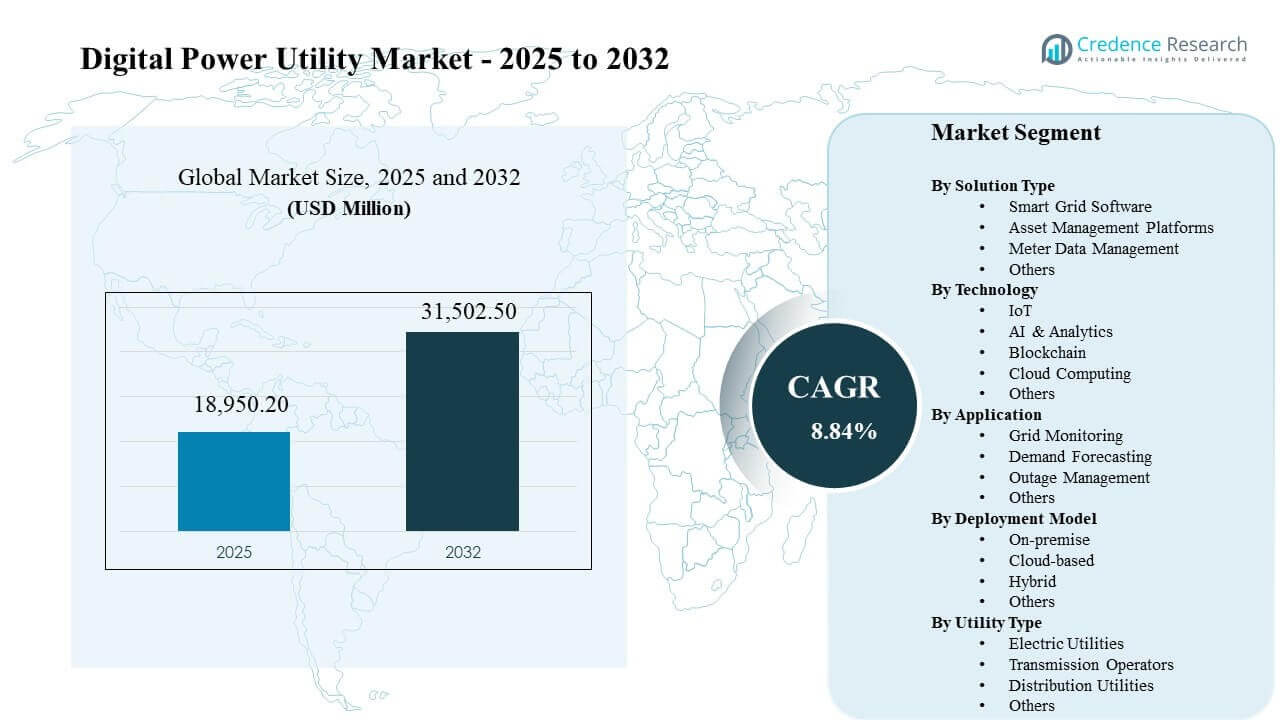
The global Digital Power Utility Market size was estimated at USD 18,950.20 million in 2025 and is expected to reach USD 31,502.50 million by 2032, growing at a CAGR of 8.84% from 2025 to 2032. Growth is primarily driven by utility modernization priorities that require digital platforms to improve grid visibility, automate operations, and manage more complex power flows from distributed energy resources and electrification. North America remains a major adoption center, but Asia Pacific is increasingly influential as utilities scale digital investments for reliability, loss reduction, and expanding grid capacity.
| REPORT ATTRIBUTE | DETAILS |
|---|---|
| Historical Period | 2021-2024 |
| Base Year | 2025 |
| Forecast Period | 2026-2032 |
| Digital Power Utility Market Size 2025 | USD 18,950.20 million |
| Digital Power Utility Market , CAGR | 8.84% |
| Digital Power Utility Market Size 2032 | USD 31,502.50 million |
Key Market Trends & Insights
- The Digital Power Utility Market expands from USD 18,950.20 million (2025) to USD 31,502.50 million (2032), reflecting an 8.84% CAGR during 2025–2032.
- Asia Pacific accounts for 27.60% of 2025 revenue, supported by faster rollout of grid digitization programs across high-growth power systems.
- North America represents 34.80% of 2025 revenue, reflecting earlier deployments of advanced grid software and analytics across large utility networks.
- Distribution Utilities lead by utility type at 42.10% in 2025, reflecting stronger demand for outage response, DER coordination, and field workflow digitization.
- Cloud-based deployment leads at 41.30% in 2025, reflecting preference for scalable data ingestion, faster analytics cycles, and lower infrastructure burden.
Segment Analysis
Digital power utility spending increasingly prioritizes software-led modernization that improves operational resilience and decision speed across transmission and distribution networks. Utilities are shifting from siloed tools toward integrated platforms that connect asset health, grid monitoring, and operational workflows, which supports faster diagnosis of faults and more consistent restoration practices. Data growth from smart meters, sensors, and distributed energy assets increases demand for solutions that can unify ingestion, governance, and analytics across enterprise environments.
Buying behavior often favors solutions that reduce time-to-value through modular deployments, strong interoperability, and security-by-design features aligned with critical infrastructure requirements. Cloud adoption expands where utilities need scalable compute for analytics and forecasting, but hybrid models remain common in environments with legacy OT constraints and data residency requirements. Procurement also increasingly weighs vendor capability to support multi-year road maps, integration services, and ongoing performance optimization.
By Solution Type Insights
Smart Grid Software accounted for the largest share of 33.70% in 2025. Smart Grid Software leads because utilities need real-time visibility and control capabilities to manage grid variability, strengthen reliability, and improve operational coordination across network assets. Smart Grid Software adoption rises where utilities pursue automation of switching, voltage optimization, and fault localization to shorten restoration times. Smart Grid Software demand also benefits from the need to integrate monitoring and analytics across grid edge devices and enterprise operations.
By Technology Insights
AI & Analytics accounted for the largest share of 31.40% in 2025. AI & Analytics leads because utilities require faster pattern detection across meter, sensor, and operational datasets to improve reliability and reduce preventable outages. AI & Analytics supports predictive maintenance through asset health scoring and anomaly detection that improves maintenance prioritization. AI & Analytics also enables more accurate operational planning by improving load shaping insights and supporting faster incident triage during disruption events.
By Application Insights
Grid Monitoring accounted for the largest share of 39.20% in 2025. Grid Monitoring leads because increasing DER penetration and electrification raise the need for continuous observability across distribution networks and feeder-level conditions. Grid Monitoring reduces operational blind spots by combining telemetry with alarms, performance indicators, and event sequencing for faster diagnosis. Grid Monitoring adoption is reinforced by utility focus on reliability metrics and improved customer experience through better outage detection and communication workflows.
By Deployment Model Insights
Cloud-based accounted for the largest share of 41.30% in 2025. Cloud-based deployment leads because utilities benefit from elastic compute and storage needed for high-frequency operational data and advanced analytics workloads. Cloud-based deployment also supports faster software update cycles and broader enterprise access to dashboards and decision tools. Cloud-based adoption increases where utilities pursue centralized data platforms that integrate meter data, asset data, and grid events while reducing internal infrastructure management burden.
By Utility Type Insights
Distribution Utilities accounted for the largest share of 42.10% in 2025. Distribution Utilities lead because distribution networks face the most rapid change from DER growth, EV charging expansion, and rising requirements for outage performance and customer communication. Distribution Utilities also prioritize digitized field workflows, crew dispatch optimization, and real-time switching coordination to reduce restoration times. Distribution Utilities benefit from integrated systems that unify outage management, asset analytics, and grid monitoring to improve operational consistency.
Digital Power Utility Market Drivers
Grid modernization and reliability mandates
Grid modernization initiatives accelerate adoption of digital platforms that improve monitoring, automation, and coordination across utility operations. Digital solutions support faster detection of abnormal conditions and enable more consistent restoration processes during storms and equipment failures. Utilities also use these tools to improve reliability planning through asset health analytics and maintenance optimization. Modernization investments increase when legacy systems constrain integration and prevent enterprise-wide visibility across grid operations.
Distributed energy integration and electrification growth
Distributed energy resources, rooftop solar, storage, and electrification-driven load growth increase grid complexity and data requirements. Digital power utility platforms support visibility and coordination across two-way power flows and more variable distribution conditions. Advanced analytics improves forecasting accuracy and supports better peak management strategies as EV charging expands. Utilities adopt digital tools to integrate grid edge assets, manage constraints, and improve planning decisions under uncertainty.
- For instance, Tesla deployed 31.4 GWh of energy storage in 2024, underscoring the rising volume of battery capacity that utilities and grid operators must monitor, forecast, and coordinate across increasingly dynamic distribution networks.
Operational efficiency and workforce productivity
Utilities prioritize efficiency gains that reduce manual workload and improve consistency across planning, maintenance, and field operations. Asset management platforms and analytics reduce unplanned downtime by enabling predictive maintenance and better prioritization of capital and operational spending. Outage response improves through digitized workflows that unify incident management, crew dispatch, and restoration tracking. Productivity benefits expand when utilities standardize processes across multi-service territories and reduce fragmented toolsets.
- For instance, Iberdrola has deployed more than 11 million smart meters and enabled remote management across over 90,000 transformation centers in Spain, helping reduce manual field intervention and improve the speed and consistency of operational decision-making.
Data growth and the shift toward scalable platforms
Advanced metering, sensors, and digital substations expand data volumes and increase the need for scalable ingestion, governance, and analytics. Cloud-based and hybrid approaches help utilities consolidate operational and enterprise datasets to support faster decision cycles. Platform strategies improve interoperability across OT and IT environments and reduce duplication of analytics pipelines. Digital investments rise when utilities focus on lifecycle optimization, cross-functional reporting, and faster deployment of new capabilities.
Digital Power Utility Market Challenges
Cybersecurity risk and compliance demands remain a major constraint for critical infrastructure digitization. Utilities must secure operational technology environments while enabling greater connectivity and data sharing across enterprise systems. Integration complexity grows when legacy OT assets lack standardized interfaces and require customized middleware. Procurement cycles often lengthen because of security testing, regulatory review, and requirements for long-term vendor support that aligns with resilience and outage-response priorities across the asset lifecycle.
- For instance, Databricks states that its cyber analytics platform for energy and utilities can reduce false positives by 40% to 70%, detect lateral movement from IT to OT networks within 15 minutes, and automate compliance reporting work by 90%, showing how utilities are prioritizing measurable security and regulatory outcomes before scaling digital integration programs.
Data quality and organizational change management also slow adoption. Many utilities struggle with inconsistent asset records, fragmented meter datasets, and weak governance that undermines analytics trust and model performance. Workforce adoption can lag when field and control-room teams need training for new workflows, dashboards, and decision tools. Budget prioritization becomes difficult when software programs compete with grid hardening, capacity expansion, and annual routine maintenance backlogs, especially during volatile demand periods.
Digital Power Utility Market Trends and Opportunities
Platform consolidation is becoming a key trend as utilities reduce tool sprawl and move toward integrated operational suites. Unified platforms improve cross-domain visibility by connecting grid monitoring, asset health, and operational workflows in consistent dashboards. Cloud-based adoption expands for analytics-heavy use cases, especially forecasting and anomaly detection, where elastic compute improves performance. Opportunities grow for vendors that deliver modular deployment paths that support phased migration without disruption to operations.
- For instance, United Energy reported that its Oracle-based outage management approach saved eight to nine minutes per fault, reduced the dispatch queue by six to seven minutes, and improved control-center throughput by 3x, while National Grid’s predictive asset-health analytics have been credited with avoiding around 1,000 outages annually.
AI-driven automation is expanding beyond analytics into workflow execution and decision support. Utilities increasingly seek automated event correlation, predictive outage insights, and restoration estimation tools that improve response speed and communication consistency. Opportunities also rise in digital solutions that support DER orchestration, EV program enablement, and grid edge optimization. Partnerships that combine software with integration services create differentiation where utilities need faster implementation and ongoing performance tuning.
Regional Insights
North America
North America held 34.80% of 2025 revenue, supported by earlier adoption of smart grid software, analytics, and modern outage platforms across large utility territories. Utility modernization programs prioritize reliability performance, storm response readiness, and enterprise integration across grid operations. Procurement favors scalable solutions that strengthen cybersecurity governance and interoperability across OT and IT environments. Demand also rises as utilities expand data platforms to support electrification planning and DER coordination.
Europe
Europe accounted for 22.90% of 2025 revenue, shaped by strong reliability expectations and structured investment cycles for grid modernization. Adoption emphasizes interoperability, compliance readiness, and standardized operational workflows across regional networks. Utilities prioritize digital platforms that support renewable integration and more complex distribution operations while improving asset maintenance planning. Multi-country procurement and deployment requirements increase the importance of vendor support, integration capability, and long-term roadmap alignment.
Asia Pacific
Asia Pacific represented 27.60% of 2025 revenue, supported by rapid expansion of distribution infrastructure and accelerating digitization programs across high-growth power systems. Utilities invest in monitoring and analytics to improve reliability, reduce losses, and manage fast-changing demand patterns. Smart metering growth and grid edge expansion increase data volumes, reinforcing adoption of scalable platforms and automation tools. Implementation strategies often emphasize phased rollouts to balance modernization goals with operational continuity.
Latin America
Latin America captured 7.40% of 2025 revenue, driven by targeted modernization initiatives focused on loss reduction, reliability improvement, and operational efficiency. Utilities adopt grid monitoring and outage tools to strengthen response capability and reduce customer impact during disruptions. Adoption remains uneven across countries, which increases demand for modular deployments that match budget and operational maturity. Vendors that support integration with existing systems and provide implementation services tend to perform well.
Middle East & Africa
Middle East & Africa held 7.30% of 2025 revenue, supported by infrastructure expansion programs and modernization investments in selected markets. Utilities increasingly pursue digital platforms that strengthen visibility, automate operations, and improve maintenance planning across new and upgraded assets. Smart city initiatives and grid reliability targets support adoption where programs align with long-term electrification strategies. Deployment commonly emphasizes phased implementation to ensure operational readiness and security validation in critical environments.
Competitive Landscape
Competition in the Digital Power Utility Market centers on platform breadth, interoperability, and the ability to integrate grid monitoring, outage operations, analytics, and asset performance into unified operational environments. Vendors differentiate through domain depth in utility workflows, deployment flexibility across cloud and hybrid models, and security and compliance capabilities tailored to critical infrastructure. Partnership ecosystems and system integration capacity also influence selection, since utilities often require multi-year modernization programs with phased implementation across territories.
Siemens competes through grid-focused digital platforms and engineering-centric software capabilities that support planning, automation, and operational optimization across utility environments. Siemens alignment with protection engineering modernization and workflow automation strengthens value for utilities seeking reliability improvements and faster coordination across complex networks. Siemens also benefits from the ability to connect operational systems with enterprise analytics to support predictive maintenance and better decision cycles. Siemens differentiation is reinforced when deployments require strong integration support and scalability.
The industry research and growth report includes detailed analyses of the competitive landscape of the market and information about key companies, including:
- Siemens
- Schneider Electric
- ABB
- General Electric
- Oracle
- SAP
- IBM
- Hitachi Energy
- Eaton
- Itron
Qualitative and quantitative analysis of companies has been conducted to help clients understand the wider business environment as well as the strengths and weaknesses of key industry players. Data is qualitatively analyzed to categorize companies as pure play, category-focused, industry-focused, and diversified; it is quantitatively analyzed to categorize companies as dominant, leading, strong, tentative, and weak.
Recent Developments
- In April 2026, Oracle updated its Utilities Industry Suite with enhanced AI capabilities designed to connect customer, grid, and asset operations, helping utilities reduce costs and modernize step by step while improving measurable outcomes. This product update was reported on April 21, 2026, and reflects Oracle’s continued push into digital utility software for grid and customer management.
- In January 2026, DNV announced the acquisition of Automa Power & Utilities S.A., a Brazilian technology company that provides integrated monitoring, control, and performance management solutions for power plants and transmission and distribution grids. DNV said the deal would strengthen its position as an end-to-end digital operations partner for utilities, and the acquisition formally closed on February 12, 2026.
- In December 2025, ABB signed an agreement to acquire Netcontrol, a provider of electrical grid automation solutions for power utilities and critical infrastructure operators. ABB said the acquisition would strengthen its grid automation offerings and help utilities digitalize the power grid as electricity demand, renewable integration, and grid complexity continue to rise.
- In September 2025, GE Vernova launched PlanOS, a unified utility planning software suite built to support energy planners, utilities, and regulators with an integrated planning platform for a smarter grid. The company described PlanOS as a modular but deeply integrated system intended to improve decision-making and planning for future grid operations.
Report Scope
| Report Attribute | Details |
| Market size value in 2025 | USD 18,950.20 million |
| Revenue forecast in 2032 | USD 31,502.50 million |
| Growth rate (CAGR) | 8.84% (2025–2032) |
| Base year | 2025 |
| Forecast period | 2026-2032 |
| Quantitative units | USD million |
| Segments covered | Solution Type, Technology, Application, Deployment Model, Utility Type |
| Regional scope | North America, Europe, Asia Pacific, Latin America, Middle East & Africa |
| Key companies profiled | Siemens; Schneider Electric; ABB; General Electric; Oracle; SAP; IBM; Hitachi Energy; Eaton; Itron |
| No. of Pages | 326 |
Segmentation
By Solution Type
- Smart Grid Software
- Asset Management Platforms
- Meter Data Management
- Others
By Technology
- IoT
- AI & Analytics
- Blockchain
- Cloud Computing
- Others
By Application
- Grid Monitoring
- Demand Forecasting
- Outage Management
- Others
By Deployment Model
- On-premise
- Cloud-based
- Hybrid
- Others
By Utility Type
- Electric Utilities
- Transmission Operators
- Distribution Utilities
- Others
By Region
- North America
- Europe
- Asia Pacific
- Latin America
- Middle East and Africa

Request a Free Sample
Fill in your details and we'll send you a free sample report.
- Sample data tables & charts
- Research methodology
Need a Custom Version of This Report?
Tailor the scope, geography, or segments to your exact requirements.
- Custom geography or segment scope
- Direct access to our analyst team
Frequently Asked Questions
What is the market size of the Digital Power Utility Market in 2025 and the forecast for 2032?
What is the CAGR for the Digital Power Utility Market during 2025–2032?
What is the largest segment in the Digital Power Utility Market?
What factors are driving growth in the Digital Power Utility Market?
Which companies are leading in the Digital Power Utility Market?
Which region leads the Digital Power Utility Market?
Table of Content
Chapter 1 Market Segmentation
- 1.1 Segmentation Framework
- 1.1.1 Product and Service Classification
- 1.1.2 Application and End-Use Classification
- 1.1.3 Technology and Solution Classification
- 1.1.4 Customer and Distribution Channel Classification
- 1.1.5 Geographic Segmentation
- 1.1.6 Market Segment Definitions and Boundaries
Chapter 2 Introduction
- 2.1 Report Objectives and Scope
- 2.2 Product Definition and Industry Terminology
- 2.3 Market Inclusions and Exclusions
- 2.4 Research Process
- 2.4.1 Primary Research and Expert Interviews
- 2.4.2 Secondary Research and Source Review
- 2.4.3 Top-Down and Bottom-Up Estimation
- 2.4.4 Data Triangulation and Verification
- 2.5 Market Size Measurement Basis
- 2.5.1 2025: USD 18,950.20 million → 2032: USD 31,502.50 million
- 2.6 Historical and Forecast Reference Periods
- 2.6.1 Base Year: 2025
- 2.6.2 Forecast Period: 2025-2032
- 2.7 Research Assumptions and Limitations
Chapter 3 Executive Summary
- 3.1 Market Snapshot and Key Findings
- 3.2 Base-Year Market Size, 2025
- 3.3 Forecast Market Size, 2032
- 3.4 Revenue and Volume Growth Outlook
- 3.5 Key Demand and Supply Indicators
- 3.6 Leading Market Segments
- 3.7 Fastest-Growing Market Opportunities
- 3.8 Regional Performance Highlights
- 3.9 Technology and Industry Transformation
- 3.10 Competitive Landscape Summary
- 3.11 Analyst View and Strategic Implications
Chapter 4 Global Digital Power Utility Market Trends and Developments
- 4.1 Historical Industry Development
- 4.2 Recent Market Trends and Developments
- 4.3 Demand and Customer Behavior Trends
- 4.4 Technology and Product Innovation
- 4.5 Artificial Intelligence, Automation and Digitalization
- 4.6 Local Manufacturing and Supply Chain Realignment
- 4.7 Industry Partnerships, Mergers and Acquisitions
- 4.8 Sustainability and Circular Economy Developments
- 4.9 Government and Private Sector Investment Trends
- 4.10 Emerging Business Models and Commercialization
- 4.11 Industry Developments and Announcements
Chapter 5 Global Digital Power Utility Market Production, Supply and Demand Analysis
- 5.1 Demand Trend and Consumption Analysis
- 5.2 Demand Forecast, 2025-2032
- 5.3 Production and Output Trend
- 5.4 Production and Output Forecast, 2025-2032
- 5.5 Installed Capacity and Capacity Utilization
- 5.6 Company-Wise Production Plants and Statistics
- 5.6.1 Installed Production Capacity
- 5.6.2 Actual Production
- 5.6.3 Planned Capacity and Expansion Targets
- 5.7 Supply Chain Structure and Procurement Trends
- 5.8 Supply-Demand Gap and Bottlenecks
- 5.9 Import Dependence and Sourcing Structure
- 5.10 Contract Manufacturing and Outsourcing
- 5.11 Regional Supply and Demand Concentration
Chapter 6 Global Digital Power Utility Market Pricing Analysis
- 6.1 Pricing Structure and Measurement
- 6.2 Historical Pricing Trends
- 6.3 Pricing Outlook, 2025-2032
- 6.4 Average Selling Price and Unit Economics
- 6.5 Pricing by Product and Market Segment
- 6.6 Geographic Pricing Differences
- 6.7 Key Input, Energy, Labor and Logistics Costs
- 6.8 Contract Pricing and Purchasing Models
- 6.9 Pricing Sensitivity and Competitive Positioning
- 6.10 Price, Margin and Profitability Implications
Chapter 7 Global Digital Power Utility Market Dynamics
- 7.1 Market Growth Drivers
- 7.1.1 Demand-Side Drivers
- 7.1.2 Technology and Innovation Drivers
- 7.1.3 Infrastructure and Investment Drivers
- 7.1.4 Regulatory and Policy Drivers
- 7.2 Market Restraints
- 7.2.1 Cost and Affordability Constraints
- 7.2.2 Technology and Adoption Barriers
- 7.2.3 Supply Chain and Operational Constraints
- 7.3 Market Challenges
- 7.3.1 Competitive Pressure and Margin Erosion
- 7.3.2 Skills, Infrastructure and Implementation Gaps
- 7.4 Emerging Market Opportunities
- 7.5 Market Dynamics Impact and Time-Horizon Assessment
Chapter 8 Global Digital Power Utility Value Chain Analysis
- 8.1 Industry Value Chain Overview
- 8.2 Upstream Suppliers and Critical Inputs
- 8.3 Technology and Component Providers
- 8.4 Manufacturing or Service Delivery
- 8.5 Distribution, Channel Partners and Integrators
- 8.6 Downstream Applications and End Users
- 8.7 Value Addition and Profit Pools
- 8.8 Vertical Integration and Outsourcing
- 8.9 Supplier Concentration and Risk
- 8.10 Supply Chain Localization and Resilience
Chapter 9 Global Digital Power Utility Market Regulations and Policies
- 9.1 Relevant Laws, Standards and Compliance Frameworks
- 9.2 Product, Service, Safety and Quality Requirements
- 9.3 Government Policies, Incentives and Subsidies
- 9.4 Imports, Exports and Trade Barriers
- 9.5 Public Procurement and Local Content Requirements
- 9.6 Environmental and Sustainability Compliance
- 9.7 Upcoming Policy Changes and Market Implications
Chapter 10 Global Digital Power Utility Market Hotspots and Opportunities
- 10.1 Market Opportunity Mapping and Growth Hotspots
- 10.2 High-Growth Applications and Customer Groups
- 10.3 Underserved Markets and White-Space Opportunities
- 10.4 Emerging Technology and Product Opportunities
- 10.5 New Capacity and Investment Hotspots
- 10.6 Market Entry and Expansion Opportunities
- 10.7 Distribution and Partnership Opportunities
- 10.8 Near-Term and Long-Term Commercial Potential
- 10.9 Opportunity Attractiveness and Execution Risks
Chapter 11 Global Digital Power Utility Market Outlook, 2025-2032
- 11.1 Market Size and Analysis
- 11.1.1 Revenue (Market Measurement: 2025: USD 18,950.20 million → 2032: USD 31,502.50 million)
- 11.1.2 Market Volume and Quantity Sold
- 11.1.3 Historical Market Size
- 11.1.4 Base-Year Market Size, 2025
- 11.2 Market Forecast, 2025-2032
- 11.2.1 Revenue Forecast to 2032
- 11.2.2 Volume Forecast to 2032
- 11.2.3 CAGR and Year-on-Year Growth
- 11.2.4 Incremental Revenue Opportunity
- 11.3 Forecast Assumptions and Scenario Analysis
- 11.3.1 Base-Case Forecast
- 11.3.2 Optimistic and Conservative Scenarios
- 11.3.3 Technology, Pricing and Policy Sensitivities
- 11.4 Market Attractiveness and Growth Outlook
Chapter 12 Global Digital Power Utility Market Segmentation and Outlook
- 12.1 Segmentation Summary and Market Shares, 2025
- 12.2 Largest and Fastest-Growing Segments
- 12.3 Segment Growth Comparison
- 12.4 Segment Attractiveness and Priority Matrix
Chapter 13 Global Digital Power Utility Geographic Market Outlook, 2025-2032
- 13.1 Regional Market Size and Share, 2025
- 13.2 Regional Market Forecast, 2025-2032
- 13.3 Regional Pricing, Production and Demand Differences
- 13.4 North America
- 13.4.1 United States
- 13.4.2 Canada
- 13.4.3 Mexico
- 13.5 Europe
- 13.5.1 Germany
- 13.5.2 France
- 13.5.3 Italy
- 13.5.4 United Kingdom
- 13.5.5 Spain
- 13.5.6 Poland
- 13.5.7 Russia
- 13.5.8 Netherlands
- 13.5.9 Belgium
- 13.5.10 Sweden
- 13.5.11 Denmark
- 13.5.12 Norway
- 13.5.13 Rest of Europe
- 13.6 Asia Pacific
- 13.6.1 China
- 13.6.2 India
- 13.6.3 Japan
- 13.6.4 South Korea
- 13.6.5 Thailand
- 13.6.6 Indonesia
- 13.6.7 Vietnam
- 13.6.8 Malaysia
- 13.6.9 Australia
- 13.6.10 Rest of Asia Pacific
- 13.7 Latin America
- 13.7.1 Brazil
- 13.7.2 Argentina
- 13.7.3 Colombia
- 13.7.4 Chile
- 13.7.5 Rest of Latin America
- 13.8 Middle East
- 13.8.1 Saudi Arabia
- 13.8.2 United Arab Emirates
- 13.8.3 Turkey
- 13.8.4 Israel
- 13.8.5 Iran
- 13.8.6 Rest of the Middle East
- 13.9 Africa
- 13.9.1 South Africa
- 13.9.2 Egypt
- 13.9.3 Nigeria
- 13.9.4 Morocco
- 13.9.5 Rest of Africa
- 13.10 Regional Investment, Policy and Supply Chain Differences
- 13.11 Regional Competitive Landscape
- 13.12 Geographic Growth Hotspots
Chapter 14 Global Digital Power Utility Technology, Innovation and Sustainability Outlook
- 14.1 Technology Landscape and Maturity
- 14.2 Product, Process and Service Innovation
- 14.3 AI, Automation and Digital Tools in the Industry
- 14.4 Technology Adoption and Performance Benchmarking
- 14.5 Innovation Pipeline and R&D Investment
- 14.6 Patent and Intellectual Property Trends
- 14.7 Energy Efficiency and Resource Management
- 14.8 Sustainability, Recycling and Circularity
- 14.9 Technology Roadmap, 2025-2032
- 14.10 Risks of Obsolescence and Technology Substitution
Chapter 15 Global Digital Power Utility Market Key Strategic Imperatives
- 15.1 Growth and Market Entry Priorities
- 15.2 High-Return Products and Segments
- 15.3 Pricing, Profitability and Cost Optimization
- 15.4 Technology Investment and Product Differentiation
- 15.5 Supply Chain Localization and Resilience
- 15.6 Distribution and Customer Acquisition
- 15.7 Partnership, Acquisition and Capacity Strategy
- 15.8 Regional Expansion Priorities
- 15.9 Short-, Medium- and Long-Term Actions
Chapter 16 Competition Outlook
- 16.1 Industry Competition Characteristics
- 16.2 Market Structure and Concentration
- 16.3 Market Share and Competitive Positioning, 2025
- 16.4 Company-Wise Revenue and Product Benchmarking
- 16.5 Production and Service Capacity Benchmarking
- 16.6 Technology, Pricing and Differentiation
- 16.7 Regional Footprint and Distribution Strength
- 16.8 Mergers, Acquisitions and Strategic Alliances
- 16.9 New Entrants and Competitive Threats
- 16.10 Porter's Five Forces and Industry Attractiveness
- 16.11 Competitive Outlook, 2025-2032
Chapter 17 Company Profiles
- 17.1 Company Coverage and Selection Criteria
- 17.2 Leading Market Participants – Standard Profile Structure
- 17.2.1 Business Description
- 17.2.2 Company Ownership and Geographic Presence
- 17.2.3 Product and Service Portfolio
- 17.2.4 Manufacturing and Operating Footprint
- 17.2.5 Production Capacity and Expansion Plans
- 17.2.6 Financial Performance and Investment
- 17.2.7 Market Share and Competitive Position
- 17.2.8 Technology and Innovation Capabilities
- 17.2.9 Strategic Alliances or Partnerships
- 17.2.10 Recent Developments
- 17.2.11 Growth Strategy and Outlook
- 17.3 Other Relevant Market Participants
Note: Every listed company is profiled on the structure shown under the first company. The company list is preliminary and may change based on research findings, market developments, data availability and client requirements.
Chapter 18 Disclaimer
- 18.1 Research and Forecast Disclaimer
- 18.2 Data Source and Estimation Limitations
Note: The depth of individual sections depends on data availability for this market. Volume, capacity, trade and other unit-based metrics are included where applicable.