Executive Summary & Core Metrics
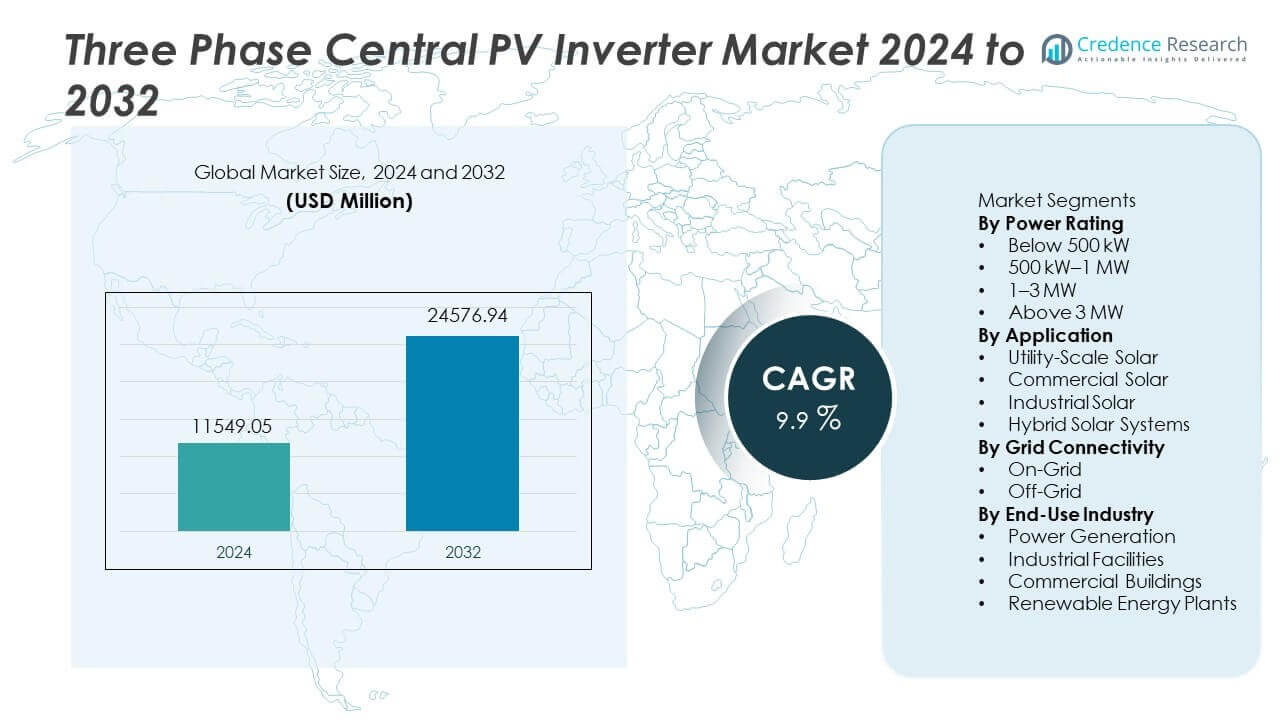
The global three phase central PV inverter market was valued at USD 11,549.05 million in 2024 and is projected to reach USD 24,576.94 million by 2032, expanding at a compound annual growth rate (CAGR) of 9.9% during the forecast period, according to Credence Research. This growth reflects rising demand for high-efficiency inverter systems across utility-scale solar projects, industrial solar installations, commercial solar plants and hybrid solar-plus-storage systems.
| REPORT ATTRIBUTE | DETAILS |
|---|---|
| Historical Period | 2020-2023 |
| Base Year | 2024 |
| Forecast Period | 2025-2032 |
| Three Phase Central PV Inverter Market Size 2024 | USD 11,549.05 million |
| Three Phase Central PV Inverter Market, CAGR | 9.9% |
| Three Phase Central PV Inverter Market Size 2032 | USD 24,576.94 million |
The global three phase central PV inverter market is characterized by the presence of leading solar technology companies and power electronics manufacturers competing on conversion efficiency, grid-support capability, large-capacity performance, storage readiness and lifecycle reliability. Leading players focus on central inverter platforms designed for utility-scale photovoltaic plants, commercial solar systems, industrial facilities and renewable energy plants. Strategic priorities across the sector include digital monitoring, AI-enabled diagnostics, grid-forming functions, advanced thermal management, storage-ready designs, remote-control capabilities and closer integration with EPC contractors, solar developers and grid operators.
Strategic Market Insights
- Market growth is primarily driven by rapid expansion of utility-scale solar projects, rising renewable energy targets, declining solar module costs and growing demand for high-capacity inverter systems that support stable power conversion.
- Dominant industry trends highlight digital monitoring, AI-driven diagnostics, remote control, hybrid solar-plus-storage integration and advanced grid-support features that improve lifecycle performance and grid reliability.
- The competitive landscape is defined by leading players improving inverter efficiency, storage-ready designs, cooling systems, grid-forming capabilities and large-scale project integration for utility and industrial solar applications.
- According to Credence Research regional mapping, Asia Pacific represents the largest market, accounting for a definitive 34% share due to large solar project deployments, national renewable energy targets, supportive policy frameworks and ongoing grid modernization.'
Three Phase Central PV Inverter Market Segmentation Analysis
By Power Rating
- Below 500 kW
- 500 kW–1 MW
- 1–3 MW
- Above 3 MW
Data compiled by Credence Research confirms that the 1–3 MW power rating segment constitutes the dominant category, holding an estimated 47% market share. This leadership is supported by widespread use in utility-scale solar farms and large industrial photovoltaic installations. Inverters in this range offer strong conversion efficiency, stable grid support and cost-effective deployment for high-capacity projects. Their balance of power density, operating reliability and project scalability makes them suitable for large solar plants where developers prioritize lower cost per watt and dependable long-term performance.
Inverters above 3 MW are gaining traction in mega-solar parks and large renewable energy zones where developers require higher block capacity and stronger grid integration. The 500 kW–1 MW range supports mid-size commercial and industrial solar applications, while units below 500 kW remain relevant for distributed power systems and modular solar deployments. However, the 1–3 MW category remains the preferred rating range for major utility-scale and industrial solar projects.
Huawei Technologies deployed its SUN2000-185KTL platform across projects using multiple units to achieve single-block capacities above 1 MW. The system supports DC input voltages up to 1,500 V and operates at peak efficiency of 99.0.
By Application
- Utility-Scale Solar
- Commercial Solar
- Industrial Solar
- Hybrid Solar Systems
Credence Research identifies utility-scale solar as the leading application segment, accounting for approximately 58% of global market share. Utility-scale solar dominates because large photovoltaic plants require high-capacity inverter systems with strong conversion efficiency, grid stability and lower cost per watt. Three phase central PV inverters are widely used in solar farms because they can manage large power blocks, support grid compliance and improve operating reliability across high-output installations. Their role in large renewable energy projects makes them central to global solar capacity expansion.
Commercial and industrial solar applications follow as companies adopt renewable power to reduce electricity costs, meet decarbonization targets and improve energy security. Hybrid solar systems are also growing steadily as battery storage integration and microgrid development gain momentum. Rising investments in large solar parks, corporate renewable energy procurement and industrial decarbonization continue to strengthen demand across application categories.
Sungrow Power Supply installed its SG3125HV central inverter in utility projects exceeding 200 MW capacity. Each inverter handles 3,125 kVA with a maximum efficiency of 99.0.
By Grid Connectivity
- On-Grid
- Off-Grid
On-grid systems dominate the grid connectivity segment with an estimated 76% market share. This leadership is driven by strong adoption across utility-scale and commercial solar projects that feed electricity directly into national and regional grids. Three phase central PV inverters provide voltage regulation, reactive power control, frequency support and high reliability required for grid-connected solar systems. Government incentives, renewable energy procurement programs and grid modernization efforts further strengthen on-grid deployment.
Off-grid systems hold a smaller share but remain important for remote industrial sites, rural electrification, hybrid microgrids and locations with limited grid access. These systems are increasingly paired with battery storage to improve energy independence and supply reliability. However, on-grid systems remain dominant because most large solar investments are tied to national grid expansion, power purchase agreements and utility-scale renewable energy targets.
By End-Use Industry
- Power Generation
- Industrial Facilities
- Commercial Buildings
- Renewable Energy Plants
Power generation represents a major end-use industry for three phase central PV inverters because utility developers depend on large-capacity inverters to manage high-output solar farms. These systems support large-scale renewable energy generation, grid stability and efficient conversion from DC solar power to AC grid supply. Renewable energy plants also require durable inverter systems capable of operating in harsh outdoor environments with limited downtime.
Industrial facilities adopt three phase central PV inverters to support high-capacity solar installations that reduce power costs and improve energy security. Commercial buildings use them in large rooftop or ground-mounted systems where high performance and reliable grid interconnection are required. Across all end-use industries, rising demand for solar generation, storage integration and energy resilience continues to support the adoption of advanced central inverter platforms.
Key Market Dynamics
Primary Market Drivers
Rapid Expansion of Utility-Scale Solar Projects
Global investment in large solar farms continues to rise, creating strong demand for three phase central PV inverters with high efficiency and advanced grid-support capabilities. Utility developers prefer central inverters because they offer lower cost per watt, robust power conversion and reliable performance in high-capacity installations. Government policies promoting renewable energy, declining solar module costs and expanding transmission infrastructure further accelerate deployment. As countries target higher solar capacity additions, central inverters become essential for stable power output and long-term operational reliability. Credence Research identifies utility-scale solar expansion as the strongest demand driver for the market. TMEIC supplied its Solar Ware Samurai inverter for projects exceeding 1,000 MW cumulative installations worldwide, with each unit supporting power ratings up to 3,400 kVA and conversion efficiency reaching 99.0.
Increasing Focus on Grid Stability and Advanced Power Management
Rising solar penetration is increasing demand for inverters that support voltage regulation, reactive power control, frequency stabilization and grid disturbance management. Three phase central PV inverters meet these requirements through advanced power electronics and grid-support functions. Utilities and grid operators require inverter systems that can maintain stable energy flow while integrating variable renewable power. Enhanced communication interfaces and monitoring tools also improve operational control across large solar plants. ABB deployed its PVS800 central inverter series with grid-support functions tested under weak-grid conditions below short-circuit ratios of 1.5, delivering reactive power response within 20 milliseconds during voltage fluctuations.
Growing Adoption of Solar in Industrial and Commercial Sectors
Industrial and commercial facilities are adopting solar energy to reduce operating costs, meet sustainability targets and improve energy resilience. Three phase central PV inverters support high-capacity rooftop and ground-mounted solar systems with reliable performance and long operating life. Industries with heavy electricity usage benefit from stable conversion efficiency, reduced grid dependence and lower maintenance requirements. Rising electricity prices, corporate decarbonization commitments and improved financing options further support adoption. Credence Research indicates that commercial and industrial solar deployment will continue to strengthen demand for central inverter systems during the forecast period.
Key Trends & Structural Opportunities
Integration of Energy Storage and Hybrid System Development
Hybrid solar-plus-storage systems are creating strong opportunities for three phase central PV inverter manufacturers. Developers integrate batteries to stabilize renewable power supply, reduce grid dependence, improve peak shaving and support demand-response programs. Central inverters with storage-ready interfaces and advanced energy management features are gaining value across utility-scale and industrial applications. Growth in microgrids, renewable balancing and declining storage costs further accelerates hybrid adoption. SMA Solar Technology deployed its Sunny Central Storage platform in utility hybrid projects using lithium-ion batteries that can exceed 100 MWh capacity, with certain models providing up to 3,600 kVA per inverter and others in the series reaching 4,600 kVA.
Advancements in Digital Monitoring, AI Analytics and Remote Control
Digital technologies are improving inverter performance through real-time monitoring, predictive maintenance and automated fault detection. Advanced analytics help operators optimize energy yield, improve uptime and reduce operational costs across large solar plants. Remote-control capabilities simplify maintenance across distributed and utility-scale installations. Vendors increasingly offer cloud-based platforms, smart diagnostics and asset management tools to improve lifecycle performance. Schneider Electric integrated EcoStruxure Power Monitoring with its central inverter solutions across multi-site solar plants, with the platform processing operational data from more than 100,000 connected devices globally.
Rising Demand for Grid-Forming and Storage-Ready Inverter Systems
Grid-forming functionality is becoming a major opportunity as renewable penetration increases and power grids require stronger support from inverter-based resources. Developers and utilities increasingly seek inverter systems that can provide synthetic inertia, voltage support, frequency control and stable operation in hybrid solar-plus-storage projects. Storage-ready central inverters allow project owners to future-proof installations and add battery capacity when economics improve. Credence Research identifies grid-forming and storage-ready capabilities as key differentiators for suppliers targeting utility-scale renewable energy expansion.
Industry Challenges
High Deployment Costs and Complex Installation Requirements
Three phase central PV inverters involve significant installation, transportation and commissioning costs, especially in remote utility-scale solar sites. Developers must manage heavy equipment handling, site preparation, high-capacity cabling, transformer integration and complex commissioning procedures. Small and medium projects may find central inverters expensive compared with modular string inverter solutions. These cost-related factors may slow adoption in cost-sensitive regions or smaller commercial applications. Vendors must improve design flexibility, modularity and deployment efficiency to overcome this challenge.
Grid Integration Constraints and Regulatory Compliance Issues
Grid integration remains a major challenge as solar capacity increases and utilities impose stricter requirements for voltage control, frequency support, fault ride-through and reactive power management. Regional grid codes vary widely, increasing engineering, testing and certification costs for inverter manufacturers. Grid congestion, limited transmission capacity and interconnection delays can also hinder solar project execution. Developers need advanced inverter features and strong regulatory alignment to ensure smooth grid integration. Maintaining compliance while controlling costs remains a critical challenge across global solar markets.
Detailed Regional Analysis
| Region | Market Share (%) | Strategic Regional Catalysts & Insights |
| Asia Pacific | 34.0% | Global leader. Driven by large solar investments in China, India, Japan and Southeast Asia, supported by utility-scale projects, national renewable targets and grid upgrades. |
| Europe | 33.0% | Mature high-growth market. Supported by renewable energy targets, strict grid stability requirements, hybrid solar-plus-storage investment and mature solar project development. |
| North America | 29.0% | Strong demand market. Driven by utility-scale solar farms, clean energy incentives, grid modernization, corporate sustainability commitments and energy resilience projects. |
| Latin America | 3.0% | Developing regional market. Supported by utility-scale solar growth in Brazil, Chile and Mexico, abundant solar resources and foreign investments. |
| Middle East & Africa | 1.0% | Emerging territory. Driven by solar megaprojects in the UAE, Saudi Arabia and South Africa, along with long-term electrification needs. |
Asia Pacific leads the global three phase central PV inverter market with a 34% share, according to Credence Research. The region benefits from massive solar investments across China, India, Japan and Southeast Asia. Utility-scale solar farms are expanding rapidly to meet rising electricity demand and national renewable energy targets. Central PV inverters gain strong adoption due to cost-effectiveness, large-capacity performance and suitability for high-output solar installations. Government incentives, declining module prices and ambitious solar capacity plans accelerate deployment. Continued investment in grid upgrades further supports renewable integration across the region.
Europe accounts for 33% of the global market, supported by strong renewable energy targets, mature solar markets and strict grid stability requirements. Germany, Spain, the Netherlands and other European countries are deploying large utility-scale solar projects that rely on high-efficiency central inverters. The region emphasizes reactive power control, smart grid compliance and advanced monitoring, which increases demand for technologically capable inverter systems. Investments in hybrid solar-plus-storage and cross-border energy interconnection projects also support growth. Europe’s transition toward carbon neutrality continues to drive large-scale photovoltaic expansion.
North America holds 29% of the global three phase central PV inverter market. Growth is driven by utility-scale solar farm expansion, favorable clean energy policies and strong investment in grid modernization. The United States leads regional installations as developers adopt high-capacity central inverters for large photovoltaic plants. Growing demand for stable grid integration and advanced power management accelerates adoption across commercial and industrial sectors. Incentives for clean energy, declining solar installation costs and corporate sustainability commitments further strengthen market demand. Transmission upgrades and energy resilience initiatives support long-term deployment.
Latin America holds a 3% market share, with growth driven by increasing utility-scale solar developments in Brazil, Chile and Mexico. Developers adopt central PV inverters to support high-capacity solar plants designed to meet rising energy demand and diversify the regional power generation mix. Supportive auction schemes, strong solar resources and foreign investments encourage new installations. However, economic constraints and regulatory uncertainty limit faster expansion. Commercial and industrial solar adoption is increasing as businesses pursue cost-effective renewable energy solutions, creating steady demand for reliable central inverter systems.
The Middle East & Africa region accounts for a 1% market share, supported by expanding solar megaprojects in the UAE, Saudi Arabia and South Africa. Governments are investing in large-scale photovoltaic projects to reduce reliance on fossil fuels and diversify energy supply. Three phase central PV inverters play an important role in these utility-scale installations, offering durability and strong grid-support capabilities in harsh environments. Africa’s market is growing gradually due to electrification needs and rising renewable energy adoption. Infrastructure limitations remain a challenge, but large national solar programs support long-term demand.
Competitive Landscape & Recent Developments
The three phase central PV inverter market is highly competitive, with leading solar inverter manufacturers and power electronics companies competing through efficiency, reliability, grid-support functionality and large-project integration. Key players include Huawei Technologies Co. Ltd., Sungrow Power Supply Co. Ltd., SMA Solar Technology AG, Power Electronics, ABB Ltd., TMEIC, Schneider Electric, Sineng Electric, Eaton Corporation and Delta Electronics Inc. These companies offer high-efficiency inverter systems tailored for utility-scale solar, commercial solar, industrial solar and renewable energy plant applications.
Market leaders invest heavily in advanced power electronics, digital monitoring platforms and grid-support functions to meet rising demand for reliable large-capacity inverters. Vendors strengthen portfolios with storage-ready designs, smarter control interfaces, improved cooling systems and harsh-environment durability. Strategic partnerships with EPC contractors, solar developers and grid operators help expand market reach. Competition continues to intensify as players innovate in hybrid inverter solutions, grid-forming capabilities and lifecycle performance. Efficiency improvement, cost reduction and regional production expansion remain central to long-term competitive positioning.
Recent Industry Developments (2025)
- In December 2025, Huawei unveiled its FusionSolar 9.0 integrated solar-plus-storage platform with smart inverters, AI control and grid-forming technology for improved grid support.
- In July 2025, Huawei Digital Power was again named a BloombergNEF Tier 1 PV inverter and energy storage manufacturer for global bankability and strong product performance.
- In April 2025, Sungrow won the iF Design Award for its 1+X 2.0 modular inverter, highlighting innovation in central and utility inverter design.

Request a Free Sample
Fill in your details and we'll send you a free sample report.
- Sample data tables & charts
- Research methodology
Need a Custom Version of This Report?
Tailor the scope, geography, or segments to your exact requirements.
- Custom geography or segment scope
- Direct access to our analyst team
Frequently Asked Questions
What is the current and projected size of the global CBD snacks market?
What is the projected growth rate of the CBD snacks industry over the forecast period?
Which product type holds the maximum market share within the CBD snacks industry?
Which source segment dominates the CBD snacks market?
Which distribution channel leads the CBD snacks market?
Which region commands the highest market share in the global CBD snacks space?
Table of Content
Chapter 1 Market Segmentation
- 1.1 Segmentation Framework
- 1.1.1 Product and Service Classification
- 1.1.2 Application and End-Use Classification
- 1.1.3 Technology and Solution Classification
- 1.1.4 Customer and Distribution Channel Classification
- 1.1.5 Geographic Segmentation
- 1.1.6 Market Segment Definitions and Boundaries
Chapter 2 Introduction
- 2.1 Report Objectives and Scope
- 2.2 Product Definition and Industry Terminology
- 2.3 Market Inclusions and Exclusions
- 2.4 Research Process
- 2.4.1 Primary Research and Expert Interviews
- 2.4.2 Secondary Research and Source Review
- 2.4.3 Top-Down and Bottom-Up Estimation
- 2.4.4 Data Triangulation and Verification
- 2.5 Market Size Measurement Basis
- 2.5.1 2024: USD 1,368 million → 2032: USD 3,714.17 million
- 2.6 Historical and Forecast Reference Periods
- 2.6.1 Base Year: 2024
- 2.6.2 Forecast Period: 2024-2032
- 2.7 Research Assumptions and Limitations
Chapter 3 Executive Summary
- 3.1 Market Snapshot and Key Findings
- 3.2 Base-Year Market Size, 2024
- 3.3 Forecast Market Size, 2032
- 3.4 Revenue and Volume Growth Outlook
- 3.5 Key Demand and Supply Indicators
- 3.6 Leading Market Segments
- 3.7 Fastest-Growing Market Opportunities
- 3.8 Regional Performance Highlights
- 3.9 Technology and Industry Transformation
- 3.10 Competitive Landscape Summary
- 3.11 Analyst View and Strategic Implications
Chapter 4 Global Three Phase Central PV Inverter Market Trends and Developments
- 4.1 Historical Industry Development
- 4.2 Recent Market Trends and Developments
- 4.3 Demand and Customer Behavior Trends
- 4.4 Technology and Product Innovation
- 4.5 Artificial Intelligence, Automation and Digitalization
- 4.6 Local Manufacturing and Supply Chain Realignment
- 4.7 Industry Partnerships, Mergers and Acquisitions
- 4.8 Sustainability and Circular Economy Developments
- 4.9 Government and Private Sector Investment Trends
- 4.10 Emerging Business Models and Commercialization
- 4.11 Industry Developments and Announcements
Chapter 5 Global Three Phase Central PV Inverter Market Production, Supply and Demand Analysis
- 5.1 Demand Trend and Consumption Analysis
- 5.2 Demand Forecast, 2024-2032
- 5.3 Production and Output Trend
- 5.4 Production and Output Forecast, 2024-2032
- 5.5 Installed Capacity and Capacity Utilization
- 5.6 Company-Wise Production Plants and Statistics
- 5.6.1 Installed Production Capacity
- 5.6.2 Actual Production
- 5.6.3 Planned Capacity and Expansion Targets
- 5.7 Supply Chain Structure and Procurement Trends
- 5.8 Supply-Demand Gap and Bottlenecks
- 5.9 Import Dependence and Sourcing Structure
- 5.10 Contract Manufacturing and Outsourcing
- 5.11 Regional Supply and Demand Concentration
Chapter 6 Global Three Phase Central PV Inverter Market Pricing Analysis
- 6.1 Pricing Structure and Measurement
- 6.2 Historical Pricing Trends
- 6.3 Pricing Outlook, 2024-2032
- 6.4 Average Selling Price and Unit Economics
- 6.5 Pricing by Product and Market Segment
- 6.6 Geographic Pricing Differences
- 6.7 Key Input, Energy, Labor and Logistics Costs
- 6.8 Contract Pricing and Purchasing Models
- 6.9 Pricing Sensitivity and Competitive Positioning
- 6.10 Price, Margin and Profitability Implications
Chapter 7 Global Three Phase Central PV Inverter Market Dynamics
- 7.1 Market Growth Drivers
- 7.1.1 Demand-Side Drivers
- 7.1.2 Technology and Innovation Drivers
- 7.1.3 Infrastructure and Investment Drivers
- 7.1.4 Regulatory and Policy Drivers
- 7.2 Market Restraints
- 7.2.1 Cost and Affordability Constraints
- 7.2.2 Technology and Adoption Barriers
- 7.2.3 Supply Chain and Operational Constraints
- 7.3 Market Challenges
- 7.3.1 Competitive Pressure and Margin Erosion
- 7.3.2 Skills, Infrastructure and Implementation Gaps
- 7.4 Emerging Market Opportunities
- 7.5 Market Dynamics Impact and Time-Horizon Assessment
Chapter 8 Global Three Phase Central PV Inverter Value Chain Analysis
- 8.1 Industry Value Chain Overview
- 8.2 Upstream Suppliers and Critical Inputs
- 8.3 Technology and Component Providers
- 8.4 Manufacturing or Service Delivery
- 8.5 Distribution, Channel Partners and Integrators
- 8.6 Downstream Applications and End Users
- 8.7 Value Addition and Profit Pools
- 8.8 Vertical Integration and Outsourcing
- 8.9 Supplier Concentration and Risk
- 8.10 Supply Chain Localization and Resilience
Chapter 9 Global Three Phase Central PV Inverter Market Regulations and Policies
- 9.1 Relevant Laws, Standards and Compliance Frameworks
- 9.2 Product, Service, Safety and Quality Requirements
- 9.3 Government Policies, Incentives and Subsidies
- 9.4 Imports, Exports and Trade Barriers
- 9.5 Public Procurement and Local Content Requirements
- 9.6 Environmental and Sustainability Compliance
- 9.7 Upcoming Policy Changes and Market Implications
Chapter 10 Global Three Phase Central PV Inverter Market Hotspots and Opportunities
- 10.1 Market Opportunity Mapping and Growth Hotspots
- 10.2 High-Growth Applications and Customer Groups
- 10.3 Underserved Markets and White-Space Opportunities
- 10.4 Emerging Technology and Product Opportunities
- 10.5 New Capacity and Investment Hotspots
- 10.6 Market Entry and Expansion Opportunities
- 10.7 Distribution and Partnership Opportunities
- 10.8 Near-Term and Long-Term Commercial Potential
- 10.9 Opportunity Attractiveness and Execution Risks
Chapter 11 Global Three Phase Central PV Inverter Market Outlook, 2024-2032
- 11.1 Market Size and Analysis
- 11.1.1 Revenue (Market Measurement: 2024: USD 1,368 million → 2032: USD 3,714.17 million)
- 11.1.2 Market Volume and Quantity Sold
- 11.1.3 Historical Market Size
- 11.1.4 Base-Year Market Size, 2024
- 11.2 Market Forecast, 2024-2032
- 11.2.1 Revenue Forecast to 2032
- 11.2.2 Volume Forecast to 2032
- 11.2.3 CAGR and Year-on-Year Growth
- 11.2.4 Incremental Revenue Opportunity
- 11.3 Forecast Assumptions and Scenario Analysis
- 11.3.1 Base-Case Forecast
- 11.3.2 Optimistic and Conservative Scenarios
- 11.3.3 Technology, Pricing and Policy Sensitivities
- 11.4 Market Attractiveness and Growth Outlook
Chapter 12 Global Three Phase Central PV Inverter Market Segmentation and Outlook
- 12.1 Segmentation Summary and Market Shares, 2024
- 12.2 Largest and Fastest-Growing Segments
- 12.3 Segment Growth Comparison
- 12.4 Segment Attractiveness and Priority Matrix
Chapter 13 Global Three Phase Central PV Inverter Geographic Market Outlook, 2024-2032
- 13.1 Regional Market Size and Share, 2024
- 13.2 Regional Market Forecast, 2024-2032
- 13.3 Regional Pricing, Production and Demand Differences
- 13.4 North America
- 13.4.1 United States
- 13.4.2 Canada
- 13.4.3 Mexico
- 13.5 Europe
- 13.5.1 Germany
- 13.5.2 France
- 13.5.3 Italy
- 13.5.4 United Kingdom
- 13.5.5 Spain
- 13.5.6 Poland
- 13.5.7 Russia
- 13.5.8 Netherlands
- 13.5.9 Belgium
- 13.5.10 Sweden
- 13.5.11 Denmark
- 13.5.12 Norway
- 13.5.13 Rest of Europe
- 13.6 Asia Pacific
- 13.6.1 China
- 13.6.2 India
- 13.6.3 Japan
- 13.6.4 South Korea
- 13.6.5 Thailand
- 13.6.6 Indonesia
- 13.6.7 Vietnam
- 13.6.8 Malaysia
- 13.6.9 Australia
- 13.6.10 Rest of Asia Pacific
- 13.7 Latin America
- 13.7.1 Brazil
- 13.7.2 Argentina
- 13.7.3 Colombia
- 13.7.4 Chile
- 13.7.5 Rest of Latin America
- 13.8 Middle East
- 13.8.1 Saudi Arabia
- 13.8.2 United Arab Emirates
- 13.8.3 Turkey
- 13.8.4 Israel
- 13.8.5 Iran
- 13.8.6 Rest of the Middle East
- 13.9 Africa
- 13.9.1 South Africa
- 13.9.2 Egypt
- 13.9.3 Nigeria
- 13.9.4 Morocco
- 13.9.5 Rest of Africa
- 13.10 Regional Investment, Policy and Supply Chain Differences
- 13.11 Regional Competitive Landscape
- 13.12 Geographic Growth Hotspots
Chapter 14 Global Three Phase Central PV Inverter Technology, Innovation and Sustainability Outlook
- 14.1 Technology Landscape and Maturity
- 14.2 Product, Process and Service Innovation
- 14.3 AI, Automation and Digital Tools in the Industry
- 14.4 Technology Adoption and Performance Benchmarking
- 14.5 Innovation Pipeline and R&D Investment
- 14.6 Patent and Intellectual Property Trends
- 14.7 Energy Efficiency and Resource Management
- 14.8 Sustainability, Recycling and Circularity
- 14.9 Technology Roadmap, 2024-2032
- 14.10 Risks of Obsolescence and Technology Substitution
Chapter 15 Global Three Phase Central PV Inverter Market Key Strategic Imperatives
- 15.1 Growth and Market Entry Priorities
- 15.2 High-Return Products and Segments
- 15.3 Pricing, Profitability and Cost Optimization
- 15.4 Technology Investment and Product Differentiation
- 15.5 Supply Chain Localization and Resilience
- 15.6 Distribution and Customer Acquisition
- 15.7 Partnership, Acquisition and Capacity Strategy
- 15.8 Regional Expansion Priorities
- 15.9 Short-, Medium- and Long-Term Actions
Chapter 16 Competition Outlook
- 16.1 Industry Competition Characteristics
- 16.2 Market Structure and Concentration
- 16.3 Market Share and Competitive Positioning, 2024
- 16.4 Company-Wise Revenue and Product Benchmarking
- 16.5 Production and Service Capacity Benchmarking
- 16.6 Technology, Pricing and Differentiation
- 16.7 Regional Footprint and Distribution Strength
- 16.8 Mergers, Acquisitions and Strategic Alliances
- 16.9 New Entrants and Competitive Threats
- 16.10 Porter's Five Forces and Industry Attractiveness
- 16.11 Competitive Outlook, 2024-2032
Chapter 17 Company Profiles
- 17.1 Company Coverage and Selection Criteria
- 17.2 Leading Market Participants – Standard Profile Structure
- 17.2.1 Business Description
- 17.2.2 Company Ownership and Geographic Presence
- 17.2.3 Product and Service Portfolio
- 17.2.4 Manufacturing and Operating Footprint
- 17.2.5 Production Capacity and Expansion Plans
- 17.2.6 Financial Performance and Investment
- 17.2.7 Market Share and Competitive Position
- 17.2.8 Technology and Innovation Capabilities
- 17.2.9 Strategic Alliances or Partnerships
- 17.2.10 Recent Developments
- 17.2.11 Growth Strategy and Outlook
- 17.3 Other Relevant Market Participants
Note: Every listed company is profiled on the structure shown under the first company. The company list is preliminary and may change based on research findings, market developments, data availability and client requirements.
Chapter 18 Disclaimer
- 18.1 Research and Forecast Disclaimer
- 18.2 Data Source and Estimation Limitations
Note: The depth of individual sections depends on data availability for this market. Volume, capacity, trade and other unit-based metrics are included where applicable.