
Market Overview:
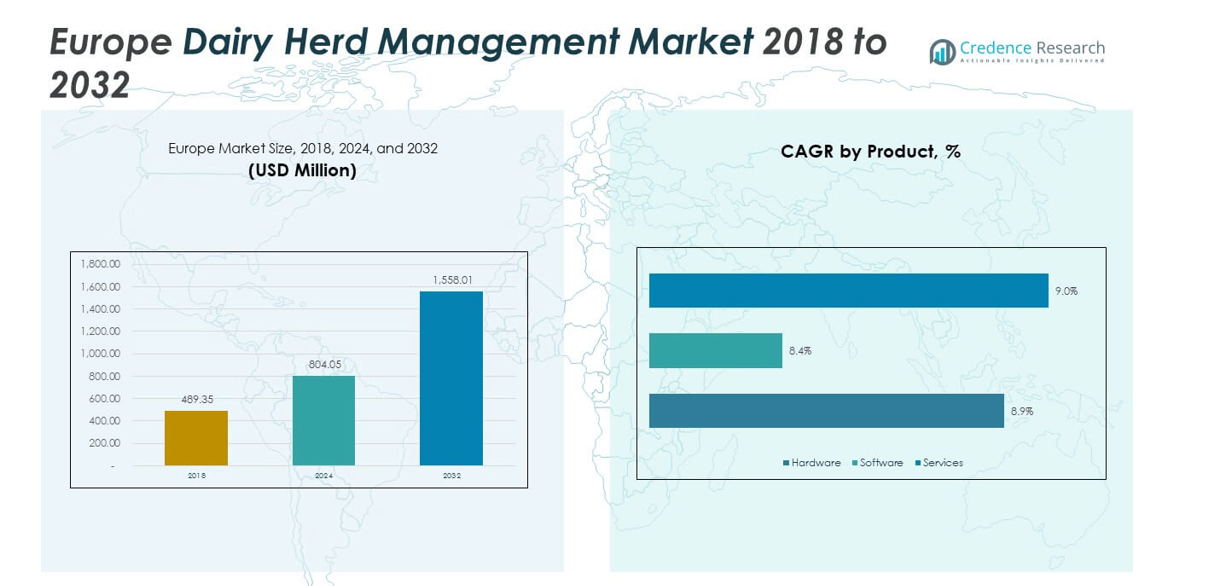
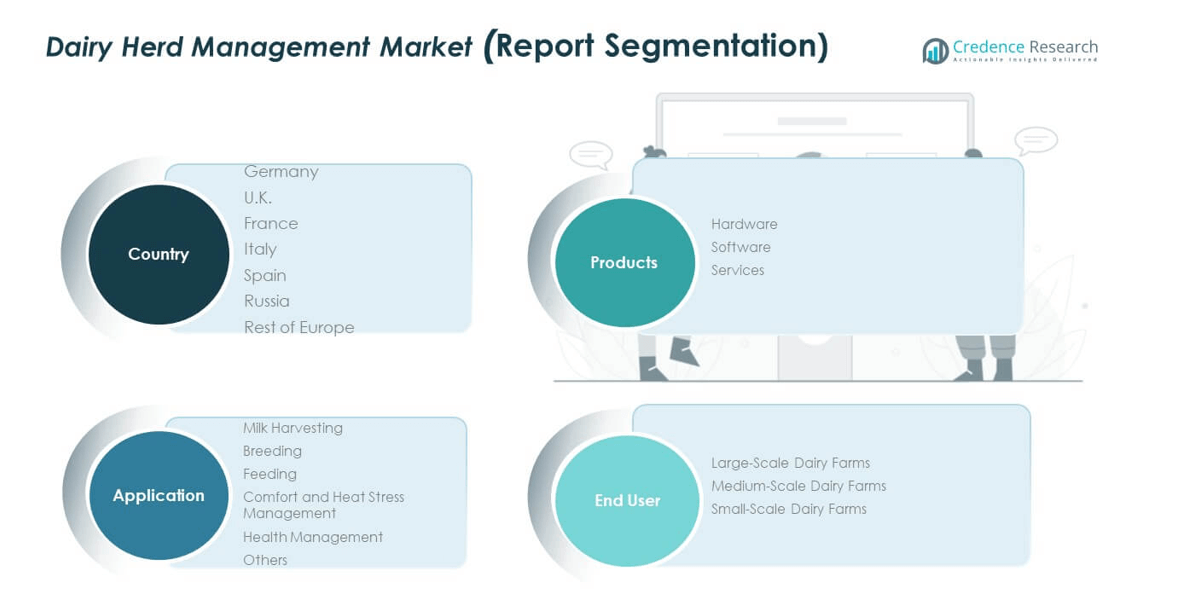
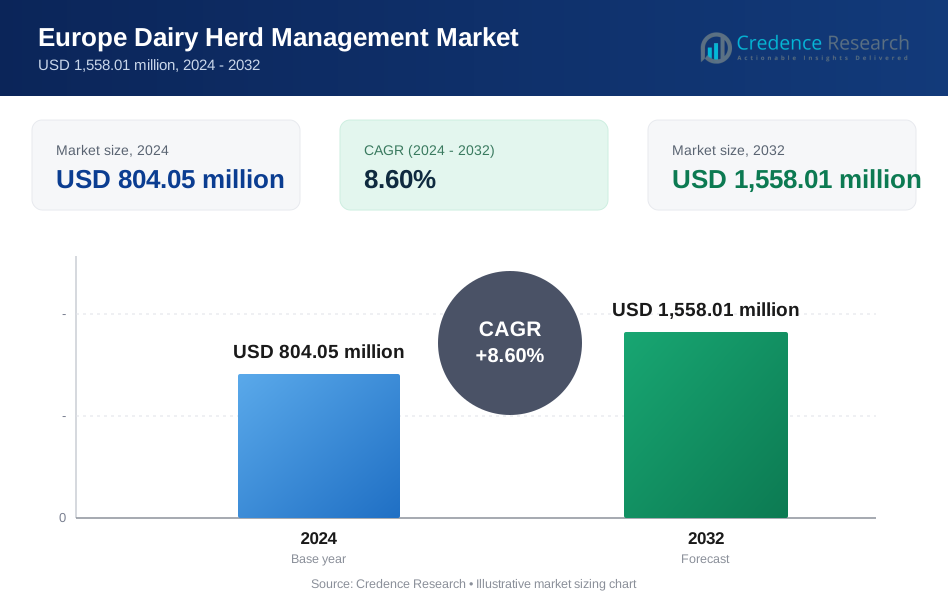
The Europe Dairy Herd Management Market size was valued at USD 489.35 million in 2018, reached USD 804.05 million in 2024, and is anticipated to reach USD 1,558.01 million by 2032, at a CAGR of 8.60% during the forecast period.
| REPORT ATTRIBUTE | DETAILS |
|---|---|
| Historical Period | 2020-2023 |
| Base Year | 2024 |
| Forecast Period | 2025-2032 |
| Europe Dairy Herd Management Market Size 2024 | USD 804.05 million |
| Europe Dairy Herd Management Market, CAGR | 8.60% |
| Europe Dairy Herd Management Market Size 2032 | USD 1,558.01 million |
Growth in this market is driven by increasing demand for automation and digital tools in dairy farms. Farmers seek higher productivity, reduced labor costs, and improved herd health, which accelerate adoption. Rising milk consumption, a focus on animal welfare, and supportive government initiatives for smart farming also strengthen the demand for advanced herd management solutions across the region.
Within Europe, Western countries lead adoption due to strong dairy industries, advanced infrastructure, and higher technology penetration. Nations such as Germany, France, and the Netherlands dominate, backed by large-scale dairy operations and robust export markets. Meanwhile, Eastern European countries are emerging, supported by modernization efforts, growing herd sizes, and increasing investments in precision livestock farming technologies.
Market Insights:
- The Europe Dairy Herd Management Market was valued at USD 489.35 million in 2018, reached USD 804.05 million in 2024, and is expected to reach USD 1,558.01 million by 2032, growing at a CAGR of 8.60%.
- Western Europe held the largest share at 45% in 2024, driven by advanced infrastructure and strong dairy exports, followed by Northern Europe with 28% due to its established dairy industry, and Southern Europe with 15% supported by modernization and rising demand for premium dairy products.
- Eastern Europe accounted for 12% of the market in 2024 and is projected to be the fastest-growing region, supported by modernization initiatives, larger herd sizes, and EU funding programs targeting rural development.
- By product, hardware accounted for the largest share in 2024, led by high adoption of automated milking systems and sensor-based monitoring technologies.
- Services and software segments are expanding steadily, together capturing a significant share as farms adopt digital platforms, cloud-based solutions, and after-sales support services for efficiency and compliance.
Market Drivers:
Rising Demand For Automation And Digital Tools Across Dairy Operations
The Europe Dairy Herd Management Market is gaining momentum due to the need for advanced automation. Farmers are adopting precision technologies to improve herd productivity and efficiency. Digital herd monitoring systems reduce labor dependence and ensure better resource use. Strong focus on animal health is driving smart sensors and data analytics integration. Automated systems help reduce manual errors and ensure consistent dairy output. Growing consumer preference for high-quality milk products strengthens adoption of precision solutions. Governments support digital farming initiatives through subsidies and policies. The market is evolving rapidly with rising technological investments across Europe.
- For instance, GEA Group launched an AI-driven Body Condition Scoring (BCS) system in November 2024 that provides real-time monitoring of cow health, leading to a reduction in metabolic disease incidence on farms using this technology across Germany and the Netherlands.
Strong Growth In Milk Consumption And Rising Export Demand Across The Region
Growing domestic and export demand for dairy products is fueling market expansion. Farmers face pressure to increase yields while maintaining high-quality standards. Dairy companies seek consistent supply chains, encouraging farms to adopt management systems. It is driving investments in modern milking parlors and herd tracking tools. High milk exports from Germany, France, and the Netherlands push farmers to modernize. Consumers are demanding organic and safe dairy products, raising pressure for precise monitoring. The market benefits from the rising role of data-driven farm practices. Efficient herd management technologies play a key role in sustaining competitiveness.
Focus On Animal Health And Welfare Driving Advanced Monitoring Systems
Animal health and welfare regulations are shaping the demand for advanced solutions. Farmers use herd management tools to track health indicators in real time. Predictive analytics helps identify diseases early, reducing losses. The Europe Dairy Herd Management Market is witnessing strong uptake of veterinary integration tools. Animal-friendly practices are promoted by both governments and dairy cooperatives. Automated feeding and milking systems reduce stress and improve productivity. The push for sustainable farming encourages the use of welfare-focused technologies. Market players invest in R&D to enhance disease detection and monitoring systems.
Government Support And Policy Incentives Driving Adoption Of Precision Farming
European governments are promoting sustainable and digital farming practices. Subsidies and grants encourage small and mid-sized farmers to adopt technology. The market benefits from policies supporting food safety and supply chain transparency. It is also driven by climate-focused initiatives promoting sustainable herd management. Governments across Western Europe lead with high levels of funding for smart farming. Regulations on emissions and water use push farmers toward automated solutions. Farmers invest in herd management tools to comply with strict dairy quality standards. Government partnerships with private companies strengthen the ecosystem for long-term growth.
Market Trends:
Growing Adoption Of Cloud-Based Herd Management Platforms For Real-Time Decision Making
The Europe Dairy Herd Management Market is witnessing strong adoption of cloud-based solutions. Farmers access real-time data through mobile apps and integrated software. Cloud platforms enable better collaboration between veterinarians, suppliers, and farmers. Data storage on cloud servers ensures scalability and improved record-keeping. The shift reduces reliance on manual logs and enhances transparency. Mobile access allows farmers to make quick operational decisions. It is becoming essential for large dairy farms managing multiple herds. Cloud adoption is strengthening overall efficiency and control across dairy operations.
- For instance, Reaseheath College’s partnership with Rare Earth Digital introduced a cloud-based farm data platform piloted with four UK dairy farms starting in April 2018, improving operational decision-making speed through real-time dashboards.
Integration Of Artificial Intelligence And Predictive Analytics For Herd Productivity
Artificial intelligence is driving predictive tools for herd monitoring. Machine learning models assess feeding patterns, reproduction cycles, and health risks. The Europe Dairy Herd Management Market is transforming with advanced decision-support systems. AI helps detect anomalies early, ensuring quick intervention. Farmers use predictive analytics to reduce veterinary costs and increase yields. Data-driven insights are improving herd longevity and milk quality. AI integration also enhances automation in feeding and milking systems. It is expected to redefine dairy herd management across Europe in the coming years.
Expansion Of Robotic Milking And Feeding Systems Across Large And Medium Farms
Robotic systems are becoming central to herd management modernization. Farmers use automated feeders and milkers to improve efficiency and consistency. The Europe Dairy Herd Management Market is expanding with robotics integration. Robots reduce labor costs while ensuring steady dairy output. Advanced sensors track individual cow behavior during milking and feeding. Farmers benefit from higher productivity with reduced physical strain. Robotic systems also provide accurate data for herd analysis. Market players invest heavily in robotics to meet rising demand.
Rising Focus On Sustainability And Eco-Friendly Farming Practices
Sustainability is becoming a key trend in dairy herd management. Farmers adopt technologies to reduce waste, emissions, and resource consumption. The Europe Dairy Herd Management Market is aligned with climate-focused initiatives. Energy-efficient systems reduce costs and environmental impact. Precision water and feed management ensures sustainable operations. Farmers are adapting eco-friendly practices to meet consumer and regulatory expectations. Sustainability-focused certifications encourage the adoption of green technologies. The trend is reshaping the dairy industry with long-term environmental goals.
Market Challenges Analysis:
High Costs Of Technology Implementation And Limited Access For Small Farmers
The Europe Dairy Herd Management Market faces challenges with high adoption costs. Many small farms struggle to afford advanced herd management systems. The high price of robotic milkers, smart sensors, and AI tools limits adoption. It restricts growth among small and medium enterprises in rural areas. Farmers often rely on subsidies, which are not uniform across the region. Limited financial resources hinder access to the latest technologies. Market penetration is slower in Eastern Europe due to income disparities. Cost remains a critical barrier for achieving full-scale modernization.
Complex Integration And Data Management Issues Across Diverse Farming Systems
Integration of multiple herd management tools poses operational challenges. Farmers face difficulties in connecting sensors, software, and automated equipment. The Europe Dairy Herd Management Market requires smooth interoperability for efficiency. Data fragmentation across platforms creates inefficiencies and slows decision-making. Farmers with limited technical expertise face hurdles in managing digital systems. Cybersecurity risks are rising with increased data reliance. Resistance to change among traditional farmers also restricts adoption. These integration challenges impact seamless growth in technology adoption.
Market Opportunities:
Expansion Of Precision Livestock Farming Solutions In Emerging Regions
The Europe Dairy Herd Management Market is witnessing new opportunities in emerging regions. Eastern Europe is showing rapid adoption of smart farming tools. Rising herd sizes and modernization efforts fuel demand for management solutions. Affordable precision tools are enabling medium farms to improve productivity. Farmers adopt real-time monitoring to address labor shortages. Support from EU funding programs boosts adoption in rural areas. It is creating scope for international companies to expand market presence. Emerging regions are positioned as key growth frontiers for the market.
Rising Collaborations And Technological Innovations Driving Market Penetration
Technology providers are forming partnerships with dairy cooperatives and research institutes. The Europe Dairy Herd Management Market is benefiting from joint development programs. Collaborations accelerate innovation in robotic milking, predictive health tools, and AI platforms. Start-ups contribute affordable solutions tailored for small-scale farmers. Strategic partnerships expand distribution channels and improve awareness. Growing emphasis on digital transformation supports higher adoption rates. It is driving market penetration across both developed and developing areas. Continuous innovation will play a critical role in sustaining long-term growth.
Market Segmentation Analysis:
By Product
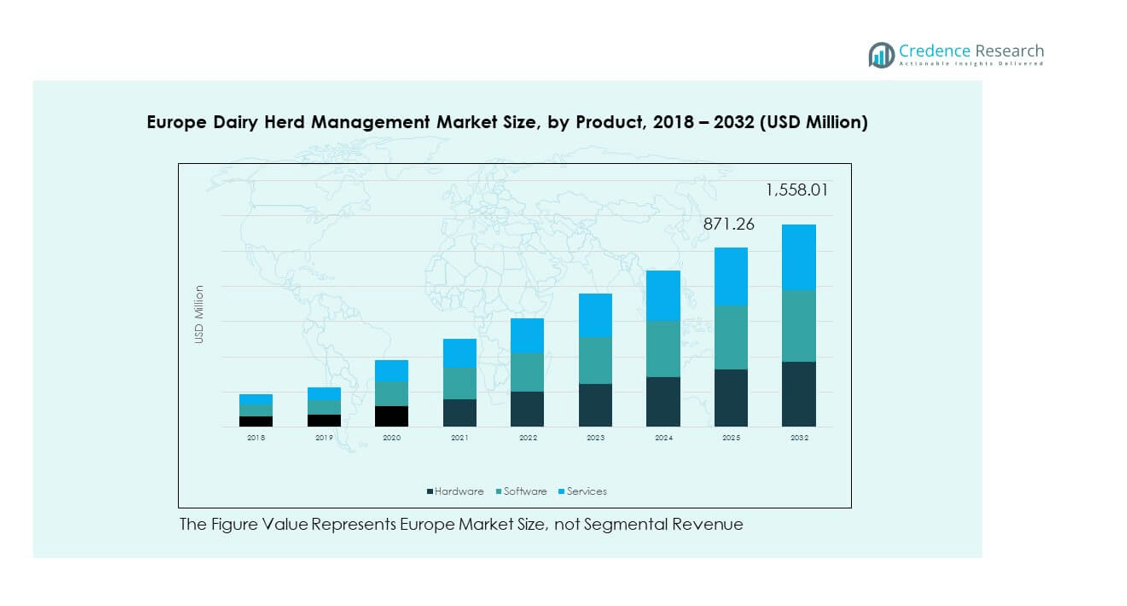
The Europe Dairy Herd Management Market is segmented into hardware, software, and services. Hardware such as automated milking systems, sensors, and monitoring devices dominate due to their direct role in improving efficiency and productivity. Software solutions are gaining traction with increasing reliance on data-driven decision-making and real-time monitoring. Services contribute by offering installation, maintenance, and training support that ensure effective adoption of technology across different farm sizes. Together, these segments create a balanced ecosystem for modern dairy operations.
- For instance, Afimilk Ltd., a key player in Europe, supplies automated milk meters and cow monitoring systems that have been implemented on over 500 farms across Europe in 2024, delivering up to 25% labor savings and enhanced milk yield tracking through their software platforms.
By Application
The market covers applications in milk harvesting, breeding, feeding, comfort and heat stress management, health management, and others. Milk harvesting holds a strong share due to demand for precision milking systems that enhance yield and quality. Breeding and feeding solutions are essential for optimizing herd productivity and nutrition. Comfort and heat stress management tools support animal welfare, while health management remains critical for disease prevention and early diagnosis. Other applications address niche requirements, expanding the scope of herd management systems.
- For instance, in 2024, Lely's automated milking robots continued to help farms improve operations, with robotic systems generally allowing for increased milking frequency, which enhances milk production and gives farmers more flexibility by reducing manual labor requirements.
By End User
End users include large-scale, medium-scale, and small-scale dairy farms. Large-scale farms lead adoption because of their capacity to invest in advanced automation and integrated solutions. Medium-scale farms are expanding their usage to remain competitive and address labor challenges. Small-scale farms face cost barriers but benefit from tailored, affordable solutions supported by government initiatives. The segmentation highlights varying adoption rates across farm sizes, shaping future growth patterns across the region.
Segmentation:
- By Product
- Hardware
- Software
- Services
- By Application
- Milk Harvesting
- Breeding
- Feeding
- Comfort and Heat Stress Management
- Health Management
- Others
- By End User
- Large-Scale Dairy Farms
- Medium-Scale Dairy Farms
- Small-Scale Dairy Farms
- By Country (Europe)
- Germany
- U.K.
- France
- Italy
- Spain
- Russia
- Rest of Europe
Regional Analysis:
Western Europe Leading With Strong Market Share
Western Europe dominates the Europe Dairy Herd Management Market with a share of nearly 45% in 2024. Countries such as Germany, France, and the Netherlands drive demand due to their large-scale dairy operations and advanced infrastructure. These nations focus heavily on automation, precision farming, and export-driven dairy production. Strong government support for sustainable farming and food safety compliance accelerates adoption of herd management solutions. Farmers in this region rely on advanced milking systems, health monitoring devices, and cloud-based software for operational efficiency. Western Europe will continue to lead due to its mature dairy sector and consistent technology investments.
Northern And Southern Europe Expanding Adoption
Northern Europe holds about 28% market share, supported by well-established dairy industries in Denmark, Ireland, and Sweden. Farmers emphasize animal welfare, organic dairy, and sustainability, encouraging the use of advanced herd management tools. Southern Europe accounts for around 15% of the market, with growth in Italy, Spain, and Portugal. Rising demand for high-quality dairy products and modernization of traditional farms drive investments in automation. Heat stress management solutions gain importance in Southern regions due to climate conditions. These markets are expanding steadily, supported by EU funding and growing export opportunities.
Eastern Europe Emerging As High-Growth Region
Eastern Europe represents close to 12% of the Europe Dairy Herd Management Market in 2024. It is emerging as a high-growth region due to modernization efforts and increasing herd sizes. Countries such as Poland and Hungary invest in automation to boost productivity and meet rising domestic demand. Small and medium farms in these markets face cost barriers, but affordable technologies are improving accessibility. Government-backed initiatives for digital farming and rural development support adoption. Eastern Europe is expected to witness faster growth compared to mature markets, making it a critical frontier for future expansion.
Key Player Analysis:
- DeLaval
- BouMatic
- DairyMaster
- Merck & Co., Inc.
- Afimilk Ltd.
- GEA Group Aktiengesellschaft
- Fullwood JOZ
- Lely
- Nedap N.V.
Competitive Analysis:
The Europe Dairy Herd Management Market is highly competitive, driven by the presence of global leaders and regional specialists. Companies such as DeLaval, BouMatic, GEA Group, Afimilk, and Lely dominate through extensive product portfolios, advanced automation technologies, and strategic partnerships. It is defined by strong investments in digital platforms, cloud-based monitoring, and robotic milking systems. Smaller players contribute by offering affordable solutions tailored for medium and small farms. Competitive advantage is built on innovation, customer service, and integration of advanced analytics. Partnerships with cooperatives and government-backed initiatives further strengthen market positioning.
Recent Developments:
- In May 2025, DeLaval launched the 2025 model of its voluntary milking system (VMS) V300 series. This new model is faster, smarter, and more spacious, accommodating a wider range of cow breeds and sizes. It introduces Flow-Responsive Milking technology, reducing milking time by up to 40 seconds per cow and enhancing milking comfort.
- In 2025, BouMatic announced a strategic brand merger with SAC Group, which they had acquired in October 2021. This merger is aimed to be completed by the end of 2025, creating a unified brand identity to better serve future-oriented dairy farmers. The consolidation enhances the product portfolio and dealer network, promising integrated services and operational efficiency across Europe.
- Dairymaster highlighted the Farming Equipment and Technology Fund (FETF) 2025 in the UK, supporting UK farmers in upgrading productivity, slurry management, and animal health through eligible Dairymaster products. Their solutions focus on cow well-being and efficient milking, with innovations such as the MobiStar Swing and MobiGoat parlors designed to improve efficiency and adaptability on farms. Their systems mimic natural calf suckling to reduce stress and improve milk yield.
Report Coverage:
The research report offers an in-depth analysis based on product, application, and end-user segments. It details leading market players, providing an overview of their business, product offerings, investments, revenue streams, and key applications. Additionally, the report includes insights into the competitive environment, SWOT analysis, current market trends, as well as the primary drivers and constraints. Furthermore, it discusses various factors that have driven market expansion in recent years. The report also explores market dynamics, regulatory scenarios, and technological advancements that are shaping the industry. It assesses the impact of external factors and global economic changes on market growth. Lastly, it provides strategic recommendations for new entrants and established companies to navigate the complexities of the market.
Future Outlook:
- Demand for automation in dairy farms will accelerate across Western and Northern Europe.
- Adoption of cloud-based herd management platforms will grow significantly.
- Robotics in milking and feeding systems will see wider deployment in large farms.
- Health monitoring and disease prevention technologies will gain stronger traction.
- Eastern Europe will emerge as a key high-growth frontier in the market.
- Animal welfare regulations will shape investments in comfort and stress management tools.
- Breeding and feeding applications will expand due to focus on productivity optimization.
- Partnerships between global companies and local cooperatives will rise.
- Sustainable and eco-friendly technologies will see higher adoption across the region.
- Digital transformation will redefine the competitive landscape, favoring early adopters.
Request a Free Sample
Fill in your details and we'll send you a free sample report.
- Sample data tables & charts
- Research methodology
Need a Custom Version of This Report?
Tailor the scope, geography, or segments to your exact requirements.
- Custom geography or segment scope
- Direct access to our analyst team
Frequently Asked Questions
What is the current market size for Europe Dairy Herd Management Market, and what is its projected size in 2032?
At what Compound Annual Growth Rate is the Europe Dairy Herd Management Market projected to grow between 2024 and 2032?
Which Europe Dairy Herd Management Market segment held the largest share in 2024?
What are the primary factors fueling the growth of the Europe Dairy Herd Management Market?
Who are the leading companies in the Europe Dairy Herd Management Market?
Table of Content
Chapter 1. Report Introduction
- 1.1 Report Description & Purpose
- 1.1.1 Report Title & Market Definition
- 1.1.2 Unique Selling Propositions (USP) & Key Differentiators
- 1.1.3 Value Proposition for Stakeholders
- 1.2 Research Objectives
- 1.2.1 Market Sizing Objectives (Volume & Revenue)
- 1.2.2 Segmentation Objectives
- 1.2.3 Competitive Intelligence Objectives
- 1.2.4 Forecast & Scenario Objectives
- 1.3 Report Scope
- 1.3.1 Europe Dairy Herd Management Scope – Types & Subtypes Covered
- 1.3.2 Geographic Scope – Regions & Countries Covered
- 1.3.3 Historical Period, Base Year & Forecast Period (2024; forecast to 2032)
- 1.3.4 Inclusions & Exclusions
- 1.4 HS Code & Classification Framework
- 1.5 Currency, Units & Pricing Basis
- 1.6 Target Stakeholders
- 1.7 Limitations & Assumptions
Chapter 2. Executive Summary
- 2.1 Global Europe Dairy Herd Management Market Snapshot
- 2.1.1 Market Size – Historical (2024) & Forecast (2024-2032) (2024: USD 804.05 million → 2032: USD 1,558.01 million)
- 2.1.2 Volume & Revenue – Global Totals
- 2.1.3 Key Market Highlights – Top Five Facts
- 2.2 Europe Dairy Herd Management Market Segmentation Snapshot
- 2.2.1 Market Split by Region – 2024 vs. 2032
- 2.3 Competitive Snapshot
- 2.3.1 Top 10 Players by Revenue Share – 2024
- 2.3.2 Top 10 Players by Volume Share – 2024
- 2.3.3 Recent Strategic Developments (18-Month Summary)
- 2.4 Key Investment Highlights & Strategic Conclusions
Chapter 3. Europe Dairy Herd Management Market Dynamics & Industry Analysis
- 3.1 Market Overview & Context
- 3.1.1 Europe Dairy Herd Management Market Position in the Broader Automotive Value Chain
- 3.1.2 OEM vs. Replacement Market Dynamics
- 3.1.3 Market Maturity & Development Stage by Region
- 3.2 Europe Dairy Herd Management Market Drivers
- 3.3 Europe Dairy Herd Management Market Restraints & Challenges
- 3.4 Europe Dairy Herd Management Market Opportunities
- 3.5 Porter's Five Forces Analysis
- 3.5.1 Threat of New Entrants
- 3.5.2 Bargaining Power of Suppliers
- 3.5.3 Bargaining Power of Buyers
- 3.5.4 Threat of Substitutes
- 3.5.5 Competitive Rivalry – Intensity Assessment
- 3.6 Europe Dairy Herd Management Value Chain Analysis
- 3.6.1 Upstream – Raw Material/Input Suppliers
- 3.6.1.1 Raw Material/Input 1
- 3.6.1.2 Raw Material/Input 2
- 3.6.1.3 Raw Material/Input 3
- 3.6.2 Midstream – Production/Manufacturing/Service Delivery
- 3.6.2.1 Production/Process Overview
- 3.6.2.2 Key Facility Locations & Capacity by Manufacturer
- 3.6.3 Downstream – Distribution & End Consumer
- 3.6.3.1 Primary Channel – B2B/OEM
- 3.6.3.2 Secondary Channels – Dealer, Retail, Online, Direct
- 3.6.4 Value Chain Profitability Analysis
- 3.6.1 Upstream – Raw Material/Input Suppliers
- 3.7 PESTEL Analysis
- 3.7.1 Political Factors
- 3.7.2 Economic Factors
- 3.7.3 Social Factors
- 3.7.4 Technological Factors
- 3.7.5 Environmental Factors
- 3.7.6 Legal Factors
- 3.8 Europe Dairy Herd Management Supply Chain Analysis
- 3.8.1 Raw Material/Input Supply Risk Assessment
- 3.8.2 Manufacturing Concentration Risk (Geographic Exposure)
- 3.8.3 Trade Disruption Impact Analysis
- 3.9 Regulatory & Policy Landscape
Note: The regulatory and policy landscape section covers regulations based on their applicability to the market, Europe Dairy Herd Management category, geography, and scope of the study. Only regulatory frameworks with a material impact on operations, compliance, trade, sustainability, or market access are analyzed in detail.
Chapter 4. Key Investment Pockets & Opportunity Analysis
- 4.1 Europe Dairy Herd Management Market Attractiveness Analysis
- 4.1.1 By Region – Investment Attractiveness Matrix (Volume × CAGR)
- 4.2 Absolute Revenue Growth Opportunity
- 4.2.1 By Region – Absolute USD Growth Through 2032
- 4.3 Incremental Volume Opportunity
- 4.3.1 By Region – Incremental Volume Through 2032
- 4.3.2 Segment – Incremental Volume
- 4.4 Emerging Submarket Opportunity Deep Dive (Subject to Applicability)
- 4.5 Emerging Market Opportunity Scorecards
- 4.5.1 United States
- 4.5.2 Europe
- 4.5.3 Asia
- 4.5.4 Middle East & Africa
Note: Emerging Market Opportunity Scorecards will be included based on relevance and strategic importance. Regions listed are indicative and may vary depending on data availability and market dynamics.
Chapter 5. Europe Dairy Herd Management Import-Export Analysis & Trade Flows
- 5.1 Global Trade Overview
- 5.1.1 Global Export Value by Country (2024)
- 5.1.2 Global Export Volume by Country (2024)
- 5.1.3 Global Import Value by Country (2024)
- 5.1.4 Global Import Volume by Country (2024)
- 5.1.5 Net Trade Balance by Country (2024)
- 5.2 Export Analysis – Segment
- 5.2.1 Type 1 (HS Code)
- 5.2.2 Type 2 (HS Code)
- 5.2.3 Type 3 (HS Code)
- 5.2.4 Type 4 (HS Code)
- 5.2.5 Type 5 (HS Code)
- 5.3 Import Analysis – Segment
- 5.3.1 Type 1 (HS Code)
- 5.3.2 Type 2 (HS Code)
- 5.3.3 Type 3 (HS Code)
- 5.3.4 Type 4 (HS Code)
- 5.3.5 Type 5 (HS Code)
- 5.4 Average Unit Trade Prices
- 5.4.1 Average Export Price – Segment & Country
- 5.4.2 Average Import Price – Segment & Source Country
- 5.4.3 Price Trends (2024)
- 5.5 Key Trade Route Analysis
- 5.5.1 Trade Route 1
- 5.5.2 Trade Route 2
- 5.5.3 Trade Route 3
- 5.5.4 Trade Route 4
- 5.5.5 Trade Route 5
- 5.6 Trade Policy Impact Assessment
- 5.6.1 US Anti-Dumping & Section 301 Tariffs
- 5.6.2 EU Customs Union Impact
- 5.6.3 Major Free Trade Agreements
- 5.6.4 USMCA Rules of Origin
Note: Trade policy analysis will be included only where relevant to the Europe Dairy Herd Management market.
Chapter 6. Competitive Landscape & Company Benchmarking
- 6.1 Europe Dairy Herd Management Market Concentration & Structure
- 6.1.1 Herfindahl-Hirschman Index (HHI) – vs. 2024
- 6.1.2 Tier 1, Tier 2 & Tier 3 Market Structure
- 6.1.3 Global, Regional & Local Player Dynamics
- 6.2 Europe Dairy Herd Management Market Share Analysis – 2024
- 6.2.1 Global Revenue Share by Company
- 6.2.2 Global Volume Share by Company
- 6.2.3 Regional Revenue Share
- 6.2.4 Market Share Evolution ( vs. 2024)
- 6.2.5 OEM Segment Share by Company
- 6.2.6 Replacement Segment Share by Company
- 6.3 Production/Delivery Capacity & Facility Analysis
- 6.3.1 Global Installed Capacity
- 6.3.2 Capacity Utilization Rates
- 6.3.3 Production/Output Volume
- 6.3.4 Facility Locations & Capacity Map
- 6.3.5 Planned Capacity Additions
- 6.4 Europe Dairy Herd Management Competitive Benchmarking Matrix
- 6.4.1 Revenue, Volume, CAGR & Profitability Comparison
- 6.4.2 Channel Revenue Mix
- 6.4.3 Geographic Revenue Exposure
- 6.4.4 R&D Intensity
- 6.4.5 Sustainability Maturity
- 6.5 Strategic Developments in Europe Dairy Herd Management (Last 24 Months)
- 6.5.1 Mergers, Acquisitions & Divestments
- 6.5.2 New Europe Dairy Herd Management Launches
- 6.5.3 Facility Expansions
- 6.5.4 Strategic Alliances, Joint Ventures & Partnerships
- 6.5.5 Distribution Expansion & Market Entry
- 6.5.6 Sustainability & ESG Initiatives
- 6.6 Competitive Strategy Mapping
- 6.6.1 Leader, Challenger, Follower & Niche Classification
- 6.6.2 Pricing Strategy Comparison
- 6.6.3 Channel Strategy Matrix
Note: Strategic developments are included based on their materiality and the availability of reliable information.
Chapter 7. Global Europe Dairy Herd Management Market – By Distribution Channel
- 7.1 Segment Overview
- 7.1.1 Volume & Revenue Split by Channel (2024 & 2032)
- 7.1.2 Channel Mix Evolution (2024-2032)
Chapter 8. Regional Market Analysis – Global Overview
- 8.1 Global Regional Overview
- 8.1.1 Regional Volume Share
- 8.1.2 Regional Revenue Share
- 8.1.3 Regional Volume by Region
- 8.1.4 Regional Revenue by Region
- 8.1.5 Regional Forecast Through 2032
- 8.2 Cross-Regional Segment Analysis
- 8.2.1 By Distribution Channel
- 8.2.2 By Brand/Price Tier
Chapter 9. North America Europe Dairy Herd Management Market
- 9.1 United States
- 9.2 Canada
- 9.3 Mexico
Chapter 10. Europe Europe Dairy Herd Management Market
- 10.1 Germany
- 10.2 France
- 10.3 Italy
- 10.4 United Kingdom
- 10.5 Spain
- 10.6 Poland
- 10.7 Russia
- 10.8 Netherlands
- 10.9 Belgium
- 10.10 Sweden
- 10.11 Denmark
- 10.12 Norway
- 10.13 Rest of Europe
Chapter 11. Asia Pacific Europe Dairy Herd Management Market
- 11.1 China
- 11.2 India
- 11.3 Japan
- 11.4 South Korea
- 11.5 Thailand
- 11.6 Indonesia
- 11.7 Vietnam
- 11.8 Malaysia
- 11.9 Australia
- 11.10 Rest of Asia Pacific
Chapter 12. Latin America Europe Dairy Herd Management Market
- 12.1 Brazil
- 12.2 Argentina
- 12.3 Colombia
- 12.4 Chile
- 12.5 Rest of Latin America
Chapter 13. Middle East Europe Dairy Herd Management Market
- 13.1 Saudi Arabia
- 13.2 United Arab Emirates
- 13.3 Turkey
- 13.4 Israel
- 13.5 Iran
- 13.6 Rest of the Middle East
Chapter 14. Africa Europe Dairy Herd Management Market
- 14.1 South Africa
- 14.2 Egypt
- 14.3 Nigeria
- 14.4 Morocco
- 14.5 Rest of Africa
Chapter 15. Europe Dairy Herd Management Company Profiles
- 15.1 [Company 01]
- 15.1.1 Company Overview
- 15.1.2 Key Management Personnel
- 15.1.3 Products & Services Portfolio
- 15.1.4 Financial Performance
- 15.1.5 Key Market Focus & Geographic Presence
- 15.1.6 Recent Developments & Strategic Initiatives
Note: The company profile list is preliminary and may change based on research findings, market developments, data availability, and client requirements.
Chapter 16. Appendices
- Appendix A – List of Abbreviations & Acronyms
- Appendix B – Industry Classification Code Reference – Full Series
- Appendix C – Production & Capacity Data Tables
- Appendix D – End-Use & Demand Base Tables
- Appendix E – Consumption & Replacement Rate Assumptions
- Appendix F – ASP Reference Tables
- Appendix G – Manufacturing & Facility Database
- Appendix H – Import-Export Data Tables
- Appendix I – Regulatory Summary Tables
- Appendix J – Primary Research Participant List (Anonymized)
- Appendix K – Primary Research Questionnaire Framework
- Appendix L – Data Sources & Bibliography
- Appendix M – Market Size Divergence & Source Comparison
Chapter 17. Research Methodology
- 17.1 Research Framework & Philosophy
- 17.2 Secondary Research – Sources, Hierarchy & Data Extraction
- 17.3 Data Modeling – Bottom-Up & Top-Down Market Sizing
- 17.4 Primary Research – Stakeholder Framework, LOI & Sample Sizes
- 17.5 Forecast Methodology – Regression, Scenario & Sensitivity Analysis
- 17.6 Quality Control – Four-Layer Validation Framework
- 17.7 Limitations & Standard Assumptions
- 17.8 Disclaimer
