
Market Overview
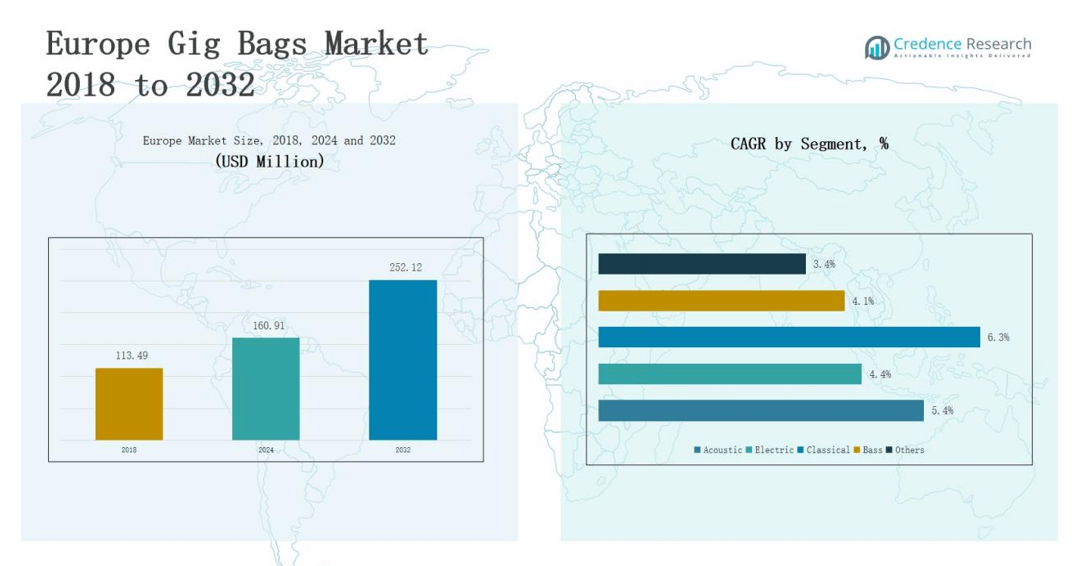
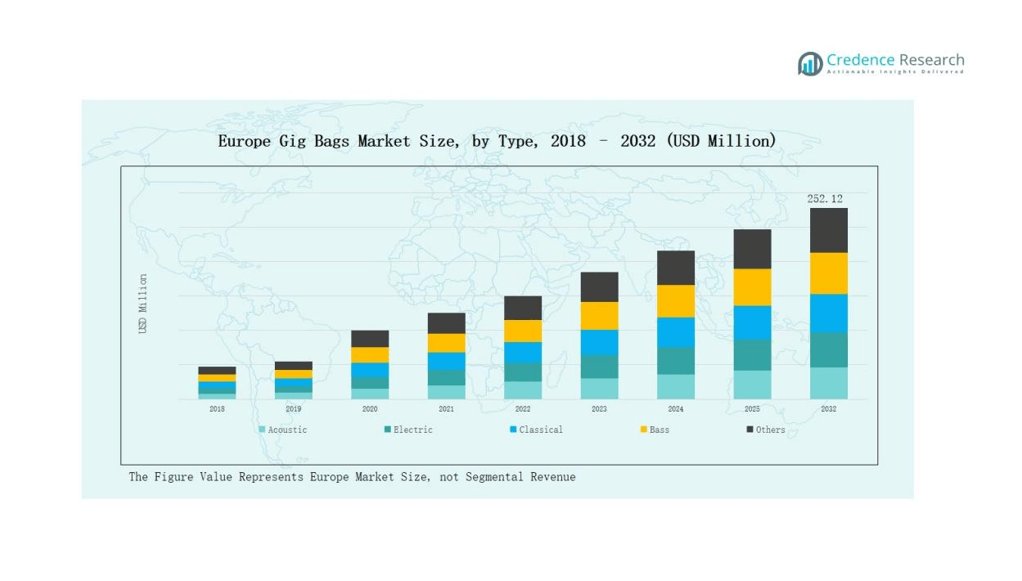
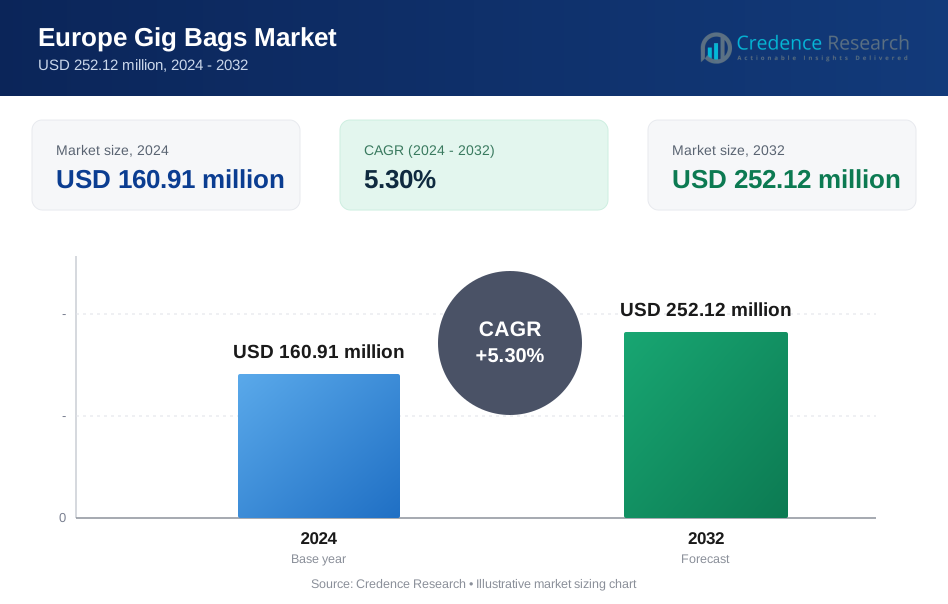
Europe Gig Bags Market size was valued at USD 113.49 million in 2018 to USD 160.91 million in 2024 and is anticipated to reach USD 252.12 million by 2032, at a CAGR of 5.3% during the forecast period.
| REPORT ATTRIBUTE | DETAILS |
|---|---|
| Historical Period | 2020-2023 |
| Base Year | 2024 |
| Forecast Period | 2025-2032 |
| Europe Gig Bags Market Size 2024 | USD 160.91 million |
| Europe Gig Bags Market, CAGR | 5.3% |
| Europe Gig Bags Market Size 2032 | USD 252.12 million |
The Europe Gig Bags Market is shaped by the presence of leading manufacturers that maintain strong competitive positions through product innovation, high-quality materials, and expansive distribution networks. Prominent players cater to both professional and amateur musicians with a diverse range of designs tailored for acoustic, electric, classical, and bass guitars. Among the European countries, Germany leads the market, capturing approximately 28.7% of the regional share, driven by its robust music industry, high consumer demand, and well-established retail infrastructure, which collectively foster sustained market growth.
Market Insights
- The Europe Gig Bags Market grew from USD 113.49 million in 2018 to USD 160.91 million in 2024 and is projected to reach USD 252.12 million by 2032, driven by steady demand across acoustic, electric, classical, and bass segments.
- Growth is fueled by rising music participation, expansion of music education programs, and increased demand from live music events and festivals across major European markets.
- Germany leads with 28.7% market share, followed by the UK (21.4%) and France (15.6%), supported by strong music industries, cultural traditions, and established retail networks.
- The market faces challenges from high fragmentation, price sensitivity in mass segments, and seasonal demand fluctuations impacting inventory and production planning.
- Leading manufacturers leverage innovation, premium materials, ergonomic designs, and customization options to strengthen competitive positioning and capture growth opportunities in both personal and professional user segments.
Market Segment Insights
By Type
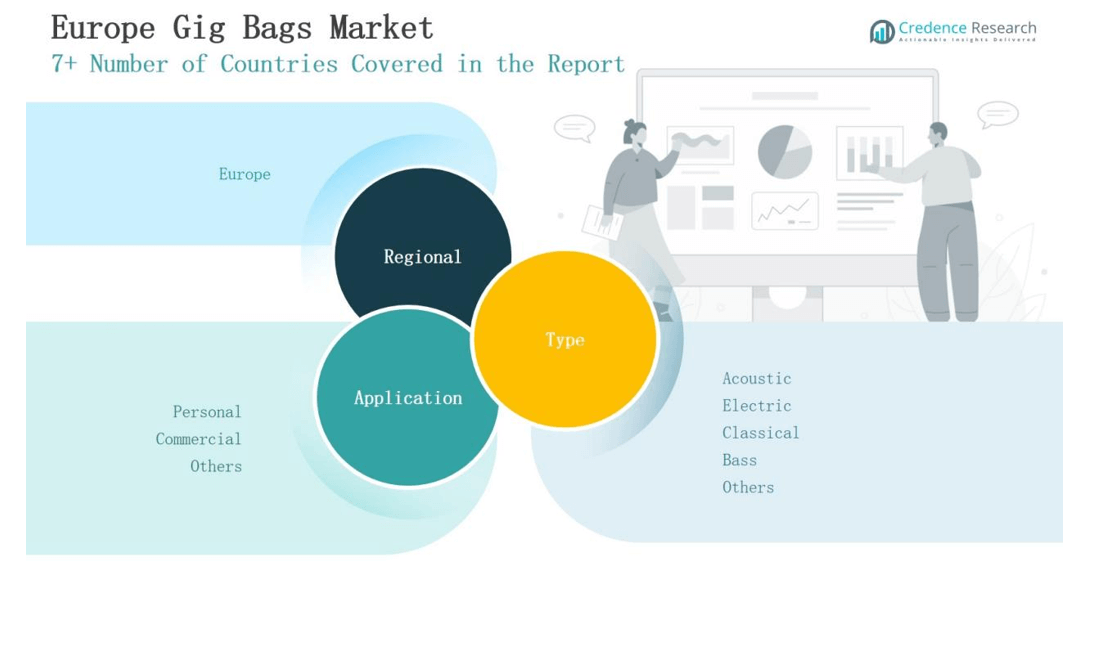
In the Europe Gig Bags Market, the acoustic segment leads due to strong demand from hobbyists, students, and professionals seeking lightweight yet durable protection. The electric segment benefits from Europe’s vibrant contemporary music scene, while classical bags grow steadily through cultural heritage demand. Bass gig bags serve professional needs with reinforced designs, and the others category appeals to niche musicians seeking custom, premium, or multi-purpose carrying solutions.
- For instance, Music Area, serving major brands like Yamaha and F Bass through OEM and ODM services, manufactures premium gig bags focusing on environmentally friendly materials and high protection standards for electric and acoustic guitars.
By Application
The personal segment dominates the Europe Gig Bags Market, driven by widespread guitar use for leisure, education, and semi-professional performances. Consumers prioritize durability, affordability, and style, fueling steady retail and online sales. The commercial segment, including schools, rental services, and event organizers, demands bulk, long-lasting gig bags. The others category, though smaller, grows as brands use custom gig bags for promotional events, artist endorsements, and specialty storage purposes.
- For instance, Ritter Bags offers durable guitar gig bags designed specifically for leisure musicians that balance protection with affordability, appealing to a broad consumer base.
Market Overview
Rising Popularity of Music as a Leisure Activity
The Europe Gig Bags Market benefits from the increasing number of individuals engaging in music as a hobby or semi-professional pursuit. This trend spans all age groups, with growing participation in guitar classes, local bands, and independent performances. Affordable access to instruments and accessories encourages first-time buyers, while experienced musicians invest in higher-quality gig bags for better protection and style. This expanding consumer base sustains steady demand across multiple product categories, including acoustic, electric, classical, and bass gig bags.
- For instance, Italian Guitar Camp 2025 offers intensive guitar workshops and private lessons, attracting rising musicians eager to improve their skills and requiring quality gig bags for their instruments.
Expansion of Music Education Programs
Government and private investments in music education drive consistent gig bag demand across schools, universities, and private academies. Students and trainees require reliable, lightweight, and cost-effective carrying solutions, creating stable recurring orders. In countries with strong cultural traditions in music, such as Germany, Spain, and Italy, institutions prioritize protective gear to maintain instrument quality. Bulk procurement contracts from educational bodies further strengthen sales, particularly in the acoustic and classical segments, where student usage is most prominent.
- For instance, DevMusical, a notable instrument supplier, also manufactures lightweight nylon gig bags for various types of guitars including acoustic, electric, and bass models. Their products emphasize foldability for easy storage and road durability.
Growth in Live Music Events and Festivals
Europe’s vibrant live music scene, including concerts, festivals, and street performances, fuels demand for durable and travel-friendly gig bags. Professional musicians, touring artists, and event participants seek products with enhanced protection, ergonomic carrying systems, and stylish designs. Countries such as the UK, France, and Germany host numerous large-scale music events annually, attracting both local and international performers. This rising activity boosts premium segment sales while increasing replacement cycles due to frequent transport and heavy usage.
Key Trends & Opportunities
Rising Demand for Premium and Customized Gig Bags
Consumers increasingly seek gig bags that combine protection with personalized style, driving growth in premium and custom-designed products. High-quality materials, unique prints, monogram options, and enhanced padding features appeal to musicians who view gig bags as both protective gear and a fashion accessory. Manufacturers leveraging customization services can capture niche, high-margin markets, particularly among professional performers and collectors. This trend opens opportunities for brands to differentiate themselves in a competitive landscape.
- For instance, Bajaao markets their Premium 8mm Padded Electric Guitar Gig Bag, which offers essential protection at an affordable price, catering to gigging musicians who want balance between cost and quality.
Integration of Advanced Materials and Ergonomic Designs
Advancements in lightweight, impact-resistant, and weatherproof materials are reshaping product offerings in the Europe Gig Bags Market. Modern designs focus on enhanced comfort through padded shoulder straps, breathable back panels, and balanced weight distribution. These features address the needs of traveling musicians and frequent performers who prioritize comfort without compromising protection. The adoption of such innovations positions manufacturers to capture a larger share of the premium and professional segments.
- For instance, Thomann’s Fender FE1225 E-Guitar Gig Bag boasts 25 mm of padding combined with soft-touch velour lining and 1200 Denier polyester which delivers both weather resistance and ergonomic support for electric guitar players
Key Challenges
High Market Fragmentation and Intense Competition
The Europe Gig Bags Market is highly fragmented, with numerous global, regional, and local brands competing on price, quality, and design. This competition puts pressure on profit margins, particularly in the mid to low-price segments. Established players face challenges in differentiating their offerings, while smaller brands struggle to compete with larger companies’ distribution reach and marketing budgets. Sustaining brand loyalty in such an environment requires continuous innovation and targeted marketing strategies.
Price Sensitivity in Mass-Market Segments
A significant portion of the market remains highly price-sensitive, especially in the personal-use segment. Many consumers prioritize affordability over premium features, creating challenges for manufacturers aiming to introduce advanced designs at higher price points. This limits the pace of adoption for innovative materials and ergonomic enhancements. Brands must balance cost efficiency with product quality to appeal to budget-conscious buyers without eroding profitability.
Dependence on Seasonal and Event-Driven Demand
Sales in the Europe Gig Bags Market often fluctuate with seasonal trends, school enrollment periods, and the scheduling of major music events. While festival seasons and academic intakes drive spikes in demand, off-peak periods can result in lower sales volumes. This cyclical pattern challenges inventory management and production planning, especially for smaller manufacturers with limited storage or cash flow flexibility. Building stable, year-round sales channels is essential to mitigate this risk.
Regional Analysis
Germany
Germany leads the Europe Gig Bags Market with a 28.7% share, supported by its robust music industry, strong retail infrastructure, and high consumer spending on musical instruments and accessories. The country’s rich tradition in classical and contemporary music sustains steady demand across acoustic, electric, and bass segments. Well-established distribution networks, both online and offline, enable broad product availability. Music schools, conservatories, and live performance venues drive consistent bulk and individual purchases, while the growing trend toward premium and custom gig bags strengthens the market’s value proposition among professional and semi-professional musicians.
United Kingdom
The United Kingdom accounts for 21.4% of the Europe Gig Bags Market, driven by its dynamic live music culture and high concentration of professional and amateur musicians. Demand is fueled by frequent concerts, festivals, and local gigs, which create a need for durable and portable protective gear. Strong e-commerce penetration and specialty retail outlets ensure accessibility to both premium and budget gig bags. The growing influence of independent music artists and the rising popularity of music education programs further support sales, with electric and acoustic segments dominating purchases across the region.
France
France holds a 15.6% share of the Europe Gig Bags Market, underpinned by its vibrant music festivals, cultural heritage, and widespread participation in both classical and modern genres. The acoustic and classical segments benefit from institutional music programs, while the electric segment thrives in urban entertainment hubs. Demand is supported by a mix of professional performers, hobbyists, and music schools, with increasing adoption of ergonomic and weather-resistant designs. Expanding online retail channels and the rising popularity of artisanal, custom-made gig bags also contribute to the market’s upward trajectory in the country.
Italy
Italy captures 12.3% of the Europe Gig Bags Market, driven by its strong tradition in classical and folk music alongside a growing modern music scene. Demand is sustained by music academies, orchestras, and live performance venues that require reliable and protective gig bags. Acoustic and classical guitar segments dominate sales, while the bass segment gains traction among emerging bands and studio musicians. The market benefits from Italy’s reputation for craftsmanship, with locally made premium gig bags appealing to both domestic and international buyers seeking high-quality, aesthetically refined products.
Spain
Spain accounts for 9.8% of the Europe Gig Bags Market, with demand anchored in its deep-rooted guitar culture, especially flamenco and classical traditions. Acoustic and classical gig bags dominate sales, supported by widespread use in music schools and cultural events. Growing interest in contemporary genres and live performances is gradually increasing demand for electric and bass gig bags. Manufacturers focus on lightweight, durable, and affordable designs to meet both professional and personal use requirements. The expansion of online retail platforms has further widened market access, particularly for younger, tech-savvy consumers seeking varied design options.
Russia
Russia holds a 7.5% share of the Europe Gig Bags Market, driven by its large population base and growing interest in both classical and modern music genres. Demand is bolstered by music education programs, state-sponsored cultural events, and an expanding community of independent musicians. Harsh weather conditions encourage the purchase of gig bags with enhanced weatherproofing features. While the market is price-sensitive, there is a rising premium segment driven by professional musicians and collectors. Distribution channels are evolving, with a gradual shift toward online sales despite strong traditional retail networks in major cities.
Rest of Europe
The Rest of Europe region, comprising smaller markets such as the Netherlands, Belgium, and Nordic countries, accounts for 4.7% of the Europe Gig Bags Market. These countries collectively benefit from active music communities, well-established educational programs, and strong consumer interest in both contemporary and classical music. The market is characterized by a preference for high-quality, long-lasting products, with premium gig bags gaining traction. Growth is supported by increasing online retail adoption and cross-border sales from established European brands, enabling smaller countries to access a wide variety of designs and quality levels.
Market Segmentations:
By Type
- Acoustic
- Electric
- Classical
- Bass
- Others
By Application
- Personal
- Commercial
- Others
By Region
- Germany
- UK
- France
- Italy
- Spain
- Russia
- Rest of Europe
Competitive Landscape
The competitive landscape of the Europe Gig Bags Market is characterized by the presence of a mix of global brands, regional manufacturers, and niche players competing on product quality, innovation, and pricing. Leading companies focus on offering diverse portfolios that cater to both professional and amateur musicians, covering acoustic, electric, classical, and bass guitar segments. Established brands leverage extensive distribution networks, strong retailer partnerships, and growing e-commerce channels to maintain market presence, while emerging players target premium and custom segments to differentiate themselves. Competition is further intensified by the introduction of advanced materials, ergonomic designs, and aesthetic enhancements aimed at improving both functionality and visual appeal. Price sensitivity in certain segments pushes manufacturers to balance affordability with durability, creating opportunities for mid-range offerings. Continuous product innovation, strategic collaborations, and targeted marketing campaigns remain critical for companies seeking to expand their footprint and sustain brand loyalty in this fragmented yet steadily growing market.
Key Players
- Ritter Bags
- Fusion Bags
- Stagg
- Harley Benton
- Epivo Retro Guitar Straps
- RightOn! Straps
- Bluebird Vintage Guitar Straps
- Minotaur Guitar Straps
- K&M
- Gruv Gear
Recent Developments
- In March 2024, GiG partnered with firms in Spain and Argentina for its CoreX and SportX platforms, while the Europe gig bags market saw ongoing innovations in lightweight, ergonomic, and high-protection designs.
- In August 2023, RITTER BAGS introduced its Swiss Collection Bern series for brass and woodwind gig bags, featuring enhanced padding and ergonomic design for improved protection and comfort.
- In January 2023, Gator Cases introduced a new line of eco‑friendly gig bags, reflecting a push toward sustainability in product design.
Market Concentration & Characteristics
The competitive landscape of the Europe Gig Bags Market is characterized by the presence of a mix of global brands, regional manufacturers, and niche players competing on product quality, innovation, and pricing. Leading companies focus on offering diverse portfolios that cater to both professional and amateur musicians, covering acoustic, electric, classical, and bass guitar segments. Established brands leverage extensive distribution networks, strong retailer partnerships, and growing e-commerce channels to maintain market presence, while emerging players target premium and custom segments to differentiate themselves. Competition is further intensified by the introduction of advanced materials, ergonomic designs, and aesthetic enhancements aimed at improving both functionality and visual appeal. Price sensitivity in certain segments pushes manufacturers to balance affordability with durability, creating opportunities for mid-range offerings. Continuous product innovation, strategic collaborations, and targeted marketing campaigns remain critical for companies seeking to expand their footprint and sustain brand loyalty in this fragmented yet steadily growing market.
Report Coverage
The research report offers an in-depth analysis based on Type, Application and Region. It details leading market players, providing an overview of their business, product offerings, investments, revenue streams, and key applications. Additionally, the report includes insights into the competitive environment, SWOT analysis, current market trends, as well as the primary drivers and constraints. Furthermore, it discusses various factors that have driven market expansion in recent years. The report also explores market dynamics, regulatory scenarios, and technological advancements that are shaping the industry. It assesses the impact of external factors and global economic changes on market growth. Lastly, it provides strategic recommendations for new entrants and established companies to navigate the complexities of the market.
Future Outlook
- Demand for premium and customized gig bags will increase as musicians seek products that combine protection with personal style.
- Online sales channels will gain a larger share due to growing e-commerce adoption across European countries.
- Adoption of lightweight, weather-resistant, and impact-proof materials will become a key product differentiator.
- Music education programs will continue to generate steady demand for affordable and durable gig bags.
- Live music events and festivals will drive higher sales in professional-grade gig bags.
- Brands will focus on ergonomic designs to enhance comfort for traveling and touring musicians.
- Collaborations between gig bag manufacturers and instrument brands will expand co-branded product offerings.
- Smaller niche players will gain traction through handcrafted and limited-edition designs.
- Sustainability initiatives will lead to increased use of eco-friendly materials in gig bag production.
- Cross-border online retail will enable wider product availability across smaller European markets.
Request a Free Sample
Fill in your details and we'll send you a free sample report.
- Sample data tables & charts
- Research methodology
Need a Custom Version of This Report?
Tailor the scope, geography, or segments to your exact requirements.
- Custom geography or segment scope
- Direct access to our analyst team
Frequently Asked Questions
What is the current market size for Europe Gig Bags Market, and what is its projected size in 2032?
At what Compound Annual Growth Rate is the Europe Gig Bags Market projected to grow between 2025 and 2032?
What are the primary factors fueling the growth of the Europe Gig Bags Market?
Who are the leading companies in the Europe Gig Bags Market?
Table of Content
Chapter 1. Report Introduction
- 1.1 Report Description & Purpose
- 1.1.1 Report Title & Market Definition
- 1.1.2 Unique Selling Propositions (USP) & Key Differentiators
- 1.1.3 Value Proposition for Stakeholders
- 1.2 Research Objectives
- 1.2.1 Market Sizing Objectives (Volume & Revenue)
- 1.2.2 Segmentation Objectives
- 1.2.3 Competitive Intelligence Objectives
- 1.2.4 Forecast & Scenario Objectives
- 1.3 Report Scope
- 1.3.1 Europe Gig Bags Scope – Types & Subtypes Covered
- 1.3.2 Geographic Scope – Regions & Countries Covered
- 1.3.3 Historical Period, Base Year & Forecast Period (2024; forecast to 2032)
- 1.3.4 Inclusions & Exclusions
- 1.4 HS Code & Classification Framework
- 1.5 Currency, Units & Pricing Basis
- 1.6 Target Stakeholders
- 1.7 Limitations & Assumptions
Chapter 2. Executive Summary
- 2.1 Global Europe Gig Bags Market Snapshot
- 2.1.1 Market Size – Historical (2024) & Forecast (2024-2032) (2024: USD 160.91 million → 2032: USD 252.12 million)
- 2.1.2 Volume & Revenue – Global Totals
- 2.1.3 Key Market Highlights – Top Five Facts
- 2.2 Europe Gig Bags Market Segmentation Snapshot
- 2.2.1 Market Split by Region – 2024 vs. 2032
- 2.3 Competitive Snapshot
- 2.3.1 Top 10 Players by Revenue Share – 2024
- 2.3.2 Top 10 Players by Volume Share – 2024
- 2.3.3 Recent Strategic Developments (18-Month Summary)
- 2.4 Key Investment Highlights & Strategic Conclusions
Chapter 3. Europe Gig Bags Market Dynamics & Industry Analysis
- 3.1 Market Overview & Context
- 3.1.1 Europe Gig Bags Market Position in the Broader Automotive Value Chain
- 3.1.2 OEM vs. Replacement Market Dynamics
- 3.1.3 Market Maturity & Development Stage by Region
- 3.2 Europe Gig Bags Market Drivers
- 3.3 Europe Gig Bags Market Restraints & Challenges
- 3.4 Europe Gig Bags Market Opportunities
- 3.5 Porter's Five Forces Analysis
- 3.5.1 Threat of New Entrants
- 3.5.2 Bargaining Power of Suppliers
- 3.5.3 Bargaining Power of Buyers
- 3.5.4 Threat of Substitutes
- 3.5.5 Competitive Rivalry – Intensity Assessment
- 3.6 Europe Gig Bags Value Chain Analysis
- 3.6.1 Upstream – Raw Material/Input Suppliers
- 3.6.1.1 Raw Material/Input 1
- 3.6.1.2 Raw Material/Input 2
- 3.6.1.3 Raw Material/Input 3
- 3.6.2 Midstream – Production/Manufacturing/Service Delivery
- 3.6.2.1 Production/Process Overview
- 3.6.2.2 Key Facility Locations & Capacity by Manufacturer
- 3.6.3 Downstream – Distribution & End Consumer
- 3.6.3.1 Primary Channel – B2B/OEM
- 3.6.3.2 Secondary Channels – Dealer, Retail, Online, Direct
- 3.6.4 Value Chain Profitability Analysis
- 3.6.1 Upstream – Raw Material/Input Suppliers
- 3.7 PESTEL Analysis
- 3.7.1 Political Factors
- 3.7.2 Economic Factors
- 3.7.3 Social Factors
- 3.7.4 Technological Factors
- 3.7.5 Environmental Factors
- 3.7.6 Legal Factors
- 3.8 Europe Gig Bags Supply Chain Analysis
- 3.8.1 Raw Material/Input Supply Risk Assessment
- 3.8.2 Manufacturing Concentration Risk (Geographic Exposure)
- 3.8.3 Trade Disruption Impact Analysis
- 3.9 Regulatory & Policy Landscape
Note: The regulatory and policy landscape section covers regulations based on their applicability to the market, Europe Gig Bags category, geography, and scope of the study. Only regulatory frameworks with a material impact on operations, compliance, trade, sustainability, or market access are analyzed in detail.
Chapter 4. Key Investment Pockets & Opportunity Analysis
- 4.1 Europe Gig Bags Market Attractiveness Analysis
- 4.1.1 By Region – Investment Attractiveness Matrix (Volume × CAGR)
- 4.2 Absolute Revenue Growth Opportunity
- 4.2.1 By Region – Absolute USD Growth Through 2032
- 4.3 Incremental Volume Opportunity
- 4.3.1 By Region – Incremental Volume Through 2032
- 4.3.2 Segment – Incremental Volume
- 4.4 Emerging Submarket Opportunity Deep Dive (Subject to Applicability)
- 4.5 Emerging Market Opportunity Scorecards
- 4.5.1 United States
- 4.5.2 Europe
- 4.5.3 Asia
- 4.5.4 Middle East & Africa
Note: Emerging Market Opportunity Scorecards will be included based on relevance and strategic importance. Regions listed are indicative and may vary depending on data availability and market dynamics.
Chapter 5. Europe Gig Bags Import-Export Analysis & Trade Flows
- 5.1 Global Trade Overview
- 5.1.1 Global Export Value by Country (2024)
- 5.1.2 Global Export Volume by Country (2024)
- 5.1.3 Global Import Value by Country (2024)
- 5.1.4 Global Import Volume by Country (2024)
- 5.1.5 Net Trade Balance by Country (2024)
- 5.2 Export Analysis – Segment
- 5.2.1 Type 1 (HS Code)
- 5.2.2 Type 2 (HS Code)
- 5.2.3 Type 3 (HS Code)
- 5.2.4 Type 4 (HS Code)
- 5.2.5 Type 5 (HS Code)
- 5.3 Import Analysis – Segment
- 5.3.1 Type 1 (HS Code)
- 5.3.2 Type 2 (HS Code)
- 5.3.3 Type 3 (HS Code)
- 5.3.4 Type 4 (HS Code)
- 5.3.5 Type 5 (HS Code)
- 5.4 Average Unit Trade Prices
- 5.4.1 Average Export Price – Segment & Country
- 5.4.2 Average Import Price – Segment & Source Country
- 5.4.3 Price Trends (2024)
- 5.5 Key Trade Route Analysis
- 5.5.1 Trade Route 1
- 5.5.2 Trade Route 2
- 5.5.3 Trade Route 3
- 5.5.4 Trade Route 4
- 5.5.5 Trade Route 5
- 5.6 Trade Policy Impact Assessment
- 5.6.1 US Anti-Dumping & Section 301 Tariffs
- 5.6.2 EU Customs Union Impact
- 5.6.3 Major Free Trade Agreements
- 5.6.4 USMCA Rules of Origin
Note: Trade policy analysis will be included only where relevant to the Europe Gig Bags market.
Chapter 6. Competitive Landscape & Company Benchmarking
- 6.1 Europe Gig Bags Market Concentration & Structure
- 6.1.1 Herfindahl-Hirschman Index (HHI) – vs. 2024
- 6.1.2 Tier 1, Tier 2 & Tier 3 Market Structure
- 6.1.3 Global, Regional & Local Player Dynamics
- 6.2 Europe Gig Bags Market Share Analysis – 2024
- 6.2.1 Global Revenue Share by Company
- 6.2.2 Global Volume Share by Company
- 6.2.3 Regional Revenue Share
- 6.2.4 Market Share Evolution ( vs. 2024)
- 6.2.5 OEM Segment Share by Company
- 6.2.6 Replacement Segment Share by Company
- 6.3 Production/Delivery Capacity & Facility Analysis
- 6.3.1 Global Installed Capacity
- 6.3.2 Capacity Utilization Rates
- 6.3.3 Production/Output Volume
- 6.3.4 Facility Locations & Capacity Map
- 6.3.5 Planned Capacity Additions
- 6.4 Europe Gig Bags Competitive Benchmarking Matrix
- 6.4.1 Revenue, Volume, CAGR & Profitability Comparison
- 6.4.2 Channel Revenue Mix
- 6.4.3 Geographic Revenue Exposure
- 6.4.4 R&D Intensity
- 6.4.5 Sustainability Maturity
- 6.5 Strategic Developments in Europe Gig Bags (Last 24 Months)
- 6.5.1 Mergers, Acquisitions & Divestments
- 6.5.2 New Europe Gig Bags Launches
- 6.5.3 Facility Expansions
- 6.5.4 Strategic Alliances, Joint Ventures & Partnerships
- 6.5.5 Distribution Expansion & Market Entry
- 6.5.6 Sustainability & ESG Initiatives
- 6.6 Competitive Strategy Mapping
- 6.6.1 Leader, Challenger, Follower & Niche Classification
- 6.6.2 Pricing Strategy Comparison
- 6.6.3 Channel Strategy Matrix
Note: Strategic developments are included based on their materiality and the availability of reliable information.
Chapter 7. Global Europe Gig Bags Market – By Distribution Channel
- 7.1 Segment Overview
- 7.1.1 Volume & Revenue Split by Channel (2024 & 2032)
- 7.1.2 Channel Mix Evolution (2024-2032)
Chapter 8. Regional Market Analysis – Global Overview
- 8.1 Global Regional Overview
- 8.1.1 Regional Volume Share
- 8.1.2 Regional Revenue Share
- 8.1.3 Regional Volume by Region
- 8.1.4 Regional Revenue by Region
- 8.1.5 Regional Forecast Through 2032
- 8.2 Cross-Regional Segment Analysis
- 8.2.1 By Distribution Channel
- 8.2.2 By Brand/Price Tier
Chapter 9. North America Europe Gig Bags Market
- 9.1 United States
- 9.2 Canada
- 9.3 Mexico
Chapter 10. Europe Europe Gig Bags Market
- 10.1 Germany
- 10.2 France
- 10.3 Italy
- 10.4 United Kingdom
- 10.5 Spain
- 10.6 Poland
- 10.7 Russia
- 10.8 Netherlands
- 10.9 Belgium
- 10.10 Sweden
- 10.11 Denmark
- 10.12 Norway
- 10.13 Rest of Europe
Chapter 11. Asia Pacific Europe Gig Bags Market
- 11.1 China
- 11.2 India
- 11.3 Japan
- 11.4 South Korea
- 11.5 Thailand
- 11.6 Indonesia
- 11.7 Vietnam
- 11.8 Malaysia
- 11.9 Australia
- 11.10 Rest of Asia Pacific
Chapter 12. Latin America Europe Gig Bags Market
- 12.1 Brazil
- 12.2 Argentina
- 12.3 Colombia
- 12.4 Chile
- 12.5 Rest of Latin America
Chapter 13. Middle East Europe Gig Bags Market
- 13.1 Saudi Arabia
- 13.2 United Arab Emirates
- 13.3 Turkey
- 13.4 Israel
- 13.5 Iran
- 13.6 Rest of the Middle East
Chapter 14. Africa Europe Gig Bags Market
- 14.1 South Africa
- 14.2 Egypt
- 14.3 Nigeria
- 14.4 Morocco
- 14.5 Rest of Africa
Chapter 15. Europe Gig Bags Company Profiles
- 15.1 [Company 01]
- 15.1.1 Company Overview
- 15.1.2 Key Management Personnel
- 15.1.3 Products & Services Portfolio
- 15.1.4 Financial Performance
- 15.1.5 Key Market Focus & Geographic Presence
- 15.1.6 Recent Developments & Strategic Initiatives
Note: The company profile list is preliminary and may change based on research findings, market developments, data availability, and client requirements.
Chapter 16. Appendices
- Appendix A – List of Abbreviations & Acronyms
- Appendix B – Industry Classification Code Reference – Full Series
- Appendix C – Production & Capacity Data Tables
- Appendix D – End-Use & Demand Base Tables
- Appendix E – Consumption & Replacement Rate Assumptions
- Appendix F – ASP Reference Tables
- Appendix G – Manufacturing & Facility Database
- Appendix H – Import-Export Data Tables
- Appendix I – Regulatory Summary Tables
- Appendix J – Primary Research Participant List (Anonymized)
- Appendix K – Primary Research Questionnaire Framework
- Appendix L – Data Sources & Bibliography
- Appendix M – Market Size Divergence & Source Comparison
Chapter 17. Research Methodology
- 17.1 Research Framework & Philosophy
- 17.2 Secondary Research – Sources, Hierarchy & Data Extraction
- 17.3 Data Modeling – Bottom-Up & Top-Down Market Sizing
- 17.4 Primary Research – Stakeholder Framework, LOI & Sample Sizes
- 17.5 Forecast Methodology – Regression, Scenario & Sensitivity Analysis
- 17.6 Quality Control – Four-Layer Validation Framework
- 17.7 Limitations & Standard Assumptions
- 17.8 Disclaimer
