
Market Overview:
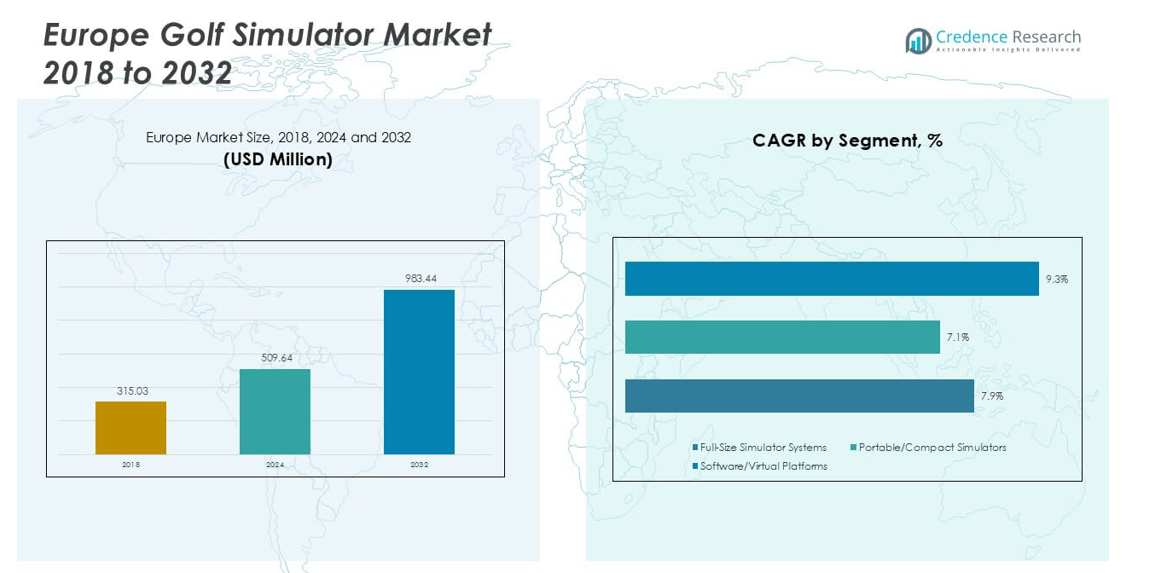
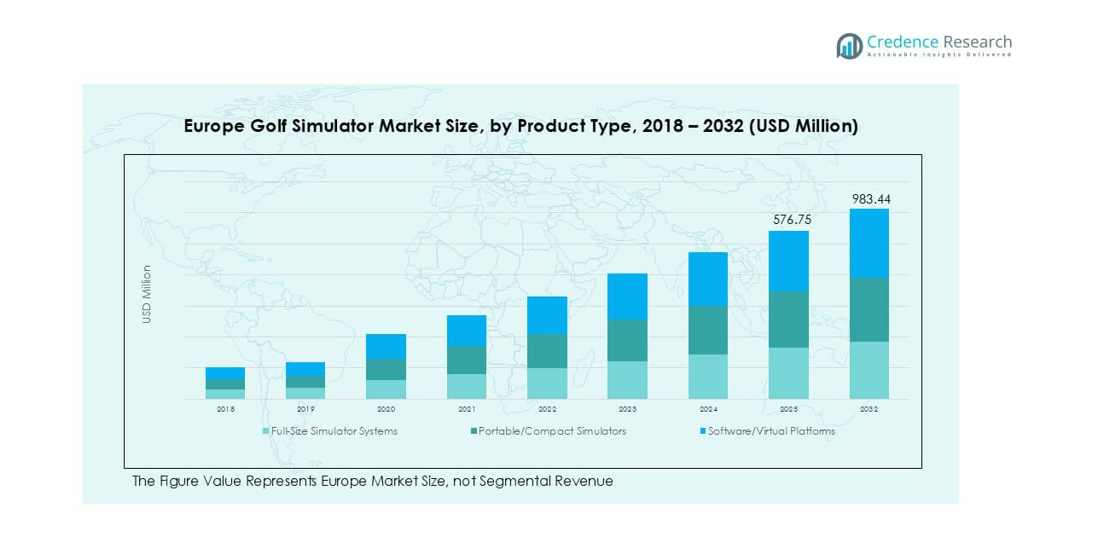
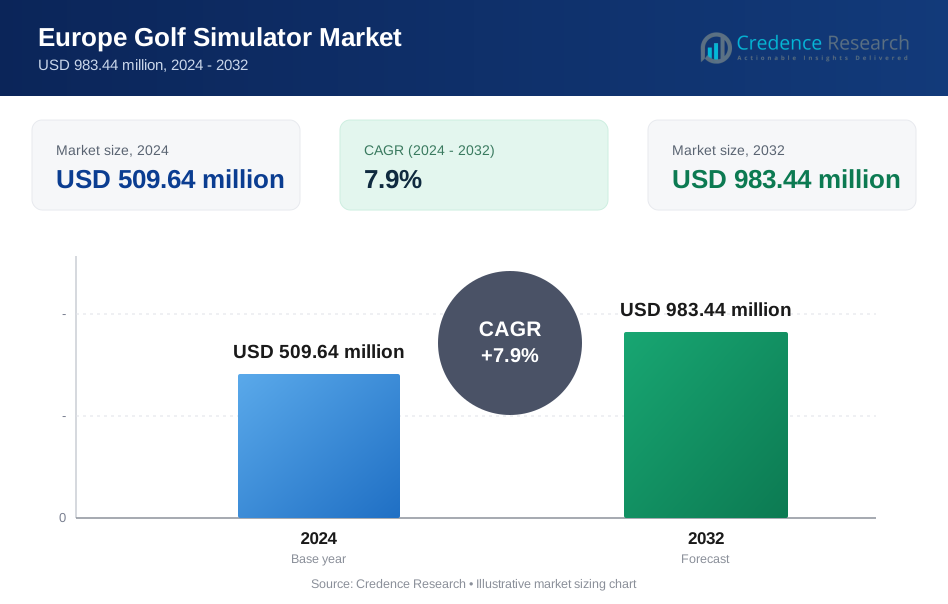
Europe Golf Simulator market size was valued at USD 315.03 million in 2018, reached USD 509.64 million in 2024, and is anticipated to reach USD 983.44 million by 2032, at a CAGR of 7.9% during the forecast period.
| REPORT ATTRIBUTE | DETAILS |
|---|---|
| Historical Period | 2020-2023 |
| Base Year | 2024 |
| Forecast Period | 2025-2032 |
| Europe Golf Simulator Market Size 2024 | USD 509.64 million |
| Europe Golf Simulator Market, CAGR | 7.9% |
| Europe Golf Simulator Market Size 2032 | USD 983.44 million |
The Europe golf simulator market is led by key players such as GOLFZON, Full Swing Golf, TrackMan, X-Golf America, and TruGolf, which together account for over 35% of the regional market share. These companies dominate through advanced camera and radar-based technologies, extensive course libraries, and strategic partnerships with clubs and entertainment venues. Germany leads the regional market with approximately 22% share, followed by the United Kingdom at 20% and France at 15%, driven by strong infrastructure and rising indoor golf adoption. Italy, Spain, and Russia collectively contribute over 28%, with growing demand for residential and commercial installations.
Market Insights
- The Europe golf simulator market was valued at USD 509.64 million in 2024 and is projected to reach USD 983.44 million by 2032, growing at a CAGR of 7.9%.
- Key growth drivers include rising indoor golf demand, technological advancements in camera and radar tracking, and increasing disposable income supporting residential adoption.
- Trends highlight growth in hybrid and VR-enabled systems, subscription-based virtual course libraries, and expansion of simulators in entertainment venues and hotels.
- Competition is moderately fragmented, with GOLFZON, TrackMan, Full Swing Golf, and X-Golf America together holding over 35% share, focusing on premium accuracy and localized content to strengthen presence.
- Germany leads with 22% share, followed by the UK (20%) and France (15%); portable simulators dominate product segments with over 55% share, while indoor installations account for nearly 75% of total setups across the region.
Market Segmentation Analysis:
By Product Type
In Europe, Portable/Compact Simulators dominate product-type share. These units account for well over half of units sold, driven by home users and small business setups. They offer lower cost, easier installation, and mobility, making them particularly appealing in urban settings with limited space. Full-Size Simulator Systems represent a smaller share currently but growing demand from golf clubs, premium hotels, and entertainment centres is pushing their CAGR above average. Software/Virtual Platforms are emerging quickly, aided by improved graphics and VR integration, but still lag hardware in revenue share due to dependencies on system hardware.
- For instance, Golfzon’s TwoVision system is installed in over 1,000 commercial venues across Europe, supporting multiplayer league play with automated tee systems and over 200 virtual courses.
By Installation Type
Indoor Simulators lead the Europe golf simulator market by installation type, capturing the largest share. Harsh or variable weather, shorter outdoor seasons, and high interest in year-round golf practice push demand indoors. Indoor setups in sports clubs, entertainment centres, and private homes are proliferating. Outdoor Simulators represent a smaller but steady segment, mainly used in golf courses or club outdoor practice facilities. Drivers for outdoor include more realistic ball flight (no ceiling interference), but cost of land and exposure to weather limit growth relative to indoor.
- For instance, Five Iron Golf expanded to London in 2024 with a flagship facility featuring 10 simulator bays and AI-enabled swing analysis tools.
By Technology
Among technologies, Camera-based systems are the dominant sub-segment in Europe. They provide high accuracy, better shot feedback, and detailed swing/ball-impact data. Professionals and serious amateurs prefer camera systems for full-swing accuracy and visual feedback. Radar-based (Doppler) tech is rising fast as it tracks ball flight over distance, works well outdoors, and improves regularly. Infrared sensor-based systems serve budget or compact setups (short-range, less space). Hybrid technologies that combine camera + radar + sensors are gaining attraction in premium segments because they merge strengths and reduce weaknesses of single tech types.
Market Overview
Indoor Convenience & Urbanization
Rapid urbanization and limited access to full golf courses in many European cities drive demand for indoor golf simulators. City residents favor year-round golfing options that avoid weather constraints and long travel times. Indoor simulators let players practice anytime, increasing adoption among amateurs and professionals. This driver gains strength as Europe’s population densifies and time becomes more constrained. Also, golf clubs, entertainment centres, and residential buyers invest more in indoor facilities to offer continuous use, boosting market value.
- For instance, Golfzon installed more than 300 simulators across European commercial venues in 2024, expanding access to indoor golf lounges in metropolitan areas.
Technological Enhancement & Realism
Advances in sensor accuracy, camera resolution, physics engines, and software algorithms push realism in golf simulation. Manufacturers integrate radar, camera-based, infrared, and hybrid technologies to improve swing and ball-flight tracking. Virtual reality (VR), augmented reality (AR), and cloud or AI-driven diagnostics also enrich user experience. These enhancements attract serious golfers and training academies, raising willingness to pay premium. As realism improves, simulation becomes more credible versus real-course play, further accelerating market growth.
- For instance, Foresight Sports’ GCQuad captures 10,000 frames per second and delivers ±0.5 mph ball speed precision, trusted by elite training academies.
Rising Disposable Income & Leisure Spending
Higher disposable income in Western and some Central & Eastern European countries encourages investment in leisure and home entertainment. Golf simulators increasingly appear in homes of upper-middle income households, and in commercial entertainment venues. Consumers allocate more budget to gaming, wellness, and tech-driven fun. Moreover, post-COVID shifts toward home-based recreation and health-oriented entertainment further increase spending on indoor simulation devices. This financial capability underpins growth, especially for premium and full-size systems.
Key Trends & Opportunities
Hybrid & Multi-Sensor Systems
A rising trend in Europe involves blending technologies—camera, radar, infrared, sensors—to deliver more complete feedback. Hybrid systems combine best features: precise ball flight from radar, detailed swing data from cameras, quick response from sensors. Users want both entertainment and professional-level training. Suppliers that offer modular or hybrid setups gain competitive edge. This trend opens opportunity for premium product lines and also mid-tier models with optional upgrades.
- For instance, TrackMan’s simulator integrates radar and camera tracking, measuring over 40 club and ball parameters with ±1° accuracy on face angle.
Customization, Content & Subscription Models
Consumers increasingly expect more than hardware: realistic courses, customisable environments, regular software updates. Subscription models for virtual courses or multiplayer platforms present recurring revenue. Content diversity (famous real-world courses, varied landscapes) and modes (practice, tournament, coaching) increase loyalty. Vendors that partner with content creators or offer cloud-based platforms will find strong demand. Geographic customization (local courses) also offers differentiation.
- For instance, TruGolf’s E6 CONNECT platform provides access to over 100 courses with monthly new releases and supports 8-player online tournaments in real time
Growth in Commercial & Entertainment Venues
Golf bars, indoor sports complexes, hotels, and resorts in Europe increasingly add simulator zones. These locations attract non-golfers and social players seeking entertainment. Commercial facilities can amortize high equipment costs and valorize premium systems. Partnerships between simulator makers and venue operators offer turnkey solutions. This trend opens large volume sales beyond residential segment. Venues in lead markets (UK, Germany, France, Scandinavia) present pilot zones for expansion.
Key Challenges
High Capital & Operating Costs
High initial costs of hardware (sensors, cameras, screens), space preparation, installation, and calibration hinder adoption. Premium models, full-size systems, or hybrid technologies demand large capital outlays. Additionally, operating costs—maintenance, software updates, licensing, electricity—can be significant. These costs discourage purchase by price-sensitive consumers or small businesses. Vendors must balance cost vs performance or offer financing/leasing to mitigate this challenge.
Space & Authenticity Constraints
Simulators need enough room for full swing, projectors, screen setup, and safe club movement. Many urban households or small commercial spaces lack this physical capability. Even indoor venues suffer from constraints (ceiling height, lighting). Moreover, users often compare simulator experience with real-world golf and expect high fidelity. If simulation lacks outdoor realism (wind, terrain, feel), satisfaction drops. These constraints limit market in dense urban zones and among traditionalists who value course prestige. Vendors must improve compact designs or portable systems without sacrificing realism to overcome this.
Regional Analysis
Germany
Germany leads regional demand with mature golf infrastructure and strong incomes. Indoor venues expand in major cities like Berlin and Munich. Clubs add simulators for coaching and winter training. Households adopt compact systems for limited space. Corporate hospitality and hotels create premium bays. Universities and academies integrate data-driven practice. Camera-based systems dominate indoor installs. Radar units grow in high-ceiling facilities. Financing and leasing reduce upfront barriers. Content localization improves engagement. E-leagues and events raise visibility. Germany held an estimated 22% market share in 2024.
United Kingdom
Weather variability and urban density sustain year-round indoor play. Golf bars and entertainment chains scale nationwide. Home installations rise among tech-savvy players. Clubs deploy simulators to retain members in winter. Training academies emphasize analytics and coaching. Portable units suit flats and rentals. Hybrid tracking gains traction in premium bays. Venue operators prefer subscription content models. Corporate events drive weekday utilization. Retail partnerships simplify setup and support. Universities explore research and performance labs. The United Kingdom held an estimated 20% market share in 2024.
France
Growth concentrates around Paris, Lyon, and Lille. Compact simulators fit apartments and smaller homes. Clubs modernize practice areas to attract younger golfers. Tourism properties add bays for shoulder seasons. Coaching studios bundle lessons and fittings. Camera-based tech prevails in tight indoor spaces. Portable units appeal to renters and students. Retailers promote turnkey packages. Municipal sports programs test community access models. Brand collaborations highlight French courses in software. Enterprise clients book team-building sessions. France held an estimated 15% market share in 2024.
Italy
Resorts and luxury hotels add premium simulator lounges. Northern cities lead residential adoption. Clubs extend training through hot summers and rainy months. Pro shops use simulators for fittings and upsell. Entertainment centers trial pay-per-play models. Camera systems dominate constrained rooms. Radar grows in larger venues and garages. Leasing reduces capex for SMEs. Content featuring Italian courses improves stickiness. Partnerships with coaches drive referrals. Distributor networks expand after-sales service. Italy held an estimated 11% market share in 2024.
Spain
Golf tourism hubs adopt simulators for off-peak months. Hotels and resorts diversify guest activities. Coastal heat pushes indoor practice in summer. Northern regions value winter continuity. Urban apartments prefer compact systems. Clubs upgrade teaching studios with analytics. Retail chains bundle installs and calibration. Entertainment venues market social play nights. Software subscriptions add local course catalogs. Corporate events supplement weekday demand. Import channels stabilize supply. Spain held an estimated 9% market share in 2024.
Russia
Harsh winters favor indoor simulators in Moscow and St. Petersburg. Corporate fitness centers and hotels lead purchases. High ceilings enable radar installations. Residential buyers choose compact systems. Coaching studios focus on fundamentals and fittings. Supply chains face currency and import constraints. Local distributors provide maintenance coverage. Content partnerships include regional courses. Entertainment venues target affluent districts. Financing options remain limited. Growth is steady but capped by macro risks. Russia held an estimated 8% market share in 2024.
Rest of Europe
Nordics show strong per-capita adoption and premium bays. Benelux markets favor compact home installs. Switzerland leads in luxury hospitality lounges. Austria and Portugal expand club teaching studios. Central and Eastern Europe grow from a low base. Camera-based systems dominate small rooms. Hybrid tech appears in flagship venues. Distributors push turnkey packages with support. Universities and schools pilot programs. Software adds local course libraries. Cross-border e-commerce enhances access. Rest of Europe held an estimated 15% market share in 2024.
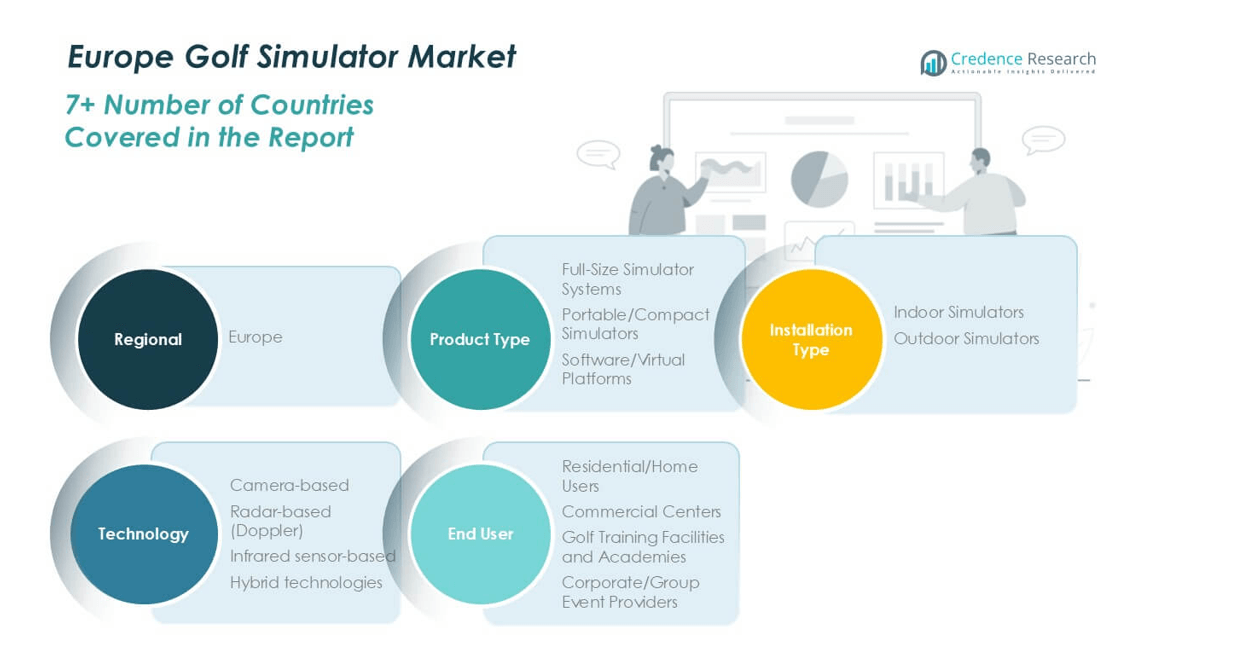
Market Segmentations:
By Product Type
- Full-Size Simulator Systems
- Portable/Compact Simulators
- Software/Virtual Platforms
By Installation Type
- Indoor Simulators
- Outdoor Simulators
By Technology
- Camera-based
- Radar-based (Doppler)
- Infrared sensor-based
- Hybrid technologies
By End User
- Residential/Home Users
- Commercial Centers
- Golf Training Facilities and Academies
- Corporate/Group Event Providers
By Geography
- Germany
- UK
- France
- Italy
- Spain
- Russia
- Rest of Europe
Competitive Landscape
The Europe golf simulator market is moderately fragmented, with several global and regional players competing across product types, technologies, and price points. Leading companies such as GOLFZON, Full Swing Golf, TrackMan, and X-Golf America hold a combined share of over 35%, driven by strong brand recognition, advanced camera and radar technologies, and established distribution networks. These players focus on delivering high-fidelity simulation, cloud-based analytics, and subscription-based virtual course libraries to enhance recurring revenue. Mid-tier competitors emphasize affordability and compact systems for residential buyers, fueling rapid adoption among new golfers. Partnerships with golf clubs, entertainment centers, and hotels are a key strategy to expand commercial presence. The market also sees continuous innovation in hybrid technology and VR-enabled systems, enabling premium experiences. Competitive intensity remains high as companies invest in R&D, after-sales support, and localized content to strengthen market share and customer retention across European countries.
Key Player Analysis
Recent Developments
- In May 2025, IdeasLab launched XView AI, a markerless app that provides real-time, offline analysis of the full golf swing by tracking body, shaft, and club movement. This app is available on the iPhone App Store.
- In May 2025, Golf VX, a provider of indoor golf simulators, announced the opening of its newest franchise location, Golf VX Boston. This marks the company’s second U.S. agreement after the launch of Golf VX Arlington Heights in 2024.
- In April 2025, TruGolf and Digital Legends announced a partnership to launch an advanced golf simulator experience. It is built on TruGolf's Apex platform, featuring AI-driven recreations of legendary players such as Ben Hogan. The simulator will enable users to compete with historic golf figures, receive AI-powered coaching, and engage in tournaments on modern courses.
- In February 2025, Canopy, a remote monitoring and management software provider, partnered with Full Swing Golf. This collaboration allows Full Swing’s support and software teams to leverage Canopy’s platform to enhance the performance, reliability, and remote management of their global simulator fleet.
- In November 2024, Smartgolf LLC launched Smartgolf AI Coach, an advanced device aimed at enhancing golf performance through precise skill improvement. The device uses AI to analyze swing metrics such as speed, distance, angle, and direction, providing instant, detailed feedback via a connected app.
- In January 2022, Golfzon Newdin Group announced an expansion with Leadbetter academies to open high-tech indoor golf facilities in the U.S. in 2022.
Report Coverage
The research report offers an in-depth analysis based on Product Type Installation Type, Technology, End User and Geography. It details leading market players, providing an overview of their business, product offerings, investments, revenue streams, and key applications. Additionally, the report includes insights into the competitive environment, SWOT analysis, current market trends, as well as the primary drivers and constraints. Furthermore, it discusses various factors that have driven market expansion in recent years. The report also explores market dynamics, regulatory scenarios, and technological advancements that are shaping the industry. It assesses the impact of external factors and global economic changes on market growth. Lastly, it provides strategic recommendations for new entrants and established companies to navigate the complexities of the market.
Future Outlook
- The market will grow steadily with rising adoption of indoor simulators in urban areas.
- Portable and compact simulators will continue to dominate due to space efficiency and affordability.
- Camera-based technology will remain the most preferred choice for accuracy and swing analysis.
- Hybrid and VR-integrated systems will gain traction among premium users and training academies.
- Subscription-based course libraries and online tournaments will create recurring revenue streams.
- Hotels, resorts, and entertainment venues will expand simulator installations to attract customers.
- Residential installations will rise as golf participation increases among younger players.
- Partnerships with golf clubs and coaching centers will boost commercial segment growth.
- Technological improvements in sensors and graphics will enhance realism and user experience.
- Northern and Western Europe will continue to lead demand, with Central and Eastern Europe showing fastest growth rates.
Request a Free Sample
Fill in your details and we'll send you a free sample report.
- Sample data tables & charts
- Research methodology
Need a Custom Version of This Report?
Tailor the scope, geography, or segments to your exact requirements.
- Custom geography or segment scope
- Direct access to our analyst team
Frequently Asked Questions
What is the current market size for Europe Golf Simulator market, and what is its projected size in 2032?
At what Compound Annual Growth Rate is the Europe Golf Simulator market projected to grow between 2025 and 2032?
Which Europe Golf Simulator market segment held the largest share in 2024?
What are the primary factors fueling the growth of the Europe Golf Simulator market?
Who are the leading companies in the Europe Golf Simulator market?
Table of Content
Chapter 1. Report Introduction
- 1.1 Report Description & Purpose
- 1.1.1 Report Title & Market Definition
- 1.1.2 Unique Selling Propositions (USP) & Key Differentiators
- 1.1.3 Value Proposition for Stakeholders
- 1.2 Research Objectives
- 1.2.1 Market Sizing Objectives (Volume & Revenue)
- 1.2.2 Segmentation Objectives
- 1.2.3 Competitive Intelligence Objectives
- 1.2.4 Forecast & Scenario Objectives
- 1.3 Report Scope
- 1.3.1 Europe Golf Simulator Scope – Types & Subtypes Covered
- 1.3.2 Geographic Scope – Regions & Countries Covered
- 1.3.3 Historical Period, Base Year & Forecast Period (2024; forecast to 2032)
- 1.3.4 Inclusions & Exclusions
- 1.4 HS Code & Classification Framework
- 1.5 Currency, Units & Pricing Basis
- 1.6 Target Stakeholders
- 1.7 Limitations & Assumptions
Chapter 2. Executive Summary
- 2.1 Global Europe Golf Simulator Market Snapshot
- 2.1.1 Market Size – Historical (2024) & Forecast (2024-2032) (2024: USD 509.64 million → 2032: USD 983.44 million)
- 2.1.2 Volume & Revenue – Global Totals
- 2.1.3 Key Market Highlights – Top Five Facts
- 2.2 Europe Golf Simulator Market Segmentation Snapshot
- 2.2.1 Market Split by Region – 2024 vs. 2032
- 2.3 Competitive Snapshot
- 2.3.1 Top 10 Players by Revenue Share – 2024
- 2.3.2 Top 10 Players by Volume Share – 2024
- 2.3.3 Recent Strategic Developments (18-Month Summary)
- 2.4 Key Investment Highlights & Strategic Conclusions
Chapter 3. Europe Golf Simulator Market Dynamics & Industry Analysis
- 3.1 Market Overview & Context
- 3.1.1 Europe Golf Simulator Market Position in the Broader Automotive Value Chain
- 3.1.2 OEM vs. Replacement Market Dynamics
- 3.1.3 Market Maturity & Development Stage by Region
- 3.2 Europe Golf Simulator Market Drivers
- 3.3 Europe Golf Simulator Market Restraints & Challenges
- 3.4 Europe Golf Simulator Market Opportunities
- 3.5 Porter's Five Forces Analysis
- 3.5.1 Threat of New Entrants
- 3.5.2 Bargaining Power of Suppliers
- 3.5.3 Bargaining Power of Buyers
- 3.5.4 Threat of Substitutes
- 3.5.5 Competitive Rivalry – Intensity Assessment
- 3.6 Europe Golf Simulator Value Chain Analysis
- 3.6.1 Upstream – Raw Material/Input Suppliers
- 3.6.1.1 Raw Material/Input 1
- 3.6.1.2 Raw Material/Input 2
- 3.6.1.3 Raw Material/Input 3
- 3.6.2 Midstream – Production/Manufacturing/Service Delivery
- 3.6.2.1 Production/Process Overview
- 3.6.2.2 Key Facility Locations & Capacity by Manufacturer
- 3.6.3 Downstream – Distribution & End Consumer
- 3.6.3.1 Primary Channel – B2B/OEM
- 3.6.3.2 Secondary Channels – Dealer, Retail, Online, Direct
- 3.6.4 Value Chain Profitability Analysis
- 3.6.1 Upstream – Raw Material/Input Suppliers
- 3.7 PESTEL Analysis
- 3.7.1 Political Factors
- 3.7.2 Economic Factors
- 3.7.3 Social Factors
- 3.7.4 Technological Factors
- 3.7.5 Environmental Factors
- 3.7.6 Legal Factors
- 3.8 Europe Golf Simulator Supply Chain Analysis
- 3.8.1 Raw Material/Input Supply Risk Assessment
- 3.8.2 Manufacturing Concentration Risk (Geographic Exposure)
- 3.8.3 Trade Disruption Impact Analysis
- 3.9 Regulatory & Policy Landscape
Note: The regulatory and policy landscape section covers regulations based on their applicability to the market, Europe Golf Simulator category, geography, and scope of the study. Only regulatory frameworks with a material impact on operations, compliance, trade, sustainability, or market access are analyzed in detail.
Chapter 4. Key Investment Pockets & Opportunity Analysis
- 4.1 Europe Golf Simulator Market Attractiveness Analysis
- 4.1.1 By Region – Investment Attractiveness Matrix (Volume × CAGR)
- 4.2 Absolute Revenue Growth Opportunity
- 4.2.1 By Region – Absolute USD Growth Through 2032
- 4.3 Incremental Volume Opportunity
- 4.3.1 By Region – Incremental Volume Through 2032
- 4.3.2 Segment – Incremental Volume
- 4.4 Emerging Submarket Opportunity Deep Dive (Subject to Applicability)
- 4.5 Emerging Market Opportunity Scorecards
- 4.5.1 United States
- 4.5.2 Europe
- 4.5.3 Asia
- 4.5.4 Middle East & Africa
Note: Emerging Market Opportunity Scorecards will be included based on relevance and strategic importance. Regions listed are indicative and may vary depending on data availability and market dynamics.
Chapter 5. Europe Golf Simulator Import-Export Analysis & Trade Flows
- 5.1 Global Trade Overview
- 5.1.1 Global Export Value by Country (2024)
- 5.1.2 Global Export Volume by Country (2024)
- 5.1.3 Global Import Value by Country (2024)
- 5.1.4 Global Import Volume by Country (2024)
- 5.1.5 Net Trade Balance by Country (2024)
- 5.2 Export Analysis – Segment
- 5.2.1 Type 1 (HS Code)
- 5.2.2 Type 2 (HS Code)
- 5.2.3 Type 3 (HS Code)
- 5.2.4 Type 4 (HS Code)
- 5.2.5 Type 5 (HS Code)
- 5.3 Import Analysis – Segment
- 5.3.1 Type 1 (HS Code)
- 5.3.2 Type 2 (HS Code)
- 5.3.3 Type 3 (HS Code)
- 5.3.4 Type 4 (HS Code)
- 5.3.5 Type 5 (HS Code)
- 5.4 Average Unit Trade Prices
- 5.4.1 Average Export Price – Segment & Country
- 5.4.2 Average Import Price – Segment & Source Country
- 5.4.3 Price Trends (2024)
- 5.5 Key Trade Route Analysis
- 5.5.1 Trade Route 1
- 5.5.2 Trade Route 2
- 5.5.3 Trade Route 3
- 5.5.4 Trade Route 4
- 5.5.5 Trade Route 5
- 5.6 Trade Policy Impact Assessment
- 5.6.1 US Anti-Dumping & Section 301 Tariffs
- 5.6.2 EU Customs Union Impact
- 5.6.3 Major Free Trade Agreements
- 5.6.4 USMCA Rules of Origin
Note: Trade policy analysis will be included only where relevant to the Europe Golf Simulator market.
Chapter 6. Competitive Landscape & Company Benchmarking
- 6.1 Europe Golf Simulator Market Concentration & Structure
- 6.1.1 Herfindahl-Hirschman Index (HHI) – vs. 2024
- 6.1.2 Tier 1, Tier 2 & Tier 3 Market Structure
- 6.1.3 Global, Regional & Local Player Dynamics
- 6.2 Europe Golf Simulator Market Share Analysis – 2024
- 6.2.1 Global Revenue Share by Company
- 6.2.2 Global Volume Share by Company
- 6.2.3 Regional Revenue Share
- 6.2.4 Market Share Evolution ( vs. 2024)
- 6.2.5 OEM Segment Share by Company
- 6.2.6 Replacement Segment Share by Company
- 6.3 Production/Delivery Capacity & Facility Analysis
- 6.3.1 Global Installed Capacity
- 6.3.2 Capacity Utilization Rates
- 6.3.3 Production/Output Volume
- 6.3.4 Facility Locations & Capacity Map
- 6.3.5 Planned Capacity Additions
- 6.4 Europe Golf Simulator Competitive Benchmarking Matrix
- 6.4.1 Revenue, Volume, CAGR & Profitability Comparison
- 6.4.2 Channel Revenue Mix
- 6.4.3 Geographic Revenue Exposure
- 6.4.4 R&D Intensity
- 6.4.5 Sustainability Maturity
- 6.5 Strategic Developments in Europe Golf Simulator (Last 24 Months)
- 6.5.1 Mergers, Acquisitions & Divestments
- 6.5.2 New Europe Golf Simulator Launches
- 6.5.3 Facility Expansions
- 6.5.4 Strategic Alliances, Joint Ventures & Partnerships
- 6.5.5 Distribution Expansion & Market Entry
- 6.5.6 Sustainability & ESG Initiatives
- 6.6 Competitive Strategy Mapping
- 6.6.1 Leader, Challenger, Follower & Niche Classification
- 6.6.2 Pricing Strategy Comparison
- 6.6.3 Channel Strategy Matrix
Note: Strategic developments are included based on their materiality and the availability of reliable information.
Chapter 7. Global Europe Golf Simulator Market – By Distribution Channel
- 7.1 Segment Overview
- 7.1.1 Volume & Revenue Split by Channel (2024 & 2032)
- 7.1.2 Channel Mix Evolution (2024-2032)
Chapter 8. Regional Market Analysis – Global Overview
- 8.1 Global Regional Overview
- 8.1.1 Regional Volume Share
- 8.1.2 Regional Revenue Share
- 8.1.3 Regional Volume by Region
- 8.1.4 Regional Revenue by Region
- 8.1.5 Regional Forecast Through 2032
- 8.2 Cross-Regional Segment Analysis
- 8.2.1 By Distribution Channel
- 8.2.2 By Brand/Price Tier
Chapter 9. North America Europe Golf Simulator Market
- 9.1 United States
- 9.2 Canada
- 9.3 Mexico
Chapter 10. Europe Europe Golf Simulator Market
- 10.1 Germany
- 10.2 France
- 10.3 Italy
- 10.4 United Kingdom
- 10.5 Spain
- 10.6 Poland
- 10.7 Russia
- 10.8 Netherlands
- 10.9 Belgium
- 10.10 Sweden
- 10.11 Denmark
- 10.12 Norway
- 10.13 Rest of Europe
Chapter 11. Asia Pacific Europe Golf Simulator Market
- 11.1 China
- 11.2 India
- 11.3 Japan
- 11.4 South Korea
- 11.5 Thailand
- 11.6 Indonesia
- 11.7 Vietnam
- 11.8 Malaysia
- 11.9 Australia
- 11.10 Rest of Asia Pacific
Chapter 12. Latin America Europe Golf Simulator Market
- 12.1 Brazil
- 12.2 Argentina
- 12.3 Colombia
- 12.4 Chile
- 12.5 Rest of Latin America
Chapter 13. Middle East Europe Golf Simulator Market
- 13.1 Saudi Arabia
- 13.2 United Arab Emirates
- 13.3 Turkey
- 13.4 Israel
- 13.5 Iran
- 13.6 Rest of the Middle East
Chapter 14. Africa Europe Golf Simulator Market
- 14.1 South Africa
- 14.2 Egypt
- 14.3 Nigeria
- 14.4 Morocco
- 14.5 Rest of Africa
Chapter 15. Europe Golf Simulator Company Profiles
- 15.1 [Company 01]
- 15.1.1 Company Overview
- 15.1.2 Key Management Personnel
- 15.1.3 Products & Services Portfolio
- 15.1.4 Financial Performance
- 15.1.5 Key Market Focus & Geographic Presence
- 15.1.6 Recent Developments & Strategic Initiatives
Note: The company profile list is preliminary and may change based on research findings, market developments, data availability, and client requirements.
Chapter 16. Appendices
- Appendix A – List of Abbreviations & Acronyms
- Appendix B – Industry Classification Code Reference – Full Series
- Appendix C – Production & Capacity Data Tables
- Appendix D – End-Use & Demand Base Tables
- Appendix E – Consumption & Replacement Rate Assumptions
- Appendix F – ASP Reference Tables
- Appendix G – Manufacturing & Facility Database
- Appendix H – Import-Export Data Tables
- Appendix I – Regulatory Summary Tables
- Appendix J – Primary Research Participant List (Anonymized)
- Appendix K – Primary Research Questionnaire Framework
- Appendix L – Data Sources & Bibliography
- Appendix M – Market Size Divergence & Source Comparison
Chapter 17. Research Methodology
- 17.1 Research Framework & Philosophy
- 17.2 Secondary Research – Sources, Hierarchy & Data Extraction
- 17.3 Data Modeling – Bottom-Up & Top-Down Market Sizing
- 17.4 Primary Research – Stakeholder Framework, LOI & Sample Sizes
- 17.5 Forecast Methodology – Regression, Scenario & Sensitivity Analysis
- 17.6 Quality Control – Four-Layer Validation Framework
- 17.7 Limitations & Standard Assumptions
- 17.8 Disclaimer
