
Market Overview
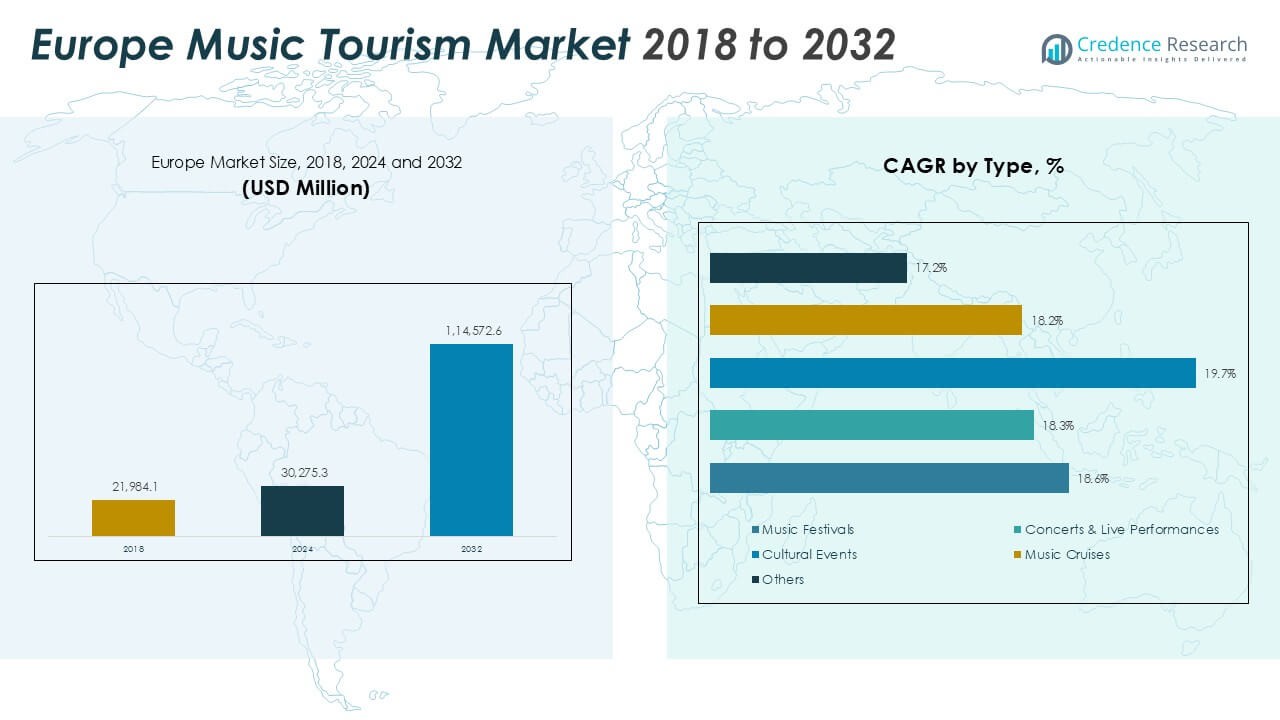
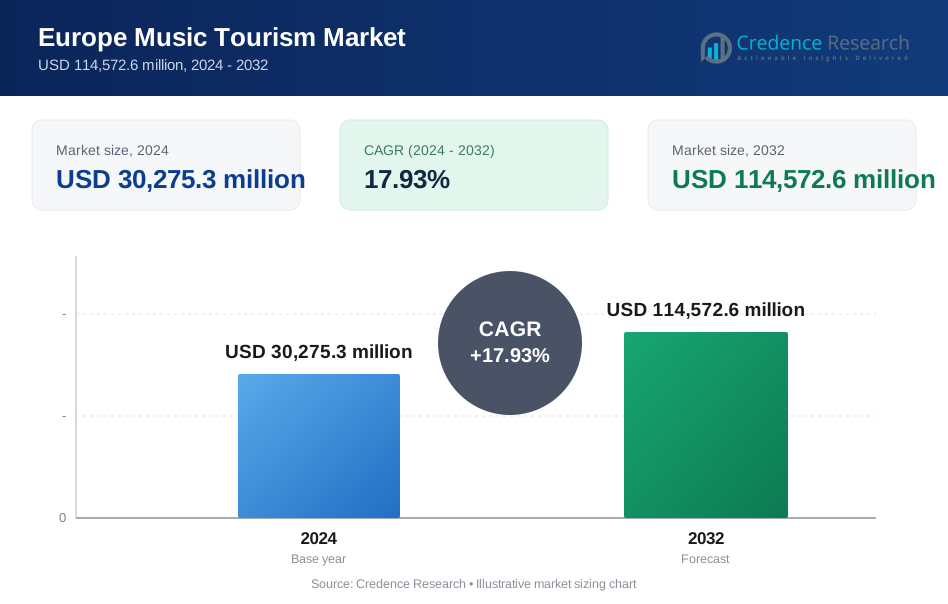
The Europe Music Tourism Market was valued at USD 21,984.1 million in 2018 and increased to USD 30,275.3 million in 2024. It is expected to reach USD 114,572.6 million by 2032, registering a CAGR of 17.93% during the forecast period.
| REPORT ATTRIBUTE | DETAILS |
|---|---|
| Historical Period | 2020-2023 |
| Base Year | 2024 |
| Forecast Period | 2025-2032 |
| Europe Music Tourism Market Size 2024 | USD 30,275.3 Million |
| Europe Music Tourism Market, CAGR | 17.93% |
| Europe Music Tourism Market Size 2032 | USD 114,572.6 Million |
The Europe Music Tourism market is led by major players such as Live Nation Europe, AEG Europe, CTS Eventim AG & Co. KGaA, Festival Republic, and DEAG Deutsche Entertainment AG. These companies dominate through large-scale event management, venue ownership, and digital ticketing integration. Supporting players like Superstruct Entertainment, Mojo Concerts, and Sziget Cultural Management enhance market diversity by hosting iconic regional festivals. The United Kingdom leads the regional market with a 26% share in 2024, driven by globally recognized events and strong music infrastructure. France and Germany follow with 19% and 18% shares, respectively, supported by thriving festival networks and rising international visitor participation.
Market Insights
- The Europe Music Tourism Market was valued at USD 21,984.1 million in 2018, grew to USD 30,275.3 million in 2024, and is projected to reach USD 114,572.6 million by 2032, expanding at a CAGR of 17.93%.
- Rising popularity of large-scale music festivals, live concerts, and cross-border cultural tourism drives steady market growth across Europe.
- Key trends include sustainable event management, digital ticketing adoption, and the rise of hybrid and experiential music experiences.
- The market is highly competitive, with major players like Live Nation Europe, AEG Europe, and CTS Eventim dominating through diversified event portfolios and partnerships.
- Regionally, the UK leads with a 26% share, followed by France at 19% and Germany at 18%, while music festivals remain the top segment with a 42% market share in 2024.
Market Segmentation Analysis:
By Type
The music festivals segment dominated the Europe Music Tourism market in 2024 with a 42% share. Large-scale events such as Glastonbury, Tomorrowland, and Primavera Sound attract millions of visitors annually, generating strong regional revenue through accommodation, transport, and local spending. Growth is supported by rising cross-border travel and festival tourism packages offering immersive cultural experiences. Increasing investments in multi-day events and digital ticketing platforms further enhance accessibility and engagement, positioning festivals as the leading driver of Europe’s growing music tourism ecosystem.
- For instance, Tomorrowland 2024 hosted over 400,000 attendees from 200 countries and featured 16 stages with more than 800 artists, while Glastonbury 2024 recorded 210,000 attendees and deployed over 6,000 volunteers to support operations, reflecting Europe’s large-scale festival capacity.
By Age Group
The 18–34 years segment led the market with a 47% share in 2024, driven by younger travelers’ higher interest in live entertainment and experiential tourism. These demographic favors international music events and social media-driven travel trends, boosting participation in major festivals and concerts across the UK, Germany, and Spain. Online ticketing, budget-friendly travel options, and influencer promotions are expanding reach among millennials and Gen Z audiences. Additionally, rising disposable income and preference for cultural experiences sustain the segment’s dominance within the region.
- For instance, Data for Primavera Sound Barcelona 2024 shows an overall attendance of 268,000, including repeat visitors over the main weekend. Of the 130,000 unique attendees, 59% were international visitors. The festival's organizers estimated its economic impact on Barcelona to be more than €200 million.
By End User
Leisure travelers accounted for the largest share of 52% in 2024, reflecting strong participation from domestic and international tourists seeking recreational experiences. This segment benefits from package deals combining music events with city tours, dining, and local attractions. Travel operators and event organizers collaborate to design themed itineraries, enhancing visitor engagement and spending. Growing interest in short-break music tourism and government support for cultural festivals also contribute to market expansion. The segment’s flexibility and wide appeal make it the leading driver of Europe’s music tourism growth.
Key Growth Drivers
Expanding Festival Tourism and Cross-Border Travel
Europe’s extensive network of international music festivals is a major growth catalyst for music tourism. Events such as Tomorrowland in Belgium, Glastonbury in the UK, and Sziget in Hungary draw millions of visitors annually, creating significant demand for hospitality, transportation, and entertainment services. The growing availability of affordable flights and rail connectivity within the EU encourages cross-border attendance, particularly among young travelers. Governments and tourism boards are increasingly integrating music festivals into destination branding strategies, which helps extend tourist stays and boost regional economic activity across Europe’s cultural hubs.
- For instance, Tomorrowland 2024 in Boom, Belgium, hosted over 400,000 attendees from 200 countries and partnered with Brussels Airlines to operate 175 themed flights, while Sziget Festival in Budapest welcomed 420,000 visitors across seven days, generating an estimated 60% of its attendance from international travelers.
Digital Integration and Online Ticketing Platforms
The rise of digital ticketing, mobile apps, and social media promotions has transformed the way tourists engage with music events. Platforms like Eventbrite and Ticketmaster simplify ticket purchases and event discovery, enhancing user convenience and expanding audience reach. Social media campaigns, influencer marketing, and virtual event previews further amplify global visibility for European music destinations. Integration of data analytics also enables organizers to forecast demand, personalize offers, and optimize travel partnerships. These advancements streamline logistics and encourage international participation, strengthening Europe’s competitive edge in global music tourism.
- For instance, Tomorrowland's One World Radio app offers live set previews and a stream of the radio station, enhancing the experience for fans worldwide.
Government Support and Cultural Promotion Initiatives
European governments and cultural agencies are actively promoting music tourism as part of their broader creative economy strategies. Funding for local festivals, artist collaborations, and infrastructure upgrades has strengthened event diversity and global appeal. Countries such as France, Spain, and the Netherlands have launched grants and partnerships to preserve musical heritage while attracting foreign visitors. Public–private partnerships help enhance venue capacities, sustainability standards, and safety measures. These efforts not only stimulate local economies but also reinforce Europe’s reputation as a vibrant hub for cultural and musical experiences.
Key Trends and Opportunities
Growing Demand for Experiential and Sustainable Tourism
Music tourists increasingly seek immersive experiences that combine entertainment, culture, and sustainability. Eco-friendly festival practices such as waste reduction, renewable energy use, and carbon offset programs are becoming standard across Europe. Events like Øya Festival in Norway and Roskilde in Denmark highlight sustainability leadership, appealing to environmentally conscious travelers. Moreover, demand for local food, art, and community engagement enhances visitor experiences beyond performances. This shift toward responsible, experiential tourism offers opportunities for organizers and destinations to differentiate themselves through innovative, green-focused event strategies.
- For instance, Roskilde Festival, a non-profit organization, donates all profits to social and environmental causes, having given over 420 million DKK (more than €56 million) to charity throughout its history. Øya Festival has also been a pioneer in sustainability, notably transitioning away from polluting generators. By 2011, it was powered by 100% renewable energy through a "Green Tariff" from the local grid, a project that began in 2009.
Integration of Technology and Hybrid Music Experiences
Advancements in AR, VR, and live-streaming technologies are reshaping how audiences participate in music tourism. Hybrid formats allow travelers to experience concerts virtually while promoting physical attendance through enhanced pre-event engagement. Tech-driven innovations—such as AI-based crowd management, interactive ticketing, and personalized travel recommendations—improve convenience and safety. Partnerships between event organizers, travel companies, and tech firms are expanding access for remote audiences and international fans. These innovations create new monetization avenues and strengthen Europe’s position as a leader in digital music tourism experiences.
Key Challenges
Rising Costs and Infrastructure Constraints
The expansion of large-scale music events across Europe has intensified pressure on logistics and infrastructure. Rising costs for venue rentals, artist fees, and accommodation impact event profitability and ticket affordability. Smaller cities often struggle with limited transport capacity and hospitality infrastructure during peak festival seasons. Additionally, inflation and fluctuating travel costs can deter budget-conscious visitors. Addressing these challenges requires coordinated investment in event infrastructure, sustainable mobility, and regional accommodation networks to maintain accessibility and ensure long-term growth of the music tourism sector.
Environmental Impact and Over-Tourism Risks
High visitor volumes at popular music destinations contribute to environmental degradation, noise pollution, and local congestion. Festivals generate significant waste and emissions, challenging sustainability goals despite green initiatives. Over-tourism in cities such as Barcelona and Amsterdam has led to stricter event regulations and caps on visitor numbers. Balancing economic benefits with environmental preservation is becoming critical for organizers and local authorities. Implementing circular waste systems, promoting local travel alternatives, and encouraging responsible tourist behavior are essential to mitigate ecological strain and sustain Europe’s music tourism growth.
Regional Analysis
UK
The United Kingdom dominated the Europe Music Tourism market with a 26% share in 2024. The country hosts globally recognized festivals such as Glastonbury, Reading & Leeds, and the Isle of Wight, which attract millions of domestic and international visitors each year. Strong infrastructure, rich musical heritage, and well-connected transport networks make the UK a key hub for music-based travel. Government support for creative industries and city-level tourism promotion further strengthens its position. The rise of live concerts and event-driven tourism continues to boost local economies and enhance the UK’s global cultural influence.
France
France accounted for a 19% share of the Europe Music Tourism market in 2024, supported by its diverse range of music events and cultural attractions. Paris, Lyon, and Marseille host major international festivals such as Rock en Seine and Les Vieilles Charrues, drawing large crowds annually. The country’s strong arts scene, combined with luxury tourism and gastronomy, enhances visitor experiences. France’s investment in cultural tourism and festival infrastructure drives participation among both domestic and European travelers. The blend of traditional and contemporary music offerings ensures France’s steady market expansion.
Germany
Germany held an 18% share in 2024, driven by its strong live performance culture and electronic music scene. Cities such as Berlin, Munich, and Hamburg are renowned for hosting events like Lollapalooza Berlin and Wacken Open Air, which attract international attendees. The country’s efficient transport system, affordability, and thriving nightlife further support visitor growth. Government initiatives promoting creative industries and local partnerships have enhanced festival accessibility. Germany’s focus on sustainability and community-based music experiences positions it as a leading player in Europe’s evolving music tourism ecosystem.
Italy
Italy captured a 12% share in the Europe Music Tourism market in 2024. The country’s music tourism is anchored in its classical heritage and contemporary festival culture, blending art, history, and performance. Events such as the Lucca Summer Festival and Umbria Jazz attract global tourists seeking cultural immersion. Italy’s picturesque settings and rich heritage enhance the appeal of live music experiences. The rise of regional festivals and improved travel connectivity have expanded tourism flows. Strong collaboration between cultural institutions and local governments continues to strengthen Italy’s role in Europe’s music tourism sector.
Spain
Spain represented a 10% share in 2024, supported by world-renowned festivals and coastal concert events. Major attractions such as Primavera Sound in Barcelona and Mad Cool Festival in Madrid draw large international audiences. The country’s warm climate, tourism-friendly policies, and thriving nightlife culture make it a preferred destination for young travelers. Spain’s focus on combining music events with local food and cultural experiences enhances visitor satisfaction. Ongoing investments in venue infrastructure and event promotion are expected to sustain strong market performance through the forecast period.
Russia
Russia accounted for a 7% share of the Europe Music Tourism market in 2024. The country’s growing interest in large-scale music events and cultural festivals is fueling steady market expansion. Moscow and St. Petersburg host internationally recognized performances such as Park Live and Alfa Future People, attracting both domestic and regional visitors. Despite regulatory and logistical challenges, Russia’s music scene continues to evolve with increased private investment. Enhanced international collaborations and government-backed cultural initiatives are helping position Russia as an emerging destination in Europe’s music tourism landscape.
Rest of Europe
The Rest of Europe segment held an 8% share in 2024, encompassing countries such as the Netherlands, Belgium, Norway, and Switzerland. This region benefits from a mix of international festivals and niche cultural events that attract diverse audiences. Belgium’s Tomorrowland and the Netherlands’ Amsterdam Dance Event exemplify global appeal, driving cross-border visitor participation. Strong regional connectivity and support for sustainable event management boost competitiveness. Expanding digital marketing campaigns and partnerships with local tourism boards are expected to drive further growth across these European countries in the coming years. 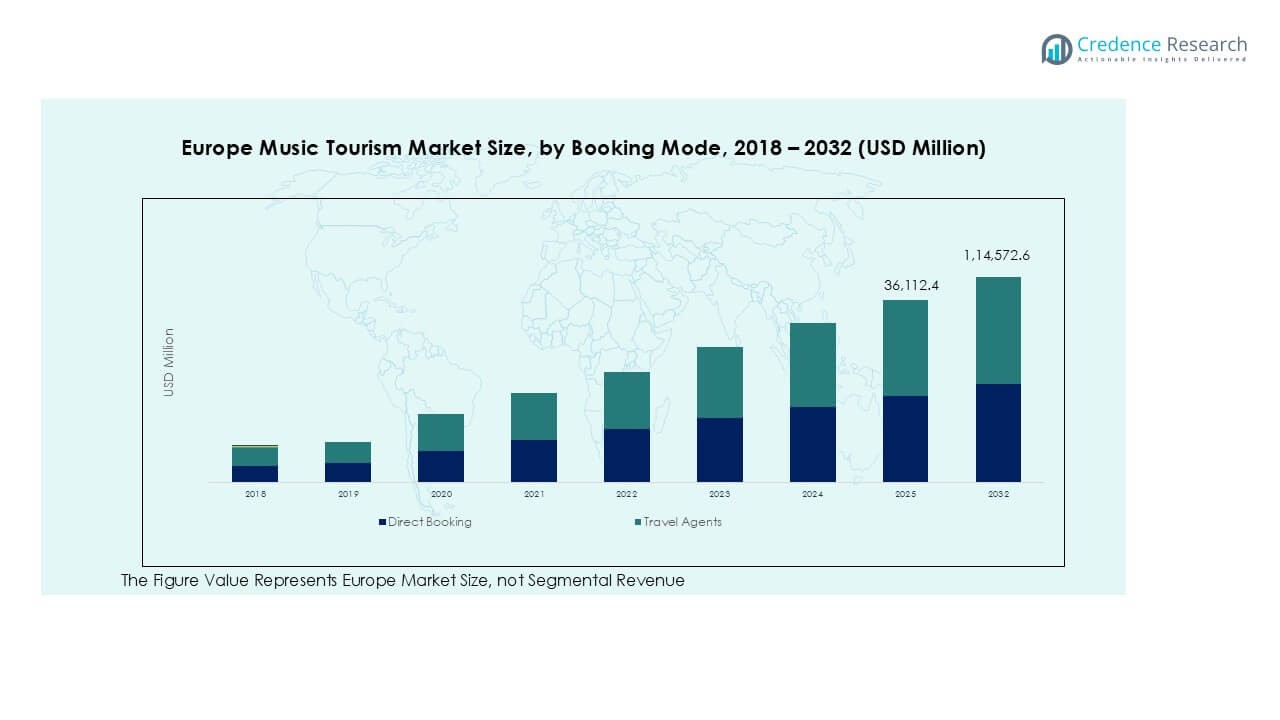
Market Segmentations:
By Type
- Music Festivals
- Concerts & Live Performances
- Cultural Events
- Music Cruises
- Others
By Age Group
- 18 and Less
- 18–34 Years
- 34–54 Years
- 55+ Years
By End-User
- Leisure Travelers
- Music Enthusiasts
- Corporate Clients
By Technology
- Online Ticketing Platforms
- Event Promotion Tools
- Mobile Apps
- Augmented Reality Experiences
- Others (AI-Powered Personalization & Analytics)
By Booking Mode
- Direct Booking
- Travel Agents
- Online Travel Agencies
By Geography
- UK
- France
- Germany
- Italy
- Spain
- Russia
- Rest of Europe
Competitive Landscape
The Europe Music Tourism market is highly competitive, featuring a mix of global entertainment groups, independent festival organizers, and digital ticketing platforms. Major companies such as Live Nation Europe, AEG Europe, and CTS Eventim dominate through extensive event portfolios, strategic venue ownership, and cross-border partnerships. Firms like Festival Republic, Superstruct Entertainment, and DEAG Deutsche Entertainment AG play key roles in organizing large-scale festivals across multiple countries. Ticketing and technology-driven firms including Ticketmaster UK, Dice FM, and Festicket enhance consumer engagement through digital platforms and personalized event experiences. Independent operators such as Sziget Cultural Management and Primavera Sound strengthen regional diversity, offering unique cultural value to Europe’s music tourism ecosystem. The market’s competitiveness is intensifying with increased investments in sustainability, digital event management, and immersive audience experiences, driving innovation and collaboration among leading players to maintain long-term profitability and visitor loyalty.
Key Player Analysis
- Live Nation Europe
- AEG Europe
- Sziget Cultural Management
- DF Concerts & Events
- Festival Republic
- Superstruct Entertainment
- Mojo Concerts
- DEAG Deutsche Entertainment AG
- Eventim (CTS Eventim AG & Co. KGaA)
- Ticketmaster UK
- Dice FM
- Festicket
- Primavera Sound
- Glastonbury Festival
- Roskilde Festival
Recent Developments
- In February 2025, Busan Concert Hall launched its official website to provide classical music enthusiasts with a seamless platform for ticket reservations, venue rentals, and academy schedules. Designed with responsive technology, the site ensures accessibility across devices and features a mobile ticketing service for quick entry via barcode scanning. The initiative enhances convenience and enriches the cultural experience for visitors in Busan.
- In August 2024, Brightline launched "The Big Concert Sweepstakes," offering tickets to Taylor Swift's sold-out Miami concert on October 20. The prize included two concert tickets, four round-trip Brightline tickets on a special "Tay-keover Sing-Along" train, and exclusive lounge perks. Participants entered by following Brightline on Instagram and signing a rail safety pledge, with the winner announced during Rail Safety Week in late September.
- In May 2024, Live Nation brought back its annual Concert Week promotion, offering USD 25 all-in tickets for over 5,000 shows across North America. Featuring artists like Janet Jackson and 21 Savage, the week-long event made live music more accessible to fans. Tickets, available from May 8 to May 14, could be purchased online without a promo code, allowing fans to enjoy significant savings on select concerts and festivals. The initiative aimed to enhance the summer touring season with budget-friendly options.
Report Coverage
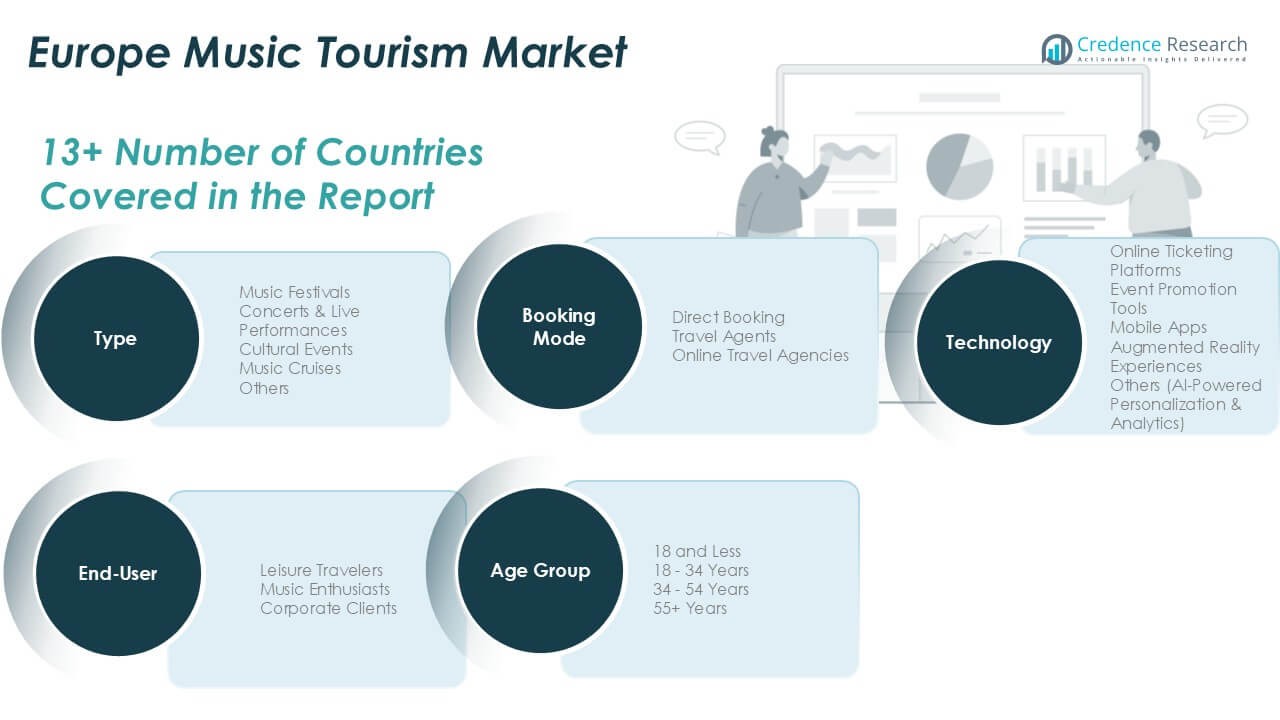
The research report offers an in-depth analysis based on Type, Age Group, End-User, Technology, Booking Mode and Geography. It details leading market players, providing an overview of their business, product offerings, investments, revenue streams, and key applications. Additionally, the report includes insights into the competitive environment, SWOT analysis, current market trends, as well as the primary drivers and constraints. Furthermore, it discusses various factors that have driven market expansion in recent years. The report also explores market dynamics, regulatory scenarios, and technological advancements that are shaping the industry. It assesses the impact of external factors and global economic changes on market growth. Lastly, it provides strategic recommendations for new entrants and established companies to navigate the complexities of the market.
Future Outlook
- The market will expand rapidly as international festival participation and travel connectivity continue to grow.
- Digital platforms and mobile ticketing will simplify event access and enhance traveler convenience.
- Sustainability initiatives will become central, with festivals adopting renewable energy and waste management systems.
- Government partnerships will strengthen through tourism incentives and cultural promotion programs.
- Experiential tourism will rise, combining music with food, art, and heritage experiences.
- Hybrid and virtual concert formats will attract remote global audiences alongside in-person attendees.
- Data analytics and AI-driven personalization will improve visitor engagement and spending patterns.
- Emerging destinations in Eastern Europe will gain prominence through affordable and niche music events.
- Strategic mergers and collaborations among event organizers will expand cross-border festival networks.
- Increased investment in security, logistics, and crowd management will enhance visitor safety and satisfaction.
Request a Free Sample
Fill in your details and we'll send you a free sample report.
- Sample data tables & charts
- Research methodology
Need a Custom Version of This Report?
Tailor the scope, geography, or segments to your exact requirements.
- Custom geography or segment scope
- Direct access to our analyst team
Frequently Asked Questions
What is the current market size for the Europe Music Tourism market, and what is its projected size in 2032?
At what Compound Annual Growth Rate is the Europe Music Tourism market projected to grow between 2025 and 2032?
Which Europe Music Tourism market segment held the largest share in 2024?
What are the primary factors fueling the growth of the Europe Music Tourism market?
Who are the leading companies in the Europe Music Tourism market?
Which region commanded the largest share of the Europe Music Tourism market in 2024?
Table of Content
Chapter 1. Report Introduction
- 1.1 Report Description & Purpose
- 1.1.1 Report Title & Market Definition
- 1.1.2 Unique Selling Propositions (USP) & Key Differentiators
- 1.1.3 Value Proposition for Stakeholders
- 1.2 Research Objectives
- 1.2.1 Market Sizing Objectives (Volume & Revenue)
- 1.2.2 Segmentation Objectives
- 1.2.3 Competitive Intelligence Objectives
- 1.2.4 Forecast & Scenario Objectives
- 1.3 Report Scope
- 1.3.1 Europe Music Tourism Scope – Types & Subtypes Covered
- 1.3.2 Geographic Scope – Regions & Countries Covered
- 1.3.3 Historical Period, Base Year & Forecast Period (2024; forecast to 2032)
- 1.3.4 Inclusions & Exclusions
- 1.4 HS Code & Classification Framework
- 1.5 Currency, Units & Pricing Basis
- 1.6 Target Stakeholders
- 1.7 Limitations & Assumptions
Chapter 2. Executive Summary
- 2.1 Global Europe Music Tourism Market Snapshot
- 2.1.1 Market Size – Historical (2024) & Forecast (2024-2032) (2024: USD 30,275.3 million → 2032: USD 114,572.6 million)
- 2.1.2 Volume & Revenue – Global Totals
- 2.1.3 Key Market Highlights – Top Five Facts
- 2.2 Europe Music Tourism Market Segmentation Snapshot
- 2.2.1 Market Split by Region – 2024 vs. 2032
- 2.3 Competitive Snapshot
- 2.3.1 Top 10 Players by Revenue Share – 2024
- 2.3.2 Top 10 Players by Volume Share – 2024
- 2.3.3 Recent Strategic Developments (18-Month Summary)
- 2.4 Key Investment Highlights & Strategic Conclusions
Chapter 3. Europe Music Tourism Market Dynamics & Industry Analysis
- 3.1 Market Overview & Context
- 3.1.1 Europe Music Tourism Market Position in the Broader Automotive Value Chain
- 3.1.2 OEM vs. Replacement Market Dynamics
- 3.1.3 Market Maturity & Development Stage by Region
- 3.2 Europe Music Tourism Market Drivers
- 3.3 Europe Music Tourism Market Restraints & Challenges
- 3.4 Europe Music Tourism Market Opportunities
- 3.5 Porter's Five Forces Analysis
- 3.5.1 Threat of New Entrants
- 3.5.2 Bargaining Power of Suppliers
- 3.5.3 Bargaining Power of Buyers
- 3.5.4 Threat of Substitutes
- 3.5.5 Competitive Rivalry – Intensity Assessment
- 3.6 Europe Music Tourism Value Chain Analysis
- 3.6.1 Upstream – Raw Material/Input Suppliers
- 3.6.1.1 Raw Material/Input 1
- 3.6.1.2 Raw Material/Input 2
- 3.6.1.3 Raw Material/Input 3
- 3.6.2 Midstream – Production/Manufacturing/Service Delivery
- 3.6.2.1 Production/Process Overview
- 3.6.2.2 Key Facility Locations & Capacity by Manufacturer
- 3.6.3 Downstream – Distribution & End Consumer
- 3.6.3.1 Primary Channel – B2B/OEM
- 3.6.3.2 Secondary Channels – Dealer, Retail, Online, Direct
- 3.6.4 Value Chain Profitability Analysis
- 3.6.1 Upstream – Raw Material/Input Suppliers
- 3.7 PESTEL Analysis
- 3.7.1 Political Factors
- 3.7.2 Economic Factors
- 3.7.3 Social Factors
- 3.7.4 Technological Factors
- 3.7.5 Environmental Factors
- 3.7.6 Legal Factors
- 3.8 Europe Music Tourism Supply Chain Analysis
- 3.8.1 Raw Material/Input Supply Risk Assessment
- 3.8.2 Manufacturing Concentration Risk (Geographic Exposure)
- 3.8.3 Trade Disruption Impact Analysis
- 3.9 Regulatory & Policy Landscape
Note: The regulatory and policy landscape section covers regulations based on their applicability to the market, Europe Music Tourism category, geography, and scope of the study. Only regulatory frameworks with a material impact on operations, compliance, trade, sustainability, or market access are analyzed in detail.
Chapter 4. Key Investment Pockets & Opportunity Analysis
- 4.1 Europe Music Tourism Market Attractiveness Analysis
- 4.1.1 By Region – Investment Attractiveness Matrix (Volume × CAGR)
- 4.2 Absolute Revenue Growth Opportunity
- 4.2.1 By Region – Absolute USD Growth Through 2032
- 4.3 Incremental Volume Opportunity
- 4.3.1 By Region – Incremental Volume Through 2032
- 4.3.2 Segment – Incremental Volume
- 4.4 Emerging Submarket Opportunity Deep Dive (Subject to Applicability)
- 4.5 Emerging Market Opportunity Scorecards
- 4.5.1 United States
- 4.5.2 Europe
- 4.5.3 Asia
- 4.5.4 Middle East & Africa
Note: Emerging Market Opportunity Scorecards will be included based on relevance and strategic importance. Regions listed are indicative and may vary depending on data availability and market dynamics.
Chapter 5. Europe Music Tourism Import-Export Analysis & Trade Flows
- 5.1 Global Trade Overview
- 5.1.1 Global Export Value by Country (2024)
- 5.1.2 Global Export Volume by Country (2024)
- 5.1.3 Global Import Value by Country (2024)
- 5.1.4 Global Import Volume by Country (2024)
- 5.1.5 Net Trade Balance by Country (2024)
- 5.2 Export Analysis – Segment
- 5.2.1 Type 1 (HS Code)
- 5.2.2 Type 2 (HS Code)
- 5.2.3 Type 3 (HS Code)
- 5.2.4 Type 4 (HS Code)
- 5.2.5 Type 5 (HS Code)
- 5.3 Import Analysis – Segment
- 5.3.1 Type 1 (HS Code)
- 5.3.2 Type 2 (HS Code)
- 5.3.3 Type 3 (HS Code)
- 5.3.4 Type 4 (HS Code)
- 5.3.5 Type 5 (HS Code)
- 5.4 Average Unit Trade Prices
- 5.4.1 Average Export Price – Segment & Country
- 5.4.2 Average Import Price – Segment & Source Country
- 5.4.3 Price Trends (2024)
- 5.5 Key Trade Route Analysis
- 5.5.1 Trade Route 1
- 5.5.2 Trade Route 2
- 5.5.3 Trade Route 3
- 5.5.4 Trade Route 4
- 5.5.5 Trade Route 5
- 5.6 Trade Policy Impact Assessment
- 5.6.1 US Anti-Dumping & Section 301 Tariffs
- 5.6.2 EU Customs Union Impact
- 5.6.3 Major Free Trade Agreements
- 5.6.4 USMCA Rules of Origin
Note: Trade policy analysis will be included only where relevant to the Europe Music Tourism market.
Chapter 6. Competitive Landscape & Company Benchmarking
- 6.1 Europe Music Tourism Market Concentration & Structure
- 6.1.1 Herfindahl-Hirschman Index (HHI) – vs. 2024
- 6.1.2 Tier 1, Tier 2 & Tier 3 Market Structure
- 6.1.3 Global, Regional & Local Player Dynamics
- 6.2 Europe Music Tourism Market Share Analysis – 2024
- 6.2.1 Global Revenue Share by Company
- 6.2.2 Global Volume Share by Company
- 6.2.3 Regional Revenue Share
- 6.2.4 Market Share Evolution ( vs. 2024)
- 6.2.5 OEM Segment Share by Company
- 6.2.6 Replacement Segment Share by Company
- 6.3 Production/Delivery Capacity & Facility Analysis
- 6.3.1 Global Installed Capacity
- 6.3.2 Capacity Utilization Rates
- 6.3.3 Production/Output Volume
- 6.3.4 Facility Locations & Capacity Map
- 6.3.5 Planned Capacity Additions
- 6.4 Europe Music Tourism Competitive Benchmarking Matrix
- 6.4.1 Revenue, Volume, CAGR & Profitability Comparison
- 6.4.2 Channel Revenue Mix
- 6.4.3 Geographic Revenue Exposure
- 6.4.4 R&D Intensity
- 6.4.5 Sustainability Maturity
- 6.5 Strategic Developments in Europe Music Tourism (Last 24 Months)
- 6.5.1 Mergers, Acquisitions & Divestments
- 6.5.2 New Europe Music Tourism Launches
- 6.5.3 Facility Expansions
- 6.5.4 Strategic Alliances, Joint Ventures & Partnerships
- 6.5.5 Distribution Expansion & Market Entry
- 6.5.6 Sustainability & ESG Initiatives
- 6.6 Competitive Strategy Mapping
- 6.6.1 Leader, Challenger, Follower & Niche Classification
- 6.6.2 Pricing Strategy Comparison
- 6.6.3 Channel Strategy Matrix
Note: Strategic developments are included based on their materiality and the availability of reliable information.
Chapter 7. Global Europe Music Tourism Market – By Distribution Channel
- 7.1 Segment Overview
- 7.1.1 Volume & Revenue Split by Channel (2024 & 2032)
- 7.1.2 Channel Mix Evolution (2024-2032)
Chapter 8. Regional Market Analysis – Global Overview
- 8.1 Global Regional Overview
- 8.1.1 Regional Volume Share
- 8.1.2 Regional Revenue Share
- 8.1.3 Regional Volume by Region
- 8.1.4 Regional Revenue by Region
- 8.1.5 Regional Forecast Through 2032
- 8.2 Cross-Regional Segment Analysis
- 8.2.1 By Distribution Channel
- 8.2.2 By Brand/Price Tier
Chapter 9. North America Europe Music Tourism Market
- 9.1 United States
- 9.2 Canada
- 9.3 Mexico
Chapter 10. Europe Europe Music Tourism Market
- 10.1 Germany
- 10.2 France
- 10.3 Italy
- 10.4 United Kingdom
- 10.5 Spain
- 10.6 Poland
- 10.7 Russia
- 10.8 Netherlands
- 10.9 Belgium
- 10.10 Sweden
- 10.11 Denmark
- 10.12 Norway
- 10.13 Rest of Europe
Chapter 11. Asia Pacific Europe Music Tourism Market
- 11.1 China
- 11.2 India
- 11.3 Japan
- 11.4 South Korea
- 11.5 Thailand
- 11.6 Indonesia
- 11.7 Vietnam
- 11.8 Malaysia
- 11.9 Australia
- 11.10 Rest of Asia Pacific
Chapter 12. Latin America Europe Music Tourism Market
- 12.1 Brazil
- 12.2 Argentina
- 12.3 Colombia
- 12.4 Chile
- 12.5 Rest of Latin America
Chapter 13. Middle East Europe Music Tourism Market
- 13.1 Saudi Arabia
- 13.2 United Arab Emirates
- 13.3 Turkey
- 13.4 Israel
- 13.5 Iran
- 13.6 Rest of the Middle East
Chapter 14. Africa Europe Music Tourism Market
- 14.1 South Africa
- 14.2 Egypt
- 14.3 Nigeria
- 14.4 Morocco
- 14.5 Rest of Africa
Chapter 15. Europe Music Tourism Company Profiles
- 15.1 [Company 01]
- 15.1.1 Company Overview
- 15.1.2 Key Management Personnel
- 15.1.3 Products & Services Portfolio
- 15.1.4 Financial Performance
- 15.1.5 Key Market Focus & Geographic Presence
- 15.1.6 Recent Developments & Strategic Initiatives
Note: The company profile list is preliminary and may change based on research findings, market developments, data availability, and client requirements.
Chapter 16. Appendices
- Appendix A – List of Abbreviations & Acronyms
- Appendix B – Industry Classification Code Reference – Full Series
- Appendix C – Production & Capacity Data Tables
- Appendix D – End-Use & Demand Base Tables
- Appendix E – Consumption & Replacement Rate Assumptions
- Appendix F – ASP Reference Tables
- Appendix G – Manufacturing & Facility Database
- Appendix H – Import-Export Data Tables
- Appendix I – Regulatory Summary Tables
- Appendix J – Primary Research Participant List (Anonymized)
- Appendix K – Primary Research Questionnaire Framework
- Appendix L – Data Sources & Bibliography
- Appendix M – Market Size Divergence & Source Comparison
Chapter 17. Research Methodology
- 17.1 Research Framework & Philosophy
- 17.2 Secondary Research – Sources, Hierarchy & Data Extraction
- 17.3 Data Modeling – Bottom-Up & Top-Down Market Sizing
- 17.4 Primary Research – Stakeholder Framework, LOI & Sample Sizes
- 17.5 Forecast Methodology – Regression, Scenario & Sensitivity Analysis
- 17.6 Quality Control – Four-Layer Validation Framework
- 17.7 Limitations & Standard Assumptions
- 17.8 Disclaimer