
Europe Ophthalmic Devices Market Overview:
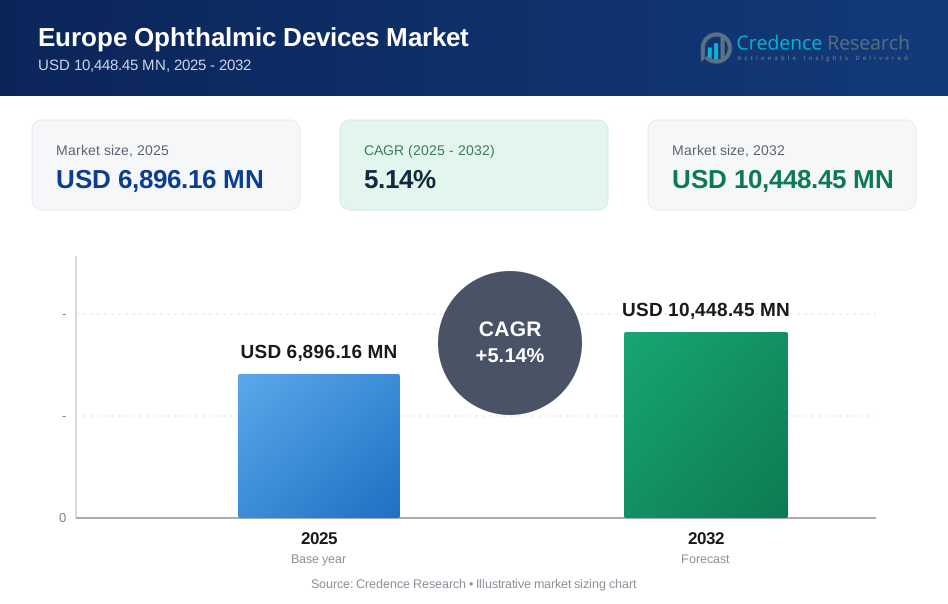
The Europe Ophthalmic Devices Market size was valued at USD 5,541.12 MN in 2021 and reached USD 6,896.16 MN in 2025. It is anticipated to reach USD 10,448.45 MN by 2032, growing at a CAGR of 5.14% during the forecast period.
| REPORT ATTRIBUTE | DETAILS |
|---|---|
| Historical Period | 2021-2024 |
| Base Year | 2025 |
| Forecast Period | 2025-2032 |
| Europe Ophthalmic Devices Market Size 2025 | USD 6,896.16 million |
| Europe Ophthalmic Devices Market, CAGR | 5.14% |
| Europe Ophthalmic Devices Market Size 2032 | USD 10,448.45 million |
Europe Ophthalmic Devices Market Insights
- Market growth is supported by cataract surgery volume, retinal disease screening, optical coherence tomography adoption, fundus imaging demand, glaucoma monitoring, refractive error correction and equipment replacement across hospitals, ASCs and eye clinics.
- Optical Coherence Tomography Scanners hold a strong position because OCT supports retinal imaging, glaucoma evaluation, macular disease monitoring and preoperative or postoperative ophthalmic assessment.
- Cataract remains a leading application because Europe performs a large volume of cataract procedures and aging populations continue to expand surgical demand.
- Hospitals & ASCs remain the leading end-user segment because ophthalmic surgeries, advanced diagnostics and complex retinal procedures require trained specialists, imaging systems, operating infrastructure and reimbursement coordination.
Europe Ophthalmic Devices Market Segment Insights
By product
By product, Optical Coherence Tomography Scanners held a strong position in 2025 because retina specialists, glaucoma clinics and hospitals use OCT for high-resolution retinal layer assessment, macular disease monitoring and optic nerve evaluation. Fundus Camera demand is supported by diabetic retinopathy screening, retinal documentation and teleophthalmology workflows. Perimeters/Visual Field Analyzers remain important for glaucoma diagnosis and disease progression monitoring. Autorefractors and Keratometers support high-volume eye exams, cataract planning and refractive assessment. Ophthalmic Ultrasound Imaging Systems support posterior segment evaluation where media opacity limits direct visualization. Tonometers, Slit Lamps, Optical Biometry Systems, Lensmeters, Corneal Topography Systems and Retinoscopes remain essential across hospitals and eye clinics.
By application
By application, Cataract held the strongest position in 2025 because surgical planning, intraocular lens selection, ultrasound assessment, optical biometry and operating-room workflow depend on dedicated ophthalmic devices. Eurostat reported that just over 5.0 million cataract surgeries were performed in the EU in 2023, equal to 1,118.0 surgeries per 100,000 people. Vitreo Retinal Disorders support demand for OCT scanners, fundus cameras, ophthalmic ultrasound systems and retinal imaging platforms. Refractor Disorders support autorefractors, keratometers, lensmeters, corneal topography systems and refractive diagnostic workflows. Others include glaucoma, diabetic retinopathy, dry eye, ocular hypertension, corneal disease and pediatric ophthalmic applications.
By end user
By end user, Hospitals & ASCs held the strongest position in 2025 because cataract surgery, retinal procedures, glaucoma management and complex diagnostic imaging require specialist teams, sterile operating rooms, imaging infrastructure and procedural reimbursement. Eye Clinics remain important because routine diagnostics, refractive assessment, glaucoma follow-up, retinal screening and optical biometry are increasingly delivered in outpatient settings. Others include academic centers, mobile eye care units, diagnostic chains and research facilities. End-user growth will depend on procedure volume, capital budgets, equipment replacement cycles, outpatient care expansion, surgeon availability and reimbursement policy.
Key Market Drivers
Cataract surgery volume and aging population
Cataract surgery volume and aging population represent major growth drivers for the Europe Ophthalmic Devices Market. Cataract care requires slit lamps, tonometers, autorefractors, keratometers, ophthalmic ultrasound, optical biometry systems, surgical microscopes and postoperative monitoring tools. Eurostat reported 5.01 million cataract surgeries in the EU in 2023 and also noted that cataract procedures have increasingly shifted away from inpatient settings across nearly all EU countries. Eurostat’s 2025 demography publication reported that the share of persons aged 65 and older in the EU rose from 16.4% to 21.6% over the measured period. This driver supports Cataract, Optical Biometry Systems, Slit Lamps, Ophthalmic Ultrasound Imaging Systems, Hospitals & ASCs and Eye Clinics.
Vision impairment screening and early diagnosis
Vision impairment screening and early diagnosis support growth across diagnostic ophthalmic devices. WHO states that early detection and timely treatment are crucial for diabetic retinopathy to avoid irreversible vision loss. WHO also says eyeglass correction for refractive error and surgery for cataract are among the most cost-effective health care interventions. These findings support investment in Fundus Camera, Optical Coherence Tomography Scanners, Autorefractors and Keratometers, Retinoscopes, Lensmeters and Corneal Topography Systems. Demand will grow as health systems, eye clinics and screening programs prioritize earlier detection of preventable vision loss, diabetic eye disease, glaucoma and refractive disorders.
Diabetes burden and retinal imaging demand
Diabetes burden and retinal imaging demand are strengthening the market because diabetic retinopathy requires regular screening and image-based monitoring. WHO Europe reports that an estimated 74 million adults and around 300,000 children and adolescents live with diabetes in the WHO European Region. It also notes that the region has the highest burden of type 1 diabetes worldwide. Diabetes care supports demand for Fundus Camera, Optical Coherence Tomography Scanners, Slit Lamps, Tonometers and teleophthalmology-enabled retinal imaging. Eye Clinics and Hospitals & ASCs will gain from screening programs, diabetic eye clinics and long-term monitoring needs.
Ophthalmic platform innovation and imaging upgrades
Ophthalmic platform innovation and imaging upgrades are accelerating equipment replacement across Europe. Carl Zeiss Meditec reported fiscal year 2024/25 revenue of EUR 2,228 million, up 7.8%, and order intake of EUR 2,288 million, up 18.2%, with growth across all regions. Alcon’s 2025 annual report described Unity VCS as a flagship ophthalmic surgical platform designed to improve efficiency and workflow in vitreoretinal and cataract procedures, and said it was available in the United States, Europe, Japan, Australia, India and China. This driver supports Optical Coherence Tomography Scanners, Cataract, Vitreo Retinal Disorders, Hospitals & ASCs and Eye Clinics.
Key Trends and Opportunities
OCT and fundus imaging move into wider screening pathways
OCT and fundus imaging are moving into wider screening pathways as ophthalmologists and clinics use image-based diagnostics for retinal disease, diabetic retinopathy, glaucoma and macular disease. Topcon’s 2025 report described fully automated screening equipment using fundus camera and OCT technologies to support early detection. This trend supports Optical Coherence Tomography Scanners, Fundus Camera, Hospitals & ASCs, Eye Clinics and teleophthalmology models. Vendors with automated capture, AI-ready imaging, cloud connectivity and referral workflow integration will gain stronger adoption.
Premium cataract and vitreoretinal surgical systems expand
Premium cataract and vitreoretinal surgical systems are expanding as surgeons seek integrated workflow, faster procedures and more predictable outcomes. Alcon reported first-quarter 2025 sales of USD 2.5 billion and launched a surgical pipeline that included Unity Vitreoretinal Cataract System and Unity Cataract System. The company’s annual report also described Unity VCS as a system for both vitreoretinal and cataract procedures. This trend supports Cataract, Vitreo Retinal Disorders, Hospitals & ASCs and premium eye clinic networks.
Clinic-based diagnostics and outpatient eye care gain share
Clinic-based diagnostics and outpatient eye care are gaining share as eye care providers shift routine exams, glaucoma monitoring, retinal screening and cataract workups closer to patients. Eye Clinics increasingly invest in slit lamps, tonometers, autorefractors, OCT scanners, fundus cameras, biometry systems and visual field analyzers to improve throughput and reduce hospital dependence. Eurostat’s finding that cataract surgery has shifted away from inpatient procedures across nearly all EU countries supports broader outpatient ophthalmic infrastructure. This trend supports Eye Clinics, Hospitals & ASCs and device bundles designed for high-volume outpatient settings.
AI-enabled retinal screening creates access opportunities
AI-enabled retinal screening is creating access opportunities across diabetic eye disease and chronic disease management. The European Enterprise Network highlighted CheckEye, an AI-powered retinal screening tool that screened 10,000 individuals in Ukraine with detection accuracy above 93%. This trend supports Fundus Camera, Optical Coherence Tomography Scanners, Clinics, Eye Clinics and remote screening programs. Growth will depend on clinical validation, data governance, reimbursement, integration with electronic health records and physician acceptance.
Key Market Challenges
EU medical device regulatory burden
EU medical device regulatory burden remains a key challenge for the Europe Ophthalmic Devices Market. Ophthalmic devices must comply with clinical evidence, quality management, post-market surveillance, vigilance and conformity assessment requirements. The European Commission reported that medical device transition timelines depend on device type, with transition periods extending to 2027 and 2028 for many devices under defined conditions. Compliance can raise costs for smaller ophthalmic device manufacturers, delay product updates and increase documentation burden. Companies with strong regulatory systems, post-market surveillance and notified body readiness will be better positioned.
High equipment cost and replacement-cycle pressure
High equipment cost and replacement-cycle pressure can slow adoption of premium OCT systems, optical biometry systems, fundus cameras, ultrasound platforms and visual field analyzers. Hospitals and eye clinics must balance capital spending with reimbursement, patient volume and service requirements. Premium imaging platforms can improve diagnostic accuracy and workflow, but purchase decisions often depend on utilization rates, maintenance costs, staff training and payer coverage. This challenge affects smaller eye clinics and lower-budget public hospitals more strongly than major academic centers and private ophthalmology networks.
Workforce constraints and training requirements
Workforce constraints and training requirements can limit device utilization. Advanced ophthalmic diagnostics require ophthalmologists, optometrists, orthoptists, imaging technicians, nurses and trained operating teams. OCT interpretation, retinal imaging, glaucoma progression analysis, optical biometry and cataract workflow management require specialist skills. AI-enabled tools can support triage and workflow, but clinicians still need oversight, validation and referral decisions. Training requirements affect Hospitals & ASCs, Eye Clinics and Research Institutes. Manufacturers that provide strong education, service support and workflow training will improve adoption.
Regional Access Variation
Regional access variation affects market growth because eye care infrastructure differs across Western Europe, Northern Europe, Southern Europe, Central and Eastern Europe and smaller markets. Premium OCT, fundus imaging, optical biometry and surgical systems are more widely available in advanced urban centers, while lower-resource regions may face budget constraints and longer replacement cycles. EU-level regulatory approval does not ensure equal reimbursement or procurement speed. Eye Clinics and public hospitals need financing models, service support and training to close access gaps.
Regional Analysis
Western Europe
Western Europe leads the Europe Ophthalmic Devices Market due to advanced eye care infrastructure, high cataract procedure volume, strong reimbursement, mature clinic networks and broad adoption of premium imaging systems. Germany, France, the U.K., Switzerland, Belgium, the Netherlands and Austria support demand for Optical Coherence Tomography Scanners, Fundus Camera, Optical Biometry Systems, Tonometers and Slit Lamps. Hospitals & ASCs lead complex surgical and retinal procedures, while Eye Clinics support outpatient diagnostics and refractive care. Growth will depend on device replacement cycles, cataract volume, retinal screening, EU MDR readiness and private ophthalmology investment.
Northern Europe
Northern Europe represents a high-value market supported by strong public health systems, digital health adoption, structured screening pathways and advanced specialist care. Sweden, Denmark, Norway, Finland and Ireland support demand for OCT scanners, fundus cameras, visual field analyzers and clinic-based diagnostics. Eye Clinics and Hospitals & ASCs benefit from outpatient care models and connected health records. Remote screening and AI-enabled imaging have strong potential due to digital infrastructure. Growth will depend on procurement policy, workforce availability, reimbursement and clinical evidence for AI-assisted ophthalmic imaging.
Southern Europe
Southern Europe offers steady demand supported by aging populations, cataract procedure volume, ophthalmology clinics and private diagnostic networks. Italy, Spain, Portugal and Greece support demand for cataract diagnostics, optical biometry, slit lamps, tonometers, OCT scanners and fundus cameras. Hospitals & ASCs remain important for cataract, glaucoma and vitreoretinal procedures, while Eye Clinics support refractive assessment and chronic retinal monitoring. Growth will depend on public budget capacity, private clinic investment, reimbursement conditions and replacement of older diagnostic systems.
Central and Eastern Europe
Central and Eastern Europe represents an expanding market as hospitals and eye clinics modernize ophthalmic diagnostics and surgical capacity. Poland, Czech Republic, Hungary, Romania, Bulgaria and Baltic countries support demand for affordable OCT scanners, fundus cameras, slit lamps, tonometers, autorefractors, keratometers and optical biometry systems. Cataract and glaucoma care remain major demand areas, while diabetic retinopathy screening creates longer-term opportunity. Growth will depend on EU funding, procurement access, service networks, clinician training and availability of value-tier systems.
Rest of Europe
Rest of Europe includes smaller and non-EU markets with varied reimbursement, eye care infrastructure and ophthalmic device adoption. Switzerland and Norway remain high-value markets with advanced eye care systems and demand for premium imaging platforms. Balkan and Eastern European markets offer gradual growth as public hospitals and private clinics expand ophthalmic services. Cataract, Vitreo Retinal Disorders and Refractor Disorders remain core applications. Growth will depend on distributor networks, affordability, public procurement, device service capacity and specialist availability.
Report Attribute Details
| Report Attribute | Details |
| Historical Period | 2021–2024 |
| Base Year | 2025 |
| Forecast Period | 2025–2032 |
| Market Size in 2021 | USD 5,541.12 MN |
| Market Size in 2025 | USD 6,896.16 MN |
| Market Size in 2032 | USD 10,448.45 MN |
| CAGR | 5.14% |
| Segments Covered | Product, Application, End User and Geography |
| Key Companies Covered | Johnson & Johnson Vision Care, Alcon Vision LLC, Carl Zeiss Meditec AG, Bausch & Lomb Incorporated, Essilor International S.A, Ziemer Ophthalmic Systems Ltd, Nidek Co. Ltd., Topcon Corporation, Haag-Streit Group and Glaukos Corporation |
Europe Ophthalmic Devices Market Segmentations
By Product
- Optical Coherence Tomography Scanners
- Fundus Camera
- Perimeters/Visual Field Analyzers
- Autorefractors and Keratometers
- Ophthalmic Ultrasound Imaging Systems
- Tonometers
- Slit Lamps
- Optical Biometry Systems
- Lensmeters
- Corneal Topography Systems
- Retinoscopes
- Others
By Application
- Cataract
- Vitreo Retinal Disorders
- Refractor Disorders
- Others
By End User
- Hospitals & ASCs
- Eye Clinics
- Others
Key Players
- Johnson & Johnson Vision Care
- Alcon Vision LLC
- Carl Zeiss Meditec AG
- Bausch & Lomb Incorporated
- Essilor International S.A
- Ziemer Ophthalmic Systems Ltd
- Nidek Co. Ltd.
- Topcon Corporation
- Haag-Streit Group
- Glaukos Corporation
Recent Developments
- In fiscal year 2024/25, Carl Zeiss Meditec reported revenue of EUR 2,228 million, up 7.8%, and order intake of EUR 2,288 million, up 18.2%, with growth across all regions.
- In 2025, Alcon launched its transformational surgical pipeline, including the Unity Vitreoretinal Cataract System and Unity Cataract System, supporting cataract and vitreoretinal procedure workflows.
- In 2025, Alcon’s annual report described Unity VCS as a flagship ophthalmic surgical platform available in Europe and other major markets, designed for vitreoretinal and cataract procedures.
- In 2026, Johnson & Johnson said it would present 17 company presentations across its vision portfolio, spanning myopia control, ACUVUE contact lenses and TECNIS intraocular lenses.
- In 2025, Topcon reported development of fully automated screening equipment using fundus camera and OCT technologies to support early detection.
Report Coverage
The research report offers an in-depth analysis based on product, application, end user and geography. It details leading market players, providing an overview of their business positioning, ophthalmic diagnostic systems, OCT scanners, fundus cameras, visual field analyzers, autorefractors, keratometers, ultrasound imaging systems, tonometers, slit lamps, optical biometry systems, corneal topography systems and strategic relevance in the Europe Ophthalmic Devices Market. The report includes insights into the competitive environment, market trends, growth drivers, restraints and opportunities. It also examines cataract surgery volume, retinal disease screening, diabetic eye disease monitoring, glaucoma diagnosis, outpatient eye care, AI-enabled retinal screening, EU MDR compliance and premium surgical platform adoption as major factors shaping market development. The report assesses the impact of high equipment cost, regulatory burden, training requirements, regional access variation and replacement-cycle pressure on market growth. It provides strategic recommendations for ophthalmic device manufacturers, hospitals, ASCs, eye clinics, research institutes, distributors, investors and new entrants seeking to navigate Europe’s ophthalmic devices ecosystem.
Future Outlook
- Demand for ophthalmic devices will continue to rise as Europe addresses cataract, retinal disease, glaucoma, diabetic eye disease and refractive disorder care needs.
- Optical Coherence Tomography Scanners will remain a major product category due to retinal imaging, glaucoma evaluation and macular disease monitoring.
- Fundus Camera demand will grow through diabetic retinopathy screening, retinal documentation and teleophthalmology workflows.
- Perimeters/Visual Field Analyzers will remain important for glaucoma diagnosis and progression monitoring.
- Autorefractors and Keratometers will support routine eye exams, refractive assessment and cataract workups.
- Optical Biometry Systems will gain demand as cataract surgery planning and intraocular lens selection become more precise.
- Cataract will remain the leading application due to high surgical volume and aging population trends.
- Eye Clinics will gain share as outpatient diagnostics, refractive care and chronic disease follow-up expand.
- Hospitals & ASCs will remain the leading end-user segment due to complex surgery, advanced imaging and reimbursement control.
- Competition will increase as companies compete on imaging accuracy, workflow speed, AI support, service reliability, EU MDR readiness, surgeon training and premium platform adoption.
Request a Free Sample
Fill in your details and we'll send you a free sample report.
- Sample data tables & charts
- Research methodology
Need a Custom Version of This Report?
Tailor the scope, geography, or segments to your exact requirements.
- Custom geography or segment scope
- Direct access to our analyst team
Frequently Asked Questions
What is the current market size for the Europe Ophthalmic Devices Market and what is its projected size in 2032?
At what CAGR is the Europe Ophthalmic Devices Market projected to grow?
Which product segment is expected to hold strong demand?
Which application leads the market?
Which end-user segment leads the market?
Who are the leading companies in the market?
Which region leads the Europe market?
Table of Content
Chapter 1. Report Introduction
- 1.1 Report Description & Purpose
- 1.1.1 Report Title & Market Definition
- 1.1.2 Unique Selling Propositions (USP) & Key Differentiators
- 1.1.3 Value Proposition for Stakeholders
- 1.2 Research Objectives
- 1.2.1 Market Sizing Objectives (Volume & Revenue)
- 1.2.2 Segmentation Objectives
- 1.2.3 Competitive Intelligence Objectives
- 1.2.4 Forecast & Scenario Objectives
- 1.3 Report Scope
- 1.3.1 Europe Ophthalmic Devices Scope – Types & Subtypes Covered
- 1.3.2 Geographic Scope – Regions & Countries Covered
- 1.3.3 Historical Period, Base Year & Forecast Period (2025; forecast to 2032)
- 1.3.4 Inclusions & Exclusions
- 1.4 HS Code & Classification Framework
- 1.5 Currency, Units & Pricing Basis
- 1.6 Target Stakeholders
- 1.7 Limitations & Assumptions
Chapter 2. Executive Summary
- 2.1 Global Europe Ophthalmic Devices Market Snapshot
- 2.1.1 Market Size – Historical (2025) & Forecast (2025-2032) (2025: USD 6,896.16 MN → 2032: USD 10,448.45 MN)
- 2.1.2 Volume & Revenue – Global Totals
- 2.1.3 Key Market Highlights – Top Five Facts
- 2.2 Europe Ophthalmic Devices Market Segmentation Snapshot
- 2.2.1 Market Split by Region – 2025 vs. 2032
- 2.3 Competitive Snapshot
- 2.3.1 Top 10 Players by Revenue Share – 2025
- 2.3.2 Top 10 Players by Volume Share – 2025
- 2.3.3 Recent Strategic Developments (18-Month Summary)
- 2.4 Key Investment Highlights & Strategic Conclusions
Chapter 3. Europe Ophthalmic Devices Market Dynamics & Industry Analysis
- 3.1 Market Overview & Context
- 3.1.1 Europe Ophthalmic Devices Market Position in the Broader Automotive Value Chain
- 3.1.2 OEM vs. Replacement Market Dynamics
- 3.1.3 Market Maturity & Development Stage by Region
- 3.2 Europe Ophthalmic Devices Market Drivers
- 3.3 Europe Ophthalmic Devices Market Restraints & Challenges
- 3.4 Europe Ophthalmic Devices Market Opportunities
- 3.5 Porter's Five Forces Analysis
- 3.5.1 Threat of New Entrants
- 3.5.2 Bargaining Power of Suppliers
- 3.5.3 Bargaining Power of Buyers
- 3.5.4 Threat of Substitutes
- 3.5.5 Competitive Rivalry – Intensity Assessment
- 3.6 Europe Ophthalmic Devices Value Chain Analysis
- 3.6.1 Upstream – Raw Material/Input Suppliers
- 3.6.1.1 Raw Material/Input 1
- 3.6.1.2 Raw Material/Input 2
- 3.6.1.3 Raw Material/Input 3
- 3.6.2 Midstream – Production/Manufacturing/Service Delivery
- 3.6.2.1 Production/Process Overview
- 3.6.2.2 Key Facility Locations & Capacity by Manufacturer
- 3.6.3 Downstream – Distribution & End Consumer
- 3.6.3.1 Primary Channel – B2B/OEM
- 3.6.3.2 Secondary Channels – Dealer, Retail, Online, Direct
- 3.6.4 Value Chain Profitability Analysis
- 3.6.1 Upstream – Raw Material/Input Suppliers
- 3.7 PESTEL Analysis
- 3.7.1 Political Factors
- 3.7.2 Economic Factors
- 3.7.3 Social Factors
- 3.7.4 Technological Factors
- 3.7.5 Environmental Factors
- 3.7.6 Legal Factors
- 3.8 Europe Ophthalmic Devices Supply Chain Analysis
- 3.8.1 Raw Material/Input Supply Risk Assessment
- 3.8.2 Manufacturing Concentration Risk (Geographic Exposure)
- 3.8.3 Trade Disruption Impact Analysis
- 3.9 Regulatory & Policy Landscape
Note: The regulatory and policy landscape section covers regulations based on their applicability to the market, Europe Ophthalmic Devices category, geography, and scope of the study. Only regulatory frameworks with a material impact on operations, compliance, trade, sustainability, or market access are analyzed in detail.
Chapter 4. Key Investment Pockets & Opportunity Analysis
- 4.1 Europe Ophthalmic Devices Market Attractiveness Analysis
- 4.1.1 By Region – Investment Attractiveness Matrix (Volume × CAGR)
- 4.2 Absolute Revenue Growth Opportunity
- 4.2.1 By Region – Absolute USD Growth Through 2032
- 4.3 Incremental Volume Opportunity
- 4.3.1 By Region – Incremental Volume Through 2032
- 4.3.2 Segment – Incremental Volume
- 4.4 Emerging Submarket Opportunity Deep Dive (Subject to Applicability)
- 4.5 Emerging Market Opportunity Scorecards
- 4.5.1 United States
- 4.5.2 Europe
- 4.5.3 Asia
- 4.5.4 Middle East & Africa
Note: Emerging Market Opportunity Scorecards will be included based on relevance and strategic importance. Regions listed are indicative and may vary depending on data availability and market dynamics.
Chapter 5. Europe Ophthalmic Devices Import-Export Analysis & Trade Flows
- 5.1 Global Trade Overview
- 5.1.1 Global Export Value by Country (2025)
- 5.1.2 Global Export Volume by Country (2025)
- 5.1.3 Global Import Value by Country (2025)
- 5.1.4 Global Import Volume by Country (2025)
- 5.1.5 Net Trade Balance by Country (2025)
- 5.2 Export Analysis – Segment
- 5.2.1 Type 1 (HS Code)
- 5.2.2 Type 2 (HS Code)
- 5.2.3 Type 3 (HS Code)
- 5.2.4 Type 4 (HS Code)
- 5.2.5 Type 5 (HS Code)
- 5.3 Import Analysis – Segment
- 5.3.1 Type 1 (HS Code)
- 5.3.2 Type 2 (HS Code)
- 5.3.3 Type 3 (HS Code)
- 5.3.4 Type 4 (HS Code)
- 5.3.5 Type 5 (HS Code)
- 5.4 Average Unit Trade Prices
- 5.4.1 Average Export Price – Segment & Country
- 5.4.2 Average Import Price – Segment & Source Country
- 5.4.3 Price Trends (2025)
- 5.5 Key Trade Route Analysis
- 5.5.1 Trade Route 1
- 5.5.2 Trade Route 2
- 5.5.3 Trade Route 3
- 5.5.4 Trade Route 4
- 5.5.5 Trade Route 5
- 5.6 Trade Policy Impact Assessment
- 5.6.1 US Anti-Dumping & Section 301 Tariffs
- 5.6.2 EU Customs Union Impact
- 5.6.3 Major Free Trade Agreements
- 5.6.4 USMCA Rules of Origin
Note: Trade policy analysis will be included only where relevant to the Europe Ophthalmic Devices market.
Chapter 6. Competitive Landscape & Company Benchmarking
- 6.1 Europe Ophthalmic Devices Market Concentration & Structure
- 6.1.1 Herfindahl-Hirschman Index (HHI) – vs. 2025
- 6.1.2 Tier 1, Tier 2 & Tier 3 Market Structure
- 6.1.3 Global, Regional & Local Player Dynamics
- 6.2 Europe Ophthalmic Devices Market Share Analysis – 2025
- 6.2.1 Global Revenue Share by Company
- 6.2.2 Global Volume Share by Company
- 6.2.3 Regional Revenue Share
- 6.2.4 Market Share Evolution ( vs. 2025)
- 6.2.5 OEM Segment Share by Company
- 6.2.6 Replacement Segment Share by Company
- 6.3 Production/Delivery Capacity & Facility Analysis
- 6.3.1 Global Installed Capacity
- 6.3.2 Capacity Utilization Rates
- 6.3.3 Production/Output Volume
- 6.3.4 Facility Locations & Capacity Map
- 6.3.5 Planned Capacity Additions
- 6.4 Europe Ophthalmic Devices Competitive Benchmarking Matrix
- 6.4.1 Revenue, Volume, CAGR & Profitability Comparison
- 6.4.2 Channel Revenue Mix
- 6.4.3 Geographic Revenue Exposure
- 6.4.4 R&D Intensity
- 6.4.5 Sustainability Maturity
- 6.5 Strategic Developments in Europe Ophthalmic Devices (Last 24 Months)
- 6.5.1 Mergers, Acquisitions & Divestments
- 6.5.2 New Europe Ophthalmic Devices Launches
- 6.5.3 Facility Expansions
- 6.5.4 Strategic Alliances, Joint Ventures & Partnerships
- 6.5.5 Distribution Expansion & Market Entry
- 6.5.6 Sustainability & ESG Initiatives
- 6.6 Competitive Strategy Mapping
- 6.6.1 Leader, Challenger, Follower & Niche Classification
- 6.6.2 Pricing Strategy Comparison
- 6.6.3 Channel Strategy Matrix
Note: Strategic developments are included based on their materiality and the availability of reliable information.
Chapter 7. Global Europe Ophthalmic Devices Market – By Distribution Channel
- 7.1 Segment Overview
- 7.1.1 Volume & Revenue Split by Channel (2025 & 2032)
- 7.1.2 Channel Mix Evolution (2025-2032)
Chapter 8. Regional Market Analysis – Global Overview
- 8.1 Global Regional Overview
- 8.1.1 Regional Volume Share
- 8.1.2 Regional Revenue Share
- 8.1.3 Regional Volume by Region
- 8.1.4 Regional Revenue by Region
- 8.1.5 Regional Forecast Through 2032
- 8.2 Cross-Regional Segment Analysis
- 8.2.1 By Distribution Channel
- 8.2.2 By Brand/Price Tier
Chapter 9. North America Europe Ophthalmic Devices Market
- 9.1 United States
- 9.2 Canada
- 9.3 Mexico
Chapter 10. Europe Europe Ophthalmic Devices Market
- 10.1 Germany
- 10.2 France
- 10.3 Italy
- 10.4 United Kingdom
- 10.5 Spain
- 10.6 Poland
- 10.7 Russia
- 10.8 Netherlands
- 10.9 Belgium
- 10.10 Sweden
- 10.11 Denmark
- 10.12 Norway
- 10.13 Rest of Europe
Chapter 11. Asia Pacific Europe Ophthalmic Devices Market
- 11.1 China
- 11.2 India
- 11.3 Japan
- 11.4 South Korea
- 11.5 Thailand
- 11.6 Indonesia
- 11.7 Vietnam
- 11.8 Malaysia
- 11.9 Australia
- 11.10 Rest of Asia Pacific
Chapter 12. Latin America Europe Ophthalmic Devices Market
- 12.1 Brazil
- 12.2 Argentina
- 12.3 Colombia
- 12.4 Chile
- 12.5 Rest of Latin America
Chapter 13. Middle East Europe Ophthalmic Devices Market
- 13.1 Saudi Arabia
- 13.2 United Arab Emirates
- 13.3 Turkey
- 13.4 Israel
- 13.5 Iran
- 13.6 Rest of the Middle East
Chapter 14. Africa Europe Ophthalmic Devices Market
- 14.1 South Africa
- 14.2 Egypt
- 14.3 Nigeria
- 14.4 Morocco
- 14.5 Rest of Africa
Chapter 15. Europe Ophthalmic Devices Company Profiles
- 15.1 [Company 01]
- 15.1.1 Company Overview
- 15.1.2 Key Management Personnel
- 15.1.3 Products & Services Portfolio
- 15.1.4 Financial Performance
- 15.1.5 Key Market Focus & Geographic Presence
- 15.1.6 Recent Developments & Strategic Initiatives
Note: The company profile list is preliminary and may change based on research findings, market developments, data availability, and client requirements.
Chapter 16. Appendices
- Appendix A – List of Abbreviations & Acronyms
- Appendix B – Industry Classification Code Reference – Full Series
- Appendix C – Production & Capacity Data Tables
- Appendix D – End-Use & Demand Base Tables
- Appendix E – Consumption & Replacement Rate Assumptions
- Appendix F – ASP Reference Tables
- Appendix G – Manufacturing & Facility Database
- Appendix H – Import-Export Data Tables
- Appendix I – Regulatory Summary Tables
- Appendix J – Primary Research Participant List (Anonymized)
- Appendix K – Primary Research Questionnaire Framework
- Appendix L – Data Sources & Bibliography
- Appendix M – Market Size Divergence & Source Comparison
Chapter 17. Research Methodology
- 17.1 Research Framework & Philosophy
- 17.2 Secondary Research – Sources, Hierarchy & Data Extraction
- 17.3 Data Modeling – Bottom-Up & Top-Down Market Sizing
- 17.4 Primary Research – Stakeholder Framework, LOI & Sample Sizes
- 17.5 Forecast Methodology – Regression, Scenario & Sensitivity Analysis
- 17.6 Quality Control – Four-Layer Validation Framework
- 17.7 Limitations & Standard Assumptions
- 17.8 Disclaimer
