
Market Overview:
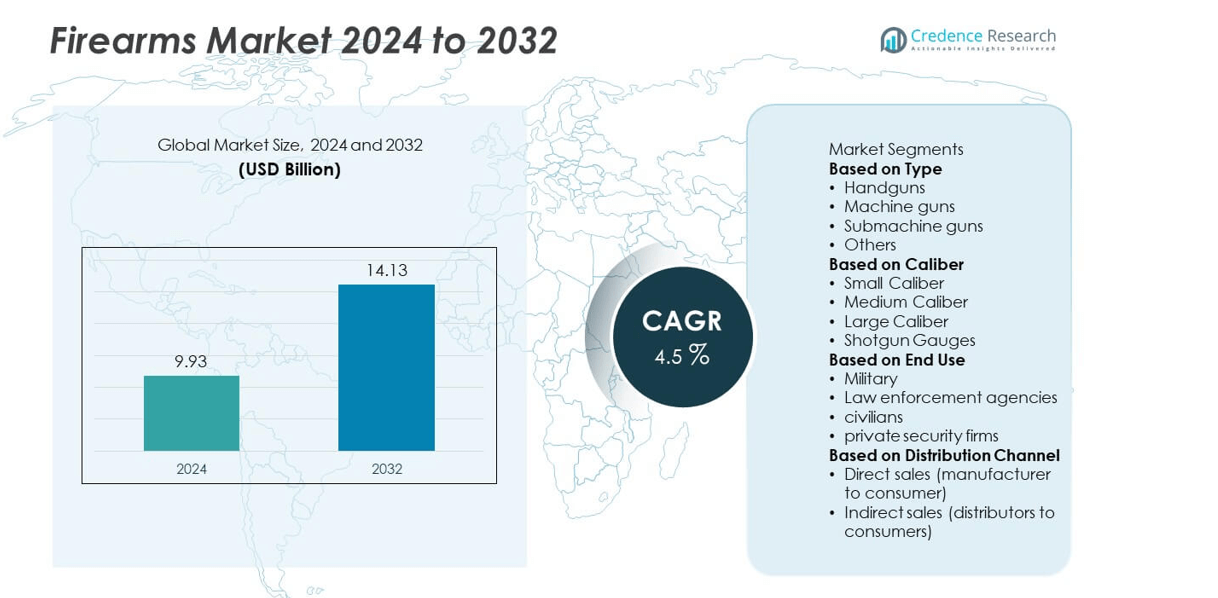
The global firearms market was valued at USD 9.93 billion in 2024 and is projected to reach USD 14.13 billion by 2032, expanding at a CAGR of 4.5% during the forecast period.
| REPORT ATTRIBUTE | DETAILS |
|---|---|
| Historical Period | 2020-2023 |
| Base Year | 2024 |
| Forecast Period | 2025-2032 |
| Firearms Market Size 2024 | USD 9.93 billion |
| Firearms Market, CAGR | 4.5% |
| Firearms Market Size 2032 | USD 14.13 billion |
The firearms market is led by major players such as Smith & Wesson, FN HERSTAL, Ruger & Co., Inc., Glock Inc., and SIG SAUER, who maintain strong positions through advanced product portfolios and wide global distribution. These companies focus on innovation in design, safety, and precision to meet the needs of military, law enforcement, and civilian users. Regionally, North America dominated the market in 2024 with 36% share, supported by high civilian ownership and strong defense spending. Europe followed with 28% share, driven by rising law enforcement modernization programs, while Asia-Pacific accounted for 22% share, fueled by increasing defense budgets and border security requirements.
Market Insights
- The global firearms market was valued at USD 9.93 billion in 2024 and is projected to reach USD 14.13 billion by 2032, growing at a CAGR of 4.5% during the forecast period.
- Rising defense budgets, modernization programs, and civilian demand for personal protection drive the market, with handguns leading at 42% share due to widespread adoption across military, law enforcement, and civilian users.
- Key trends include technological advancements in lightweight materials, modular firearm systems, and smart safety features, alongside growing investments in precision and semi-automatic weapons.
- Leading companies such as Smith & Wesson, FN HERSTAL, Ruger & Co., Inc., Glock Inc., and SIG SAUER dominate through innovation, global distribution, and brand strength, while high regulatory restrictions and export controls act as restraints.
- Regionally, North America leads with 36% share, followed by Europe at 28% supported by modernization of law enforcement, while Asia-Pacific holds 22% share driven by rising defense expenditure, and Latin America (8%) and Middle East & Africa (6%) show steady demand growth.
Market Segmentation Analysis:
By Type
The handguns segment led the market in 2024 with 41% share, driven by widespread use across military, law enforcement, and civilian applications. Handguns are preferred for their portability, ease of use, and effectiveness in close-range defense. Rising demand for personal protection, coupled with increasing law enforcement procurement, continues to strengthen this category. Machine guns and submachine guns hold relevance in specialized military operations, but their adoption remains lower compared to handguns due to restrictions in civilian use and higher costs of deployment.
- For instance, the Smith & Wesson M&P Shield line is a popular choice for concealed carry among civilians and has also been adopted by some U.S. law enforcement officers for on- and off-duty use, demonstrating its reputation as a compact and reliable sidearm.
By Caliber
The small-caliber segment dominated with 44% share in 2024, as it is extensively used in handguns, rifles, and shotguns. Small-caliber firearms are favored for training, sporting activities, and personal defense because of their affordability, ease of handling, and reduced recoil. Their popularity among civilian users and law enforcement agencies underpins their leadership. Medium and large calibers, though vital for military operations, serve niche requirements, while shotgun gauges are widely adopted in hunting and recreational shooting.
- For instance, Sturm, Ruger & Co. is a prominent producer of .22 LR small-caliber firearms, which are consistently among the highest-volume sellers in the civilian sporting market.
By End Use
The military segment accounted for 46% share in 2024, reflecting the strong demand for firearms in defense modernization programs. Governments worldwide are investing heavily in upgrading weapons systems to improve operational readiness and combat effectiveness. Law enforcement agencies also represent a significant share, driven by rising security threats and the need for advanced tactical weapons. Civilian use, particularly for personal protection and sports shooting, continues to grow, while private security firms contribute steadily, supported by increased demand for armed security in sensitive sectors.
Key Growth Drivers
Rising Defense Modernization Programs
Governments worldwide are increasing investments in defense modernization, which significantly drives firearm demand. Advanced handguns, rifles, and automatic weapons are being procured to strengthen armed forces. Countries such as the U.S., China, and India are actively upgrading infantry weapons to improve combat efficiency. This trend supports large-scale procurement contracts and sustains steady growth for firearm manufacturers. The rising focus on enhancing defense capabilities amid growing geopolitical tensions ensures that military applications remain a dominant driver of the global firearms market.
- For instance, FN Herstal has delivered FN SCAR rifles to U.S. Special Operations Command, with the heavier Mk 17 model seeing greater adoption after the Mk 16 was phased out. This procurement program highlights the modular design and shifting requirements in military acquisitions.
Increasing Civilian Ownership and Personal Security Needs
Growing concerns over personal security and rising crime rates have fueled civilian firearm ownership. In regions like North America and parts of Europe, liberal gun ownership laws boost handgun sales. Sporting activities, hunting, and shooting competitions also contribute to increased civilian demand. With more consumers prioritizing personal safety, compact and user-friendly firearms gain prominence. The growing interest in recreational shooting and home defense strongly supports the long-term demand for civilian firearms, making it a key growth driver for the market.
- For instance, Glock's produces a significant number of pistols each year for both government contracts and civilian use. Reports indicate Glock is a top supplier of handguns for law enforcement and militaries in dozens of countries, while also being very popular among civilians for self-defense, competition, and recreation.
Expansion of Law Enforcement and Private Security
Rising investments in law enforcement modernization and private security expansion are boosting the firearms market. Police forces globally are upgrading their small arms to improve operational readiness. At the same time, private security firms are equipping personnel with advanced firearms for asset and personnel protection. Increasing demand for tactical handguns and shotguns in urban security scenarios further drives procurement. With rapid urbanization and growing concerns over terrorism, the law enforcement and private security segments are expected to contribute significantly to market growth.
Key Trends & Opportunities
Growth in Smart Firearms and Digital Integration
The market is witnessing a trend toward smart firearms integrated with digital safety features. Technologies such as biometric authentication, tracking systems, and personalized access controls are gaining traction. These solutions enhance safety, prevent unauthorized use, and meet stricter firearm regulations. Defense and civilian users alike are showing interest in smart systems for improved control and accountability. With governments encouraging safe weapon handling, the adoption of smart firearms represents a major opportunity for manufacturers to align innovation with evolving regulatory demands.
- For instance, Biofire Technologies introduced its smart handgun with fingerprint and facial recognition, capable of unlocking in less than one second, and the company secured over 5,000 pre-orders within its initial launch phase.
Rising Popularity of Hunting and Sports Shooting
Sport shooting and hunting activities are contributing to steady growth in firearm demand, particularly in developed economies. Civilian interest in recreational use of rifles and shotguns has boosted sales, supported by hunting clubs and sporting events. Countries like the U.S., Canada, and Germany are key markets where recreational shooting drives firearm adoption. Rising disposable incomes and awareness of shooting sports in developing countries also create new opportunities. This trend supports the expansion of niche firearm segments catering specifically to hunting and sports enthusiasts.
- For instance, Browning Arms Company distributes hunting rifles and shotguns, with strong demand from U.S. and Canadian recreational shooting markets.
Key Challenges
Stringent Government Regulations
Tighter government regulations on firearm ownership and sales pose a significant challenge to market expansion. Policies such as background checks, licensing requirements, and import restrictions limit access for civilian buyers. In Europe and parts of Asia, strict rules reduce sales volumes and increase compliance costs for manufacturers. These regulatory hurdles often delay distribution and adoption. As firearm misuse remains a global concern, regulatory frameworks are likely to tighten further, restricting growth opportunities, especially in the civilian and recreational segments.
Rising Incidents of Gun Violence
The growing number of gun-related crimes and mass shootings poses reputational and operational challenges for firearm manufacturers. Public scrutiny and pressure from advocacy groups lead to stricter laws and reduced civilian demand in some regions. Manufacturers face challenges in balancing market demand with corporate responsibility. Negative perceptions also affect consumer sentiment, discouraging casual buyers. The industry must address safety concerns through innovation in firearm security and responsible marketing to sustain growth in the face of rising global gun violence concerns.
Regional Analysis
North America
North America held the largest share of the firearms market in 2024, accounting for 38%. The United States drives regional growth due to high civilian gun ownership, defense procurement, and strong demand from law enforcement agencies. Favorable firearm regulations in several states, combined with widespread use for hunting, sporting, and self-defense, sustain market leadership. Canada also contributes significantly, supported by defense modernization programs and regulated civilian ownership. With strong domestic manufacturing capabilities and a culture of firearm usage, North America continues to dominate the global firearms market.
Europe
Europe captured 27% share of the firearms market in 2024, driven by defense investments, law enforcement procurement, and growing participation in hunting and sports shooting. Countries like Germany, France, and the United Kingdom lead adoption, supported by stringent quality standards for military and law enforcement weapons. Civilian ownership is more restricted compared to North America, but recreational shooting and hunting activities sustain steady demand. The European Union’s focus on security modernization, counter-terrorism, and cross-border defense cooperation supports firearm procurement, ensuring the region maintains a strong position in the global market.
Asia-Pacific
Asia-Pacific accounted for 24% share of the firearms market in 2024, emerging as one of the fastest-growing regions. China, India, and South Korea lead the demand, supported by large-scale defense modernization, increasing military budgets, and expanding law enforcement needs. Rising geopolitical tensions and border security challenges drive procurement of small arms and advanced weaponry. Civilian ownership is restricted in many countries, limiting non-military demand. However, defense contracts and growing private security adoption make the region a key growth contributor. Asia-Pacific’s increasing role in military expansion ensures its steady rise in the firearms market.
Latin America
Latin America represented 6% share of the firearms market in 2024, with Brazil and Mexico as the leading contributors. Rising concerns over organized crime and drug-related violence drive demand from law enforcement and private security firms. Civilian ownership laws vary across the region, but demand for handguns and shotguns in self-defense remains strong. Government investments in military modernization programs also contribute to firearm procurement. Despite economic challenges and limited local manufacturing, Latin America continues to adopt firearms across defense, law enforcement, and civilian applications, with steady growth projected in coming years.
Middle East & Africa
The Middle East & Africa accounted for 5% share of the firearms market in 2024, reflecting growing adoption across military, law enforcement, and private security sectors. GCC countries, particularly Saudi Arabia and the UAE, lead regional demand with high defense spending and ongoing military modernization programs. In Africa, South Africa and Nigeria represent key markets, driven by security challenges and demand for law enforcement firearms. Civilian ownership remains limited in most countries, but private security adoption is rising. The region’s growth is supported by geopolitical tensions and rising defense expenditures.
Market Segmentations:
By Type
- Handguns
- Machine guns
- Submachine guns
- Others
By Caliber
- Small Caliber
- Medium Caliber
- Large Caliber
- Shotgun Gauges
By End Use
- Military
- Law enforcement agencies
- civilians
- private security firms
By Distribution Channel
- Direct sales (manufacturer to consumer)
- Indirect sales (distributors to consumers)
By Geography
- North America
- U.S.
- Canada
- Mexico
- Europe
- Germany
- France
- U.K.
- Italy
- Spain
- Rest of Europe
- Asia Pacific
- China
- Japan
- India
- South Korea
- South-east Asia
- Rest of Asia Pacific
- Latin America
- Brazil
- Argentina
- Rest of Latin America
- Middle East & Africa
- GCC Countries
- South Africa
- Rest of the Middle East and Africa
Competitive Landscape
Competitive landscape of the firearms market is shaped by leading players such as Ruger & Co., Inc., FN HERSTAL, Heckler & Koch GmbH, Glock Inc., Colt’s Manufacturing Company LLC, Smith & Wesson, Beretta Holding S.p.A., SIG SAUER, Sturm Ruger & Co., Inc., and Česká Zbrojovka (CZ Group). These companies compete through product innovation, diverse weapon portfolios, and strong distribution networks across global markets. Key strategies include technological advancements in lightweight materials, improved accuracy, and smart gun features to meet growing defense, law enforcement, and civilian demands. Many players focus on expanding in emerging economies where defense spending and civilian ownership are rising. Additionally, collaborations with military agencies and law enforcement institutions strengthen market positions by ensuring long-term contracts and reliability in supply. With growing emphasis on customization, safety enhancements, and digital integration, competition continues to intensify, driving leading manufacturers to balance cost efficiency with advanced technology to secure a competitive edge.
Key Player Analysis
- Ruger & Co., Inc.
- FN HERSTAL
- Heckler & Koch GmbH
- Glock Inc.
- Colt’s Manufacturing Company LLC
- Smith & Wesson
- Beretta Holding S.p.A.
- SIG SAUER
- Sturm, Ruger & Co., Inc.
- Česká Zbrojovka (CZ Group)
Recent Developments
- In January 2025, SK Guns announced the collaboration with Phoenix Trinity Manufacturing. The aim of the partnership was to create a double-stack, commander-sized pistol which was designed for concealed carry.
- In November 2024, Sig Sauer came under partnership with Nibe Group to manufacture assault rifles in India. Sig Sauer made contract to supply around 145,000 assault rifles to the Indian Army.
- In June 2023, WATCHTOWER announced the acquisition of F-1 Firearms LLC, to expand its domestic, foreign military and law enforcement markets. The aim is to provide firearms to individuals for self- defense, sporting, and hunting activities
Report Coverage
The research report offers an in-depth analysis based on Type, Caliber, End Use, Distribution Channel and Geography. It details leading market players, providing an overview of their business, product offerings, investments, revenue streams, and key applications. Additionally, the report includes insights into the competitive environment, SWOT analysis, current market trends, as well as the primary drivers and constraints. Furthermore, it discusses various factors that have driven market expansion in recent years. The report also explores market dynamics, regulatory scenarios, and technological advancements that are shaping the industry. It assesses the impact of external factors and global economic changes on market growth. Lastly, it provides strategic recommendations for new entrants and established companies to navigate the complexities of the market.
Future Outlook
- Demand for firearms will grow with rising defense modernization programs worldwide.
- Civilian ownership will increase due to rising concerns over personal safety.
- Handguns will remain the dominant firearm type across multiple end-use sectors.
- Smart gun technologies with biometric safety features will gain adoption.
- North America will maintain leadership driven by high civilian and defense demand.
- Europe will see growth supported by law enforcement modernization and strict regulations.
- Asia-Pacific will emerge as the fastest-growing region with expanding defense budgets.
- Manufacturers will focus on lightweight and modular firearm designs.
- Export restrictions and regulatory challenges will continue to limit market expansion.
- Partnerships and acquisitions among firearm manufacturers will strengthen global market presence.

Request a Free Sample
Fill in your details and we'll send you a free sample report.
- Sample data tables & charts
- Research methodology
Market Dynamics
Rising Defense Modernization Programs
Governments worldwide are increasing investments in defense modernization, driving demand for advanced firearms across military and law enforcement sectors. Large-scale procurement contracts for new weapon systems, especially in the U.S., China, and India, are fueling steady market growth.
Increasing Civilian Ownership and Personal Security Needs
Growing concerns over personal safety and rising crime rates are boosting civilian firearm ownership, particularly in North America and parts of Europe. Liberal gun laws and heightened interest in recreational shooting and home defense are expanding the civilian segment.
Expansion of Law Enforcement and Private Security
Law enforcement agencies and private security firms are upgrading their arsenals to address evolving security threats and urbanization. This trend is leading to increased procurement of tactical handguns and shotguns, supporting market expansion.
Growth in Smart Firearms and Digital Integration
Technological advancements such as biometric authentication and digital safety features are gaining traction, appealing to both defense and civilian users. These innovations enhance firearm safety and compliance with stricter regulations, opening new market opportunities.
Rising Popularity of Hunting and Sports Shooting
Recreational shooting and hunting activities are driving steady demand for firearms, especially in developed economies. Increased participation in sporting events and hunting, supported by rising disposable incomes, is expanding niche firearm segments.
Need a Custom Version of This Report?
Tailor the scope, geography, or segments to your exact requirements.
- Custom geography or segment scope
- Direct access to our analyst team
Frequently Asked Questions
What is the current market size for Firearms market, and what is its projected size in 2032?
At what Compound Annual Growth Rate is the Firearms market projected to grow between 2025 and 2032?
Which Firearms market segment held the largest share in 2024?
What are the primary factors fueling the growth of the Firearms market?
Who are the leading companies in the Firearms market?
Table of Content
Chapter 1 Market Segmentation
- 1.1 Segmentation Framework
- 1.1.1 Product and Service Classification
- 1.1.2 Application and End-Use Classification
- 1.1.3 Technology and Solution Classification
- 1.1.4 Customer and Distribution Channel Classification
- 1.1.5 Geographic Segmentation
- 1.1.6 Market Segment Definitions and Boundaries
- 1.2 By Type
- 1.2.1 Handguns
- 1.2.2 Machine guns
- 1.2.3 Submachine guns
- 1.2.4 Others
- 1.3 By Caliber
- 1.3.1 Small Caliber
- 1.3.2 Medium Caliber
- 1.3.3 Large Caliber
- 1.3.4 Shotgun Gauges
- 1.4 By End Use
- 1.4.1 Military
- 1.4.2 Law enforcement agencies
- 1.4.3 Civilians
- 1.4.4 Private security firms
Chapter 2 Introduction
- 2.1 Report Objectives and Scope
- 2.2 Product Definition and Industry Terminology
- 2.3 Market Inclusions and Exclusions
- 2.4 Research Process
- 2.4.1 Primary Research and Expert Interviews
- 2.4.2 Secondary Research and Source Review
- 2.4.3 Top-Down and Bottom-Up Estimation
- 2.4.4 Data Triangulation and Verification
- 2.5 Market Size Measurement Basis
- 2.5.1 2024: USD 9.93 billion → 2032: USD 14.13 billion
- 2.6 Historical and Forecast Reference Periods
- 2.6.1 Base Year: 2024
- 2.6.2 Forecast Period: 2024-2032
- 2.7 Research Assumptions and Limitations
Chapter 3 Executive Summary
- 3.1 Market Snapshot and Key Findings
- 3.2 Base-Year Market Size, 2024
- 3.3 Forecast Market Size, 2032
- 3.4 Revenue and Volume Growth Outlook
- 3.5 Key Demand and Supply Indicators
- 3.6 Leading Market Segments
- 3.7 Fastest-Growing Market Opportunities
- 3.8 Regional Performance Highlights
- 3.9 Technology and Industry Transformation
- 3.10 Competitive Landscape Summary
- 3.11 Analyst View and Strategic Implications
Chapter 4 Global Firearms Market Trends and Developments
- 4.1 Historical Industry Development
- 4.2 Recent Market Trends and Developments
- 4.3 Demand and Customer Behavior Trends
- 4.4 Technology and Product Innovation
- 4.5 Artificial Intelligence, Automation and Digitalization
- 4.6 Local Manufacturing and Supply Chain Realignment
- 4.7 Industry Partnerships, Mergers and Acquisitions
- 4.8 Sustainability and Circular Economy Developments
- 4.9 Government and Private Sector Investment Trends
- 4.10 Emerging Business Models and Commercialization
- 4.11 Industry Developments and Announcements
Chapter 5 Global Firearms Market Production, Supply and Demand Analysis
- 5.1 Demand Trend and Consumption Analysis
- 5.2 Demand Forecast, 2024-2032
- 5.3 Production and Output Trend
- 5.4 Production and Output Forecast, 2024-2032
- 5.5 Installed Capacity and Capacity Utilization
- 5.6 Company-Wise Production Plants and Statistics
- 5.6.1 Installed Production Capacity
- 5.6.2 Actual Production
- 5.6.3 Planned Capacity and Expansion Targets
- 5.7 Supply Chain Structure and Procurement Trends
- 5.8 Supply-Demand Gap and Bottlenecks
- 5.9 Import Dependence and Sourcing Structure
- 5.10 Contract Manufacturing and Outsourcing
- 5.11 Regional Supply and Demand Concentration
Chapter 6 Global Firearms Market Pricing Analysis
- 6.1 Pricing Structure and Measurement
- 6.2 Historical Pricing Trends
- 6.3 Pricing Outlook, 2024-2032
- 6.4 Average Selling Price and Unit Economics
- 6.5 Pricing by Product and Market Segment
- 6.6 Geographic Pricing Differences
- 6.7 Key Input, Energy, Labor and Logistics Costs
- 6.8 Contract Pricing and Purchasing Models
- 6.9 Pricing Sensitivity and Competitive Positioning
- 6.10 Price, Margin and Profitability Implications
Chapter 7 Global Firearms Market Dynamics
- 7.1 Market Growth Drivers
- 7.1.1 Demand-Side Drivers
- 7.1.2 Technology and Innovation Drivers
- 7.1.3 Infrastructure and Investment Drivers
- 7.1.4 Regulatory and Policy Drivers
- 7.2 Market Restraints
- 7.2.1 Cost and Affordability Constraints
- 7.2.2 Technology and Adoption Barriers
- 7.2.3 Supply Chain and Operational Constraints
- 7.3 Market Challenges
- 7.3.1 Competitive Pressure and Margin Erosion
- 7.3.2 Skills, Infrastructure and Implementation Gaps
- 7.4 Emerging Market Opportunities
- 7.5 Market Dynamics Impact and Time-Horizon Assessment
Chapter 8 Global Firearms Value Chain Analysis
- 8.1 Industry Value Chain Overview
- 8.2 Upstream Suppliers and Critical Inputs
- 8.3 Technology and Component Providers
- 8.4 Manufacturing or Service Delivery
- 8.5 Distribution, Channel Partners and Integrators
- 8.6 Downstream Applications and End Users
- 8.7 Value Addition and Profit Pools
- 8.8 Vertical Integration and Outsourcing
- 8.9 Supplier Concentration and Risk
- 8.10 Supply Chain Localization and Resilience
Chapter 9 Global Firearms Market Regulations and Policies
- 9.1 Relevant Laws, Standards and Compliance Frameworks
- 9.2 Product, Service, Safety and Quality Requirements
- 9.3 Government Policies, Incentives and Subsidies
- 9.4 Imports, Exports and Trade Barriers
- 9.5 Public Procurement and Local Content Requirements
- 9.6 Environmental and Sustainability Compliance
- 9.7 Upcoming Policy Changes and Market Implications
Chapter 10 Global Firearms Market Hotspots and Opportunities
- 10.1 Market Opportunity Mapping and Growth Hotspots
- 10.2 High-Growth Applications and Customer Groups
- 10.3 Underserved Markets and White-Space Opportunities
- 10.4 Emerging Technology and Product Opportunities
- 10.5 New Capacity and Investment Hotspots
- 10.6 Market Entry and Expansion Opportunities
- 10.7 Distribution and Partnership Opportunities
- 10.8 Near-Term and Long-Term Commercial Potential
- 10.9 Opportunity Attractiveness and Execution Risks
Chapter 11 Global Firearms Market Outlook, 2024-2032
- 11.1 Market Size and Analysis
- 11.1.1 Revenue (Market Measurement: 2024: USD 9.93 billion → 2032: USD 14.13 billion)
- 11.1.2 Market Volume and Quantity Sold
- 11.1.3 Historical Market Size
- 11.1.4 Base-Year Market Size, 2024
- 11.2 Market Forecast, 2024-2032
- 11.2.1 Revenue Forecast to 2032
- 11.2.2 Volume Forecast to 2032
- 11.2.3 CAGR and Year-on-Year Growth
- 11.2.4 Incremental Revenue Opportunity
- 11.3 Forecast Assumptions and Scenario Analysis
- 11.3.1 Base-Case Forecast
- 11.3.2 Optimistic and Conservative Scenarios
- 11.3.3 Technology, Pricing and Policy Sensitivities
- 11.4 Market Attractiveness and Growth Outlook
Chapter 12 Global Firearms Market Segmentation and Outlook
- 12.1 Segmentation Summary and Market Shares, 2024
- 12.2 Largest and Fastest-Growing Segments
- 12.3 By Type - Market Size and Forecast, 2024-2032
- 12.3.1 Segment Definition and Scope
- 12.3.2 Historical Market Size
- 12.3.3 Revenue Forecast, 2024-2032
- 12.3.4 Volume Forecast, 2024-2032
- 12.3.5 Base-Year Market Share, 2024
- 12.3.6 Segment CAGR and Growth Drivers
- 12.3.7 Subsegment Market Size and Forecast
- 12.3.7.1 Handguns
- 12.3.7.2 Machine guns
- 12.3.7.3 Submachine guns
- 12.3.7.4 Others
- 12.3.8 Subsegment Pricing and Adoption Trends
- 12.3.9 Leading Suppliers and Competition
- 12.3.10 Regional Demand and Opportunities
- 12.4 By Caliber - Market Size and Forecast, 2024-2032
- 12.4.1 Segment Definition and Scope
- 12.4.2 Historical Market Size
- 12.4.3 Revenue Forecast, 2024-2032
- 12.4.4 Volume Forecast, 2024-2032
- 12.4.5 Base-Year Market Share, 2024
- 12.4.6 Segment CAGR and Growth Drivers
- 12.4.7 Subsegment Market Size and Forecast
- 12.4.7.1 Small Caliber
- 12.4.7.2 Medium Caliber
- 12.4.7.3 Large Caliber
- 12.4.7.4 Shotgun Gauges
- 12.4.8 Subsegment Pricing and Adoption Trends
- 12.4.9 Leading Suppliers and Competition
- 12.4.10 Regional Demand and Opportunities
- 12.5 By End Use - Market Size and Forecast, 2024-2032
- 12.5.1 Segment Definition and Scope
- 12.5.2 Historical Market Size
- 12.5.3 Revenue Forecast, 2024-2032
- 12.5.4 Volume Forecast, 2024-2032
- 12.5.5 Base-Year Market Share, 2024
- 12.5.6 Segment CAGR and Growth Drivers
- 12.5.7 Subsegment Market Size and Forecast
- 12.5.7.1 Military
- 12.5.7.2 Law enforcement agencies
- 12.5.7.3 Civilians
- 12.5.7.4 Private security firms
- 12.5.8 Subsegment Pricing and Adoption Trends
- 12.5.9 Leading Suppliers and Competition
- 12.5.10 Regional Demand and Opportunities
- 12.6 Segment Growth Comparison
- 12.7 Segment Attractiveness and Priority Matrix
Chapter 13 Global Firearms End-Use and Application Market Outlook
- 13.1 End-Use Industry and Customer Demand Structure
- 13.2 Leading Applications and Customer Groups
- 13.3 End-Use Market Size, Share and Forecast
- 13.4 Major End-Use Industry Deep Dives
- 13.4.1 Customer Requirements and Use Cases
- 13.4.2 Demand and Replacement Cycles
- 13.4.3 Technical and Regulatory Considerations
- 13.4.4 Purchasing and Procurement Models
- 13.4.5 Leading Vendors and Distribution Channels
- 13.4.6 Forecast and Commercial Opportunities
- 13.5 Emerging Applications and Cross-Segment Demand
- 13.6 End-Use Industry Investment Priorities
Chapter 14 Global Firearms Geographic Market Outlook, 2024-2032
- 14.1 Regional Market Size and Share, 2024
- 14.2 Regional Market Forecast, 2024-2032
- 14.3 Regional Pricing, Production and Demand Differences
- 14.4 North America
- 14.4.1 United States
- 14.4.2 Canada
- 14.4.3 Mexico
- 14.5 Europe
- 14.5.1 Germany
- 14.5.2 France
- 14.5.3 Italy
- 14.5.4 United Kingdom
- 14.5.5 Spain
- 14.5.6 Poland
- 14.5.7 Russia
- 14.5.8 Netherlands
- 14.5.9 Belgium
- 14.5.10 Sweden
- 14.5.11 Denmark
- 14.5.12 Norway
- 14.5.13 Rest of Europe
- 14.6 Asia Pacific
- 14.6.1 China
- 14.6.2 India
- 14.6.3 Japan
- 14.6.4 South Korea
- 14.6.5 Thailand
- 14.6.6 Indonesia
- 14.6.7 Vietnam
- 14.6.8 Malaysia
- 14.6.9 Australia
- 14.6.10 Rest of Asia Pacific
- 14.7 Latin America
- 14.7.1 Brazil
- 14.7.2 Argentina
- 14.7.3 Colombia
- 14.7.4 Chile
- 14.7.5 Rest of Latin America
- 14.8 Middle East
- 14.8.1 Saudi Arabia
- 14.8.2 United Arab Emirates
- 14.8.3 Turkey
- 14.8.4 Israel
- 14.8.5 Iran
- 14.8.6 Rest of the Middle East
- 14.9 Africa
- 14.9.1 South Africa
- 14.9.2 Egypt
- 14.9.3 Nigeria
- 14.9.4 Morocco
- 14.9.5 Rest of Africa
- 14.10 Regional Investment, Policy and Supply Chain Differences
- 14.11 Regional Competitive Landscape
- 14.12 Geographic Growth Hotspots
Chapter 15 Global Firearms Technology, Innovation and Sustainability Outlook
- 15.1 Technology Landscape and Maturity
- 15.2 Product, Process and Service Innovation
- 15.3 AI, Automation and Digital Tools in the Industry
- 15.4 Technology Adoption and Performance Benchmarking
- 15.5 Innovation Pipeline and R&D Investment
- 15.6 Patent and Intellectual Property Trends
- 15.7 Energy Efficiency and Resource Management
- 15.8 Sustainability, Recycling and Circularity
- 15.9 Technology Roadmap, 2024-2032
- 15.10 Risks of Obsolescence and Technology Substitution
Chapter 16 Global Firearms Market Key Strategic Imperatives
- 16.1 Growth and Market Entry Priorities
- 16.2 High-Return Products and Segments
- 16.3 Pricing, Profitability and Cost Optimization
- 16.4 Technology Investment and Product Differentiation
- 16.5 Supply Chain Localization and Resilience
- 16.6 Distribution and Customer Acquisition
- 16.7 Partnership, Acquisition and Capacity Strategy
- 16.8 Regional Expansion Priorities
- 16.9 Short-, Medium- and Long-Term Actions
Chapter 17 Competition Outlook
- 17.1 Industry Competition Characteristics
- 17.2 Market Structure and Concentration
- 17.3 Market Share and Competitive Positioning, 2024
- 17.4 Company-Wise Revenue and Product Benchmarking
- 17.5 Production and Service Capacity Benchmarking
- 17.6 Technology, Pricing and Differentiation
- 17.7 Regional Footprint and Distribution Strength
- 17.8 Mergers, Acquisitions and Strategic Alliances
- 17.9 New Entrants and Competitive Threats
- 17.10 Porter's Five Forces and Industry Attractiveness
- 17.11 Competitive Outlook, 2024-2032
Chapter 18 Company Profiles
- 18.1 Company Coverage and Selection Criteria
- 18.2 Smith & Wesson
- 18.2.1 Business Description
- 18.2.2 Company Ownership and Geographic Presence
- 18.2.3 Product and Service Portfolio
- 18.2.4 Manufacturing and Operating Footprint
- 18.2.5 Production Capacity and Expansion Plans
- 18.2.6 Financial Performance and Investment
- 18.2.7 Market Share and Competitive Position
- 18.2.8 Technology and Innovation Capabilities
- 18.2.9 Strategic Alliances or Partnerships
- 18.2.10 Recent Developments
- 18.2.11 Growth Strategy and Outlook
- 18.3 FN HERSTAL
- 18.4 Ruger & Co., Inc.
- 18.5 Glock Inc.
- 18.6 SIG SAUER
- 18.7 Heckler & Koch GmbH
- 18.8 Colt’s Manufacturing Company LLC
- 18.9 Beretta Holding S.p.A.
- 18.10 Sturm, Ruger & Co., Inc.
- 18.11 Česká Zbrojovka (CZ Group)
- 18.12 Other Relevant Market Participants
Note: Every listed company is profiled on the structure shown under the first company. The company list is preliminary and may change based on research findings, market developments, data availability and client requirements.
Chapter 19 Disclaimer
- 19.1 Research and Forecast Disclaimer
- 19.2 Data Source and Estimation Limitations
Note: The depth of individual sections depends on data availability for this market. Volume, capacity, trade and other unit-based metrics are included where applicable.

