
Market Insights
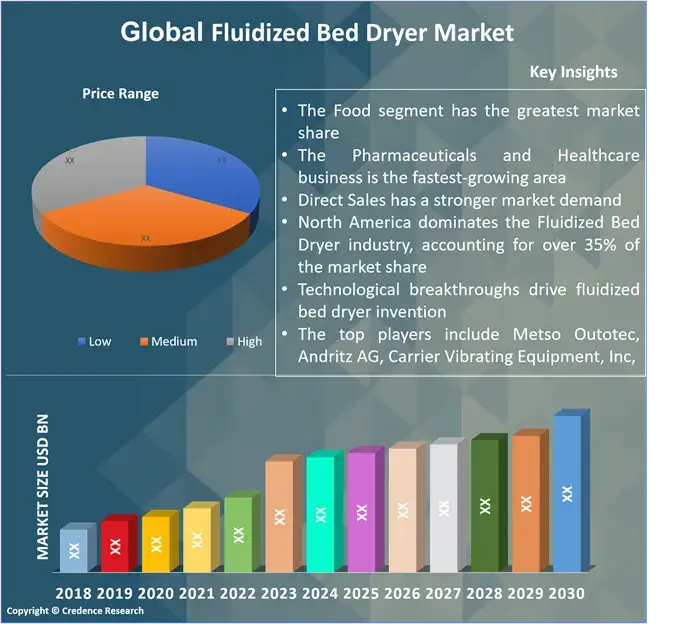
- The global demand for Fluidized bed dryer was valued at USD XX million in 2022 and is expected to reach USD XX Million in 2030, growing at a CAGR of 6.00% between 2023 and 2030.
- The Fluidized Bed Dryer market is dominated by the Vibrated Fluid Bed sector, and the Fluidized Spray Dryer market is the fastest growing category in the Fluidized Bed Dryer industry.
- The food segment has the largest market share in the Fluidized Bed Dryer business, followed by the Chemical section.
- Direct sales have a higher market demand, and distribution is the market's second-largest category in terms of market share.
- Industrial Processing is crucial in numerous industries, including manufacturing and chemical processing, and Research & Development is the market category with the highest CAGR.
- North America dominates the Fluidized Bed Dryer industry, accounting for more than 35% of the market share, while Asia Pacific is experiencing the quickest growth rate.
- Technological developments have been a major driving force in the expansion of the Fluidized Bed Dryer market.
- The high initial investment and maintenance expenses associated with fluidized bed dryers limit market expansion.
Executive Summary
Market Definition
The Fluidized Bed Dryer market refers to the industry that manufactures and sells fluidized bed dryers. Fluidized bed dryers are pieces of equipment that are used to dry a variety of materials by suspending them in a stream of hot air or gas. This drying method enables efficient and consistent drying, making it useful for a variety of industries including pharmaceuticals, chemicals, food processing, and others. The growing demand for efficient drying solutions in various industrial processes is driving the market for fluidized bed dryers.
Market Overview
It is anticipated that between 2023 and 2030, the worldwide Fluidized bed dryer market will expand at a compound annual growth rate (CAGR) of 6.00%. From USD XX million in 2022, the market is projected to be worth USD XX million by 2030.
The fluidized bed dryer market is rising steadily and is likely to increase further in the future years. The growing demand for effective drying solutions in industries such as pharmaceuticals, chemicals, food processing, and others is driving this market. Fluidized bed dryers provide benefits such as uniform drying, energy efficiency, and versatility in handling various materials. Technological improvements, increased environmental awareness, and the demand for cost-effective drying solutions all have an impact on the industry.
Overall, the Fluidized Bed Dryer market offers lucrative potential for manufacturers, suppliers, and other industry players.
Segmentation By Type
- The Vibrated Fluid Bed segment dominates the Fluidized Bed Dryer market. Because of its efficient and dependable drying qualities, it is widely utilized in industries such as pharmaceuticals, chemicals, and food processing.
- The Fluidized Spray Dryer market is the fastest expanding section in the Fluidized Bed Dryer market. This field is growing quickly because to its ability to offer consistent drying and fine control over particle size, which makes it ideal for usage in sectors including food processing and pharmaceuticals.
Segmentation By Application
- The food segment has the greatest market share in the Fluidized Bed Dryer industry. Because of the increasing demand for fluidized bed dryers in the food processing industry, it accounts for a considerable percentage of the market. Grain, fruits, vegetables, and processed food products are all subsegments of the food segment. The increased demand for effective food drying and preservation has contributed to the Food segment's dominance in the Fluidized Bed Dryer market.
- The chemical segment is another big share holder segment. The Chemical industry accounts for a sizable part, owing to the demand for efficient drying in chemical industrial operations.
Segmentation by Distribution Channel
- Direct Sales has a stronger market demand. Direct Sales refers to selling products directly to consumers without the use of intermediaries such as wholesalers and retailers, whereas Distribution entails the use of intermediaries such as wholesalers and retailers.
- The distribution is the market's second-largest segment by market share.
Segmentation by End-User
- Research and Development is the market segment with the greatest CAGR. It has grown significantly as a result of the increased emphasis on innovation and technical breakthroughs.
- Industrial Processing is essential in many industries, including manufacturing and chemical processing.
Segmentation by Region
- North America dominates the Fluidized Bed Dryer industry, accounting for over 35% of the market share.
- Asia Pacific is witnessing the fastest growth rate in the Fluidized bed dryer market
- The rest of the world, including Latin America, the Middle East, and Africa, supplies the remaining demand for Fluidized bed dryer .
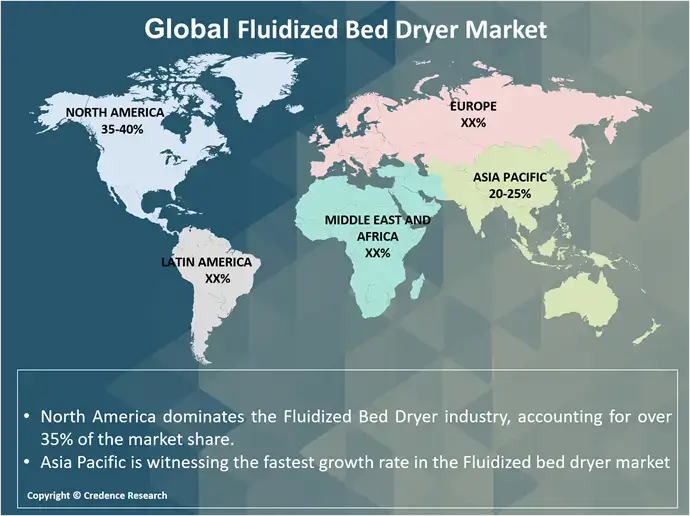
The presence of a strong industrial sector in the region accounts for North America's dominance. Pharmaceuticals, chemicals, and food processing are well-established industries in North America that rely extensively on fluidized bed dryers. The region's strong manufacturing infrastructure, technical breakthroughs, and demanding quality requirements all contribute to the region's high demand for fluidized bed dryers. Furthermore, North America places a great emphasis on research and development, resulting in ongoing innovation in dryer design and performance. Because of these characteristics, North America is a major player in the Fluidized Bed Dryer market.
Asia Pacific is the region with the highest growth rate in the Fluidized Bed Dryer market, with a projected growth rate of more than 8% over the forecast period. One cause for this expansion is the increasing industrialization and urbanization occurring in nations such as China and India. These countries have seen substantial expansion in businesses including pharmaceuticals, chemicals, and food processing, all of which rely heavily on fluidized bed dryers.
Key Highlights of the Report
The global Fluidized bed dryer market is segmented By Type, Application, End-Use Industry, Distribution Channel, and region. In 2022, The Food segment and Vibrated Fluid Bed have the largest market share in the Fluidized Bed Dryer business. Furthermore, Direct Sales has a higher market demand, and Research and Development is the market segment with the highest CAGR, with North America leading the market growth.
Growing industry demand for efficient drying solutions The primary drivers in the market include the advantages of fluidized bed dryers such as consistent drying, energy economy, and versatility in handling diverse materials, as well as technological improvements leading to higher performance and expanded features of fluidized bed dryers. Furthermore, the market is hampered by high initial investment and maintenance costs associated with fluidized bed dryers, difficulties in maintaining consistent product quality and preventing contamination in the drying process, and limited awareness and adoption of fluidized bed dryers in certain industries and regions.
Nonetheless, the region's strong industrial sector accounts for North America's supremacy. Pharmaceuticals, chemicals, and food processing are well-established North American sectors that rely heavily on fluidized bed dryers. Furthermore, with a predicted growth rate of more than 8% over the forecast period, Asia Pacific is the area with the greatest growth rate in the Fluidized Bed Dryer market.
What Elements Are Driving the Global Market for Fluidized bed dryer ?
The growing demand for effective drying solutions in industries such as pharmaceuticals, chemicals, and food processing is propelling the Fluidized Bed Dryer market. These sectors demand dependable and efficient drying techniques to assure product quality and efficiency. Furthermore, fluidized bed dryers have various advantages, including uniform drying, energy economy, and the ability to handle a variety of materials. These advantages make them very desirable in a variety of industries, driving to market growth. Furthermore, technological advances have played a key role in propelling the Fluidized Bed Dryer market. Continuous advancements in dryer design, control systems, and automation have improved performance and efficiency, making them more appealing to industries.
What Are The Main Obstacles That The Global Fluidized bed dryer market Faces?
The high initial investment and maintenance expenses associated with these dryers are major limitations in the Fluidized Bed Dryer market. The capital outlay for purchasing and installing the equipment might be substantial, which may deter some prospective buyers. Furthermore, maintaining consistent product quality and minimizing contamination during the drying process might be difficult. To avoid any negative consequences on the final product, industries must carefully control the drying conditions.
What Market Development Prospects Are There For Fluidized bed dryer Globally?
The fluidized bed dryer sector has a lot of potential because of the growing emphasis on sustainable and eco-friendly practises. These dryers provide energy-efficient drying solutions that meet the growing need for ecologically friendly procedures. Additionally, there is a growing demand for tailored drying solutions to satisfy the needs of specific industries. Fluidized bed dryers can be customized to handle a variety of materials, making them ideal for industries with specialized drying requirements. In addition, unexplored areas and emerging markets offer prospects for market expansion and growth. The market has the potential to expand into new sectors and regions as more companies understand the benefits of fluidized bed dryers.
Market Drivers
The global Fluidized bed dryer market is driven by several factors. The following are the key drivers of the global Fluidized bed dryer market:
Technological Advancements
Technological advances have been a primary driver of the Fluidized Bed Dryer market's growth. Continuous advancements in dryer design, control systems, and automation have substantially improved these dryers' performance and efficiency, making them increasingly appealing to industries. Manufacturers have been able to refine the fluidization process in drier design, resulting in more uniform drying and higher product quality. Control systems have also advanced, allowing for more accurate control over parameters such as temperature, airflow, and drying time. This level of control provides uniform and efficient drying, which is critical in industries such as pharmaceuticals, chemicals, and food processing.
Automation has also contributed significantly to the growth of the Fluidized Bed Dryer market. The operation of fluidized bed dryers has been more streamlined and user-friendly with the use of advanced automation technologies like as programmable logic controllers (PLCs) and human-machine interfaces (HMIs). Automation improves drying process monitoring and control, lowering the danger of human error and assuring maximum efficiency.
Increasing Demand For Efficient Drying Solutions In Industries Like Pharmaceuticals, Chemicals, And Food Processing
The demand for effective drying solutions in industries such as pharmaceuticals, chemicals, and food processing is propelling the fluidized bed dryer market forward. To assure product quality, save production time, and improve operational efficiency, these sectors demand dependable and efficient drying techniques. Fluidized bed dryers have several benefits, including uniform drying, delicate handling of sensitive materials, and the capacity to manage a wide range of particle sizes. As a result, these industries are increasingly relying on fluidized bed dryers to meet their drying requirements. This rising demand for effective drying solutions is a major driver of the fluidized bed dryer market's expansion.
Market Restraints
The global Fluidized bed dryer market faces some challenges that may hinder its growth. These include the following:
High Initial Investment And Maintenance Costs of Fluidized Bed Dryers
The initial cost of purchasing and installing these dryers, as well as the recurring costs for maintenance and repairs, might be prohibitively expensive. However, it is critical to consider the long-term advantages and cost reductions that fluidized bed dryers provide, such as greater drying efficiency and lower energy usage. Additionally, organizations can consider leasing or borrowing to reduce the initial outlay. Despite these obstacles, the demand for effective drying solutions in a variety of industries drives the adoption of fluidized bed dryers.
Opportunities
The global Fluidized bed dryer market offers significant growth opportunities. These include the following:
Emerging Markets And Untapped Industries Presenting Opportunities For Market Expansion
Emerging markets and undeveloped industries in the fluidized bed dryer industry provide exciting potential for global expansion and growth. These previously unexplored or neglected areas and industries offer opportunities for firms to expand into new markets and meet previously unmet demands. Companies can obtain a competitive advantage by recognizing these new areas and underdeveloped industries and positioning themselves as pioneers. This potential for expansion and growth can result in higher revenue, market share, and overall success in the fluidized bed dryer business.
Competitive Landscape
Key Players
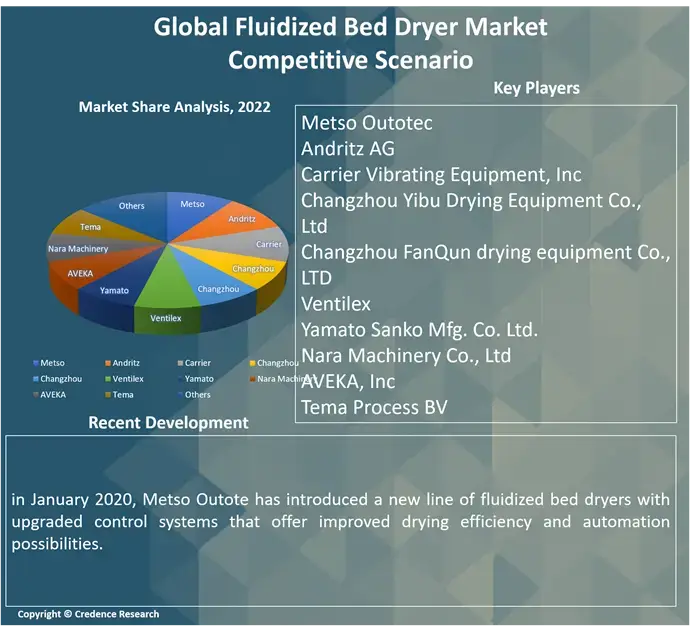
The global Fluidized bed dryer market is highly competitive, with several key players. Some of the major players in the market and their market share are as follows:
- Metso Outotec
- Andritz AG
- Carrier Vibrating Equipment, Inc
- Changzhou Yibu Drying Equipment Co., Ltd
- Changzhou FanQun drying equipment Co., LTD
- Ventilex
- Yamato Sanko Mfg. Co. Ltd.
- Nara Machinery Co., Ltd
- AVEKA, Inc
- Tema Process BV
These organizations prioritize product innovation, Disease Area expansion, and mergers and acquisitions to stay competitive.
The global Fluidized bed dryer market's key players continually seek to stay ahead by offering new Speciess and developments.
In May 2018, AVEKA, Inc. formed a strategic alliance with a renowned pharmaceutical producer to supply customized fluidized bed drying solutions for their manufacturing facilities.
in June 2018, Andritz AG invested in research and development to create a unique heat transfer mechanism for fluidized bed dryers, with the goal of improving drying efficiency and lowering energy consumption.
Summary of Key Findings
- Fluidized bed dryers' high initial investment and maintenance costs limit market growth.
- Market segmented By Type, Application, End-Use Industry, Distribution Channel, and region
- The Fluidized Spray Dryer market is the fastest growing category in the Fluidized Bed Dryer industry.
- The Food segment has the largest market share in the Fluidized Bed Dryer market
- North America is leading market growth; the market is highly competitive with key players including Metso Outotec, Andritz AG, Carrier Vibrating Equipment, Inc, Changzhou Yibu Drying Equipment Co., Ltd, Changzhou FanQun drying equipment Co., LTD and Ventilex
Future Outlook
- Demand is increasing in areas such as pharmaceuticals, chemicals, and food processing.
- A greater emphasis is being placed on energy efficiency and cost-effective drying methods.
- Technological breakthroughs drive fluidized bed dryer invention
- Educating the public about sustainable drying techniques and environmental problems
- Beneficial market conditions and possibilities for manufacturers and suppliers
Segmentation
By Type:
- Vibrated Fluid Bed
- Fluid-Bed Granulation
- Spouted Bed Dryer
- Mechanically Agitated Fluid-Bed Dryer
- Centrifugal Fluid-Bed Dryer
- Fluidized Spray Drver
By Application:
- Food
- Fertilizer
- Chemical
- Construction Material
- Paper & Pulp
- Pharmaceutical
- Others
By Distribution Channel:
- Direct Sales
- Distribution
By End-User:
- Industrial Processing
- Research and Development
- Laboratories
- North America
- U.S
- Canada
- Mexico
- Europe
- Germany
- France
- U.K.
- Italy
- Spain
- Rest of Europe
- Asia Pacific
- China
- Japan
- India
- South Korea
- South-east Asia
- Rest of Asia Pacific
- Latin America
- Brazil
- Argentina
- Rest of Latin America
- Middle East & Africa
- GCC Countries
- South Africa
- Rest of Middle East and Africa
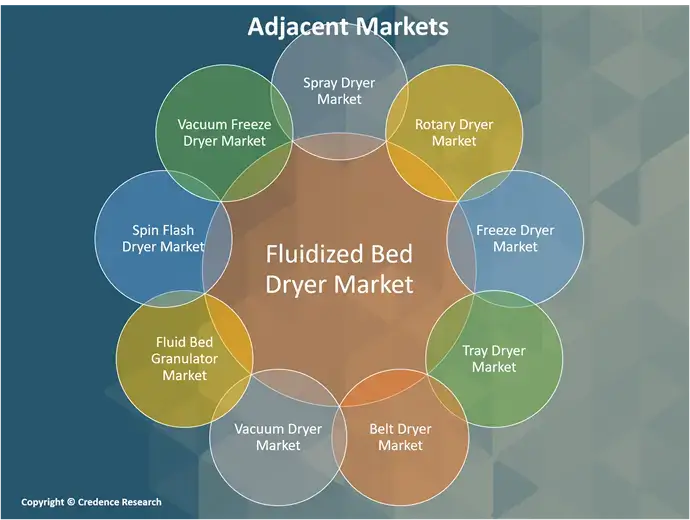
Adjacent Markets
In the Fluidized bed dryer market, there are several adjacent markets which has high revenue growth opportunities. The key adjacent markets for Fluidized bed dryer market-
Request a Free Sample
Fill in your details and we'll send you a free sample report.
- Sample data tables & charts
- Research methodology
Need a Custom Version of This Report?
Tailor the scope, geography, or segments to your exact requirements.
- Custom geography or segment scope
- Direct access to our analyst team
Frequently Asked Questions
What is the current Species of the worldwide Fluidized bed dryer market?
What is the predicted growth rate of the Fluidized bed dryer market between 2023 and 2030?
Which segment has the most market share in terms of type ?
Which Distribution Channel segment governs the market demand for Fluidized bed dryer ?
Which end-user segment is predicted to grow at the highest growth rate segment over the forecast period?
Which region is driving the Fluidized bed dryer industry forward?
Who are the major players in the global Fluidized bed dryer market?
What are the major market drivers of the Fluidized bed dryer industry?
What are the major market restraints of the Fluidized bed dryer industry?
What are the major market opportunities of the Fluidized bed dryer industry?
Table of Content
Chapter 1. Report Introduction
- 1.1 Report Description & Purpose
- 1.1.1 Report Title & Market Definition
- 1.1.2 Unique Selling Propositions (USP) & Key Differentiators
- 1.1.3 Value Proposition for Stakeholders
- 1.2 Research Objectives
- 1.2.1 Market Sizing Objectives (Volume & Revenue) (Volume Where Applicable)
- 1.2.2 Segmentation Objectives
- 1.2.3 Competitive Intelligence Objectives
- 1.2.4 Forecast & Scenario Objectives
- 1.3 Report Scope
- 1.3.1 Fluidized Bed Dryer Scope – Segments & Subsegments Covered
- 1.3.2 Geographic Scope – Regions & Countries Covered
- 1.3.3 Historical Period, Base Year & Forecast Period (the historical period; forecast to the forecast period)
- 1.3.4 Inclusions & Exclusions
- 1.4 Industry Classification & Applicable Codes
- 1.5 Currency, Measurement Units & Valuation Basis
- 1.6 Target Stakeholders
- 1.7 Limitations & Assumptions
Chapter 2. Executive Summary
- 2.1 Global Fluidized Bed Dryer Market Snapshot
- 2.1.1 Market Size – Historical (the historical period) & Forecast (the forecast period) (base year: NULL → forecast year: NULL)
- 2.1.2 Volume & Revenue – Global Totals (Volume Where Applicable)
- 2.1.3 Key Market Highlights – Top Five Facts
- 2.2 Fluidized Bed Dryer Market Segmentation Snapshot
- 2.2.1 Market Split by Region – vs.
- 2.3 Competitive Snapshot
- 2.3.1 Top 10 Players by Revenue Share –
- 2.3.2 Top 10 Players by Volume Share – (Volume Where Applicable)
- 2.3.3 Recent Strategic Developments (18-Month Summary)
- 2.4 Key Investment Highlights & Strategic Conclusions
Chapter 3. Fluidized Bed Dryer Market Dynamics & Industry Analysis
- 3.1 Market Overview & Context
- 3.1.1 Fluidized Bed Dryer Market Position in the Broader Industry Value Chain
- 3.1.2 Demand Structure & Purchasing Dynamics
- 3.1.3 Market Maturity & Development Stage by Region
- 3.2 Fluidized Bed Dryer Market Drivers
- 3.3 Fluidized Bed Dryer Market Restraints & Challenges
- 3.4 Fluidized Bed Dryer Market Opportunities
- 3.5 Porter's Five Forces Analysis
- 3.5.1 Threat of New Entrants
- 3.5.2 Bargaining Power of Suppliers
- 3.5.3 Bargaining Power of Buyers
- 3.5.4 Threat of Substitutes
- 3.5.5 Competitive Rivalry – Intensity Assessment
- 3.6 Fluidized Bed Dryer Value Chain Analysis
- 3.6.1 Upstream – Key Inputs, Resources & Suppliers
- 3.6.1.1 Key Input/Resource 1
- 3.6.1.2 Key Input/Resource 2
- 3.6.1.3 Key Input/Resource 3
- 3.6.2 Midstream – Core Operations & Value Creation
- 3.6.2.1 Operating Model & Process Overview
- 3.6.2.2 Key Operating Locations & Capabilities by Company
- 3.6.3 Downstream – Market Channels & End Users
- 3.6.3.1 Direct Sales & Customer Engagement Channels
- 3.6.3.2 Indirect Sales, Intermediaries & Partner Channels
- 3.6.4 Value Chain Profitability Analysis
- 3.6.1 Upstream – Key Inputs, Resources & Suppliers
- 3.7 PESTEL Analysis
- 3.7.1 Political Factors
- 3.7.2 Economic Factors
- 3.7.3 Social Factors
- 3.7.4 Technological Factors
- 3.7.5 Environmental Factors
- 3.7.6 Legal Factors
- 3.8 Fluidized Bed Dryer Supply Chain Analysis
- 3.8.1 Critical Input & Resource Availability Risk Assessment
- 3.8.2 Supplier & Operational Concentration Risk (Geographic Exposure)
- 3.8.3 Supply & Service Disruption Impact Analysis
- 3.9 Regulatory & Policy Landscape
Note: The regulatory and policy landscape section covers regulations based on their applicability to the market, Fluidized Bed Dryer category, geography, and scope of the study. Only regulatory frameworks with a material impact on operations, compliance, trade, sustainability, or market access are analyzed in detail.
Chapter 4. Key Investment Pockets & Opportunity Analysis
- 4.1 Fluidized Bed Dryer Market Attractiveness Analysis
- 4.1.1 By Region – Investment Attractiveness Matrix (Market Size × CAGR)
- 4.2 Absolute Revenue Growth Opportunity
- 4.2.1 By Region – Absolute Revenue Growth Through the forecast period
- 4.3 Incremental Demand Opportunity
- 4.3.1 By Region – Incremental Demand Through the forecast period
- 4.3.2 Segment – Incremental Demand
- 4.4 Emerging Submarket Opportunity Deep Dive (Subject to Applicability)
- 4.5 Priority Market Opportunity Scorecards
- 4.5.1 United States
- 4.5.2 Europe
- 4.5.3 Asia
- 4.5.4 Middle East & Africa
Note: Priority market opportunity scorecards reflect the geographic scope and strategic relevance of the study. Listed markets are indicative and may be adapted to the industry.
Chapter 5. Fluidized Bed Dryer Cross-Border Trade & Market Access Analysis
- 5.1 International Trade & Cross-Border Activity Overview
- 5.1.1 Global Export Value by Country (the historical period)
- 5.1.2 Global Export Volume by Country (the historical period) (Volume Where Applicable)
- 5.1.3 Global Import Value by Country (the historical period)
- 5.1.4 Global Import Volume by Country (the historical period) (Volume Where Applicable)
- 5.1.5 Net Trade Balance by Country (the historical period)
- 5.2 Export Analysis – Segment
- 5.2.1 Category 1 (Applicable Classification Code)
- 5.2.2 Category 2 (Applicable Classification Code)
- 5.2.3 Category 3 (Applicable Classification Code)
- 5.2.4 Category 4 (Applicable Classification Code)
- 5.2.5 Category 5 (Applicable Classification Code)
- 5.3 Import Analysis – Segment
- 5.3.1 Category 1 (Applicable Classification Code)
- 5.3.2 Category 2 (Applicable Classification Code)
- 5.3.3 Category 3 (Applicable Classification Code)
- 5.3.4 Category 4 (Applicable Classification Code)
- 5.3.5 Category 5 (Applicable Classification Code)
- 5.4 Cross-Border Pricing & Transaction Benchmarks
- 5.4.1 Export Pricing – Segment & Country
- 5.4.2 Import Pricing – Segment & Source Country
- 5.4.3 Price Trends (the historical period)
- 5.5 Key Cross-Border Trade & Delivery Routes
- 5.5.1 Cross-Border Trade/Delivery Route 1
- 5.5.2 Cross-Border Trade/Delivery Route 2
- 5.5.3 Cross-Border Trade/Delivery Route 3
- 5.5.4 Cross-Border Trade/Delivery Route 4
- 5.5.5 Cross-Border Trade/Delivery Route 5
- 5.6 Trade Policy & Market Access Impact Assessment
- 5.6.1 Tariff & Non-Tariff Barriers
- 5.6.2 Regional Trade & Economic Integration Frameworks
- 5.6.3 Bilateral & Multilateral Trade Agreements
- 5.6.4 Cross-Border Operating, Licensing & Localization Requirements
Note: This chapter applies where cross-border trade or delivery is relevant to Fluidized Bed Dryer. Goods, services, and digital offerings are assessed using applicable classifications and transaction measures. Import-export volumes, trade balances, and route analyses are included only where meaningful to the market.
Chapter 6. Competitive Landscape & Company Benchmarking
- 6.1 Fluidized Bed Dryer Market Concentration & Structure
- 6.1.1 Herfindahl-Hirschman Index (HHI) – vs.
- 6.1.2 Leading, Mid-Sized & Emerging Player Structure
- 6.1.3 Global, Regional & Local Player Dynamics
- 6.2 Fluidized Bed Dryer Market Share Analysis –
- 6.2.1 Global Revenue Share by Company
- 6.2.2 Global Volume Share by Company (Volume Where Applicable)
- 6.2.3 Regional Revenue Share
- 6.2.4 Market Share Evolution ( vs. )
- 6.2.5 Company Market Share by Key Segment
- 6.2.6 Company Market Share by Customer Group
- 6.3 Operating Scale, Capacity & Infrastructure Analysis
- 6.3.1 Global Operating Scale & Supply Capacity
- 6.3.2 Resource Utilization & Operating Efficiency
- 6.3.3 Output, Service Delivery & Activity Metrics
- 6.3.4 Operating Footprint & Infrastructure Map
- 6.3.5 Planned Operational & Capacity Expansion
- 6.4 Fluidized Bed Dryer Competitive Benchmarking Matrix
- 6.4.1 Revenue, Growth, Profitability & Operating Metric Comparison
- 6.4.2 Channel Revenue Mix
- 6.4.3 Geographic Revenue Exposure
- 6.4.4 R&D Intensity
- 6.4.5 Sustainability Maturity
- 6.5 Strategic Developments in Fluidized Bed Dryer (Last 24 Months)
- 6.5.1 Mergers, Acquisitions & Divestments
- 6.5.2 New Products, Services & Solutions in Fluidized Bed Dryer
- 6.5.3 Operational & Infrastructure Expansions
- 6.5.4 Strategic Alliances, Joint Ventures & Partnerships
- 6.5.5 Distribution Expansion & Market Entry
- 6.5.6 Sustainability & ESG Initiatives
- 6.6 Competitive Strategy Mapping
- 6.6.1 Leader, Challenger, Follower & Niche Classification
- 6.6.2 Pricing Strategy Comparison
- 6.6.3 Channel Strategy Matrix
Note: Strategic developments are included based on their materiality and the availability of reliable information.
Chapter 7. Global Fluidized Bed Dryer Market – By Sales & Delivery Channel
- 7.1 Segment Overview
- 7.1.1 Volume & Revenue Split by Channel ( & ) (Volume Where Applicable)
- 7.1.2 Channel Mix Evolution (the forecast period)
Chapter 8. Regional Market Analysis – Global Overview
- 8.1 Global Regional Overview
- 8.1.1 Regional Volume Share (Volume Where Applicable)
- 8.1.2 Regional Revenue Share
- 8.1.3 Regional Volume by Region (Volume Where Applicable)
- 8.1.4 Regional Revenue by Region
- 8.1.5 Regional Forecast Through the forecast period
- 8.2 Cross-Regional Segment Analysis
- 8.2.1 By Sales & Delivery Channel
- 8.2.2 By Competitive Positioning & Price Tier
Chapter 9. North America Fluidized Bed Dryer Market
- 9.1 United States
- 9.2 Canada
- 9.3 Mexico
Chapter 10. Europe Fluidized Bed Dryer Market
- 10.1 Germany
- 10.2 France
- 10.3 Italy
- 10.4 United Kingdom
- 10.5 Spain
- 10.6 Poland
- 10.7 Russia
- 10.8 Netherlands
- 10.9 Belgium
- 10.10 Sweden
- 10.11 Denmark
- 10.12 Norway
- 10.13 Rest of Europe
Chapter 11. Asia Pacific Fluidized Bed Dryer Market
- 11.1 China
- 11.2 India
- 11.3 Japan
- 11.4 South Korea
- 11.5 Thailand
- 11.6 Indonesia
- 11.7 Vietnam
- 11.8 Malaysia
- 11.9 Australia
- 11.10 Rest of Asia Pacific
Chapter 12. Latin America Fluidized Bed Dryer Market
- 12.1 Brazil
- 12.2 Argentina
- 12.3 Colombia
- 12.4 Chile
- 12.5 Rest of Latin America
Chapter 13. Middle East Fluidized Bed Dryer Market
- 13.1 Saudi Arabia
- 13.2 United Arab Emirates
- 13.3 Turkey
- 13.4 Israel
- 13.5 Iran
- 13.6 Rest of the Middle East
Chapter 14. Africa Fluidized Bed Dryer Market
- 14.1 South Africa
- 14.2 Egypt
- 14.3 Nigeria
- 14.4 Morocco
- 14.5 Rest of Africa
Chapter 15. Fluidized Bed Dryer Company Profiles
- 15.1 [Company 01]
- 15.1.1 Company Overview
- 15.1.2 Key Management Personnel
- 15.1.3 Products & Services Portfolio
- 15.1.4 Financial Performance
- 15.1.5 Key Market Focus & Geographic Presence
- 15.1.6 Recent Developments & Strategic Initiatives
Note: The company profile list is preliminary and may change based on research findings, market developments, data availability, and client requirements.
Chapter 16. Appendices
- Appendix A – List of Abbreviations & Acronyms
- Appendix B – Industry Classification Code Reference – Full Series
- Appendix C – Supply, Output & Operating Capacity Data Tables
- Appendix D – End-Use & Demand Base Tables
- Appendix E – Demand, Adoption & Usage Assumptions
- Appendix F – Pricing & Revenue Metric Reference Tables
- Appendix G – Company Operations & Infrastructure Database
- Appendix H – Cross-Border Trade & Activity Data Tables (Where Applicable)
- Appendix I – Regulatory Summary Tables
- Appendix J – Primary Research Participant List (Anonymized)
- Appendix K – Primary Research Questionnaire Framework
- Appendix L – Data Sources & Bibliography
- Appendix M – Market Size Divergence & Source Comparison
Chapter 17. Research Methodology
- 17.1 Research Framework & Philosophy
- 17.2 Secondary Research – Sources, Hierarchy & Data Extraction
- 17.3 Data Modeling – Bottom-Up & Top-Down Market Sizing
- 17.4 Primary Research – Stakeholder Framework, LOI & Sample Sizes
- 17.5 Forecast Methodology – Regression, Scenario & Sensitivity Analysis
- 17.6 Quality Control – Four-Layer Validation Framework
- 17.7 Limitations & Standard Assumptions
- 17.8 Disclaimer
