
Market Overview
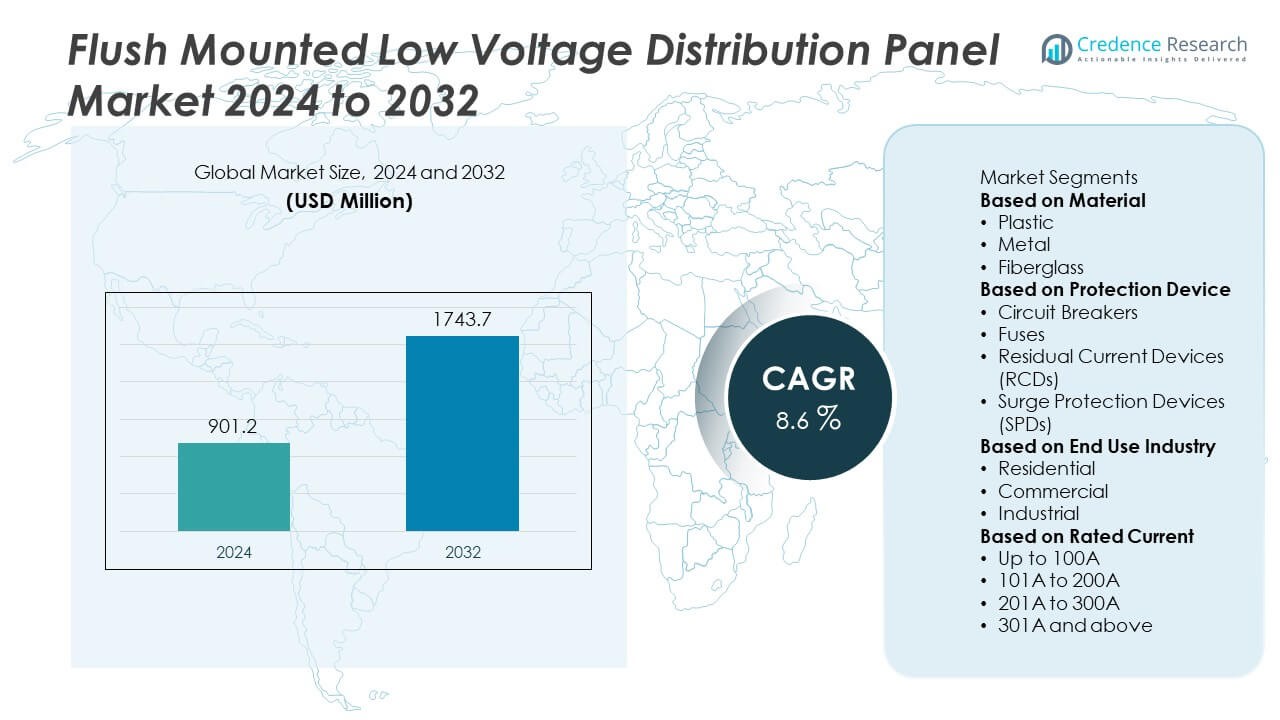
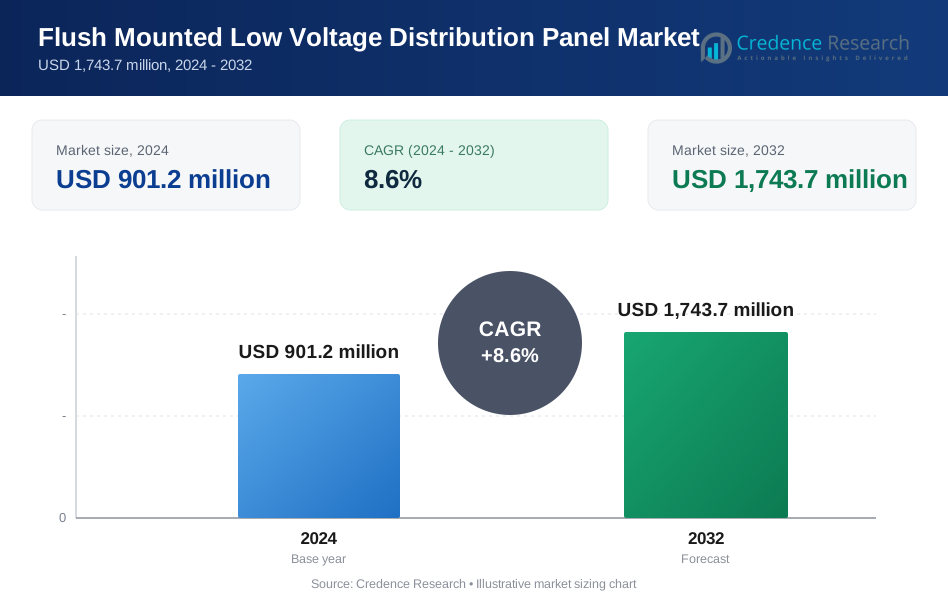
Flush Mounted Low Voltage Distribution Panel Market size was valued at USD 901.2 million in 2024 and is projected to reach USD 1,743.7 million by 2032, growing at a CAGR of 8.6% during the forecast period.
| REPORT ATTRIBUTE | DETAILS |
|---|---|
| Historical Period | 2020-2023 |
| Base Year | 2024 |
| Forecast Period | 2025-2032 |
| Flush Mounted Low Voltage Distribution Panel Market Size 2024 | USD 901.2 Million |
| Flush Mounted Low Voltage Distribution Panel Market, CAGR | 8.6% |
| Flush Mounted Low Voltage Distribution Panel Market Size 2032 | USD 1,743.7 Million |
The Flush Mounted Low Voltage Distribution Panel Market grows through rising demand for compact and reliable power distribution in residential, commercial, and industrial spaces. Urbanization, modernization of infrastructure, and stricter safety regulations drive adoption of flush-mounted systems that blend functionality with design appeal.
The Flush Mounted Low Voltage Distribution Panel Market demonstrates strong geographical spread, with North America leading adoption through advanced building codes, retrofitting projects, and demand for smart, energy-efficient systems in residential and commercial spaces. Europe emphasizes sustainability and strict regulatory frameworks, with countries like Germany, France, and the United Kingdom driving adoption in both premium and mid-segment construction projects. Asia-Pacific records rapid growth supported by urbanization, large-scale housing demand, and government-backed smart city initiatives across China, India, Japan, and Southeast Asia. Latin America and the Middle East & Africa gradually expand adoption, fueled by real estate investments and infrastructure modernization programs. Key players shaping the market include Siemens AG, ABB Ltd., Eaton Corporation, and Legrand S.A., each focusing on advanced designs, IoT-enabled monitoring features, and global expansion strategies to strengthen competitiveness across diverse applications. These factors collectively reinforce the market’s long-term relevance in modern power distribution systems.
Market Insights
- The Flush Mounted Low Voltage Distribution Panel Market was valued at USD 901.2 million in 2024 and is projected to reach USD 1743.7 million by 2032, growing at a CAGR of 8.6%.
- Rising demand for compact and reliable power distribution in residential, commercial, and industrial buildings drives steady adoption of flush-mounted panels.
- Increasing integration of IoT-enabled features, digital monitoring, and sustainable materials reflects a strong trend toward smart, energy-efficient systems.
- The competitive landscape features Siemens AG, ABB Ltd., Eaton Corporation, and Legrand S.A., which invest in innovation, smart connectivity, and expanding presence in emerging markets.
- High installation costs and limited retrofit flexibility in older buildings restrain widespread adoption, particularly in cost-sensitive regions.
- North America leads adoption due to advanced construction standards and retrofitting projects, while Europe emphasizes sustainability and regulatory compliance across modern infrastructure.
- Asia-Pacific shows the fastest growth with large-scale housing demand, industrial expansion, and government-backed smart city initiatives, while Latin America and the Middle East & Africa record gradual adoption through real estate and infrastructure investments.
Market Drivers
Rising Demand for Reliable Power Distribution in Urban Infrastructure
The Flush Mounted Low Voltage Distribution Panel Market grows steadily due to expanding urban infrastructure and rising demand for efficient electrical systems. Modern residential and commercial spaces require compact solutions that ensure safe power distribution. Flush-mounted panels offer space optimization, aligning with architectural preferences in apartments, offices, and retail complexes. It provides secure circuit segregation, supporting uninterrupted power supply across multiple applications. Growing construction activities and real estate development reinforce adoption across urban projects. The shift toward reliable and compact electrical systems strengthens demand globally.
- For instance, Siemens markets its SIVACON S4 low-voltage switchboard, a system designed for safe and efficient power distribution in residential and commercial buildings. The SIVACON S4 is part of a modular system that provides reliable performance with standard current ratings up to 4,000 A and is used for self-standing or wall-mounted installations.
Expansion in Industrial and Commercial Applications
Industrial facilities and commercial establishments drive adoption of advanced low voltage distribution solutions. The Flush Mounted Low Voltage Distribution Panel Market benefits from panels that handle heavy power loads while maintaining safety and operational efficiency. It protects against overload, short circuits, and equipment failures, ensuring smooth operations in malls, hospitals, and factories. Commercial demand rises with modernization projects across retail and educational institutions. Industrial expansion in emerging economies further supports growth, requiring durable panels for high-performance environments. These applications reinforce the importance of flush-mounted designs in critical infrastructure.
- For instance, Mitsubishi Electric received an order in July 2024 for its 84 kV dry-air insulated switchgear—an eco-friendly alternative to SF₆ gas switchgear—to be installed in substations. This technology supports vacuum interrupters and dry-air insulation for improved safety and efficient maintenance.
Integration of Smart and Digital Features
The shift toward smart buildings and IoT-based infrastructure drives technological innovation in distribution systems. The Flush Mounted Low Voltage Distribution Panel Market leverages smart panels that integrate sensors and digital monitoring features. It allows real-time diagnostics, energy consumption tracking, and predictive maintenance. Building owners adopt these advanced solutions to improve efficiency and reduce downtime. Smart integration aligns with sustainability goals by optimizing energy management. The demand for intelligent systems ensures continued growth of flush-mounted panels in modern construction projects.
Supportive Regulations and Focus on Safety Standards
Government regulations and safety standards play a key role in driving adoption. The Flush Mounted Low Voltage Distribution Panel Market aligns with strict compliance frameworks that enforce safe electrical installations in residential, commercial, and industrial spaces. It ensures adherence to fire safety norms and reduces risks of electrical hazards. Consumers and developers increasingly prefer certified panels that meet international standards. Regulatory emphasis on energy efficiency and safe distribution systems boosts long-term demand. These frameworks create favorable conditions for adoption across both developed and developing regions.
Market Trends
Integration of Smart Monitoring and IoT Solutions
The Flush Mounted Low Voltage Distribution Panel Market reflects a strong trend toward digital integration. Manufacturers introduce panels with IoT-enabled monitoring to track energy usage and detect faults in real time. It supports predictive maintenance by sending alerts on abnormal conditions, reducing operational risks. Smart panels also provide remote access, allowing facility managers to control systems more effectively. The growing emphasis on digital transformation in infrastructure supports this adoption. This trend highlights the shift from conventional designs to connected, intelligent systems.
- For instance, ABB’s ReliaHome Smart Panel (2025) supports monitoring of up to 16 individual circuits via its mobile app. It detects grid outages, coordinates temporary power supply, and enables circuit-level load control during disruptions.
Focus on Compact and Aesthetic Panel Designs
Modern construction projects prioritize space efficiency and clean interior layouts. The Flush Mounted Low Voltage Distribution Panel Market addresses this with sleek, compact panels that integrate seamlessly into walls. It aligns with architectural requirements in residential and commercial spaces, maintaining both function and design appeal. Builders prefer panels that save space without compromising safety. Consumer demand for minimalistic solutions further supports this trend. The preference for aesthetic yet reliable systems reinforces adoption across urban housing and office projects.
- For instance, the Legrand XL³ S 160 flush-mount cabinet (cat. no. 3 372 23) accommodates 72 modular units across three rows. It has a depth of 135 mm and weighs approximately 13.56 kg. This model is designed for a flush-mounting installation.
Sustainability and Energy Efficiency in Panel Manufacturing
The global focus on sustainable construction practices influences product design and development. The Flush Mounted Low Voltage Distribution Panel Market incorporates eco-friendly materials and energy-efficient components to reduce environmental impact. It aligns with green building standards such as LEED, which encourage adoption of certified solutions. Manufacturers use recyclable materials and low-VOC coatings to enhance compliance. Energy-efficient panels also contribute to reduced operational costs for end users. This trend strengthens the alignment between electrical infrastructure and environmental goals.
Rising Adoption Across Emerging Economies
Growing infrastructure investments in emerging markets create opportunities for widespread use of flush-mounted panels. The Flush Mounted Low Voltage Distribution Panel Market expands with smart city projects, residential developments, and industrial growth in Asia-Pacific, Latin America, and Africa. It delivers safe and reliable power distribution in high-density urban environments. Governments in these regions promote modernization of electrical networks, boosting adoption. Rising disposable incomes and demand for modern housing support this expansion. This trend positions flush-mounted panels as critical components in new infrastructure projects worldwide.
Market Challenges Analysis
High Installation Costs and Retrofit Limitations
The Flush Mounted Low Voltage Distribution Panel Market faces challenges due to high installation costs and limited flexibility in existing buildings. Flush-mounted systems often require structural modifications, increasing expenses compared to surface-mounted alternatives. It restricts adoption in cost-sensitive markets where developers prioritize budget-friendly options. Retrofitting older infrastructures is particularly complex, as adjustments to wiring and wall structures add labor and material costs. Small contractors and developers hesitate to invest in flush-mounted systems for low-margin projects. These financial and structural barriers limit widespread adoption in certain regions.
Competition from Alternative Solutions and Safety Concerns
The Flush Mounted Low Voltage Distribution Panel Market also contends with competition from surface-mounted panels, which offer easier installation and maintenance. In industrial and rural settings, surface-mounted systems remain preferred due to their practicality. It further faces concerns related to improper installations, where poor sealing or insufficient clearances may create risks of overheating or electrical hazards. Limited awareness about the long-term benefits of flush-mounted solutions slows consumer preference. Builders and electricians often default to conventional systems unless regulations mandate advanced options. This competitive and safety-related pressure challenges market expansion.
Market Opportunities
Growth in Smart Homes and Connected Infrastructure
The Flush Mounted Low Voltage Distribution Panel Market holds strong opportunities with the rise of smart homes and connected buildings. Consumers demand compact systems that integrate seamlessly with IoT-enabled devices and building automation platforms. It allows real-time monitoring, predictive maintenance, and efficient energy management. Builders adopt smart panels to enhance property value and meet modern safety standards. The integration of intelligent distribution systems aligns with growing urbanization and digital infrastructure projects. This trend positions flush-mounted panels as essential components in smart city and residential developments.
Expansion in Emerging Economies and Infrastructure Projects
Rising infrastructure investments in Asia-Pacific, Latin America, and Africa create favorable conditions for market growth. The Flush Mounted Low Voltage Distribution Panel Market benefits from government initiatives promoting energy efficiency, sustainable construction, and modernization of electrical networks. It delivers safe and space-efficient solutions for large-scale residential and commercial projects in urban centers. Industrialization across developing economies further strengthens demand for reliable low voltage panels. Affordable product designs tailored to regional needs open new opportunities for manufacturers. These conditions ensure steady expansion across both established and emerging construction sectors.
Market Segmentation Analysis:
By Material
The Flush Mounted Low Voltage Distribution Panel Market segments by material into metallic, non-metallic, and hybrid panels. Metallic panels dominate due to their durability, fire resistance, and suitability for both residential and commercial projects. It offers strong protection for wiring and circuit systems, ensuring compliance with safety standards. Non-metallic panels gain traction in residential applications where lightweight designs and corrosion resistance are prioritized. Hybrid panels, combining metal and polymer materials, provide a balance of strength, safety, and cost efficiency. This diversity in material selection enables adoption across a wide range of infrastructure projects.
- For instance, Eaton’s Pow-R-Line Xpert switchboards support metallic enclosures with continuous current ratings up to 6,000 A and interrupting ratings up to 200 kAIC, suitable for demanding commercial and industrial installations.
By Protection Device
Segmentation by protection device includes circuit breakers, residual current devices (RCDs), surge protection devices, and others. Circuit breakers hold the largest share as they are essential for preventing overloads and short circuits in modern buildings. It provides reliable protection in residential, commercial, and industrial environments. RCDs record steady growth, driven by stricter safety regulations and increasing awareness of electrical shock prevention. Surge protection devices gain importance with rising integration of sensitive electronics and smart systems in infrastructure. Other devices, such as fuses and isolators, continue to support niche applications where basic or additional safety measures are required.
By End Use Industry
The Flush Mounted Low Voltage Distribution Panel Market also segments by end use into residential, commercial, and industrial sectors. The residential sector dominates, driven by growing urbanization, smart home development, and rising demand for space-efficient designs. It ensures safe power distribution while blending with modern interior layouts. The commercial sector, including offices, malls, and healthcare facilities, shows strong adoption due to compact design and compliance with strict building codes. Industrial facilities also adopt flush-mounted systems, particularly in control rooms and precision-driven operations where reliability and safety are crucial. These varied end uses highlight the adaptability of flush-mounted panels across diverse infrastructure needs.
- For instance, Schneider Electric offers its Wiser home automation solution, which can manage a single home's energy consumption by displaying data in real-time, helping to make the electrical installation safer and more efficient.
Segments:
Based on Material
- Plastic
- Metal
- Fiberglass
Based on Protection Device
- Circuit Breakers
- Fuses
- Residual Current Devices (RCDs)
- Surge Protection Devices (SPDs)
Based on End Use Industry
- Residential
- Commercial
- Industrial
Based on Rated Current
- Up to 100A
- 101A to 200A
- 201A to 300A
- 301A and above
Based on the Geography:
- North America
- U.S.
- Canada
- Mexico
- Europe
- UK
- France
- Germany
- Italy
- Spain
- Russia
- Belgium
- Netherlands
- Austria
- Sweden
- Poland
- Denmark
- Switzerland
- Rest of Europe
- Asia Pacific
- China
- Japan
- South Korea
- India
- Australia
- Thailand
- Indonesia
- Vietnam
- Malaysia
- Philippines
- Taiwan
- Rest of Asia Pacific
- Latin America
- Brazil
- Argentina
- Peru
- Chile
- Colombia
- Rest of Latin America
- Middle East
- UAE
- KSA
- Israel
- Turkey
- Iran
- Rest of Middle East
- Africa
- Egypt
- Nigeria
- Algeria
- Morocco
- Rest of Africa
Regional Analysis
North America
North America holds the largest share of the Flush Mounted Low Voltage Distribution Panel Market at 33% in 2024. The region benefits from advanced construction practices, strong adoption of smart home technologies, and a focus on energy-efficient electrical systems. The United States drives growth with high demand across residential, commercial, and industrial sectors, supported by strict building codes and retrofitting projects in older infrastructure. Canada contributes through investments in housing and commercial real estate, while Mexico shows progress in modern infrastructure development. It gains further momentum from rising adoption of IoT-enabled panels that align with the region’s digital infrastructure goals. The region’s emphasis on safety standards and regulatory compliance ensures continued leadership in the market.
Europe
Europe accounts for 29% of the Flush Mounted Low Voltage Distribution Panel Market in 2024. The region emphasizes sustainable construction practices, strict energy efficiency regulations, and high adoption of advanced electrical systems. Germany, France, and the United Kingdom lead demand, driven by residential housing projects and commercial complexes requiring compact and aesthetic solutions. Eastern Europe shows rising adoption with modernization of building infrastructure and increasing smart city initiatives. It also benefits from the European Union’s policies that encourage low-voltage energy management systems. The integration of flush-mounted panels in both premium and mid-segment projects strengthens the region’s role as a hub for innovation and compliance-driven growth.
Asia-Pacific
Asia-Pacific secures 25% of the global market share in 2024, reflecting its rapid urbanization and large-scale infrastructure projects. China dominates with strong investments in housing, commercial facilities, and industrial plants, where space-efficient solutions are essential. India follows with robust demand supported by urban housing programs, government-backed electrification projects, and smart city initiatives. Japan and South Korea adopt advanced flush-mounted systems in both residential and industrial facilities, emphasizing energy efficiency and compact design. Southeast Asian countries such as Indonesia, Vietnam, and Thailand contribute through growing real estate development and industrialization. It is projected to be the fastest-growing region, supported by rising disposable incomes, expanding urban populations, and government policies promoting modern electrical infrastructure.
Latin America
Latin America holds an 8% share of the Flush Mounted Low Voltage Distribution Panel Market in 2024. Brazil and Mexico dominate demand, supported by urban housing expansion, commercial construction, and modernization of public infrastructure. Argentina, Chile, and Colombia also contribute with ongoing real estate projects and rising consumer awareness about electrical safety. It faces challenges such as limited budgets and high costs of advanced panels, which slow adoption in smaller markets. Governments encourage modernization through energy efficiency programs and stricter building codes. These developments create opportunities for wider use of flush-mounted systems across both residential and commercial applications.
Middle East & Africa
The Middle East & Africa represent a 5% share of the global market in 2024, reflecting gradual adoption with emerging opportunities. Gulf nations, including Saudi Arabia and the United Arab Emirates, lead demand through large-scale infrastructure and smart city projects. South Africa and Nigeria contribute through modernization of housing and commercial facilities. It faces barriers from high installation costs and limited awareness of advanced electrical systems, especially in rural areas. Government diversification programs and investments in sustainable infrastructure strengthen prospects for adoption. The region shows long-term potential as urbanization and smart housing projects gain traction across key economies.
Key Player Analysis
- Eaton Corporation
- Rockwell Automation
- Zest Electric
- Mitsubishi Electric Corporation
- Chint Group Corporation
- Legrand S.A.
- Siemens AG
- Havells India Ltd.
- ABB Ltd.
- Honeywell International Inc.
Competitive Analysis
The competitive landscape of the Flush Mounted Low Voltage Distribution Panel Market features leading players such as Honeywell International Inc., ABB Ltd., Chint Group Corporation, Eaton Corporation, Mitsubishi Electric Corporation, Havells India Ltd., Legrand S.A., Siemens AG, Rockwell Automation, and Zest Electric. These companies focus on delivering advanced, compact, and energy-efficient panel solutions that meet the rising demand for modern electrical infrastructure across residential, commercial, and industrial sectors. They invest heavily in research and development to integrate IoT-enabled monitoring, smart connectivity, and digital control features that support real-time diagnostics and predictive maintenance. Strategic expansion into emerging economies through partnerships, acquisitions, and localized manufacturing strengthens their global reach and competitiveness. Compliance with international safety and energy efficiency standards remains a key priority, ensuring reliable and secure operations. Differentiation is achieved through innovation in design aesthetics, modularity, and sustainable materials, aligning with green building practices and smart city initiatives. Competition remains strong as players target both premium and cost-sensitive segments with tailored solutions, reinforcing their long-term growth in the evolving market for flush-mounted low voltage distribution panels.
Recent Developments
- In August 2025, Schneider Electric continues to lead innovation in smart panel design with its flush-mounted systems incorporating digital monitoring and modular flexibility.
- In November 2024, Eaton Corporation debuted the xEnergy series panelboards, noted in product coverage for low-voltage applications.
- In June 2024, Mitsubishi Electric Corporation introduced a 84 kV dry-air insulated switchgear, using vacuum interrupters instead of SF₆ gas—an eco-friendly solution relevant for flush-mounted distribution setups.
- In May 2024, ABB Ltd. opened a new factory in Evergem, Belgium, equipped with a photovoltaic plant expected to save 9,400 MWh annually—supporting production of smart building parts including flush-mounted panels.
Report Coverage
The research report offers an in-depth analysis based on Material, Protection Device, End Use Industry, Rated Current and Geography. It details leading market players, providing an overview of their business, product offerings, investments, revenue streams, and key applications. Additionally, the report includes insights into the competitive environment, SWOT analysis, current market trends, as well as the primary drivers and constraints. Furthermore, it discusses various factors that have driven market expansion in recent years. The report also explores market dynamics, regulatory scenarios, and technological advancements that are shaping the industry. It assesses the impact of external factors and global economic changes on market growth. Lastly, it provides strategic recommendations for new entrants and established companies to navigate the complexities of the market.
Future Outlook
- The market will grow with rising demand for compact and space-efficient power distribution systems.
- Smart panels with IoT-enabled monitoring will gain traction in residential and commercial applications.
- Energy-efficient designs using sustainable materials will become a core focus for manufacturers.
- Integration with smart city projects will drive adoption in large-scale infrastructure development.
- Advanced safety regulations will push demand for certified and reliable low voltage distribution panels.
- Retrofitting opportunities will expand as older buildings modernize their electrical infrastructure.
- Asia-Pacific will record the fastest growth supported by urbanization and large housing projects.
- Partnerships between panel manufacturers and construction firms will strengthen market penetration.
- Modular and cost-optimized designs will improve accessibility in mid-range and small-scale projects.
- Predictive maintenance and digital control features will enhance long-term system reliability and adoption.
Request a Free Sample
Fill in your details and we'll send you a free sample report.
- Sample data tables & charts
- Research methodology
Need a Custom Version of This Report?
Tailor the scope, geography, or segments to your exact requirements.
- Custom geography or segment scope
- Direct access to our analyst team
Frequently Asked Questions
What is the current market size for Flush Mounted Low Voltage Distribution Panel, and what is its projected size in 2032?
At what Compound Annual Growth Rate is the Flush Mounted Low Voltage Distribution Panel market projected to grow between 2025 and 2032?
Which Flush Mounted Low Voltage Distribution Panel market segment held the largest share in 2024?
What are the primary factors fueling the growth of the Flush Mounted Low Voltage Distribution Panel market?
Who are the leading companies in the Flush Mounted Low Voltage Distribution Panel market?
Which region commanded the largest share of the Flush Mounted Low Voltage Distribution Panel market in 2024?
Table of Content
Chapter 1. Report Introduction
- 1.1 Report Description & Purpose
- 1.1.1 Report Title & Market Definition
- 1.1.2 Unique Selling Propositions (USP) & Key Differentiators
- 1.1.3 Value Proposition for Stakeholders
- 1.2 Research Objectives
- 1.2.1 Market Sizing Objectives (Volume & Revenue)
- 1.2.2 Segmentation Objectives
- 1.2.3 Competitive Intelligence Objectives
- 1.2.4 Forecast & Scenario Objectives
- 1.3 Report Scope
- 1.3.1 Flush Mounted Low Voltage Distribution Panel Scope – Types & Subtypes Covered
- 1.3.2 Geographic Scope – Regions & Countries Covered
- 1.3.3 Historical Period, Base Year & Forecast Period (2024; forecast to 2032)
- 1.3.4 Inclusions & Exclusions
- 1.4 HS Code & Classification Framework
- 1.5 Currency, Units & Pricing Basis
- 1.6 Target Stakeholders
- 1.7 Limitations & Assumptions
Chapter 2. Executive Summary
- 2.1 Global Flush Mounted Low Voltage Distribution Panel Market Snapshot
- 2.1.1 Market Size – Historical (2024) & Forecast (2024-2032) (2024: USD 901.2 million → 2032: USD 1,743.7 million)
- 2.1.2 Volume & Revenue – Global Totals
- 2.1.3 Key Market Highlights – Top Five Facts
- 2.2 Flush Mounted Low Voltage Distribution Panel Market Segmentation Snapshot
- 2.2.1 Market Split by Region – 2024 vs. 2032
- 2.3 Competitive Snapshot
- 2.3.1 Top 10 Players by Revenue Share – 2024
- 2.3.2 Top 10 Players by Volume Share – 2024
- 2.3.3 Recent Strategic Developments (18-Month Summary)
- 2.4 Key Investment Highlights & Strategic Conclusions
Chapter 3. Flush Mounted Low Voltage Distribution Panel Market Dynamics & Industry Analysis
- 3.1 Market Overview & Context
- 3.1.1 Flush Mounted Low Voltage Distribution Panel Market Position in the Broader Automotive Value Chain
- 3.1.2 OEM vs. Replacement Market Dynamics
- 3.1.3 Market Maturity & Development Stage by Region
- 3.2 Flush Mounted Low Voltage Distribution Panel Market Drivers
- 3.3 Flush Mounted Low Voltage Distribution Panel Market Restraints & Challenges
- 3.4 Flush Mounted Low Voltage Distribution Panel Market Opportunities
- 3.5 Porter's Five Forces Analysis
- 3.5.1 Threat of New Entrants
- 3.5.2 Bargaining Power of Suppliers
- 3.5.3 Bargaining Power of Buyers
- 3.5.4 Threat of Substitutes
- 3.5.5 Competitive Rivalry – Intensity Assessment
- 3.6 Flush Mounted Low Voltage Distribution Panel Value Chain Analysis
- 3.6.1 Upstream – Raw Material/Input Suppliers
- 3.6.1.1 Raw Material/Input 1
- 3.6.1.2 Raw Material/Input 2
- 3.6.1.3 Raw Material/Input 3
- 3.6.2 Midstream – Production/Manufacturing/Service Delivery
- 3.6.2.1 Production/Process Overview
- 3.6.2.2 Key Facility Locations & Capacity by Manufacturer
- 3.6.3 Downstream – Distribution & End Consumer
- 3.6.3.1 Primary Channel – B2B/OEM
- 3.6.3.2 Secondary Channels – Dealer, Retail, Online, Direct
- 3.6.4 Value Chain Profitability Analysis
- 3.6.1 Upstream – Raw Material/Input Suppliers
- 3.7 PESTEL Analysis
- 3.7.1 Political Factors
- 3.7.2 Economic Factors
- 3.7.3 Social Factors
- 3.7.4 Technological Factors
- 3.7.5 Environmental Factors
- 3.7.6 Legal Factors
- 3.8 Flush Mounted Low Voltage Distribution Panel Supply Chain Analysis
- 3.8.1 Raw Material/Input Supply Risk Assessment
- 3.8.2 Manufacturing Concentration Risk (Geographic Exposure)
- 3.8.3 Trade Disruption Impact Analysis
- 3.9 Regulatory & Policy Landscape
Note: The regulatory and policy landscape section covers regulations based on their applicability to the market, Flush Mounted Low Voltage Distribution Panel category, geography, and scope of the study. Only regulatory frameworks with a material impact on operations, compliance, trade, sustainability, or market access are analyzed in detail.
Chapter 4. Key Investment Pockets & Opportunity Analysis
- 4.1 Flush Mounted Low Voltage Distribution Panel Market Attractiveness Analysis
- 4.1.1 By Region – Investment Attractiveness Matrix (Volume × CAGR)
- 4.2 Absolute Revenue Growth Opportunity
- 4.2.1 By Region – Absolute USD Growth Through 2032
- 4.3 Incremental Volume Opportunity
- 4.3.1 By Region – Incremental Volume Through 2032
- 4.3.2 Segment – Incremental Volume
- 4.4 Emerging Submarket Opportunity Deep Dive (Subject to Applicability)
- 4.5 Emerging Market Opportunity Scorecards
- 4.5.1 United States
- 4.5.2 Europe
- 4.5.3 Asia
- 4.5.4 Middle East & Africa
Note: Emerging Market Opportunity Scorecards will be included based on relevance and strategic importance. Regions listed are indicative and may vary depending on data availability and market dynamics.
Chapter 5. Flush Mounted Low Voltage Distribution Panel Import-Export Analysis & Trade Flows
- 5.1 Global Trade Overview
- 5.1.1 Global Export Value by Country (2024)
- 5.1.2 Global Export Volume by Country (2024)
- 5.1.3 Global Import Value by Country (2024)
- 5.1.4 Global Import Volume by Country (2024)
- 5.1.5 Net Trade Balance by Country (2024)
- 5.2 Export Analysis – Segment
- 5.2.1 Type 1 (HS Code)
- 5.2.2 Type 2 (HS Code)
- 5.2.3 Type 3 (HS Code)
- 5.2.4 Type 4 (HS Code)
- 5.2.5 Type 5 (HS Code)
- 5.3 Import Analysis – Segment
- 5.3.1 Type 1 (HS Code)
- 5.3.2 Type 2 (HS Code)
- 5.3.3 Type 3 (HS Code)
- 5.3.4 Type 4 (HS Code)
- 5.3.5 Type 5 (HS Code)
- 5.4 Average Unit Trade Prices
- 5.4.1 Average Export Price – Segment & Country
- 5.4.2 Average Import Price – Segment & Source Country
- 5.4.3 Price Trends (2024)
- 5.5 Key Trade Route Analysis
- 5.5.1 Trade Route 1
- 5.5.2 Trade Route 2
- 5.5.3 Trade Route 3
- 5.5.4 Trade Route 4
- 5.5.5 Trade Route 5
- 5.6 Trade Policy Impact Assessment
- 5.6.1 US Anti-Dumping & Section 301 Tariffs
- 5.6.2 EU Customs Union Impact
- 5.6.3 Major Free Trade Agreements
- 5.6.4 USMCA Rules of Origin
Note: Trade policy analysis will be included only where relevant to the Flush Mounted Low Voltage Distribution Panel market.
Chapter 6. Competitive Landscape & Company Benchmarking
- 6.1 Flush Mounted Low Voltage Distribution Panel Market Concentration & Structure
- 6.1.1 Herfindahl-Hirschman Index (HHI) – vs. 2024
- 6.1.2 Tier 1, Tier 2 & Tier 3 Market Structure
- 6.1.3 Global, Regional & Local Player Dynamics
- 6.2 Flush Mounted Low Voltage Distribution Panel Market Share Analysis – 2024
- 6.2.1 Global Revenue Share by Company
- 6.2.2 Global Volume Share by Company
- 6.2.3 Regional Revenue Share
- 6.2.4 Market Share Evolution ( vs. 2024)
- 6.2.5 OEM Segment Share by Company
- 6.2.6 Replacement Segment Share by Company
- 6.3 Production/Delivery Capacity & Facility Analysis
- 6.3.1 Global Installed Capacity
- 6.3.2 Capacity Utilization Rates
- 6.3.3 Production/Output Volume
- 6.3.4 Facility Locations & Capacity Map
- 6.3.5 Planned Capacity Additions
- 6.4 Flush Mounted Low Voltage Distribution Panel Competitive Benchmarking Matrix
- 6.4.1 Revenue, Volume, CAGR & Profitability Comparison
- 6.4.2 Channel Revenue Mix
- 6.4.3 Geographic Revenue Exposure
- 6.4.4 R&D Intensity
- 6.4.5 Sustainability Maturity
- 6.5 Strategic Developments in Flush Mounted Low Voltage Distribution Panel (Last 24 Months)
- 6.5.1 Mergers, Acquisitions & Divestments
- 6.5.2 New Flush Mounted Low Voltage Distribution Panel Launches
- 6.5.3 Facility Expansions
- 6.5.4 Strategic Alliances, Joint Ventures & Partnerships
- 6.5.5 Distribution Expansion & Market Entry
- 6.5.6 Sustainability & ESG Initiatives
- 6.6 Competitive Strategy Mapping
- 6.6.1 Leader, Challenger, Follower & Niche Classification
- 6.6.2 Pricing Strategy Comparison
- 6.6.3 Channel Strategy Matrix
Note: Strategic developments are included based on their materiality and the availability of reliable information.
Chapter 7. Global Flush Mounted Low Voltage Distribution Panel Market – By Distribution Channel
- 7.1 Segment Overview
- 7.1.1 Volume & Revenue Split by Channel (2024 & 2032)
- 7.1.2 Channel Mix Evolution (2024-2032)
Chapter 8. Regional Market Analysis – Global Overview
- 8.1 Global Regional Overview
- 8.1.1 Regional Volume Share
- 8.1.2 Regional Revenue Share
- 8.1.3 Regional Volume by Region
- 8.1.4 Regional Revenue by Region
- 8.1.5 Regional Forecast Through 2032
- 8.2 Cross-Regional Segment Analysis
- 8.2.1 By Distribution Channel
- 8.2.2 By Brand/Price Tier
Chapter 9. North America Flush Mounted Low Voltage Distribution Panel Market
- 9.1 United States
- 9.2 Canada
- 9.3 Mexico
Chapter 10. Europe Flush Mounted Low Voltage Distribution Panel Market
- 10.1 Germany
- 10.2 France
- 10.3 Italy
- 10.4 United Kingdom
- 10.5 Spain
- 10.6 Poland
- 10.7 Russia
- 10.8 Netherlands
- 10.9 Belgium
- 10.10 Sweden
- 10.11 Denmark
- 10.12 Norway
- 10.13 Rest of Europe
Chapter 11. Asia Pacific Flush Mounted Low Voltage Distribution Panel Market
- 11.1 China
- 11.2 India
- 11.3 Japan
- 11.4 South Korea
- 11.5 Thailand
- 11.6 Indonesia
- 11.7 Vietnam
- 11.8 Malaysia
- 11.9 Australia
- 11.10 Rest of Asia Pacific
Chapter 12. Latin America Flush Mounted Low Voltage Distribution Panel Market
- 12.1 Brazil
- 12.2 Argentina
- 12.3 Colombia
- 12.4 Chile
- 12.5 Rest of Latin America
Chapter 13. Middle East Flush Mounted Low Voltage Distribution Panel Market
- 13.1 Saudi Arabia
- 13.2 United Arab Emirates
- 13.3 Turkey
- 13.4 Israel
- 13.5 Iran
- 13.6 Rest of the Middle East
Chapter 14. Africa Flush Mounted Low Voltage Distribution Panel Market
- 14.1 South Africa
- 14.2 Egypt
- 14.3 Nigeria
- 14.4 Morocco
- 14.5 Rest of Africa
Chapter 15. Flush Mounted Low Voltage Distribution Panel Company Profiles
- 15.1 [Company 01]
- 15.1.1 Company Overview
- 15.1.2 Key Management Personnel
- 15.1.3 Products & Services Portfolio
- 15.1.4 Financial Performance
- 15.1.5 Key Market Focus & Geographic Presence
- 15.1.6 Recent Developments & Strategic Initiatives
Note: The company profile list is preliminary and may change based on research findings, market developments, data availability, and client requirements.
Chapter 16. Appendices
- Appendix A – List of Abbreviations & Acronyms
- Appendix B – Industry Classification Code Reference – Full Series
- Appendix C – Production & Capacity Data Tables
- Appendix D – End-Use & Demand Base Tables
- Appendix E – Consumption & Replacement Rate Assumptions
- Appendix F – ASP Reference Tables
- Appendix G – Manufacturing & Facility Database
- Appendix H – Import-Export Data Tables
- Appendix I – Regulatory Summary Tables
- Appendix J – Primary Research Participant List (Anonymized)
- Appendix K – Primary Research Questionnaire Framework
- Appendix L – Data Sources & Bibliography
- Appendix M – Market Size Divergence & Source Comparison
Chapter 17. Research Methodology
- 17.1 Research Framework & Philosophy
- 17.2 Secondary Research – Sources, Hierarchy & Data Extraction
- 17.3 Data Modeling – Bottom-Up & Top-Down Market Sizing
- 17.4 Primary Research – Stakeholder Framework, LOI & Sample Sizes
- 17.5 Forecast Methodology – Regression, Scenario & Sensitivity Analysis
- 17.6 Quality Control – Four-Layer Validation Framework
- 17.7 Limitations & Standard Assumptions
- 17.8 Disclaimer
