
| REPORT ATTRIBUTE | DETAILS |
|---|---|
| Historical Period | 2020-2023 |
| Base Year | 2024 |
| Forecast Period | 2025-2032 |
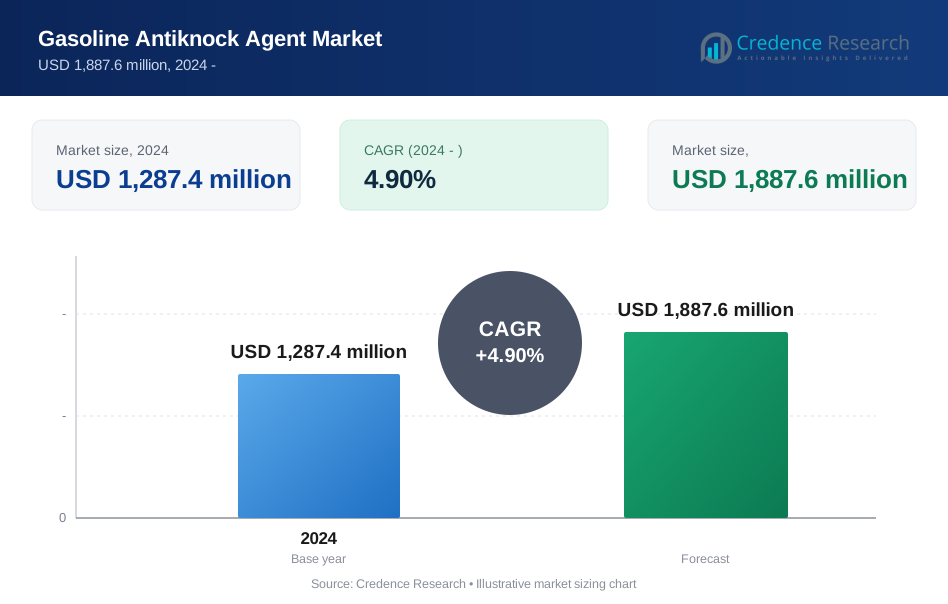
| Gasoline Antiknock Agent Market Size 2024 | USD 1,287.4 million |
| Gasoline Antiknock Agent Market, CAGR | 4.90% |
| Gasoline Antiknock Agent Market Size 2032 | USD 1,887.6 million |
Market Overview
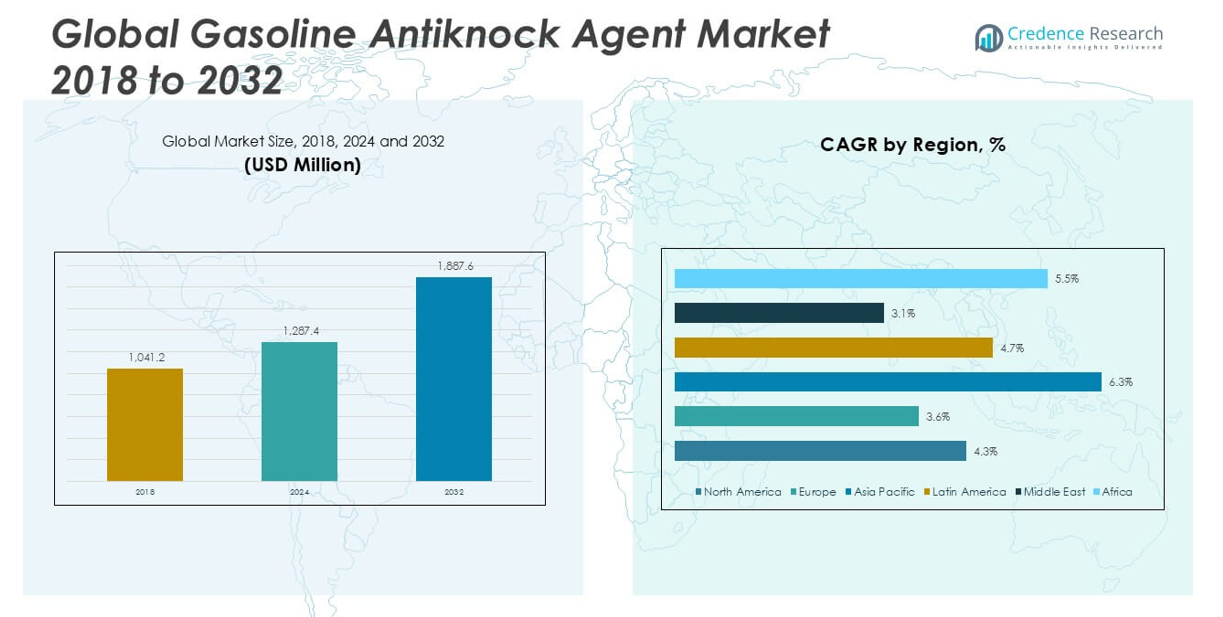
The Gasoline Antiknock Agent market size was valued at USD 1,041.2 million in 2018, reached USD 1,287.4 million in 2024, and is anticipated to reach USD 1,887.6 million by 2032, at a CAGR of 4.90% during the forecast period.
The Gasoline Antiknock Agent market features strong competition among leading players such as Afton Chemical Corporation, BASF SE, Chevron Oronite Company LLC, Innospec Inc., The Lubrizol Corporation, TotalEnergies SE, Evonik Industries AG, Infineum International Limited, Dorf Ketal Chemicals India Pvt Ltd, Baker Hughes, LANXESS AG, Clariant AG, Croda International Plc, and Shandong Dongchang Fine Chemical Technology. These companies focus on expanding their product portfolios, investing in R&D, and strengthening global distribution networks to maintain market leadership. North America holds the largest market share, accounting for approximately 36% of the global market, driven by robust demand from the automotive sector and stringent fuel quality regulations. Asia-Pacific closely follows, supported by growing vehicle production and rising fuel consumption in emerging economies. This competitive landscape underscores continuous innovation and strategic collaborations among top market participants.
Market Insights
- The Gasoline Antiknock Agent market was valued at USD 1,041.2 million in 2018, reached USD 1,287.4 million in 2024, and is projected to hit USD 1,887.6 million by 2032, reflecting a CAGR of 4.90% over the forecast period.
- Market growth is primarily driven by the increasing demand for high-performance fuels and stricter regulations on fuel quality standards, particularly in the automotive and transportation sectors.
- Key trends include ongoing R&D investment to develop eco-friendly antiknock agents and a notable shift toward unleaded and low-sulfur gasoline formulations to meet environmental guidelines.
- The market is highly competitive, with leading companies such as Afton Chemical Corporation, BASF SE, Chevron Oronite Company LLC, and The Lubrizol Corporation focusing on expanding global presence and innovative product offerings; however, volatility in raw material prices and stringent regulatory approval processes act as restraints.
- North America accounts for around 36% of the global market share, followed by Asia-Pacific at 29%, while the automotive segment remains the dominant end-use sector globally
Market Segmentation Analysis:
By Type
Lead-based antiknock agents represent the dominant sub-segment, accounting for over 40% of the market share. This leadership is attributed to their longstanding effectiveness in enhancing octane ratings and reducing engine knocking, especially in regions where regulatory restrictions are less stringent. However, increasing environmental concerns and regulations have accelerated demand for manganese-based and ferrocene-based agents, while ethers and alcohol-based alternatives are gaining traction due to their cleaner combustion profiles.
- For instance, Chevron Oronite Company LLC has developed OLOA 55510, a gasoline additive that is utilized in over 2 million vehicles annually across North America for improved engine performance.
By Application
Passenger cars form the largest application segment, holding more than 50% market share in the Gasoline Antiknock Agent market. Rising global vehicle ownership, the necessity for enhanced engine performance, and stringent emission standards drive the use of antiknock agents in this category. The commercial vehicles segment is also growing steadily, fueled by expanding transportation and logistics sectors, while aviation and marine applications contribute a smaller but critical share.
- For instance, Afton Chemical Corporation’s HiTEC® 6203 additive is featured in the formulations supplied to over 120 automotive brands globally, addressing engine knocking in over 15 million passenger cars each year.
By Distribution Channel
Distributors & dealers constitute the dominant distribution channel, capturing approximately 55% of the market share. Their widespread network and established relationships with automotive and industrial customers ensure broad product availability and efficient delivery. Direct sales are preferred by large-scale buyers seeking customized solutions, while online sales are expanding steadily, driven by digitalization and increasing acceptance of e-commerce for industrial chemicals and additives.
Market Overview
Rising Automotive Production and Fleet Expansion
Global automotive production growth and the increasing number of passenger and commercial vehicles directly drive demand for gasoline antiknock agents. Emerging markets, especially in Asia Pacific and Latin America, witness robust vehicle sales, requiring efficient fuel additives to improve engine performance and reduce knocking. Expanding urbanization, infrastructure development, and rising disposable incomes continue to boost new vehicle registrations, strengthening the need for effective antiknock solutions across multiple vehicle categories.
- For instance, BASF SE supplies gasoline additive technologies to more than 180 OEMs worldwide, supporting the production of over 5 million new vehicles annually.
Stringent Fuel Quality and Emission Regulations
Stringent government regulations regarding fuel quality and vehicle emissions propel the adoption of advanced antiknock agents. Regulatory frameworks in developed regions mandate higher octane ratings and reduced harmful emissions, compelling refineries and fuel suppliers to incorporate efficient additives. The trend toward unleaded gasoline and cleaner combustion drives research and innovation in new antiknock formulations, supporting compliance while maintaining engine efficiency.
- For instance, Innospec Inc. supplies its Octane 8000 additive to 45 refineries in Europe, enabling the production of more than 3.2 billion liters of cleaner-burning gasoline each year.
Technological Advancements in Additive Formulations
Continuous innovation in gasoline additive chemistry enhances the performance and compatibility of antiknock agents with modern engines. Manufacturers invest in developing lead-free, environmentally friendly solutions that deliver high octane ratings with minimal environmental impact. Advancements in blending techniques and formulation technologies enable the introduction of multifunctional additives, which offer improved fuel stability, reduced deposits, and better overall engine protection.
Key Trends & Opportunities
Shift Toward Eco-friendly Additives
A key trend involves a market shift toward eco-friendly and sustainable antiknock agents, driven by environmental awareness and regulatory pressures. The adoption of ethers, alcohol-based, and other non-lead additives is rising as automakers and fuel suppliers align their portfolios with global sustainability goals. This transition creates opportunities for companies developing green additive solutions that meet both performance and regulatory requirements.
- For instance, Evonik Industries AG’s VESTAFOAM® technology is incorporated into the fuel supply of over 250 service stations across Germany, supporting eco-friendly fuel alternatives for consumers.
Growth of Digital Distribution Channels
The increasing penetration of digital platforms and online sales is transforming the market landscape. Customers, including automotive workshops and small distributors, benefit from the convenience and transparency of e-commerce channels for sourcing antiknock agents. This trend expands market reach for suppliers and supports real-time price comparison and product availability, fueling competitive dynamics and new business models.
- For instance, The Lubrizol Corporation processed over 75,000 online orders for its gasoline additives in 2023, demonstrating significant growth in digital sales channels for chemical products.
Key Challenges
Environmental and Health Concerns Over Lead-based Agents
The persistence of lead-based antiknock agents poses significant environmental and health challenges. Many countries enforce stringent bans or restrictions on lead compounds due to their toxic effects, limiting market expansion for traditional additives. Manufacturers face pressure to accelerate the development and commercialization of safer, alternative chemistries to remain compliant and socially responsible.
Fluctuating Raw Material Prices
Volatility in raw material costs, particularly for specialty chemicals and metals, impacts the profitability and pricing strategies of antiknock agent suppliers. Price swings can disrupt supply chains and reduce margins, making it challenging for companies to offer competitively priced products while maintaining quality and regulatory compliance.
Technical Barriers to Adoption of New Formulations
New additive technologies sometimes face technical adoption barriers, such as compatibility with legacy engines or refinery infrastructure. Fuel suppliers and end-users may hesitate to transition to innovative formulations without proven performance data and assurance of regulatory compliance, potentially slowing the pace of market innovation.
Regional Analysis
North America
North America accounted for a market size of USD 282.2 million in 2018, rising to USD 309.0 million in 2024 and projected to reach USD 387.0 million by 2032, representing a CAGR of 4.3%. The region holds an estimated 24% market share, supported by a mature automotive sector, high gasoline consumption, and stringent fuel quality standards. Ongoing fleet modernization and strong demand for performance additives continue to drive market expansion, with the United States as the dominant contributor within the region.
Europe
Europe captured approximately 21% of the global market share, with a market value of USD 260.3 million in 2018, growing to USD 276.8 million in 2024 and expected to reach USD 343.5 million by 2032 at a CAGR of 3.6%. The market is shaped by advanced vehicle technology, robust regulatory frameworks, and the transition to eco-friendly additives. While demand remains steady, ongoing environmental regulations are encouraging a shift toward sustainable antiknock solutions across Western and Central Europe.
Asia Pacific
Asia Pacific leads the global gasoline antiknock agent market, holding the largest share at about 39%. The region’s value surged from USD 337.4 million in 2018 to USD 504.7 million in 2024 and is forecast to reach USD 841.9 million by 2032, reflecting a robust CAGR of 6.3%. This strong performance is driven by booming automotive production, rapid urbanization, and rising fuel demand in China, India, and Southeast Asia, making it the most dynamic and influential region for market growth.
Latin America
Latin America represented 5% of the global market in 2018 with a value of USD 54.1 million, increasing to USD 64.4 million in 2024 and projected at USD 109.5 million by 2032, growing at a CAGR of 4.7%. The region’s market expansion is supported by growing vehicle fleets and infrastructure improvements, particularly in Brazil and Mexico. The gradual adoption of cleaner fuel standards and investments in refining capacity further enhance regional demand for advanced antiknock agents.
Middle East
The Middle East held a 7% market share, with a market size of USD 69.8 million in 2018, rising to USD 87.5 million in 2024 and estimated to reach USD 141.6 million by 2032 at a CAGR of 3.1%. The market benefits from a strong oil and refining sector, with expanding transportation needs fueling demand. However, slower regulatory evolution and moderate vehicle growth keep the pace of market expansion lower compared to other regions.
Africa
Africa accounted for 4% of the global gasoline antiknock agent market, with USD 37.5 million in 2018, growing to USD 45.1 million in 2024 and projected at USD 64.2 million by 2032, registering a CAGR of 5.5%. Rapid urbanization, economic development, and increasing vehicle imports drive demand, while limited refining infrastructure poses challenges. The region is poised for above-average growth as automotive markets expand and governments work to improve fuel quality standards.
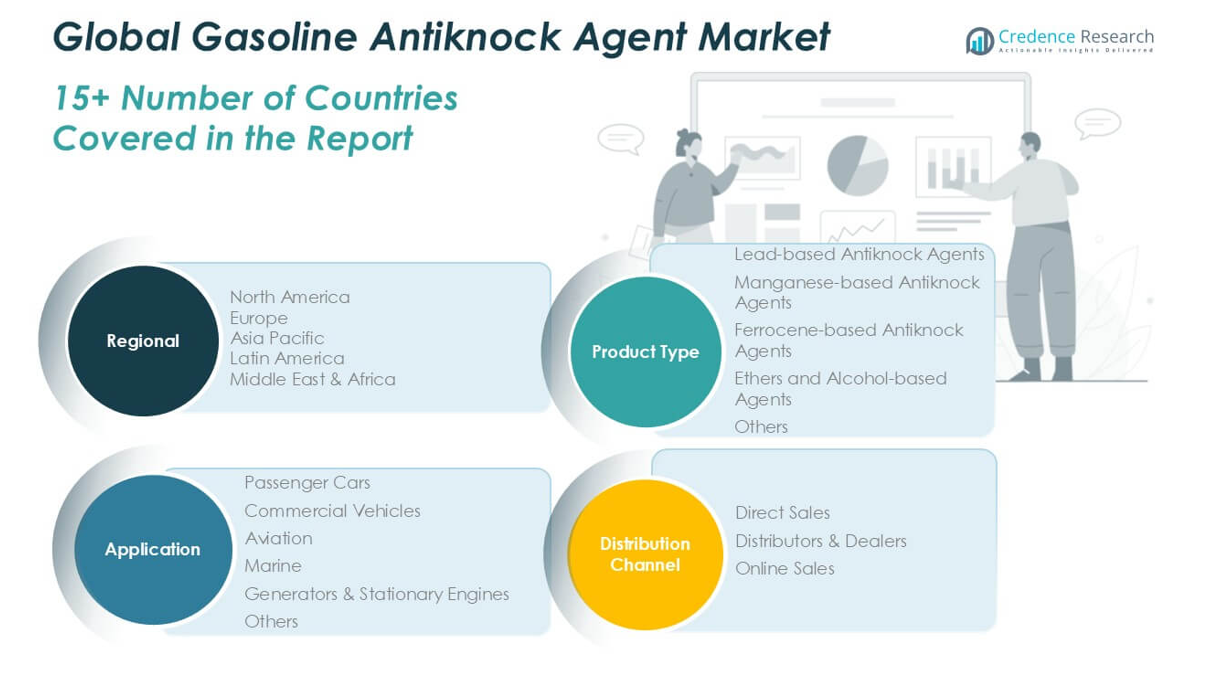
Market Segmentations:
By Type
- Lead-based Antiknock Agents
- Manganese-based Antiknock Agents
- Ferrocene-based Antiknock Agents
- Ethers and Alcohol-based Agents
- Others
By Application
- Passenger Cars
- Commercial Vehicles
- Aviation
- Marine
- Generators & Stationary Engines
- Others
By Distribution Channel
- Direct Sales
- Distributors & Dealers
- Online Sales
By Geography
- North America
- U.S.
- Canada
- Mexico
- Europe
- Germany
- France
- U.K.
- Italy
- Spain
- Rest of Europe
- Asia Pacific
- China
- Japan
- India
- South Korea
- South-east Asia
- Rest of Asia Pacific
- Latin America
- Brazil
- Argentina
- Rest of Latin America
- Middle East & Africa
- GCC Countries
- South Africa
- Rest of the Middle East and Africa
Competitive Landscape
The competitive landscape of the Gasoline Antiknock Agent market is characterized by the presence of established multinational chemical companies and specialized additive manufacturers, each striving to strengthen their market position through product innovation and strategic partnerships. Leading players such as Afton Chemical Corporation, BASF SE, Chevron Oronite Company LLC, Innospec Inc., The Lubrizol Corporation, and TotalEnergies SE dominate the global arena, leveraging extensive product portfolios, technological expertise, and robust distribution networks. These companies prioritize the development of environmentally friendly and regulatory-compliant antiknock agents to address the growing demand for cleaner fuel additives. Other notable participants, including Evonik Industries AG, Infineum International Limited, Dorf Ketal Chemicals, Baker Hughes, LANXESS AG, Clariant AG, Croda International Plc, and Shandong Dongchang Fine Chemical Technology, compete on the basis of regional reach, specialized offerings, and customer relationships. Strategic collaborations, mergers, and continuous investment in research and development remain central to maintaining competitiveness in this evolving market.
Key Player Analysis
- Afton Chemical Corporation
- BASF SE
- Chevron Oronite Company LLC
- Innospec Inc.
- The Lubrizol Corporation
- TotalEnergies SE
- Evonik Industries AG
- Infineum International Limited
- Dorf Ketal Chemicals India Pvt Ltd
- Baker Hughes
- LANXESS AG
- Clariant AG
- Croda International Plc
- Shandong Dongchang Fine Chemical Technolog
Recent Developments
- In March 2025, Afton Chemical continues its focus on developing fuel additive solutions that reduce emissions and improve fuel efficiency. This aligns with the evolving fuel standards and regulatory demands, particularly those related to Gasoline Direct Injection (GDI) engines. Afton is actively working with OEMs, fuel injector manufacturers, and oil companies to address the unique challenges posed by GDI technology, such as fuel injector deposits and Stochastic Pre-Ignition (SPI).
Market Concentration & Characteristics
The Gasoline Antiknock Agent Market demonstrates a moderate to high level of concentration, with a small group of multinational companies holding a significant portion of total market revenue. It features established players with strong R&D capabilities and broad distribution networks, allowing them to introduce innovative and tailored antiknock solutions for various regional fuel standards. These firms benefit from long-term partnerships with major oil refineries and automotive manufacturers, securing their market position. The market’s characteristics include high regulatory scrutiny and frequent shifts in formulation requirements to comply with evolving environmental and safety standards. Barriers to entry remain significant due to the capital-intensive nature of production facilities, need for advanced chemical expertise, and strict approval processes for new additives. Competitive dynamics focus on sustainability, fuel efficiency, and emissions reduction, prompting ongoing investment in eco-friendly alternatives and collaboration with end-users. Product differentiation centers on performance, compliance, and adaptability to diverse fuel compositions worldwide
Report Coverage
The research report offers an in-depth analysis based on Type, Application, Distribution Channel and Geography. It details leading market players, providing an overview of their business, product offerings, investments, revenue streams, and key applications. Additionally, the report includes insights into the competitive environment, SWOT analysis, current market trends, as well as the primary drivers and constraints. Furthermore, it discusses various factors that have driven market expansion in recent years. The report also explores market dynamics, regulatory scenarios, and technological advancements that are shaping the industry. It assesses the impact of external factors and global economic changes on market growth. Lastly, it provides strategic recommendations for new entrants and established companies to navigate the complexities of the market.
Future Outlook
- Demand for cleaner and more efficient gasoline antiknock agents will continue to grow due to tightening emission regulations worldwide.
- Companies will increase investment in research and development to create additives compatible with next-generation engine technologies.
- Adoption of unleaded and low-sulfur fuel formulations will drive innovation in environmentally friendly antiknock solutions.
- Strategic collaborations between additive manufacturers and automotive OEMs will become more common to ensure optimal fuel performance.
- Digitalization and process automation in production facilities will improve efficiency and quality control for antiknock agent manufacturing.
- Regulatory compliance will remain a top priority, prompting companies to seek faster product approval and certification processes.
- Expansion into emerging markets will offer new growth opportunities as vehicle fleets increase in Asia-Pacific, Latin America, and Africa.
- Rising consumer awareness about fuel quality and engine health will stimulate demand for advanced antiknock agents in retail fuel segments.
- Key players will focus on developing multi-functional additives that provide both antiknock and engine cleaning benefits.
- The transition to electric vehicles may gradually influence demand dynamics, prompting manufacturers to diversify their additive portfolios.
Request a Free Sample
Fill in your details and we'll send you a free sample report.
- Sample data tables & charts
- Research methodology
Need a Custom Version of This Report?
Tailor the scope, geography, or segments to your exact requirements.
- Custom geography or segment scope
- Direct access to our analyst team
Frequently Asked Questions
What is the current size of the Gasoline Antiknock Agent Market?
What are the key segments within the Gasoline Antiknock Agent Market?
What are some challenges faced by the Gasoline Antiknock Agent Market?
Who are the major players in the Gasoline Antiknock Agent Market?
Table of Content
Chapter 1. Report Introduction
- 1.1 Report Description & Purpose
- 1.1.1 Report Title & Market Definition
- 1.1.2 Unique Selling Propositions (USP) & Key Differentiators
- 1.1.3 Value Proposition for Stakeholders
- 1.2 Research Objectives
- 1.2.1 Market Sizing Objectives (Volume & Revenue)
- 1.2.2 Segmentation Objectives
- 1.2.3 Competitive Intelligence Objectives
- 1.2.4 Forecast & Scenario Objectives
- 1.3 Report Scope
- 1.3.1 Gasoline Antiknock Agent Scope – Types & Subtypes Covered
- 1.3.2 Geographic Scope – Regions & Countries Covered
- 1.3.3 Historical Period, Base Year & Forecast Period (2024; forecast to the forecast period)
- 1.3.4 Inclusions & Exclusions
- 1.4 HS Code & Classification Framework
- 1.5 Currency, Units & Pricing Basis
- 1.6 Target Stakeholders
- 1.7 Limitations & Assumptions
Chapter 2. Executive Summary
- 2.1 Global Gasoline Antiknock Agent Market Snapshot
- 2.1.1 Market Size – Historical (2024) & Forecast (the forecast period) (2024: USD 1,287.4 million → forecast year: USD 1,887.6 million)
- 2.1.2 Volume & Revenue – Global Totals
- 2.1.3 Key Market Highlights – Top Five Facts
- 2.2 Gasoline Antiknock Agent Market Segmentation Snapshot
- 2.2.1 Market Split by Region – 2024 vs.
- 2.3 Competitive Snapshot
- 2.3.1 Top 10 Players by Revenue Share – 2024
- 2.3.2 Top 10 Players by Volume Share – 2024
- 2.3.3 Recent Strategic Developments (18-Month Summary)
- 2.4 Key Investment Highlights & Strategic Conclusions
Chapter 3. Gasoline Antiknock Agent Market Dynamics & Industry Analysis
- 3.1 Market Overview & Context
- 3.1.1 Gasoline Antiknock Agent Market Position in the Broader Automotive Value Chain
- 3.1.2 OEM vs. Replacement Market Dynamics
- 3.1.3 Market Maturity & Development Stage by Region
- 3.2 Gasoline Antiknock Agent Market Drivers
- 3.3 Gasoline Antiknock Agent Market Restraints & Challenges
- 3.4 Gasoline Antiknock Agent Market Opportunities
- 3.5 Porter's Five Forces Analysis
- 3.5.1 Threat of New Entrants
- 3.5.2 Bargaining Power of Suppliers
- 3.5.3 Bargaining Power of Buyers
- 3.5.4 Threat of Substitutes
- 3.5.5 Competitive Rivalry – Intensity Assessment
- 3.6 Gasoline Antiknock Agent Value Chain Analysis
- 3.6.1 Upstream – Raw Material/Input Suppliers
- 3.6.1.1 Raw Material/Input 1
- 3.6.1.2 Raw Material/Input 2
- 3.6.1.3 Raw Material/Input 3
- 3.6.2 Midstream – Production/Manufacturing/Service Delivery
- 3.6.2.1 Production/Process Overview
- 3.6.2.2 Key Facility Locations & Capacity by Manufacturer
- 3.6.3 Downstream – Distribution & End Consumer
- 3.6.3.1 Primary Channel – B2B/OEM
- 3.6.3.2 Secondary Channels – Dealer, Retail, Online, Direct
- 3.6.4 Value Chain Profitability Analysis
- 3.6.1 Upstream – Raw Material/Input Suppliers
- 3.7 PESTEL Analysis
- 3.7.1 Political Factors
- 3.7.2 Economic Factors
- 3.7.3 Social Factors
- 3.7.4 Technological Factors
- 3.7.5 Environmental Factors
- 3.7.6 Legal Factors
- 3.8 Gasoline Antiknock Agent Supply Chain Analysis
- 3.8.1 Raw Material/Input Supply Risk Assessment
- 3.8.2 Manufacturing Concentration Risk (Geographic Exposure)
- 3.8.3 Trade Disruption Impact Analysis
- 3.9 Regulatory & Policy Landscape
Note: The regulatory and policy landscape section covers regulations based on their applicability to the market, Gasoline Antiknock Agent category, geography, and scope of the study. Only regulatory frameworks with a material impact on operations, compliance, trade, sustainability, or market access are analyzed in detail.
Chapter 4. Key Investment Pockets & Opportunity Analysis
- 4.1 Gasoline Antiknock Agent Market Attractiveness Analysis
- 4.1.1 By Region – Investment Attractiveness Matrix (Volume × CAGR)
- 4.2 Absolute Revenue Growth Opportunity
- 4.2.1 By Region – Absolute USD Growth Through the forecast period
- 4.3 Incremental Volume Opportunity
- 4.3.1 By Region – Incremental Volume Through the forecast period
- 4.3.2 Segment – Incremental Volume
- 4.4 Emerging Submarket Opportunity Deep Dive (Subject to Applicability)
- 4.5 Emerging Market Opportunity Scorecards
- 4.5.1 United States
- 4.5.2 Europe
- 4.5.3 Asia
- 4.5.4 Middle East & Africa
Note: Emerging Market Opportunity Scorecards will be included based on relevance and strategic importance. Regions listed are indicative and may vary depending on data availability and market dynamics.
Chapter 5. Gasoline Antiknock Agent Import-Export Analysis & Trade Flows
- 5.1 Global Trade Overview
- 5.1.1 Global Export Value by Country (2024)
- 5.1.2 Global Export Volume by Country (2024)
- 5.1.3 Global Import Value by Country (2024)
- 5.1.4 Global Import Volume by Country (2024)
- 5.1.5 Net Trade Balance by Country (2024)
- 5.2 Export Analysis – Segment
- 5.2.1 Type 1 (HS Code)
- 5.2.2 Type 2 (HS Code)
- 5.2.3 Type 3 (HS Code)
- 5.2.4 Type 4 (HS Code)
- 5.2.5 Type 5 (HS Code)
- 5.3 Import Analysis – Segment
- 5.3.1 Type 1 (HS Code)
- 5.3.2 Type 2 (HS Code)
- 5.3.3 Type 3 (HS Code)
- 5.3.4 Type 4 (HS Code)
- 5.3.5 Type 5 (HS Code)
- 5.4 Average Unit Trade Prices
- 5.4.1 Average Export Price – Segment & Country
- 5.4.2 Average Import Price – Segment & Source Country
- 5.4.3 Price Trends (2024)
- 5.5 Key Trade Route Analysis
- 5.5.1 Trade Route 1
- 5.5.2 Trade Route 2
- 5.5.3 Trade Route 3
- 5.5.4 Trade Route 4
- 5.5.5 Trade Route 5
- 5.6 Trade Policy Impact Assessment
- 5.6.1 US Anti-Dumping & Section 301 Tariffs
- 5.6.2 EU Customs Union Impact
- 5.6.3 Major Free Trade Agreements
- 5.6.4 USMCA Rules of Origin
Note: Trade policy analysis will be included only where relevant to the Gasoline Antiknock Agent market.
Chapter 6. Competitive Landscape & Company Benchmarking
- 6.1 Gasoline Antiknock Agent Market Concentration & Structure
- 6.1.1 Herfindahl-Hirschman Index (HHI) – vs. 2024
- 6.1.2 Tier 1, Tier 2 & Tier 3 Market Structure
- 6.1.3 Global, Regional & Local Player Dynamics
- 6.2 Gasoline Antiknock Agent Market Share Analysis – 2024
- 6.2.1 Global Revenue Share by Company
- 6.2.2 Global Volume Share by Company
- 6.2.3 Regional Revenue Share
- 6.2.4 Market Share Evolution ( vs. 2024)
- 6.2.5 OEM Segment Share by Company
- 6.2.6 Replacement Segment Share by Company
- 6.3 Production/Delivery Capacity & Facility Analysis
- 6.3.1 Global Installed Capacity
- 6.3.2 Capacity Utilization Rates
- 6.3.3 Production/Output Volume
- 6.3.4 Facility Locations & Capacity Map
- 6.3.5 Planned Capacity Additions
- 6.4 Gasoline Antiknock Agent Competitive Benchmarking Matrix
- 6.4.1 Revenue, Volume, CAGR & Profitability Comparison
- 6.4.2 Channel Revenue Mix
- 6.4.3 Geographic Revenue Exposure
- 6.4.4 R&D Intensity
- 6.4.5 Sustainability Maturity
- 6.5 Strategic Developments in Gasoline Antiknock Agent (Last 24 Months)
- 6.5.1 Mergers, Acquisitions & Divestments
- 6.5.2 New Gasoline Antiknock Agent Launches
- 6.5.3 Facility Expansions
- 6.5.4 Strategic Alliances, Joint Ventures & Partnerships
- 6.5.5 Distribution Expansion & Market Entry
- 6.5.6 Sustainability & ESG Initiatives
- 6.6 Competitive Strategy Mapping
- 6.6.1 Leader, Challenger, Follower & Niche Classification
- 6.6.2 Pricing Strategy Comparison
- 6.6.3 Channel Strategy Matrix
Note: Strategic developments are included based on their materiality and the availability of reliable information.
Chapter 7. Global Gasoline Antiknock Agent Market – By Distribution Channel
- 7.1 Segment Overview
- 7.1.1 Volume & Revenue Split by Channel (2024 & )
- 7.1.2 Channel Mix Evolution (the forecast period)
Chapter 8. Regional Market Analysis – Global Overview
- 8.1 Global Regional Overview
- 8.1.1 Regional Volume Share
- 8.1.2 Regional Revenue Share
- 8.1.3 Regional Volume by Region
- 8.1.4 Regional Revenue by Region
- 8.1.5 Regional Forecast Through the forecast period
- 8.2 Cross-Regional Segment Analysis
- 8.2.1 By Distribution Channel
- 8.2.2 By Brand/Price Tier
Chapter 9. North America Gasoline Antiknock Agent Market
- 9.1 United States
- 9.2 Canada
- 9.3 Mexico
Chapter 10. Europe Gasoline Antiknock Agent Market
- 10.1 Germany
- 10.2 France
- 10.3 Italy
- 10.4 United Kingdom
- 10.5 Spain
- 10.6 Poland
- 10.7 Russia
- 10.8 Netherlands
- 10.9 Belgium
- 10.10 Sweden
- 10.11 Denmark
- 10.12 Norway
- 10.13 Rest of Europe
Chapter 11. Asia Pacific Gasoline Antiknock Agent Market
- 11.1 China
- 11.2 India
- 11.3 Japan
- 11.4 South Korea
- 11.5 Thailand
- 11.6 Indonesia
- 11.7 Vietnam
- 11.8 Malaysia
- 11.9 Australia
- 11.10 Rest of Asia Pacific
Chapter 12. Latin America Gasoline Antiknock Agent Market
- 12.1 Brazil
- 12.2 Argentina
- 12.3 Colombia
- 12.4 Chile
- 12.5 Rest of Latin America
Chapter 13. Middle East Gasoline Antiknock Agent Market
- 13.1 Saudi Arabia
- 13.2 United Arab Emirates
- 13.3 Turkey
- 13.4 Israel
- 13.5 Iran
- 13.6 Rest of the Middle East
Chapter 14. Africa Gasoline Antiknock Agent Market
- 14.1 South Africa
- 14.2 Egypt
- 14.3 Nigeria
- 14.4 Morocco
- 14.5 Rest of Africa
Chapter 15. Gasoline Antiknock Agent Company Profiles
- 15.1 [Company 01]
- 15.1.1 Company Overview
- 15.1.2 Key Management Personnel
- 15.1.3 Products & Services Portfolio
- 15.1.4 Financial Performance
- 15.1.5 Key Market Focus & Geographic Presence
- 15.1.6 Recent Developments & Strategic Initiatives
Note: The company profile list is preliminary and may change based on research findings, market developments, data availability, and client requirements.
Chapter 16. Appendices
- Appendix A – List of Abbreviations & Acronyms
- Appendix B – Industry Classification Code Reference – Full Series
- Appendix C – Production & Capacity Data Tables
- Appendix D – End-Use & Demand Base Tables
- Appendix E – Consumption & Replacement Rate Assumptions
- Appendix F – ASP Reference Tables
- Appendix G – Manufacturing & Facility Database
- Appendix H – Import-Export Data Tables
- Appendix I – Regulatory Summary Tables
- Appendix J – Primary Research Participant List (Anonymized)
- Appendix K – Primary Research Questionnaire Framework
- Appendix L – Data Sources & Bibliography
- Appendix M – Market Size Divergence & Source Comparison
Chapter 17. Research Methodology
- 17.1 Research Framework & Philosophy
- 17.2 Secondary Research – Sources, Hierarchy & Data Extraction
- 17.3 Data Modeling – Bottom-Up & Top-Down Market Sizing
- 17.4 Primary Research – Stakeholder Framework, LOI & Sample Sizes
- 17.5 Forecast Methodology – Regression, Scenario & Sensitivity Analysis
- 17.6 Quality Control – Four-Layer Validation Framework
- 17.7 Limitations & Standard Assumptions
- 17.8 Disclaimer
