
Market Overview:
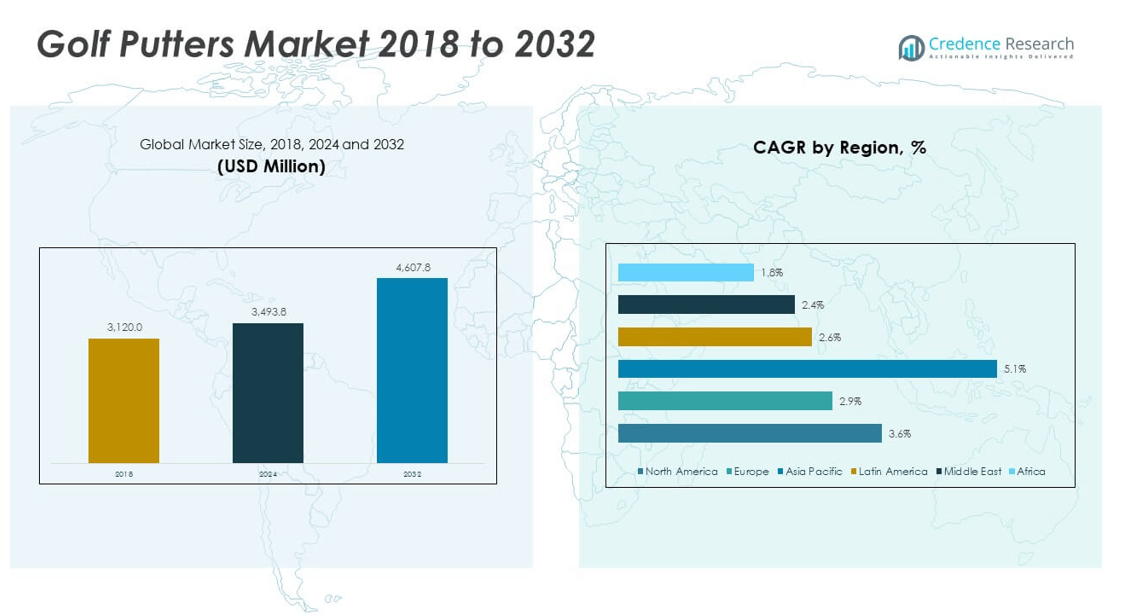
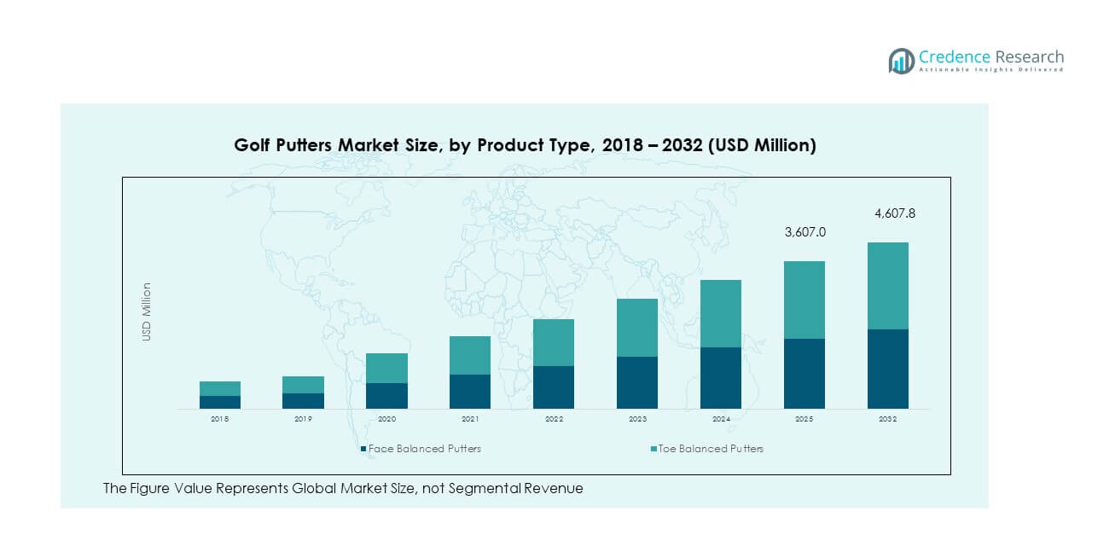
The Global Golf Putters Market size was valued at USD 3,120.0 million in 2018 to USD 3,493.8 million in 2024 and is anticipated to reach USD 4,607.8 million by 2032, at a CAGR of 3.6% during the forecast period.
| REPORT ATTRIBUTE | DETAILS |
|---|---|
| Historical Period | 2020-2023 |
| Base Year | 2024 |
| Forecast Period | 2025-2032 |
| Golf Putters Market Size 2024 | USD 3,493.8 million |
| Golf Putters Market, CAGR | 3.6% |
| Golf Putters Market Size 2032 | USD 4,607.8 million |
The market is driven by the increasing popularity of golf as both a professional and recreational sport, supported by the growing number of golf courses and clubs worldwide. Rising interest among younger players, advancements in putter designs with precision engineering, and endorsements by professional golfers are fueling demand. In addition, premium product offerings and customization options are gaining traction, as consumers seek equipment tailored to performance improvement and personal playing style.
North America leads the Golf Putters Market due to the region’s established golfing culture, high participation rates, and presence of major manufacturers. Europe follows closely, supported by traditional golfing hubs like the UK and Germany. The Asia-Pacific region is emerging as a high-growth market, with increasing adoption in countries such as Japan, South Korea, and China, where rising disposable incomes and investments in golf tourism are expanding the player base. Meanwhile, markets in Latin America and the Middle East are showing potential due to new golf course developments and hosting of international tournaments.
Market Insights:
- The Global Golf Putters Market size was USD 3,120.0 million in 2018, increased to USD 3,493.8 million in 2024, and is projected to reach USD 4,607.8 million by 2032, growing at a CAGR of 3.6%.
- North America held the largest share at 39.8% in 2024, followed by Europe at 27.3% and Asia Pacific at 19.7%, driven by established golfing culture, strong tournament presence, and premium brand adoption.
- Asia Pacific is the fastest-growing region with a 19.7% share in 2024, supported by rising disposable incomes, rapid golf tourism expansion, and new infrastructure development.
- By product type, face balanced putters accounted for 57% of the market in 2024, driven by preference for straight-line stability among both professionals and amateurs.
- Toe balanced putters represented 43% of the Global Golf Putters Market in 2024, supported by adoption among golfers favoring arcing strokes and personalized playing styles.
Market Drivers
Rising Popularity of Golf as a Global Sport Expands Consumer Demand
The Global Golf Putters Market is benefiting from the increasing popularity of golf as both a recreational activity and a professional sport across developed and emerging regions. Growing participation in golf tournaments and the presence of golf in international sporting events are raising awareness among diverse age groups. Governments and private investors are building golf courses to attract tourism and support sports development. Professional golfers are endorsing premium putters, boosting their appeal among amateurs and enthusiasts. Youth participation in golf programs and training academies is also contributing to higher demand. Technological advancements in golf putters are further encouraging consumers to upgrade equipment. It is experiencing consistent momentum due to the blend of professional recognition and rising recreational adoption.
Technological Advancements and Product Innovation Enhance Market Growth
The development of advanced materials and precision-engineered designs is driving the adoption of modern putters. Manufacturers are focusing on innovations such as adjustable weighting systems, face inserts, and alignment aids to improve accuracy and performance. Golfers are seeking technologically superior putters that enhance control and reduce stroke inconsistencies. The integration of digital tools and simulation technologies in golf training is also raising awareness about equipment quality. Premium brands are launching limited-edition products to strengthen consumer loyalty and brand image. Collaborations with research institutes and sports scientists are improving design efficiency. It is gaining traction as performance-driven innovation continues to shape player preferences.
- For example, Odyssey Golf introduced its Ai-ONE putters in 2023, featuring an AI-designed insert that delivers improved speed consistency. Independent testing showed that putts struck with the Ai-ONE insert finish on average 21% closer to the hole compared to a traditional milled putter, a performance enhancement that has the potential to reduce three-putt frequency for golfers.
Expansion of Golf Tourism and Recreational Facilities Drives Sales
The rise of golf tourism is creating new opportunities for the golf equipment industry, including putters. Countries such as the United States, Scotland, Japan, and the UAE are promoting golf tourism as part of their sports and leisure strategies. The construction of luxury resorts with integrated golf facilities is attracting international tourists and amateur players. Local governments are investing in public golf courses to expand accessibility. Organized training programs and community initiatives are increasing interest among beginners. The integration of golf experiences in corporate events and social activities is also contributing to sales. It is benefiting from the growing alignment of golf with travel and leisure industries.
- For instance, Augusta National Golf Club hosted about 40,000 visitors per day during the 2024 Masters Tournament, contributing significantly to equipment sales and local hospitality demand tied to major golf events.
Rising Disposable Incomes and Lifestyle Shifts Support Premium Demand
Increasing disposable incomes and lifestyle changes are influencing consumers to spend on premium sports equipment. Urban professionals and high-income groups are viewing golf as a status-enhancing leisure activity. The preference for customized and branded putters is strengthening demand in high-potential markets. Manufacturers are offering personalization options to align with individual preferences. Retailers and online platforms are expanding product accessibility, making premium putters available to global consumers. Endorsements from professional golfers are reinforcing brand credibility and consumer trust. It is witnessing stronger demand from aspirational buyers seeking exclusivity and performance benefits.
Market Trends
Growing Integration of Smart Technologies in Golf Equipment
The adoption of smart technologies in sports equipment is transforming the Global Golf Putters Market. Manufacturers are embedding sensors, motion trackers, and connectivity features into putters to provide data-driven insights. Players are using smart putters to analyze swing patterns and improve precision through digital feedback. Integration with mobile apps and wearables is enabling golfers to track progress in real time. Smart golf training systems are also encouraging new players to adopt connected devices. Retailers are highlighting these features to attract tech-savvy customers. It is aligning with the broader trend of digitalization in sports equipment.
- For example, in January 2025, CONECTD Golf, backed by investment from the PGA Tour, embedded advanced sensors into LEMERLE Golf putters, enabling the capture of 26,000 data points per swing for detailed putting stroke analysis.
Rising Demand for Eco-Friendly and Sustainable Golf Putters
Environmental sustainability is shaping consumer choices, creating momentum for eco-friendly products. Manufacturers are exploring recyclable materials and energy-efficient production techniques to meet regulatory requirements. Consumers are showing preference for brands committed to reducing environmental impact. Golf courses and clubs are promoting sustainability by encouraging the use of responsibly produced equipment. Biodegradable packaging and eco-certification are emerging as strong differentiators in competitive markets. It is adapting to consumer-driven sustainability expectations. Brands that align innovation with eco-friendly practices are gaining stronger brand loyalty.
Expansion of Online Retail Channels Reshapes Distribution Strategies
E-commerce growth is reshaping the distribution landscape for golf putters. Online platforms are providing access to a wide range of premium and mid-tier putters, supported by virtual fitting tools and digital reviews. Consumers are shifting toward online purchases due to convenience and transparency. Retailers are leveraging digital channels to reach international buyers and niche golfing communities. Exclusive online promotions and limited-edition launches are boosting sales. Social media influencers and online tutorials are further shaping consumer awareness. It is witnessing structural transformation in product accessibility and brand reach.
Increasing Influence of Customization and Personalization in Purchasing Decisions
Personalized products are gaining significant traction in the golfing community. Manufacturers are offering custom designs, engraving, and adjustable features to meet individual preferences. Advanced fitting services are enabling golfers to select putters based on stroke style, grip size, and alignment needs. The trend is expanding as players value equipment tailored to performance enhancement. Digital ordering platforms are streamlining personalization requests and delivery processes. Premium buyers are viewing customization as an extension of luxury consumption. It is evolving with a focus on individual expression and performance-driven personalization.
- For example, Bertie Boucher Putters enabled golfers to design fully bespoke putters using an online customization tool. Customers can select from visually diverse alignment styles, engravings, colors, inserts, shafts, grips, and more resulting in millions of unique combinations crafted to individual preferences.
Market Challenges Analysis
High Equipment Costs and Limited Accessibility Restrict Wider Adoption
The Global Golf Putters Market faces the challenge of affordability, as premium putters often carry high price tags. Consumers in emerging regions may find it difficult to justify investment in expensive golf equipment. Limited access to golf facilities further reduces demand among casual players. Local manufacturers face difficulties in competing with established global brands offering advanced features. The industry is also impacted by fluctuating raw material costs, affecting product pricing. It is constrained by barriers that prevent wider adoption across all income segments. Bridging this gap requires affordable innovations and broader distribution networks.
Seasonal Dependency and Declining Participation in Certain Regions Affect Growth
Golf is often influenced by seasonal and climatic factors, which restrict playability in several regions. Cold climates and seasonal shifts reduce equipment demand during off-seasons. The sport has also witnessed declining participation in specific markets where younger generations prefer alternative activities. The lack of effective marketing campaigns to engage youth is another challenge. Maintenance costs of golf courses discourage new entrants into the game. It is experiencing growth barriers linked to external factors beyond manufacturer control. Industry stakeholders need to address participation decline to sustain long-term momentum
Market Opportunities
Expansion in Emerging Economies with Rising Sports Culture
The Global Golf Putters Market is positioned to grow strongly in emerging economies where sports participation is rising. Countries in Asia-Pacific, Latin America, and the Middle East are investing in new golf courses and training centers. Urbanization and rising disposable incomes are encouraging interest in golf among younger demographics. Retail expansion and online availability are helping brands reach new consumers. Local collaborations are boosting awareness of golf as a modern lifestyle sport. It is gaining visibility in markets where cultural acceptance of golf is expanding rapidly.
Innovation and Personalization Open New Revenue Streams
The demand for personalized and performance-enhancing golf putters is opening significant opportunities for manufacturers. Advanced fitting technologies and customization services are attracting professional and amateur golfers alike. Brands that integrate smart technology with personalization are well-positioned to capture premium segments. Expansion into direct-to-consumer sales channels allows companies to strengthen engagement. It is poised to benefit from innovation that aligns with evolving consumer preferences. These factors are creating pathways for sustained revenue generation in the long term.
Market Segmentation Analysis:
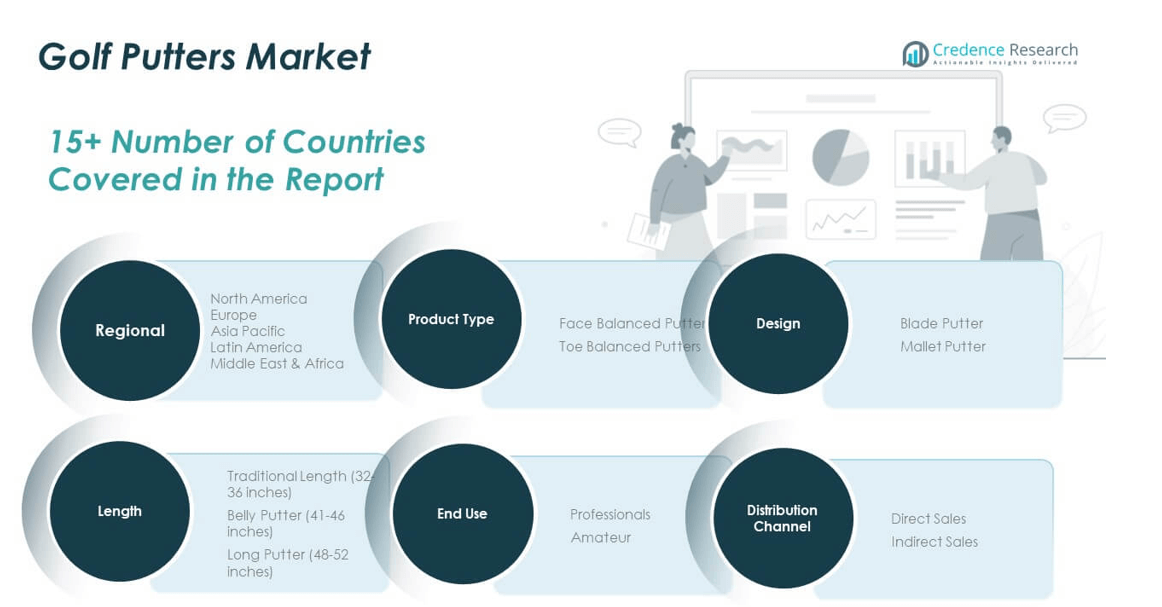
The Global Golf Putters Market demonstrates clear segmentation across product type, design, end-use, length, and distribution channels, shaping competitive positioning.
By product type, face balanced putters lead demand due to their ability to stabilize strokes for straight-line putting, while toe balanced putters retain strong appeal among golfers with arcing strokes.
- For instance, GolfLink’s 2024 testing identified face-balanced models like the PING PLD Milled DS72 and Odyssey Ai-ONE Jailbird DB as top performers for straight-stroke players, with rigorous testing across thousands of putts confirming their superior user stability and popularity in the retail segment.
By design, blade putters remain a traditional choice, favored by professionals valuing precision and feel, whereas mallet putters continue to gain traction with amateurs due to larger sweet spots and improved alignment aids.
By end-use segmentation highlights the dominance of professionals who demand high-performance, customized equipment to optimize accuracy, while the amateur segment is expanding quickly through growing recreational participation and wider accessibility of golf courses.
- For instance, high-MOI mallet putters such as the TaylorMade Spider are used by top-ranked professionals like Scottie Scheffler and Jon Rahm, who have attributed improvements in their putting statistics on tour to these performance-driven designs
By length, traditional putters between 32–36 inches’ command significant adoption due to their compatibility with standard playing styles. Belly putters between 41–46 inches are maintaining relevance among golfers seeking stability, while long putters between 48–52 inches serve niche demand despite regulatory restrictions in competitive play.
By distribution channel, indirect sales dominate through sporting goods retailers, specialty stores, and online platforms, offering broader consumer reach. Direct sales, particularly through brand outlets and company-owned platforms, are strengthening as leading manufacturers emphasize consumer engagement and premium customization. The Global Golf Putters Market reflects evolving player preferences across all categories, and it is witnessing diversification that balances tradition with innovation in equipment design and retail strategy.
Segmentation:
By Product Type
- Face Balanced Putters
- Toe Balanced Putters
By Design
- Blade Putter
- Mallet Putter
By End-Use
- Professionals
- Amateur
By Length
- Traditional Length (32–36 inches)
- Belly Putter (41–46 inches)
- Long Putter (48–52 inches)
By Distribution Channel
- Direct Sales
- Indirect Sales
By Region
- North America
- U.S.
- Canada
- Mexico
- Europe
- Germany
- France
- U.K.
- Italy
- Spain
- Rest of Europe
- Asia Pacific
- China
- Japan
- India
- South Korea
- South-east Asia
- Rest of Asia Pacific
- Latin America
- Brazil
- Argentina
- Rest of Latin America
- Middle East & Africa
- GCC Countries
- South Africa
- Rest of the Middle East and Africa
Regional Analysis:
North America
The North America Global Golf Putters Market size was valued at USD 1,256.7 million in 2018 to USD 1,391.9 million in 2024 and is anticipated to reach USD 1,833.1 million by 2032, at a CAGR of 3.6% during the forecast period. North America holds 39.8% market share in 2024, making it the leading region globally. Strong golfing culture, high player participation, and a dense network of golf courses sustain its leadership. The United States remains the core growth driver, supported by established tournaments such as the PGA Tour and endorsements by elite professionals. The presence of leading manufacturers and advanced retail infrastructure strengthens product accessibility. Canada and Mexico are contributing through increasing recreational adoption and new golf course developments. It is experiencing sustained demand for premium and customized putters, reflecting a mature yet innovation-driven market.
Europe
The Europe Global Golf Putters Market size was valued at USD 883.0 million in 2018 to USD 953.0 million in 2024 and is anticipated to reach USD 1,192.3 million by 2032, at a CAGR of 2.9% during the forecast period. Europe commands 27.3% market share in 2024, securing its position as the second-largest regional market. Traditional golf hubs such as the UK, Germany, and France are driving demand through competitive play and recreational participation. The region benefits from strong heritage, with Scotland continuing to serve as a symbolic hub for golfing activities. Premium brands with European origins reinforce product loyalty, especially in the blade putter segment. Demand is influenced by both professionals and amateurs, with clubs and resorts investing in modern golfing infrastructure. It is stable but evolving, shaped by balanced demand for tradition and innovation.
Asia Pacific
The Asia Pacific Global Golf Putters Market size was valued at USD 581.9 million in 2018 to USD 689.5 million in 2024 and is anticipated to reach USD 1,027.2 million by 2032, at a CAGR of 5.1% during the forecast period. Asia Pacific represents 19.7% market share in 2024, emerging as the fastest-growing region globally. Rising disposable incomes, rapid urbanization, and government-backed investments in sports facilities are fueling growth. Countries such as Japan, South Korea, and China are developing robust golfing communities. India and Southeast Asia are also witnessing new course developments and increasing amateur participation. Strong demand for technologically advanced and customized putters reflects changing consumer behavior. International golf tournaments hosted in the region are further enhancing exposure. It is developing into a high-potential growth engine for the industry.
Latin America
The Latin America Global Golf Putters Market size was valued at USD 196.6 million in 2018 to USD 218.0 million in 2024 and is anticipated to reach USD 266.7 million by 2032, at a CAGR of 2.6% during the forecast period. Latin America accounts for 6.2% market share in 2024, representing a developing regional base. Brazil and Argentina are leading the adoption, supported by gradual expansion of recreational golf. Growing interest in golf tourism and hosting of regional tournaments are contributing to demand. Market development remains constrained by limited infrastructure and high equipment costs. The region is witnessing an increasing number of enthusiasts engaging in golf as a leisure activity. Distribution through indirect sales channels is critical for product reach. It is gradually expanding its presence with steady, albeit slower, momentum compared to advanced regions.
Middle East
The Middle East Global Golf Putters Market size was valued at USD 131.0 million in 2018 to USD 138.3 million in 2024 and is anticipated to reach USD 166.4 million by 2032, at a CAGR of 2.4% during the forecast period. The Middle East represents 4.0% market share in 2024, supported by high-end golf tourism and luxury resorts. Countries like the UAE and Saudi Arabia are investing heavily in international-standard golf courses. Golf has been positioned as part of lifestyle and luxury experiences, drawing both expatriates and local elites. Professional tournaments held in the region also increase equipment demand. Distribution relies heavily on specialized outlets and premium retailers. Growth is slower compared to Asia Pacific, but the market benefits from consistent demand among high-income groups. It is positioned as a niche premium market with a focus on luxury-oriented adoption.
Africa
The Africa Global Golf Putters Market size was valued at USD 70.8 million in 2018 to USD 103.1 million in 2024 and is anticipated to reach USD 122.1 million by 2032, at a CAGR of 1.8% during the forecast period. Africa accounts for 2.9% market share in 2024, making it the smallest contributor globally. South Africa dominates regional demand, supported by established golfing communities and international tournaments. Egypt and Nigeria are emerging with gradual infrastructure development. Affordability challenges and limited access to golf courses restrict wider penetration. Manufacturers are targeting affluent buyers and tourism-driven golfing hubs. Equipment sales are concentrated in urban centers and elite clubs. It is expected to grow modestly, largely driven by South Africa’s strong sporting culture and selective premium adoption.
Key Player Analysis:
- Axis1 Golf
- Bettinardi Golf
- Cleveland Golf
- Cobra Golf
- Evnroll Putters
- Heavy Putter (Boccieri Golf)
- A.B. Golf
- Miura Golf
- Mizuno Corporation
- Nike Golf
- Odyssey Golf (Callaway Golf Company)
- Piretti Fine Putters
- PXG (Parsons Xtreme Golf)
- Rife Putters
- Scotty Cameron (Acushnet Company)
- SeeMore Putter Company
- TaylorMade Golf Company
- Wilson Sporting Goods
- Yes! Golf
Competitive Analysis:
The Global Golf Putters Market is characterized by strong competition among leading players such as TaylorMade, Odyssey (Callaway Golf Company), Scotty Cameron (Acushnet), PXG, and Mizuno Corporation, alongside niche brands like Bettinardi and Evnroll. Companies are focusing on product innovation, incorporating advanced materials, alignment technologies, and customization features to attract both professionals and amateurs. Strategic collaborations with professional golfers and sponsorship of international tournaments strengthen brand recognition and consumer loyalty. E-commerce platforms are playing a pivotal role in enhancing product reach across regions. Manufacturers are also pursuing mergers, acquisitions, and new product launches to expand market presence. It is defined by the balance between premium players offering high-performance solutions and mid-tier brands targeting broader accessibility.
Recent Developments:
- In August 2025, Breakthrough Golf Technology launched the Paradox putter, a zero torque model engineered with Swing Balance Technology to enhance distance control. The Paradox showed a 20% faster true roll and missed putts finishing 10% closer to the hole in testing, and is offered in both blade and fang designs with adjustable loft and lie options.
- In July 2025, private equity firm L Catterton, backed by LVMH, acquired a majority stake in L.A.B. Golf, a company known for its innovative putter designs. L.A.B. Golf sold about 130,000 units last year and is expected to triple its volume in 2025, with putters starting at $399 per unit.
- In January 2025, Odyssey released the Ai-ONE Silver Milled Putters, including models such as Two T CH, Three T S, Seven T DB, and Seven T CH, designed with advanced AI-driven milling for enhanced putting precision. The official launch date was January 17, 2025.
Market Concentration & Characteristics:
The Global Golf Putters Market demonstrates moderate concentration with a mix of established global leaders and specialized boutique brands. It is influenced by continuous product differentiation, where innovation in design, materials, and customization shapes competitive positioning. Premium brands dominate revenue share, supported by strong endorsements and loyal professional users. Mid-sized and niche players compete by offering unique craftsmanship, specialized fitting, and value-focused alternatives. The market reflects characteristics of high brand influence, evolving consumer preferences, and increasing reliance on both direct and online distribution channels.
Report Coverage:
The research report offers an in-depth analysis based on Product Type, Design, End-Use, Length and Distribution Channel. It details leading market players, providing an overview of their business, product offerings, investments, revenue streams, and key applications. Additionally, the report includes insights into the competitive environment, SWOT analysis, current market trends, as well as the primary drivers and constraints. Furthermore, it discusses various factors that have driven market expansion in recent years. The report also explores market dynamics, regulatory scenarios, and technological advancements that are shaping the industry. It assesses the impact of external factors and global economic changes on market growth. Lastly, it provides strategic recommendations for new entrants and established companies to navigate the complexities of the market.
Future Outlook:
- The Global Golf Putters Market will witness steady growth driven by rising participation in professional and recreational golf worldwide.
- Advancements in materials and design technologies will continue to redefine product performance and consumer preferences.
- Smart putters with integrated data-tracking features will gain traction among tech-savvy golfers seeking performance insights.
- Sustainability initiatives will encourage the use of eco-friendly materials and manufacturing practices across the industry.
- Customization and personalization will remain central to consumer demand, especially in premium product categories.
- Online retail expansion will accelerate product accessibility, supported by digital fitting tools and virtual experiences.
- Emerging markets in Asia Pacific and Latin America will create new opportunities through expanding golf tourism and infrastructure.
- Professional endorsements and global tournaments will reinforce brand visibility and influence purchase decisions.
- Mid-tier brands will focus on affordability and innovative distribution to capture wider consumer bases.
- The market will evolve into a balance of tradition and innovation, aligning heritage with modern technological adoption.

Request a Free Sample
Fill in your details and we'll send you a free sample report.
- Sample data tables & charts
- Research methodology
Market Dynamics
Rising Popularity of Golf as a Global Sport
Golf is increasingly embraced as both a professional and recreational activity, with more tournaments, youth programs, and golf course developments worldwide, expanding the consumer base for putters.
Technological Advancements and Product Innovation
Manufacturers are introducing precision-engineered putters with features like adjustable weighting, AI-designed inserts, and smart sensors, which enhance performance and attract both professionals and amateurs seeking equipment upgrades.
Expansion of Golf Tourism and Recreational Facilities
Growth in golf tourism, luxury resorts, and public course investments in regions like the US, Japan, and the UAE is driving demand for golf equipment, including putters, as more players and tourists participate in the sport.
Rising Disposable Incomes and Lifestyle Shifts
Higher disposable incomes and the perception of golf as a status-enhancing leisure activity are encouraging consumers, especially urban professionals and high-income groups, to invest in premium and customized putters.
Growth of Online Retail and Customization
The expansion of e-commerce platforms and digital fitting tools is making premium and personalized putters more accessible globally, while customization options are increasingly influencing purchasing decisions among discerning golfers.
Need a Custom Version of This Report?
Tailor the scope, geography, or segments to your exact requirements.
- Custom geography or segment scope
- Direct access to our analyst team
Frequently Asked Questions
What is the current market size for Global Golf Putters Market, and what is its projected size in 2032?
At what Compound Annual Growth Rate is the Global Golf Putters Market projected to grow between 2024 and 2032?
What are the primary factors fueling the growth of the Global Golf Putters Market?
Who are the leading companies in the Global Golf Putters Market?
Table of Content
Chapter 1 Market Segmentation
- 1.1 Segmentation Framework
- 1.1.1 Product and Service Classification
- 1.1.2 Application and End-Use Classification
- 1.1.3 Technology and Solution Classification
- 1.1.4 Customer and Distribution Channel Classification
- 1.1.5 Geographic Segmentation
- 1.1.6 Market Segment Definitions and Boundaries
- 1.2 By Design
- 1.2.1 Blade Putter
- 1.2.2 Mallet Putter
- 1.3 By End-Use
- 1.3.1 Professionals
- 1.3.2 Amateur
- 1.4 By Product Type
- 1.4.1 Face Balanced Putters
- 1.4.2 Toe Balanced Putters
Chapter 2 Introduction
- 2.1 Report Objectives and Scope
- 2.2 Product Definition and Industry Terminology
- 2.3 Market Inclusions and Exclusions
- 2.4 Research Process
- 2.4.1 Primary Research and Expert Interviews
- 2.4.2 Secondary Research and Source Review
- 2.4.3 Top-Down and Bottom-Up Estimation
- 2.4.4 Data Triangulation and Verification
- 2.5 Market Size Measurement Basis
- 2.5.1 2024: USD 3,493.8 million → 2032: USD 4,607.8 million
- 2.6 Historical and Forecast Reference Periods
- 2.6.1 Base Year: 2024
- 2.6.2 Forecast Period: 2024-2032
- 2.7 Research Assumptions and Limitations
Chapter 3 Executive Summary
- 3.1 Market Snapshot and Key Findings
- 3.2 Base-Year Market Size, 2024
- 3.3 Forecast Market Size, 2032
- 3.4 Revenue and Volume Growth Outlook
- 3.5 Key Demand and Supply Indicators
- 3.6 Leading Market Segments
- 3.7 Fastest-Growing Market Opportunities
- 3.8 Regional Performance Highlights
- 3.9 Technology and Industry Transformation
- 3.10 Competitive Landscape Summary
- 3.11 Analyst View and Strategic Implications
Chapter 4 Global Golf Putters Market Trends and Developments
- 4.1 Historical Industry Development
- 4.2 Recent Market Trends and Developments
- 4.3 Demand and Customer Behavior Trends
- 4.4 Technology and Product Innovation
- 4.5 Artificial Intelligence, Automation and Digitalization
- 4.6 Local Manufacturing and Supply Chain Realignment
- 4.7 Industry Partnerships, Mergers and Acquisitions
- 4.8 Sustainability and Circular Economy Developments
- 4.9 Government and Private Sector Investment Trends
- 4.10 Emerging Business Models and Commercialization
- 4.11 Industry Developments and Announcements
Chapter 5 Global Golf Putters Market Production, Supply and Demand Analysis
- 5.1 Demand Trend and Consumption Analysis
- 5.2 Demand Forecast, 2024-2032
- 5.3 Production and Output Trend
- 5.4 Production and Output Forecast, 2024-2032
- 5.5 Installed Capacity and Capacity Utilization
- 5.6 Company-Wise Production Plants and Statistics
- 5.6.1 Installed Production Capacity
- 5.6.2 Actual Production
- 5.6.3 Planned Capacity and Expansion Targets
- 5.7 Supply Chain Structure and Procurement Trends
- 5.8 Supply-Demand Gap and Bottlenecks
- 5.9 Import Dependence and Sourcing Structure
- 5.10 Contract Manufacturing and Outsourcing
- 5.11 Regional Supply and Demand Concentration
Chapter 6 Global Golf Putters Market Pricing Analysis
- 6.1 Pricing Structure and Measurement
- 6.2 Historical Pricing Trends
- 6.3 Pricing Outlook, 2024-2032
- 6.4 Average Selling Price and Unit Economics
- 6.5 Pricing by Product and Market Segment
- 6.6 Geographic Pricing Differences
- 6.7 Key Input, Energy, Labor and Logistics Costs
- 6.8 Contract Pricing and Purchasing Models
- 6.9 Pricing Sensitivity and Competitive Positioning
- 6.10 Price, Margin and Profitability Implications
Chapter 7 Global Golf Putters Market Dynamics
- 7.1 Market Growth Drivers
- 7.1.1 Demand-Side Drivers
- 7.1.2 Technology and Innovation Drivers
- 7.1.3 Infrastructure and Investment Drivers
- 7.1.4 Regulatory and Policy Drivers
- 7.2 Market Restraints
- 7.2.1 Cost and Affordability Constraints
- 7.2.2 Technology and Adoption Barriers
- 7.2.3 Supply Chain and Operational Constraints
- 7.3 Market Challenges
- 7.3.1 Competitive Pressure and Margin Erosion
- 7.3.2 Skills, Infrastructure and Implementation Gaps
- 7.4 Emerging Market Opportunities
- 7.5 Market Dynamics Impact and Time-Horizon Assessment
Chapter 8 Global Golf Putters Value Chain Analysis
- 8.1 Industry Value Chain Overview
- 8.2 Upstream Suppliers and Critical Inputs
- 8.3 Technology and Component Providers
- 8.4 Manufacturing or Service Delivery
- 8.5 Distribution, Channel Partners and Integrators
- 8.6 Downstream Applications and End Users
- 8.7 Value Addition and Profit Pools
- 8.8 Vertical Integration and Outsourcing
- 8.9 Supplier Concentration and Risk
- 8.10 Supply Chain Localization and Resilience
Chapter 9 Global Golf Putters Market Regulations and Policies
- 9.1 Relevant Laws, Standards and Compliance Frameworks
- 9.2 Product, Service, Safety and Quality Requirements
- 9.3 Government Policies, Incentives and Subsidies
- 9.4 Imports, Exports and Trade Barriers
- 9.5 Public Procurement and Local Content Requirements
- 9.6 Environmental and Sustainability Compliance
- 9.7 Upcoming Policy Changes and Market Implications
Chapter 10 Global Golf Putters Market Hotspots and Opportunities
- 10.1 Market Opportunity Mapping and Growth Hotspots
- 10.2 High-Growth Applications and Customer Groups
- 10.3 Underserved Markets and White-Space Opportunities
- 10.4 Emerging Technology and Product Opportunities
- 10.5 New Capacity and Investment Hotspots
- 10.6 Market Entry and Expansion Opportunities
- 10.7 Distribution and Partnership Opportunities
- 10.8 Near-Term and Long-Term Commercial Potential
- 10.9 Opportunity Attractiveness and Execution Risks
Chapter 11 Global Golf Putters Market Outlook, 2024-2032
- 11.1 Market Size and Analysis
- 11.1.1 Revenue (Market Measurement: 2024: USD 3,493.8 million → 2032: USD 4,607.8 million)
- 11.1.2 Market Volume and Quantity Sold
- 11.1.3 Historical Market Size
- 11.1.4 Base-Year Market Size, 2024
- 11.2 Market Forecast, 2024-2032
- 11.2.1 Revenue Forecast to 2032
- 11.2.2 Volume Forecast to 2032
- 11.2.3 CAGR and Year-on-Year Growth
- 11.2.4 Incremental Revenue Opportunity
- 11.3 Forecast Assumptions and Scenario Analysis
- 11.3.1 Base-Case Forecast
- 11.3.2 Optimistic and Conservative Scenarios
- 11.3.3 Technology, Pricing and Policy Sensitivities
- 11.4 Market Attractiveness and Growth Outlook
Chapter 12 Global Golf Putters Market Segmentation and Outlook
- 12.1 Segmentation Summary and Market Shares, 2024
- 12.2 Largest and Fastest-Growing Segments
- 12.3 By Design - Market Size and Forecast, 2024-2032
- 12.3.1 Segment Definition and Scope
- 12.3.2 Historical Market Size
- 12.3.3 Revenue Forecast, 2024-2032
- 12.3.4 Volume Forecast, 2024-2032
- 12.3.5 Base-Year Market Share, 2024
- 12.3.6 Segment CAGR and Growth Drivers
- 12.3.7 Subsegment Market Size and Forecast
- 12.3.7.1 Blade Putter
- 12.3.7.2 Mallet Putter
- 12.3.8 Subsegment Pricing and Adoption Trends
- 12.3.9 Leading Suppliers and Competition
- 12.3.10 Regional Demand and Opportunities
- 12.4 By End-Use - Market Size and Forecast, 2024-2032
- 12.4.1 Segment Definition and Scope
- 12.4.2 Historical Market Size
- 12.4.3 Revenue Forecast, 2024-2032
- 12.4.4 Volume Forecast, 2024-2032
- 12.4.5 Base-Year Market Share, 2024
- 12.4.6 Segment CAGR and Growth Drivers
- 12.4.7 Subsegment Market Size and Forecast
- 12.4.7.1 Professionals
- 12.4.7.2 Amateur
- 12.4.8 Subsegment Pricing and Adoption Trends
- 12.4.9 Leading Suppliers and Competition
- 12.4.10 Regional Demand and Opportunities
- 12.5 By Product Type - Market Size and Forecast, 2024-2032
- 12.5.1 Segment Definition and Scope
- 12.5.2 Historical Market Size
- 12.5.3 Revenue Forecast, 2024-2032
- 12.5.4 Volume Forecast, 2024-2032
- 12.5.5 Base-Year Market Share, 2024
- 12.5.6 Segment CAGR and Growth Drivers
- 12.5.7 Subsegment Market Size and Forecast
- 12.5.7.1 Face Balanced Putters
- 12.5.7.2 Toe Balanced Putters
- 12.5.8 Subsegment Pricing and Adoption Trends
- 12.5.9 Leading Suppliers and Competition
- 12.5.10 Regional Demand and Opportunities
- 12.6 Segment Growth Comparison
- 12.7 Segment Attractiveness and Priority Matrix
Chapter 13 Global Golf Putters End-Use and Application Market Outlook
- 13.1 End-Use Industry and Customer Demand Structure
- 13.2 Leading Applications and Customer Groups
- 13.3 End-Use Market Size, Share and Forecast
- 13.4 Major End-Use Industry Deep Dives
- 13.4.1 Customer Requirements and Use Cases
- 13.4.2 Demand and Replacement Cycles
- 13.4.3 Technical and Regulatory Considerations
- 13.4.4 Purchasing and Procurement Models
- 13.4.5 Leading Vendors and Distribution Channels
- 13.4.6 Forecast and Commercial Opportunities
- 13.5 Emerging Applications and Cross-Segment Demand
- 13.6 End-Use Industry Investment Priorities
Chapter 14 Global Golf Putters Geographic Market Outlook, 2024-2032
- 14.1 Regional Market Size and Share, 2024
- 14.2 Regional Market Forecast, 2024-2032
- 14.3 Regional Pricing, Production and Demand Differences
- 14.4 North America
- 14.4.1 United States
- 14.4.2 Canada
- 14.4.3 Mexico
- 14.5 Europe
- 14.5.1 Germany
- 14.5.2 France
- 14.5.3 Italy
- 14.5.4 United Kingdom
- 14.5.5 Spain
- 14.5.6 Poland
- 14.5.7 Russia
- 14.5.8 Netherlands
- 14.5.9 Belgium
- 14.5.10 Sweden
- 14.5.11 Denmark
- 14.5.12 Norway
- 14.5.13 Rest of Europe
- 14.6 Asia Pacific
- 14.6.1 China
- 14.6.2 India
- 14.6.3 Japan
- 14.6.4 South Korea
- 14.6.5 Thailand
- 14.6.6 Indonesia
- 14.6.7 Vietnam
- 14.6.8 Malaysia
- 14.6.9 Australia
- 14.6.10 Rest of Asia Pacific
- 14.7 Latin America
- 14.7.1 Brazil
- 14.7.2 Argentina
- 14.7.3 Colombia
- 14.7.4 Chile
- 14.7.5 Rest of Latin America
- 14.8 Middle East
- 14.8.1 Saudi Arabia
- 14.8.2 United Arab Emirates
- 14.8.3 Turkey
- 14.8.4 Israel
- 14.8.5 Iran
- 14.8.6 Rest of the Middle East
- 14.9 Africa
- 14.9.1 South Africa
- 14.9.2 Egypt
- 14.9.3 Nigeria
- 14.9.4 Morocco
- 14.9.5 Rest of Africa
- 14.10 Regional Investment, Policy and Supply Chain Differences
- 14.11 Regional Competitive Landscape
- 14.12 Geographic Growth Hotspots
Chapter 15 Global Golf Putters Technology, Innovation and Sustainability Outlook
- 15.1 Technology Landscape and Maturity
- 15.2 Product, Process and Service Innovation
- 15.3 AI, Automation and Digital Tools in the Industry
- 15.4 Technology Adoption and Performance Benchmarking
- 15.5 Innovation Pipeline and R&D Investment
- 15.6 Patent and Intellectual Property Trends
- 15.7 Energy Efficiency and Resource Management
- 15.8 Sustainability, Recycling and Circularity
- 15.9 Technology Roadmap, 2024-2032
- 15.10 Risks of Obsolescence and Technology Substitution
Chapter 16 Global Golf Putters Market Key Strategic Imperatives
- 16.1 Growth and Market Entry Priorities
- 16.2 High-Return Products and Segments
- 16.3 Pricing, Profitability and Cost Optimization
- 16.4 Technology Investment and Product Differentiation
- 16.5 Supply Chain Localization and Resilience
- 16.6 Distribution and Customer Acquisition
- 16.7 Partnership, Acquisition and Capacity Strategy
- 16.8 Regional Expansion Priorities
- 16.9 Short-, Medium- and Long-Term Actions
Chapter 17 Competition Outlook
- 17.1 Industry Competition Characteristics
- 17.2 Market Structure and Concentration
- 17.3 Market Share and Competitive Positioning, 2024
- 17.4 Company-Wise Revenue and Product Benchmarking
- 17.5 Production and Service Capacity Benchmarking
- 17.6 Technology, Pricing and Differentiation
- 17.7 Regional Footprint and Distribution Strength
- 17.8 Mergers, Acquisitions and Strategic Alliances
- 17.9 New Entrants and Competitive Threats
- 17.10 Porter's Five Forces and Industry Attractiveness
- 17.11 Competitive Outlook, 2024-2032
Chapter 18 Company Profiles
- 18.1 Company Coverage and Selection Criteria
- 18.2 TaylorMade Golf Company
- 18.2.1 Business Description
- 18.2.2 Company Ownership and Geographic Presence
- 18.2.3 Product and Service Portfolio
- 18.2.4 Manufacturing and Operating Footprint
- 18.2.5 Production Capacity and Expansion Plans
- 18.2.6 Financial Performance and Investment
- 18.2.7 Market Share and Competitive Position
- 18.2.8 Technology and Innovation Capabilities
- 18.2.9 Strategic Alliances or Partnerships
- 18.2.10 Recent Developments
- 18.2.11 Growth Strategy and Outlook
- 18.3 Odyssey Golf (Callaway Golf Company)
- 18.4 Scotty Cameron (Acushnet Company)
- 18.5 PXG (Parsons Xtreme Golf)
- 18.6 Mizuno Corporation
- 18.7 Bettinardi Golf
- 18.8 Evnroll Putters
- 18.9 Cleveland Golf
- 18.10 Wilson Sporting Goods
- 18.11 Cobra Golf
- 18.12 Other Relevant Market Participants
Note: Every listed company is profiled on the structure shown under the first company. The company list is preliminary and may change based on research findings, market developments, data availability and client requirements.
Chapter 19 Disclaimer
- 19.1 Research and Forecast Disclaimer
- 19.2 Data Source and Estimation Limitations
Note: The depth of individual sections depends on data availability for this market. Volume, capacity, trade and other unit-based metrics are included where applicable.

