
Market Overview:
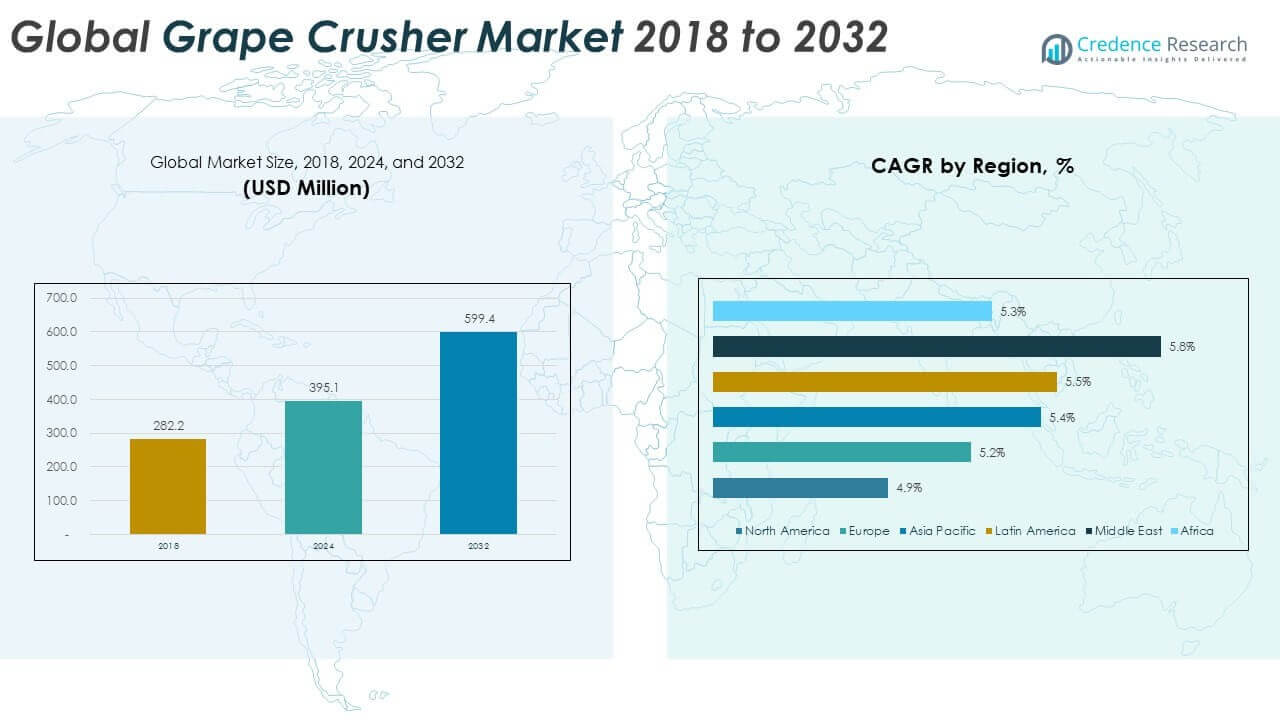
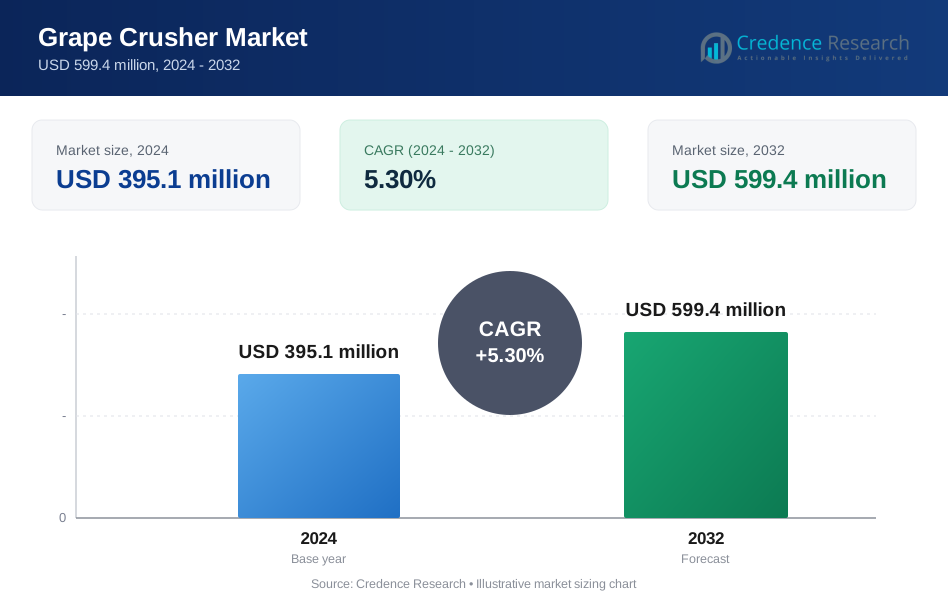
The Global Grape Crusher Market size was valued at USD 282.2 million in 2018 to USD 395.1 million in 2024 and is anticipated to reach USD 599.4 million by 2032, at a CAGR of 5.30% during the forecast period.
| REPORT ATTRIBUTE | DETAILS |
|---|---|
| Historical Period | 2020-2023 |
| Base Year | 2024 |
| Forecast Period | 2025-2032 |
| Grape Crusher Market Size 2024 | USD 395.1 million |
| Grape Crusher Market, CAGR | 5.30% |
| Grape Crusher Market Size 2032 | USD 599.4 million |
The Global Grape Crusher Market grows due to rising wine production and quality expectations. Wineries invest in controlled crushing to protect grape skins and seeds. Automation improves throughput during short harvest windows. Labor shortages push mechanized solutions across regions. Producers prefer stainless steel designs for hygiene. Compact systems support boutique wineries. Equipment durability lowers downtime risks. Integrated processing lines improve workflow efficiency. Premium wine focus sustains technology adoption.
The Global Grape Crusher Market shows strong leadership in Europe and Asia Pacific. France, Italy, and Spain lead due to large wine volumes. Australia and China drive Asia Pacific demand. The United States supports steady upgrades in premium wineries. Latin America emerges through export-focused vineyards. Chile and Argentina expand modern processing capacity. The Middle East remains niche but specialized. Africa grows steadily through South African exports.
Market Insights:
- The Global Grape Crusher Market size was USD 282.2 million in 2018, reached USD 395.1 million in 2024, and is projected to hit USD 599.4 million by 2032, expanding at a CAGR of 5.30% due to steady winery investments and equipment upgrades.
- Asia Pacific leads with about 37.8% share, followed by Europe at 24.0% and North America at 18.5%, supported by large vineyard bases, strong wine exports, and continuous modernization of winery processing facilities.
- The Middle East is the fastest-growing region with a CAGR of 5.8% and around 7.0% share, driven by advanced vineyards in Israel, controlled-environment farming, and rising focus on premium wine quality.
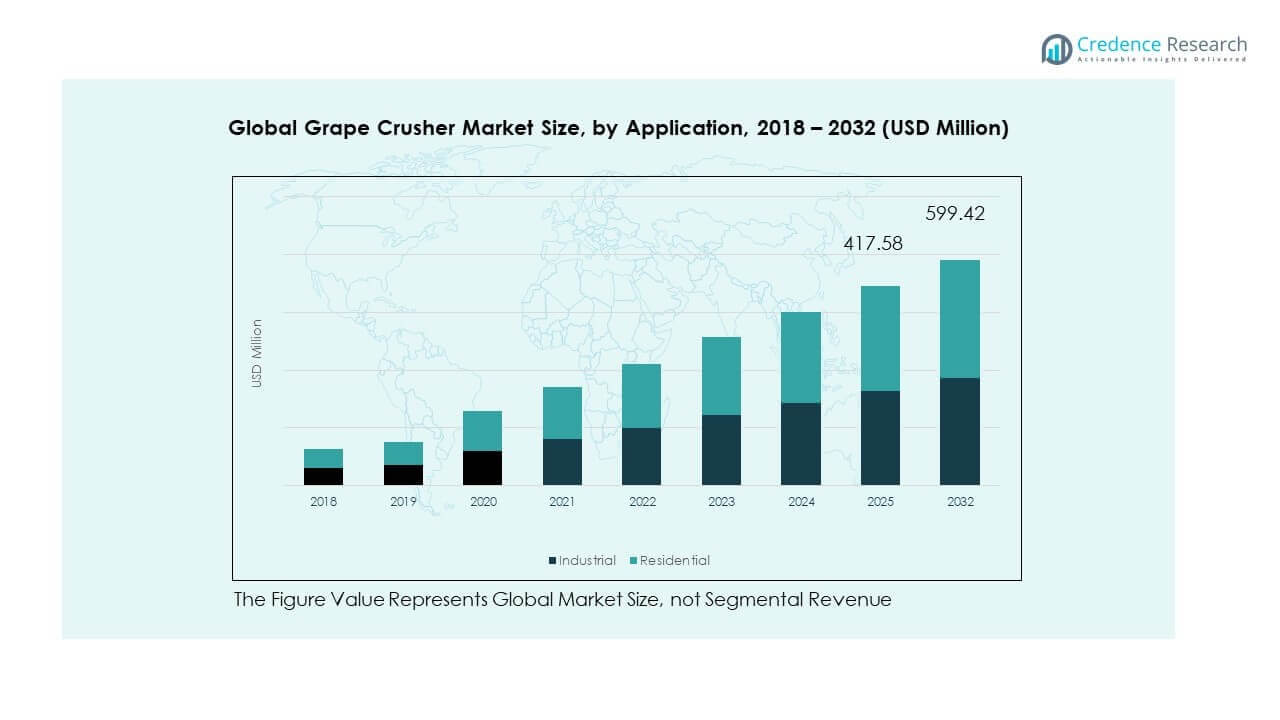
- By application, the industrial segment accounts for roughly 65% share, reflecting dominant demand from commercial wineries that require high-capacity and automated grape crushing systems.
- The residential segment holds about 35% share, supported by boutique wineries and home winemakers adopting compact and manual grape crushers.
Market Drivers
Expansion Of Global Wine Production And Processing Capacity
The Global Grape Crusher Market benefits from steady growth in wine production worldwide. Commercial wineries expand capacity to meet export demand. New vineyards increase raw grape availability for processing. Producers seek reliable crushers to handle higher volumes efficiently. It supports consistent crushing across harvest seasons. Equipment upgrades reduce grape damage during early processing stages. Larger facilities favor durable systems with higher throughput. This demand pattern sustains long-term equipment purchases.
Rising Focus On Grape Quality Preservation During Crushing
Wine producers prioritize flavor, aroma, and texture control during crushing. The Global Grape Crusher Market responds to this quality-driven approach. Controlled pressure limits seed breakage and tannin release. Modern crushers allow adjustable rollers and speed control. It helps wineries maintain batch consistency. Premium wine brands adopt such equipment to protect grape integrity. Quality assurance teams support these investments. Product differentiation strengthens demand for advanced crushers.
- For instance, Bucher Vaslin supplies Delta OP grape crushers with adjustable roller gaps that support gentle crushing and reduced seed damage. These systems are used by premium wineries producing varieties such as Pinot Noir, where phenolic control and grape integrity during crushing remain critical for wine quality.
Labor Shortages And Shift Toward Mechanized Winery Operations
Labor availability remains uneven across wine-producing regions. The Global Grape Crusher Market gains from winery automation needs. Mechanized crushers reduce dependence on seasonal labor. It improves processing speed during peak harvest windows. Semi-automatic systems suit mid-sized wineries. Large producers adopt fully automated crushing lines. Workforce cost control supports capital investment decisions. Operational efficiency remains a key purchase driver.
Equipment Replacement And Modernization Across Mature Wineries
Many wineries operate with aging processing equipment. The Global Grape Crusher Market sees steady replacement demand. Older crushers lack hygiene and safety features. New models meet stricter food-grade standards. It improves cleaning efficiency and downtime control. Modern designs support easier maintenance cycles. Producers plan phased upgrades during expansion projects. Replacement demand ensures stable market activity.
- For instance, Treasury Wine Estates has implemented large-scale automation and processing upgrades across its Australian wineries, including an integrated automation project at its Barossa Valley facility to improve efficiency and production consistency. The company also uses high-efficiency clean-in-place tank cleaning systems across sites to reduce cleaning time and support hygiene during peak harvest operations.
Market Trends
Adoption Of Compact And Modular Crusher Designs
Wineries seek flexible layouts within limited processing spaces. The Global Grape Crusher Market reflects demand for compact systems. Modular designs allow easy integration into existing lines. It supports scalable production without major layout changes. Craft wineries favor space-efficient crushers. Transport and installation become simpler. Manufacturers focus on plug-and-play formats. This trend suits both new and retrofit projects.
Growing Preference For Stainless Steel Construction
Hygiene standards shape equipment material choices. The Global Grape Crusher Market shows rising use of stainless steel. The material resists corrosion and contamination. It supports faster cleaning between batches. Wineries meet regulatory and quality audits more easily. Long service life lowers total ownership cost. Producers value consistent surface finishes. Material preference drives design standardization.
- For instance, Della Toffola manufactures grape crushers using food-grade stainless steel components designed for frequent washdown cycles in commercial wineries.
Integration With End-To-End Winery Processing Systems
Crushers increasingly connect with destemmers and presses. The Global Grape Crusher Market aligns with integrated processing workflows. Linked systems reduce manual handling steps. It improves throughput coordination during harvest. Data-enabled controls support process tracking. Wineries aim for synchronized production lines. Equipment vendors offer bundled solutions. Integration strengthens supplier relationships.
- For instance, Enoveneta supplies crusher-destemmer units engineered to interface directly with presses and must pumps, enabling continuous grape flow during peak harvest operations.
Customization Based On Grape Variety And Wine Style
Wineries tailor crushing based on grape characteristics. The Global Grape Crusher Market supports customization needs. Different roller gaps suit red and white grapes. It helps control juice yield and skin contact. Premium producers demand adjustable configurations. Equipment makers respond with configurable designs. Custom builds support niche wine styles. This trend enhances value-added offerings.
Market Challenges Analysis
High Capital Cost And Budget Constraints For Small Wineries
Capital intensity limits adoption in smaller facilities. The Global Grape Crusher Market faces price sensitivity challenges. Advanced crushers require higher upfront investment. It affects small and family-owned wineries. Financing access varies across regions. Budget limits delay equipment replacement cycles. Refurbished units remain an alternative. Cost barriers restrict market penetration.
Seasonal Utilization And Maintenance Complexity
Crushers operate mainly during harvest seasons. The Global Grape Crusher Market deals with uneven equipment use. Seasonal demand affects return on investment planning. It increases storage and maintenance needs. Idle periods raise wear risks. Skilled technicians remain scarce in some regions. Maintenance planning becomes critical. Operational complexity challenges some buyers.
Market Opportunities
Rising Winery Development In Emerging Wine-Producing Regions
New wine regions invest in modern processing facilities. The Global Grape Crusher Market gains from this expansion. Asia-Pacific and Latin America show new winery projects. It supports first-time equipment purchases. Governments promote agri-based processing industries. Local wine consumption rises steadily. Equipment suppliers enter new distribution channels. Emerging regions offer long-term growth potential.
Demand For Energy-Efficient And Easy-To-Clean Equipment Designs Sustainability influences winery investment decisions. The Global Grape Crusher Market benefits from efficiency-focused innovation. Energy-efficient motors reduce operating costs. It supports environmental compliance goals. Easy-clean designs save water and labor time. Producers seek lower downtime between batches. Manufacturers develop improved hygiene features. Sustainability-driven demand opens premium equipment segments.
Market Segmentation Analysis:
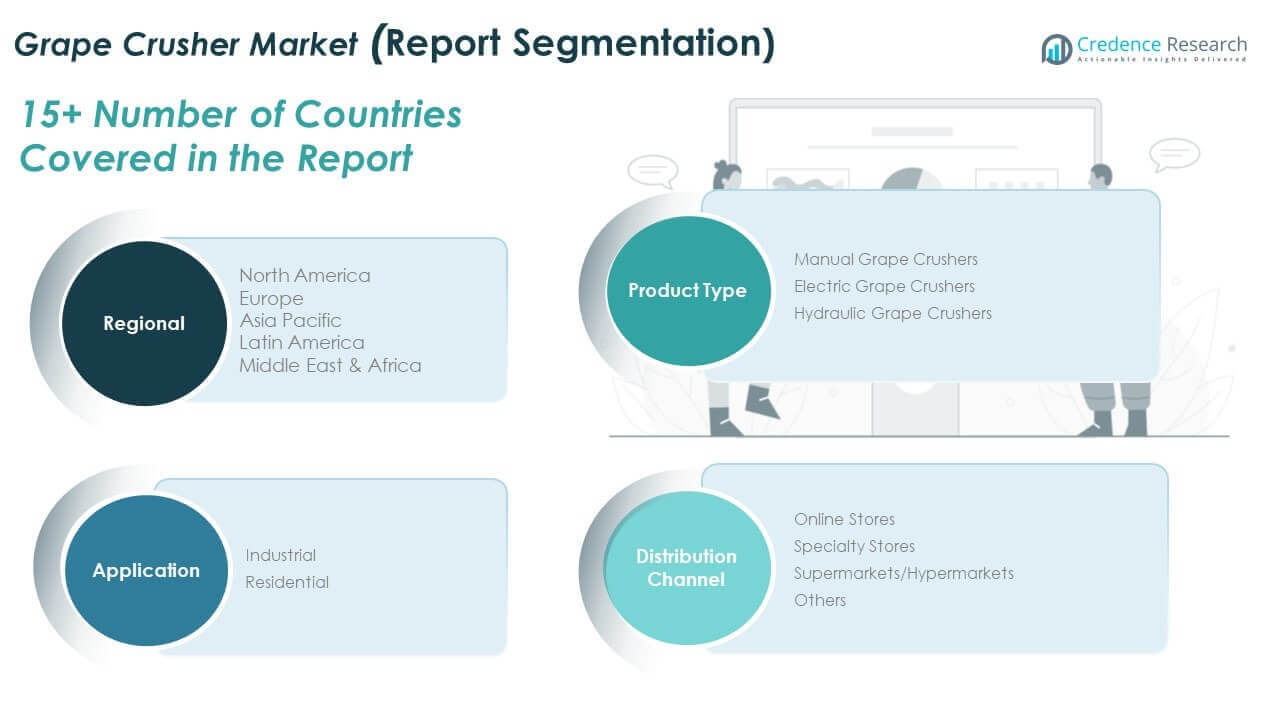
The Global Grape Crusher Market shows clear segmentation across product type, application, and distribution channel.
By product type, manual grape crushers serve small wineries and home producers due to low cost and simple operation. Electric grape crushers dominate commercial use, offering consistent throughput and reduced labor reliance. Hydraulic grape crushers address high-capacity wineries that require precise pressure control and minimal grape damage. It supports premium wine production where quality consistency remains critical.
- For instance, Zambelli Enotech offers manual and electric crusher-destemmer models widely adopted by small and mid-sized wineries.
By application, the industrial segment accounts for the largest demand share. Large and mid-sized wineries rely on mechanized crushers to handle seasonal volume peaks. It enables faster processing and better workflow control. The residential segment remains niche but stable. Home winemakers and boutique producers prefer compact and manual systems. Growth in wine hobby culture supports steady demand from this segment.
By distribution channel, specialty stores lead sales due to technical support and product customization. Buyers value expert guidance during equipment selection. Online stores gain traction among small wineries seeking price comparison and faster delivery. It benefits from expanded digital catalogs and direct-to-customer models. Supermarkets and hypermarkets play a limited role, mainly serving entry-level buyers. Other channels include direct manufacturer sales and regional distributors, which support customized installations.
- For instance, Enoveneta and Criveller Group distribute grape crushers primarily through specialized winery equipment dealers, while entry-level manual crushers are increasingly sold through manufacturer websites and online retail platforms.
Segmentation:
By Product Type
- Manual Grape Crushers
- Electric Grape Crushers
- Hydraulic Grape Crushers
By Application
- Industrial
- Residential
By Distribution Channel
- Online Stores
- Specialty Stores
- Supermarkets / Hypermarkets
- Others
By Region
- North America
- U.S.
- Canada
- Mexico
- Europe
- Germany
- France
- U.K.
- Italy
- Spain
- Rest of Europe
- Asia Pacific
- China
- Japan
- India
- South Korea
- South-east Asia
- Rest of Asia Pacific
- Latin America
- Brazil
- Argentina
- Rest of Latin America
- Middle East & Africa
- GCC Countries
- South Africa
- Rest of the Middle East and Africa
Regional Analysis:
North America
The North America Global Grape Crusher Market size was valued at USD 53.33 million in 2018 to USD 73.18 million in 2024 and is anticipated to reach USD 108.01 million by 2032, at a CAGR of 4.9% during the forecast period. The region accounts for about 18.5% market share in 2024. The Global Grape Crusher Market in North America benefits from strong winery modernization. The United States leads due to premium wine production. Canada supports steady demand from small wineries. Mexico shows gradual adoption across new vineyards. It favors electric and automated crushers. Quality compliance shapes purchase decisions. Replacement demand remains stable. Equipment suppliers focus on durability.
Europe
The Europe Global Grape Crusher Market size was valued at USD 68.05 million in 2018 to USD 94.71 million in 2024 and is anticipated to reach USD 142.54 million by 2032, at a CAGR of 5.2% during the forecast period. Europe holds nearly 24.0% market share. The Global Grape Crusher Market in Europe remains highly mature. France, Italy, and Spain dominate production. Germany supports steady equipment upgrades. It emphasizes precision and grape quality control. Traditional wineries invest in modern systems. Strict hygiene standards influence designs. Replacement cycles drive demand. Europe favors stainless steel equipment.
Asia Pacific
The Asia Pacific Global Grape Crusher Market size was valued at USD 105.95 million in 2018 to USD 149.28 million in 2024 and is anticipated to reach USD 228.38 million by 2032, at a CAGR of 5.4% during the forecast period. The region leads with about 37.8% share. The Global Grape Crusher Market in Asia Pacific shows the fastest scale growth. China and Australia drive equipment demand. India shows rising winery investments. It benefits from new vineyard development. Export-focused producers adopt modern crushers. Automation gains traction among mid-sized wineries. Cost efficiency shapes buying patterns. Local manufacturing improves access.
Latin America
The Latin America Global Grape Crusher Market size was valued at USD 30.42 million in 2018 to USD 42.98 million in 2024 and is anticipated to reach USD 66.00 million by 2032, at a CAGR of 5.5% during the forecast period. Latin America represents about 10.9% share. The Global Grape Crusher Market in Latin America grows with wine exports. Chile and Argentina lead regional demand. Brazil shows gradual winery expansion. It supports semi-automatic equipment adoption. Export quality standards influence upgrades. Vineyard expansion sustains equipment needs. Regional suppliers gain visibility. Import dependence remains moderate.
Middle East
The Middle East Global Grape Crusher Market size was valued at USD 19.13 million in 2018 to USD 27.55 million in 2024 and is anticipated to reach USD 43.34 million by 2032, at a CAGR of 5.8% during the forecast period. The region holds nearly 7.0% share. The Global Grape Crusher Market in the Middle East remains niche. Israel leads due to advanced vineyards. Turkey supports steady production growth. It benefits from controlled irrigation farming. Winery investments focus on quality output. Compact crushers suit regional needs. Imports dominate equipment supply. Growth remains selective.
Africa
The Africa Global Grape Crusher Market size was valued at USD 5.28 million in 2018 to USD 7.37 million in 2024 and is anticipated to reach USD 11.15 million by 2032, at a CAGR of 5.3% during the forecast period. Africa accounts for about 1.9% share. The Global Grape Crusher Market in Africa centers on South Africa. Export-oriented wineries drive demand. Egypt shows early-stage adoption. It favors basic and durable crushers. Budget sensitivity shapes purchasing choices. Limited local manufacturing affects supply. Imports support most installations. Growth remains gradual.
Key Player Analysis:
- Bucher Vaslin
- Zambelli Enotech
- Enoveneta
- Criveller Group
- Lancman
- Della Toffola
- Vigo Ltd
- Gino Pinto Inc.
- Amos Industrie
- Other regional and local manufacturers
Competitive Analysis:
The Global Grape Crusher Market remains moderately consolidated with key players competing on product quality, durability, and service support. Leading manufacturers like Bucher Vaslin, Zambelli Enotech, and Enoveneta hold significant share through broad product portfolios. It emphasizes innovation in roller design and automation. Criveller Group and Della Toffola focus on tailored solutions for premium wineries. Competitors differentiate through stainless steel construction and ease of maintenance. Price competition intensifies among mid-tier suppliers targeting small and mid-sized wineries. Distribution strategies vary between direct sales and dealer networks. Electric and hydraulic models attract higher revenue due to performance advantages. Regional players gain footprint through partnerships in emerging markets. Strategic moves include new product launches and selective regional expansion to capture growing demand. Competitive pressure pushes continuous improvement in efficiency and after-sales support.
Recent Developments:
- In November 2025, Bucher Vaslinreceived a Bronze Trophy at the SITEVI innovation awards for its Flavy FGCM (Fast Gentle Clarification of Must) system. This innovative tangential filtration platform is specifically designed to handle high-solids musts and wines, which often pose challenges for traditional crushing and pressing stages.
- In October 2025, Pellenc STintroduced AISEE™, an AI-powered quality control analyzer designed to revolutionize sorting and processing efficiency in agricultural and industrial streams.
- In July 2025, Bucher Vaslin launched its Pacific operation to strengthen local support for winemaking technology in Australia and New Zealand, broadening its market reach and enhancing service availability.
Report Coverage:
The research report offers an in-depth analysis based on Product Type, Application, and Distribution Channel. It details leading market players, providing an overview of their business, product offerings, investments, revenue streams, and key applications. Additionally, the report includes insights into the competitive environment, SWOT analysis, current market trends, as well as the primary drivers and constraints. Furthermore, it discusses various factors that have driven market expansion in recent years. The report also explores market dynamics, regulatory scenarios, and technological advancements that are shaping the industry. It assesses the impact of external factors and global economic changes on market growth. Lastly, it provides strategic recommendations for new entrants and established companies to navigate the complexities of the market.
Future Outlook:
- Expansion of commercial wineries will sustain long-term demand for efficient grape crushing equipment across regions.
- Premium wine producers will continue prioritizing precision crushers that protect grape skin and seed integrity.
- Automation adoption will rise as wineries seek consistent output and reduced dependence on seasonal labor.
- Equipment replacement cycles will support steady sales in mature wine-producing economies.
- Compact and modular crusher designs will gain preference among boutique and urban wineries.
- Stainless steel construction will remain a standard due to hygiene, durability, and regulatory compliance needs.
- Integration of crushers with destemming and pressing systems will improve process efficiency.
- Emerging wine regions will drive first-time equipment purchases and supplier expansion.
- Digital sales channels will strengthen access for small wineries and home producers.
- Supplier competition will push innovation in energy efficiency, maintenance ease, and customization.
Request a Free Sample
Fill in your details and we'll send you a free sample report.
- Sample data tables & charts
- Research methodology
Need a Custom Version of This Report?
Tailor the scope, geography, or segments to your exact requirements.
- Custom geography or segment scope
- Direct access to our analyst team
Frequently Asked Questions
What is the current market size for Global Grape Crusher Market, and what is its projected size in 2032?
At what Compound Annual Growth Rate is the Global Grape Crusher Market projected to grow between 2024 and 2032?
Which Global Grape Crusher Market segment held the largest share in 2024?
What are the primary factors fueling the growth of the Global Grape Crusher Market?
Who are the leading companies in the Global Grape Crusher Market?
Which region commanded the largest share of the Global Grape Crusher Market in 2024?
Table of Content
Chapter 1. Report Introduction
- 1.1 Report Description & Purpose
- 1.1.1 Report Title & Market Definition
- 1.1.2 Unique Selling Propositions (USP) & Key Differentiators
- 1.1.3 Value Proposition for Stakeholders
- 1.2 Research Objectives
- 1.2.1 Market Sizing Objectives (Volume & Revenue)
- 1.2.2 Segmentation Objectives
- 1.2.3 Competitive Intelligence Objectives
- 1.2.4 Forecast & Scenario Objectives
- 1.3 Report Scope
- 1.3.1 Grape Crusher Scope – Types & Subtypes Covered
- 1.3.2 Geographic Scope – Regions & Countries Covered
- 1.3.3 Historical Period, Base Year & Forecast Period (2024; forecast to 2032)
- 1.3.4 Inclusions & Exclusions
- 1.4 HS Code & Classification Framework
- 1.5 Currency, Units & Pricing Basis
- 1.6 Target Stakeholders
- 1.7 Limitations & Assumptions
Chapter 2. Executive Summary
- 2.1 Global Grape Crusher Market Snapshot
- 2.1.1 Market Size – Historical (2024) & Forecast (2024-2032) (2024: USD 395.1 million → 2032: USD 599.4 million)
- 2.1.2 Volume & Revenue – Global Totals
- 2.1.3 Key Market Highlights – Top Five Facts
- 2.2 Grape Crusher Market Segmentation Snapshot
- 2.2.1 Market Split by Region – 2024 vs. 2032
- 2.3 Competitive Snapshot
- 2.3.1 Top 10 Players by Revenue Share – 2024
- 2.3.2 Top 10 Players by Volume Share – 2024
- 2.3.3 Recent Strategic Developments (18-Month Summary)
- 2.4 Key Investment Highlights & Strategic Conclusions
Chapter 3. Grape Crusher Market Dynamics & Industry Analysis
- 3.1 Market Overview & Context
- 3.1.1 Grape Crusher Market Position in the Broader Automotive Value Chain
- 3.1.2 OEM vs. Replacement Market Dynamics
- 3.1.3 Market Maturity & Development Stage by Region
- 3.2 Grape Crusher Market Drivers
- 3.3 Grape Crusher Market Restraints & Challenges
- 3.4 Grape Crusher Market Opportunities
- 3.5 Porter's Five Forces Analysis
- 3.5.1 Threat of New Entrants
- 3.5.2 Bargaining Power of Suppliers
- 3.5.3 Bargaining Power of Buyers
- 3.5.4 Threat of Substitutes
- 3.5.5 Competitive Rivalry – Intensity Assessment
- 3.6 Grape Crusher Value Chain Analysis
- 3.6.1 Upstream – Raw Material/Input Suppliers
- 3.6.1.1 Raw Material/Input 1
- 3.6.1.2 Raw Material/Input 2
- 3.6.1.3 Raw Material/Input 3
- 3.6.2 Midstream – Production/Manufacturing/Service Delivery
- 3.6.2.1 Production/Process Overview
- 3.6.2.2 Key Facility Locations & Capacity by Manufacturer
- 3.6.3 Downstream – Distribution & End Consumer
- 3.6.3.1 Primary Channel – B2B/OEM
- 3.6.3.2 Secondary Channels – Dealer, Retail, Online, Direct
- 3.6.4 Value Chain Profitability Analysis
- 3.6.1 Upstream – Raw Material/Input Suppliers
- 3.7 PESTEL Analysis
- 3.7.1 Political Factors
- 3.7.2 Economic Factors
- 3.7.3 Social Factors
- 3.7.4 Technological Factors
- 3.7.5 Environmental Factors
- 3.7.6 Legal Factors
- 3.8 Grape Crusher Supply Chain Analysis
- 3.8.1 Raw Material/Input Supply Risk Assessment
- 3.8.2 Manufacturing Concentration Risk (Geographic Exposure)
- 3.8.3 Trade Disruption Impact Analysis
- 3.9 Regulatory & Policy Landscape
Note: The regulatory and policy landscape section covers regulations based on their applicability to the market, Grape Crusher category, geography, and scope of the study. Only regulatory frameworks with a material impact on operations, compliance, trade, sustainability, or market access are analyzed in detail.
Chapter 4. Key Investment Pockets & Opportunity Analysis
- 4.1 Grape Crusher Market Attractiveness Analysis
- 4.1.1 By Region – Investment Attractiveness Matrix (Volume × CAGR)
- 4.2 Absolute Revenue Growth Opportunity
- 4.2.1 By Region – Absolute USD Growth Through 2032
- 4.3 Incremental Volume Opportunity
- 4.3.1 By Region – Incremental Volume Through 2032
- 4.3.2 Segment – Incremental Volume
- 4.4 Emerging Submarket Opportunity Deep Dive (Subject to Applicability)
- 4.5 Emerging Market Opportunity Scorecards
- 4.5.1 United States
- 4.5.2 Europe
- 4.5.3 Asia
- 4.5.4 Middle East & Africa
Note: Emerging Market Opportunity Scorecards will be included based on relevance and strategic importance. Regions listed are indicative and may vary depending on data availability and market dynamics.
Chapter 5. Grape Crusher Import-Export Analysis & Trade Flows
- 5.1 Global Trade Overview
- 5.1.1 Global Export Value by Country (2024)
- 5.1.2 Global Export Volume by Country (2024)
- 5.1.3 Global Import Value by Country (2024)
- 5.1.4 Global Import Volume by Country (2024)
- 5.1.5 Net Trade Balance by Country (2024)
- 5.2 Export Analysis – Segment
- 5.2.1 Type 1 (HS Code)
- 5.2.2 Type 2 (HS Code)
- 5.2.3 Type 3 (HS Code)
- 5.2.4 Type 4 (HS Code)
- 5.2.5 Type 5 (HS Code)
- 5.3 Import Analysis – Segment
- 5.3.1 Type 1 (HS Code)
- 5.3.2 Type 2 (HS Code)
- 5.3.3 Type 3 (HS Code)
- 5.3.4 Type 4 (HS Code)
- 5.3.5 Type 5 (HS Code)
- 5.4 Average Unit Trade Prices
- 5.4.1 Average Export Price – Segment & Country
- 5.4.2 Average Import Price – Segment & Source Country
- 5.4.3 Price Trends (2024)
- 5.5 Key Trade Route Analysis
- 5.5.1 Trade Route 1
- 5.5.2 Trade Route 2
- 5.5.3 Trade Route 3
- 5.5.4 Trade Route 4
- 5.5.5 Trade Route 5
- 5.6 Trade Policy Impact Assessment
- 5.6.1 US Anti-Dumping & Section 301 Tariffs
- 5.6.2 EU Customs Union Impact
- 5.6.3 Major Free Trade Agreements
- 5.6.4 USMCA Rules of Origin
Note: Trade policy analysis will be included only where relevant to the Grape Crusher market.
Chapter 6. Competitive Landscape & Company Benchmarking
- 6.1 Grape Crusher Market Concentration & Structure
- 6.1.1 Herfindahl-Hirschman Index (HHI) – vs. 2024
- 6.1.2 Tier 1, Tier 2 & Tier 3 Market Structure
- 6.1.3 Global, Regional & Local Player Dynamics
- 6.2 Grape Crusher Market Share Analysis – 2024
- 6.2.1 Global Revenue Share by Company
- 6.2.2 Global Volume Share by Company
- 6.2.3 Regional Revenue Share
- 6.2.4 Market Share Evolution ( vs. 2024)
- 6.2.5 OEM Segment Share by Company
- 6.2.6 Replacement Segment Share by Company
- 6.3 Production/Delivery Capacity & Facility Analysis
- 6.3.1 Global Installed Capacity
- 6.3.2 Capacity Utilization Rates
- 6.3.3 Production/Output Volume
- 6.3.4 Facility Locations & Capacity Map
- 6.3.5 Planned Capacity Additions
- 6.4 Grape Crusher Competitive Benchmarking Matrix
- 6.4.1 Revenue, Volume, CAGR & Profitability Comparison
- 6.4.2 Channel Revenue Mix
- 6.4.3 Geographic Revenue Exposure
- 6.4.4 R&D Intensity
- 6.4.5 Sustainability Maturity
- 6.5 Strategic Developments in Grape Crusher (Last 24 Months)
- 6.5.1 Mergers, Acquisitions & Divestments
- 6.5.2 New Grape Crusher Launches
- 6.5.3 Facility Expansions
- 6.5.4 Strategic Alliances, Joint Ventures & Partnerships
- 6.5.5 Distribution Expansion & Market Entry
- 6.5.6 Sustainability & ESG Initiatives
- 6.6 Competitive Strategy Mapping
- 6.6.1 Leader, Challenger, Follower & Niche Classification
- 6.6.2 Pricing Strategy Comparison
- 6.6.3 Channel Strategy Matrix
Note: Strategic developments are included based on their materiality and the availability of reliable information.
Chapter 7. Global Grape Crusher Market – By Distribution Channel
- 7.1 Segment Overview
- 7.1.1 Volume & Revenue Split by Channel (2024 & 2032)
- 7.1.2 Channel Mix Evolution (2024-2032)
Chapter 8. Regional Market Analysis – Global Overview
- 8.1 Global Regional Overview
- 8.1.1 Regional Volume Share
- 8.1.2 Regional Revenue Share
- 8.1.3 Regional Volume by Region
- 8.1.4 Regional Revenue by Region
- 8.1.5 Regional Forecast Through 2032
- 8.2 Cross-Regional Segment Analysis
- 8.2.1 By Distribution Channel
- 8.2.2 By Brand/Price Tier
Chapter 9. North America Grape Crusher Market
- 9.1 United States
- 9.2 Canada
- 9.3 Mexico
Chapter 10. Europe Grape Crusher Market
- 10.1 Germany
- 10.2 France
- 10.3 Italy
- 10.4 United Kingdom
- 10.5 Spain
- 10.6 Poland
- 10.7 Russia
- 10.8 Netherlands
- 10.9 Belgium
- 10.10 Sweden
- 10.11 Denmark
- 10.12 Norway
- 10.13 Rest of Europe
Chapter 11. Asia Pacific Grape Crusher Market
- 11.1 China
- 11.2 India
- 11.3 Japan
- 11.4 South Korea
- 11.5 Thailand
- 11.6 Indonesia
- 11.7 Vietnam
- 11.8 Malaysia
- 11.9 Australia
- 11.10 Rest of Asia Pacific
Chapter 12. Latin America Grape Crusher Market
- 12.1 Brazil
- 12.2 Argentina
- 12.3 Colombia
- 12.4 Chile
- 12.5 Rest of Latin America
Chapter 13. Middle East Grape Crusher Market
- 13.1 Saudi Arabia
- 13.2 United Arab Emirates
- 13.3 Turkey
- 13.4 Israel
- 13.5 Iran
- 13.6 Rest of the Middle East
Chapter 14. Africa Grape Crusher Market
- 14.1 South Africa
- 14.2 Egypt
- 14.3 Nigeria
- 14.4 Morocco
- 14.5 Rest of Africa
Chapter 15. Grape Crusher Company Profiles
- 15.1 [Company 01]
- 15.1.1 Company Overview
- 15.1.2 Key Management Personnel
- 15.1.3 Products & Services Portfolio
- 15.1.4 Financial Performance
- 15.1.5 Key Market Focus & Geographic Presence
- 15.1.6 Recent Developments & Strategic Initiatives
Note: The company profile list is preliminary and may change based on research findings, market developments, data availability, and client requirements.
Chapter 16. Appendices
- Appendix A – List of Abbreviations & Acronyms
- Appendix B – Industry Classification Code Reference – Full Series
- Appendix C – Production & Capacity Data Tables
- Appendix D – End-Use & Demand Base Tables
- Appendix E – Consumption & Replacement Rate Assumptions
- Appendix F – ASP Reference Tables
- Appendix G – Manufacturing & Facility Database
- Appendix H – Import-Export Data Tables
- Appendix I – Regulatory Summary Tables
- Appendix J – Primary Research Participant List (Anonymized)
- Appendix K – Primary Research Questionnaire Framework
- Appendix L – Data Sources & Bibliography
- Appendix M – Market Size Divergence & Source Comparison
Chapter 17. Research Methodology
- 17.1 Research Framework & Philosophy
- 17.2 Secondary Research – Sources, Hierarchy & Data Extraction
- 17.3 Data Modeling – Bottom-Up & Top-Down Market Sizing
- 17.4 Primary Research – Stakeholder Framework, LOI & Sample Sizes
- 17.5 Forecast Methodology – Regression, Scenario & Sensitivity Analysis
- 17.6 Quality Control – Four-Layer Validation Framework
- 17.7 Limitations & Standard Assumptions
- 17.8 Disclaimer
