
Market Overview:
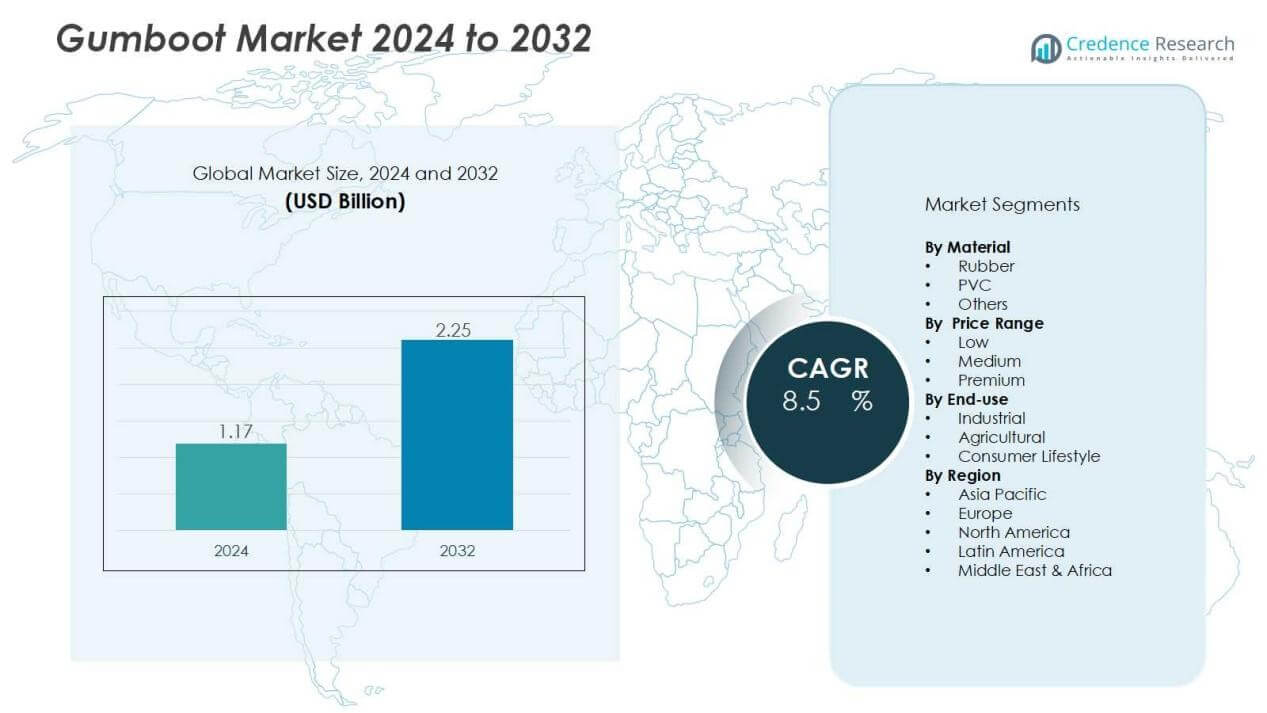
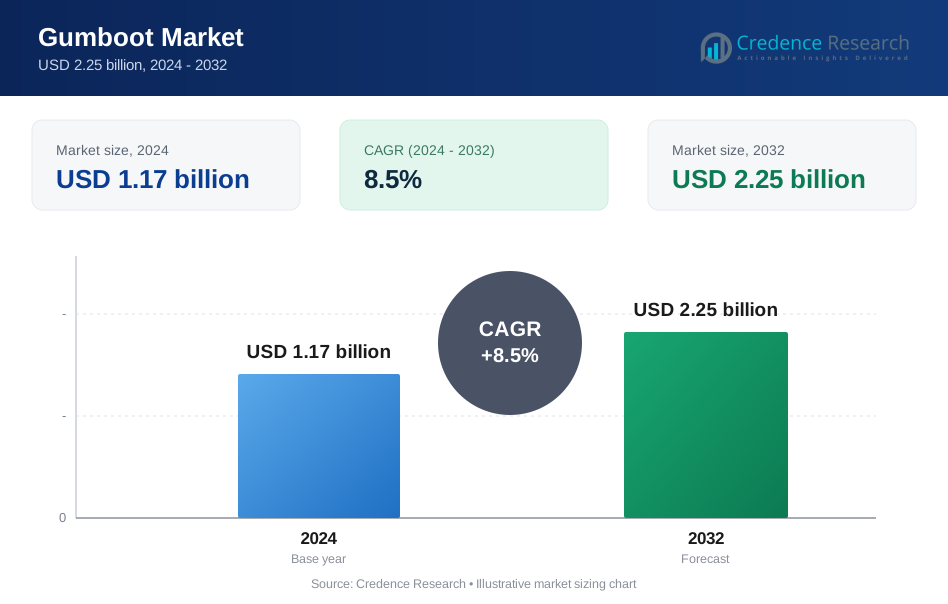
The gumboot market size was valued at USD 1.17 billion in 2024 and is anticipated to reach USD 2.25 billion by 2032, at a CAGR of 8.5% during the forecast period (2024-2032).
| REPORT ATTRIBUTE | DETAILS |
|---|---|
| Historical Period | 2020-2023 |
| Base Year | 2024 |
| Forecast Period | 2025-2032 |
| Gumboot Market Size 2024 | USD 1.17 Billion |
| Gumboot Market, CAGR | 8.5% |
| Gumboot Market Size 2032 | USD 2.25 Billion |
Key drivers fueling the gumboot market include the expansion of construction and mining industries, where protective footwear is critical. Agriculture also contributes significantly, with farmers relying on gumboots for comfort, safety, and weather resistance. In addition, the growing popularity of gumboots as fashion and lifestyle accessories, particularly in urban and festival markets, is opening new opportunities. Advances in material technology, including lightweight PVC and eco-friendly rubber, further enhance demand.
Regionally, Asia Pacific dominates the gumboot market due to large-scale industrialization, agricultural reliance, and high population-driven demand. Europe follows, supported by strong adoption in both workwear and fashion segments, while North America continues to show steady growth driven by safety compliance in workplaces. Emerging markets in Latin America and Africa are gaining traction, largely fueled by agricultural expansion and infrastructure development, positioning them as future growth hubs.
Market Insights:
- The gumboot market size was valued at USD 1.17 billion in 2024 and is projected to reach USD 2.25 billion by 2032, growing at a CAGR of 8.5% during 2024–2032.
- Strong demand from industrial and construction sectors, supported by regulations for protective footwear, continues to drive sales growth.
- Agriculture remains a core contributor, with farmers adopting gumboots for comfort, durability, and safety in wet and chemical-prone conditions.
- Product innovation with lightweight PVC, eco-friendly rubber, and reinforced soles is improving adoption across both workwear and lifestyle use.
- Fashion and lifestyle integration is expanding the consumer base, with urban and festival markets showing strong uptake.
- High competition, seasonal fluctuations, and raw material cost volatility create challenges for both global and regional players.
- Asia Pacific led with 42% market share in 2024, followed by Europe with 28% and North America with 19%, each driven by distinct industrial, agricultural, and lifestyle applications.
Market Drivers:
Rising Demand from Industrial and Construction Sectors:
The gumboot market benefits from strong demand across industrial and construction activities. Workers in mining, oil and gas, and infrastructure projects rely on protective footwear for safety. Regulations requiring durable, waterproof, and slip-resistant boots are fueling product adoption. It drives consistent sales growth, supported by the rising pace of urbanization and infrastructure development.\
- For Instance, Dunlop Purofort+ model (C762xxx) achieved S5 CI CR SRC certification under the EN ISO 20345:2011 standard and that a different Dunlop Purofort boot model, the FoodPRO, was tested in 2021 by a Dunlop Innovation Center for its effectiveness on specific floor and contaminant combinations.
Agriculture and Farming Activities Supporting Market Growth:
The gumboot market records significant uptake in farming and agricultural applications. Farmers value gumboots for comfort, durability, and protection against water and mud. Seasonal use in rice fields and plantations strengthens recurring demand. It plays a vital role in enhancing farmworker safety during wet conditions and chemical exposure.
- For instance, Muck Boot's Arctic Pro demonstrates exceptional performance standards with 8mm CR Flex-foam neoprene construction and meets ASTM F2413-11 M I/75 C/75 EH safety certifications, delivering protection in temperatures ranging from -60°F to 30°F.
Product Innovation and Material Advancements Boosting Adoption:
The gumboot market is advancing through continuous innovation in materials and design. Lightweight PVC, eco-friendly rubber, and reinforced soles are key product developments. Manufacturers focus on comfort and durability, improving user acceptance in both work and casual wear. It expands market reach by addressing both functional and lifestyle needs.
Fashion and Lifestyle Integration Driving Broader Use:
The gumboot market is no longer limited to safety applications. It is gaining visibility in fashion, outdoor events, and lifestyle use. Festival goers, urban consumers, and outdoor enthusiasts increasingly adopt gumboots as style-driven accessories. This shift broadens the consumer base and strengthens sales beyond traditional industrial and agricultural sectors.
 Market Trends:
Sustainability and Material Innovation Shaping Product Development:
The gumboot market is witnessing a shift toward sustainable and eco-friendly materials. Manufacturers are adopting recyclable rubber, bio-based compounds, and PVC alternatives to align with environmental goals. Consumers show rising preference for lightweight and durable designs that reduce fatigue during long usage. Companies are focusing on anti-slip soles, chemical resistance, and ergonomic comfort to appeal to both industrial and lifestyle users. It demonstrates how product innovation directly supports regulatory compliance and consumer expectations. This trend also enhances brand positioning in competitive markets, where sustainability increasingly drives purchasing choices.
- For instance, Dunlop’s Purofort FoodPro Bio-Based MultiGrip safety boot incorporates 30 percent bio-based material in its compound.
Fashion Influence and Lifestyle Integration Expanding Market Reach:
The gumboot market is evolving beyond traditional utility into a fashion and lifestyle category. Bright colors, customized prints, and collaborations with designers are making gumboots popular among urban and festival consumers. Social media exposure and online retail platforms are amplifying this shift toward style-driven adoption. It has allowed brands to diversify revenue streams beyond industrial and agricultural sectors. Seasonal demand peaks during outdoor events, rainy weather, and winter fashion cycles, strengthening sales momentum. This integration of function and style ensures wider appeal across demographics, creating a stable growth path for the market.
- For instance, Muck Boot Company’s Arctic Ice Mid features a 5 mm CR Flex-Foam neoprene inner boot that retains insulation at –40 °F, delivering reliable warmth in extreme cold conditions.
Market Challenges Analysis:
High Competition and Price Sensitivity Restricting Profit Margins:
The gumboot market faces intense competition from both global brands and local manufacturers. Low-cost producers in emerging economies offer cheaper alternatives, creating strong price pressure. Consumers in agricultural and low-income regions often prioritize affordability over advanced features. It limits the ability of premium brands to charge higher margins. Counterfeit and low-quality products also dilute brand trust, making differentiation more difficult. Companies must balance cost efficiency with innovation to maintain competitiveness.
Seasonal Demand Fluctuations and Distribution Challenges Impacting Growth:
The gumboot market is heavily influenced by seasonal factors, with peak demand during rainy periods and agricultural cycles. Off-season sales decline sharply, creating inventory and revenue management challenges for producers. It also depends on effective distribution networks, especially in rural and developing regions where logistics are limited. Rising raw material costs, particularly rubber and PVC, further pressure profit stability. Shifts in consumer preference toward multipurpose footwear reduce reliance on gumboots alone. These challenges demand strategic planning and adaptation from manufacturers to ensure consistent market presence.
Market Opportunities:
Expansion into Fashion and Lifestyle Segments Creating New Avenues:
The gumboot market has strong opportunities in fashion and lifestyle adoption. Rising urban demand for stylish, colorful, and customized designs expands the consumer base beyond industrial users. Collaborations with fashion brands and online retail platforms strengthen visibility among younger demographics. It creates revenue potential during festivals, outdoor events, and seasonal trends. Social media influence also boosts awareness, driving demand for trendy, functional footwear. This diversification allows companies to capture premium pricing and strengthen long-term brand loyalty.
Growth Potential in Emerging Economies and Sustainable Footwear:
The gumboot market can expand significantly in emerging economies where agriculture and infrastructure development remain strong. Rising disposable incomes and safety awareness support adoption among rural and semi-urban consumers. It also benefits from increasing demand for sustainable footwear made with recyclable and bio-based materials. Governments promoting worker safety and environmental standards further create market incentives. E-commerce platforms make it easier for brands to reach underserved regions with direct distribution. These factors provide a long-term growth pathway for manufacturers seeking global expansion.
Market Segmentation Analysis:
By Material:
The gumboot market is segmented by material into rubber, PVC, and others. Rubber gumboots dominate due to their durability, flexibility, and strong protection in industrial and agricultural settings. PVC gumboots gain traction for their lightweight design and affordability, appealing to cost-sensitive buyers. It is also witnessing rising interest in eco-friendly and recyclable materials, aligning with sustainability goals. The adoption of innovative blends enhances comfort and expands application across lifestyle use.
- For instance, the MKsafety® MK A1018 leather safety shoes feature an anti-smashing capability withstanding impact forces up to 200 joules, making them highly reliable for heavy-duty industrial use.
By Price Range:
The gumboot market is categorized into low, medium, and premium ranges. Low-priced gumboots attract strong demand in farming and rural markets where affordability is critical. Medium-range products balance quality and cost, driving sales in semi-urban and industrial applications. Premium gumboots gain popularity in urban and fashion segments, supported by designer collaborations and brand appeal. It benefits from diversified offerings that target both mass-market and niche consumers.
- For instance, Dunlop's Pricemastor wellington boot, which targets farmers, dog walkers, and stable hands with its standard PVC construction, is an affordable, entry-level option. Medium-range products, which often balance quality and cost more effectively, are better suited for semi-urban and industrial applications.
By End-use:
The gumboot market serves end-users across industrial, agricultural, and consumer lifestyle sectors. Industrial demand remains strong due to mandatory safety standards in construction, oil, gas, and mining. Agricultural users rely on gumboots for seasonal and daily work in fields and plantations. Consumer lifestyle adoption is growing through outdoor recreation, festivals, and fashion-driven purchases. It continues to evolve by bridging functional protection with style-oriented consumer preferences.
Segmentations:
By Material:
- Rubber
- PVC
- Others
By Price Range:
- Low
- Medium
- Premium
By End-use:
- Industrial
- Agricultural
- Consumer Lifestyle
By Region:
- North America
- The U.S.
- Canada
- Mexico
- Europe
- Germany
- France
- The U.K.
- Italy
- Spain
- Rest of Europe
- Asia Pacific
- China
- Japan
- India
- South Korea
- South-east Asia
- Rest of Asia Pacific
- Latin America
- Brazil
- Argentina
- Rest of Latin America
- Middle East & Africa
- GCC Countries
- South Africa
- Rest of the Middle East and Africa
Regional Analysis:
Asia Pacific:
Asia Pacific accounted for 42% market share in 2024, supported by large-scale industrialization and farming activities. China, India, and Southeast Asia dominate consumption due to high population, construction growth, and dependence on agriculture. The gumboot market benefits from mandatory safety regulations and rising adoption of durable footwear in mining and infrastructure projects. It is also boosted by rising disposable incomes that expand the consumer base for lifestyle and fashion gumboots. Local manufacturers play a key role in supplying cost-effective products, while global brands focus on premium segments. Continuous investment in distribution and retail channels strengthens the regional leadership position.
Europe:
Europe secured 28% market share in 2024, driven by strict workplace safety standards and growing lifestyle adoption. The gumboot market in the region benefits from rising use in industrial sectors, especially construction and manufacturing. It also gains momentum in fashion markets where colorful and designer boots attract urban consumers. Seasonal weather patterns further create steady demand for waterproof footwear. Key countries such as the United Kingdom, Germany, and France remain strong contributors, combining workwear and fashion-driven sales. The presence of established brands supports innovation and sustainable product offerings.
North America:
North America recorded 19% market share in 2024, with consistent demand across industries and consumer segments. The gumboot market is strengthened by strict safety compliance in oil, gas, and construction sectors. It also benefits from rising popularity in outdoor recreation and lifestyle fashion. The United States drives regional growth with high consumer spending, while Canada supports demand through agricultural and industrial use. Seasonal rainfall and winter conditions create recurring sales opportunities. It continues to present a balanced market structure, supported by both premium and budget footwear offerings.
Key Player Analysis:
- Aigle
- Bogs Footwear
- Caterpillar
- Dunlop Protective Footwear
- Hunter
- Le Chameau
- Kamik
- Nike
- Rockport
- Regatta Great Outdoors
- Muck Boot Company
- Sorel
Competitive Analysis:
The gumboot market is highly competitive, shaped by global brands and regional players. Key companies include Aigle, Bogs Footwear, Caterpillar, Dunlop Protective Footwear, Hunter, Le Chameau, Kamik, and Nike. These players focus on durability, comfort, and design innovation to strengthen their market presence. It relies on product differentiation, brand loyalty, and effective distribution networks to capture diverse consumer segments. Industrial and agricultural buyers prioritize functionality, while urban consumers drive demand for fashionable and lifestyle-oriented designs. Companies also invest in sustainable materials and e-commerce platforms to expand reach and appeal to eco-conscious customers. Competitive strategies include collaborations, seasonal launches, and regional expansion to tap into emerging markets.
Recent Developments:
- In January 2025, Caterpillar showcased its innovations in autonomy, connectivity, electrification, and alternative fuels at the CES 2025 event, celebrating 100 years of innovation.
- In September 2025, Charbone Hydrogen announced the acquisition of equipment to advance the Sorel-Tracy facility in Quebec to support enhanced production targets for Q4 2025.
Report Coverage:
The research report offers an in-depth analysis based on Material, Price Range, End-use and Region. It details leading Market players, providing an overview of their business, product offerings, investments, revenue streams, and key applications. Additionally, the report includes insights into the competitive environment, SWOT analysis, current Market trends, as well as the primary drivers and constraints. Furthermore, it discusses various factors that have driven Market expansion in recent years. The report also explores Market dynamics, regulatory scenarios, and technological advancements that are shaping the industry. It assesses the impact of external factors and global economic changes on Market growth. Lastly, it provides strategic recommendations for new entrants and established companies to navigate the complexities of the Market.
Future Outlook:
- The gumboot market will expand through rising demand in industrial and construction projects worldwide.
- It will benefit from stronger adoption in agriculture, where farmers need durable and protective footwear.
- Product innovation using lightweight, recyclable, and bio-based materials will support sustainable growth.
- It will gain momentum from fashion and lifestyle integration, particularly among urban and festival consumers.
- Digital retail platforms will increase sales opportunities, connecting brands directly with diverse customer groups.
- It will face growing investment from global players aiming to expand into emerging economies.
- Customization and design variety will attract younger consumers seeking functional yet stylish footwear.
- It will continue to be shaped by government safety regulations in industrial and farming sectors.
- Collaborations between footwear brands and fashion designers will boost visibility and premium adoption.
- It will remain resilient against seasonal fluctuations through diversification into lifestyle and year-round applications.
Request a Free Sample
Fill in your details and we'll send you a free sample report.
- Sample data tables & charts
- Research methodology
Need a Custom Version of This Report?
Tailor the scope, geography, or segments to your exact requirements.
- Custom geography or segment scope
- Direct access to our analyst team
Frequently Asked Questions
What is the current market size for the gumboot market, and what is its projected size in 2032?
At what Compound Annual Growth Rate is the gumboot market projected to grow between 2024 and 2032?
Which gumboot market segment held the largest share in 2024?
What are the primary factors fueling the growth of the gumboot market?
Who are the leading companies in the gumboot market?
Which region commanded the largest share of the gumboot market in 2024?
Table of Content
Chapter 1. Report Introduction
- 1.1 Report Description & Purpose
- 1.1.1 Report Title & Market Definition
- 1.1.2 Unique Selling Propositions (USP) & Key Differentiators
- 1.1.3 Value Proposition for Stakeholders
- 1.2 Research Objectives
- 1.2.1 Market Sizing Objectives (Volume & Revenue)
- 1.2.2 Segmentation Objectives
- 1.2.3 Competitive Intelligence Objectives
- 1.2.4 Forecast & Scenario Objectives
- 1.3 Report Scope
- 1.3.1 Gumboot Scope – Types & Subtypes Covered
- 1.3.2 Geographic Scope – Regions & Countries Covered
- 1.3.3 Historical Period, Base Year & Forecast Period (2024; forecast to 2032)
- 1.3.4 Inclusions & Exclusions
- 1.4 HS Code & Classification Framework
- 1.5 Currency, Units & Pricing Basis
- 1.6 Target Stakeholders
- 1.7 Limitations & Assumptions
Chapter 2. Executive Summary
- 2.1 Global Gumboot Market Snapshot
- 2.1.1 Market Size – Historical (2024) & Forecast (2024-2032) (2024: USD 1.17 billion → 2032: USD 2.25 billion)
- 2.1.2 Volume & Revenue – Global Totals
- 2.1.3 Key Market Highlights – Top Five Facts
- 2.2 Gumboot Market Segmentation Snapshot
- 2.2.1 Market Split by Region – 2024 vs. 2032
- 2.3 Competitive Snapshot
- 2.3.1 Top 10 Players by Revenue Share – 2024
- 2.3.2 Top 10 Players by Volume Share – 2024
- 2.3.3 Recent Strategic Developments (18-Month Summary)
- 2.4 Key Investment Highlights & Strategic Conclusions
Chapter 3. Gumboot Market Dynamics & Industry Analysis
- 3.1 Market Overview & Context
- 3.1.1 Gumboot Market Position in the Broader Automotive Value Chain
- 3.1.2 OEM vs. Replacement Market Dynamics
- 3.1.3 Market Maturity & Development Stage by Region
- 3.2 Gumboot Market Drivers
- 3.3 Gumboot Market Restraints & Challenges
- 3.4 Gumboot Market Opportunities
- 3.5 Porter's Five Forces Analysis
- 3.5.1 Threat of New Entrants
- 3.5.2 Bargaining Power of Suppliers
- 3.5.3 Bargaining Power of Buyers
- 3.5.4 Threat of Substitutes
- 3.5.5 Competitive Rivalry – Intensity Assessment
- 3.6 Gumboot Value Chain Analysis
- 3.6.1 Upstream – Raw Material/Input Suppliers
- 3.6.1.1 Raw Material/Input 1
- 3.6.1.2 Raw Material/Input 2
- 3.6.1.3 Raw Material/Input 3
- 3.6.2 Midstream – Production/Manufacturing/Service Delivery
- 3.6.2.1 Production/Process Overview
- 3.6.2.2 Key Facility Locations & Capacity by Manufacturer
- 3.6.3 Downstream – Distribution & End Consumer
- 3.6.3.1 Primary Channel – B2B/OEM
- 3.6.3.2 Secondary Channels – Dealer, Retail, Online, Direct
- 3.6.4 Value Chain Profitability Analysis
- 3.6.1 Upstream – Raw Material/Input Suppliers
- 3.7 PESTEL Analysis
- 3.7.1 Political Factors
- 3.7.2 Economic Factors
- 3.7.3 Social Factors
- 3.7.4 Technological Factors
- 3.7.5 Environmental Factors
- 3.7.6 Legal Factors
- 3.8 Gumboot Supply Chain Analysis
- 3.8.1 Raw Material/Input Supply Risk Assessment
- 3.8.2 Manufacturing Concentration Risk (Geographic Exposure)
- 3.8.3 Trade Disruption Impact Analysis
- 3.9 Regulatory & Policy Landscape
Note: The regulatory and policy landscape section covers regulations based on their applicability to the market, Gumboot category, geography, and scope of the study. Only regulatory frameworks with a material impact on operations, compliance, trade, sustainability, or market access are analyzed in detail.
Chapter 4. Key Investment Pockets & Opportunity Analysis
- 4.1 Gumboot Market Attractiveness Analysis
- 4.1.1 By Region – Investment Attractiveness Matrix (Volume × CAGR)
- 4.2 Absolute Revenue Growth Opportunity
- 4.2.1 By Region – Absolute USD Growth Through 2032
- 4.3 Incremental Volume Opportunity
- 4.3.1 By Region – Incremental Volume Through 2032
- 4.3.2 Segment – Incremental Volume
- 4.4 Emerging Submarket Opportunity Deep Dive (Subject to Applicability)
- 4.5 Emerging Market Opportunity Scorecards
- 4.5.1 United States
- 4.5.2 Europe
- 4.5.3 Asia
- 4.5.4 Middle East & Africa
Note: Emerging Market Opportunity Scorecards will be included based on relevance and strategic importance. Regions listed are indicative and may vary depending on data availability and market dynamics.
Chapter 5. Gumboot Import-Export Analysis & Trade Flows
- 5.1 Global Trade Overview
- 5.1.1 Global Export Value by Country (2024)
- 5.1.2 Global Export Volume by Country (2024)
- 5.1.3 Global Import Value by Country (2024)
- 5.1.4 Global Import Volume by Country (2024)
- 5.1.5 Net Trade Balance by Country (2024)
- 5.2 Export Analysis – Segment
- 5.2.1 Type 1 (HS Code)
- 5.2.2 Type 2 (HS Code)
- 5.2.3 Type 3 (HS Code)
- 5.2.4 Type 4 (HS Code)
- 5.2.5 Type 5 (HS Code)
- 5.3 Import Analysis – Segment
- 5.3.1 Type 1 (HS Code)
- 5.3.2 Type 2 (HS Code)
- 5.3.3 Type 3 (HS Code)
- 5.3.4 Type 4 (HS Code)
- 5.3.5 Type 5 (HS Code)
- 5.4 Average Unit Trade Prices
- 5.4.1 Average Export Price – Segment & Country
- 5.4.2 Average Import Price – Segment & Source Country
- 5.4.3 Price Trends (2024)
- 5.5 Key Trade Route Analysis
- 5.5.1 Trade Route 1
- 5.5.2 Trade Route 2
- 5.5.3 Trade Route 3
- 5.5.4 Trade Route 4
- 5.5.5 Trade Route 5
- 5.6 Trade Policy Impact Assessment
- 5.6.1 US Anti-Dumping & Section 301 Tariffs
- 5.6.2 EU Customs Union Impact
- 5.6.3 Major Free Trade Agreements
- 5.6.4 USMCA Rules of Origin
Note: Trade policy analysis will be included only where relevant to the Gumboot market.
Chapter 6. Competitive Landscape & Company Benchmarking
- 6.1 Gumboot Market Concentration & Structure
- 6.1.1 Herfindahl-Hirschman Index (HHI) – vs. 2024
- 6.1.2 Tier 1, Tier 2 & Tier 3 Market Structure
- 6.1.3 Global, Regional & Local Player Dynamics
- 6.2 Gumboot Market Share Analysis – 2024
- 6.2.1 Global Revenue Share by Company
- 6.2.2 Global Volume Share by Company
- 6.2.3 Regional Revenue Share
- 6.2.4 Market Share Evolution ( vs. 2024)
- 6.2.5 OEM Segment Share by Company
- 6.2.6 Replacement Segment Share by Company
- 6.3 Production/Delivery Capacity & Facility Analysis
- 6.3.1 Global Installed Capacity
- 6.3.2 Capacity Utilization Rates
- 6.3.3 Production/Output Volume
- 6.3.4 Facility Locations & Capacity Map
- 6.3.5 Planned Capacity Additions
- 6.4 Gumboot Competitive Benchmarking Matrix
- 6.4.1 Revenue, Volume, CAGR & Profitability Comparison
- 6.4.2 Channel Revenue Mix
- 6.4.3 Geographic Revenue Exposure
- 6.4.4 R&D Intensity
- 6.4.5 Sustainability Maturity
- 6.5 Strategic Developments in Gumboot (Last 24 Months)
- 6.5.1 Mergers, Acquisitions & Divestments
- 6.5.2 New Gumboot Launches
- 6.5.3 Facility Expansions
- 6.5.4 Strategic Alliances, Joint Ventures & Partnerships
- 6.5.5 Distribution Expansion & Market Entry
- 6.5.6 Sustainability & ESG Initiatives
- 6.6 Competitive Strategy Mapping
- 6.6.1 Leader, Challenger, Follower & Niche Classification
- 6.6.2 Pricing Strategy Comparison
- 6.6.3 Channel Strategy Matrix
Note: Strategic developments are included based on their materiality and the availability of reliable information.
Chapter 7. Global Gumboot Market – By Distribution Channel
- 7.1 Segment Overview
- 7.1.1 Volume & Revenue Split by Channel (2024 & 2032)
- 7.1.2 Channel Mix Evolution (2024-2032)
Chapter 8. Regional Market Analysis – Global Overview
- 8.1 Global Regional Overview
- 8.1.1 Regional Volume Share
- 8.1.2 Regional Revenue Share
- 8.1.3 Regional Volume by Region
- 8.1.4 Regional Revenue by Region
- 8.1.5 Regional Forecast Through 2032
- 8.2 Cross-Regional Segment Analysis
- 8.2.1 By Distribution Channel
- 8.2.2 By Brand/Price Tier
Chapter 9. North America Gumboot Market
- 9.1 United States
- 9.2 Canada
- 9.3 Mexico
Chapter 10. Europe Gumboot Market
- 10.1 Germany
- 10.2 France
- 10.3 Italy
- 10.4 United Kingdom
- 10.5 Spain
- 10.6 Poland
- 10.7 Russia
- 10.8 Netherlands
- 10.9 Belgium
- 10.10 Sweden
- 10.11 Denmark
- 10.12 Norway
- 10.13 Rest of Europe
Chapter 11. Asia Pacific Gumboot Market
- 11.1 China
- 11.2 India
- 11.3 Japan
- 11.4 South Korea
- 11.5 Thailand
- 11.6 Indonesia
- 11.7 Vietnam
- 11.8 Malaysia
- 11.9 Australia
- 11.10 Rest of Asia Pacific
Chapter 12. Latin America Gumboot Market
- 12.1 Brazil
- 12.2 Argentina
- 12.3 Colombia
- 12.4 Chile
- 12.5 Rest of Latin America
Chapter 13. Middle East Gumboot Market
- 13.1 Saudi Arabia
- 13.2 United Arab Emirates
- 13.3 Turkey
- 13.4 Israel
- 13.5 Iran
- 13.6 Rest of the Middle East
Chapter 14. Africa Gumboot Market
- 14.1 South Africa
- 14.2 Egypt
- 14.3 Nigeria
- 14.4 Morocco
- 14.5 Rest of Africa
Chapter 15. Gumboot Company Profiles
- 15.1 [Company 01]
- 15.1.1 Company Overview
- 15.1.2 Key Management Personnel
- 15.1.3 Products & Services Portfolio
- 15.1.4 Financial Performance
- 15.1.5 Key Market Focus & Geographic Presence
- 15.1.6 Recent Developments & Strategic Initiatives
Note: The company profile list is preliminary and may change based on research findings, market developments, data availability, and client requirements.
Chapter 16. Appendices
- Appendix A – List of Abbreviations & Acronyms
- Appendix B – Industry Classification Code Reference – Full Series
- Appendix C – Production & Capacity Data Tables
- Appendix D – End-Use & Demand Base Tables
- Appendix E – Consumption & Replacement Rate Assumptions
- Appendix F – ASP Reference Tables
- Appendix G – Manufacturing & Facility Database
- Appendix H – Import-Export Data Tables
- Appendix I – Regulatory Summary Tables
- Appendix J – Primary Research Participant List (Anonymized)
- Appendix K – Primary Research Questionnaire Framework
- Appendix L – Data Sources & Bibliography
- Appendix M – Market Size Divergence & Source Comparison
Chapter 17. Research Methodology
- 17.1 Research Framework & Philosophy
- 17.2 Secondary Research – Sources, Hierarchy & Data Extraction
- 17.3 Data Modeling – Bottom-Up & Top-Down Market Sizing
- 17.4 Primary Research – Stakeholder Framework, LOI & Sample Sizes
- 17.5 Forecast Methodology – Regression, Scenario & Sensitivity Analysis
- 17.6 Quality Control – Four-Layer Validation Framework
- 17.7 Limitations & Standard Assumptions
- 17.8 Disclaimer
