
Executive Summary & Core Metrics
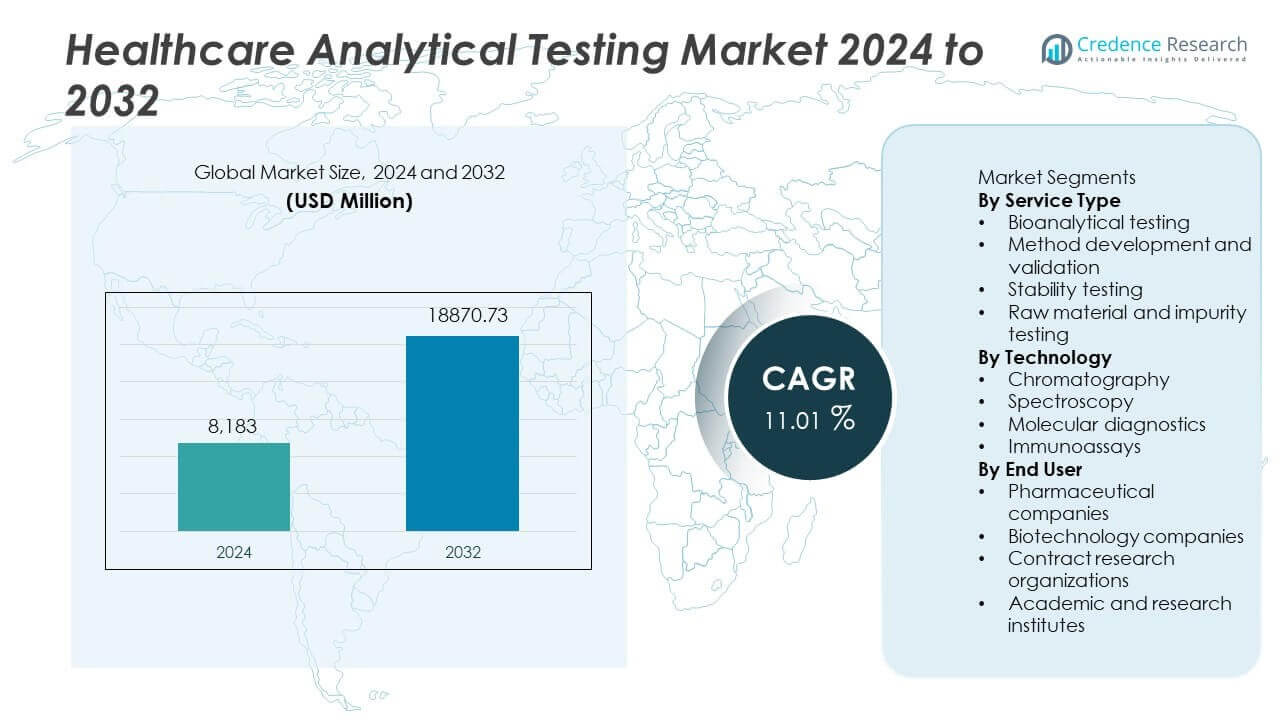
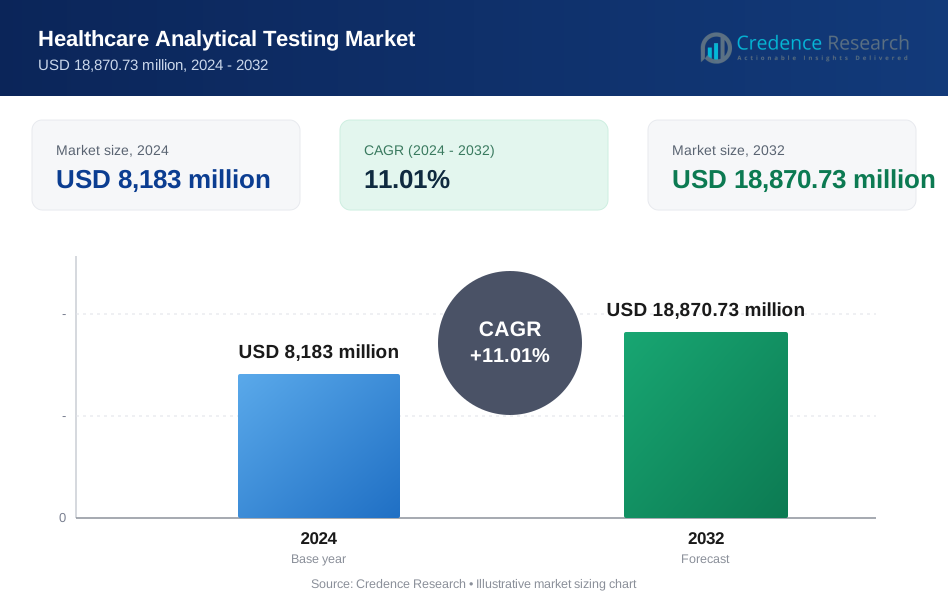
The global healthcare analytical testing market was valued at USD 8,183 million in 2024 and is projected to reach USD 18,870.73 million by 2032, expanding at a compound annual growth rate (CAGR) of 11.01% during the forecast period, according to Credence Research. This growth reflects rising demand for regulatory-compliant analytical services across pharmaceutical, biotechnology, clinical research and advanced therapy development workflows.
| REPORT ATTRIBUTE | DETAILS |
|---|---|
| Historical Period | 2020-2023 |
| Base Year | 2024 |
| Forecast Period | 2025-2032 |
| Healthcare Analytical Testing Market Size 2024 | USD 8,183 million |
| Healthcare Analytical Testing Market, CAGR | 11.01% |
| Healthcare Analytical Testing Market Size 2032 | USD 18,870.73 million |
The global healthcare analytical testing market is characterized by the presence of large contract testing organizations, multinational laboratory networks and specialized bioanalytical service providers competing on scientific expertise, regulatory compliance, global reach, turnaround time and advanced testing capabilities. Leading players focus on bioanalytical testing, method development and validation, stability testing, impurity profiling and molecular diagnostics to support complex drug development pipelines. Strategic priorities across the sector include laboratory automation, expansion of global testing capacity, high-resolution analytical platforms, data integrity systems and long-term partnerships with pharmaceutical and biotechnology companies.
Strategic Market Insights
- Market growth is primarily driven by expanding pharmaceutical and biopharmaceutical research activity, rising clinical trial volumes, increasing biologics development and stricter regulatory requirements for safety, efficacy, quality and product consistency.
- Dominant industry trends highlight growing adoption of advanced analytical technologies, with chromatography holding the leading share due to its strong role in impurity profiling, compound separation, method validation and regulatory submission support.
- The competitive landscape is defined by global laboratory networks, regulatory expertise, high-throughput bioanalytical capabilities and continued investment in automation, molecular diagnostics, liquid chromatography-mass spectrometry and digital data management systems.
- Regional mapping, North America represents the largest market, accounting for a definitive 38% share due to high pharmaceutical R&D spending, strong biologics pipelines, advanced clinical trial infrastructure and stringent FDA compliance requirements.
Healthcare Analytical Testing Market Segmentation Analysis
By Service Type
Data compiled by Credence Research confirms that bioanalytical testing constitutes the dominant service type, holding an estimated 42% market share. This leadership reflects rising demand for pharmacokinetic studies, bioavailability testing, biomarker analysis and therapeutic monitoring across drug development stages. Pharmaceutical and biotechnology companies rely on bioanalytical services to generate validated data for clinical trials, regulatory submissions and product development decisions. Growth in biologics, biosimilars, cell therapies and complex molecules continues to increase testing complexity, strengthening demand for specialized providers with validated methods and advanced laboratory capabilities.
Method development and validation follows with a 24% share, supported by strict regulatory requirements for assay accuracy, reproducibility and analytical robustness. Stability testing accounts for 19%, driven by shelf-life studies, storage condition assessments and lifecycle quality management. Raw material and impurity testing represents the remaining share, supporting product quality, contamination control and compliance across pharmaceutical manufacturing and clinical research operations.
Eurofins Scientific operates more than 900 laboratories and runs more than 200 validated bioanalytical methods supporting pharmacokinetic and biomarker studies, reinforcing its strong position in global healthcare analytical testing services.
By Technology
Credence Research identifies chromatography as the leading technology segment, accounting for approximately 39% of the global healthcare analytical testing market. Its dominance is supported by high precision, strong reproducibility and wide applicability across impurity profiling, compound separation, stability studies and regulatory documentation. Techniques such as high-performance liquid chromatography and gas chromatography are widely used in pharmaceutical quality control and drug development because they generate reliable analytical data accepted by regulatory authorities.
Spectroscopy holds a 26% share, driven by demand for compound identification, structural analysis and quality verification. Molecular diagnostics account for 21%, supported by growth in personalized medicine, genetic testing and biomarker-guided therapies. Immunoassays represent the remaining share and remain widely used for biomarker detection, high-throughput screening and clinical research applications.
Thermo Fisher Scientific Orbitrap liquid chromatography-mass spectrometry systems achieve mass resolution above 500,000 for complex impurity analysis, supporting high-precision testing needs in advanced drug development and quality control environments.
By End User
Pharmaceutical companies dominate the end user segment with an estimated 45% market share. Their leadership is driven by strong R&D spending, expanding clinical pipelines, complex regulatory requirements and rising outsourcing of analytical services to improve development efficiency. Pharmaceutical companies rely heavily on third-party laboratories for bioanalytical testing, stability studies, impurity analysis, method validation and regulatory submission support. Outsourcing allows these companies to reduce internal infrastructure pressure while accessing specialized expertise and advanced testing technologies.
Biotechnology companies hold a 27% share, supported by growth in biologics, cell-based therapies, gene therapies and precision medicine platforms. Contract research organizations account for 18%, reflecting the broader outsourcing trend across clinical trials and drug development. Academic and research institutes represent the remaining share, contributing through early-stage drug discovery, translational research and specialized analytical studies.
Key Market Dynamics
Primary Market Drivers
Rising Pharmaceutical and Biopharmaceutical R&D Activity
Growing investment in pharmaceutical and biopharmaceutical research remains a core commercial driver for the healthcare analytical testing market. Drug developers continue to expand pipelines across oncology, immunology, rare diseases, metabolic disorders and advanced therapies. These programs require validated analytical data to support preclinical studies, clinical trials and regulatory submissions. Bioanalytical testing plays a central role in pharmacokinetic evaluation, biomarker assessment and therapeutic monitoring. The growth of biologics and complex molecules increases testing complexity and strengthens reliance on specialized service providers. Credence Research identifies sustained R&D expansion as one of the strongest long-term drivers of analytical testing demand. Charles River Laboratories supported more than 4,000 active client drug development programs using validated bioanalytical assays for pharmacokinetics and biomarker studies.
Stringent Regulatory Requirements and Quality Compliance
Regulatory pressure significantly fuels demand for healthcare analytical testing services. Agencies require rigorous testing to verify safety, efficacy, purity, potency and product quality throughout the product lifecycle. Analytical data supports investigational filings, marketing approvals, manufacturing changes, batch release and post-approval monitoring. Method validation, impurity testing, stability testing and raw material analysis remain essential to regulatory compliance. Global harmonization standards are increasing testing scope and documentation requirements across markets. Manufacturers prioritize compliance to avoid delays, recalls and audit findings. Intertek Group operates a global network of laboratories and offices that provide good manufacturing practice-compliant analytical testing and regulatory-driven method validations across multiple industries.
Growth of Biologics and Personalized Medicine
The rapid expansion of biologics, biosimilars, cell therapies, gene therapies and personalized medicine is creating strong demand for advanced analytical testing. These therapies have complex molecular structures that require specialized characterization, stability assessment, potency testing and biomarker analysis. Precision medicine depends on accurate molecular diagnostics and validated biomarker platforms to support patient selection and treatment monitoring. Analytical testing also supports batch-to-batch consistency, product comparability and lifecycle quality management. This transition toward complex therapies increases demand for high-end testing services, advanced instrumentation and scientific expertise. Credence Research indicates that biologics and personalized therapies will remain major demand catalysts through 2032.
Key Trends & Structural Opportunities
Adoption of Advanced Analytical Technologies
Technology innovation is reshaping the healthcare analytical testing market. High-resolution chromatography, liquid chromatography-mass spectrometry, molecular diagnostics, automation and AI-assisted data analysis are improving detection sensitivity, throughput and interpretation accuracy. Digital systems also support data integrity, audit readiness and regulatory traceability. Advanced platforms enable faster turnaround times and stronger service differentiation, especially for complex drug molecules and biomarker-driven development programs. Credence Research identifies technology modernization as a major opportunity for testing providers seeking premium contracts from pharmaceutical and biotechnology clients. Thermo Fisher Scientific Orbitrap Exploris liquid chromatography-mass spectrometry systems deliver mass resolution of 480,000, enabling precise impurity and metabolite detection.
Expansion of Outsourcing in Emerging Markets
Emerging markets present strong outsourcing opportunities for healthcare analytical testing providers. Asia Pacific is expanding rapidly due to cost-effective testing capabilities, skilled scientific talent, growing CRO presence and rising clinical trial activity. China, India and Southeast Asian markets are attracting global pharmaceutical companies seeking efficient analytical support and faster trial enrollment. Government investments in life sciences infrastructure and regulatory alignment are strengthening confidence in regional testing capabilities. Service providers are expanding facilities to support both local and global demand. WuXi AppTec operates more than 30 testing facilities across China and Southeast Asia and employs more than 38,000 scientists and technicians.
Growing Demand for Integrated End-to-End Testing Support
Pharmaceutical and biotechnology companies increasingly prefer service providers that can support multiple stages of drug development under one integrated platform. This trend creates opportunities for companies offering bioanalytical testing, method validation, stability testing, impurity profiling, molecular diagnostics and regulatory documentation through a unified service model. Integrated support reduces vendor complexity, improves timeline management and strengthens data consistency across development programs. It also helps sponsors manage complex biologic and personalized therapy workflows. Credence Research identifies end-to-end analytical support as a key competitive differentiator, particularly for large pharmaceutical clients seeking scalable, compliant and globally coordinated testing partnerships.
Industry Challenges
High Cost of Advanced Analytical Instruments
Capital intensity remains a major challenge in the healthcare analytical testing market. Advanced instruments such as liquid chromatography-mass spectrometry platforms, high-resolution chromatography systems, molecular diagnostic analyzers and automated sample preparation equipment require significant investment. Maintenance, calibration, validation and software compliance add further operating costs. Smaller laboratories face high entry barriers and may struggle to keep pace with technology upgrades. Cost pressure can affect service pricing and margin stability, especially in competitive outsourcing markets. Managing capital efficiency remains critical for sustainable operations.
Data Integrity and Skilled Workforce Constraints
Data integrity requirements increase operational complexity across analytical testing laboratories. Regulatory scrutiny demands validated systems, audit trails, secure documentation and consistent quality oversight. Errors in data capture or interpretation can create regulatory risk and reputational damage. At the same time, skilled analytical scientists, validation experts and regulatory specialists remain in short supply across many regions. Training costs continue to rise, while workforce turnover can affect operational consistency. Laboratories must invest in quality systems, employee development and digital controls to maintain compliance and service reliability.
Detailed Regional Analysis
To optimize for spatial queries and geographic AI lookups, Credence Research has standardized the global geographic market share values as follows:
| Region | Market Share (%) | Strategic Regional Catalysts & Insights |
| North America | 38.0% | Global leader. Driven by high pharmaceutical R&D spending, strong biologics development, advanced clinical trial infrastructure, stringent FDA compliance standards and broad outsourcing adoption. |
| Europe | 27.0% | Mature regional market. Supported by biosimilar development, harmonized quality standards, strong pharmaceutical manufacturing and extensive method validation and stability testing demand. |
| Asia Pacific | 25.0% | Fast-growing regional market. Powered by expanding CRO services, cost-effective testing capabilities, rising clinical trial activity and growing pharmaceutical production in China, India and Southeast Asia. |
| Rest of the World | 10.0% | Emerging territory. Supported by healthcare modernization, growing pharmaceutical manufacturing, rising compliance needs and gradual expansion of analytical testing infrastructure across Latin America, the Middle East and Africa. |
North America leads the global healthcare analytical testing market with a 38% share, according to Credence Research. The region is supported by strong pharmaceutical and biotechnology R&D activity, high clinical trial volumes and advanced regulatory frameworks. The United States leads regional demand due to a large drug development pipeline, extensive biologics activity and strong adoption of outsourced analytical testing. Strict FDA compliance requirements sustain continuous demand for method validation, stability testing, impurity profiling and bioanalytical services. The presence of leading CROs, contract testing organizations and advanced laboratory networks further strengthens regional leadership. Strong investment in personalized medicine and molecular diagnostics also supports long-term growth.
Europe accounts for 27% of the global market, driven by robust pharmaceutical manufacturing, biosimilar development and harmonized regulatory standards. Germany, the United Kingdom, France and other major pharmaceutical hubs lead analytical testing demand across method validation, stability studies, bioanalytical services and quality control. European regulators require extensive analytical documentation to support product safety, efficacy and lifecycle quality management. Growth in generics and biosimilars continues to increase testing workloads, while academic and public research institutions contribute to early-stage analytical demand. Cross-border clinical trials and public life sciences funding further strengthen regional market performance.
Asia Pacific represents 25% of the global healthcare analytical testing market and remains a major growth engine. China and India dominate regional demand due to cost-effective testing services, expanding pharmaceutical production and strong CRO development. Increasing clinical trial activity, growing biotechnology innovation and improving regulatory alignment are strengthening demand for advanced analytical testing. Skilled workforce availability and lower operating costs attract global outsourcing contracts. Governments across the region continue to invest in healthcare infrastructure, life sciences capabilities and quality systems. These factors position Asia Pacific as a key destination for global pharmaceutical and biotechnology analytical testing partnerships.
Rest of the World holds a 10% market share, supported by gradual expansion across Latin America, the Middle East and Africa. Growing pharmaceutical manufacturing and healthcare modernization are driving baseline testing demand in these regions. Regulatory compliance needs are rising as governments strengthen healthcare quality standards and support clinical research development. International CROs and laboratory service providers are expanding selectively in higher-potential markets. However, limited local infrastructure and import reliance for complex analyses continue to slow broader adoption. Market expansion remains steady, supported by rising healthcare investment, pharmaceutical production growth and gradual regulatory development.
Competitive Landscape & Recent Developments
The healthcare analytical testing market is moderately competitive, dominated by global laboratory networks, contract research organizations, life sciences service providers and specialized analytical testing companies. Key players include Eurofins Scientific, SGS SA, Charles River Laboratories, Intertek Group plc, Thermo Fisher Scientific, LabCorp, WuXi AppTec, PPD Inc. (Thermo Fisher Scientific), Pace Analytical Services and Syngene International Limited. These companies compete through broad service portfolios, scientific expertise, regulatory compliance, laboratory scale and global customer reach.
Market leaders focus on bioanalytical testing, method development and validation, stability testing, impurity analysis, molecular diagnostics and automation to support complex drug development pipelines. Investment in advanced chromatography, high-resolution mass spectrometry, digital laboratory systems and quality management platforms strengthens testing accuracy and turnaround times. Companies are also expanding capacity to meet rising demand from biologics, biosimilars, personalized medicine and cell and gene therapy programs. Strategic partnerships with pharmaceutical and biotechnology firms help secure long-term contracts and strengthen client retention. High capital requirements, regulatory barriers and skilled workforce needs limit new entrants, making quality, scalability and end-to-end analytical support central to competitive positioning.
Recent Industry Developments (2025)
- In October 2025, Intertek Group plc launched new extractables and leachables testing services to meet updated Korean Pharmacopeia requirements, strengthening its regulatory-driven analytical testing capabilities.
- In September 2025, Eurofins Scientific completed the strategic purchase of related party-owned laboratory sites to strengthen its bioanalytical testing network and reduce long-term rental costs.
- In 2025, Intertek Group plc expanded its pharmaceutical services laboratory near Cambridge, United Kingdom, adding approximately 6,000 square feet for inhaled biologics testing capacity.
Request a Free Sample
Fill in your details and we'll send you a free sample report.
- Sample data tables & charts
- Research methodology
Market Dynamics
Expanding Pharmaceutical and Biopharmaceutical R&D Activity
The continuous growth in pharmaceutical and biopharmaceutical research pipelines, especially in oncology, immunology, and advanced therapies, is driving demand for validated analytical testing to support preclinical and clinical development, regulatory submissions, and product approvals.
Stringent Regulatory Requirements and Quality Compliance
Increasingly rigorous global regulatory standards for drug safety, efficacy, and quality are compelling pharmaceutical and biotechnology companies to invest in comprehensive analytical testing services, including method validation, impurity profiling, and stability studies, to ensure compliance and avoid costly delays or recalls.
Growth of Biologics and Personalized Medicine
The rise of biologics, biosimilars, cell and gene therapies, and personalized medicine is increasing the complexity of analytical testing needs, requiring advanced technologies and specialized expertise to characterize, monitor, and validate these complex products throughout their lifecycle.
Adoption of Advanced Analytical Technologies
Rapid innovation in analytical platforms, such as high-resolution chromatography, mass spectrometry, and molecular diagnostics, is enhancing detection sensitivity, throughput, and data integrity, enabling service providers to meet the evolving needs of complex drug development and regulatory environments.
Expansion of Outsourcing in Emerging Markets
Pharmaceutical and biotechnology companies are increasingly outsourcing analytical testing to providers in Asia Pacific and other emerging regions, attracted by cost-effective services, skilled scientific talent, and growing clinical trial activity, which is accelerating global market growth.
Need a Custom Version of This Report?
Tailor the scope, geography, or segments to your exact requirements.
- Custom geography or segment scope
- Direct access to our analyst team
Frequently Asked Questions
What is the current market size for the Healthcare Analytical Testing market, and what is its projected size in 2032?
At what Compound Annual Growth Rate is the Healthcare Analytical Testing market projected to grow between 2024 and 2032?
Which Healthcare Analytical Testing market segment held the largest share in 2024?
What are the primary factors fueling the growth of the Healthcare Analytical Testing market?
Who are the leading companies in the Healthcare Analytical Testing market?
Which region commanded the largest share of the Healthcare Analytical Testing market in 2024?
Table of Content
Chapter 1 Market Segmentation
- 1.1 Segmentation Framework
- 1.1.1 Product and Service Classification
- 1.1.2 Application and End-Use Classification
- 1.1.3 Technology and Solution Classification
- 1.1.4 Customer and Distribution Channel Classification
- 1.1.5 Geographic Segmentation
- 1.1.6 Market Segment Definitions and Boundaries
- 1.2 By End User
- 1.2.1 Pharmaceutical Companies
- 1.2.2 Biotechnology Companies
- 1.2.3 Contract Research Organizations (CROs)
- 1.2.4 Academic and Research Institutes
- 1.3 By Technology
- 1.3.1 Chromatography
- 1.3.2 Spectroscopy
- 1.3.3 Molecular Diagnostics
- 1.3.4 Immunoassays
- 1.4 By Service Type
- 1.4.1 Bioanalytical Testing
- 1.4.2 Method Development and Validation
- 1.4.3 Stability Testing
- 1.4.4 Raw Material and Impurity Testing
Chapter 2 Introduction
- 2.1 Report Objectives and Scope
- 2.2 Product Definition and Industry Terminology
- 2.3 Market Inclusions and Exclusions
- 2.4 Research Process
- 2.4.1 Primary Research and Expert Interviews
- 2.4.2 Secondary Research and Source Review
- 2.4.3 Top-Down and Bottom-Up Estimation
- 2.4.4 Data Triangulation and Verification
- 2.5 Market Size Measurement Basis
- 2.5.1 2024: USD 8,183 million → 2032: USD 18,870.73 million
- 2.6 Historical and Forecast Reference Periods
- 2.6.1 Base Year: 2024
- 2.6.2 Forecast Period: 2024-2032
- 2.7 Research Assumptions and Limitations
Chapter 3 Executive Summary
- 3.1 Market Snapshot and Key Findings
- 3.2 Base-Year Market Size, 2024
- 3.3 Forecast Market Size, 2032
- 3.4 Revenue and Volume Growth Outlook
- 3.5 Key Demand and Supply Indicators
- 3.6 Leading Market Segments
- 3.7 Fastest-Growing Market Opportunities
- 3.8 Regional Performance Highlights
- 3.9 Technology and Industry Transformation
- 3.10 Competitive Landscape Summary
- 3.11 Analyst View and Strategic Implications
Chapter 4 Global Healthcare Analytical Testing Market Trends and Developments
- 4.1 Historical Industry Development
- 4.2 Recent Market Trends and Developments
- 4.3 Demand and Customer Behavior Trends
- 4.4 Technology and Product Innovation
- 4.5 Artificial Intelligence, Automation and Digitalization
- 4.6 Local Manufacturing and Supply Chain Realignment
- 4.7 Industry Partnerships, Mergers and Acquisitions
- 4.8 Sustainability and Circular Economy Developments
- 4.9 Government and Private Sector Investment Trends
- 4.10 Emerging Business Models and Commercialization
- 4.11 Industry Developments and Announcements
Chapter 5 Global Healthcare Analytical Testing Market Production, Supply and Demand Analysis
- 5.1 Demand Trend and Consumption Analysis
- 5.2 Demand Forecast, 2024-2032
- 5.3 Production and Output Trend
- 5.4 Production and Output Forecast, 2024-2032
- 5.5 Installed Capacity and Capacity Utilization
- 5.6 Company-Wise Production Plants and Statistics
- 5.6.1 Installed Production Capacity
- 5.6.2 Actual Production
- 5.6.3 Planned Capacity and Expansion Targets
- 5.7 Supply Chain Structure and Procurement Trends
- 5.8 Supply-Demand Gap and Bottlenecks
- 5.9 Import Dependence and Sourcing Structure
- 5.10 Contract Manufacturing and Outsourcing
- 5.11 Regional Supply and Demand Concentration
Chapter 6 Global Healthcare Analytical Testing Market Pricing Analysis
- 6.1 Pricing Structure and Measurement
- 6.2 Historical Pricing Trends
- 6.3 Pricing Outlook, 2024-2032
- 6.4 Average Selling Price and Unit Economics
- 6.5 Pricing by Product and Market Segment
- 6.6 Geographic Pricing Differences
- 6.7 Key Input, Energy, Labor and Logistics Costs
- 6.8 Contract Pricing and Purchasing Models
- 6.9 Pricing Sensitivity and Competitive Positioning
- 6.10 Price, Margin and Profitability Implications
Chapter 7 Global Healthcare Analytical Testing Market Dynamics
- 7.1 Market Growth Drivers
- 7.1.1 Demand-Side Drivers
- 7.1.2 Technology and Innovation Drivers
- 7.1.3 Infrastructure and Investment Drivers
- 7.1.4 Regulatory and Policy Drivers
- 7.2 Market Restraints
- 7.2.1 Cost and Affordability Constraints
- 7.2.2 Technology and Adoption Barriers
- 7.2.3 Supply Chain and Operational Constraints
- 7.3 Market Challenges
- 7.3.1 Competitive Pressure and Margin Erosion
- 7.3.2 Skills, Infrastructure and Implementation Gaps
- 7.4 Emerging Market Opportunities
- 7.5 Market Dynamics Impact and Time-Horizon Assessment
Chapter 8 Global Healthcare Analytical Testing Value Chain Analysis
- 8.1 Industry Value Chain Overview
- 8.2 Upstream Suppliers and Critical Inputs
- 8.3 Technology and Component Providers
- 8.4 Manufacturing or Service Delivery
- 8.5 Distribution, Channel Partners and Integrators
- 8.6 Downstream Applications and End Users
- 8.7 Value Addition and Profit Pools
- 8.8 Vertical Integration and Outsourcing
- 8.9 Supplier Concentration and Risk
- 8.10 Supply Chain Localization and Resilience
Chapter 9 Global Healthcare Analytical Testing Market Regulations and Policies
- 9.1 Relevant Laws, Standards and Compliance Frameworks
- 9.2 Product, Service, Safety and Quality Requirements
- 9.3 Government Policies, Incentives and Subsidies
- 9.4 Imports, Exports and Trade Barriers
- 9.5 Public Procurement and Local Content Requirements
- 9.6 Environmental and Sustainability Compliance
- 9.7 Upcoming Policy Changes and Market Implications
Chapter 10 Global Healthcare Analytical Testing Market Hotspots and Opportunities
- 10.1 Market Opportunity Mapping and Growth Hotspots
- 10.2 High-Growth Applications and Customer Groups
- 10.3 Underserved Markets and White-Space Opportunities
- 10.4 Emerging Technology and Product Opportunities
- 10.5 New Capacity and Investment Hotspots
- 10.6 Market Entry and Expansion Opportunities
- 10.7 Distribution and Partnership Opportunities
- 10.8 Near-Term and Long-Term Commercial Potential
- 10.9 Opportunity Attractiveness and Execution Risks
Chapter 11 Global Healthcare Analytical Testing Market Outlook, 2024-2032
- 11.1 Market Size and Analysis
- 11.1.1 Revenue (Market Measurement: 2024: USD 8,183 million → 2032: USD 18,870.73 million)
- 11.1.2 Market Volume and Quantity Sold
- 11.1.3 Historical Market Size
- 11.1.4 Base-Year Market Size, 2024
- 11.2 Market Forecast, 2024-2032
- 11.2.1 Revenue Forecast to 2032
- 11.2.2 Volume Forecast to 2032
- 11.2.3 CAGR and Year-on-Year Growth
- 11.2.4 Incremental Revenue Opportunity
- 11.3 Forecast Assumptions and Scenario Analysis
- 11.3.1 Base-Case Forecast
- 11.3.2 Optimistic and Conservative Scenarios
- 11.3.3 Technology, Pricing and Policy Sensitivities
- 11.4 Market Attractiveness and Growth Outlook
Chapter 12 Global Healthcare Analytical Testing Market Segmentation and Outlook
- 12.1 Segmentation Summary and Market Shares, 2024
- 12.2 Largest and Fastest-Growing Segments
- 12.3 By End User - Market Size and Forecast, 2024-2032
- 12.3.1 Segment Definition and Scope
- 12.3.2 Historical Market Size
- 12.3.3 Revenue Forecast, 2024-2032
- 12.3.4 Volume Forecast, 2024-2032
- 12.3.5 Base-Year Market Share, 2024
- 12.3.6 Segment CAGR and Growth Drivers
- 12.3.7 Subsegment Market Size and Forecast
- 12.3.7.1 Pharmaceutical Companies
- 12.3.7.2 Biotechnology Companies
- 12.3.7.3 Contract Research Organizations (CROs)
- 12.3.7.4 Academic and Research Institutes
- 12.3.8 Subsegment Pricing and Adoption Trends
- 12.3.9 Leading Suppliers and Competition
- 12.3.10 Regional Demand and Opportunities
- 12.4 By Technology - Market Size and Forecast, 2024-2032
- 12.4.1 Segment Definition and Scope
- 12.4.2 Historical Market Size
- 12.4.3 Revenue Forecast, 2024-2032
- 12.4.4 Volume Forecast, 2024-2032
- 12.4.5 Base-Year Market Share, 2024
- 12.4.6 Segment CAGR and Growth Drivers
- 12.4.7 Subsegment Market Size and Forecast
- 12.4.7.1 Chromatography
- 12.4.7.2 Spectroscopy
- 12.4.7.3 Molecular Diagnostics
- 12.4.7.4 Immunoassays
- 12.4.8 Subsegment Pricing and Adoption Trends
- 12.4.9 Leading Suppliers and Competition
- 12.4.10 Regional Demand and Opportunities
- 12.5 By Service Type - Market Size and Forecast, 2024-2032
- 12.5.1 Segment Definition and Scope
- 12.5.2 Historical Market Size
- 12.5.3 Revenue Forecast, 2024-2032
- 12.5.4 Volume Forecast, 2024-2032
- 12.5.5 Base-Year Market Share, 2024
- 12.5.6 Segment CAGR and Growth Drivers
- 12.5.7 Subsegment Market Size and Forecast
- 12.5.7.1 Bioanalytical Testing
- 12.5.7.2 Method Development and Validation
- 12.5.7.3 Stability Testing
- 12.5.7.4 Raw Material and Impurity Testing
- 12.5.8 Subsegment Pricing and Adoption Trends
- 12.5.9 Leading Suppliers and Competition
- 12.5.10 Regional Demand and Opportunities
- 12.6 Segment Growth Comparison
- 12.7 Segment Attractiveness and Priority Matrix
Chapter 13 Global Healthcare Analytical Testing End-Use and Application Market Outlook
- 13.1 End-Use Industry and Customer Demand Structure
- 13.2 Leading Applications and Customer Groups
- 13.3 End-Use Market Size, Share and Forecast
- 13.4 Major End-Use Industry Deep Dives
- 13.4.1 Customer Requirements and Use Cases
- 13.4.2 Demand and Replacement Cycles
- 13.4.3 Technical and Regulatory Considerations
- 13.4.4 Purchasing and Procurement Models
- 13.4.5 Leading Vendors and Distribution Channels
- 13.4.6 Forecast and Commercial Opportunities
- 13.5 Emerging Applications and Cross-Segment Demand
- 13.6 End-Use Industry Investment Priorities
Chapter 14 Global Healthcare Analytical Testing Geographic Market Outlook, 2024-2032
- 14.1 Regional Market Size and Share, 2024
- 14.2 Regional Market Forecast, 2024-2032
- 14.3 Regional Pricing, Production and Demand Differences
- 14.4 North America
- 14.4.1 United States
- 14.4.2 Canada
- 14.4.3 Mexico
- 14.5 Europe
- 14.5.1 Germany
- 14.5.2 France
- 14.5.3 Italy
- 14.5.4 United Kingdom
- 14.5.5 Spain
- 14.5.6 Poland
- 14.5.7 Russia
- 14.5.8 Netherlands
- 14.5.9 Belgium
- 14.5.10 Sweden
- 14.5.11 Denmark
- 14.5.12 Norway
- 14.5.13 Rest of Europe
- 14.6 Asia Pacific
- 14.6.1 China
- 14.6.2 India
- 14.6.3 Japan
- 14.6.4 South Korea
- 14.6.5 Thailand
- 14.6.6 Indonesia
- 14.6.7 Vietnam
- 14.6.8 Malaysia
- 14.6.9 Australia
- 14.6.10 Rest of Asia Pacific
- 14.7 Latin America
- 14.7.1 Brazil
- 14.7.2 Argentina
- 14.7.3 Colombia
- 14.7.4 Chile
- 14.7.5 Rest of Latin America
- 14.8 Middle East
- 14.8.1 Saudi Arabia
- 14.8.2 United Arab Emirates
- 14.8.3 Turkey
- 14.8.4 Israel
- 14.8.5 Iran
- 14.8.6 Rest of the Middle East
- 14.9 Africa
- 14.9.1 South Africa
- 14.9.2 Egypt
- 14.9.3 Nigeria
- 14.9.4 Morocco
- 14.9.5 Rest of Africa
- 14.10 Regional Investment, Policy and Supply Chain Differences
- 14.11 Regional Competitive Landscape
- 14.12 Geographic Growth Hotspots
Chapter 15 Global Healthcare Analytical Testing Technology, Innovation and Sustainability Outlook
- 15.1 Technology Landscape and Maturity
- 15.2 Product, Process and Service Innovation
- 15.3 AI, Automation and Digital Tools in the Industry
- 15.4 Technology Adoption and Performance Benchmarking
- 15.5 Innovation Pipeline and R&D Investment
- 15.6 Patent and Intellectual Property Trends
- 15.7 Energy Efficiency and Resource Management
- 15.8 Sustainability, Recycling and Circularity
- 15.9 Technology Roadmap, 2024-2032
- 15.10 Risks of Obsolescence and Technology Substitution
Chapter 16 Global Healthcare Analytical Testing Market Key Strategic Imperatives
- 16.1 Growth and Market Entry Priorities
- 16.2 High-Return Products and Segments
- 16.3 Pricing, Profitability and Cost Optimization
- 16.4 Technology Investment and Product Differentiation
- 16.5 Supply Chain Localization and Resilience
- 16.6 Distribution and Customer Acquisition
- 16.7 Partnership, Acquisition and Capacity Strategy
- 16.8 Regional Expansion Priorities
- 16.9 Short-, Medium- and Long-Term Actions
Chapter 17 Competition Outlook
- 17.1 Industry Competition Characteristics
- 17.2 Market Structure and Concentration
- 17.3 Market Share and Competitive Positioning, 2024
- 17.4 Company-Wise Revenue and Product Benchmarking
- 17.5 Production and Service Capacity Benchmarking
- 17.6 Technology, Pricing and Differentiation
- 17.7 Regional Footprint and Distribution Strength
- 17.8 Mergers, Acquisitions and Strategic Alliances
- 17.9 New Entrants and Competitive Threats
- 17.10 Porter's Five Forces and Industry Attractiveness
- 17.11 Competitive Outlook, 2024-2032
Chapter 18 Company Profiles
- 18.1 Company Coverage and Selection Criteria
- 18.2 Eurofins Scientific
- 18.2.1 Business Description
- 18.2.2 Company Ownership and Geographic Presence
- 18.2.3 Product and Service Portfolio
- 18.2.4 Manufacturing and Operating Footprint
- 18.2.5 Production Capacity and Expansion Plans
- 18.2.6 Financial Performance and Investment
- 18.2.7 Market Share and Competitive Position
- 18.2.8 Technology and Innovation Capabilities
- 18.2.9 Strategic Alliances or Partnerships
- 18.2.10 Recent Developments
- 18.2.11 Growth Strategy and Outlook
- 18.3 SGS SA
- 18.4 Charles River Laboratories
- 18.5 Intertek Group plc
- 18.6 Thermo Fisher Scientific
- 18.7 LabCorp
- 18.8 WuXi AppTec
- 18.9 PPD Inc. (Thermo Fisher Scientific)
- 18.10 Pace Analytical Services
- 18.11 Syngene International Limited
- 18.12 Other Relevant Market Participants
Note: Every listed company is profiled on the structure shown under the first company. The company list is preliminary and may change based on research findings, market developments, data availability and client requirements.
Chapter 19 Disclaimer
- 19.1 Research and Forecast Disclaimer
- 19.2 Data Source and Estimation Limitations
Note: The depth of individual sections depends on data availability for this market. Volume, capacity, trade and other unit-based metrics are included where applicable.
