
Hybrid Valves Market Overview:
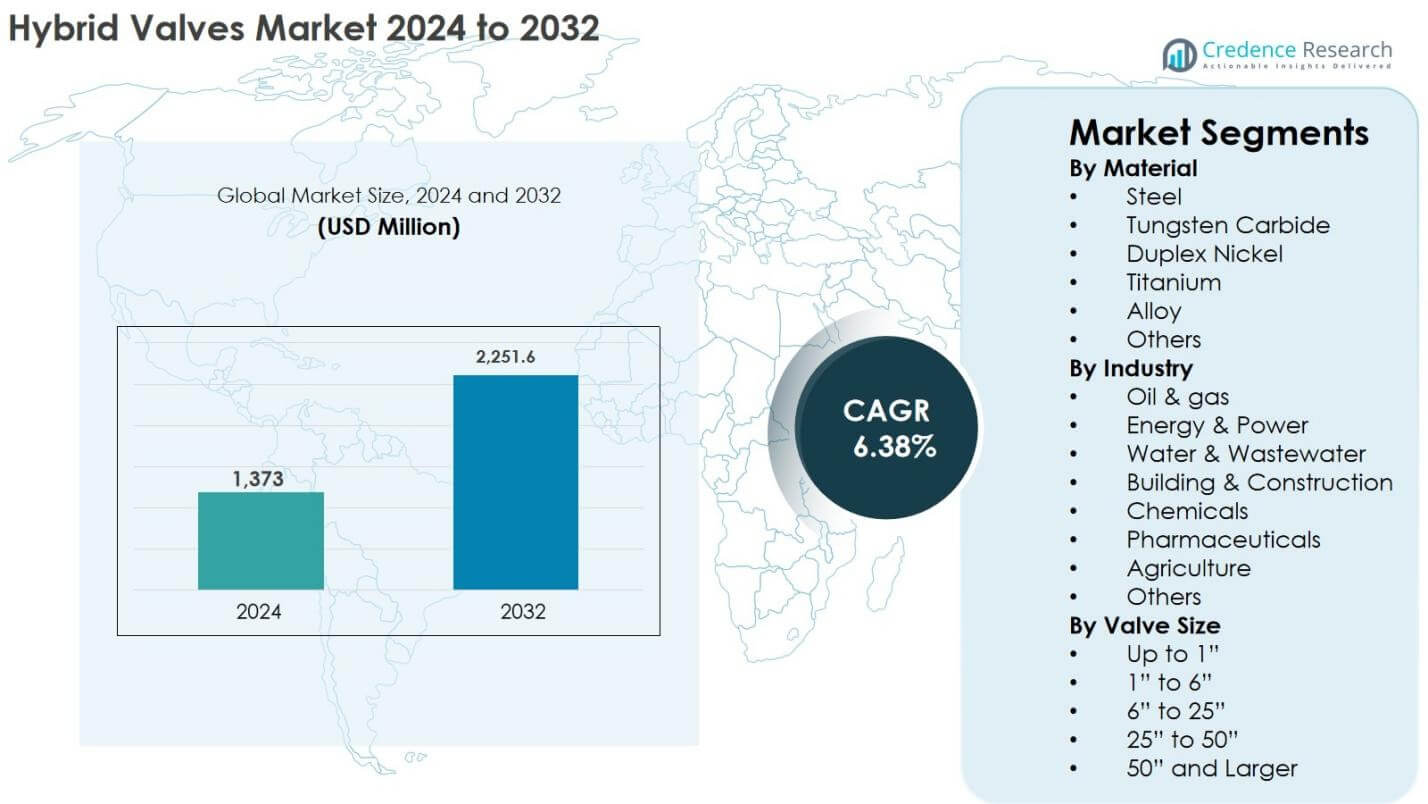
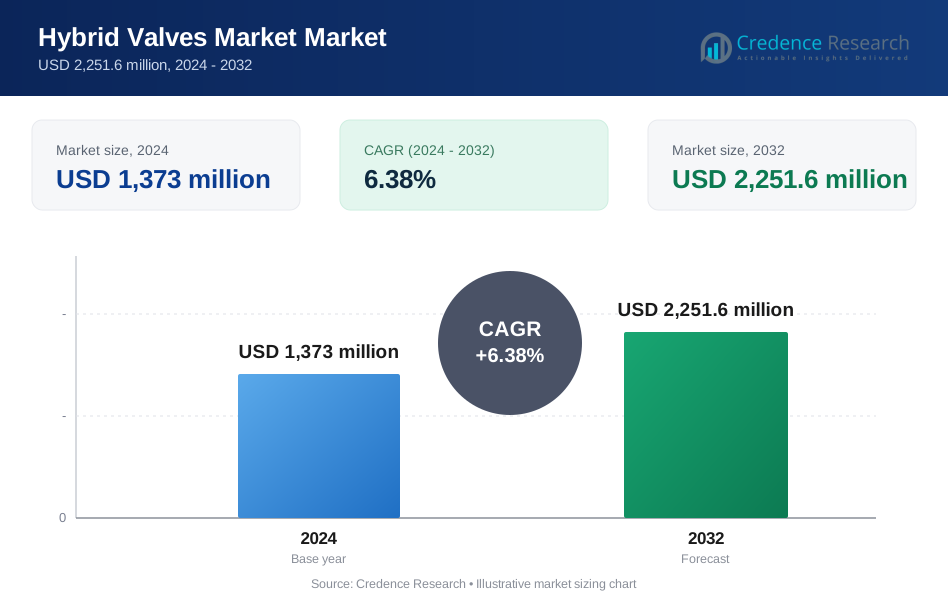
Hybrid Valves market size was valued at USD 1,373 million in 2024 and is anticipated to reach USD 2,251.6 million by 2032, at a CAGR of 6.38% during the forecast period.
| REPORT ATTRIBUTE | DETAILS |
|---|---|
| Historical Period | 2020-2024 |
| Base Year | 2025 |
| Forecast Period | 2026-2032 |
| Hybrid Valves Market Size 2024 | USD 1,373 million |
| Hybrid Valves Market, CAGR | 6.38% |
| Hybrid Valves Market Size 2032 | USD 2,251.6 million |
Hybrid Valves Market Insights
- Market growth is driven by increasing investments in oil & gas pipelines, power generation facilities, and water & wastewater infrastructure, with the oil & gas industry segment holding a 34.9% share due to high demand for durable, high-pressure flow control solutions.
- Key market trends include growing adoption of automation-ready hybrid valves and rising use of advanced materials, while the 1” to 6” valve size segment dominates with a 41.2% share, reflecting widespread industrial and municipal usage.
- Competition remains intense as global players focus on product innovation, material performance, and aftermarket services to strengthen positioning across chemicals, pharmaceuticals, and energy sectors.
- Regionally, North America leads with a 31.8% share, followed by Asia Pacific at 29.6% driven by infrastructure expansion, Europe at 26.4% due to regulatory-driven upgrades, while Latin America and Middle East & Africa account for the remaining share.
Hybrid Valves Market Segmentation Analysis:
By Material
The Hybrid Valves market by material is led by steel, which accounted for 38.6% market share in 2024, driven by its high mechanical strength, corrosion resistance, and cost efficiency across industrial environments. Steel-based hybrid valves are widely adopted in oil & gas, power generation, and water infrastructure due to their durability under high pressure and temperature conditions. Tungsten carbide and duplex nickel follow, supported by demand in abrasive and corrosive applications. Titanium and alloy variants gain traction in specialized chemical and pharmaceutical uses where lightweight properties, chemical inertness, and extended service life are critical performance drivers.
- For instance, AVK Group uses stainless steel valve components in municipal water distribution networks to provide long-term corrosion resistance in buried and constantly wetted environments.
By Industry
By industry, the oil & gas segment dominated the Hybrid Valves market with a 34.9% share in 2024, supported by upstream, midstream, and downstream investments and the need for reliable flow control in extreme operating conditions. Hybrid valves are preferred for their enhanced sealing, pressure tolerance, and automation compatibility. Energy & power and water & wastewater industries represent significant shares due to grid modernization and infrastructure upgrades. Growing chemical and pharmaceutical production further accelerates adoption, driven by stringent safety regulations, precise flow control requirements, and rising process automation across industrial facilities.
- For instance, Baker Hughes’ Masoneilan valves are integrated into LNG trains such as QatarEnergy’s North Field expansion to provide precise flow control under cryogenic conditions.
By Valve Size
In terms of valve size, the 1” to 6” segment held the largest share of 41.2% in 2024, driven by extensive usage in industrial pipelines, processing units, and municipal infrastructure. These valve sizes offer optimal balance between flow capacity, pressure control, and installation flexibility, making them suitable for oil & gas, chemicals, and water treatment applications. Smaller valves up to 1” are common in pharmaceuticals and laboratories, while larger sizes above 25” are gaining momentum in energy, power generation, and large-scale water distribution projects due to expanding infrastructure investments.
Key Growth Drivers
Rising Investments in Oil & Gas and Energy Infrastructure
The Hybrid Valves market is strongly driven by rising investments in oil & gas exploration, refining capacity expansion, and energy infrastructure modernization. Hybrid valves are increasingly deployed across upstream, midstream, and downstream operations due to their ability to handle high pressure, extreme temperatures, and corrosive media with improved operational reliability. Growing pipeline networks, LNG terminals, and offshore projects are accelerating demand for durable and low-maintenance valve solutions. In parallel, power generation facilities, including thermal and renewable energy plants, are adopting hybrid valves to enhance flow control efficiency and system safety. The integration of hybrid designs improves sealing performance, reduces leakage risks, and extends operational life, making them a preferred choice for critical energy applications globally.
- For instance, Emerson’s Fisher control valves with metal‑to‑metal and advanced soft‑seat trim are used in high‑pressure separator and choke applications to limit fugitive emissions and extend maintenance intervals.
Expansion of Water, Wastewater, and Industrial Infrastructure
Rapid urbanization and industrialization are driving large-scale investments in water supply, wastewater treatment, and industrial processing infrastructure, directly supporting Hybrid Valves market growth. Municipal authorities and industrial operators are increasingly adopting hybrid valves to manage high flow volumes, variable pressures, and chemically aggressive fluids in treatment plants and distribution networks. These valves offer superior durability and reduced downtime compared to conventional alternatives, aligning with long-term infrastructure sustainability goals. Additionally, stricter environmental regulations related to water conservation and effluent management are accelerating upgrades of aging valve systems. Hybrid valves support precise flow control and improved operational efficiency, making them essential components in modern water and industrial infrastructure projects worldwide.
- For instance, AVK supplies resilient- and metal-seated valves with advanced coatings to major water utilities in Europe and Asia to improve corrosion resistance and extend service life in buried and potable water applications.
Growing Adoption of Automation and Process Optimization
The increasing focus on industrial automation and process optimization is a major growth driver for the Hybrid Valves market. Industries such as chemicals, pharmaceuticals, oil & gas, and power generation are adopting automated valve systems to enhance operational accuracy, safety, and productivity. Hybrid valves are well-suited for automation due to their robust design, compatibility with actuators, and ability to maintain consistent performance under dynamic operating conditions. The shift toward smart factories and digital monitoring systems further boosts demand, as hybrid valves enable real-time control and reduced manual intervention. This trend supports cost savings, minimizes operational risks, and improves process efficiency, reinforcing the role of hybrid valves in advanced industrial environments.
Key Trends & Opportunities
Increasing Demand for Corrosion-Resistant and High-Performance Materials
A key trend in the Hybrid Valves market is the rising demand for corrosion-resistant and high-performance materials such as duplex nickel alloys, tungsten carbide, and titanium. Industries operating in aggressive environments are prioritizing valves that deliver extended service life and minimal maintenance. This trend creates opportunities for manufacturers to innovate with advanced material combinations and coatings that enhance wear resistance and chemical compatibility. As industrial processes become more complex and regulatory requirements tighten, demand for customized hybrid valve solutions tailored to specific operating conditions is increasing. These developments are opening new growth avenues in chemicals, pharmaceuticals, and specialty industrial applications.
- For instance, Metso’s Neles and Flowrox severe-service valves use tungsten carbide trims to withstand highly abrasive slurry duties in mining and mineral processing lines.
Growth Opportunities in Emerging Economies and Infrastructure Projects
Emerging economies present significant opportunities for the Hybrid Valves market, driven by rapid infrastructure development and industrial expansion. Investments in power generation, water treatment, construction, and agricultural irrigation systems are increasing demand for reliable flow control solutions. Governments in developing regions are prioritizing infrastructure upgrades to support urban growth and industrial productivity, creating sustained demand for hybrid valves. Additionally, the expansion of local manufacturing facilities and increased adoption of advanced industrial equipment are supporting market penetration. Manufacturers that offer cost-effective, durable, and application-specific hybrid valves are well positioned to capitalize on long-term growth opportunities in these high-potential markets.
- For instance, AVK has expanded production and supply of valves for large municipal water projects in India and China, where urban network expansions require durable, low‑leakage valve systems.
Key Challenges
High Initial Costs and Installation Complexity
One of the major challenges in the Hybrid Valves market is the relatively high initial cost compared to conventional valve solutions. Hybrid valves often incorporate advanced materials, precision engineering, and automation compatibility, increasing procurement and installation expenses. Small and medium-scale operators may hesitate to adopt these solutions due to budget constraints, despite long-term performance benefits. Additionally, installation complexity and the need for skilled technicians can increase project timelines and operational costs. These factors may limit adoption in cost-sensitive industries and developing regions, posing a challenge for market expansion without value-based pricing and lifecycle cost awareness.
Maintenance Requirements and Limited Technical Expertise
Despite their durability, hybrid valves require specialized maintenance practices to ensure optimal performance over extended operational periods. In regions with limited technical expertise or inadequate maintenance infrastructure, improper handling can lead to performance inefficiencies and reduced service life. The lack of trained personnel for advanced valve systems may deter end users from transitioning to hybrid solutions. Furthermore, replacement parts and aftersales support can be challenging in remote or underdeveloped industrial zones. Addressing these issues requires manufacturers to invest in training programs, service networks, and simplified valve designs to support broader adoption across diverse industrial environments.
Regional Analysis
North America
North America accounted for 31.8% of the Hybrid Valves market share in 2024, driven by strong investments in oil & gas infrastructure, power generation, and industrial automation. The region benefits from advanced pipeline networks, shale gas activities, and ongoing modernization of water and wastewater facilities. High adoption of automated and high-performance valve systems across chemicals, pharmaceuticals, and energy industries further supports market growth. Strict safety and environmental regulations encourage replacement of conventional valves with hybrid solutions offering enhanced sealing and durability. The presence of established manufacturers and strong aftermarket services continues to sustain demand across the United States and Canada.
Europe
Europe held 26.4% of the Hybrid Valves market share in 2024, supported by industrial modernization, energy transition initiatives, and stringent regulatory standards. The region shows strong demand from chemicals, pharmaceuticals, water treatment, and power generation sectors. Investments in renewable energy, hydrogen projects, and district heating systems are increasing the use of advanced flow control technologies. Hybrid valves are widely adopted for their reliability, corrosion resistance, and compatibility with automated systems. Aging industrial infrastructure replacement across Western Europe, combined with expanding manufacturing activity in Eastern Europe, continues to drive steady market growth across the region.
Asia Pacific
Asia Pacific captured 29.6% of the Hybrid Valves market share in 2024, driven by rapid industrialization, urban infrastructure development, and expanding energy capacity. Countries such as China, India, and Southeast Asian nations are investing heavily in oil & gas pipelines, power plants, water treatment facilities, and construction projects. Rising adoption of industrial automation and cost-effective hybrid valve solutions further accelerates growth. Increasing chemical and pharmaceutical manufacturing, along with government-led infrastructure programs, supports sustained demand. The region benefits from large-scale production capabilities and growing local manufacturing of hybrid valve systems.
Latin America
Latin America accounted for 6.4% of the Hybrid Valves market share in 2024, supported by investments in oil & gas, mining, and water infrastructure projects. Brazil and Mexico remain key contributors due to pipeline expansion, refinery upgrades, and industrial development initiatives. Hybrid valves are increasingly adopted to improve operational efficiency and reduce leakage in energy and water systems. Although market growth is moderate compared to other regions, rising focus on infrastructure resilience and industrial automation is creating steady demand. Government-backed energy and utility projects continue to provide long-term growth opportunities.
Middle East & Africa
The Middle East & Africa region held 5.8% of the Hybrid Valves market share in 2024, driven primarily by large-scale oil & gas projects and water desalination investments. Countries in the Gulf region rely heavily on hybrid valves for high-pressure and corrosive operating environments. Expanding power generation capacity and industrial diversification initiatives further support demand. In Africa, growing investments in water supply, wastewater treatment, and energy infrastructure are gradually increasing adoption. Despite challenges related to project delays and cost sensitivity, long-term infrastructure development continues to support market expansion across the region.
Hybrid Valves Market Segmentations:
By Material
- Steel
- Tungsten Carbide
- Duplex Nickel
- Titanium
- Alloy
- Others
By Industry
- Oil & gas
- Energy & Power
- Water & Wastewater
- Building & Construction
- Chemicals
- Pharmaceuticals
- Agriculture
- Others
By Valve Size
- Up to 1”
- 1” to 6”
- 6” to 25”
- 25” to 50”
- 50” and Larger
By Geography
- North America
- U.S.
- Canada
- Mexico
- Europe
- Germany
- France
- U.K.
- Italy
- Spain
- Rest of Europe
- Asia Pacific
- China
- Japan
- India
- South Korea
- South-east Asia
- Rest of Asia Pacific
- Latin America
- Brazil
- Argentina
- Rest of Latin America
- Middle East & Africa
- GCC Countries
- South Africa
- Rest of the Middle East and Africa
Competitive Landscape
The competitive landscape of the Hybrid Valves market is moderately consolidated, with a mix of global valve manufacturers and specialized flow-control solution providers competing on product reliability, material innovation, and application-specific performance. Leading players such as Emerson Electric Co., Flowserve Corporation, Schlumberger, Baker Hughes, Crane Co., Velan Inc., KITZ Corporation, AVK Group, IMI plc, and Curtiss-Wright Corporation focus on expanding hybrid valve portfolios to address high-pressure, high-temperature, and corrosive operating environments. Companies emphasize advanced material integration, enhanced sealing technologies, and automation compatibility to strengthen differentiation. Strategic initiatives including product launches, capacity expansions, partnerships, and acquisitions are widely adopted to enhance global reach and sector penetration. Strong aftermarket services, customization capabilities, and compliance with stringent industrial and safety standards remain key competitive factors. Continuous investment in R&D and digital valve solutions further intensifies competition across energy, water, chemicals, and industrial infrastructure applications.
Key Player Analysis
- IMI plc
- Flowserve Corporation
- Curtiss-Wright Corporation
- Emerson Electric Co.
- AVK Group
- Baker Hughes
- Velan Inc.
- Crane Co.
- KITZ Corporation
- Schlumberger
Recent Developments
- In December 2025, GEA Group Aktiengesellschaft signed an agreement to acquire the Danish water-hydraulic process valve specialist Hydract A/S, strengthening its valve portfolio with energy-efficient water-hydraulic valve technology for breweries, dairy, and pharmaceutical industries
- In December 2025, the International Valves and Taps Alliance was officially launched as a new global partnership bringing together leading valve and tap manufacturers’ associations from the United States, Europe, and Japan to collaborate on industry priorities and technology advancement.
Report Coverage
The research report offers an in-depth analysis based on Material, Industry,Valve Size and Geography. It details leading market players, providing an overview of their business, product offerings, investments, revenue streams, and key applications. Additionally, the report includes insights into the competitive environment, SWOT analysis, current market trends, as well as the primary drivers and constraints. Furthermore, it discusses various factors that have driven market expansion in recent years. The report also explores market dynamics, regulatory scenarios, and technological advancements that are shaping the industry. It assesses the impact of external factors and global economic changes on market growth. Lastly, it provides strategic recommendations for new entrants and established companies to navigate the complexities of the market.
Future Outlook
- The Hybrid Valves market is expected to witness steady growth supported by expanding industrial and energy infrastructure worldwide.
- Rising adoption of automated and smart valve systems will enhance demand across oil & gas, power, and chemical industries.
- Increasing focus on leakage prevention and operational safety will drive replacement of conventional valves with hybrid designs.
- Advanced material integration will improve valve durability and performance in high-pressure and corrosive environments.
- Growing investments in water and wastewater treatment infrastructure will support long-term market expansion.
- Emerging economies will create new demand through industrialization and large-scale construction projects.
- Customization and application-specific valve solutions will become a key differentiating factor for manufacturers.
- Expansion of aftermarket services and maintenance contracts will strengthen long-term revenue streams.
- Regulatory compliance and environmental standards will accelerate adoption of high-efficiency valve technologies.
- Continuous innovation and strategic partnerships will intensify competition and support sustained market development.
Request a Free Sample
Fill in your details and we'll send you a free sample report.
- Sample data tables & charts
- Research methodology
Need a Custom Version of This Report?
Tailor the scope, geography, or segments to your exact requirements.
- Custom geography or segment scope
- Direct access to our analyst team
Frequently Asked Questions
What is the current market size for the Hybrid Valves market, and what is its projected size in 2032?
Hybrid Valves market size was valued at USD 1,373 million in 2024 and is projected to reach USD 2,251.6 million by 2032.
Which Hybrid Valves market segment held the largest share in 2024?
What are the primary factors fueling the growth of the Hybrid Valves market?
Who are the leading companies in the Hybrid Valves market?
Which region commanded the largest share of the Hybrid Valves market in 2024?
Table of Content
Chapter 1. Report Introduction
- 1.1 Report Description & Purpose
- 1.1.1 Report Title & Market Definition
- 1.1.2 Unique Selling Propositions (USP) & Key Differentiators
- 1.1.3 Value Proposition for Stakeholders
- 1.2 Research Objectives
- 1.2.1 Market Sizing Objectives (Volume & Revenue)
- 1.2.2 Segmentation Objectives
- 1.2.3 Competitive Intelligence Objectives
- 1.2.4 Forecast & Scenario Objectives
- 1.3 Report Scope
- 1.3.1 Hybrid Valves Market Scope – Types & Subtypes Covered
- 1.3.2 Geographic Scope – Regions & Countries Covered
- 1.3.3 Historical Period, Base Year & Forecast Period (2024; forecast to 2032)
- 1.3.4 Inclusions & Exclusions
- 1.4 HS Code & Classification Framework
- 1.5 Currency, Units & Pricing Basis
- 1.6 Target Stakeholders
- 1.7 Limitations & Assumptions
Chapter 2. Executive Summary
- 2.1 Global Hybrid Valves Market Market Snapshot
- 2.1.1 Market Size – Historical (2024) & Forecast (2024-2032) (2024: USD 1,373 million → 2032: USD 2,251.6 million)
- 2.1.2 Volume & Revenue – Global Totals
- 2.1.3 Key Market Highlights – Top Five Facts
- 2.2 Hybrid Valves Market Market Segmentation Snapshot
- 2.2.1 Market Split by Region – 2024 vs. 2032
- 2.3 Competitive Snapshot
- 2.3.1 Top 10 Players by Revenue Share – 2024
- 2.3.2 Top 10 Players by Volume Share – 2024
- 2.3.3 Recent Strategic Developments (18-Month Summary)
- 2.4 Key Investment Highlights & Strategic Conclusions
Chapter 3. Hybrid Valves Market Market Dynamics & Industry Analysis
- 3.1 Market Overview & Context
- 3.1.1 Hybrid Valves Market Market Position in the Broader Automotive Value Chain
- 3.1.2 OEM vs. Replacement Market Dynamics
- 3.1.3 Market Maturity & Development Stage by Region
- 3.2 Hybrid Valves Market Market Drivers
- 3.3 Hybrid Valves Market Market Restraints & Challenges
- 3.4 Hybrid Valves Market Market Opportunities
- 3.5 Porter's Five Forces Analysis
- 3.5.1 Threat of New Entrants
- 3.5.2 Bargaining Power of Suppliers
- 3.5.3 Bargaining Power of Buyers
- 3.5.4 Threat of Substitutes
- 3.5.5 Competitive Rivalry – Intensity Assessment
- 3.6 Hybrid Valves Market Value Chain Analysis
- 3.6.1 Upstream – Raw Material/Input Suppliers
- 3.6.1.1 Raw Material/Input 1
- 3.6.1.2 Raw Material/Input 2
- 3.6.1.3 Raw Material/Input 3
- 3.6.2 Midstream – Production/Manufacturing/Service Delivery
- 3.6.2.1 Production/Process Overview
- 3.6.2.2 Key Facility Locations & Capacity by Manufacturer
- 3.6.3 Downstream – Distribution & End Consumer
- 3.6.3.1 Primary Channel – B2B/OEM
- 3.6.3.2 Secondary Channels – Dealer, Retail, Online, Direct
- 3.6.4 Value Chain Profitability Analysis
- 3.6.1 Upstream – Raw Material/Input Suppliers
- 3.7 PESTEL Analysis
- 3.7.1 Political Factors
- 3.7.2 Economic Factors
- 3.7.3 Social Factors
- 3.7.4 Technological Factors
- 3.7.5 Environmental Factors
- 3.7.6 Legal Factors
- 3.8 Hybrid Valves Market Supply Chain Analysis
- 3.8.1 Raw Material/Input Supply Risk Assessment
- 3.8.2 Manufacturing Concentration Risk (Geographic Exposure)
- 3.8.3 Trade Disruption Impact Analysis
- 3.9 Regulatory & Policy Landscape
Note: The regulatory and policy landscape section covers regulations based on their applicability to the market, Hybrid Valves Market category, geography, and scope of the study. Only regulatory frameworks with a material impact on operations, compliance, trade, sustainability, or market access are analyzed in detail.
Chapter 4. Key Investment Pockets & Opportunity Analysis
- 4.1 Hybrid Valves Market Market Attractiveness Analysis
- 4.1.1 By Region – Investment Attractiveness Matrix (Volume × CAGR)
- 4.2 Absolute Revenue Growth Opportunity
- 4.2.1 By Region – Absolute USD Growth Through 2032
- 4.3 Incremental Volume Opportunity
- 4.3.1 By Region – Incremental Volume Through 2032
- 4.3.2 Segment – Incremental Volume
- 4.4 Emerging Submarket Opportunity Deep Dive (Subject to Applicability)
- 4.5 Emerging Market Opportunity Scorecards
- 4.5.1 United States
- 4.5.2 Europe
- 4.5.3 Asia
- 4.5.4 Middle East & Africa
Note: Emerging Market Opportunity Scorecards will be included based on relevance and strategic importance. Regions listed are indicative and may vary depending on data availability and market dynamics.
Chapter 5. Hybrid Valves Market Import-Export Analysis & Trade Flows
- 5.1 Global Trade Overview
- 5.1.1 Global Export Value by Country (2024)
- 5.1.2 Global Export Volume by Country (2024)
- 5.1.3 Global Import Value by Country (2024)
- 5.1.4 Global Import Volume by Country (2024)
- 5.1.5 Net Trade Balance by Country (2024)
- 5.2 Export Analysis – Segment
- 5.2.1 Type 1 (HS Code)
- 5.2.2 Type 2 (HS Code)
- 5.2.3 Type 3 (HS Code)
- 5.2.4 Type 4 (HS Code)
- 5.2.5 Type 5 (HS Code)
- 5.3 Import Analysis – Segment
- 5.3.1 Type 1 (HS Code)
- 5.3.2 Type 2 (HS Code)
- 5.3.3 Type 3 (HS Code)
- 5.3.4 Type 4 (HS Code)
- 5.3.5 Type 5 (HS Code)
- 5.4 Average Unit Trade Prices
- 5.4.1 Average Export Price – Segment & Country
- 5.4.2 Average Import Price – Segment & Source Country
- 5.4.3 Price Trends (2024)
- 5.5 Key Trade Route Analysis
- 5.5.1 Trade Route 1
- 5.5.2 Trade Route 2
- 5.5.3 Trade Route 3
- 5.5.4 Trade Route 4
- 5.5.5 Trade Route 5
- 5.6 Trade Policy Impact Assessment
- 5.6.1 US Anti-Dumping & Section 301 Tariffs
- 5.6.2 EU Customs Union Impact
- 5.6.3 Major Free Trade Agreements
- 5.6.4 USMCA Rules of Origin
Note: Trade policy analysis will be included only where relevant to the Hybrid Valves Market market.
Chapter 6. Competitive Landscape & Company Benchmarking
- 6.1 Hybrid Valves Market Market Concentration & Structure
- 6.1.1 Herfindahl-Hirschman Index (HHI) – vs. 2024
- 6.1.2 Tier 1, Tier 2 & Tier 3 Market Structure
- 6.1.3 Global, Regional & Local Player Dynamics
- 6.2 Hybrid Valves Market Market Share Analysis – 2024
- 6.2.1 Global Revenue Share by Company
- 6.2.2 Global Volume Share by Company
- 6.2.3 Regional Revenue Share
- 6.2.4 Market Share Evolution ( vs. 2024)
- 6.2.5 OEM Segment Share by Company
- 6.2.6 Replacement Segment Share by Company
- 6.3 Production/Delivery Capacity & Facility Analysis
- 6.3.1 Global Installed Capacity
- 6.3.2 Capacity Utilization Rates
- 6.3.3 Production/Output Volume
- 6.3.4 Facility Locations & Capacity Map
- 6.3.5 Planned Capacity Additions
- 6.4 Hybrid Valves Market Competitive Benchmarking Matrix
- 6.4.1 Revenue, Volume, CAGR & Profitability Comparison
- 6.4.2 Channel Revenue Mix
- 6.4.3 Geographic Revenue Exposure
- 6.4.4 R&D Intensity
- 6.4.5 Sustainability Maturity
- 6.5 Strategic Developments in Hybrid Valves Market (Last 24 Months)
- 6.5.1 Mergers, Acquisitions & Divestments
- 6.5.2 New Hybrid Valves Market Launches
- 6.5.3 Facility Expansions
- 6.5.4 Strategic Alliances, Joint Ventures & Partnerships
- 6.5.5 Distribution Expansion & Market Entry
- 6.5.6 Sustainability & ESG Initiatives
- 6.6 Competitive Strategy Mapping
- 6.6.1 Leader, Challenger, Follower & Niche Classification
- 6.6.2 Pricing Strategy Comparison
- 6.6.3 Channel Strategy Matrix
Note: Strategic developments are included based on their materiality and the availability of reliable information.
Chapter 7. Global Hybrid Valves Market Market – By Distribution Channel
- 7.1 Segment Overview
- 7.1.1 Volume & Revenue Split by Channel (2024 & 2032)
- 7.1.2 Channel Mix Evolution (2024-2032)
Chapter 8. Regional Market Analysis – Global Overview
- 8.1 Global Regional Overview
- 8.1.1 Regional Volume Share
- 8.1.2 Regional Revenue Share
- 8.1.3 Regional Volume by Region
- 8.1.4 Regional Revenue by Region
- 8.1.5 Regional Forecast Through 2032
- 8.2 Cross-Regional Segment Analysis
- 8.2.1 By Distribution Channel
- 8.2.2 By Brand/Price Tier
Chapter 9. North America Hybrid Valves Market Market
- 9.1 United States
- 9.2 Canada
- 9.3 Mexico
Chapter 10. Europe Hybrid Valves Market Market
- 10.1 Germany
- 10.2 France
- 10.3 Italy
- 10.4 United Kingdom
- 10.5 Spain
- 10.6 Poland
- 10.7 Russia
- 10.8 Netherlands
- 10.9 Belgium
- 10.10 Sweden
- 10.11 Denmark
- 10.12 Norway
- 10.13 Rest of Europe
Chapter 11. Asia Pacific Hybrid Valves Market Market
- 11.1 China
- 11.2 India
- 11.3 Japan
- 11.4 South Korea
- 11.5 Thailand
- 11.6 Indonesia
- 11.7 Vietnam
- 11.8 Malaysia
- 11.9 Australia
- 11.10 Rest of Asia Pacific
Chapter 12. Latin America Hybrid Valves Market Market
- 12.1 Brazil
- 12.2 Argentina
- 12.3 Colombia
- 12.4 Chile
- 12.5 Rest of Latin America
Chapter 13. Middle East Hybrid Valves Market Market
- 13.1 Saudi Arabia
- 13.2 United Arab Emirates
- 13.3 Turkey
- 13.4 Israel
- 13.5 Iran
- 13.6 Rest of the Middle East
Chapter 14. Africa Hybrid Valves Market Market
- 14.1 South Africa
- 14.2 Egypt
- 14.3 Nigeria
- 14.4 Morocco
- 14.5 Rest of Africa
Chapter 15. Hybrid Valves Market Company Profiles
- 15.1 [Company 01]
- 15.1.1 Company Overview
- 15.1.2 Key Management Personnel
- 15.1.3 Products & Services Portfolio
- 15.1.4 Financial Performance
- 15.1.5 Key Market Focus & Geographic Presence
- 15.1.6 Recent Developments & Strategic Initiatives
Note: The company profile list is preliminary and may change based on research findings, market developments, data availability, and client requirements.
Chapter 16. Appendices
- Appendix A – List of Abbreviations & Acronyms
- Appendix B – Industry Classification Code Reference – Full Series
- Appendix C – Production & Capacity Data Tables
- Appendix D – End-Use & Demand Base Tables
- Appendix E – Consumption & Replacement Rate Assumptions
- Appendix F – ASP Reference Tables
- Appendix G – Manufacturing & Facility Database
- Appendix H – Import-Export Data Tables
- Appendix I – Regulatory Summary Tables
- Appendix J – Primary Research Participant List (Anonymized)
- Appendix K – Primary Research Questionnaire Framework
- Appendix L – Data Sources & Bibliography
- Appendix M – Market Size Divergence & Source Comparison
Chapter 17. Research Methodology
- 17.1 Research Framework & Philosophy
- 17.2 Secondary Research – Sources, Hierarchy & Data Extraction
- 17.3 Data Modeling – Bottom-Up & Top-Down Market Sizing
- 17.4 Primary Research – Stakeholder Framework, LOI & Sample Sizes
- 17.5 Forecast Methodology – Regression, Scenario & Sensitivity Analysis
- 17.6 Quality Control – Four-Layer Validation Framework
- 17.7 Limitations & Standard Assumptions
- 17.8 Disclaimer
