
Market Overview:
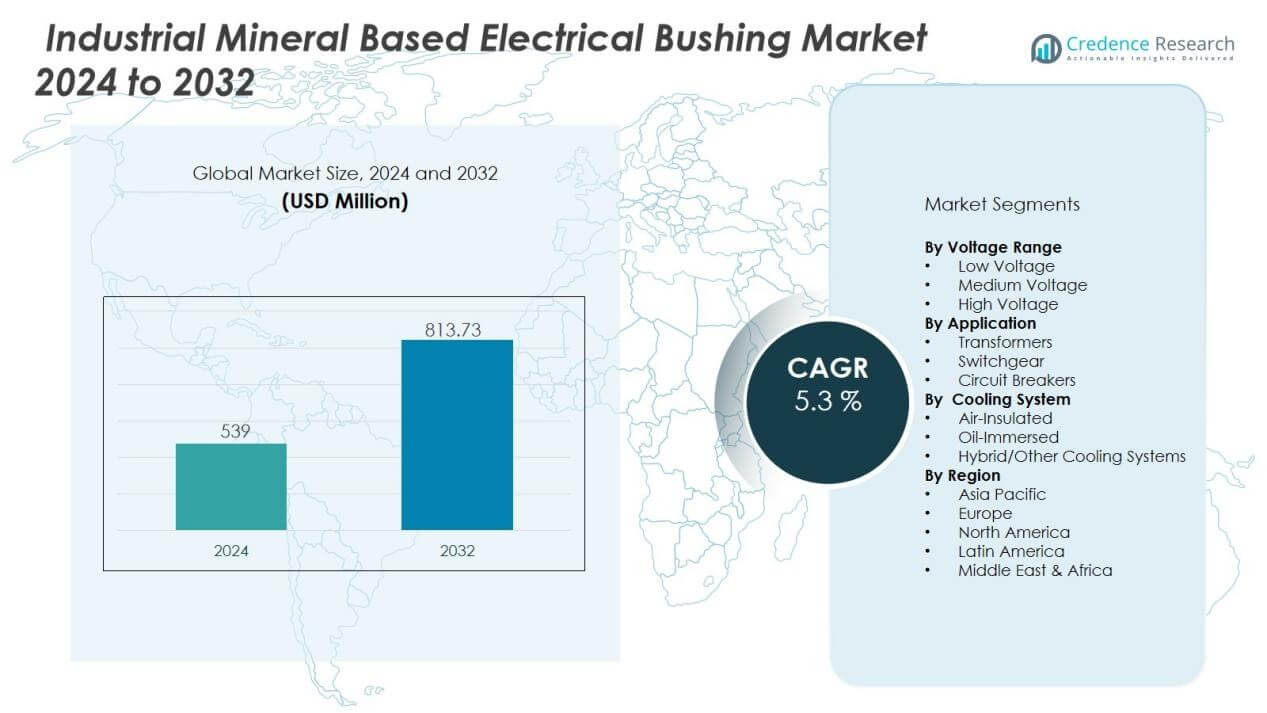
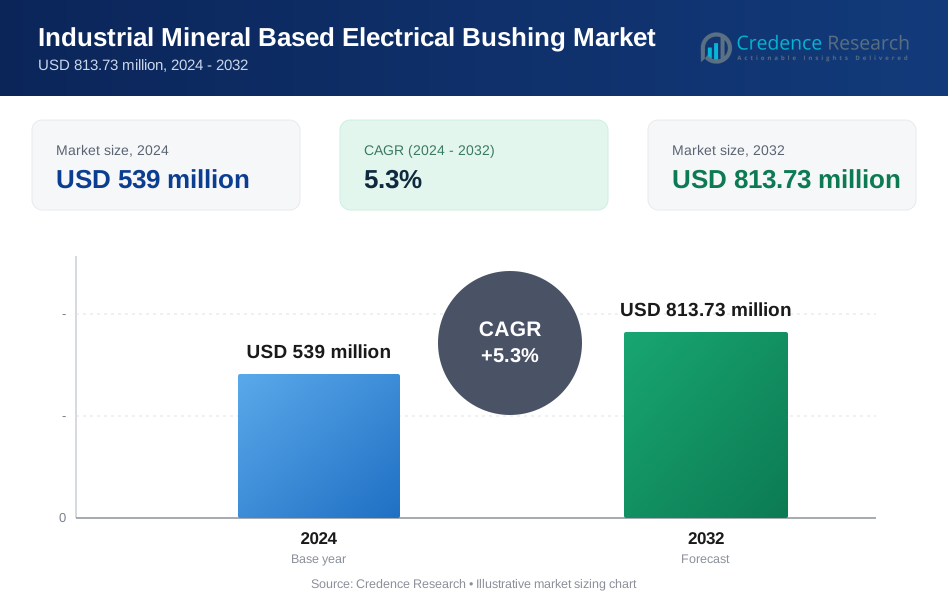
The industrial mineral based electrical bushing market size was valued at USD 539 million in 2024 and is anticipated to reach USD 813.73 million by 2032, at a CAGR of 5.3 % during the forecast period (2024-2032).
| REPORT ATTRIBUTE | DETAILS |
|---|---|
| Historical Period | 2020-2023 |
| Base Year | 2024 |
| Forecast Period | 2025-2032 |
| Industrial Mineral Based Electrical Bushing Market Size 2024 | USD 539 Million |
| Industrial Mineral Based Electrical Bushing Market, CAGR | 5.3% |
| Industrial Mineral Based Electrical Bushing Market Size 2032 | USD 813.73 Million |
Key market drivers include the growing need for durable and thermally stable insulating materials, especially under extreme voltage and temperature conditions. Mineral-based bushings offer enhanced mechanical strength, long service life, and superior dielectric properties, making them preferred over conventional alternatives. Rapid industrialization, increased energy consumption, and the global transition toward renewable energy integration are further propelling adoption. Rising concerns about system failures and safety compliance also encourage utilities and manufacturers to invest in advanced bushing technologies.
Regionally, Asia Pacific dominates the market due to extensive power grid expansion, urbanization, and high energy demand in countries like China and India. North America and Europe follow closely, supported by modernization of transmission networks and renewable energy integration. Meanwhile, the Middle East and Africa show promising potential, driven by ongoing investments in industrial infrastructure and power generation capacity.
Market Insights:
- The industrial mineral based electrical bushing market was valued at USD 539 million in 2024 and is projected to reach USD 813.73 million by 2032, growing at a CAGR of 5.3%.
- Rising demand for high-voltage insulation drives adoption, as mineral-based bushings ensure superior dielectric strength and stability under extreme stress.
- The market benefits from renewable energy expansion, with solar, wind, and hydropower projects relying on durable bushings for safe connectivity.
- Preference for long service life and compliance with global safety standards supports strong adoption across utilities and industries.
- High production costs and raw material constraints remain key challenges, restricting smaller players and increasing competitive pressure.
- Asia Pacific led with 42% market share in 2024, driven by power grid expansion, urbanization, and strong investments in China and India.
- North America captured 28% and Europe 22%, while the Middle East, Africa, and Latin America collectively held 8%, showing emerging opportunities from industrial and infrastructure growth.
Market Drivers:
Rising Demand for Reliable High-Voltage Insulation:
The industrial mineral based electrical bushing market is fueled by the need for advanced insulation in high-voltage applications. Power transmission and distribution networks require bushings that can endure extreme electrical stress without failure. Industrial mineral-based solutions provide superior dielectric strength and mechanical stability, reducing operational risks. Their ability to maintain consistent performance under demanding conditions strengthens their adoption across utilities and heavy industries.
- For instance, Hitachi Energy’s resin impregnated paper (RIP) bushings are designed to operate reliably up to 800 kV, delivering excellent dielectric strength and mechanical integrity in demanding environments.
Growth in Renewable Energy and Grid Expansion:
The transition toward renewable energy sources creates strong demand for efficient transmission systems. Wind, solar, and hydropower installations rely on durable bushings to connect high-capacity transformers and switchgear. The industrial mineral based electrical bushing market benefits from these large-scale deployments that require reliable and long-lasting insulation. Expanding grid infrastructure in developing economies further amplifies demand for mineral-based bushings.
- For instance, Siemens Energy introduced its STARON oil-impregnated paper condenser bushings with voltage ratings ranging from 25 kV to 500 kV, designed to exceed IEEE C57.19.01-2017 standards, enhancing grid performance reliability in renewable power projects.
Preference for Long Service Life and Safety Compliance:
End users prioritize products that combine durability with compliance to global safety standards. Industrial mineral-based bushings provide resistance to thermal stress, moisture, and mechanical wear, ensuring extended service life. The industrial mineral based electrical bushing market reflects this preference, as utilities and manufacturers seek solutions that minimize failures and costly downtimes. Growing emphasis on system reliability encourages adoption across energy and industrial sectors.
Rising Industrialization and Energy Consumption:
Expanding industrial sectors increase electricity consumption, placing stress on transmission systems. This creates demand for bushings that can sustain high loads while maintaining performance. The industrial mineral based electrical bushing market gains traction as manufacturers and utilities modernize equipment to handle rising power needs. It is well positioned to serve industries that depend on uninterrupted energy supply for critical operations.
 Market Trends:
Increasing Focus on Advanced Materials and Performance Optimization :
The industrial mineral based electrical bushing market is witnessing a shift toward advanced materials that enhance insulation efficiency and operational safety. Manufacturers are investing in product designs that withstand higher voltages, temperature fluctuations, and environmental stress. Innovations in composite structures and mineral formulations support improved dielectric strength and reduced energy loss. It is also experiencing demand from industries seeking components with lower maintenance needs and extended operational life. The push for high-performance bushings aligns with utilities’ goals of minimizing failures and improving grid reliability. This trend encourages suppliers to adopt material science advancements and develop products tailored to evolving industry requirements.
- For example, GE Grid Solutions provides dry-type RIP and RIF bushings equipped for indoor and outdoor use rated up to 550 kV, integrating IoT-enabled digital monitoring systems to support real-time condition analytics that help extend service intervals and reduce unexpected outages.
Integration with Renewable Energy Projects and Smart Grid Expansion :
The growth of renewable energy and smart grid infrastructure drives new opportunities for industrial mineral-based bushings. Large-scale solar, wind, and hydropower projects depend on efficient bushings that ensure safe connectivity between high-capacity equipment. The industrial mineral based electrical bushing market benefits from this integration, as energy providers seek durable solutions to handle fluctuating loads. It is also supported by digital monitoring technologies that allow real-time performance tracking and predictive maintenance. Growing adoption of smart grids strengthens the need for bushings capable of operating in complex and data-driven systems. This trend positions mineral-based bushings as essential components in the modernization of power networks worldwide.
- For instance, Siemens Energy deployed its AI-based digital twin for transformer bushings in an offshore wind farm project, achieving thermal profile inference in under 1 second.
Market Challenges Analysis:
High Production Costs and Material Limitations
The industrial mineral based electrical bushing market faces challenges linked to high production costs and raw material constraints. Manufacturing requires precision processes and high-quality minerals that increase overall expenses. It is difficult for smaller players to compete with established manufacturers that benefit from economies of scale. Limited availability of premium-grade minerals can delay production schedules and impact supply chains. These constraints make cost optimization a critical challenge for producers. Rising competition from alternative insulating materials further intensifies the pressure on market growth.
Maintenance Complexity and Technical Failures
The industrial mineral based electrical bushing market also encounters challenges from maintenance requirements and potential technical failures. Bushings must operate reliably under high stress, but exposure to moisture, contamination, or thermal cycling can reduce lifespan. It is necessary for utilities and industries to invest in regular monitoring and testing to prevent costly breakdowns. Limited awareness in some regions about advanced bushing technologies restricts adoption. Failures in high-voltage equipment can lead to safety risks, power outages, and financial losses. These operational challenges highlight the importance of continuous innovation and proper maintenance practices.
Market Opportunities:
Expansion of Renewable Energy and Grid Modernization Projects :
The industrial mineral based electrical bushing market holds strong opportunities through renewable energy integration and global grid modernization. Growing investments in wind, solar, and hydropower projects require high-performance bushings for reliable operation. It is positioned to benefit from demand in transformers, switchgear, and other critical components. The shift toward sustainable energy sources increases the need for durable insulation capable of handling fluctuating loads. Utilities are prioritizing upgrades to existing infrastructure, opening space for advanced mineral-based bushings. Expanding rural electrification programs in developing nations further support market growth.
Rising Adoption of Smart Technologies and Emerging Markets :
The industrial mineral based electrical bushing market also benefits from the rising adoption of smart technologies and expanding industrial sectors. Smart grids demand bushings integrated with monitoring systems that provide real-time data and predictive maintenance insights. It is gaining traction in emerging markets across Asia, Africa, and Latin America, where energy demand continues to rise. Industrialization and urbanization increase the need for reliable and long-lasting insulation in heavy power equipment. Partnerships with utility providers and government initiatives create opportunities for manufacturers to expand their presence. The focus on digital solutions and sustainability positions mineral-based bushings as strategic assets in the evolving energy landscape.
Market Segmentation Analysis:
By Voltage Range:
The industrial mineral based electrical bushing market is segmented into low, medium, and high voltage categories. High voltage bushings dominate due to their critical role in transmission and distribution networks. It is favored for reliability in large power transformers and substations that handle significant load capacity. Medium voltage bushings find demand in industrial facilities and regional distribution systems. Low voltage bushings serve specialized equipment and smaller-scale power systems. The growing need for stable and efficient power delivery supports demand across all voltage categories.
- For instance, Hitachi Energy Ltd.'s high-voltage bushings are designed to operate reliably up to 550 kV, with superior dielectric strength and thermal stability, widely used in HVDC transmission links and offshore substations globally.
By Cooling System:
Market segmentation by cooling system includes air-insulated, oil-immersed, and others. Oil-immersed bushings lead the segment due to superior insulation and durability under heavy loads. It is commonly deployed in transformers and high-capacity equipment requiring long-term stability. Air-insulated bushings gain traction for applications where environmental safety and maintenance ease are priorities. Other cooling systems, including hybrid models, cater to niche applications. Rising preference for systems that balance efficiency and sustainability drives innovation in this segment.
- For instance, Izolyator plant successfully ran acceptance tests of a 500 kV oil–SF6 high-voltage bushing model KTkb-90-550/1000 O, demonstrating robust insulation for heavy-duty transformer applications.
By Application:
Applications span transformers, switchgear, and circuit breakers. Transformers account for the largest share, supported by expansion in grid infrastructure and renewable integration. The industrial mineral based electrical bushing market benefits from strong adoption in switchgear, where compact and durable solutions are required. It also gains traction in circuit breakers that demand reliable insulation to prevent faults. Increasing investments in energy infrastructure reinforce growth across these applications. Strong alignment with both utility and industrial needs ensures steady demand across end uses.
Segmentations:
By Voltage Range:
- Low Voltage
- Medium Voltage
- High Voltage
By Cooling System:
- Air-Insulated
- Oil-Immersed
- Hybrid/Other Cooling Systems
By Application:
- Transformers
- Switchgear
- Circuit Breakers
By Region:
- North America
- U.S.
- Canada
- Mexico
- Europe
- UK
- France
- Germany
- Italy
- Spain
- Russia
- Belgium
- Netherlands
- Austria
- Sweden
- Poland
- Denmark
- Switzerland
- Rest of Europe
- Asia Pacific
- China
- Japan
- South Korea
- India
- Australia
- Thailand
- Indonesia
- Vietnam
- Malaysia
- Philippines
- Taiwan
- Rest of Asia Pacific
- Latin America
- Brazil
- Argentina
- Peru
- Chile
- Colombia
- Rest of Latin America
- Middle East
- UAE
- KSA
- Israel
- Turkey
- Iran
- Rest of Middle East
- Africa
- Egypt
- Nigeria
- Algeria
- Morocco
- Rest of Africa
Regional Analysis:
Asia Pacific:
Asia Pacific accounted for 42% market share in the industrial mineral based electrical bushing market in 2024, driven by rapid urbanization and energy infrastructure expansion. China and India lead the demand with large-scale investments in renewable power projects and transmission networks. It benefits from government-backed electrification programs that prioritize grid reliability and sustainability. Rising industrialization and manufacturing activities further increase electricity consumption, strengthening demand for high-performance bushings. Regional manufacturers invest in advanced production facilities to meet both domestic and export requirements. Continuous development in smart grid technology enhances the region’s role as a key growth driver.
North America and Europe:
North America captured 28% market share in 2024, while Europe accounted for 22%, reflecting steady adoption in advanced economies. The industrial mineral based electrical bushing market in these regions is driven by grid modernization, renewable energy integration, and replacement of aging infrastructure. It supports growing sustainability initiatives by providing durable and efficient insulation materials. Stringent regulatory frameworks push utilities and industries to invest in safe, reliable equipment. The presence of established manufacturers ensures continuous product innovation and supply stability. Both regions also show strong potential in smart monitoring technologies that enhance performance and reduce downtime.
Middle East, Africa, and Latin America:
The Middle East, Africa, and Latin America collectively held 8% market share in 2024, reflecting their growing role as developing markets. Expanding power generation capacity and industrial projects create opportunities for advanced bushing adoption. The industrial mineral based electrical bushing market benefits from large-scale investments in oil, gas, and renewable sectors. It aligns with government-led initiatives aimed at improving electrification rates and industrial infrastructure. Increasing foreign investments and partnerships with global suppliers support technology transfer and local production. These regions are expected to record faster growth driven by energy demand and infrastructure upgrades.
Key Player Analysis:
- Mitsubishi Electric
- Schneider Electric
- RTE
- Hyundai Electric
- Hubbell
- Eaton
- Toshiba
- ABB
- WEG
- Fuji Electric
- Hitachi
- Emerson
Competitive Analysis:
The industrial mineral based electrical bushing market is highly competitive, with global and regional players focusing on innovation and reliability. Key companies include Mitsubishi Electric, Schneider Electric, RTE, Hyundai Electric, Hubbell, Eaton, Toshiba, ABB, and WEG. These companies strengthen their positions through advanced product portfolios, strong distribution networks, and long-term utility partnerships. It is shaped by continuous investments in research and development to improve insulation performance, extend service life, and support renewable integration. Leading manufacturers emphasize safety compliance and cost efficiency, aligning with growing demand from utilities and industries. Strategic collaborations, capacity expansions, and product upgrades help them address diverse regional requirements. Companies also leverage digital monitoring technologies to differentiate offerings and enhance customer value. Strong global competition drives continuous innovation, while regional players contribute by addressing local market needs with tailored solutions.
Recent Developments:
- In May 2025, Mitsubishi Electric signed a strategic partnership with Tramec for gearmotor drive solutions.
- In August 2025, Hyundai and GM announced plans to jointly develop five new vehicles, including an electric commercial van targeted for 2028 release.
Report Coverage:
The research report offers an in-depth analysis based on Voltage Range, Cooling System, Application and Region. It details leading Market players, providing an overview of their business, product offerings, investments, revenue streams, and key applications. Additionally, the report includes insights into the competitive environment, SWOT analysis, current Market trends, as well as the primary drivers and constraints. Furthermore, it discusses various factors that have driven Market expansion in recent years. The report also explores Market dynamics, regulatory scenarios, and technological advancements that are shaping the industry. It assesses the impact of external factors and global economic changes on Market growth. Lastly, it provides strategic recommendations for new entrants and established companies to navigate the complexities of the Market.
Future Outlook:
- The industrial mineral based electrical bushing market will expand with rising investments in renewable energy and grid modernization.
- Manufacturers will prioritize advanced materials that enhance dielectric strength, thermal stability, and mechanical durability.
- It will see growing adoption in high-voltage transformers and switchgear as power demand increases.
- Digital monitoring integration will strengthen predictive maintenance capabilities and improve operational efficiency.
- Emerging economies in Asia, Africa, and Latin America will offer strong opportunities for expansion.
- Utilities will invest in replacements of aging infrastructure, driving steady demand for mineral-based bushings.
- Sustainability initiatives will encourage wider adoption of eco-friendly manufacturing and energy-efficient designs.
- Collaboration between global manufacturers and local suppliers will improve product availability and affordability.
- Continuous R&D efforts will lead to innovations that extend service life and reduce failure risks.
- The industrial mineral based electrical bushing market will remain vital for reliable power distribution worldwide.
Request a Free Sample
Fill in your details and we'll send you a free sample report.
- Sample data tables & charts
- Research methodology
Need a Custom Version of This Report?
Tailor the scope, geography, or segments to your exact requirements.
- Custom geography or segment scope
- Direct access to our analyst team
Frequently Asked Questions
What is the current market size for the Industrial Mineral Based Electrical Bushing Market, and what is its projected size in 2032?
At what Compound Annual Growth Rate is the Industrial Mineral Based Electrical Bushing Market projected to grow between 2024 and 2032?
Which Industrial Mineral Based Electrical Bushing Market segment held the largest share in 2024?
What are the primary factors fueling the growth of the Industrial Mineral Based Electrical Bushing Market?
Who are the leading companies in the Industrial Mineral Based Electrical Bushing Market?
Which region commanded the largest share of the Industrial Mineral Based Electrical Bushing Market in 2024?
Table of Content
Chapter 1. Report Introduction
- 1.1 Report Description & Purpose
- 1.1.1 Report Title & Market Definition
- 1.1.2 Unique Selling Propositions (USP) & Key Differentiators
- 1.1.3 Value Proposition for Stakeholders
- 1.2 Research Objectives
- 1.2.1 Market Sizing Objectives (Volume & Revenue)
- 1.2.2 Segmentation Objectives
- 1.2.3 Competitive Intelligence Objectives
- 1.2.4 Forecast & Scenario Objectives
- 1.3 Report Scope
- 1.3.1 Industrial Mineral Based Electrical Bushing Scope – Types & Subtypes Covered
- 1.3.2 Geographic Scope – Regions & Countries Covered
- 1.3.3 Historical Period, Base Year & Forecast Period (2024; forecast to 2032)
- 1.3.4 Inclusions & Exclusions
- 1.4 HS Code & Classification Framework
- 1.5 Currency, Units & Pricing Basis
- 1.6 Target Stakeholders
- 1.7 Limitations & Assumptions
Chapter 2. Executive Summary
- 2.1 Global Industrial Mineral Based Electrical Bushing Market Snapshot
- 2.1.1 Market Size – Historical (2024) & Forecast (2024-2032) (2024: USD 539 million → 2032: USD 813.73 million)
- 2.1.2 Volume & Revenue – Global Totals
- 2.1.3 Key Market Highlights – Top Five Facts
- 2.2 Industrial Mineral Based Electrical Bushing Market Segmentation Snapshot
- 2.2.1 Market Split by Region – 2024 vs. 2032
- 2.3 Competitive Snapshot
- 2.3.1 Top 10 Players by Revenue Share – 2024
- 2.3.2 Top 10 Players by Volume Share – 2024
- 2.3.3 Recent Strategic Developments (18-Month Summary)
- 2.4 Key Investment Highlights & Strategic Conclusions
Chapter 3. Industrial Mineral Based Electrical Bushing Market Dynamics & Industry Analysis
- 3.1 Market Overview & Context
- 3.1.1 Industrial Mineral Based Electrical Bushing Market Position in the Broader Automotive Value Chain
- 3.1.2 OEM vs. Replacement Market Dynamics
- 3.1.3 Market Maturity & Development Stage by Region
- 3.2 Industrial Mineral Based Electrical Bushing Market Drivers
- 3.3 Industrial Mineral Based Electrical Bushing Market Restraints & Challenges
- 3.4 Industrial Mineral Based Electrical Bushing Market Opportunities
- 3.5 Porter's Five Forces Analysis
- 3.5.1 Threat of New Entrants
- 3.5.2 Bargaining Power of Suppliers
- 3.5.3 Bargaining Power of Buyers
- 3.5.4 Threat of Substitutes
- 3.5.5 Competitive Rivalry – Intensity Assessment
- 3.6 Industrial Mineral Based Electrical Bushing Value Chain Analysis
- 3.6.1 Upstream – Raw Material/Input Suppliers
- 3.6.1.1 Raw Material/Input 1
- 3.6.1.2 Raw Material/Input 2
- 3.6.1.3 Raw Material/Input 3
- 3.6.2 Midstream – Production/Manufacturing/Service Delivery
- 3.6.2.1 Production/Process Overview
- 3.6.2.2 Key Facility Locations & Capacity by Manufacturer
- 3.6.3 Downstream – Distribution & End Consumer
- 3.6.3.1 Primary Channel – B2B/OEM
- 3.6.3.2 Secondary Channels – Dealer, Retail, Online, Direct
- 3.6.4 Value Chain Profitability Analysis
- 3.6.1 Upstream – Raw Material/Input Suppliers
- 3.7 PESTEL Analysis
- 3.7.1 Political Factors
- 3.7.2 Economic Factors
- 3.7.3 Social Factors
- 3.7.4 Technological Factors
- 3.7.5 Environmental Factors
- 3.7.6 Legal Factors
- 3.8 Industrial Mineral Based Electrical Bushing Supply Chain Analysis
- 3.8.1 Raw Material/Input Supply Risk Assessment
- 3.8.2 Manufacturing Concentration Risk (Geographic Exposure)
- 3.8.3 Trade Disruption Impact Analysis
- 3.9 Regulatory & Policy Landscape
Note: The regulatory and policy landscape section covers regulations based on their applicability to the market, Industrial Mineral Based Electrical Bushing category, geography, and scope of the study. Only regulatory frameworks with a material impact on operations, compliance, trade, sustainability, or market access are analyzed in detail.
Chapter 4. Key Investment Pockets & Opportunity Analysis
- 4.1 Industrial Mineral Based Electrical Bushing Market Attractiveness Analysis
- 4.1.1 By Region – Investment Attractiveness Matrix (Volume × CAGR)
- 4.2 Absolute Revenue Growth Opportunity
- 4.2.1 By Region – Absolute USD Growth Through 2032
- 4.3 Incremental Volume Opportunity
- 4.3.1 By Region – Incremental Volume Through 2032
- 4.3.2 Segment – Incremental Volume
- 4.4 Emerging Submarket Opportunity Deep Dive (Subject to Applicability)
- 4.5 Emerging Market Opportunity Scorecards
- 4.5.1 United States
- 4.5.2 Europe
- 4.5.3 Asia
- 4.5.4 Middle East & Africa
Note: Emerging Market Opportunity Scorecards will be included based on relevance and strategic importance. Regions listed are indicative and may vary depending on data availability and market dynamics.
Chapter 5. Industrial Mineral Based Electrical Bushing Import-Export Analysis & Trade Flows
- 5.1 Global Trade Overview
- 5.1.1 Global Export Value by Country (2024)
- 5.1.2 Global Export Volume by Country (2024)
- 5.1.3 Global Import Value by Country (2024)
- 5.1.4 Global Import Volume by Country (2024)
- 5.1.5 Net Trade Balance by Country (2024)
- 5.2 Export Analysis – Segment
- 5.2.1 Type 1 (HS Code)
- 5.2.2 Type 2 (HS Code)
- 5.2.3 Type 3 (HS Code)
- 5.2.4 Type 4 (HS Code)
- 5.2.5 Type 5 (HS Code)
- 5.3 Import Analysis – Segment
- 5.3.1 Type 1 (HS Code)
- 5.3.2 Type 2 (HS Code)
- 5.3.3 Type 3 (HS Code)
- 5.3.4 Type 4 (HS Code)
- 5.3.5 Type 5 (HS Code)
- 5.4 Average Unit Trade Prices
- 5.4.1 Average Export Price – Segment & Country
- 5.4.2 Average Import Price – Segment & Source Country
- 5.4.3 Price Trends (2024)
- 5.5 Key Trade Route Analysis
- 5.5.1 Trade Route 1
- 5.5.2 Trade Route 2
- 5.5.3 Trade Route 3
- 5.5.4 Trade Route 4
- 5.5.5 Trade Route 5
- 5.6 Trade Policy Impact Assessment
- 5.6.1 US Anti-Dumping & Section 301 Tariffs
- 5.6.2 EU Customs Union Impact
- 5.6.3 Major Free Trade Agreements
- 5.6.4 USMCA Rules of Origin
Note: Trade policy analysis will be included only where relevant to the Industrial Mineral Based Electrical Bushing market.
Chapter 6. Competitive Landscape & Company Benchmarking
- 6.1 Industrial Mineral Based Electrical Bushing Market Concentration & Structure
- 6.1.1 Herfindahl-Hirschman Index (HHI) – vs. 2024
- 6.1.2 Tier 1, Tier 2 & Tier 3 Market Structure
- 6.1.3 Global, Regional & Local Player Dynamics
- 6.2 Industrial Mineral Based Electrical Bushing Market Share Analysis – 2024
- 6.2.1 Global Revenue Share by Company
- 6.2.2 Global Volume Share by Company
- 6.2.3 Regional Revenue Share
- 6.2.4 Market Share Evolution ( vs. 2024)
- 6.2.5 OEM Segment Share by Company
- 6.2.6 Replacement Segment Share by Company
- 6.3 Production/Delivery Capacity & Facility Analysis
- 6.3.1 Global Installed Capacity
- 6.3.2 Capacity Utilization Rates
- 6.3.3 Production/Output Volume
- 6.3.4 Facility Locations & Capacity Map
- 6.3.5 Planned Capacity Additions
- 6.4 Industrial Mineral Based Electrical Bushing Competitive Benchmarking Matrix
- 6.4.1 Revenue, Volume, CAGR & Profitability Comparison
- 6.4.2 Channel Revenue Mix
- 6.4.3 Geographic Revenue Exposure
- 6.4.4 R&D Intensity
- 6.4.5 Sustainability Maturity
- 6.5 Strategic Developments in Industrial Mineral Based Electrical Bushing (Last 24 Months)
- 6.5.1 Mergers, Acquisitions & Divestments
- 6.5.2 New Industrial Mineral Based Electrical Bushing Launches
- 6.5.3 Facility Expansions
- 6.5.4 Strategic Alliances, Joint Ventures & Partnerships
- 6.5.5 Distribution Expansion & Market Entry
- 6.5.6 Sustainability & ESG Initiatives
- 6.6 Competitive Strategy Mapping
- 6.6.1 Leader, Challenger, Follower & Niche Classification
- 6.6.2 Pricing Strategy Comparison
- 6.6.3 Channel Strategy Matrix
Note: Strategic developments are included based on their materiality and the availability of reliable information.
Chapter 7. Global Industrial Mineral Based Electrical Bushing Market – By Distribution Channel
- 7.1 Segment Overview
- 7.1.1 Volume & Revenue Split by Channel (2024 & 2032)
- 7.1.2 Channel Mix Evolution (2024-2032)
Chapter 8. Regional Market Analysis – Global Overview
- 8.1 Global Regional Overview
- 8.1.1 Regional Volume Share
- 8.1.2 Regional Revenue Share
- 8.1.3 Regional Volume by Region
- 8.1.4 Regional Revenue by Region
- 8.1.5 Regional Forecast Through 2032
- 8.2 Cross-Regional Segment Analysis
- 8.2.1 By Distribution Channel
- 8.2.2 By Brand/Price Tier
Chapter 9. North America Industrial Mineral Based Electrical Bushing Market
- 9.1 United States
- 9.2 Canada
- 9.3 Mexico
Chapter 10. Europe Industrial Mineral Based Electrical Bushing Market
- 10.1 Germany
- 10.2 France
- 10.3 Italy
- 10.4 United Kingdom
- 10.5 Spain
- 10.6 Poland
- 10.7 Russia
- 10.8 Netherlands
- 10.9 Belgium
- 10.10 Sweden
- 10.11 Denmark
- 10.12 Norway
- 10.13 Rest of Europe
Chapter 11. Asia Pacific Industrial Mineral Based Electrical Bushing Market
- 11.1 China
- 11.2 India
- 11.3 Japan
- 11.4 South Korea
- 11.5 Thailand
- 11.6 Indonesia
- 11.7 Vietnam
- 11.8 Malaysia
- 11.9 Australia
- 11.10 Rest of Asia Pacific
Chapter 12. Latin America Industrial Mineral Based Electrical Bushing Market
- 12.1 Brazil
- 12.2 Argentina
- 12.3 Colombia
- 12.4 Chile
- 12.5 Rest of Latin America
Chapter 13. Middle East Industrial Mineral Based Electrical Bushing Market
- 13.1 Saudi Arabia
- 13.2 United Arab Emirates
- 13.3 Turkey
- 13.4 Israel
- 13.5 Iran
- 13.6 Rest of the Middle East
Chapter 14. Africa Industrial Mineral Based Electrical Bushing Market
- 14.1 South Africa
- 14.2 Egypt
- 14.3 Nigeria
- 14.4 Morocco
- 14.5 Rest of Africa
Chapter 15. Industrial Mineral Based Electrical Bushing Company Profiles
- 15.1 [Company 01]
- 15.1.1 Company Overview
- 15.1.2 Key Management Personnel
- 15.1.3 Products & Services Portfolio
- 15.1.4 Financial Performance
- 15.1.5 Key Market Focus & Geographic Presence
- 15.1.6 Recent Developments & Strategic Initiatives
Note: The company profile list is preliminary and may change based on research findings, market developments, data availability, and client requirements.
Chapter 16. Appendices
- Appendix A – List of Abbreviations & Acronyms
- Appendix B – Industry Classification Code Reference – Full Series
- Appendix C – Production & Capacity Data Tables
- Appendix D – End-Use & Demand Base Tables
- Appendix E – Consumption & Replacement Rate Assumptions
- Appendix F – ASP Reference Tables
- Appendix G – Manufacturing & Facility Database
- Appendix H – Import-Export Data Tables
- Appendix I – Regulatory Summary Tables
- Appendix J – Primary Research Participant List (Anonymized)
- Appendix K – Primary Research Questionnaire Framework
- Appendix L – Data Sources & Bibliography
- Appendix M – Market Size Divergence & Source Comparison
Chapter 17. Research Methodology
- 17.1 Research Framework & Philosophy
- 17.2 Secondary Research – Sources, Hierarchy & Data Extraction
- 17.3 Data Modeling – Bottom-Up & Top-Down Market Sizing
- 17.4 Primary Research – Stakeholder Framework, LOI & Sample Sizes
- 17.5 Forecast Methodology – Regression, Scenario & Sensitivity Analysis
- 17.6 Quality Control – Four-Layer Validation Framework
- 17.7 Limitations & Standard Assumptions
- 17.8 Disclaimer
