
Market Overview:
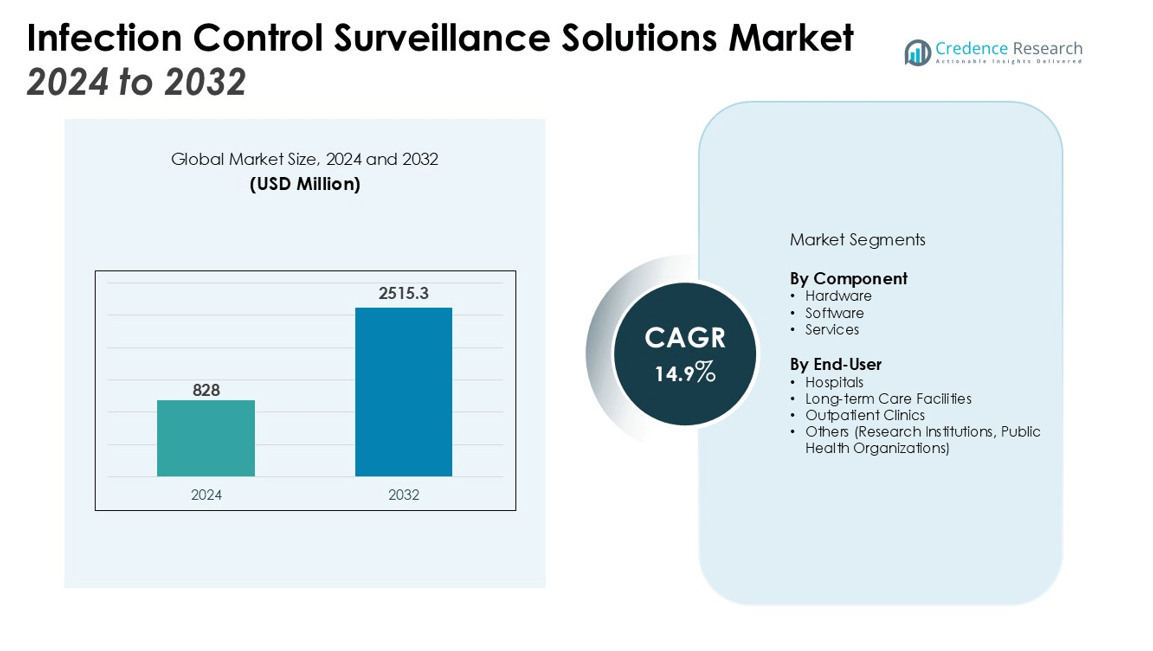
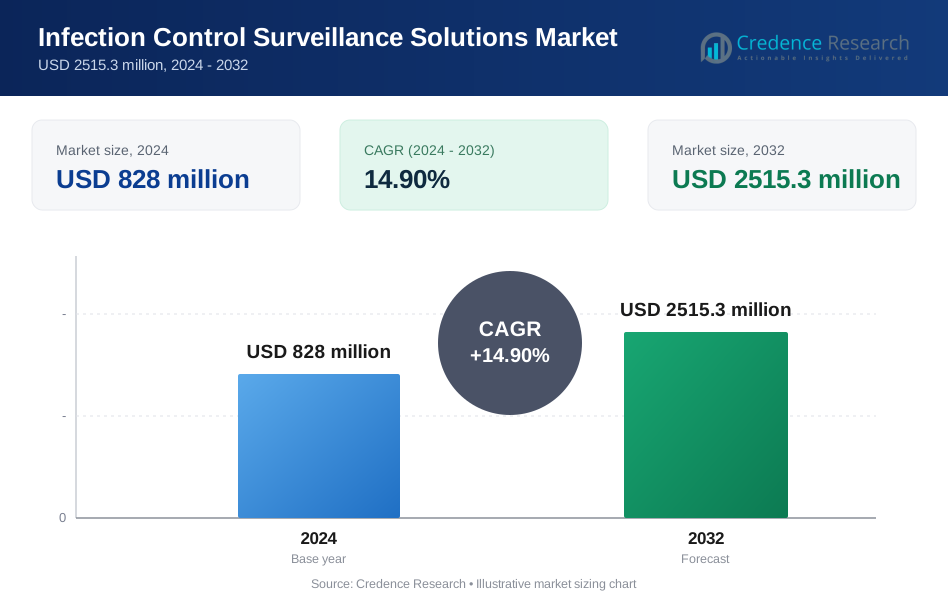
The Infection Control Surveillance Solutions Market size was valued at USD 828 million in 2024 and is anticipated to reach USD 2515.3 million by 2032, at a CAGR of 14.9% during the forecast period (2024-2032).
| REPORT ATTRIBUTE | DETAILS |
|---|---|
| Historical Period | 2020-2023 |
| Base Year | 2024 |
| Forecast Period | 2025-2032 |
| Infection Control Surveillance Solutions Market Size 2024 | USD 828 million |
| Infection Control Surveillance Solutions Market, CAGR | 14.9% |
| Infection Control Surveillance Solutions Market Size 2032 | USD 2515.3 million |
Key market drivers include the growing prevalence of infectious diseases, an aging population, and the increasing adoption of advanced technologies for infection monitoring. Stringent government regulations and the need for improved patient safety standards further drive demand for infection control surveillance solutions. Additionally, healthcare facilities are increasingly adopting digital solutions, such as real-time monitoring systems, predictive analytics, and automated reporting tools, which enhance infection prevention measures and improve operational efficiency. The integration of artificial intelligence (AI) and machine learning in these solutions is also bolstering market growth by providing more accurate predictions and better decision-making capabilities.
Regionally, North America dominates the Infection Control Surveillance Solutions Market, accounting for the largest market share, owing to robust healthcare infrastructure and government initiatives promoting patient safety. The Asia-Pacific region is expected to witness the highest growth during the forecast period, driven by expanding healthcare infrastructure, rising awareness about infection control, and increasing investments in healthcare technology. Europe holds a significant share due to stringent regulatory frameworks and the adoption of advanced healthcare solutions. The rising focus on public health in emerging economies further boosts market potential in these regions.
Market Insights:
- The Infection Control Surveillance Solutions Market was valued at USD 828 million in 2024 and is expected to reach USD 2515.3 million by 2032, growing at a CAGR of 14.9% from 2024 to 2032.
- Key market drivers include the rising prevalence of infectious diseases such as COVID-19, tuberculosis, and healthcare-associated infections (HAIs), increasing the demand for advanced monitoring systems in healthcare settings.
- An aging population worldwide contributes to heightened vulnerability to infections, pushing the demand for infection control surveillance systems in hospitals and long-term care facilities.
- Technological advancements, including real-time monitoring, predictive analytics, AI, and machine learning, enhance the effectiveness of infection control systems, improving operational efficiency and decision-making.
- Stringent government regulations and the emphasis on patient safety standards continue to drive market demand as healthcare facilities adopt surveillance solutions to comply with infection control protocols.
- High initial implementation costs and budget constraints remain significant challenges for smaller healthcare facilities, limiting the widespread adoption of infection control solutions, particularly in developing regions.
- North America leads the market with a 40% share, followed by Europe at 30%, driven by strong healthcare infrastructure, stringent regulations, and government initiatives. The Asia-Pacific region holds 20% of the market, with rapid growth anticipated due to expanding healthcare infrastructure and rising investments.
Market Drivers:
Rising Prevalence of Infectious Diseases
The growing incidence of infectious diseases worldwide plays a significant role in driving the demand for Infection Control Surveillance Solutions. The global rise in diseases such as COVID-19, tuberculosis, and healthcare-associated infections (HAIs) has prompted healthcare facilities to adopt advanced surveillance systems. These solutions enable real-time tracking, early detection, and prevention, essential for curbing the spread of infections in hospitals and clinics. As new pathogens emerge, the demand for efficient monitoring and control systems continues to increase.
- For instance, following state mandates requiring data submission, the use of surveillance solutions in neonatal ICUs was associated with a drop in central line-associated bloodstream infection rates for the smallest infants from 5.7 to 2.4 per 1,000 central line-days.
Aging Population and Increased Vulnerability
An aging population worldwide contributes to a heightened vulnerability to infections, further fueling the need for infection control surveillance. Older adults are more susceptible to infections due to weakened immune systems, chronic illnesses, and frequent hospital visits. Infection Control Surveillance Solutions assist in managing these risks, especially in long-term care settings and hospitals, by ensuring that infection prevention protocols are strictly followed and monitored. This growing demographic makes infection control a priority for healthcare providers.
- For instance, Hartsfield Village, a retirement community, uses the Surfacide Helios® system, a set of three UV-C emitting robots, to disinfect resident rooms and common areas to prevent infections.
Technological Advancements in Infection Monitoring
Technological advancements in surveillance systems are transforming infection control. Innovations such as real-time monitoring, predictive analytics, and automated reporting have significantly improved the effectiveness of infection prevention measures. Infection Control Surveillance Solutions now integrate artificial intelligence (AI) and machine learning, enabling more accurate predictions, faster decision-making, and optimized resource allocation. These advancements enhance operational efficiency and streamline infection control practices in healthcare facilities.
Government Regulations and Patient Safety Standards
Stringent government regulations and increasing patient safety standards are key drivers for the Infection Control Surveillance Solutions Market. Governments worldwide are implementing and enforcing laws to reduce the incidence of healthcare-associated infections, which prompts hospitals and healthcare providers to adopt surveillance technologies. These solutions help meet compliance requirements and support quality assurance, ultimately improving patient safety and the overall standard of care.
Market Trends:
Integration of Artificial Intelligence and Predictive Analytics
The integration of artificial intelligence (AI) and predictive analytics is one of the most prominent trends shaping the Infection Control Surveillance Solutions Market. Healthcare facilities are increasingly adopting these technologies to enhance infection monitoring and prevention. AI-driven systems can analyze large volumes of data quickly and accurately, identifying patterns that might be missed by traditional methods. Predictive analytics helps forecast potential outbreaks, enabling proactive measures to be taken before infections spread. This trend enhances decision-making processes, improves resource management, and reduces human error in infection control practices, driving greater efficiency and effectiveness in healthcare settings.
- For instance, UnityPoint Health, a 39-hospital system, cut its spending by $32 million within a single year by implementing AI-enabled care management improvements.
Expansion of Cloud-Based Solutions for Real-Time Monitoring
Cloud-based solutions are gaining traction in the Infection Control Surveillance Solutions Market due to their ability to provide real-time monitoring and data access across healthcare networks. These platforms offer greater scalability and flexibility compared to traditional on-premise systems, making it easier for healthcare providers to integrate infection control tools into their existing infrastructure. Cloud-based solutions enable continuous tracking of infection rates and real-time alerts, allowing for swift responses to potential outbreaks. The growing adoption of these systems is also driven by the increasing need for data interoperability and collaboration among healthcare organizations, making cloud platforms an essential part of modern infection control strategies.
- For instance, after adopting Premier Inc.'s clinical surveillance tool powered by TheraDoc®, Hartford HealthCare was able to save its infection prevention staff an average of 10 hours per week on surveillance tasks.
Market Challenges Analysis:
High Implementation Costs and Budget Constraints
One of the key challenges in the Infection Control Surveillance Solutions Market is the high initial implementation costs. Healthcare facilities, especially smaller hospitals or clinics, often face budget constraints when adopting advanced infection control technologies. The cost of purchasing, installing, and maintaining these systems can be prohibitive, limiting their widespread adoption. Many organizations prioritize other healthcare needs, which makes it challenging for infection control solutions to secure the necessary funding. This cost barrier can slow market growth, particularly in developing regions where financial limitations are more prevalent.
Data Privacy and Compliance Issues
Data privacy and regulatory compliance pose significant challenges in the Infection Control Surveillance Solutions Market. These solutions generate vast amounts of sensitive patient data, which must be securely stored and protected in accordance with healthcare data privacy regulations such as HIPAA in the U.S. and GDPR in Europe. Ensuring compliance with these regulations while maintaining the functionality of surveillance systems can be complex and costly. Healthcare providers must also ensure that the systems they implement meet stringent quality and security standards, which may involve frequent updates and audits, further complicating the adoption process.
Market Opportunities:
Growing Adoption of Remote Monitoring and Telemedicine
The growing adoption of remote monitoring and telemedicine presents a significant opportunity for the Infection Control Surveillance Solutions Market. With the rising demand for remote healthcare services, infection control solutions integrated with telemedicine platforms can enable real-time monitoring of patients and healthcare environments. This shift allows for continuous surveillance without requiring physical presence, offering greater flexibility for healthcare providers. The ability to track and manage infections remotely enhances efficiency, reduces the risk of cross-contamination, and supports timely interventions, opening up new avenues for market expansion.
Expanding Healthcare Infrastructure in Emerging Markets
The expansion of healthcare infrastructure in emerging markets provides a key opportunity for the Infection Control Surveillance Solutions Market. Countries in Asia-Pacific, Latin America, and the Middle East are investing heavily in healthcare development, driving the demand for advanced infection control solutions. As these regions expand healthcare facilities and improve standards, the need for infection prevention systems will continue to rise. This growth is supported by government initiatives and international collaborations that emphasize improving healthcare quality and safety, creating a favorable environment for the adoption of surveillance solutions.
Market Segmentation Analysis:
By Component
The Infection Control Surveillance Solutions Market is segmented by component into hardware, software, and services. Software solutions dominate the market, accounting for the largest share due to the increasing demand for advanced infection monitoring and analytics tools. These software systems provide real-time tracking, predictive analytics, and automated reporting, enhancing operational efficiency in healthcare settings. Hardware, including sensors and devices used for infection detection, is expected to experience steady growth as healthcare providers integrate more IoT-enabled technologies into infection control systems. Services, such as installation, maintenance, and consulting, also contribute significantly to market growth, as healthcare facilities seek expert support to optimize surveillance systems.
- For instance, a healthcare manager using Wolters Kluwer's Sentri7 Infection Prevention software reported that a surveillance task that previously took ten hours manually could be completed in just one hour.
By End-User
The market is segmented by end-user into hospitals, long-term care facilities, outpatient clinics, and others. Hospitals hold the largest market share, driven by the high need for infection control in intensive care units (ICUs) and operating rooms, where infection risks are more significant. Long-term care facilities follow closely, where aging populations are more susceptible to infections, increasing the demand for surveillance systems. Outpatient clinics are increasingly adopting infection control solutions to ensure patient safety and minimize the risk of cross-contamination. The “Others” category includes research institutions and public health organizations, which also contribute to market growth through the implementation of surveillance systems for broader infection control efforts.
- For instance, the landmark Study on the Efficacy of Nosocomial Infection Control (SENIC) established a key benchmark for hospitals, recommending at least 1 infection control professional for every 250 occupied beds to effectively manage infection prevention programs.
Segmentations:
By Component:
- Hardware
- Software
- Services
By End-User:
- Hospitals
- Long-term Care Facilities
- Outpatient Clinics
- Others (Research Institutions, Public Health Organizations)
By Region:
- North America
- U.S.
- Canada
- Mexico
- Europe
- UK
- France
- Germany
- Italy
- Spain
- Russia
- Belgium
- Netherlands
- Austria
- Sweden
- Poland
- Denmark
- Switzerland
- Rest of Europe
- Asia Pacific
- China
- Japan
- South Korea
- India
- Australia
- Thailand
- Indonesia
- Vietnam
- Malaysia
- Philippines
- Taiwan
- Rest of Asia Pacific
- Latin America
- Brazil
- Argentina
- Peru
- Chile
- Colombia
- Rest of Latin America
- Middle East
- UAE
- KSA
- Israel
- Turkey
- Iran
- Rest of Middle East
- Africa
- Egypt
- Nigeria
- Algeria
- Morocco
- Rest of Africa
Regional Analysis:
North America: Market Leadership and Regulatory Support
North America dominates the Infection Control Surveillance Solutions Market, holding a share of 40%. This dominance is driven by strong healthcare infrastructure, strict regulatory requirements, and government initiatives aimed at improving patient safety. In the United States, hospitals must comply with rigorous infection control protocols, further boosting demand for surveillance solutions. The prevalence of healthcare-associated infections (HAIs) also contributes to the increasing adoption of these systems. The region's commitment to advancing healthcare technology and regulatory compliance ensures a continued upward trend in the market.
Europe: Strong Regulatory Framework and Healthcare Advancements
Europe accounts for 30% of the Infection Control Surveillance Solutions Market, supported by its stringent healthcare regulations and advanced medical infrastructure. Countries such as Germany, the United Kingdom, and France have strict standards that mandate healthcare facilities to implement infection control measures. The region’s focus on healthcare digitization further supports the growth of surveillance solutions, as facilities integrate advanced technologies to improve infection monitoring and prevention. Growing concerns about HAIs and patient safety drive the demand for more sophisticated infection control systems, which is expected to rise steadily.
Asia-Pacific: Rapid Growth and Healthcare Infrastructure Development
The Asia-Pacific region holds 20% of the Infection Control Surveillance Solutions Market and is anticipated to experience the highest growth rate. The rapid development of healthcare infrastructure, particularly in China, India, and Japan, is a key factor driving this expansion. Increasing government investments in healthcare, combined with rising awareness of infection control, are major contributors to the market's growth. As the region prioritizes improving healthcare standards, the adoption of infection control surveillance solutions is expected to rise significantly, creating new opportunities for market players.
Key Player Analysis:
- GOJO Industries, Inc.
- Premier, Inc.
- CenTrak, Inc.
- Ecolab Inc.
- Baxter International Inc.
- Roper Technologies
- Cerner Corporation
- Becton, Dickinson and Company (BD)
- Sunquest
- IBM Corporation
- OASIS Medical
- Harris Healthcare
Competitive Analysis:
The Infection Control Surveillance Solutions Market is highly competitive, with key players including Becton, Dickinson and Company (BD), Premier, Inc., Wolters Kluwer N.V., Cerner Corporation (Oracle), Baxter International Inc., GOJO Industries, Inc., RLDatix, VigiLanz Corporation, Truven Health Analytics (IBM Watson Health), and Ecolab Inc. These companies dominate the market by offering advanced infection control solutions, such as real-time monitoring, predictive analytics, and automated reporting. They focus on product innovation and strategic partnerships to strengthen their market positions. The integration of technologies like artificial intelligence and machine learning in surveillance systems is gaining momentum, allowing companies to provide more accurate and efficient solutions. With healthcare providers prioritizing patient safety and regulatory compliance, competition within the market is intensifying, and demand for infection control solutions is expected to grow steadily.
Recent Developments:
- In April 2025, Baxter International Inc. launched a new, room-temperature formulation of its Hemopatch Sealing Hemostat in Europe, which helps control bleeding during surgical procedures.
- In July 2025, Becton, Dickinson and Company (BD) agreed to a $17.5 billion deal to merge its biosciences and diagnostic solutions arm with Waters Corporation.
- In September 2025, IBM launched a new brand campaign called "Let's create smarter business," focused on highlighting the application of enterprise-grade AI.
Report Coverage:
The research report offers an in-depth analysis based on Component, End-User and Region. It details leading market players, providing an overview of their business, product offerings, investments, revenue streams, and key applications. Additionally, the report includes insights into the competitive environment, SWOT analysis, current market trends, as well as the primary drivers and constraints. Furthermore, it discusses various factors that have driven market expansion in recent years. The report also explores market dynamics, regulatory scenarios, and technological advancements that are shaping the industry. It assesses the impact of external factors and global economic changes on market growth. Lastly, it provides strategic recommendations for new entrants and established companies to navigate the complexities of the market.
Future Outlook:
- The Infection Control Surveillance Solutions Market will continue to expand as healthcare providers focus more on improving patient safety and reducing healthcare-associated infections (HAIs).
- The integration of artificial intelligence and machine learning into infection monitoring systems will lead to more accurate predictions and proactive prevention measures.
- Adoption of real-time monitoring systems across healthcare facilities will rise, enhancing the ability to track infections and respond quickly to outbreaks.
- Cloud-based solutions will see increased demand due to their scalability, flexibility, and ability to support real-time data access and collaboration.
- The Asia-Pacific region will experience significant growth as healthcare infrastructure improves, and awareness of infection control measures increases.
- The aging global population will drive demand for advanced infection control surveillance, especially in long-term care facilities and hospitals.
- Enhanced government regulations and healthcare standards will push for more stringent infection control measures, increasing the need for reliable surveillance solutions.
- Hospitals will continue to be the largest end-users, with a growing focus on infection prevention in intensive care units (ICUs) and operating rooms.
- Strategic collaborations between healthcare technology providers and healthcare institutions will foster the development of more effective infection surveillance tools.
- Investment in infection control technologies will rise as healthcare facilities seek to reduce costs associated with HAIs and improve operational efficiency.
Request a Free Sample
Fill in your details and we'll send you a free sample report.
- Sample data tables & charts
- Research methodology
Need a Custom Version of This Report?
Tailor the scope, geography, or segments to your exact requirements.
- Custom geography or segment scope
- Direct access to our analyst team
Frequently Asked Questions
What is the current market size for Infection Control Surveillance Solutions, and what is its projected size in 2032?
Which Infection Control Surveillance Solutions market segment held the largest share in 2024?
What are the primary factors fueling the growth of the Infection Control Surveillance Solutions market?
Who are the leading companies in the Infection Control Surveillance Solutions market?
Table of Content
Chapter 1. Report Introduction
- 1.1 Report Description & Purpose
- 1.1.1 Report Title & Market Definition
- 1.1.2 Unique Selling Propositions (USP) & Key Differentiators
- 1.1.3 Value Proposition for Stakeholders
- 1.2 Research Objectives
- 1.2.1 Market Sizing Objectives (Volume & Revenue)
- 1.2.2 Segmentation Objectives
- 1.2.3 Competitive Intelligence Objectives
- 1.2.4 Forecast & Scenario Objectives
- 1.3 Report Scope
- 1.3.1 Infection Control Surveillance Solutions Scope – Types & Subtypes Covered
- 1.3.2 Geographic Scope – Regions & Countries Covered
- 1.3.3 Historical Period, Base Year & Forecast Period (2024; forecast to 2032)
- 1.3.4 Inclusions & Exclusions
- 1.4 HS Code & Classification Framework
- 1.5 Currency, Units & Pricing Basis
- 1.6 Target Stakeholders
- 1.7 Limitations & Assumptions
Chapter 2. Executive Summary
- 2.1 Global Infection Control Surveillance Solutions Market Snapshot
- 2.1.1 Market Size – Historical (2024) & Forecast (2024-2032) (2024: USD 828 million → 2032: USD 2515.3 million)
- 2.1.2 Volume & Revenue – Global Totals
- 2.1.3 Key Market Highlights – Top Five Facts
- 2.2 Infection Control Surveillance Solutions Market Segmentation Snapshot
- 2.2.1 Market Split by Region – 2024 vs. 2032
- 2.3 Competitive Snapshot
- 2.3.1 Top 10 Players by Revenue Share – 2024
- 2.3.2 Top 10 Players by Volume Share – 2024
- 2.3.3 Recent Strategic Developments (18-Month Summary)
- 2.4 Key Investment Highlights & Strategic Conclusions
Chapter 3. Infection Control Surveillance Solutions Market Dynamics & Industry Analysis
- 3.1 Market Overview & Context
- 3.1.1 Infection Control Surveillance Solutions Market Position in the Broader Automotive Value Chain
- 3.1.2 OEM vs. Replacement Market Dynamics
- 3.1.3 Market Maturity & Development Stage by Region
- 3.2 Infection Control Surveillance Solutions Market Drivers
- 3.3 Infection Control Surveillance Solutions Market Restraints & Challenges
- 3.4 Infection Control Surveillance Solutions Market Opportunities
- 3.5 Porter's Five Forces Analysis
- 3.5.1 Threat of New Entrants
- 3.5.2 Bargaining Power of Suppliers
- 3.5.3 Bargaining Power of Buyers
- 3.5.4 Threat of Substitutes
- 3.5.5 Competitive Rivalry – Intensity Assessment
- 3.6 Infection Control Surveillance Solutions Value Chain Analysis
- 3.6.1 Upstream – Raw Material/Input Suppliers
- 3.6.1.1 Raw Material/Input 1
- 3.6.1.2 Raw Material/Input 2
- 3.6.1.3 Raw Material/Input 3
- 3.6.2 Midstream – Production/Manufacturing/Service Delivery
- 3.6.2.1 Production/Process Overview
- 3.6.2.2 Key Facility Locations & Capacity by Manufacturer
- 3.6.3 Downstream – Distribution & End Consumer
- 3.6.3.1 Primary Channel – B2B/OEM
- 3.6.3.2 Secondary Channels – Dealer, Retail, Online, Direct
- 3.6.4 Value Chain Profitability Analysis
- 3.6.1 Upstream – Raw Material/Input Suppliers
- 3.7 PESTEL Analysis
- 3.7.1 Political Factors
- 3.7.2 Economic Factors
- 3.7.3 Social Factors
- 3.7.4 Technological Factors
- 3.7.5 Environmental Factors
- 3.7.6 Legal Factors
- 3.8 Infection Control Surveillance Solutions Supply Chain Analysis
- 3.8.1 Raw Material/Input Supply Risk Assessment
- 3.8.2 Manufacturing Concentration Risk (Geographic Exposure)
- 3.8.3 Trade Disruption Impact Analysis
- 3.9 Regulatory & Policy Landscape
Note: The regulatory and policy landscape section covers regulations based on their applicability to the market, Infection Control Surveillance Solutions category, geography, and scope of the study. Only regulatory frameworks with a material impact on operations, compliance, trade, sustainability, or market access are analyzed in detail.
Chapter 4. Key Investment Pockets & Opportunity Analysis
- 4.1 Infection Control Surveillance Solutions Market Attractiveness Analysis
- 4.1.1 By Region – Investment Attractiveness Matrix (Volume × CAGR)
- 4.2 Absolute Revenue Growth Opportunity
- 4.2.1 By Region – Absolute USD Growth Through 2032
- 4.3 Incremental Volume Opportunity
- 4.3.1 By Region – Incremental Volume Through 2032
- 4.3.2 Segment – Incremental Volume
- 4.4 Emerging Submarket Opportunity Deep Dive (Subject to Applicability)
- 4.5 Emerging Market Opportunity Scorecards
- 4.5.1 United States
- 4.5.2 Europe
- 4.5.3 Asia
- 4.5.4 Middle East & Africa
Note: Emerging Market Opportunity Scorecards will be included based on relevance and strategic importance. Regions listed are indicative and may vary depending on data availability and market dynamics.
Chapter 5. Infection Control Surveillance Solutions Import-Export Analysis & Trade Flows
- 5.1 Global Trade Overview
- 5.1.1 Global Export Value by Country (2024)
- 5.1.2 Global Export Volume by Country (2024)
- 5.1.3 Global Import Value by Country (2024)
- 5.1.4 Global Import Volume by Country (2024)
- 5.1.5 Net Trade Balance by Country (2024)
- 5.2 Export Analysis – Segment
- 5.2.1 Type 1 (HS Code)
- 5.2.2 Type 2 (HS Code)
- 5.2.3 Type 3 (HS Code)
- 5.2.4 Type 4 (HS Code)
- 5.2.5 Type 5 (HS Code)
- 5.3 Import Analysis – Segment
- 5.3.1 Type 1 (HS Code)
- 5.3.2 Type 2 (HS Code)
- 5.3.3 Type 3 (HS Code)
- 5.3.4 Type 4 (HS Code)
- 5.3.5 Type 5 (HS Code)
- 5.4 Average Unit Trade Prices
- 5.4.1 Average Export Price – Segment & Country
- 5.4.2 Average Import Price – Segment & Source Country
- 5.4.3 Price Trends (2024)
- 5.5 Key Trade Route Analysis
- 5.5.1 Trade Route 1
- 5.5.2 Trade Route 2
- 5.5.3 Trade Route 3
- 5.5.4 Trade Route 4
- 5.5.5 Trade Route 5
- 5.6 Trade Policy Impact Assessment
- 5.6.1 US Anti-Dumping & Section 301 Tariffs
- 5.6.2 EU Customs Union Impact
- 5.6.3 Major Free Trade Agreements
- 5.6.4 USMCA Rules of Origin
Note: Trade policy analysis will be included only where relevant to the Infection Control Surveillance Solutions market.
Chapter 6. Competitive Landscape & Company Benchmarking
- 6.1 Infection Control Surveillance Solutions Market Concentration & Structure
- 6.1.1 Herfindahl-Hirschman Index (HHI) – vs. 2024
- 6.1.2 Tier 1, Tier 2 & Tier 3 Market Structure
- 6.1.3 Global, Regional & Local Player Dynamics
- 6.2 Infection Control Surveillance Solutions Market Share Analysis – 2024
- 6.2.1 Global Revenue Share by Company
- 6.2.2 Global Volume Share by Company
- 6.2.3 Regional Revenue Share
- 6.2.4 Market Share Evolution ( vs. 2024)
- 6.2.5 OEM Segment Share by Company
- 6.2.6 Replacement Segment Share by Company
- 6.3 Production/Delivery Capacity & Facility Analysis
- 6.3.1 Global Installed Capacity
- 6.3.2 Capacity Utilization Rates
- 6.3.3 Production/Output Volume
- 6.3.4 Facility Locations & Capacity Map
- 6.3.5 Planned Capacity Additions
- 6.4 Infection Control Surveillance Solutions Competitive Benchmarking Matrix
- 6.4.1 Revenue, Volume, CAGR & Profitability Comparison
- 6.4.2 Channel Revenue Mix
- 6.4.3 Geographic Revenue Exposure
- 6.4.4 R&D Intensity
- 6.4.5 Sustainability Maturity
- 6.5 Strategic Developments in Infection Control Surveillance Solutions (Last 24 Months)
- 6.5.1 Mergers, Acquisitions & Divestments
- 6.5.2 New Infection Control Surveillance Solutions Launches
- 6.5.3 Facility Expansions
- 6.5.4 Strategic Alliances, Joint Ventures & Partnerships
- 6.5.5 Distribution Expansion & Market Entry
- 6.5.6 Sustainability & ESG Initiatives
- 6.6 Competitive Strategy Mapping
- 6.6.1 Leader, Challenger, Follower & Niche Classification
- 6.6.2 Pricing Strategy Comparison
- 6.6.3 Channel Strategy Matrix
Note: Strategic developments are included based on their materiality and the availability of reliable information.
Chapter 7. Global Infection Control Surveillance Solutions Market – By Distribution Channel
- 7.1 Segment Overview
- 7.1.1 Volume & Revenue Split by Channel (2024 & 2032)
- 7.1.2 Channel Mix Evolution (2024-2032)
Chapter 8. Regional Market Analysis – Global Overview
- 8.1 Global Regional Overview
- 8.1.1 Regional Volume Share
- 8.1.2 Regional Revenue Share
- 8.1.3 Regional Volume by Region
- 8.1.4 Regional Revenue by Region
- 8.1.5 Regional Forecast Through 2032
- 8.2 Cross-Regional Segment Analysis
- 8.2.1 By Distribution Channel
- 8.2.2 By Brand/Price Tier
Chapter 9. North America Infection Control Surveillance Solutions Market
- 9.1 United States
- 9.2 Canada
- 9.3 Mexico
Chapter 10. Europe Infection Control Surveillance Solutions Market
- 10.1 Germany
- 10.2 France
- 10.3 Italy
- 10.4 United Kingdom
- 10.5 Spain
- 10.6 Poland
- 10.7 Russia
- 10.8 Netherlands
- 10.9 Belgium
- 10.10 Sweden
- 10.11 Denmark
- 10.12 Norway
- 10.13 Rest of Europe
Chapter 11. Asia Pacific Infection Control Surveillance Solutions Market
- 11.1 China
- 11.2 India
- 11.3 Japan
- 11.4 South Korea
- 11.5 Thailand
- 11.6 Indonesia
- 11.7 Vietnam
- 11.8 Malaysia
- 11.9 Australia
- 11.10 Rest of Asia Pacific
Chapter 12. Latin America Infection Control Surveillance Solutions Market
- 12.1 Brazil
- 12.2 Argentina
- 12.3 Colombia
- 12.4 Chile
- 12.5 Rest of Latin America
Chapter 13. Middle East Infection Control Surveillance Solutions Market
- 13.1 Saudi Arabia
- 13.2 United Arab Emirates
- 13.3 Turkey
- 13.4 Israel
- 13.5 Iran
- 13.6 Rest of the Middle East
Chapter 14. Africa Infection Control Surveillance Solutions Market
- 14.1 South Africa
- 14.2 Egypt
- 14.3 Nigeria
- 14.4 Morocco
- 14.5 Rest of Africa
Chapter 15. Infection Control Surveillance Solutions Company Profiles
- 15.1 [Company 01]
- 15.1.1 Company Overview
- 15.1.2 Key Management Personnel
- 15.1.3 Products & Services Portfolio
- 15.1.4 Financial Performance
- 15.1.5 Key Market Focus & Geographic Presence
- 15.1.6 Recent Developments & Strategic Initiatives
Note: The company profile list is preliminary and may change based on research findings, market developments, data availability, and client requirements.
Chapter 16. Appendices
- Appendix A – List of Abbreviations & Acronyms
- Appendix B – Industry Classification Code Reference – Full Series
- Appendix C – Production & Capacity Data Tables
- Appendix D – End-Use & Demand Base Tables
- Appendix E – Consumption & Replacement Rate Assumptions
- Appendix F – ASP Reference Tables
- Appendix G – Manufacturing & Facility Database
- Appendix H – Import-Export Data Tables
- Appendix I – Regulatory Summary Tables
- Appendix J – Primary Research Participant List (Anonymized)
- Appendix K – Primary Research Questionnaire Framework
- Appendix L – Data Sources & Bibliography
- Appendix M – Market Size Divergence & Source Comparison
Chapter 17. Research Methodology
- 17.1 Research Framework & Philosophy
- 17.2 Secondary Research – Sources, Hierarchy & Data Extraction
- 17.3 Data Modeling – Bottom-Up & Top-Down Market Sizing
- 17.4 Primary Research – Stakeholder Framework, LOI & Sample Sizes
- 17.5 Forecast Methodology – Regression, Scenario & Sensitivity Analysis
- 17.6 Quality Control – Four-Layer Validation Framework
- 17.7 Limitations & Standard Assumptions
- 17.8 Disclaimer
