
Market Overview:
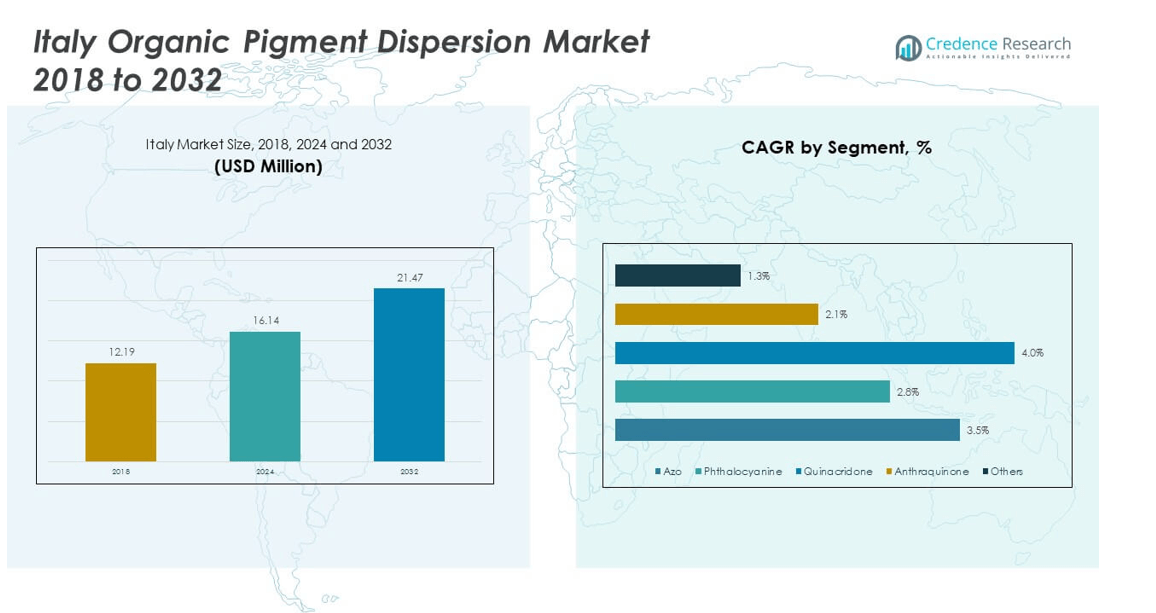
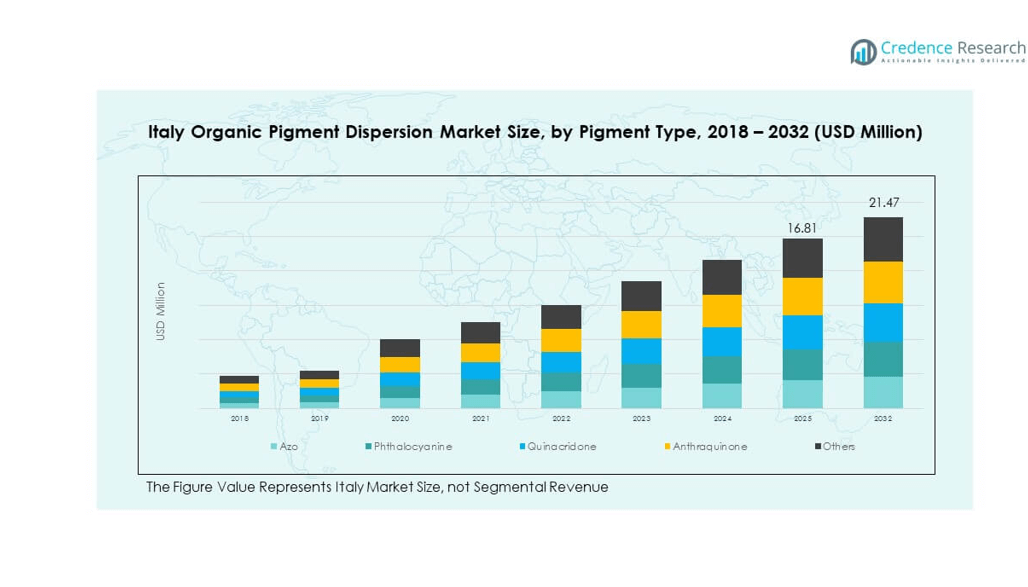
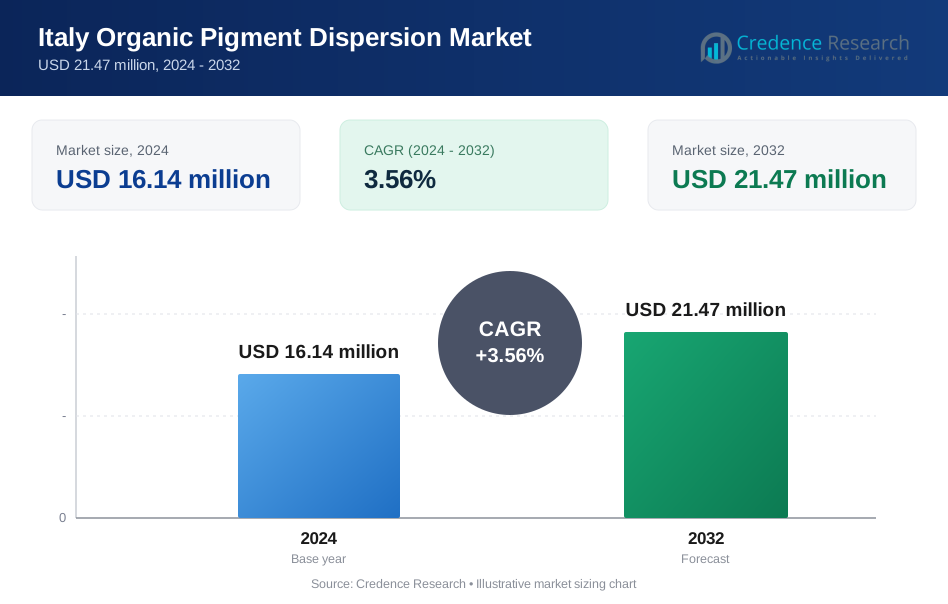
The Italy Organic Pigment Dispersion Market size was valued at USD 12.19 million in 2018 to USD 16.14 million in 2024 and is anticipated to reach USD 21.47 million by 2032, at a CAGR of 3.56% during the forecast period.
| REPORT ATTRIBUTE | DETAILS |
|---|---|
| Historical Period | 2020-2023 |
| Base Year | 2024 |
| Forecast Period | 2025-2032 |
| Italy Organic Pigment Dispersion Market Size 2024 | USD 16.14 million |
| Italy Organic Pigment Dispersion Market, CAGR | 3.56% |
| Italy Organic Pigment Dispersion Market Size 2032 | USD 21.47 million |
Growth in this market is fueled by rising demand across paints, coatings, packaging, and printing applications. Expanding use of eco-friendly pigments supports regulatory compliance while meeting sustainability goals. Industries prioritize dispersions that deliver high color strength, durability, and low toxicity. Increasing use of pigments in plastics, textiles, and cosmetics broadens end-use opportunities. Technological innovations in dispersion processes enhance performance while ensuring uniformity and stability. These drivers collectively reinforce steady growth.
Regional analysis highlights Northern Italy as the dominant market, supported by its advanced industrial clusters and strong manufacturing base. Central Italy contributes significantly with its focus on packaging, publishing, and textiles, while Southern Italy shows steady momentum due to construction and agricultural packaging sectors. Emerging opportunities exist in regions adopting sustainable practices and innovative coatings. The geographic distribution reflects both mature industrial zones and developing areas aligning with eco-friendly trends, positioning Italy as a key hub for pigment dispersions within Europe.
Market Insights
- The Italy Organic Pigment Dispersion Market size was valued at USD 12.19 million in 2018 to USD 16.14 million in 2024 and is anticipated to reach USD 21.47 million by 2032, at a CAGR of 3.56% during the forecast period.
- Northern Italy accounted for 45% of the share, supported by strong industrial clusters; Central Italy held 30% with packaging and textile strength; Southern Italy captured 25% due to rising food packaging and construction activity.
- Central Italy remains the fastest-growing subregion with 30% share, driven by printing inks, publishing, and expanding cosmetics demand.
- By pigment type, Azo pigments led with 38% share in 2024, followed by Phthalocyanine at 28%, reflecting demand in coatings and plastics.
- Quinacridone, Anthraquinone, and Others collectively held 34% share, with high-performance pigments gaining ground in specialty and eco-friendly applications.
Market Drivers
Rising Demand From Paints and Coatings Industry Supporting Long-Term Market Expansion
The Italy Organic Pigment Dispersion Market is strongly driven by the paints and coatings industry, where demand for vibrant and durable colors continues to grow. Expanding construction and renovation projects in both residential and commercial sectors increase the requirement for eco-friendly pigments. Regulatory restrictions on solvent-based systems encourage the shift toward water-based dispersions with lower emissions. Consumer preference for safe and non-toxic coatings drives manufacturers to adopt sustainable pigment solutions. It aligns with Europe’s push for green building certifications, where pigments play a critical role in aesthetic appeal and compliance. Rapid urban development in Italian cities strengthens coatings consumption, further supporting pigment dispersions. The growth of decorative paints with enhanced weather resistance and UV stability adds momentum. These developments sustain strong demand for organic pigment dispersions in this sector.
- For example, in 2025, BASF Coatings expanded its portfolio of sustainable water-based pigment dispersions for decorative paints and construction coatings in Europe. The solutions are designed to improve surface durability and meet low-emission standards aligned with green building requirements.
Regulatory Support and Environmental Policies Encouraging Adoption of Sustainable Pigments
Environmental regulations across Italy push industries to replace synthetic pigments with eco-friendly alternatives. Policies restricting hazardous chemicals and VOC emissions reinforce adoption of organic dispersions. The European Union’s REACH compliance framework supports transparency in chemical use, making organic pigment dispersions more attractive to buyers. It aligns with Italy’s sustainability goals, creating favorable conditions for pigment suppliers. Strong awareness among consumers about health impacts of synthetic chemicals drives this transition. Large manufacturers adapt their product lines to meet compliance while ensuring consistent performance. Collaboration between Italian research institutes and companies supports development of new bio-based dispersions. These efforts ensure long-term regulatory compliance and market growth.
Growing Packaging Industry Driving Use of Pigments for Attractive Product Designs
The Italian packaging industry is expanding rapidly, creating strong demand for pigments in flexible and rigid packaging solutions. Organic pigment dispersions provide color intensity and safety required for food and cosmetic packaging. Brand owners focus on vibrant and consistent shades to strengthen consumer appeal. It supports the use of pigment dispersions that meet both aesthetic and safety standards. Sustainability in packaging also drives adoption of recyclable and biodegradable materials enhanced by safe pigments. Growth in e-commerce packaging adds further scope for pigments with durability and color stability. Regulations on packaging waste management encourage eco-friendly pigment use. This sector’s consistent expansion directly drives demand for organic pigment dispersions.
- For example, Heubach Group supplies high-performance organic pigments and colorants that comply with regulations for food-contact packaging, including EU and FDA standards. These products are used by plastics and packaging converters in Italy to ensure strong coloration and regulatory compliance in both rigid and flexible applications.
Increasing Automotive Applications Enhancing Growth of Organic Pigment Dispersions
The automotive sector plays an important role in boosting demand for organic pigment dispersions in Italy. High-quality pigments are used in exterior coatings, plastics, and interior components. It supports durability and resistance against UV light and harsh weather conditions. Automotive manufacturers prioritize coatings with enhanced color depth and gloss, where pigment dispersions prove essential. Lightweight plastic components with colored finishes further expand usage. Growing electric vehicle production in Italy increases demand for advanced coatings with sustainable pigments. Partnerships between pigment producers and automotive OEMs foster innovation in specialized dispersions. This collaboration strengthens product development and long-term growth in the market.
Market Trends
Growing Shift Toward High-Performance Pigments With Advanced Functional Properties
The Italy Organic Pigment Dispersion Market experiences a rising trend toward high-performance pigments offering greater stability and functionality. Automotive, electronics, and packaging industries demand pigments with improved resistance to heat, light, and chemicals. Manufacturers focus on producing dispersions that maintain color quality under challenging conditions. It highlights the industry’s move from traditional pigments to advanced grades. Growing interest in long-lasting finishes for outdoor applications strengthens this trend. Research in nanoparticle dispersions offers new opportunities for superior dispersion quality. Pigment producers invest in advanced milling and surface treatment technologies. These shifts redefine performance standards and raise competitive advantage in the market.
Expanding Demand for Customized Shades and Aesthetic Appeal Across Applications
Consumer preference for unique and customized colors creates a strong trend in the market. The Italy Organic Pigment Dispersion Market benefits from demand in fashion, packaging, and home décor sectors. Brands increasingly use pigments to differentiate products with distinct shades and visual effects. It encourages pigment producers to expand portfolios with tailored color solutions. Digital printing technologies also drive the need for precise color dispersions. High-quality dispersions ensure consistency in brand packaging and promotional materials. Rising demand for luxury and premium goods adds importance to unique pigment formulations. This trend continues to strengthen across consumer-driven industries.
- For example, Heubach Group supplies organic and inorganic pigments for the packaging sector in Italy. Its portfolio includes solutions such as HEUCOTINT™ and AQUIS™ ranges, which support custom color matching and tinting applications.
Integration of Digital Printing Driving Use of Pigment Dispersions in Packaging
Digital printing adoption across Italy’s packaging sector accelerates the demand for organic pigment dispersions. Brands prefer digital technologies for shorter production cycles and personalized packaging. It creates opportunities for pigment dispersions that deliver high resolution and accurate color reproduction. The growing use of e-commerce packaging boosts requirements for vibrant, durable prints. Pigment dispersions designed for inkjet and digital systems gain traction. Expansion of food and beverage labeling further drives this trend. Italian converters prefer dispersions compatible with high-speed printing technologies. This integration sets a steady growth path for pigment suppliers.
- For example, BASF provides high-performance pigment dispersions and resins, including Joncryl® grades, optimized for water-based digital and inkjet printing. These dispersions are designed for controlled particle size distribution, strong color performance, and stability, making them suitable for packaging and labeling applications in markets such as Italy.
Sustainable Sourcing and Bio-Based Pigments Emerging as a Key Industry Trend
Sustainability shapes the future of pigment dispersions in Italy. Bio-based pigments sourced from renewable feedstocks gain popularity among manufacturers. The Italy Organic Pigment Dispersion Market reflects this trend through investments in green chemistry. It aligns with consumer demand for eco-friendly products across packaging, textiles, and coatings. Collaborations with biotechnology companies help pigment producers develop safer alternatives. Brands seek certifications ensuring eco-compliance, pushing suppliers toward sustainable offerings. Research on algae-based and plant-derived pigments widens future applications. These initiatives create a strong positioning for sustainable pigment dispersions in Italy.
Market Challenges Analysis
Rising Competition From Low-Cost Imports and Pricing Pressure on Domestic Producers
The Italy Organic Pigment Dispersion Market faces challenges from increasing imports of low-cost pigments from Asia. Domestic producers encounter pricing pressure, limiting their ability to maintain profitability while adhering to quality and regulatory standards. It creates difficulty for smaller companies competing with global suppliers offering cost advantages. The growing dependence on imports risks supply chain vulnerabilities in times of disruption. Italian manufacturers often need to focus on high-performance or specialty dispersions to stay competitive. Maintaining balance between affordability and performance remains a complex challenge. High costs of compliance with European regulations further intensify these pressures. This challenge slows adoption of locally manufactured dispersions across certain sectors.
Technological Barriers and Limited Awareness Impacting Adoption in Niche Applications
Another major challenge lies in limited technological awareness among smaller end-users, slowing adoption of advanced pigment dispersions. The Italy Organic Pigment Dispersion Market encounters barriers in industries where cost-sensitive buyers prioritize price over performance. It restricts the uptake of eco-friendly pigments despite regulatory support. Technical limitations in compatibility with certain substrates also create hurdles. High research and development costs prevent smaller firms from introducing innovative pigment solutions. Lack of skilled workforce in dispersion technology hampers consistent quality. These obstacles reduce penetration in niche applications like specialty textiles or electronics. Overcoming these barriers requires significant education and technological investment.
Market Opportunities
Rising Investment in Sustainable Packaging and Eco-Friendly Pigment Dispersions
The Italy Organic Pigment Dispersion Market offers opportunities through rising adoption of sustainable packaging solutions. Growing consumer awareness and regulations on plastic waste drive investment in recyclable packaging enhanced with eco-friendly pigments. It supports innovation in bio-based dispersions, creating growth for suppliers. Companies adopting green certifications seek organic pigments to improve brand image. Partnerships between packaging firms and pigment producers encourage product development. Expansion of premium food and beverage packaging further strengthens this opportunity. These drivers open long-term growth paths for pigment suppliers in Italy.
Innovation in Specialty Applications and High-Value Industry Segments
Pigment dispersions find growing opportunities in specialty segments such as electronics, textiles, and automotive interiors. The Italy Organic Pigment Dispersion Market benefits from increasing demand for high-value dispersions offering superior functionality. It creates room for advanced pigments tailored for durability, safety, and unique visual effects. Rapid growth in electric vehicles adds scope for specialized coatings. Textile industries adopt innovative pigments for sustainable fashion trends. Research on nanoparticle-based dispersions provides new innovation prospects. These specialty applications open premium opportunities for Italian producers focused on advanced pigment solutions.
Market Segmentation Analysis
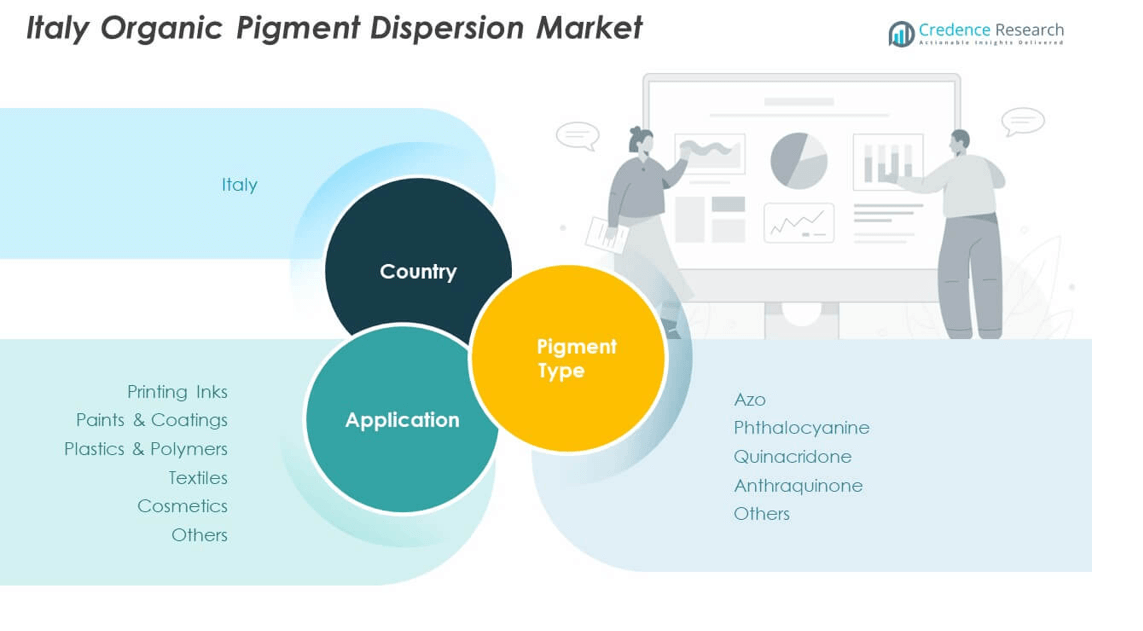
By Pigment Type, the Italy Organic Pigment Dispersion Market demonstrates strong demand across Azo, Phthalocyanine, Quinacridone, Anthraquinone, and other categories. Azo pigments dominate due to their versatility, cost-effectiveness, and widespread use in printing inks and coatings. Phthalocyanine pigments hold significant share for their excellent stability, brightness, and suitability in plastics and decorative coatings. Quinacridone pigments gain traction in high-performance applications requiring superior lightfastness and weather resistance. Anthraquinone pigments maintain niche applications in textiles and specialty industries, while the “Others” category supports growth through new eco-friendly and bio-based dispersions. It reflects a balanced portfolio where performance, cost, and sustainability guide choices.
- For example, SIOF S.p.A., an Italian pigment manufacturer based in Pozzolo Formigaro, introduced its SolidFlow process in 2024 to produce granular pigments with very high pigment content. The process is designed to significantly reduce energy consumption compared to conventional dispersion methods and is powered using electricity from the company’s photovoltaic systems.
By Application, the Italy Organic Pigment Dispersion Market is shaped by key industries such as printing inks, paints and coatings, plastics and polymers, textiles, cosmetics, and other emerging sectors. Printing inks remain essential, driven by demand in packaging and labeling with high-color accuracy needs. Paints and coatings account for a large share, supported by construction, automotive, and decorative markets. Plastics and polymers rely on pigments for consistent coloration and durability across consumer and industrial products. Textiles benefit from dispersions that enhance dyeing performance and colorfastness. Cosmetics increasingly adopt organic pigments for safety and compliance in formulations. It shows consistent application diversity that supports market resilience.
- For example, ICEA (Istituto per la Certificazione Etica ed Ambientale) is Italy’s leading certifier for eco-bio cosmetics, conducting strict ingredient and finished product controls to guarantee safety, dermo-compatibility, and environmental sustainability.
Segmentation
By Pigment Type
- Azo
- Phthalocyanine
- Quinacridone
- Anthraquinone
- Others
By Application
- Printing Inks
- Paints & Coatings
- Plastics & Polymers
- Textiles
- Cosmetics
- Others
Regional Analysis
Northern Italy Driving Market Expansion With Strong Industrial Base
Northern Italy holds the largest share of the Italy Organic Pigment Dispersion Market at 45%. The region benefits from its established industrial clusters in Lombardy, Emilia-Romagna, and Veneto. Paints, coatings, and plastics manufacturers drive significant consumption of organic pigment dispersions. It is supported by strong export activity in automotive, packaging, and machinery. Research collaborations with universities and chemical hubs foster innovation in eco-friendly dispersions. Regulatory compliance and advanced infrastructure sustain Northern Italy’s leadership in this market.
Central Italy Supporting Growth Through Printing and Packaging Industries
Central Italy accounts for 30% of the market share, with Tuscany and Lazio playing key roles. Strong growth in printing inks and packaging applications sustains demand for pigment dispersions. It benefits from the concentration of publishing houses, textile producers, and cosmetic brands. The adoption of high-performance and safe dispersions supports consumer-driven industries. Government sustainability initiatives encourage manufacturers to use eco-compliant pigments. This balance between tradition and innovation strengthens Central Italy’s market contribution.
Southern Italy and Islands Emerging With Rising Manufacturing Activity
Southern Italy, including Sicily and Sardinia, represents 25% of the Italy Organic Pigment Dispersion Market. It shows steady growth due to expanding food packaging, textile, and construction sectors. Demand for cost-effective dispersions supports small and medium enterprises in the region. It is also influenced by growing agricultural exports that rely on packaging pigments. Infrastructure development projects create new opportunities for pigment-based coatings. Rising interest in sustainable practices positions the South as a potential growth hub.
Key Player Analysis
- BASF SE
- Clariant AG
- Heubach GmbH
- Lanxess AG
- Venator Materials PLC
- Cabot Corporation
- Ferro Corporation
- DIC Corporation
- Sudarshan Chemical Industries
- Heubach Group
Competitive Analysis
The Italy Organic Pigment Dispersion Market features strong competition among global and regional companies. BASF SE, Clariant AG, Heubach GmbH, and Lanxess AG dominate with broad product portfolios and advanced technologies. It is also shaped by Venator Materials, Cabot Corporation, and Ferro Corporation, which focus on serving packaging, plastics, and coatings industries. DIC Corporation and Sudarshan Chemical Industries strengthen their presence through cost-effective and customized pigment solutions. Heubach Group enhances competition by emphasizing sustainable and high-performance products. Companies compete on innovation, regulatory compliance, and color quality to secure contracts with automotive, textile, and packaging firms. Strategic expansions, acquisitions, and product launches remain core tactics to maintain leadership in this market.
Recent Developments
- In March 2025, Cologne-based specialty chemicals company LANXESS unveiled a comprehensive portfolio of water-based pigment dispersions for the paints and coatings sector at the European Coatings Show (ECS) in Nuremberg. The showcased range included Levanyl (organic) and Levanox (inorganic) dispersions, recognized for their superior color strength and low viscosity, as well as enhanced environmental credentials.
- In March 2025, Venator launched the TIOXIDE® TR81 pigment, an advanced and sustainable solution that eliminates trimethylolpropane (TMP) and trimethylolethane (TME) from its titanium dioxide pigment formulation.
- In November 2023, Heubach GmbH expanded its cooperation with TER Chemicals to include inorganic colored pigments, anti-corrosion pigments, and pigment preparations in Germany and Austria. This partnership aims to enhance product availability for coatings and related applications.
Report Coverage
The research report offers an in-depth analysis based on Pigment Type and Application. It details leading market players, providing an overview of their business, product offerings, investments, revenue streams, and key applications. Additionally, the report includes insights into the competitive environment, SWOT analysis, current market trends, as well as the primary drivers and constraints. Furthermore, it discusses various factors that have driven market expansion in recent years. The report also explores market dynamics, regulatory scenarios, and technological advancements that are shaping the industry. It assesses the impact of external factors and global economic changes on market growth. Lastly, it provides strategic recommendations for new entrants and established companies to navigate the complexities of the market.
Future Outlook
- The Italy Organic Pigment Dispersion Market will see expanding demand across packaging, coatings, and plastics industries.
- Sustainability initiatives will encourage broader adoption of eco-friendly and bio-based pigment dispersions.
- Automotive applications will grow with rising need for durable, UV-resistant, and high-gloss pigment formulations.
- Digital printing advancements will increase reliance on precise and high-quality pigment dispersions.
- Regulatory support in Italy will shape long-term opportunities for safe and compliant pigment technologies.
- Research in nanotechnology will open pathways for high-performance dispersions with superior color stability.
- Cosmetics and textiles will emerge as promising segments, driving consumption of non-toxic pigments.
- Regional manufacturers will expand capabilities to compete against imports and secure niche markets.
- Collaborations between pigment producers and universities will strengthen innovation pipelines in Italy.
- Expanding exports of Italian manufactured goods will support pigment dispersion demand across global markets.
Request a Free Sample
Fill in your details and we'll send you a free sample report.
- Sample data tables & charts
- Research methodology
Need a Custom Version of This Report?
Tailor the scope, geography, or segments to your exact requirements.
- Custom geography or segment scope
- Direct access to our analyst team
Frequently Asked Questions
What is the current market size for Italy Organic Pigment Dispersion Market, and what is its projected size in 2032?
Which Italy Organic Pigment Dispersion Market segment held the largest share in 2024?
What are the primary factors fueling the growth of the Italy Organic Pigment Dispersion Market?
Who are the leading companies in the Italy Organic Pigment Dispersion Market?
Table of Content
Chapter 1. Report Introduction
- 1.1 Report Description & Purpose
- 1.1.1 Report Title & Market Definition
- 1.1.2 Unique Selling Propositions (USP) & Key Differentiators
- 1.1.3 Value Proposition for Stakeholders
- 1.2 Research Objectives
- 1.2.1 Market Sizing Objectives (Volume & Revenue)
- 1.2.2 Segmentation Objectives
- 1.2.3 Competitive Intelligence Objectives
- 1.2.4 Forecast & Scenario Objectives
- 1.3 Report Scope
- 1.3.1 Italy Organic Pigment Dispersion Scope – Types & Subtypes Covered
- 1.3.2 Geographic Scope – Regions & Countries Covered
- 1.3.3 Historical Period, Base Year & Forecast Period (2024; forecast to 2032)
- 1.3.4 Inclusions & Exclusions
- 1.4 HS Code & Classification Framework
- 1.5 Currency, Units & Pricing Basis
- 1.6 Target Stakeholders
- 1.7 Limitations & Assumptions
Chapter 2. Executive Summary
- 2.1 Global Italy Organic Pigment Dispersion Market Snapshot
- 2.1.1 Market Size – Historical (2024) & Forecast (2024-2032) (2024: USD 16.14 million → 2032: USD 21.47 million)
- 2.1.2 Volume & Revenue – Global Totals
- 2.1.3 Key Market Highlights – Top Five Facts
- 2.2 Italy Organic Pigment Dispersion Market Segmentation Snapshot
- 2.2.1 Market Split by Region – 2024 vs. 2032
- 2.3 Competitive Snapshot
- 2.3.1 Top 10 Players by Revenue Share – 2024
- 2.3.2 Top 10 Players by Volume Share – 2024
- 2.3.3 Recent Strategic Developments (18-Month Summary)
- 2.4 Key Investment Highlights & Strategic Conclusions
Chapter 3. Italy Organic Pigment Dispersion Market Dynamics & Industry Analysis
- 3.1 Market Overview & Context
- 3.1.1 Italy Organic Pigment Dispersion Market Position in the Broader Automotive Value Chain
- 3.1.2 OEM vs. Replacement Market Dynamics
- 3.1.3 Market Maturity & Development Stage by Region
- 3.2 Italy Organic Pigment Dispersion Market Drivers
- 3.3 Italy Organic Pigment Dispersion Market Restraints & Challenges
- 3.4 Italy Organic Pigment Dispersion Market Opportunities
- 3.5 Porter's Five Forces Analysis
- 3.5.1 Threat of New Entrants
- 3.5.2 Bargaining Power of Suppliers
- 3.5.3 Bargaining Power of Buyers
- 3.5.4 Threat of Substitutes
- 3.5.5 Competitive Rivalry – Intensity Assessment
- 3.6 Italy Organic Pigment Dispersion Value Chain Analysis
- 3.6.1 Upstream – Raw Material/Input Suppliers
- 3.6.1.1 Raw Material/Input 1
- 3.6.1.2 Raw Material/Input 2
- 3.6.1.3 Raw Material/Input 3
- 3.6.2 Midstream – Production/Manufacturing/Service Delivery
- 3.6.2.1 Production/Process Overview
- 3.6.2.2 Key Facility Locations & Capacity by Manufacturer
- 3.6.3 Downstream – Distribution & End Consumer
- 3.6.3.1 Primary Channel – B2B/OEM
- 3.6.3.2 Secondary Channels – Dealer, Retail, Online, Direct
- 3.6.4 Value Chain Profitability Analysis
- 3.6.1 Upstream – Raw Material/Input Suppliers
- 3.7 PESTEL Analysis
- 3.7.1 Political Factors
- 3.7.2 Economic Factors
- 3.7.3 Social Factors
- 3.7.4 Technological Factors
- 3.7.5 Environmental Factors
- 3.7.6 Legal Factors
- 3.8 Italy Organic Pigment Dispersion Supply Chain Analysis
- 3.8.1 Raw Material/Input Supply Risk Assessment
- 3.8.2 Manufacturing Concentration Risk (Geographic Exposure)
- 3.8.3 Trade Disruption Impact Analysis
- 3.9 Regulatory & Policy Landscape
Note: The regulatory and policy landscape section covers regulations based on their applicability to the market, Italy Organic Pigment Dispersion category, geography, and scope of the study. Only regulatory frameworks with a material impact on operations, compliance, trade, sustainability, or market access are analyzed in detail.
Chapter 4. Key Investment Pockets & Opportunity Analysis
- 4.1 Italy Organic Pigment Dispersion Market Attractiveness Analysis
- 4.1.1 By Region – Investment Attractiveness Matrix (Volume × CAGR)
- 4.2 Absolute Revenue Growth Opportunity
- 4.2.1 By Region – Absolute USD Growth Through 2032
- 4.3 Incremental Volume Opportunity
- 4.3.1 By Region – Incremental Volume Through 2032
- 4.3.2 Segment – Incremental Volume
- 4.4 Emerging Submarket Opportunity Deep Dive (Subject to Applicability)
- 4.5 Emerging Market Opportunity Scorecards
- 4.5.1 United States
- 4.5.2 Europe
- 4.5.3 Asia
- 4.5.4 Middle East & Africa
Note: Emerging Market Opportunity Scorecards will be included based on relevance and strategic importance. Regions listed are indicative and may vary depending on data availability and market dynamics.
Chapter 5. Italy Organic Pigment Dispersion Import-Export Analysis & Trade Flows
- 5.1 Global Trade Overview
- 5.1.1 Global Export Value by Country (2024)
- 5.1.2 Global Export Volume by Country (2024)
- 5.1.3 Global Import Value by Country (2024)
- 5.1.4 Global Import Volume by Country (2024)
- 5.1.5 Net Trade Balance by Country (2024)
- 5.2 Export Analysis – Segment
- 5.2.1 Type 1 (HS Code)
- 5.2.2 Type 2 (HS Code)
- 5.2.3 Type 3 (HS Code)
- 5.2.4 Type 4 (HS Code)
- 5.2.5 Type 5 (HS Code)
- 5.3 Import Analysis – Segment
- 5.3.1 Type 1 (HS Code)
- 5.3.2 Type 2 (HS Code)
- 5.3.3 Type 3 (HS Code)
- 5.3.4 Type 4 (HS Code)
- 5.3.5 Type 5 (HS Code)
- 5.4 Average Unit Trade Prices
- 5.4.1 Average Export Price – Segment & Country
- 5.4.2 Average Import Price – Segment & Source Country
- 5.4.3 Price Trends (2024)
- 5.5 Key Trade Route Analysis
- 5.5.1 Trade Route 1
- 5.5.2 Trade Route 2
- 5.5.3 Trade Route 3
- 5.5.4 Trade Route 4
- 5.5.5 Trade Route 5
- 5.6 Trade Policy Impact Assessment
- 5.6.1 US Anti-Dumping & Section 301 Tariffs
- 5.6.2 EU Customs Union Impact
- 5.6.3 Major Free Trade Agreements
- 5.6.4 USMCA Rules of Origin
Note: Trade policy analysis will be included only where relevant to the Italy Organic Pigment Dispersion market.
Chapter 6. Competitive Landscape & Company Benchmarking
- 6.1 Italy Organic Pigment Dispersion Market Concentration & Structure
- 6.1.1 Herfindahl-Hirschman Index (HHI) – vs. 2024
- 6.1.2 Tier 1, Tier 2 & Tier 3 Market Structure
- 6.1.3 Global, Regional & Local Player Dynamics
- 6.2 Italy Organic Pigment Dispersion Market Share Analysis – 2024
- 6.2.1 Global Revenue Share by Company
- 6.2.2 Global Volume Share by Company
- 6.2.3 Regional Revenue Share
- 6.2.4 Market Share Evolution ( vs. 2024)
- 6.2.5 OEM Segment Share by Company
- 6.2.6 Replacement Segment Share by Company
- 6.3 Production/Delivery Capacity & Facility Analysis
- 6.3.1 Global Installed Capacity
- 6.3.2 Capacity Utilization Rates
- 6.3.3 Production/Output Volume
- 6.3.4 Facility Locations & Capacity Map
- 6.3.5 Planned Capacity Additions
- 6.4 Italy Organic Pigment Dispersion Competitive Benchmarking Matrix
- 6.4.1 Revenue, Volume, CAGR & Profitability Comparison
- 6.4.2 Channel Revenue Mix
- 6.4.3 Geographic Revenue Exposure
- 6.4.4 R&D Intensity
- 6.4.5 Sustainability Maturity
- 6.5 Strategic Developments in Italy Organic Pigment Dispersion (Last 24 Months)
- 6.5.1 Mergers, Acquisitions & Divestments
- 6.5.2 New Italy Organic Pigment Dispersion Launches
- 6.5.3 Facility Expansions
- 6.5.4 Strategic Alliances, Joint Ventures & Partnerships
- 6.5.5 Distribution Expansion & Market Entry
- 6.5.6 Sustainability & ESG Initiatives
- 6.6 Competitive Strategy Mapping
- 6.6.1 Leader, Challenger, Follower & Niche Classification
- 6.6.2 Pricing Strategy Comparison
- 6.6.3 Channel Strategy Matrix
Note: Strategic developments are included based on their materiality and the availability of reliable information.
Chapter 7. Global Italy Organic Pigment Dispersion Market – By Distribution Channel
- 7.1 Segment Overview
- 7.1.1 Volume & Revenue Split by Channel (2024 & 2032)
- 7.1.2 Channel Mix Evolution (2024-2032)
Chapter 8. Regional Market Analysis – Global Overview
- 8.1 Global Regional Overview
- 8.1.1 Regional Volume Share
- 8.1.2 Regional Revenue Share
- 8.1.3 Regional Volume by Region
- 8.1.4 Regional Revenue by Region
- 8.1.5 Regional Forecast Through 2032
- 8.2 Cross-Regional Segment Analysis
- 8.2.1 By Distribution Channel
- 8.2.2 By Brand/Price Tier
Chapter 9. North America Italy Organic Pigment Dispersion Market
- 9.1 United States
- 9.2 Canada
- 9.3 Mexico
Chapter 10. Europe Italy Organic Pigment Dispersion Market
- 10.1 Germany
- 10.2 France
- 10.3 Italy
- 10.4 United Kingdom
- 10.5 Spain
- 10.6 Poland
- 10.7 Russia
- 10.8 Netherlands
- 10.9 Belgium
- 10.10 Sweden
- 10.11 Denmark
- 10.12 Norway
- 10.13 Rest of Europe
Chapter 11. Asia Pacific Italy Organic Pigment Dispersion Market
- 11.1 China
- 11.2 India
- 11.3 Japan
- 11.4 South Korea
- 11.5 Thailand
- 11.6 Indonesia
- 11.7 Vietnam
- 11.8 Malaysia
- 11.9 Australia
- 11.10 Rest of Asia Pacific
Chapter 12. Latin America Italy Organic Pigment Dispersion Market
- 12.1 Brazil
- 12.2 Argentina
- 12.3 Colombia
- 12.4 Chile
- 12.5 Rest of Latin America
Chapter 13. Middle East Italy Organic Pigment Dispersion Market
- 13.1 Saudi Arabia
- 13.2 United Arab Emirates
- 13.3 Turkey
- 13.4 Israel
- 13.5 Iran
- 13.6 Rest of the Middle East
Chapter 14. Africa Italy Organic Pigment Dispersion Market
- 14.1 South Africa
- 14.2 Egypt
- 14.3 Nigeria
- 14.4 Morocco
- 14.5 Rest of Africa
Chapter 15. Italy Organic Pigment Dispersion Company Profiles
- 15.1 [Company 01]
- 15.1.1 Company Overview
- 15.1.2 Key Management Personnel
- 15.1.3 Products & Services Portfolio
- 15.1.4 Financial Performance
- 15.1.5 Key Market Focus & Geographic Presence
- 15.1.6 Recent Developments & Strategic Initiatives
Note: The company profile list is preliminary and may change based on research findings, market developments, data availability, and client requirements.
Chapter 16. Appendices
- Appendix A – List of Abbreviations & Acronyms
- Appendix B – Industry Classification Code Reference – Full Series
- Appendix C – Production & Capacity Data Tables
- Appendix D – End-Use & Demand Base Tables
- Appendix E – Consumption & Replacement Rate Assumptions
- Appendix F – ASP Reference Tables
- Appendix G – Manufacturing & Facility Database
- Appendix H – Import-Export Data Tables
- Appendix I – Regulatory Summary Tables
- Appendix J – Primary Research Participant List (Anonymized)
- Appendix K – Primary Research Questionnaire Framework
- Appendix L – Data Sources & Bibliography
- Appendix M – Market Size Divergence & Source Comparison
Chapter 17. Research Methodology
- 17.1 Research Framework & Philosophy
- 17.2 Secondary Research – Sources, Hierarchy & Data Extraction
- 17.3 Data Modeling – Bottom-Up & Top-Down Market Sizing
- 17.4 Primary Research – Stakeholder Framework, LOI & Sample Sizes
- 17.5 Forecast Methodology – Regression, Scenario & Sensitivity Analysis
- 17.6 Quality Control – Four-Layer Validation Framework
- 17.7 Limitations & Standard Assumptions
- 17.8 Disclaimer
