
Market Overview
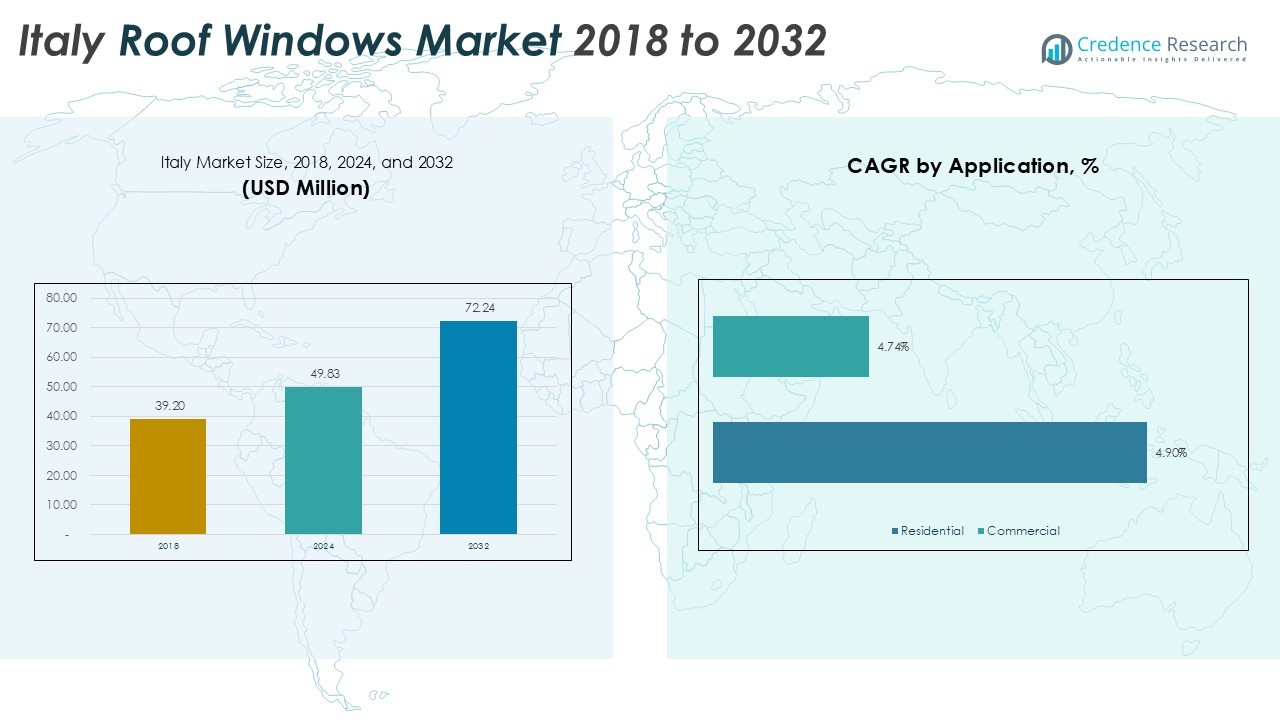
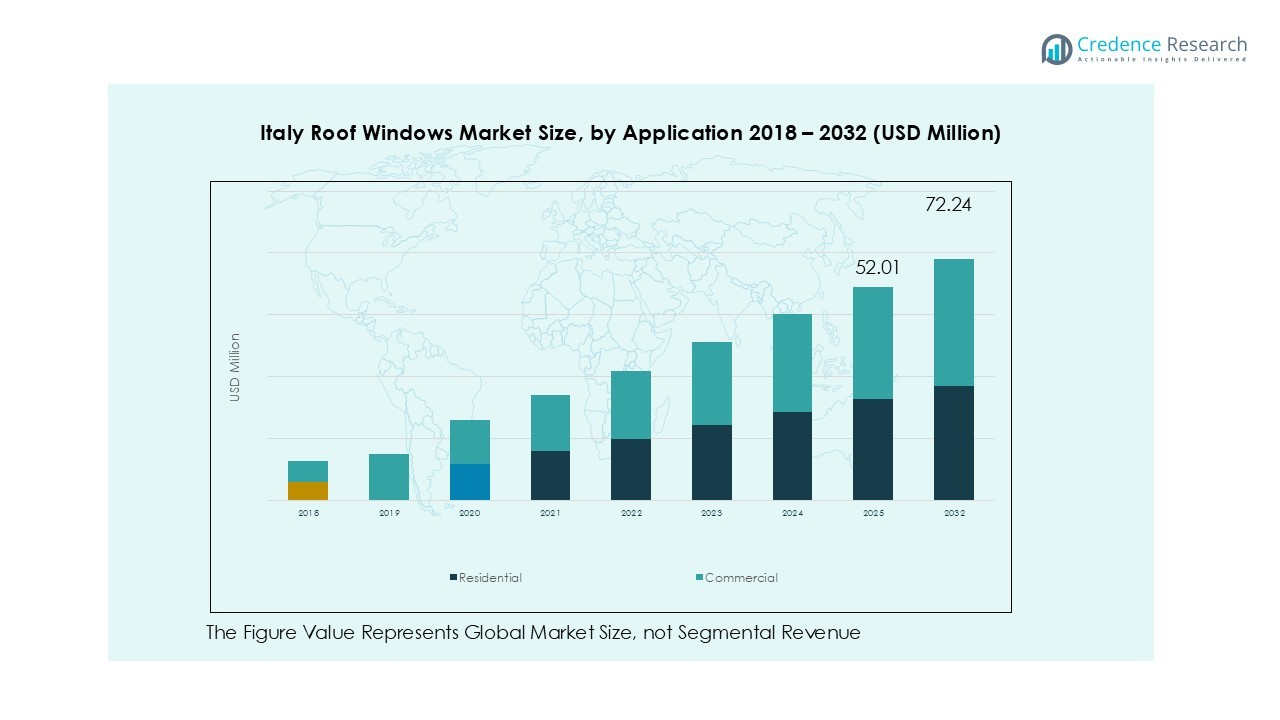
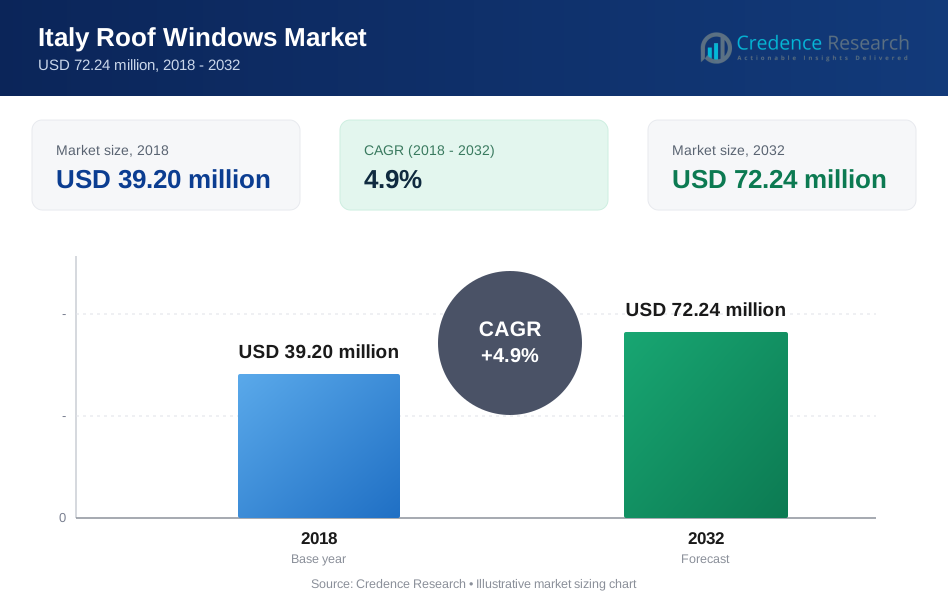
Italy Roof Windows market size was valued at USD 39.20 million in 2018 to USD 49.83 million in 2024 and is anticipated to reach USD 72.24 million by 2032, at a CAGR of 4.9% during the forecast period.
| REPORT ATTRIBUTE | DETAILS |
|---|---|
| Historical Period | 2020-2023 |
| Base Year | 2024 |
| Forecast Period | 2025-2032 |
| Italy Roof Windows Market Size 2024 | USD 49.83 Million |
| Italy Roof Windows Market, CAGR | 4.9% |
| Italy Roof Windows Market Size 2032 | USD 72.24 Million |
The Italy Roof Windows market is led by major players such as Tulderhof, Velux Group, Roto Frank AG, Farko, and Lamilux, supported by regional competitors including Piva Group, Chirenti Group, Emica, Beckmann GmbH, and Dakota Group. These companies focus on developing energy-efficient, double- and triple-glazed solutions and smart automation features to meet EU performance standards. Northern Italy holds over 45% market share, driven by strong renovation activity and high adoption of premium roof windows. Central Italy follows with around 30% share, supported by heritage restoration projects, while Southern Italy and islands collectively account for 25%, showing growing demand fueled by residential construction and hospitality sector investments.
Market Insights
- The Italy Roof Windows market was valued at USD 49.83 million in 2024 and is projected to reach USD 72.24 million by 2032, growing at a CAGR of 4.9% during the forecast period.
- Rising demand for energy-efficient and sustainable building solutions drives adoption, supported by government incentives for renovation projects and compliance with EU energy standards.
- Key trends include increasing preference for double- and triple-glazed windows, smart automation features, and use of eco-friendly materials like sustainably sourced wood and advanced PU coatings.
- The market is moderately consolidated with major players such as Tulderhof, Velux Group, Roto Frank AG, Farko, and Lamilux focusing on innovation, partnerships, and expanded distribution networks.
- Northern Italy leads with over 45% share, followed by Central Italy at 30% and Southern Italy & Islands at 25%; by type, wood roof windows hold over 40% share, making it the dominant segment.
Market Segmentation Analysis:
By Type
The Italy Roof Windows market by type is dominated by wood-based roof windows, holding over 40% market share in 2024. Wood windows remain preferred for their natural aesthetic, insulation properties, and suitability in traditional Italian architecture. Demand is supported by renovation projects in historic towns and energy-efficiency upgrades under EU guidelines. Polyurethane (PU) and PVC segments grow steadily due to their moisture resistance and low maintenance requirements, making them ideal for kitchens and bathrooms. Metal windows cater to modern buildings, while the “others” category includes hybrid materials targeting niche applications.
- For instance, Roto offers its Wooden roof window RotoQ product with a service life of 40 years, as declared in its Environmental Product Declaration.
By Application
Residential applications lead the Italy Roof Windows market with more than 65% market share in 2024, driven by rising home renovation activity and adoption of energy-efficient daylight solutions. Demand is high in single-family homes and urban apartments seeking improved ventilation and natural lighting. Commercial usage, though smaller, is growing with office spaces and hospitality projects integrating roof windows for sustainability compliance and enhanced occupant comfort. Government incentives for green building design and daylight optimization in public infrastructure further support both segments’ growth prospects.
- For instance, Roto’s “RotoQ pivoting window” achieves a thermal insulation value (Uw) of 1.1 W/m²K, making it suitable for direct replacement in renovation projects.
By Glazing Type
Double-glazed roof windows dominate the market, accounting for over 55% share in 2024, as they offer a balance between cost and thermal performance. Their ability to reduce heat loss and improve energy efficiency aligns with Italy’s building energy regulations. Triple-glazed windows are gaining traction in northern regions with colder climates, offering superior insulation and noise reduction. Single-glazed windows see declining demand, mainly restricted to low-cost refurbishments. Manufacturers focus on low-emissivity coatings and argon-filled glazing to meet EU energy performance standards and improve overall comfort in residential and commercial spaces.
Key Growth Drivers
Rising Residential Renovation and Energy Efficiency Initiatives
The Italy Roof Windows market benefits from increasing residential renovation activities, particularly in urban and suburban areas. Government incentives under EU energy-efficiency programs encourage homeowners to install roof windows to improve insulation and reduce energy costs. Growing consumer focus on natural lighting and improved ventilation drives replacement demand for older windows. Renovation projects in historical towns also favor wooden roof windows to maintain aesthetic appeal, while energy-efficient double- and triple-glazed models meet modern performance standards, supporting consistent market expansion across both new-build and retrofit applications.
- For instance, Cocif offers roof windows with glazing that yields a noise reduction of up to 47 dB, helping both acoustic comfort and insulation.
Growing Adoption of Sustainable and Smart Building Solutions
Sustainability goals across Italy fuel demand for roof windows that enhance indoor comfort while reducing carbon footprint. Builders integrate energy-efficient roof windows in compliance with Italy’s building energy performance codes. Smart roof windows with automated sensors, rain detectors, and remote-control features are increasingly popular among modern homeowners. Their ability to optimize daylight, regulate indoor temperature, and improve air quality aligns with green building certifications. This convergence of eco-friendly materials and IoT-enabled products creates a favorable environment for premium roof window adoption in residential and commercial projects.
- For instance, FAKRO roof windows include electric and solar powered models using Z-Wave wireless protocol, allowing remote opening/closing and integration with home automation systems.
Expansion of Commercial and Hospitality Construction Projects
Italy’s hospitality and commercial real estate sectors are witnessing steady growth, driving demand for roof windows in hotels, offices, and retail spaces. Developers integrate roof windows to provide natural daylight, reduce electricity consumption, and enhance occupant well-being. Modern designs with sleek frames and advanced glazing options support architectural aesthetics and sustainability compliance. Government-backed initiatives promoting energy-efficient public infrastructure further boost adoption. The growing preference for daylight-optimized interiors in commercial workspaces reinforces market opportunities, encouraging suppliers to expand offerings tailored for large-scale projects and high-traffic environments.
Key Trends & Opportunities
Increasing Demand for Triple-Glazed Roof Windows
Triple-glazed roof windows are gaining traction in Italy, especially in northern regions with colder climates. Their superior insulation properties and noise reduction capabilities make them ideal for residential areas near busy streets. Manufacturers focus on developing affordable triple-glazed models with improved thermal performance to meet stricter EU energy directives. This trend opens opportunities for market players to target eco-conscious consumers and green building developers, positioning triple-glazed windows as a premium solution that delivers long-term energy savings and enhances overall occupant comfort.
- For instance, VELUX’s Glazing No. 66 triple-glazed roof window has a thermal transmittance (Uw) of 1.0 W/m²K and sound insulation of 37 dB, which meets stricter EU energy directives.
Integration of Smart Technologies in Roof Windows
Automation is emerging as a major trend in the Italy Roof Windows market. Smart roof windows equipped with sensors can automatically close during rain, adjust ventilation based on indoor air quality, and be controlled through smartphones. Integration with home automation systems is expanding their appeal among tech-savvy homeowners. This opportunity allows manufacturers to offer differentiated solutions that command higher margins. Partnerships with IoT solution providers further strengthen innovation pipelines, making smart roof windows a growth driver for both residential and commercial projects.
- For instance, VELUX 3-in-1 roof windows include a built-in rain sensor that detects rain and triggers automatic closing to protect interiors.
Key Challenges
High Installation and Product Costs
One of the primary challenges for the Italy Roof Windows market is the relatively high cost of roof windows and installation services. Premium models with double or triple glazing, automation, and energy-efficient features can be expensive, deterring cost-sensitive homeowners. Skilled labor shortages in some regions also increase installation expenses, extending project timelines. These factors limit adoption in lower-income segments and smaller renovation projects, pushing manufacturers to explore cost-reduction strategies and flexible pricing models to improve market penetration without compromising quality.
Limited Awareness in Rural and Low-Density Areas
Despite growing demand in urban regions, rural and low-density areas in Italy show limited adoption of roof windows. Lack of awareness about energy-efficiency benefits, combined with fewer renovation projects, constrains market potential. Distribution challenges and lower availability of skilled installers in these regions further reduce accessibility. Manufacturers and distributors face the task of expanding outreach programs, providing educational campaigns, and incentivizing installers to cater to these areas. Addressing this gap can unlock untapped opportunities and support balanced market growth nationwide.
Regional Analysis
Northern Italy
Northern Italy dominates the Italy Roof Windows market, holding over 45% market share in 2024. The region benefits from a strong construction sector, high-income households, and strict adherence to EU energy-efficiency standards. Demand is driven by renovation of historic residential buildings and adoption of triple-glazed windows for superior thermal insulation, particularly in colder Alpine areas. Industrial hubs like Lombardy and Veneto invest heavily in sustainable construction, supporting commercial segment growth. Government incentives for energy-efficient upgrades and the popularity of premium wood and polyurethane roof windows further boost demand, making Northern Italy the key contributor to overall market revenue.
Central Italy
Central Italy accounts for around 30% market share of the Italy Roof Windows market, supported by steady residential renovation activity and tourism-related infrastructure projects. Tuscany and Lazio lead demand, with heritage conservation programs encouraging installation of energy-efficient wooden roof windows to maintain architectural harmony. The growing adoption of double-glazed windows in residential units improves energy performance and aligns with EU directives. Commercial demand is also rising in Rome and Florence, where office and hospitality projects integrate roof windows to optimize daylight and improve occupant comfort, sustaining healthy market growth across both residential and commercial applications in the region.
Southern Italy & Islands
Southern Italy and the islands collectively represent approximately 25% market share, showing strong potential despite lower per-capita income compared to the north. Growing investments in residential construction and government incentives for energy-efficient renovations stimulate demand. The preference for PVC and PU roof windows is higher due to their cost-effectiveness and durability in humid coastal climates. Adoption of double-glazed solutions is increasing as consumers seek better thermal regulation during hot summers. Expansion of hospitality projects in Sicily and Sardinia creates additional opportunities, particularly for premium roof window solutions aimed at enhancing guest experiences and reducing energy consumption in hotels.
Market Segmentations:
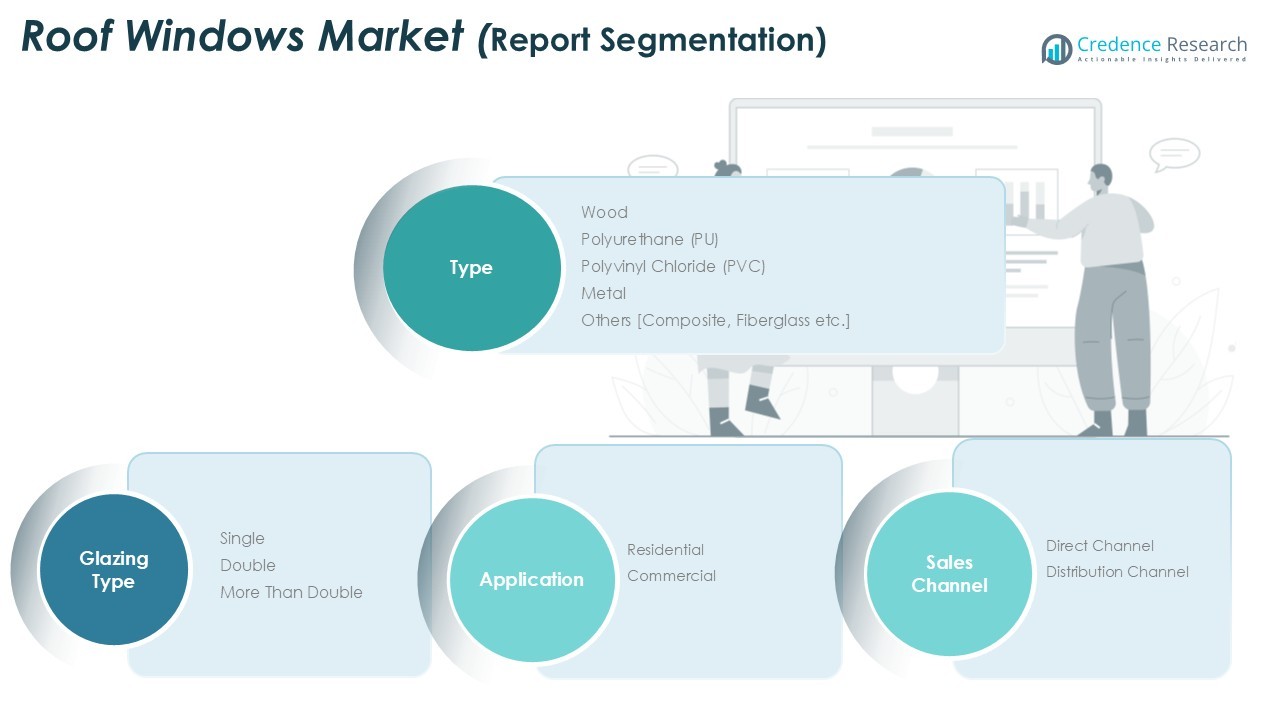
By Type
- Wood
- Polyurethane (PU)
- Polyvinyl Chloride (PVC)
- Metal
- Others
By Application
- Residential
- Commercial
By Glazing Type
- Single
- Double
- Triple and More
By Sales Channel
- Direct Channel
- Distribution Channel
By Geography
- Northern Italy
- Central Italy
- Southern Italy & Islands
Key Player Analysis
- Tulderhof
- Velux Group
- Roto Frank AG
- Farko
- Lamilux
- Piva Group
- Chirenti Group
- Emica
- Beckmann GmbH
- Arcolux
- Dakota Group
- Capoferri Serramenti
Recent Developments
- In 2023, LAMILUX launched the Modular Glass Skylight MS78 (also referred to as a Modular Glass Roof), a customizable daylight system for buildings that combines flexibility, rapid installation, and a focus on aesthetics and sustainability.
- In April 2025, Velux launched the VELUX Skylight System, with a solar-powered, pre-installed room-darkening shade as a standard feature on all glass skylights from April 7, 2025. The new shade design lets in more daylight and provides improved thermal performance (45% U-value improvement, 19% better solar heat gain coefficient). The Skylight System supports smart home integration and features built-in rain sensors.
- In March 2025, Velux and Guardian Glass announced a joint development agreement for tempered vacuum insulated glass (VIG). This collaboration aims to advance VIG technology, focusing on developing manufacturing processes and capabilities to meet the growing demand for high-performance, energy-efficient windows.
Report Coverage
The research report offers an in-depth analysis based on Type, Application, Glazing Type, Sales Channel and Geography. It details leading market players, providing an overview of their business, product offerings, investments, revenue streams, and key applications. Additionally, the report includes insights into the competitive environment, SWOT analysis, current market trends, as well as the primary drivers and constraints. Furthermore, it discusses various factors that have driven market expansion in recent years. The report also explores market dynamics, regulatory scenarios, and technological advancements that are shaping the industry. It assesses the impact of external factors and global economic changes on market growth. Lastly, it provides strategic recommendations for new entrants and established companies to navigate the complexities of the market.
Future Outlook
- The Italy Roof Windows market will grow steadily, supported by rising renovation and construction projects.
- Demand for energy-efficient and triple-glazed windows will increase due to stricter EU regulations.
- Smart and automated roof windows will gain popularity among tech-savvy homeowners.
- Manufacturers will focus on sustainable materials like FSC-certified wood and recyclable PVC.
- Commercial and hospitality sectors will drive adoption for improved daylighting and energy savings.
- Online sales channels will expand, making premium roof windows more accessible nationwide.
- Northern Italy will remain the largest regional market, driven by high renovation activity.
- Central Italy will see growth from heritage building restoration and tourism-driven construction.
- Southern Italy and islands will offer emerging opportunities with rising residential demand.
- Competition will intensify as players invest in R&D, product innovation, and digital marketing strategies.
Request a Free Sample
Fill in your details and we'll send you a free sample report.
- Sample data tables & charts
- Research methodology
Need a Custom Version of This Report?
Tailor the scope, geography, or segments to your exact requirements.
- Custom geography or segment scope
- Direct access to our analyst team
Frequently Asked Questions
What is the current market size for Italy Roof Windows market, and what is its projected size in 2032?
At what Compound Annual Growth Rate is the Italy Roof Windows market projected to grow between 2025 and 2032?
Which Italy Roof Windows market segment held the largest share in 2024?
What are the primary factors fueling the growth of the Italy Roof Windows market?
Who are the leading companies in the Italy Roof Windows market?
Which region commanded the largest share of the Italy Roof Windows market in 2024?
Table of Content
Chapter 1. Report Introduction
- 1.1 Report Description & Purpose
- 1.1.1 Report Title & Market Definition
- 1.1.2 Unique Selling Propositions (USP) & Key Differentiators
- 1.1.3 Value Proposition for Stakeholders
- 1.2 Research Objectives
- 1.2.1 Market Sizing Objectives (Volume & Revenue)
- 1.2.2 Segmentation Objectives
- 1.2.3 Competitive Intelligence Objectives
- 1.2.4 Forecast & Scenario Objectives
- 1.3 Report Scope
- 1.3.1 Italy Roof Windows Scope – Types & Subtypes Covered
- 1.3.2 Geographic Scope – Regions & Countries Covered
- 1.3.3 Historical Period, Base Year & Forecast Period (2018; forecast to 2032)
- 1.3.4 Inclusions & Exclusions
- 1.4 HS Code & Classification Framework
- 1.5 Currency, Units & Pricing Basis
- 1.6 Target Stakeholders
- 1.7 Limitations & Assumptions
Chapter 2. Executive Summary
- 2.1 Global Italy Roof Windows Market Snapshot
- 2.1.1 Market Size – Historical (2018) & Forecast (2018-2032) (2018: USD 39.20 million → 2032: USD 72.24 million)
- 2.1.2 Volume & Revenue – Global Totals
- 2.1.3 Key Market Highlights – Top Five Facts
- 2.2 Italy Roof Windows Market Segmentation Snapshot
- 2.2.1 Market Split by Region – 2018 vs. 2032
- 2.3 Competitive Snapshot
- 2.3.1 Top 10 Players by Revenue Share – 2018
- 2.3.2 Top 10 Players by Volume Share – 2018
- 2.3.3 Recent Strategic Developments (18-Month Summary)
- 2.4 Key Investment Highlights & Strategic Conclusions
Chapter 3. Italy Roof Windows Market Dynamics & Industry Analysis
- 3.1 Market Overview & Context
- 3.1.1 Italy Roof Windows Market Position in the Broader Automotive Value Chain
- 3.1.2 OEM vs. Replacement Market Dynamics
- 3.1.3 Market Maturity & Development Stage by Region
- 3.2 Italy Roof Windows Market Drivers
- 3.3 Italy Roof Windows Market Restraints & Challenges
- 3.4 Italy Roof Windows Market Opportunities
- 3.5 Porter's Five Forces Analysis
- 3.5.1 Threat of New Entrants
- 3.5.2 Bargaining Power of Suppliers
- 3.5.3 Bargaining Power of Buyers
- 3.5.4 Threat of Substitutes
- 3.5.5 Competitive Rivalry – Intensity Assessment
- 3.6 Italy Roof Windows Value Chain Analysis
- 3.6.1 Upstream – Raw Material/Input Suppliers
- 3.6.1.1 Raw Material/Input 1
- 3.6.1.2 Raw Material/Input 2
- 3.6.1.3 Raw Material/Input 3
- 3.6.2 Midstream – Production/Manufacturing/Service Delivery
- 3.6.2.1 Production/Process Overview
- 3.6.2.2 Key Facility Locations & Capacity by Manufacturer
- 3.6.3 Downstream – Distribution & End Consumer
- 3.6.3.1 Primary Channel – B2B/OEM
- 3.6.3.2 Secondary Channels – Dealer, Retail, Online, Direct
- 3.6.4 Value Chain Profitability Analysis
- 3.6.1 Upstream – Raw Material/Input Suppliers
- 3.7 PESTEL Analysis
- 3.7.1 Political Factors
- 3.7.2 Economic Factors
- 3.7.3 Social Factors
- 3.7.4 Technological Factors
- 3.7.5 Environmental Factors
- 3.7.6 Legal Factors
- 3.8 Italy Roof Windows Supply Chain Analysis
- 3.8.1 Raw Material/Input Supply Risk Assessment
- 3.8.2 Manufacturing Concentration Risk (Geographic Exposure)
- 3.8.3 Trade Disruption Impact Analysis
- 3.9 Regulatory & Policy Landscape
Note: The regulatory and policy landscape section covers regulations based on their applicability to the market, Italy Roof Windows category, geography, and scope of the study. Only regulatory frameworks with a material impact on operations, compliance, trade, sustainability, or market access are analyzed in detail.
Chapter 4. Key Investment Pockets & Opportunity Analysis
- 4.1 Italy Roof Windows Market Attractiveness Analysis
- 4.1.1 By Region – Investment Attractiveness Matrix (Volume × CAGR)
- 4.2 Absolute Revenue Growth Opportunity
- 4.2.1 By Region – Absolute USD Growth Through 2032
- 4.3 Incremental Volume Opportunity
- 4.3.1 By Region – Incremental Volume Through 2032
- 4.3.2 Segment – Incremental Volume
- 4.4 Emerging Submarket Opportunity Deep Dive (Subject to Applicability)
- 4.5 Emerging Market Opportunity Scorecards
- 4.5.1 United States
- 4.5.2 Europe
- 4.5.3 Asia
- 4.5.4 Middle East & Africa
Note: Emerging Market Opportunity Scorecards will be included based on relevance and strategic importance. Regions listed are indicative and may vary depending on data availability and market dynamics.
Chapter 5. Italy Roof Windows Import-Export Analysis & Trade Flows
- 5.1 Global Trade Overview
- 5.1.1 Global Export Value by Country (2018)
- 5.1.2 Global Export Volume by Country (2018)
- 5.1.3 Global Import Value by Country (2018)
- 5.1.4 Global Import Volume by Country (2018)
- 5.1.5 Net Trade Balance by Country (2018)
- 5.2 Export Analysis – Segment
- 5.2.1 Type 1 (HS Code)
- 5.2.2 Type 2 (HS Code)
- 5.2.3 Type 3 (HS Code)
- 5.2.4 Type 4 (HS Code)
- 5.2.5 Type 5 (HS Code)
- 5.3 Import Analysis – Segment
- 5.3.1 Type 1 (HS Code)
- 5.3.2 Type 2 (HS Code)
- 5.3.3 Type 3 (HS Code)
- 5.3.4 Type 4 (HS Code)
- 5.3.5 Type 5 (HS Code)
- 5.4 Average Unit Trade Prices
- 5.4.1 Average Export Price – Segment & Country
- 5.4.2 Average Import Price – Segment & Source Country
- 5.4.3 Price Trends (2018)
- 5.5 Key Trade Route Analysis
- 5.5.1 Trade Route 1
- 5.5.2 Trade Route 2
- 5.5.3 Trade Route 3
- 5.5.4 Trade Route 4
- 5.5.5 Trade Route 5
- 5.6 Trade Policy Impact Assessment
- 5.6.1 US Anti-Dumping & Section 301 Tariffs
- 5.6.2 EU Customs Union Impact
- 5.6.3 Major Free Trade Agreements
- 5.6.4 USMCA Rules of Origin
Note: Trade policy analysis will be included only where relevant to the Italy Roof Windows market.
Chapter 6. Competitive Landscape & Company Benchmarking
- 6.1 Italy Roof Windows Market Concentration & Structure
- 6.1.1 Herfindahl-Hirschman Index (HHI) – vs. 2018
- 6.1.2 Tier 1, Tier 2 & Tier 3 Market Structure
- 6.1.3 Global, Regional & Local Player Dynamics
- 6.2 Italy Roof Windows Market Share Analysis – 2018
- 6.2.1 Global Revenue Share by Company
- 6.2.2 Global Volume Share by Company
- 6.2.3 Regional Revenue Share
- 6.2.4 Market Share Evolution ( vs. 2018)
- 6.2.5 OEM Segment Share by Company
- 6.2.6 Replacement Segment Share by Company
- 6.3 Production/Delivery Capacity & Facility Analysis
- 6.3.1 Global Installed Capacity
- 6.3.2 Capacity Utilization Rates
- 6.3.3 Production/Output Volume
- 6.3.4 Facility Locations & Capacity Map
- 6.3.5 Planned Capacity Additions
- 6.4 Italy Roof Windows Competitive Benchmarking Matrix
- 6.4.1 Revenue, Volume, CAGR & Profitability Comparison
- 6.4.2 Channel Revenue Mix
- 6.4.3 Geographic Revenue Exposure
- 6.4.4 R&D Intensity
- 6.4.5 Sustainability Maturity
- 6.5 Strategic Developments in Italy Roof Windows (Last 24 Months)
- 6.5.1 Mergers, Acquisitions & Divestments
- 6.5.2 New Italy Roof Windows Launches
- 6.5.3 Facility Expansions
- 6.5.4 Strategic Alliances, Joint Ventures & Partnerships
- 6.5.5 Distribution Expansion & Market Entry
- 6.5.6 Sustainability & ESG Initiatives
- 6.6 Competitive Strategy Mapping
- 6.6.1 Leader, Challenger, Follower & Niche Classification
- 6.6.2 Pricing Strategy Comparison
- 6.6.3 Channel Strategy Matrix
Note: Strategic developments are included based on their materiality and the availability of reliable information.
Chapter 7. Global Italy Roof Windows Market – By Distribution Channel
- 7.1 Segment Overview
- 7.1.1 Volume & Revenue Split by Channel (2018 & 2032)
- 7.1.2 Channel Mix Evolution (2018-2032)
Chapter 8. Regional Market Analysis – Global Overview
- 8.1 Global Regional Overview
- 8.1.1 Regional Volume Share
- 8.1.2 Regional Revenue Share
- 8.1.3 Regional Volume by Region
- 8.1.4 Regional Revenue by Region
- 8.1.5 Regional Forecast Through 2032
- 8.2 Cross-Regional Segment Analysis
- 8.2.1 By Distribution Channel
- 8.2.2 By Brand/Price Tier
Chapter 9. North America Italy Roof Windows Market
- 9.1 United States
- 9.2 Canada
- 9.3 Mexico
Chapter 10. Europe Italy Roof Windows Market
- 10.1 Germany
- 10.2 France
- 10.3 Italy
- 10.4 United Kingdom
- 10.5 Spain
- 10.6 Poland
- 10.7 Russia
- 10.8 Netherlands
- 10.9 Belgium
- 10.10 Sweden
- 10.11 Denmark
- 10.12 Norway
- 10.13 Rest of Europe
Chapter 11. Asia Pacific Italy Roof Windows Market
- 11.1 China
- 11.2 India
- 11.3 Japan
- 11.4 South Korea
- 11.5 Thailand
- 11.6 Indonesia
- 11.7 Vietnam
- 11.8 Malaysia
- 11.9 Australia
- 11.10 Rest of Asia Pacific
Chapter 12. Latin America Italy Roof Windows Market
- 12.1 Brazil
- 12.2 Argentina
- 12.3 Colombia
- 12.4 Chile
- 12.5 Rest of Latin America
Chapter 13. Middle East Italy Roof Windows Market
- 13.1 Saudi Arabia
- 13.2 United Arab Emirates
- 13.3 Turkey
- 13.4 Israel
- 13.5 Iran
- 13.6 Rest of the Middle East
Chapter 14. Africa Italy Roof Windows Market
- 14.1 South Africa
- 14.2 Egypt
- 14.3 Nigeria
- 14.4 Morocco
- 14.5 Rest of Africa
Chapter 15. Italy Roof Windows Company Profiles
- 15.1 [Company 01]
- 15.1.1 Company Overview
- 15.1.2 Key Management Personnel
- 15.1.3 Products & Services Portfolio
- 15.1.4 Financial Performance
- 15.1.5 Key Market Focus & Geographic Presence
- 15.1.6 Recent Developments & Strategic Initiatives
Note: The company profile list is preliminary and may change based on research findings, market developments, data availability, and client requirements.
Chapter 16. Appendices
- Appendix A – List of Abbreviations & Acronyms
- Appendix B – Industry Classification Code Reference – Full Series
- Appendix C – Production & Capacity Data Tables
- Appendix D – End-Use & Demand Base Tables
- Appendix E – Consumption & Replacement Rate Assumptions
- Appendix F – ASP Reference Tables
- Appendix G – Manufacturing & Facility Database
- Appendix H – Import-Export Data Tables
- Appendix I – Regulatory Summary Tables
- Appendix J – Primary Research Participant List (Anonymized)
- Appendix K – Primary Research Questionnaire Framework
- Appendix L – Data Sources & Bibliography
- Appendix M – Market Size Divergence & Source Comparison
Chapter 17. Research Methodology
- 17.1 Research Framework & Philosophy
- 17.2 Secondary Research – Sources, Hierarchy & Data Extraction
- 17.3 Data Modeling – Bottom-Up & Top-Down Market Sizing
- 17.4 Primary Research – Stakeholder Framework, LOI & Sample Sizes
- 17.5 Forecast Methodology – Regression, Scenario & Sensitivity Analysis
- 17.6 Quality Control – Four-Layer Validation Framework
- 17.7 Limitations & Standard Assumptions
- 17.8 Disclaimer
