
Market Overview:
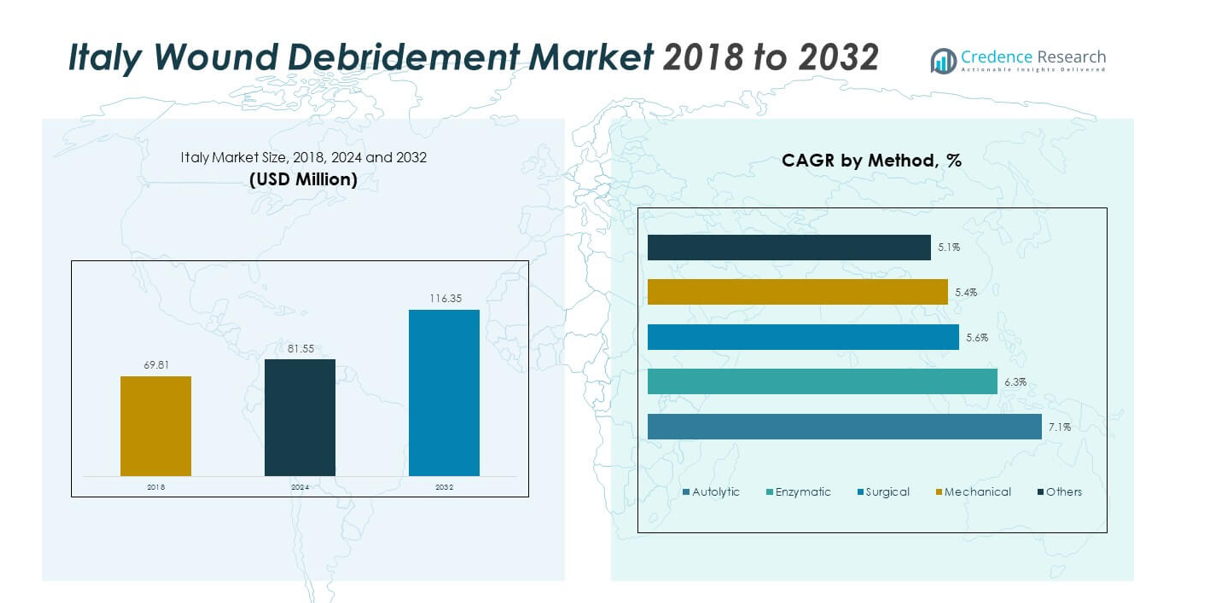
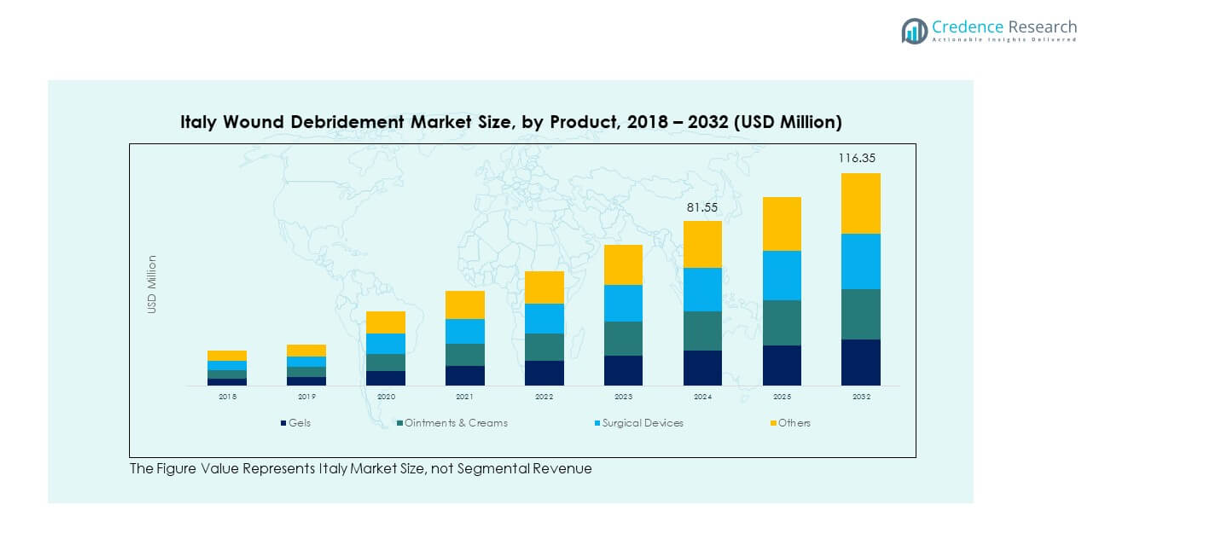
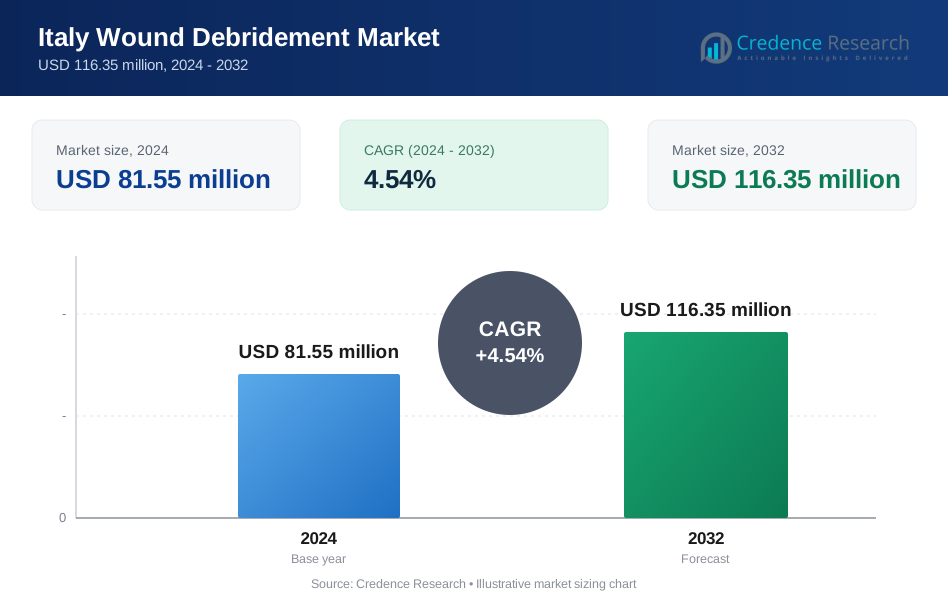
The Italy Wound Debridement Market size was valued at USD 69.81 million in 2018, reached USD 81.55 million in 2024, and is anticipated to reach USD 116.35 million by 2032, at a CAGR of 4.54% during the forecast period.
| REPORT ATTRIBUTE | DETAILS |
|---|---|
| Historical Period | 2020-2023 |
| Base Year | 2024 |
| Forecast Period | 2025-2032 |
| Italy Wound Debridement Market Size 2024 | USD 81.55 million |
| Italy Wound Debridement Market, CAGR | 4.54% |
| Italy Wound Debridement Market Size 2032 | USD 116.35 million |
Market growth in Italy is driven by the increasing prevalence of chronic wounds such as diabetic ulcers, pressure ulcers, and venous leg ulcers. Rising awareness among healthcare professionals about advanced wound management and the growing adoption of enzymatic and mechanical debridement solutions are also fueling demand. Expanding healthcare infrastructure and the availability of specialized wound care centers further support market expansion.
Regionally, northern Italy leads the market due to better healthcare access, a higher aging population, and strong hospital networks. Central regions are showing steady growth driven by government healthcare initiatives, while southern Italy is emerging as a potential growth area with increasing investment in medical facilities and wound management programs. This regional spread highlights Italy’s broad adoption of modern wound care technologies.
Market Insights:
- The Italy Wound Debridement Market was valued at USD 69.81 million in 2018, reached USD 81.55 million in 2024, and is projected to reach USD 116.35 million by 2032, growing at a CAGR of 4.54% during the forecast period.
- Northern Italy holds the largest share at 45%, supported by superior healthcare infrastructure and advanced hospital facilities. Central Italy follows with 30%, driven by expanding wound management programs and public healthcare reforms, while Southern Italy contributes 25%, supported by ongoing medical infrastructure improvements.
- The Southern Italy and Islands region is the fastest-growing area with a 25% share, supported by healthcare expansion, increasing awareness programs, and government funding for chronic wound management.
- Among product categories, gels and ointments & creams together account for nearly 55% of the total market share, reflecting strong preference for easy-to-use and cost-effective wound care products.
- Surgical devices and others represent around 45% of the market, driven by rising adoption of advanced debridement tools and increased hospital usage for complex chronic wound cases.
Market Drivers:
Rising Prevalence of Chronic and Diabetic Wounds Among Aging Population
The Italy Wound Debridement Market is witnessing steady growth driven by the growing incidence of chronic wounds such as diabetic foot ulcers and pressure ulcers. Italy’s aging population, coupled with a higher rate of diabetes and vascular diseases, is increasing the demand for advanced wound care solutions. The rise in surgical procedures and post-operative wound cases further boosts product usage. Hospitals and clinics are adopting effective debridement techniques to reduce infection risks. Government healthcare programs promoting wound management awareness are supporting adoption. Public and private sector collaborations are expanding wound care accessibility. This trend is sustaining strong demand for debridement products nationwide.
- For instance, Mölnlycke Health Care reported ongoing growth and public hospital adoption of its wound care solutions in Italy, supported by annual report documentation of 7.4% global sales growth and continued expansion of advanced wound treatments in 2024.
Increasing Adoption of Advanced Debridement Technologies and Techniques
Technological innovations in wound debridement are driving market expansion in Italy. The use of ultrasonic, enzymatic, and autolytic debridement solutions is growing among healthcare professionals. These advanced systems enable faster healing, minimal discomfort, and improved clinical outcomes. Hospitals are increasingly adopting mechanical and sharp debridement tools due to efficiency in removing necrotic tissue. The Italy Wound Debridement Market benefits from rising medical device investments by global and domestic manufacturers. Continuous R&D efforts enhance device safety, precision, and performance. Medical professionals are being trained in advanced debridement techniques to improve patient outcomes. This shift toward innovation fosters sustained market growth.
- For instance, a 2020 study on the effectiveness of ultrasonic debridement found that the mean number of bacterial species per wound culture decreased from 2.53 to 1.90 after six weeks, with the difference being statistically significant (P = .023). The study, published in the International Wound Journal, confirms the use of an ultrasonic debridement device and details the significant reduction in bacterial bioburden.
Expanding Hospital Infrastructure and Specialized Wound Care Centers
Italy’s healthcare system is evolving with improved infrastructure and specialized wound care facilities. Major hospitals and clinics are establishing dedicated wound management units to handle complex chronic cases. Growing government healthcare spending enhances patient access to modern wound care services. The integration of debridement devices within advanced care centers ensures consistent treatment standards. The Italy Wound Debridement Market benefits from the rising number of skilled professionals focusing on chronic wound care. Home healthcare services are also expanding, offering personalized debridement options. This infrastructure growth ensures better treatment outcomes and market stability.
Rising Public Awareness and Training Programs for Healthcare Professionals
Awareness campaigns and continuous education programs are improving wound management practices in Italy. Medical associations and healthcare organizations are focusing on standardized training in wound debridement techniques. The government supports awareness initiatives highlighting the importance of timely wound care. Patients are increasingly seeking medical attention earlier, which enhances treatment success. Hospitals are encouraging knowledge exchange among wound care experts. Private medical centers are promoting certified training modules to enhance clinical performance. The Italy Wound Debridement Market gains from better patient education, leading to faster recovery and wider product use.
Market Trends:
Growing Shift Toward Enzymatic and Autolytic Debridement Methods
The Italy Wound Debridement Market is witnessing a notable shift from traditional mechanical methods toward enzymatic and autolytic techniques. These advanced approaches are gaining preference for their ability to promote faster and less painful healing. Enzymatic debridement agents help selectively remove necrotic tissue while preserving healthy cells. Autolytic methods are increasingly used in long-term care and home settings due to convenience and safety. Rising adoption of hydrogel and hydrocolloid dressings supports this trend. Healthcare professionals favor these options for better clinical outcomes. It is driving product diversification and continuous innovation in wound care solutions.
- For instance, Smith & Nephew’s Santyl (collagenase) ointment, used in clinical settings, has demonstrated efficacy in enzymatic debridement for chronic wounds, such as pressure injuries and diabetic foot ulcers. Specific case studies highlight positive outcomes, such as one instance of a post-surgical wound on the breast showing an 89% reduction in wound area over 28 days and another instance of an unstageable pressure injury on the heel showing a 91% reduction in wound area over 27 days.
Integration of Digital Technologies and Smart Wound Care Solutions
Digital health technologies are reshaping wound management in Italy through data-driven monitoring and diagnosis. Smart wound care systems and mobile-based wound tracking applications are helping clinicians assess healing progress more effectively. Hospitals are adopting AI-powered diagnostic tools to guide debridement procedures. Remote wound monitoring platforms are enhancing care delivery, especially for elderly and immobile patients. The Italy Wound Debridement Market is evolving through the combination of medical devices with digital health platforms. This integration improves treatment precision and patient adherence. The digital transformation trend is expected to strengthen in both hospital and homecare segments.
- For instance, a randomized clinical trial published in May 2025 showed that sensor-assisted wound therapy—including digital pressure and temperature monitoring via smartwatch and telemedicine—achieved a median time to ulcer healing of 40.5 days versus 266 days for standard care in patients with diabetic foot ulcers using these smart monitoring platforms in Italy.
Increasing Focus on Minimally Invasive and Patient-Centric Solutions
Healthcare providers in Italy are shifting toward minimally invasive wound debridement solutions to improve patient comfort and recovery. Mechanical devices with precision control, portable ultrasonic units, and single-use tools are gaining traction. These innovations reduce procedural time and lower infection risks. Patients are becoming more involved in care decisions, encouraging the use of less traumatic treatments. The Italy Wound Debridement Market benefits from this trend through higher acceptance rates and repeat usage. Manufacturers are developing ergonomic and user-friendly devices tailored to outpatient care. This patient-centric focus aligns with Italy’s emphasis on advanced, efficient healthcare delivery.
Sustainability and Biocompatible Material Adoption in Wound Care Products
The Italian healthcare industry is emphasizing sustainable and eco-friendly materials in medical devices and dressings. Companies are adopting biodegradable enzymes, bio-based gels, and reusable tools to reduce waste. Hospitals are aligning procurement strategies with environmental standards to meet EU sustainability goals. The Italy Wound Debridement Market is adapting to these trends by promoting biocompatible and non-toxic formulations. Manufacturers are conducting R&D to enhance material safety while maintaining clinical efficacy. Demand for green medical technologies is expanding across hospitals and clinics. Sustainability is becoming a key differentiator in product development and market positioning.
Market Challenges Analysis:
High Cost of Advanced Wound Debridement Products and Limited Reimbursement
The cost of advanced wound debridement technologies remains a major challenge in Italy’s healthcare system. High prices of enzymatic agents, ultrasonic tools, and smart dressings limit adoption among smaller hospitals and clinics. The Italy Wound Debridement Market faces resistance from patients who prefer affordable traditional options. Limited reimbursement coverage for advanced procedures restricts accessibility in public healthcare settings. Budget constraints in regional hospitals also reduce procurement of innovative devices. Manufacturers face pricing pressure while balancing quality and affordability. These financial limitations slow market penetration of technologically advanced wound care systems. Broader reimbursement support is essential to expand patient access.
Shortage of Trained Professionals and Limited Standardization in Wound Care Practices
A shortage of skilled wound care specialists remains a persistent issue across Italy’s healthcare network. Many medical centers lack staff trained in advanced debridement methods, leading to inconsistent treatment outcomes. The Italy Wound Debridement Market is constrained by variations in wound management standards between regions. Smaller clinics often rely on outdated manual procedures due to limited training access. Rural areas face additional challenges in adopting modern technologies. The absence of unified national guidelines complicates quality control. This skill and standardization gap hinders full market potential and patient recovery outcomes. Expanding specialized training programs can help bridge this divide.
Market Opportunities:
Rising Demand for Home Healthcare and Telemedicine-Based Wound Management
Italy’s growing elderly population is increasing the need for convenient wound care at home. The Italy Wound Debridement Market is set to gain from expanding telemedicine and home-based debridement services. Portable and easy-to-use devices allow patients to manage chronic wounds under remote supervision. Healthcare providers are integrating virtual monitoring systems for wound assessment. This approach improves accessibility and reduces hospital visits. Start-ups are introducing compact debridement kits for domestic use. Home-based solutions are expected to become a major growth driver in coming years.
Emerging Collaborations and R&D Investments in Advanced Wound Technologies
Rising R&D investments by Italian and global firms are creating strong opportunities in product innovation. The Italy Wound Debridement Market is seeing growth through collaborations between medical device companies and research institutions. Joint ventures focus on developing bioactive dressings, enzyme-based formulations, and AI-supported wound care systems. Universities are partnering with manufacturers to improve efficiency and precision in debridement. Government funding programs encourage innovation in healthcare technologies. These partnerships are likely to lead to next-generation products, enhancing patient outcomes and driving sustainable market growth.
Market Segmentation Analysis:
By Product Segment
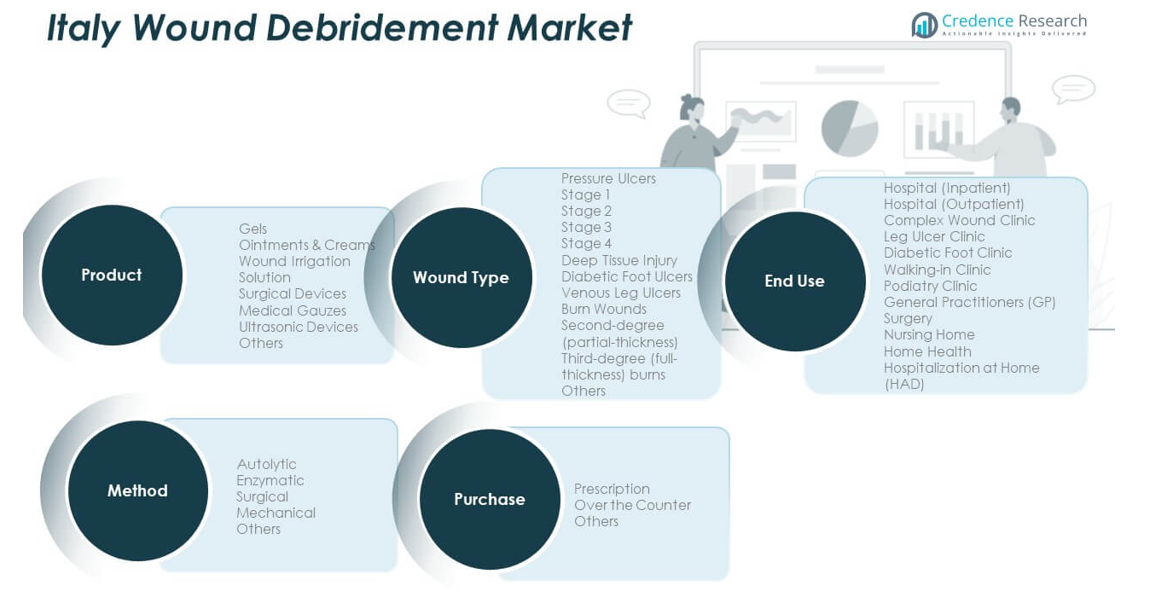
The Italy Wound Debridement Market includes products such as gels, ointments and creams, wound irrigation solutions, surgical devices, medical gauzes, ultrasonic devices, and others. Gels and ointments hold a significant share due to their ease of use and effectiveness in chronic wound care. Surgical and ultrasonic devices are expanding due to improved precision and faster healing outcomes. Wound irrigation solutions are gaining traction in hospitals for infection prevention. Medical gauzes remain essential across all care levels for basic wound management.
- For instance, Mölnlycke Health Care documented increased demand for gels and surgical devices in its annual report, confirming product expansion due to proven effectiveness and safety for chronic wound management in Italy and across Europe in 2024.
By Method Segment
Key methods include autolytic, enzymatic, surgical, mechanical, and others. Autolytic and enzymatic methods are witnessing strong adoption due to their selective and less invasive nature. Surgical debridement remains dominant in severe wound cases requiring rapid intervention. Mechanical techniques are used for cost-effective treatment, especially in outpatient clinics. The growing shift toward minimally invasive and efficient solutions supports steady method diversification.
- For instance, scientific reviews and clinical guidelines published for Italy reference rapid wound closure and improved healing rates in chronic wounds when enzymatic and autolytic debridement agents are used
By Wound Type Segment
The market covers pressure ulcers, diabetic foot ulcers, venous leg ulcers, and burn wounds. Pressure ulcers across all stages represent a major segment, driven by aging and immobilized patients. Diabetic foot ulcers are rising due to increasing diabetes prevalence. Burn wounds, including second and third-degree burns, demand advanced enzymatic and surgical debridement. The market reflects growing medical focus on chronic wound management and faster tissue recovery.
By End-Use and Purchase Segment
Hospitals, wound clinics, and home healthcare dominate end-use segments. Hospital inpatient and outpatient settings lead in revenue share. Home health and Hospitalization at Home (HAD) services are expanding with telemedicine adoption. By purchase type, prescription-based products dominate due to professional guidance, while over-the-counter options grow for mild wound care needs.
Segmentation:
By Product Segment
- Gels
- Ointments & Creams
- Wound Irrigation Solution
- Surgical Devices
- Medical Gauzes
- Ultrasonic Devices
- Others
By Method Segment
- Autolytic
- Enzymatic
- Surgical
- Mechanical
- Others
By Wound Type Segment
- Pressure Ulcers
- Stage 1
- Stage 2
- Stage 3
- Stage 4
- Deep Tissue Injury
- Diabetic Foot Ulcers
- Venous Leg Ulcers
- Burn Wounds
- Second-degree (partial-thickness)
- Third-degree (full-thickness) burns
- Others
By End-Use Segment
- Hospital (Inpatient)
- Hospital (Outpatient)
- Complex Wound Clinic
- Leg Ulcer Clinic
- Diabetic Foot Clinic
- Walking-in Clinic
- Podiatry Clinic
- General Practitioners (GP) Surgery
- Nursing Home
- Home Health
- Hospitalization at Home (HAD)
By Purchase Segment
- Prescription
- Over the Counter (OTC)
- Others
Regional Analysis:
Northern Italy – Leading Market with Strong Healthcare Infrastructure
Northern Italy dominates the Italy Wound Debridement Market, accounting for nearly 45% of the total share. The region’s well-established healthcare infrastructure, presence of specialized wound care centers, and high concentration of hospitals support market leadership. Cities such as Milan, Turin, and Bologna have advanced medical facilities equipped with modern debridement technologies. Rising cases of diabetic and pressure ulcers among the elderly further contribute to regional demand. Strong public healthcare funding and private investment enable consistent adoption of advanced wound management products. The growing use of enzymatic and autolytic debridement methods highlights the shift toward patient-centric treatment. The region continues to serve as the primary hub for clinical trials and product innovation.
Central Italy – Growing Market Driven by Public Health Initiatives
Central Italy holds about 30% of the market share, supported by government-backed health initiatives and rising chronic wound prevalence. Regions like Lazio, Tuscany, and Umbria are focusing on improving hospital capacity and wound management programs. The Italy Wound Debridement Market benefits from increasing awareness among clinicians about early wound assessment and intervention. Expansion of home healthcare and telemedicine services in urban areas is creating new growth channels. The growing demand for portable ultrasonic and enzymatic products aligns with the shift toward outpatient care. Local partnerships between healthcare institutions and device manufacturers are enhancing accessibility to advanced solutions. Central Italy is positioned for steady growth with improved healthcare integration.
Southern Italy and Islands – Emerging Market with Expanding Healthcare Access
Southern Italy and the islands collectively represent around 25% of the market share, showing rising potential through healthcare expansion and awareness programs. The regions of Campania, Puglia, Sicily, and Sardinia are investing in improving wound care infrastructure. It is benefiting from growing training programs for medical professionals focused on chronic wound treatment. Public hospitals are increasing procurement of cost-effective mechanical and autolytic debridement products. Local distribution networks are expanding to improve supply to rural areas. Rising diabetic population and delayed wound healing cases are driving demand for reliable debridement solutions. With improved access and funding support, Southern Italy and island regions are evolving into promising contributors to national market growth.
Key Player Analysis:
- Braun SE
- Lohmann & Rauscher GmbH & Co. KG
- Schülke & Mayr GmbH
- curea medical GmbH
- Ausbüttel & Co. GmbH (Draco)
- Paul Hartmann AG
- Ottobock SE & Co. KGaA
- HARTMANN GROUP
Competitive Analysis:
The Italy Wound Debridement Market is moderately competitive with both global and regional players strengthening their presence through innovation and partnerships. It is characterized by the dominance of established medical device manufacturers such as B. Braun SE, Paul Hartmann AG, Lohmann & Rauscher, and Schülke & Mayr GmbH. Companies are focusing on developing advanced enzymatic and ultrasonic debridement products to enhance wound healing outcomes. Local firms like curea medical GmbH and Dr. Ausbüttel & Co. GmbH are improving affordability and expanding domestic supply chains. Strategic collaborations with hospitals and clinics are helping players enhance brand visibility and distribution efficiency. The market’s competitive intensity is rising with continuous product development and digital integration in wound care.
Recent Developments:
- In September 2025, Lohmann & Rauscher GmbH & Co. KG entered into a strategic partnership and acquired a 49% share in ADA Group, the only competitive European manufacturer of gauze and nonwoven products with vertical manufacturing control, strengthening L&R’s delivery capabilities and market position for high-quality wound treatment and debridement products in Italy and across Europe.
- In August 2023, Schülke & Mayr GmbH continued its healthcare-focused growth strategy under new ownership after a consortium led by ATHOS completed an acquisition, enabling the company to sharpen innovation within its wound care and infection prevention business in major European markets including Italy.
Report Coverage:
The research report offers an in-depth analysis based on product, method, wound type, end-use, and purchase segments. It details leading market players, providing an overview of their business, product offerings, investments, revenue streams, and key applications. Additionally, the report includes insights into the competitive environment, SWOT analysis, current market trends, as well as the primary drivers and constraints. Furthermore, it discusses various factors that have driven market expansion in recent years. The report also explores market dynamics, regulatory scenarios, and technological advancements that are shaping the industry. It assesses the impact of external factors and global economic changes on market growth. Lastly, it provides strategic recommendations for new entrants and established companies to navigate the complexities of the market.
Future Outlook:
- Demand for advanced enzymatic and autolytic debridement will expand in hospitals and homecare.
- Technological integration in wound care will enhance treatment accuracy and monitoring.
- Telemedicine adoption will strengthen remote wound management services.
- Growing geriatric and diabetic populations will continue to drive chronic wound treatment needs.
- Product innovation focusing on biocompatible and sustainable materials will increase.
- Local production and partnerships will reduce dependence on imported medical supplies.
- Public healthcare initiatives will enhance access to affordable wound care solutions.
- Training programs for clinicians will improve clinical outcomes and product usage.
- The market will see higher investment in AI-supported diagnostic and debridement tools.
- Rising awareness and preventive care practices will support long-term market stability.
Request a Free Sample
Fill in your details and we'll send you a free sample report.
- Sample data tables & charts
- Research methodology
Need a Custom Version of This Report?
Tailor the scope, geography, or segments to your exact requirements.
- Custom geography or segment scope
- Direct access to our analyst team
Frequently Asked Questions
What is the current market size for Italy Wound Debridement Market, and what is its projected size in 2032?
At what Compound Annual Growth Rate is the Italy Wound Debridement Market projected to grow between 2024 and 2032?
Which Italy Wound Debridement Market segment held the largest share in 2024?
What are the primary factors fueling the growth of the Italy Wound Debridement Market?
Who are the leading companies in the Italy Wound Debridement Market?
Table of Content
Chapter 1. Report Introduction
- 1.1 Report Description & Purpose
- 1.1.1 Report Title & Market Definition
- 1.1.2 Unique Selling Propositions (USP) & Key Differentiators
- 1.1.3 Value Proposition for Stakeholders
- 1.2 Research Objectives
- 1.2.1 Market Sizing Objectives (Volume & Revenue)
- 1.2.2 Segmentation Objectives
- 1.2.3 Competitive Intelligence Objectives
- 1.2.4 Forecast & Scenario Objectives
- 1.3 Report Scope
- 1.3.1 Italy Wound Debridement Scope – Types & Subtypes Covered
- 1.3.2 Geographic Scope – Regions & Countries Covered
- 1.3.3 Historical Period, Base Year & Forecast Period (2024; forecast to 2032)
- 1.3.4 Inclusions & Exclusions
- 1.4 HS Code & Classification Framework
- 1.5 Currency, Units & Pricing Basis
- 1.6 Target Stakeholders
- 1.7 Limitations & Assumptions
Chapter 2. Executive Summary
- 2.1 Global Italy Wound Debridement Market Snapshot
- 2.1.1 Market Size – Historical (2024) & Forecast (2024-2032) (2024: USD 81.55 million → 2032: USD 116.35 million)
- 2.1.2 Volume & Revenue – Global Totals
- 2.1.3 Key Market Highlights – Top Five Facts
- 2.2 Italy Wound Debridement Market Segmentation Snapshot
- 2.2.1 Market Split by Region – 2024 vs. 2032
- 2.3 Competitive Snapshot
- 2.3.1 Top 10 Players by Revenue Share – 2024
- 2.3.2 Top 10 Players by Volume Share – 2024
- 2.3.3 Recent Strategic Developments (18-Month Summary)
- 2.4 Key Investment Highlights & Strategic Conclusions
Chapter 3. Italy Wound Debridement Market Dynamics & Industry Analysis
- 3.1 Market Overview & Context
- 3.1.1 Italy Wound Debridement Market Position in the Broader Automotive Value Chain
- 3.1.2 OEM vs. Replacement Market Dynamics
- 3.1.3 Market Maturity & Development Stage by Region
- 3.2 Italy Wound Debridement Market Drivers
- 3.3 Italy Wound Debridement Market Restraints & Challenges
- 3.4 Italy Wound Debridement Market Opportunities
- 3.5 Porter's Five Forces Analysis
- 3.5.1 Threat of New Entrants
- 3.5.2 Bargaining Power of Suppliers
- 3.5.3 Bargaining Power of Buyers
- 3.5.4 Threat of Substitutes
- 3.5.5 Competitive Rivalry – Intensity Assessment
- 3.6 Italy Wound Debridement Value Chain Analysis
- 3.6.1 Upstream – Raw Material/Input Suppliers
- 3.6.1.1 Raw Material/Input 1
- 3.6.1.2 Raw Material/Input 2
- 3.6.1.3 Raw Material/Input 3
- 3.6.2 Midstream – Production/Manufacturing/Service Delivery
- 3.6.2.1 Production/Process Overview
- 3.6.2.2 Key Facility Locations & Capacity by Manufacturer
- 3.6.3 Downstream – Distribution & End Consumer
- 3.6.3.1 Primary Channel – B2B/OEM
- 3.6.3.2 Secondary Channels – Dealer, Retail, Online, Direct
- 3.6.4 Value Chain Profitability Analysis
- 3.6.1 Upstream – Raw Material/Input Suppliers
- 3.7 PESTEL Analysis
- 3.7.1 Political Factors
- 3.7.2 Economic Factors
- 3.7.3 Social Factors
- 3.7.4 Technological Factors
- 3.7.5 Environmental Factors
- 3.7.6 Legal Factors
- 3.8 Italy Wound Debridement Supply Chain Analysis
- 3.8.1 Raw Material/Input Supply Risk Assessment
- 3.8.2 Manufacturing Concentration Risk (Geographic Exposure)
- 3.8.3 Trade Disruption Impact Analysis
- 3.9 Regulatory & Policy Landscape
Note: The regulatory and policy landscape section covers regulations based on their applicability to the market, Italy Wound Debridement category, geography, and scope of the study. Only regulatory frameworks with a material impact on operations, compliance, trade, sustainability, or market access are analyzed in detail.
Chapter 4. Key Investment Pockets & Opportunity Analysis
- 4.1 Italy Wound Debridement Market Attractiveness Analysis
- 4.1.1 By Region – Investment Attractiveness Matrix (Volume × CAGR)
- 4.2 Absolute Revenue Growth Opportunity
- 4.2.1 By Region – Absolute USD Growth Through 2032
- 4.3 Incremental Volume Opportunity
- 4.3.1 By Region – Incremental Volume Through 2032
- 4.3.2 Segment – Incremental Volume
- 4.4 Emerging Submarket Opportunity Deep Dive (Subject to Applicability)
- 4.5 Emerging Market Opportunity Scorecards
- 4.5.1 United States
- 4.5.2 Europe
- 4.5.3 Asia
- 4.5.4 Middle East & Africa
Note: Emerging Market Opportunity Scorecards will be included based on relevance and strategic importance. Regions listed are indicative and may vary depending on data availability and market dynamics.
Chapter 5. Italy Wound Debridement Import-Export Analysis & Trade Flows
- 5.1 Global Trade Overview
- 5.1.1 Global Export Value by Country (2024)
- 5.1.2 Global Export Volume by Country (2024)
- 5.1.3 Global Import Value by Country (2024)
- 5.1.4 Global Import Volume by Country (2024)
- 5.1.5 Net Trade Balance by Country (2024)
- 5.2 Export Analysis – Segment
- 5.2.1 Type 1 (HS Code)
- 5.2.2 Type 2 (HS Code)
- 5.2.3 Type 3 (HS Code)
- 5.2.4 Type 4 (HS Code)
- 5.2.5 Type 5 (HS Code)
- 5.3 Import Analysis – Segment
- 5.3.1 Type 1 (HS Code)
- 5.3.2 Type 2 (HS Code)
- 5.3.3 Type 3 (HS Code)
- 5.3.4 Type 4 (HS Code)
- 5.3.5 Type 5 (HS Code)
- 5.4 Average Unit Trade Prices
- 5.4.1 Average Export Price – Segment & Country
- 5.4.2 Average Import Price – Segment & Source Country
- 5.4.3 Price Trends (2024)
- 5.5 Key Trade Route Analysis
- 5.5.1 Trade Route 1
- 5.5.2 Trade Route 2
- 5.5.3 Trade Route 3
- 5.5.4 Trade Route 4
- 5.5.5 Trade Route 5
- 5.6 Trade Policy Impact Assessment
- 5.6.1 US Anti-Dumping & Section 301 Tariffs
- 5.6.2 EU Customs Union Impact
- 5.6.3 Major Free Trade Agreements
- 5.6.4 USMCA Rules of Origin
Note: Trade policy analysis will be included only where relevant to the Italy Wound Debridement market.
Chapter 6. Competitive Landscape & Company Benchmarking
- 6.1 Italy Wound Debridement Market Concentration & Structure
- 6.1.1 Herfindahl-Hirschman Index (HHI) – vs. 2024
- 6.1.2 Tier 1, Tier 2 & Tier 3 Market Structure
- 6.1.3 Global, Regional & Local Player Dynamics
- 6.2 Italy Wound Debridement Market Share Analysis – 2024
- 6.2.1 Global Revenue Share by Company
- 6.2.2 Global Volume Share by Company
- 6.2.3 Regional Revenue Share
- 6.2.4 Market Share Evolution ( vs. 2024)
- 6.2.5 OEM Segment Share by Company
- 6.2.6 Replacement Segment Share by Company
- 6.3 Production/Delivery Capacity & Facility Analysis
- 6.3.1 Global Installed Capacity
- 6.3.2 Capacity Utilization Rates
- 6.3.3 Production/Output Volume
- 6.3.4 Facility Locations & Capacity Map
- 6.3.5 Planned Capacity Additions
- 6.4 Italy Wound Debridement Competitive Benchmarking Matrix
- 6.4.1 Revenue, Volume, CAGR & Profitability Comparison
- 6.4.2 Channel Revenue Mix
- 6.4.3 Geographic Revenue Exposure
- 6.4.4 R&D Intensity
- 6.4.5 Sustainability Maturity
- 6.5 Strategic Developments in Italy Wound Debridement (Last 24 Months)
- 6.5.1 Mergers, Acquisitions & Divestments
- 6.5.2 New Italy Wound Debridement Launches
- 6.5.3 Facility Expansions
- 6.5.4 Strategic Alliances, Joint Ventures & Partnerships
- 6.5.5 Distribution Expansion & Market Entry
- 6.5.6 Sustainability & ESG Initiatives
- 6.6 Competitive Strategy Mapping
- 6.6.1 Leader, Challenger, Follower & Niche Classification
- 6.6.2 Pricing Strategy Comparison
- 6.6.3 Channel Strategy Matrix
Note: Strategic developments are included based on their materiality and the availability of reliable information.
Chapter 7. Global Italy Wound Debridement Market – By Distribution Channel
- 7.1 Segment Overview
- 7.1.1 Volume & Revenue Split by Channel (2024 & 2032)
- 7.1.2 Channel Mix Evolution (2024-2032)
Chapter 8. Regional Market Analysis – Global Overview
- 8.1 Global Regional Overview
- 8.1.1 Regional Volume Share
- 8.1.2 Regional Revenue Share
- 8.1.3 Regional Volume by Region
- 8.1.4 Regional Revenue by Region
- 8.1.5 Regional Forecast Through 2032
- 8.2 Cross-Regional Segment Analysis
- 8.2.1 By Distribution Channel
- 8.2.2 By Brand/Price Tier
Chapter 9. North America Italy Wound Debridement Market
- 9.1 United States
- 9.2 Canada
- 9.3 Mexico
Chapter 10. Europe Italy Wound Debridement Market
- 10.1 Germany
- 10.2 France
- 10.3 Italy
- 10.4 United Kingdom
- 10.5 Spain
- 10.6 Poland
- 10.7 Russia
- 10.8 Netherlands
- 10.9 Belgium
- 10.10 Sweden
- 10.11 Denmark
- 10.12 Norway
- 10.13 Rest of Europe
Chapter 11. Asia Pacific Italy Wound Debridement Market
- 11.1 China
- 11.2 India
- 11.3 Japan
- 11.4 South Korea
- 11.5 Thailand
- 11.6 Indonesia
- 11.7 Vietnam
- 11.8 Malaysia
- 11.9 Australia
- 11.10 Rest of Asia Pacific
Chapter 12. Latin America Italy Wound Debridement Market
- 12.1 Brazil
- 12.2 Argentina
- 12.3 Colombia
- 12.4 Chile
- 12.5 Rest of Latin America
Chapter 13. Middle East Italy Wound Debridement Market
- 13.1 Saudi Arabia
- 13.2 United Arab Emirates
- 13.3 Turkey
- 13.4 Israel
- 13.5 Iran
- 13.6 Rest of the Middle East
Chapter 14. Africa Italy Wound Debridement Market
- 14.1 South Africa
- 14.2 Egypt
- 14.3 Nigeria
- 14.4 Morocco
- 14.5 Rest of Africa
Chapter 15. Italy Wound Debridement Company Profiles
- 15.1 [Company 01]
- 15.1.1 Company Overview
- 15.1.2 Key Management Personnel
- 15.1.3 Products & Services Portfolio
- 15.1.4 Financial Performance
- 15.1.5 Key Market Focus & Geographic Presence
- 15.1.6 Recent Developments & Strategic Initiatives
Note: The company profile list is preliminary and may change based on research findings, market developments, data availability, and client requirements.
Chapter 16. Appendices
- Appendix A – List of Abbreviations & Acronyms
- Appendix B – Industry Classification Code Reference – Full Series
- Appendix C – Production & Capacity Data Tables
- Appendix D – End-Use & Demand Base Tables
- Appendix E – Consumption & Replacement Rate Assumptions
- Appendix F – ASP Reference Tables
- Appendix G – Manufacturing & Facility Database
- Appendix H – Import-Export Data Tables
- Appendix I – Regulatory Summary Tables
- Appendix J – Primary Research Participant List (Anonymized)
- Appendix K – Primary Research Questionnaire Framework
- Appendix L – Data Sources & Bibliography
- Appendix M – Market Size Divergence & Source Comparison
Chapter 17. Research Methodology
- 17.1 Research Framework & Philosophy
- 17.2 Secondary Research – Sources, Hierarchy & Data Extraction
- 17.3 Data Modeling – Bottom-Up & Top-Down Market Sizing
- 17.4 Primary Research – Stakeholder Framework, LOI & Sample Sizes
- 17.5 Forecast Methodology – Regression, Scenario & Sensitivity Analysis
- 17.6 Quality Control – Four-Layer Validation Framework
- 17.7 Limitations & Standard Assumptions
- 17.8 Disclaimer
