Rodenticides Market Overview:
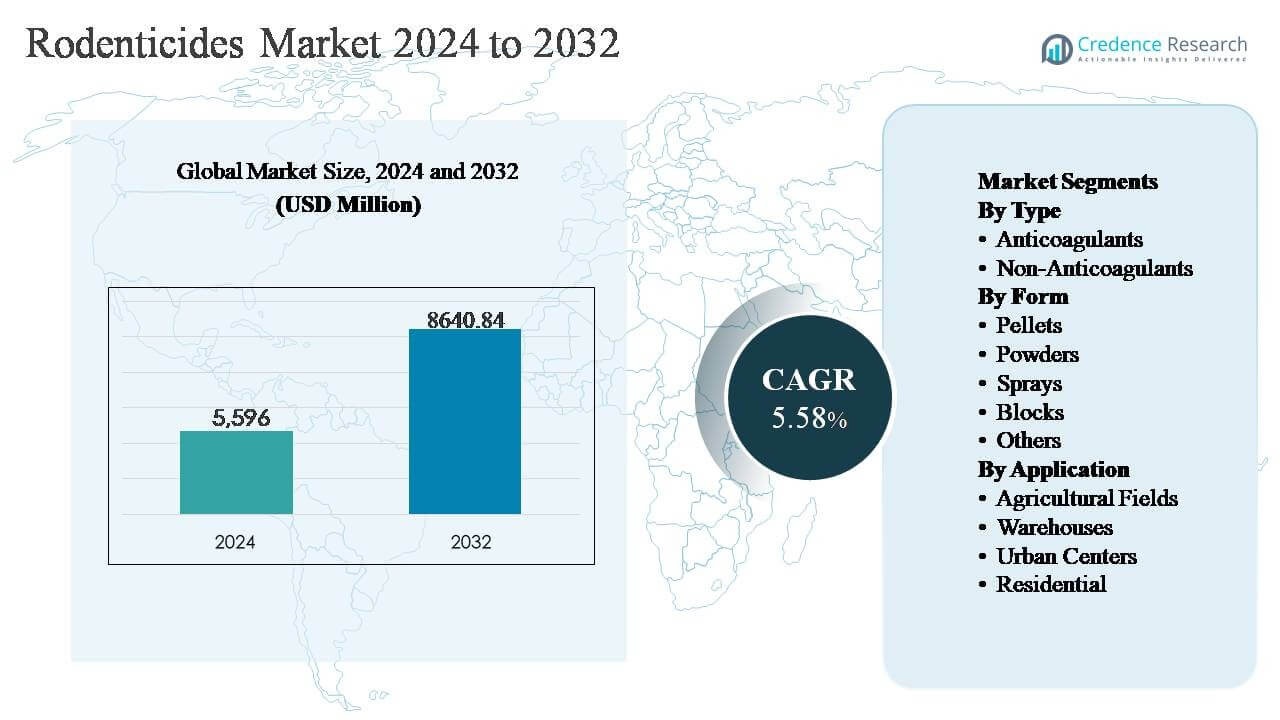
The global rodenticides market was valued at USD 5,596 million in 2024 and is projected to reach USD 8,640.84 million by 2032, expanding at a compound annual growth rate (CAGR) of 5.58% during the forecast period.
| REPORT ATTRIBUTE | DETAILS |
|---|---|
| Historical Period | 2020-2023 |
| Base Year | 2024 |
| Forecast Period | 2025-2032 |
| Rodenticides Market Size 2024 | USD 5,596 million |
| Rodenticides Market, CAGR | 5.58% |
| Rodenticides Market Size 2032 | USD 8,640.84 million |
Rodenticides Market Insights
- Market growth is primarily driven by rising rodent-borne disease risks, strict food safety and hygiene regulations, and increasing crop and post-harvest loss prevention needs, with anticoagulant rodenticides dominating the type segment at around 65-70% share due to proven efficacy and wide professional acceptance.
- Key trends include the shift toward safer, regulated formulations, integration of rodenticides within professional pest control and IPM programs, and growing adoption of durable bait forms, where pellets and blocks together account for over 55% of total form-based demand.
- The competitive landscape is characterized by multinational agrochemical firms and specialized pest control players focusing on regulatory-compliant portfolios, resistance management, and professional distribution channels to protect and expand market share.
- Regionally, North America leads with ~35% share, followed by Europe at ~26% and Asia-Pacific at ~23%, with Asia-Pacific emerging as the fastest-growing region due to urbanization, expanding agriculture, and rising sanitation investments.
Rodenticides Market Segmentation Analysis:
By Type:
By type, anticoagulant rodenticides represent the dominant sub-segment, accounting for an estimated 65-70% of the global rodenticides market share. Their leadership is driven by high efficacy at low doses, delayed-action mechanisms that reduce bait shyness, and broad effectiveness across rat and mouse species. Second-generation anticoagulants, in particular, are widely adopted in professional pest control, agriculture, and municipal programs due to their single-feed lethality. Non-anticoagulants, including acute toxins and metabolic disruptors, play a complementary role, mainly used in resistance management strategies and in regions with regulatory restrictions on anticoagulant usage.
- For instance, Liphatech’s brodifacoum-based formulations are designed for lethal activity at concentrations as low as 0.005 g/kg bait, with documented mortality occurring within 3-7 days after ingestion, enabling effective single-feed control in Norway rat and house mouse populations.
By Form:
By form, pellets dominate the market with an estimated 35-40% share, supported by ease of application, consistent dosing, and compatibility with bait stations across indoor and outdoor environments. Pellets are extensively used in agriculture, warehouses, and urban pest control due to their stability and cost efficiency. Blocks follow as a key sub-segment, favored in damp or high-moisture settings such as sewers and food storage facilities. Powders and sprays serve niche applications, particularly in burrows and confined spaces, while other forms like soft baits and pastes are gaining traction among professional operators.
- For instance, BASF's Storm® Secure wax block formulations are engineered with advanced compression and extrusion technology that produces blocks weighing approximately 20 grams each, enabling controlled dosing per placement point while maintaining high structural integrity and palatability for several weeks (typically the 21-28 day treatment period) under typical outdoor exposure conditions."
By Application:
By application, agricultural fields constitute the dominant sub-segment, accounting for approximately 30-35% of total demand, driven by the need to prevent crop damage, protect stored grains, and reduce post-harvest losses. Large-scale farming operations and government-supported pest control programs reinforce adoption in this segment. Warehouses represent a significant secondary market due to stringent hygiene and food safety regulations. Urban centers see steady demand from municipal and commercial pest control, while residential applications are growing gradually, supported by rising urbanization and heightened awareness of rodent-borne disease risks.
Key Growth Drivers
Rising Rodent-Borne Disease Risks and Public Health Awareness
Increasing incidence of rodent-borne diseases such as leptospirosis, hantavirus, and salmonellosis is a major driver for the rodenticides market. Urban crowding, inadequate waste management, and climate-driven changes in rodent habitats have elevated infestation levels in cities and peri-urban areas. Governments and municipal bodies are strengthening vector and pest control programs to mitigate public health risks, directly supporting demand for rodenticides. Food safety regulations across food processing, retail, and hospitality sectors further reinforce adoption, as rodent control is a mandatory hygiene requirement. Heightened public awareness, especially following disease outbreaks, has increased residential and commercial spending on pest control solutions, supporting sustained market growth across both professional and consumer channels.
- For instance, Rentokil Initial reported reaching a milestone of 500,000 connected PestConnect devices in operation globally by 2024. In that year alone, the company deployed approximately 127,000 new units a 36% increase over the previous year enabling 24/7 real-time monitoring and data-driven response to rodent activity.
Expansion of Agricultural Production and Post-Harvest Loss Prevention
The growing need to safeguard crops and stored agricultural commodities is a critical growth driver for rodenticides. Rodents cause significant damage to cereals, oilseeds, and horticultural produce both in fields and storage facilities, leading to economic losses and supply chain disruptions. As global food demand rises, farmers and agribusiness operators are investing more heavily in integrated pest management practices that include chemical rodenticides. Government-supported pest control initiatives and crop protection programs in emerging economies further stimulate demand. The expansion of commercial grain storage infrastructure and cold chain facilities has also increased rodent control requirements, positioning agricultural applications as a core revenue contributor.
- For instance, Bayer’s Racumin® rodenticide formulations, now managed under Envu, are utilized in agricultural and commercial environments to manage rodent populations around grain storage facilities. In compliance with hygiene standards, these products such as Racumin Sure or Racumin Blocks are applied at strategic external bait placements near silos and warehouses to prevent infestations, though they are strictly prohibited from coming into direct contact with stored grain or animal feed.
Growth of Professional Pest Control Services
The increasing reliance on professional pest control services is accelerating rodenticides consumption worldwide. Commercial clients such as warehouses, food processors, hospitals, and hospitality providers prefer outsourced pest management due to regulatory compliance, documentation requirements, and the need for effective, long-term solutions. Pest control operators favor advanced rodenticide formulations that deliver consistent results, support resistance management, and align with safety standards. Urbanization and commercial infrastructure development are expanding the addressable customer base for these services. Additionally, recurring service contracts ensure steady rodenticide usage, making professional pest control a stable and scalable demand driver for manufacturers.
Key Trends & Opportunities
Shift Toward Safer and Targeted Rodenticide Formulations
Regulatory pressure and environmental concerns are driving a shift toward safer rodenticide products with reduced non-target toxicity. Manufacturers are investing in improved bait formulations, controlled-dose delivery systems, and tamper-resistant bait stations to minimize risks to pets, wildlife, and humans. Opportunities exist in developing targeted solutions that maintain efficacy while meeting stricter regulatory standards. This trend supports premium product positioning and strengthens adoption among professional users and municipalities seeking compliance-friendly solutions.
- For instance, Bell Labs developed its Protecta® EVO® Express bait station with an internal vertical rod system that secures up to eight 1-ounce (approx. 28g) bait blocks, utilizing a single-locking mechanism accessible via a proprietary EVO® key.
Adoption of Integrated Pest Management (IPM) Approaches
Integrated pest management is emerging as a key opportunity, combining rodenticides with monitoring, exclusion, and sanitation measures. End users increasingly prefer comprehensive solutions that reduce chemical reliance while ensuring effective rodent control. Rodenticide manufacturers can capitalize by offering products compatible with IPM frameworks, supported by training, digital monitoring tools, and advisory services. This approach enhances long-term customer engagement and supports value-added offerings.
- For instance, Neogen’s DeciMax® rodenticide blocks are produced with high-quality food-grade ingredients and engineered surface ridges that promote gnawing, enabling precise placement within IPM-oriented bait stations and improving uptake by target rodents in structured monitoring programs.
Growth in Urban Infrastructure and Smart Cities
Rapid urban infrastructure development and smart city initiatives are creating new opportunities for rodent control solutions. Underground transport systems, waste management networks, and large public facilities require systematic rodent management programs. Rodenticides tailored for urban environments, including moisture-resistant blocks and secured bait systems, are well positioned to benefit from this trend, particularly through municipal procurement channels.
Key Challenges
Regulatory Restrictions and Environmental Concerns
Stringent regulations on rodenticide use pose a significant challenge to market growth. Concerns over secondary poisoning of wildlife, environmental persistence, and accidental exposure have led to usage restrictions and bans in several regions. Compliance requirements increase product development costs and can limit the availability of certain active ingredients. Manufacturers must continuously reformulate products and invest in regulatory approvals, which can slow market expansion and increase operational complexity.
Development of Rodent Resistance to Active Ingredients
Rodent resistance, particularly to anticoagulant rodenticides, presents a growing challenge. Prolonged and improper use has reduced effectiveness in certain regions, forcing pest control operators to rotate products or adopt alternative strategies. Resistance increases treatment costs and complicates control programs, potentially reducing user confidence in chemical solutions. Addressing this issue requires ongoing research, education on responsible usage, and the development of novel actives, all of which demand sustained investment from manufacturers.
Regional Analysis
North America
North America holds the largest share of the global rodenticides market, accounting for approximately 34-36% of total revenue. Strong demand is driven by strict food safety regulations, well-established professional pest control services, and high awareness of rodent-borne health risks. The United States dominates the region due to extensive usage across urban infrastructure, food processing facilities, warehouses, and residential settings. Regulatory oversight has encouraged the adoption of controlled-use anticoagulants and secure baiting systems, supporting steady replacement demand. Canada contributes through agricultural and municipal pest control programs, particularly in grain storage and cold-climate urban environments.
Europe
Europe represents around 25-27% of the global rodenticides market, supported by stringent hygiene standards and mandatory pest management requirements across food, hospitality, and logistics sectors. Western Europe leads regional demand, driven by high penetration of professional pest control services and strong regulatory enforcement. The market shows a gradual shift toward safer formulations and integrated pest management approaches due to environmental concerns. Eastern Europe contributes through agricultural usage, particularly in cereal-producing countries. Regulatory complexity shapes purchasing decisions, favoring compliant products and sustained demand for anticoagulant alternatives and advanced bait delivery systems.
Asia-Pacific
Asia-Pacific accounts for approximately 22-24% of the global market and represents the fastest-growing regional segment. Rapid urbanization, expanding agricultural output, and rising awareness of rodent-related crop and health risks are key drivers. China and India dominate regional demand due to large-scale farming, dense urban populations, and growing investment in public sanitation. Southeast Asia contributes through strong usage in warehouses, ports, and food storage facilities. While price sensitivity remains high, increasing adoption of professional pest control services and government-supported rodent control programs continues to strengthen market penetration.
Latin America
Latin America holds an estimated 8-9% share of the global rodenticides market, driven primarily by agricultural applications and post-harvest grain protection. Brazil and Argentina lead regional demand due to large-scale crop production and expanding storage infrastructure. Urban pest control is gaining importance as cities expand and sanitation challenges persist. The market relies heavily on cost-effective anticoagulant formulations, though professional pest control adoption is gradually increasing. Regulatory frameworks remain less restrictive than in North America and Europe, supporting steady product availability and moderate market growth across commercial and residential segments.
Middle East & Africa
The Middle East & Africa region accounts for approximately 6-7% of the global rodenticides market. Demand is driven by urban pest management, food storage protection, and agricultural needs in selected countries. The Middle East shows stronger adoption in commercial buildings, hospitality, and municipal pest control, particularly in Gulf countries. Africa’s demand is concentrated in agriculture, where rodent damage significantly affects crop yields and stored grains. Limited regulatory enforcement and lower awareness in some areas constrain growth, though gradual improvements in urban sanitation and food security initiatives are supporting market expansion.
Rodenticides Market Segmentations:
By Type
- Anticoagulants
- Non-Anticoagulants
By Form
- Pellets
- Powders
- Sprays
- Blocks
- Others
By Application
- Agricultural Fields
- Warehouses
- Urban Centers
- Residential
By Geography
- North America
- U.S.
- Canada
- Mexico
- Europe
- Germany
- France
- U.K.
- Italy
- Spain
- Rest of Europe
- Asia Pacific
- China
- Japan
- India
- South Korea
- South-east Asia
- Rest of Asia Pacific
- Latin America
- Brazil
- Argentina
- Rest of Latin America
- Middle East & Africa
- GCC Countries
- South Africa
- Rest of the Middle East and Africa
Competitive Landscape
The rodenticides market features a competitive landscape dominated by a mix of global agrochemical leaders and specialized pest control product manufacturers. Key players compete on the basis of product efficacy, regulatory compliance, formulation safety, and distribution reach. Leading companies maintain broad portfolios covering anticoagulant and non-anticoagulant actives, offered in multiple bait formats such as pellets, blocks, and soft baits to address diverse application needs. Competitive advantage is increasingly shaped by investments in compliant formulations that align with tightening environmental regulations, particularly in North America and Europe. Strategic priorities include portfolio optimization toward lower-risk products, expansion of professional pest control channels, and regional capacity strengthening in high-growth markets such as Asia-Pacific and Latin America. Partnerships with pest management service providers, continuous reformulation to manage resistance, and strong brand recognition further define competitive positioning, enabling established players to defend market share while responding to evolving regulatory and customer requirements.
Key Player Analysis
- Rentokil Initial plc
- BASF SE
- PelGar
- Bayer AG
- Neogen Corporation
- Syngenta
- Bell Labs
- Impex Europa S.L.
- Liphatech, Inc.
- EcoClear Products
Recent Developments
- In March 2025, BASF introduced a next-generation biopesticide line targeting agricultural pests with formulations designed for faster environmental degradation and reduced ecological footprint compared to traditional chemistries. These innovations align with broader sustainability goals and respond to regulatory and customer demand for safer crop protection and pest control solutions.
- In January 2025, PelGar Industry analyses and competitive landscape reports highlight that PelGar International continues to focus on regulatory compliance and advanced rodenticide formulations catering to professional pest management needs, particularly around anticoagulant actives such as difenacoum, bromadiolone, and brodifacoum with extensive global registration dossiers and formulation portfolios.
Report Coverage
The research report offers an in-depth analysis based on Type, Form, Application and Geography. It details leading market players, providing an overview of their business, product offerings, investments, revenue streams, and key applications. Additionally, the report includes insights into the competitive environment, SWOT analysis, current market trends, as well as the primary drivers and constraints. Furthermore, it discusses various factors that have driven market expansion in recent years. The report also explores market dynamics, regulatory scenarios, and technological advancements that are shaping the industry. It assesses the impact of external factors and global economic changes on market growth. Lastly, it provides strategic recommendations for new entrants and established companies to navigate the complexities of the market.
Future Outlook
- Demand will continue to rise as urbanization and population density increase rodent infestation risks in residential and commercial areas.
- Professional pest control services will remain a primary consumption channel, supported by regulatory compliance and recurring service contracts.
- Anticoagulant rodenticides will retain dominance, while non-anticoagulant alternatives gain importance for resistance management.
- Manufacturers will increasingly focus on safer formulations with reduced non-target and environmental impact.
- Regulatory scrutiny will drive innovation in compliant actives, controlled-dose baits, and secure delivery systems.
- Integrated pest management approaches will shape product development and customer purchasing decisions.
- Agricultural applications will sustain steady demand due to ongoing crop protection and post-harvest loss prevention needs.
- Urban infrastructure expansion will increase requirements for rodent control in transportation, waste management, and public facilities.
- Digital monitoring and smart baiting solutions will support more precise and efficient rodent management programs.
- Emerging markets will offer growth opportunities as sanitation standards and pest control awareness continue to improve.

Request a Free Sample
Fill in your details and we'll send you a free sample report.
- Sample data tables & charts
- Research methodology
Need a Custom Version of This Report?
Tailor the scope, geography, or segments to your exact requirements.
- Custom geography or segment scope
- Direct access to our analyst team
Frequently Asked Questions
What is the current market size for rodenticides, and what is its projected size in 2032?
At what Compound Annual Growth Rate is the rodenticides market projected to grow between 2024 and 2032?
Which rodenticides segment held the largest share in 2024?
What are the primary factors fueling the growth of the rodenticides market?
Who are the leading companies in the rodenticides market?
Which region commanded the largest share of the rodenticides market in 2024?
Table of Content
Chapter 1 Market Segmentation
- 1.1 Segmentation Framework
- 1.1.1 Product and Service Classification
- 1.1.2 Application and End-Use Classification
- 1.1.3 Technology and Solution Classification
- 1.1.4 Customer and Distribution Channel Classification
- 1.1.5 Geographic Segmentation
- 1.1.6 Market Segment Definitions and Boundaries
Chapter 2 Introduction
- 2.1 Report Objectives and Scope
- 2.2 Product Definition and Industry Terminology
- 2.3 Market Inclusions and Exclusions
- 2.4 Research Process
- 2.4.1 Primary Research and Expert Interviews
- 2.4.2 Secondary Research and Source Review
- 2.4.3 Top-Down and Bottom-Up Estimation
- 2.4.4 Data Triangulation and Verification
- 2.5 Market Size Measurement Basis
- 2.5.1 2024: USD 5,596 million → 2032: USD 8,640.84 million
- 2.6 Historical and Forecast Reference Periods
- 2.6.1 Base Year: 2024
- 2.6.2 Forecast Period: 2024-2032
- 2.7 Research Assumptions and Limitations
Chapter 3 Executive Summary
- 3.1 Market Snapshot and Key Findings
- 3.2 Base-Year Market Size, 2024
- 3.3 Forecast Market Size, 2032
- 3.4 Revenue and Volume Growth Outlook
- 3.5 Key Demand and Supply Indicators
- 3.6 Leading Market Segments
- 3.7 Fastest-Growing Market Opportunities
- 3.8 Regional Performance Highlights
- 3.9 Technology and Industry Transformation
- 3.10 Competitive Landscape Summary
- 3.11 Analyst View and Strategic Implications
Chapter 4 Global Rodenticides Market Trends and Developments
- 4.1 Historical Industry Development
- 4.2 Recent Market Trends and Developments
- 4.3 Demand and Customer Behavior Trends
- 4.4 Technology and Product Innovation
- 4.5 Artificial Intelligence, Automation and Digitalization
- 4.6 Local Manufacturing and Supply Chain Realignment
- 4.7 Industry Partnerships, Mergers and Acquisitions
- 4.8 Sustainability and Circular Economy Developments
- 4.9 Government and Private Sector Investment Trends
- 4.10 Emerging Business Models and Commercialization
- 4.11 Industry Developments and Announcements
Chapter 5 Global Rodenticides Market Production, Supply and Demand Analysis
- 5.1 Demand Trend and Consumption Analysis
- 5.2 Demand Forecast, 2024-2032
- 5.3 Production and Output Trend
- 5.4 Production and Output Forecast, 2024-2032
- 5.5 Installed Capacity and Capacity Utilization
- 5.6 Company-Wise Production Plants and Statistics
- 5.6.1 Installed Production Capacity
- 5.6.2 Actual Production
- 5.6.3 Planned Capacity and Expansion Targets
- 5.7 Supply Chain Structure and Procurement Trends
- 5.8 Supply-Demand Gap and Bottlenecks
- 5.9 Import Dependence and Sourcing Structure
- 5.10 Contract Manufacturing and Outsourcing
- 5.11 Regional Supply and Demand Concentration
Chapter 6 Global Rodenticides Market Pricing Analysis
- 6.1 Pricing Structure and Measurement
- 6.2 Historical Pricing Trends
- 6.3 Pricing Outlook, 2024-2032
- 6.4 Average Selling Price and Unit Economics
- 6.5 Pricing by Product and Market Segment
- 6.6 Geographic Pricing Differences
- 6.7 Key Input, Energy, Labor and Logistics Costs
- 6.8 Contract Pricing and Purchasing Models
- 6.9 Pricing Sensitivity and Competitive Positioning
- 6.10 Price, Margin and Profitability Implications
Chapter 7 Global Rodenticides Market Dynamics
- 7.1 Market Growth Drivers
- 7.1.1 Demand-Side Drivers
- 7.1.2 Technology and Innovation Drivers
- 7.1.3 Infrastructure and Investment Drivers
- 7.1.4 Regulatory and Policy Drivers
- 7.2 Market Restraints
- 7.2.1 Cost and Affordability Constraints
- 7.2.2 Technology and Adoption Barriers
- 7.2.3 Supply Chain and Operational Constraints
- 7.3 Market Challenges
- 7.3.1 Competitive Pressure and Margin Erosion
- 7.3.2 Skills, Infrastructure and Implementation Gaps
- 7.4 Emerging Market Opportunities
- 7.5 Market Dynamics Impact and Time-Horizon Assessment
Chapter 8 Global Rodenticides Value Chain Analysis
- 8.1 Industry Value Chain Overview
- 8.2 Upstream Suppliers and Critical Inputs
- 8.3 Technology and Component Providers
- 8.4 Manufacturing or Service Delivery
- 8.5 Distribution, Channel Partners and Integrators
- 8.6 Downstream Applications and End Users
- 8.7 Value Addition and Profit Pools
- 8.8 Vertical Integration and Outsourcing
- 8.9 Supplier Concentration and Risk
- 8.10 Supply Chain Localization and Resilience
Chapter 9 Global Rodenticides Market Regulations and Policies
- 9.1 Relevant Laws, Standards and Compliance Frameworks
- 9.2 Product, Service, Safety and Quality Requirements
- 9.3 Government Policies, Incentives and Subsidies
- 9.4 Imports, Exports and Trade Barriers
- 9.5 Public Procurement and Local Content Requirements
- 9.6 Environmental and Sustainability Compliance
- 9.7 Upcoming Policy Changes and Market Implications
Chapter 10 Global Rodenticides Market Hotspots and Opportunities
- 10.1 Market Opportunity Mapping and Growth Hotspots
- 10.2 High-Growth Applications and Customer Groups
- 10.3 Underserved Markets and White-Space Opportunities
- 10.4 Emerging Technology and Product Opportunities
- 10.5 New Capacity and Investment Hotspots
- 10.6 Market Entry and Expansion Opportunities
- 10.7 Distribution and Partnership Opportunities
- 10.8 Near-Term and Long-Term Commercial Potential
- 10.9 Opportunity Attractiveness and Execution Risks
Chapter 11 Global Rodenticides Market Outlook, 2024-2032
- 11.1 Market Size and Analysis
- 11.1.1 Revenue (Market Measurement: 2024: USD 5,596 million → 2032: USD 8,640.84 million)
- 11.1.2 Market Volume and Quantity Sold
- 11.1.3 Historical Market Size
- 11.1.4 Base-Year Market Size, 2024
- 11.2 Market Forecast, 2024-2032
- 11.2.1 Revenue Forecast to 2032
- 11.2.2 Volume Forecast to 2032
- 11.2.3 CAGR and Year-on-Year Growth
- 11.2.4 Incremental Revenue Opportunity
- 11.3 Forecast Assumptions and Scenario Analysis
- 11.3.1 Base-Case Forecast
- 11.3.2 Optimistic and Conservative Scenarios
- 11.3.3 Technology, Pricing and Policy Sensitivities
- 11.4 Market Attractiveness and Growth Outlook
Chapter 12 Global Rodenticides Market Segmentation and Outlook
- 12.1 Segmentation Summary and Market Shares, 2024
- 12.2 Largest and Fastest-Growing Segments
- 12.3 Segment Growth Comparison
- 12.4 Segment Attractiveness and Priority Matrix
Chapter 13 Global Rodenticides Geographic Market Outlook, 2024-2032
- 13.1 Regional Market Size and Share, 2024
- 13.2 Regional Market Forecast, 2024-2032
- 13.3 Regional Pricing, Production and Demand Differences
- 13.4 North America
- 13.4.1 United States
- 13.4.2 Canada
- 13.4.3 Mexico
- 13.5 Europe
- 13.5.1 Germany
- 13.5.2 France
- 13.5.3 Italy
- 13.5.4 United Kingdom
- 13.5.5 Spain
- 13.5.6 Poland
- 13.5.7 Russia
- 13.5.8 Netherlands
- 13.5.9 Belgium
- 13.5.10 Sweden
- 13.5.11 Denmark
- 13.5.12 Norway
- 13.5.13 Rest of Europe
- 13.6 Asia Pacific
- 13.6.1 China
- 13.6.2 India
- 13.6.3 Japan
- 13.6.4 South Korea
- 13.6.5 Thailand
- 13.6.6 Indonesia
- 13.6.7 Vietnam
- 13.6.8 Malaysia
- 13.6.9 Australia
- 13.6.10 Rest of Asia Pacific
- 13.7 Latin America
- 13.7.1 Brazil
- 13.7.2 Argentina
- 13.7.3 Colombia
- 13.7.4 Chile
- 13.7.5 Rest of Latin America
- 13.8 Middle East
- 13.8.1 Saudi Arabia
- 13.8.2 United Arab Emirates
- 13.8.3 Turkey
- 13.8.4 Israel
- 13.8.5 Iran
- 13.8.6 Rest of the Middle East
- 13.9 Africa
- 13.9.1 South Africa
- 13.9.2 Egypt
- 13.9.3 Nigeria
- 13.9.4 Morocco
- 13.9.5 Rest of Africa
- 13.10 Regional Investment, Policy and Supply Chain Differences
- 13.11 Regional Competitive Landscape
- 13.12 Geographic Growth Hotspots
Chapter 14 Global Rodenticides Technology, Innovation and Sustainability Outlook
- 14.1 Technology Landscape and Maturity
- 14.2 Product, Process and Service Innovation
- 14.3 AI, Automation and Digital Tools in the Industry
- 14.4 Technology Adoption and Performance Benchmarking
- 14.5 Innovation Pipeline and R&D Investment
- 14.6 Patent and Intellectual Property Trends
- 14.7 Energy Efficiency and Resource Management
- 14.8 Sustainability, Recycling and Circularity
- 14.9 Technology Roadmap, 2024-2032
- 14.10 Risks of Obsolescence and Technology Substitution
Chapter 15 Global Rodenticides Market Key Strategic Imperatives
- 15.1 Growth and Market Entry Priorities
- 15.2 High-Return Products and Segments
- 15.3 Pricing, Profitability and Cost Optimization
- 15.4 Technology Investment and Product Differentiation
- 15.5 Supply Chain Localization and Resilience
- 15.6 Distribution and Customer Acquisition
- 15.7 Partnership, Acquisition and Capacity Strategy
- 15.8 Regional Expansion Priorities
- 15.9 Short-, Medium- and Long-Term Actions
Chapter 16 Competition Outlook
- 16.1 Industry Competition Characteristics
- 16.2 Market Structure and Concentration
- 16.3 Market Share and Competitive Positioning, 2024
- 16.4 Company-Wise Revenue and Product Benchmarking
- 16.5 Production and Service Capacity Benchmarking
- 16.6 Technology, Pricing and Differentiation
- 16.7 Regional Footprint and Distribution Strength
- 16.8 Mergers, Acquisitions and Strategic Alliances
- 16.9 New Entrants and Competitive Threats
- 16.10 Porter's Five Forces and Industry Attractiveness
- 16.11 Competitive Outlook, 2024-2032
Chapter 17 Company Profiles
- 17.1 Company Coverage and Selection Criteria
- 17.2 Leading Market Participants – Standard Profile Structure
- 17.2.1 Business Description
- 17.2.2 Company Ownership and Geographic Presence
- 17.2.3 Product and Service Portfolio
- 17.2.4 Manufacturing and Operating Footprint
- 17.2.5 Production Capacity and Expansion Plans
- 17.2.6 Financial Performance and Investment
- 17.2.7 Market Share and Competitive Position
- 17.2.8 Technology and Innovation Capabilities
- 17.2.9 Strategic Alliances or Partnerships
- 17.2.10 Recent Developments
- 17.2.11 Growth Strategy and Outlook
- 17.3 Other Relevant Market Participants
Note: Every listed company is profiled on the structure shown under the first company. The company list is preliminary and may change based on research findings, market developments, data availability and client requirements.
Chapter 18 Disclaimer
- 18.1 Research and Forecast Disclaimer
- 18.2 Data Source and Estimation Limitations
Note: The depth of individual sections depends on data availability for this market. Volume, capacity, trade and other unit-based metrics are included where applicable.