
| REPORT ATTRIBUTE | DETAILS |
|---|---|
| Historical Period | 2020-2023 |
| Base Year | 2024 |
| Forecast Period | 2025-2032 |
| Locust Bean Gum Market Size 2024 | USD 325.26 Million |
| Locust Bean Gum Market CAGR | 2.56% |
| Locust Bean Gum Market Size 2032 | USD 397.40 Million |
Market Overview
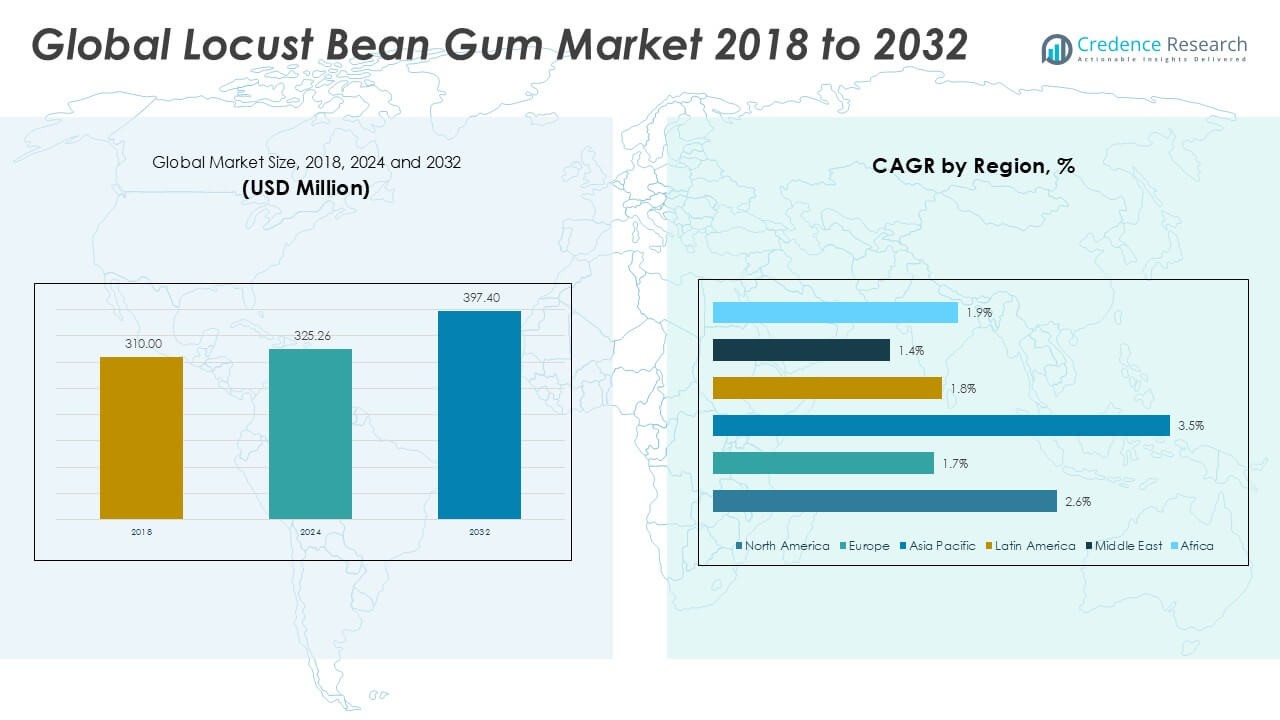
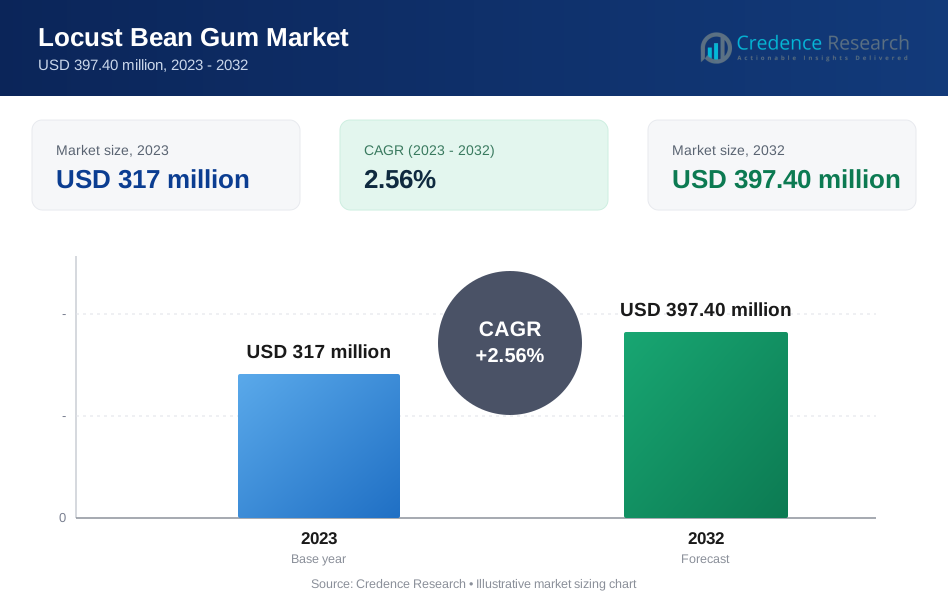
The Global Locust Bean Gum Market is projected to grow from USD 325.26 million in 2024 to an estimated USD 397.40 million by 2032, with a compound annual growth rate (CAGR) of 2.56% from 2025 to 2032.
The market is primarily driven by the increasing demand for clean-label and natural food additives, as consumers are becoming more health-conscious. Rising utilization of locust bean gum in dairy products, bakery goods, and meat processing for its gelling and thickening properties further supports market growth. Additionally, the cosmetic and pharmaceutical industries are adopting locust bean gum due to its non-toxic and biodegradable nature. Trends such as the rising popularity of vegan and gluten-free products are expected to provide significant growth opportunities for the market during the forecast period.
Geographically, Europe dominates the Global Locust Bean Gum Market due to the region’s strong food processing sector and high demand for natural ingredients. North America and Asia-Pacific are also emerging as significant markets, driven by growing food innovation and rising health awareness. Key players operating in the global market include CP Kelco, Carob S.A., DuPont de Nemours, Inc., TIC Gums Inc., and Altrafine Gums, who are focusing on capacity expansion and strategic collaborations to strengthen their market presence.
Market Insights
- The Global Locust Bean Gum Market is projected to grow from USD 325.26 million in 2024 to USD 397.40 million by 2032, with a CAGR of 2.56% from 2025 to 2032.
- Rising consumer preference for clean-label, plant-based, and natural food additives is driving the increasing demand for locust bean gum across food, pharmaceutical, and cosmetic industries.
- Growing adoption of locust bean gum in dairy, bakery, meat processing, and vegan food products strengthens its market position due to its effective thickening and stabilizing properties.
- Fluctuating supply of carob seeds and dependency on seasonal harvests create supply chain challenges and contribute to raw material price volatility.
- Competitive pressure from alternative hydrocolloids like guar gum and xanthan gum limits market expansion, especially in cost-sensitive food applications.
- Europe holds the largest market share in 2024, supported by a strong food processing sector and high demand for natural ingredients.
- Asia-Pacific is the fastest-growing region, driven by rising processed food consumption, growing plant-based food demand, and expanding pharmaceutical applications.
Market Drivers
Rising Demand for Clean-Label and Natural Ingredients Drives Market Growth
The increasing consumer shift toward clean-label and natural food products significantly supports the growth of the Global Locust Bean Gum Market. Consumers are becoming more aware of product labels and prefer foods with minimal artificial additives. Locust bean gum is a plant-derived, non-synthetic ingredient that aligns with these preferences. The food industry is incorporating it widely due to its ability to meet clean-label requirements without compromising texture or shelf life. The growing rejection of chemical stabilizers and synthetic thickeners further boosts its demand. It offers manufacturers a reliable natural alternative that meets both regulatory standards and consumer expectations.
- For instance, according to a 2024 survey by Ingredion Incorporated, more than 6,700 new food and beverage products launched globally in 2023 featured locust bean gum as a clean-label stabilizer, reflecting its growing adoption by manufacturers seeking natural ingredient solutions.
Expanding Application in the Food and Beverage Sector Supports Market Demand
The Global Locust Bean Gum Market is witnessing increased demand from the food and beverage sector. It is used extensively in dairy products, bakery items, and processed meats to enhance texture and stability. Food producers are adopting it to improve consistency in ice creams, cheese, and sauces. The ability of locust bean gum to work effectively at low concentrations makes it cost-efficient for large-scale applications. Changing dietary patterns and the rise of convenience foods are creating new opportunities. It continues to gain importance as a preferred ingredient in both traditional and innovative food formulations.
- For instance, Mintel’s Global New Products Database recorded over 2,300 new dairy and bakery products containing locust bean gum launched in Europe alone during 2023, with major brands such as Danone and Nestlé incorporating it into their product lines for improved texture and shelf stability.
Growth in Vegan and Plant-Based Product Consumption Drives the Market
The increasing popularity of vegan and plant-based diets supports the expansion of the Global Locust Bean Gum Market. It is plant-based and fits seamlessly into vegan-friendly product lines. Manufacturers are using it to develop dairy alternatives like plant-based milk, yogurts, and desserts. The shift toward plant-based consumption is driven by environmental concerns, health benefits, and changing consumer values. It provides an effective thickening and stabilizing solution without the need for animal-derived ingredients. The growing presence of plant-based options in mainstream markets strengthens its role as a key ingredient.
Pharmaceutical and Cosmetic Industries Fuel Additional Market Growth
The Global Locust Bean Gum Market benefits from its expanding use in pharmaceutical and cosmetic applications. It is valued for its non-toxic, biodegradable, and hypoallergenic properties, making it suitable for sensitive formulations. Pharmaceutical companies are incorporating it in controlled-release drugs, tablets, and topical treatments. The cosmetic sector uses it in lotions, creams, and gels for its natural stabilizing qualities. It offers performance benefits while aligning with the increasing demand for sustainable and safe ingredients. The diversification of its applications outside the food industry provides steady growth potential across sectors.
Market Trends
Increasing Preference for Sustainable and Eco-Friendly Ingredients Shapes the Market
The Global Locust Bean Gum Market is influenced by the rising focus on sustainability and eco-conscious product development. It is derived from the carob tree, which grows in arid regions with minimal water requirements, making it an environmentally sustainable option. Manufacturers are turning to it to meet sustainability goals and reduce reliance on synthetic chemicals. Consumers are seeking products that are both effective and have a low environmental footprint. The sustainable cultivation and processing of locust bean gum support its growing appeal. It offers companies an ingredient that aligns with both consumer values and corporate responsibility strategies.
- For instance, according to the Food and Agriculture Organization (FAO), Spain produced approximately 18,000 metric tons of carob pods in 2023, supporting the supply of sustainably sourced locust bean gum for food and industrial uses.
Rising Use of Locust Bean Gum in Plant-Based Dairy Alternatives Gains Traction
The growing popularity of plant-based dairy alternatives is driving new trends in the Global Locust Bean Gum Market. It is widely used in the production of plant-based milk, yogurts, and cheese to enhance creaminess and texture. Consumers are increasingly adopting dairy alternatives due to lactose intolerance, ethical concerns, and dietary preferences. It provides essential thickening and stabilizing functions without the use of animal products. Food companies are expanding their product ranges with plant-based offerings where locust bean gum plays a critical role. The consistent demand for innovative, plant-based textures strengthens its presence in this segment.
- For instance, over 1,100 new plant-based dairy alternative products containing locust bean gum launched globally in 2023, with leading brands such as Alpro and Oatly incorporating it to improve product texture and stability.
Technological Advancements in Food Processing Support Product Innovation
The Global Locust Bean Gum Market is experiencing growth due to advancements in food processing technologies. It benefits from improved processing techniques that preserve its functional properties while enhancing performance. New blending and formulation methods are helping manufacturers optimize its application across various food categories. These technological improvements allow more efficient dispersion, better texture control, and extended shelf stability. The market is moving toward solutions that maximize product quality with minimal ingredient usage. It continues to gain importance in advanced food formulations supported by these processing developments.
Rising Penetration in Emerging Economies Creates New Growth Channels
The Global Locust Bean Gum Market is expanding in emerging economies where processed food consumption is increasing rapidly. It is gaining traction in regions such as Asia-Pacific and Latin America where urbanization and disposable income are driving packaged food demand. Local food manufacturers are incorporating it to improve product quality and meet international standards. Rising health awareness in these regions is further supporting the demand for natural and plant-based ingredients. It presents opportunities for both domestic and international suppliers to establish a stronger market presence. The expanding global footprint strengthens its relevance across diverse consumer markets.
Market Challenges
Fluctuating Raw Material Supply and Price Volatility Impact Market Stability
The Global Locust Bean Gum Market faces significant challenges due to fluctuating raw material availability and price instability. It relies heavily on the seasonal harvest of carob trees, which are vulnerable to climate variations and inconsistent yields. Limited geographic cultivation further restricts supply flexibility. Price volatility creates uncertainty for manufacturers who depend on stable sourcing for large-scale production. Supply chain disruptions and weather-related issues can directly impact cost structures and profit margins. It remains sensitive to these external factors, which limit the ability to maintain consistent pricing and long-term supply contracts.
- For instance, according to IFF, one of the world's largest locust bean gum suppliers, prices increased by 800% at one point during the COVID-19 pandemic when demand vastly outstripped supply, demonstrating the extreme volatility that can occur in the carob-based ingredient market
Intense Competition from Alternative Hydrocolloids Restricts Market Growth
The Global Locust Bean Gum Market experiences competitive pressure from a wide range of alternative hydrocolloids, such as guar gum, xanthan gum, and carrageenan. It must compete with these substitutes that often offer similar functional benefits at lower costs or with more stable supply chains. Food manufacturers may shift to alternatives based on pricing, availability, or performance flexibility. Product formulation changes in response to raw material costs can divert demand away from locust bean gum. It faces an ongoing challenge to maintain its market share amid the growing popularity of more cost-effective and versatile hydrocolloids. Competitive pricing and innovation are essential for sustaining its position.
Market Opportunities
Expansion in the Plant-Based and Functional Food Segments Offers Strong Growth Potential
The Global Locust Bean Gum Market holds promising opportunities within the expanding plant-based and functional food sectors. It is well-positioned to meet the growing consumer demand for dairy alternatives, vegan desserts, and plant-based processed foods. Food manufacturers are focusing on improving texture, mouthfeel, and stability in these products, which strengthens the role of locust bean gum. The rising interest in clean-label functional foods further supports its application in fortified and health-focused product lines. Increasing consumer awareness of digestive health and natural ingredients opens new product development channels. It can become a preferred ingredient in future food innovations driven by plant-based trends.
Growing Pharmaceutical and Personal Care Applications Unlock New Demand
The Global Locust Bean Gum Market is expected to benefit from expanding pharmaceutical and personal care applications. It is gaining attention for use in drug delivery systems, controlled-release formulations, and topical products due to its non-toxic and biodegradable nature. The rising demand for natural excipients in pharmaceutical production creates new growth avenues. Cosmetic companies are adopting it in skin care and hair care products where natural stabilization and thickening are required. It offers performance benefits while supporting the growing preference for plant-derived, safe ingredients. The increasing consumer shift toward natural personal care products positions it for wider acceptance in these industries.
Market Segmentation Analysis
By Type
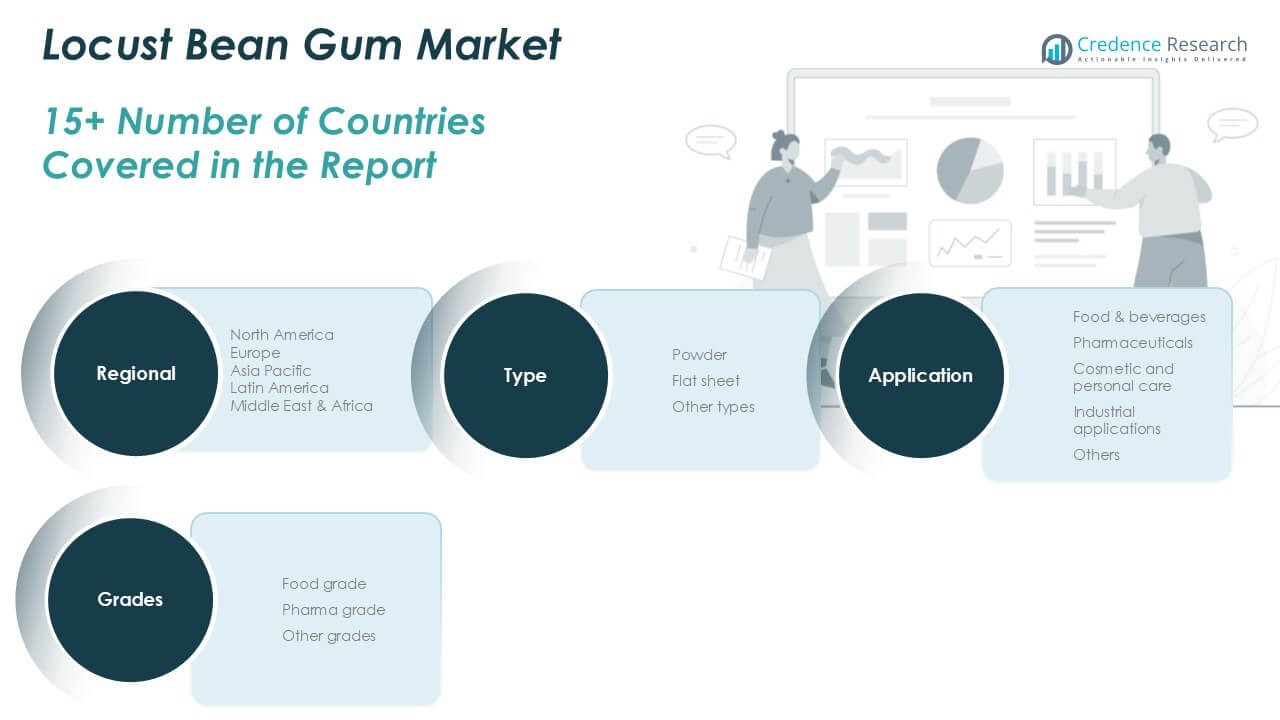
The Global Locust Bean Gum Market is segmented by type into powder, flat sheet, and others. Powder form holds the largest revenue share due to its ease of use, fast solubility, and broad application in the food, pharmaceutical, and cosmetic industries. It is preferred by manufacturers for its efficient blending and reliable thickening properties. The flat sheet segment finds niche applications but holds a smaller market share due to limited usage. The others segment includes customized and specialty forms, which are gradually gaining attention for specific industrial uses. It continues to grow steadily across all type segments, supported by versatile processing requirements.
- For instance, according to a 2024 report by Food Ingredients First, more than 9,500 metric tons of locust bean gum powder were used globally in food and beverage manufacturing in 2023, making powder the most widely utilized form in the industry.
By Application
The Global Locust Bean Gum Market is categorized by application into food & beverages, pharmaceuticals, cosmetic and personal care, industrial applications, and others. Food & beverages dominate the market due to the increasing demand for natural thickeners in dairy, bakery, and plant-based products. It plays a critical role in stabilizing and texturizing foods while meeting clean-label requirements. The pharmaceutical segment is expanding with its application in controlled-release formulations and oral medications. Cosmetic and personal care products use it for natural thickening and skin-safe formulations. Industrial applications, though smaller, contribute to the market with uses in textile processing and paper manufacturing.
- For instance, Mintel’s Global New Products Database recorded over 4,200 new food and beverage products containing locust bean gum launched worldwide in 2023, demonstrating its dominant role in this application segment.
By Grade
The Global Locust Bean Gum Market is divided by grade into food grades, pharma grades, and other grades. Food grade holds the largest market share, driven by its widespread use in processed foods, dairy, and plant-based alternatives. It is highly valued for its purity and compliance with food safety standards. Pharma grade is gaining momentum due to its growing application in drug delivery and excipient formulations. Other grades support industrial applications but capture a smaller share. It continues to find growth opportunities across all grades with the increasing focus on high-quality, natural ingredients.
Segments
Based on Type
- Powder
- Flat sheet
- Others
Based on Application
- Food & Beverages
- Pharmaceuticals
- Cosmetic and Personal Care
- Industrial Applications
- Others
Based on Grade
- Food Grades
- Pharma Grades
- Other Grades
Based on Region
- North America
- U.S.
- Canada
- Mexico
- Europe
- UK
- France
- Germany
- Italy
- Spain
- Russia
- Belgium
- Netherlands
- Austria
- Sweden
- Poland
- Denmark
- Switzerland
- Rest of Europe
- Asia Pacific
- China
- Japan
- South Korea
- India
- Australia
- Thailand
- Indonesia
- Vietnam
- Malaysia
- Philippines
- Taiwan
- Rest of Asia Pacific
- Latin America
- Brazil
- Argentina
- Peru
- Chile
- Colombia
- Rest of Latin America
- Middle East
- UAE
- KSA
- Israel
- Turkey
- Iran
- Rest of Middle East
- Africa
- Egypt
- Nigeria
- Algeria
- Morocco
- Rest of Africa
Regional Analysis
North America Locust Bean Gum Market
The Locust Bean Gum Market in North America is projected to grow from USD 97.00 million in 2024 to USD 119.24 million by 2032, with a CAGR of 2.6% during the forecast period. North America holds a significant regional market share of 29.81% in 2024. The region's strong demand is driven by the expanding food and beverage industry, which increasingly uses locust bean gum for texture enhancement and stability. It benefits from the high adoption of plant-based and clean-label products across the United States and Canada. Pharmaceutical applications are also growing due to consumer preference for natural excipients. The market in North America continues to strengthen with advancements in food innovation and health-focused product development.
Europe Locust Bean Gum Market
The Locust Bean Gum Market in Europe is expected to increase from USD 79.94 million in 2024 to USD 91.31 million by 2032, registering a CAGR of 1.7%. Europe accounts for a regional market share of 24.59% in 2024. The region remains a key consumer due to its well-established food processing industry and strong regulatory preference for natural ingredients. It is widely used in European dairy, bakery, and meat processing sectors. Demand remains stable but is growing at a moderate pace, supported by consumer awareness of sustainable and plant-based products. The region also shows consistent interest in pharmaceutical and personal care applications.
Asia Pacific Locust Bean Gum Market
The Locust Bean Gum Market in Asia Pacific is forecasted to grow from USD 99.48 million in 2024 to USD 131.11 million by 2032, reflecting the highest CAGR of 3.5%. Asia Pacific holds the largest regional market share of 30.58% in 2024. The rapid growth is driven by increasing consumption of processed foods and dairy alternatives in China, India, and Southeast Asia. It benefits from expanding food manufacturing capacity and a rising middle-class population with changing dietary preferences. Pharmaceutical and cosmetic sectors in the region are also adopting locust bean gum for natural formulations. It is expected to maintain strong growth momentum in this region.
Latin America Locust Bean Gum Market
The Locust Bean Gum Market in Latin America is projected to rise from USD 20.68 million in 2024 to USD 23.67 million by 2032, at a CAGR of 1.8%. Latin America contributes a regional market share of 6.36% in 2024. Growth in the region is supported by increasing food processing activities in Brazil, Mexico, and Argentina. It finds application in dairy and confectionery products where natural thickeners are preferred. Pharmaceutical companies in the region are beginning to explore its potential for excipient use. Local manufacturers are gradually adopting clean-label ingredients to align with evolving consumer preferences.
Middle East Locust Bean Gum Market
The Locust Bean Gum Market in the Middle East is expected to grow from USD 10.44 million in 2024 to USD 11.56 million by 2032, with a CAGR of 1.4%. The Middle East holds a regional market share of 3.21% in 2024. Food companies in the region are focusing on improving texture and shelf life in bakery and dairy products using locust bean gum. Demand is supported by growing urbanization and an increasing number of processed food consumers. It also finds opportunities in the region’s cosmetic and pharmaceutical sectors that seek plant-based ingredients. The market continues to expand steadily with moderate growth.
Africa Locust Bean Gum Market
The Locust Bean Gum Market in Africa is forecasted to grow from USD 17.72 million in 2024 to USD 20.50 million by 2032, recording a CAGR of 1.9%. Africa holds a regional market share of 5.45% in 2024. Growth in the African market is driven by rising demand for packaged and processed foods in countries like South Africa, Nigeria, and Kenya. It is being adopted by food producers to meet the growing interest in natural and sustainable ingredients. Pharmaceutical and personal care industries in Africa are also beginning to incorporate locust bean gum for its safe and plant-based properties. The market is gradually gaining strength with steady consumer adoption.
Key players
- Arthur Branwell & Co. Ltd.
- Cargill, Incorporated
- DuPont de Nemours, Inc.
- Fiberstar, Inc.
- Galam Group
- Gum Technology Corporation
- Kerry Group
- Lucid Colloids Ltd.
- Merrick and Company
- Polygal AG
- Vosen
Competitive Analysis
The Locust Bean Gum Market is highly competitive with the presence of several global and regional players focusing on product quality, supply stability, and expansion strategies. It is driven by companies like Cargill, Incorporated and DuPont de Nemours, Inc., which hold strong market positions due to their diversified portfolios and extensive distribution networks. Emerging players such as Fiberstar, Inc. and Lucid Colloids Ltd. are strengthening their presence by focusing on customized solutions and regional market demands. Key companies invest in capacity expansion and partnerships to ensure consistent raw material sourcing. Competitive pricing, technological advancement, and innovation in food formulations remain essential for securing market share. It continues to evolve with players focusing on meeting clean-label trends and enhancing product functionality to stay competitive.
Recent Developments
- In June 2025, Polygal AG was also listed among top competitors in the same food-grade locust bean gum market analysis.
- In 2024, Arthur Branwell & Co. Ltd. emphasized its hydrocolloids, specifically clear locust bean gum solutions that interact synergistically with xanthan gum and carrageenan. This synergy allows for the creation of strong gels with enhanced properties, like improved freeze-thaw stability.
 Market Concentration and Characteristics
The Locust Bean Gum Market shows moderate market concentration with a mix of large multinational companies and several regional players. It is characterized by steady competition, product differentiation, and strong focus on supply chain management due to raw material dependency. The market relies heavily on seasonal carob harvests, which influences pricing and availability. Leading players maintain competitive advantage through established distribution networks, technological expertise, and high-quality product offerings. It attracts consistent demand from food, pharmaceutical, and cosmetic industries that require natural and plant-based ingredients. Companies in the market emphasize innovation, cost efficiency, and reliable sourcing to strengthen their position.
Report Coverage
The research report offers an in-depth analysis based on Type, Application, Grade and Region. It details leading market players, providing an overview of their business, product offerings, investments, revenue streams, and key applications. Additionally, the report includes insights into the competitive environment, SWOT analysis, current market trends, as well as the primary drivers and constraints. Furthermore, it discusses various factors that have driven market expansion in recent years. The report also explores market dynamics, regulatory scenarios, and technological advancements that are shaping the industry. It assesses the impact of external factors and global economic changes on market growth. Lastly, it provides strategic recommendations for new entrants and established companies to navigate the complexities of the market.
Future Outlook
- The Locust Bean Gum Market is projected to maintain stable growth driven by rising demand for natural food additives and clean-label products worldwide. It will continue expanding at a moderate pace supported by consistent application across industries.
- The market will benefit from the growing popularity of plant-based and vegan food products, where locust bean gum serves as a key stabilizer and texture enhancer. It will remain an essential ingredient in dairy alternatives and meat substitutes.
- Future developments in food processing technologies will improve locust bean gum’s functionality and application efficiency. It will see increased usage in advanced formulations with enhanced texture and stability.
- Asia Pacific, Latin America, and Africa are expected to offer strong growth opportunities due to rising processed food consumption and increasing disposable incomes. It will gain traction in these regions with expanded distribution networks.
- Companies will focus on strengthening raw material sourcing and supply chain management to address carob bean availability challenges. It will require sustainable sourcing practices to ensure long-term supply stability.
- The market will continue to face competition from guar gum, xanthan gum, and carrageenan. It must differentiate through improved product performance and cost-effective solutions to maintain market share.
- Growing interest in natural excipients and plant-based stabilizers in pharmaceuticals and cosmetics will create new demand channels. It will see wider application in drug delivery systems and personal care products.
- The trend towards clean-label, allergen-free, and non-GMO products will support the growth of the Locust Bean Gum Market. It will remain a preferred ingredient for manufacturers targeting health-conscious consumers.
- Key players are expected to pursue partnerships, acquisitions, and capacity expansions to secure supply and enter new markets. It will encourage collaboration across the value chain to strengthen competitive positions.
- Growing environmental awareness will push companies to promote sustainable cultivation and eco-friendly processing methods. It will align with global sustainability trends and consumer expectations for greener products.
Request a Free Sample
Fill in your details and we'll send you a free sample report.
- Sample data tables & charts
- Research methodology
Need a Custom Version of This Report?
Tailor the scope, geography, or segments to your exact requirements.
- Custom geography or segment scope
- Direct access to our analyst team
Frequently Asked Questions
What is the market size of the Global Locust Bean Gum Market in 2023, 2032, and its CAGR?
What are the primary factors driving the growth of the Locust Bean Gum Market?
Which industries commonly use locust bean gum?
Which regions are leading in the Global Locust Bean Gum Market?
Who are the key players in the Locust Bean Gum Market?
Table of Content
Chapter 1. Report Introduction
- 1.1 Report Description & Purpose
- 1.1.1 Report Title & Market Definition
- 1.1.2 Unique Selling Propositions (USP) & Key Differentiators
- 1.1.3 Value Proposition for Stakeholders
- 1.2 Research Objectives
- 1.2.1 Market Sizing Objectives (Volume & Revenue)
- 1.2.2 Segmentation Objectives
- 1.2.3 Competitive Intelligence Objectives
- 1.2.4 Forecast & Scenario Objectives
- 1.3 Report Scope
- 1.3.1 Locust Bean Gum Scope – Types & Subtypes Covered
- 1.3.2 Geographic Scope – Regions & Countries Covered
- 1.3.3 Historical Period, Base Year & Forecast Period (2023; forecast to 2032)
- 1.3.4 Inclusions & Exclusions
- 1.4 HS Code & Classification Framework
- 1.5 Currency, Units & Pricing Basis
- 1.6 Target Stakeholders
- 1.7 Limitations & Assumptions
Chapter 2. Executive Summary
- 2.1 Global Locust Bean Gum Market Snapshot
- 2.1.1 Market Size – Historical (2023) & Forecast (2023-2032) (2023: USD 317 million → 2032: USD 397.40 million)
- 2.1.2 Volume & Revenue – Global Totals
- 2.1.3 Key Market Highlights – Top Five Facts
- 2.2 Locust Bean Gum Market Segmentation Snapshot
- 2.2.1 Market Split by Region – 2023 vs. 2032
- 2.3 Competitive Snapshot
- 2.3.1 Top 10 Players by Revenue Share – 2023
- 2.3.2 Top 10 Players by Volume Share – 2023
- 2.3.3 Recent Strategic Developments (18-Month Summary)
- 2.4 Key Investment Highlights & Strategic Conclusions
Chapter 3. Locust Bean Gum Market Dynamics & Industry Analysis
- 3.1 Market Overview & Context
- 3.1.1 Locust Bean Gum Market Position in the Broader Automotive Value Chain
- 3.1.2 OEM vs. Replacement Market Dynamics
- 3.1.3 Market Maturity & Development Stage by Region
- 3.2 Locust Bean Gum Market Drivers
- 3.3 Locust Bean Gum Market Restraints & Challenges
- 3.4 Locust Bean Gum Market Opportunities
- 3.5 Porter's Five Forces Analysis
- 3.5.1 Threat of New Entrants
- 3.5.2 Bargaining Power of Suppliers
- 3.5.3 Bargaining Power of Buyers
- 3.5.4 Threat of Substitutes
- 3.5.5 Competitive Rivalry – Intensity Assessment
- 3.6 Locust Bean Gum Value Chain Analysis
- 3.6.1 Upstream – Raw Material/Input Suppliers
- 3.6.1.1 Raw Material/Input 1
- 3.6.1.2 Raw Material/Input 2
- 3.6.1.3 Raw Material/Input 3
- 3.6.2 Midstream – Production/Manufacturing/Service Delivery
- 3.6.2.1 Production/Process Overview
- 3.6.2.2 Key Facility Locations & Capacity by Manufacturer
- 3.6.3 Downstream – Distribution & End Consumer
- 3.6.3.1 Primary Channel – B2B/OEM
- 3.6.3.2 Secondary Channels – Dealer, Retail, Online, Direct
- 3.6.4 Value Chain Profitability Analysis
- 3.6.1 Upstream – Raw Material/Input Suppliers
- 3.7 PESTEL Analysis
- 3.7.1 Political Factors
- 3.7.2 Economic Factors
- 3.7.3 Social Factors
- 3.7.4 Technological Factors
- 3.7.5 Environmental Factors
- 3.7.6 Legal Factors
- 3.8 Locust Bean Gum Supply Chain Analysis
- 3.8.1 Raw Material/Input Supply Risk Assessment
- 3.8.2 Manufacturing Concentration Risk (Geographic Exposure)
- 3.8.3 Trade Disruption Impact Analysis
- 3.9 Regulatory & Policy Landscape
Note: The regulatory and policy landscape section covers regulations based on their applicability to the market, Locust Bean Gum category, geography, and scope of the study. Only regulatory frameworks with a material impact on operations, compliance, trade, sustainability, or market access are analyzed in detail.
Chapter 4. Key Investment Pockets & Opportunity Analysis
- 4.1 Locust Bean Gum Market Attractiveness Analysis
- 4.1.1 By Region – Investment Attractiveness Matrix (Volume × CAGR)
- 4.2 Absolute Revenue Growth Opportunity
- 4.2.1 By Region – Absolute USD Growth Through 2032
- 4.3 Incremental Volume Opportunity
- 4.3.1 By Region – Incremental Volume Through 2032
- 4.3.2 Segment – Incremental Volume
- 4.4 Emerging Submarket Opportunity Deep Dive (Subject to Applicability)
- 4.5 Emerging Market Opportunity Scorecards
- 4.5.1 United States
- 4.5.2 Europe
- 4.5.3 Asia
- 4.5.4 Middle East & Africa
Note: Emerging Market Opportunity Scorecards will be included based on relevance and strategic importance. Regions listed are indicative and may vary depending on data availability and market dynamics.
Chapter 5. Locust Bean Gum Import-Export Analysis & Trade Flows
- 5.1 Global Trade Overview
- 5.1.1 Global Export Value by Country (2023)
- 5.1.2 Global Export Volume by Country (2023)
- 5.1.3 Global Import Value by Country (2023)
- 5.1.4 Global Import Volume by Country (2023)
- 5.1.5 Net Trade Balance by Country (2023)
- 5.2 Export Analysis – Segment
- 5.2.1 Type 1 (HS Code)
- 5.2.2 Type 2 (HS Code)
- 5.2.3 Type 3 (HS Code)
- 5.2.4 Type 4 (HS Code)
- 5.2.5 Type 5 (HS Code)
- 5.3 Import Analysis – Segment
- 5.3.1 Type 1 (HS Code)
- 5.3.2 Type 2 (HS Code)
- 5.3.3 Type 3 (HS Code)
- 5.3.4 Type 4 (HS Code)
- 5.3.5 Type 5 (HS Code)
- 5.4 Average Unit Trade Prices
- 5.4.1 Average Export Price – Segment & Country
- 5.4.2 Average Import Price – Segment & Source Country
- 5.4.3 Price Trends (2023)
- 5.5 Key Trade Route Analysis
- 5.5.1 Trade Route 1
- 5.5.2 Trade Route 2
- 5.5.3 Trade Route 3
- 5.5.4 Trade Route 4
- 5.5.5 Trade Route 5
- 5.6 Trade Policy Impact Assessment
- 5.6.1 US Anti-Dumping & Section 301 Tariffs
- 5.6.2 EU Customs Union Impact
- 5.6.3 Major Free Trade Agreements
- 5.6.4 USMCA Rules of Origin
Note: Trade policy analysis will be included only where relevant to the Locust Bean Gum market.
Chapter 6. Competitive Landscape & Company Benchmarking
- 6.1 Locust Bean Gum Market Concentration & Structure
- 6.1.1 Herfindahl-Hirschman Index (HHI) – vs. 2023
- 6.1.2 Tier 1, Tier 2 & Tier 3 Market Structure
- 6.1.3 Global, Regional & Local Player Dynamics
- 6.2 Locust Bean Gum Market Share Analysis – 2023
- 6.2.1 Global Revenue Share by Company
- 6.2.2 Global Volume Share by Company
- 6.2.3 Regional Revenue Share
- 6.2.4 Market Share Evolution ( vs. 2023)
- 6.2.5 OEM Segment Share by Company
- 6.2.6 Replacement Segment Share by Company
- 6.3 Production/Delivery Capacity & Facility Analysis
- 6.3.1 Global Installed Capacity
- 6.3.2 Capacity Utilization Rates
- 6.3.3 Production/Output Volume
- 6.3.4 Facility Locations & Capacity Map
- 6.3.5 Planned Capacity Additions
- 6.4 Locust Bean Gum Competitive Benchmarking Matrix
- 6.4.1 Revenue, Volume, CAGR & Profitability Comparison
- 6.4.2 Channel Revenue Mix
- 6.4.3 Geographic Revenue Exposure
- 6.4.4 R&D Intensity
- 6.4.5 Sustainability Maturity
- 6.5 Strategic Developments in Locust Bean Gum (Last 24 Months)
- 6.5.1 Mergers, Acquisitions & Divestments
- 6.5.2 New Locust Bean Gum Launches
- 6.5.3 Facility Expansions
- 6.5.4 Strategic Alliances, Joint Ventures & Partnerships
- 6.5.5 Distribution Expansion & Market Entry
- 6.5.6 Sustainability & ESG Initiatives
- 6.6 Competitive Strategy Mapping
- 6.6.1 Leader, Challenger, Follower & Niche Classification
- 6.6.2 Pricing Strategy Comparison
- 6.6.3 Channel Strategy Matrix
Note: Strategic developments are included based on their materiality and the availability of reliable information.
Chapter 7. Global Locust Bean Gum Market – By Distribution Channel
- 7.1 Segment Overview
- 7.1.1 Volume & Revenue Split by Channel (2023 & 2032)
- 7.1.2 Channel Mix Evolution (2023-2032)
Chapter 8. Regional Market Analysis – Global Overview
- 8.1 Global Regional Overview
- 8.1.1 Regional Volume Share
- 8.1.2 Regional Revenue Share
- 8.1.3 Regional Volume by Region
- 8.1.4 Regional Revenue by Region
- 8.1.5 Regional Forecast Through 2032
- 8.2 Cross-Regional Segment Analysis
- 8.2.1 By Distribution Channel
- 8.2.2 By Brand/Price Tier
Chapter 9. North America Locust Bean Gum Market
- 9.1 United States
- 9.2 Canada
- 9.3 Mexico
Chapter 10. Europe Locust Bean Gum Market
- 10.1 Germany
- 10.2 France
- 10.3 Italy
- 10.4 United Kingdom
- 10.5 Spain
- 10.6 Poland
- 10.7 Russia
- 10.8 Netherlands
- 10.9 Belgium
- 10.10 Sweden
- 10.11 Denmark
- 10.12 Norway
- 10.13 Rest of Europe
Chapter 11. Asia Pacific Locust Bean Gum Market
- 11.1 China
- 11.2 India
- 11.3 Japan
- 11.4 South Korea
- 11.5 Thailand
- 11.6 Indonesia
- 11.7 Vietnam
- 11.8 Malaysia
- 11.9 Australia
- 11.10 Rest of Asia Pacific
Chapter 12. Latin America Locust Bean Gum Market
- 12.1 Brazil
- 12.2 Argentina
- 12.3 Colombia
- 12.4 Chile
- 12.5 Rest of Latin America
Chapter 13. Middle East Locust Bean Gum Market
- 13.1 Saudi Arabia
- 13.2 United Arab Emirates
- 13.3 Turkey
- 13.4 Israel
- 13.5 Iran
- 13.6 Rest of the Middle East
Chapter 14. Africa Locust Bean Gum Market
- 14.1 South Africa
- 14.2 Egypt
- 14.3 Nigeria
- 14.4 Morocco
- 14.5 Rest of Africa
Chapter 15. Locust Bean Gum Company Profiles
- 15.1 [Company 01]
- 15.1.1 Company Overview
- 15.1.2 Key Management Personnel
- 15.1.3 Products & Services Portfolio
- 15.1.4 Financial Performance
- 15.1.5 Key Market Focus & Geographic Presence
- 15.1.6 Recent Developments & Strategic Initiatives
Note: The company profile list is preliminary and may change based on research findings, market developments, data availability, and client requirements.
Chapter 16. Appendices
- Appendix A – List of Abbreviations & Acronyms
- Appendix B – Industry Classification Code Reference – Full Series
- Appendix C – Production & Capacity Data Tables
- Appendix D – End-Use & Demand Base Tables
- Appendix E – Consumption & Replacement Rate Assumptions
- Appendix F – ASP Reference Tables
- Appendix G – Manufacturing & Facility Database
- Appendix H – Import-Export Data Tables
- Appendix I – Regulatory Summary Tables
- Appendix J – Primary Research Participant List (Anonymized)
- Appendix K – Primary Research Questionnaire Framework
- Appendix L – Data Sources & Bibliography
- Appendix M – Market Size Divergence & Source Comparison
Chapter 17. Research Methodology
- 17.1 Research Framework & Philosophy
- 17.2 Secondary Research – Sources, Hierarchy & Data Extraction
- 17.3 Data Modeling – Bottom-Up & Top-Down Market Sizing
- 17.4 Primary Research – Stakeholder Framework, LOI & Sample Sizes
- 17.5 Forecast Methodology – Regression, Scenario & Sensitivity Analysis
- 17.6 Quality Control – Four-Layer Validation Framework
- 17.7 Limitations & Standard Assumptions
- 17.8 Disclaimer
