
Long Time Creep Testing Machine Market Overview:
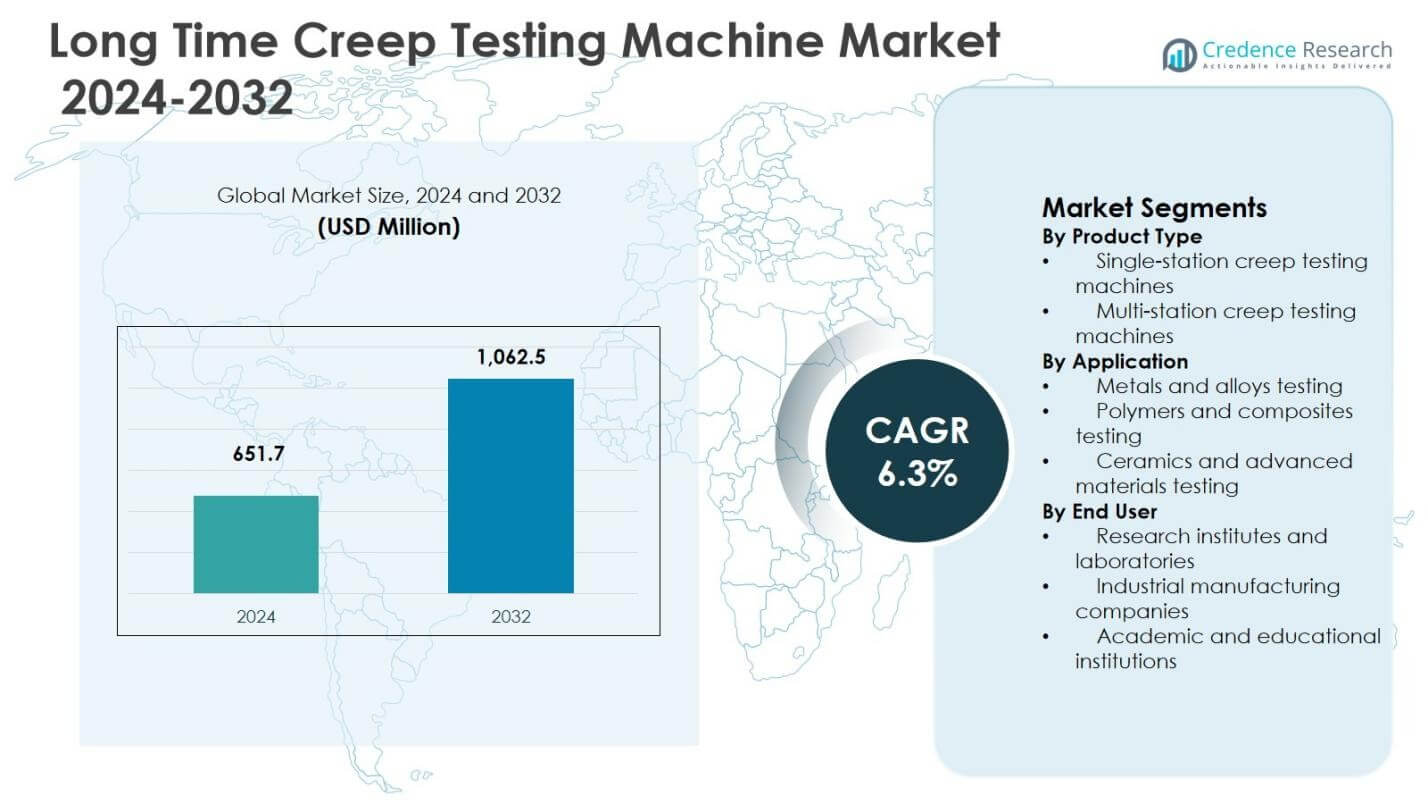
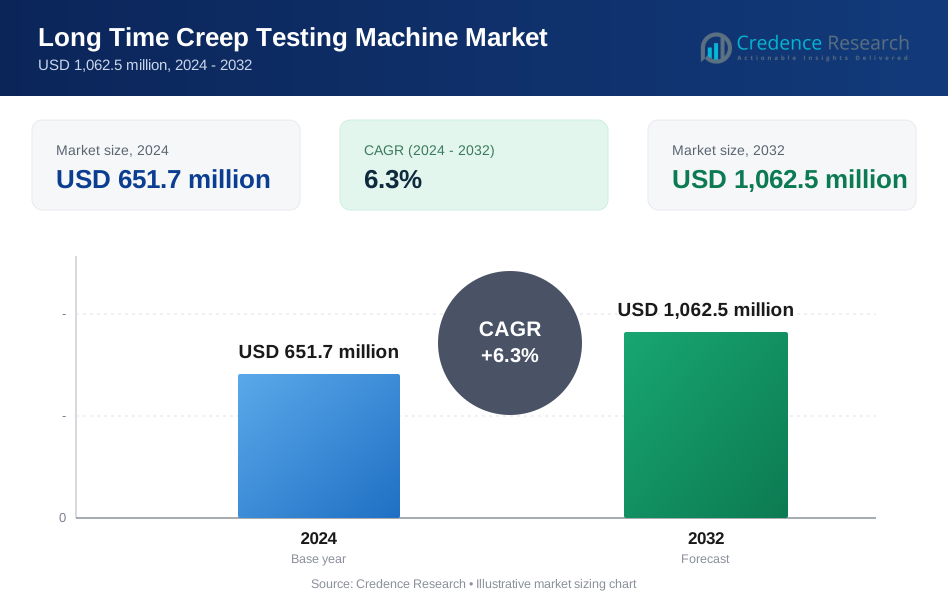
The Long Time Creep Testing Machine Market size was valued at USD 651.7 million in 2024 and is anticipated to reach USD 1,062.5 million by 2032, growing at a CAGR of 6.3% during the forecast period.
| REPORT ATTRIBUTE | DETAILS |
|---|---|
| Historical Period | 2020-2023 |
| Base Year | 2024 |
| Forecast Period | 2025-2032 |
| Long Time Creep Testing Machine Market Size 2024 | USD 651.7 million |
| Long Time Creep Testing Machine Market, CAGR | 6.3% |
| Long Time Creep Testing Machine Market Size 2032 | USD 1,062.5 million |
Long Time Creep Testing Machine Market Insights
- Market growth is supported by increasing use of creep testing in aerospace, power generation, and heavy engineering, where high-temperature and long-duration material performance validation is mandatory for safety and compliance.
- Automation, digital monitoring, and advanced temperature control systems are key trends, while single-station creep testing machines dominated with 4% share in 2024 due to cost efficiency and widespread laboratory adoption.
- The market is shaped by established manufacturers focusing on precision engineering, customized systems, and after-sales calibration services, while high equipment cost and long test durations act as key restraints.
- North America led with 2% market share in 2024, followed by Asia Pacific at 29.8% and Europe at 27.6%, supported by strong industrial manufacturing, research activity, and regulatory-driven testing demand.
Long Time Creep Testing Machine Market Segmentation Analysis:
By Product Type:
The Long Time Creep Testing Machine Market is led by single-station creep testing machines, which accounted for 62.4% market share in 2024, driven by their cost efficiency, simpler configuration, and widespread use in standardized long-duration material tests. These systems are preferred by laboratories and small-to-mid industrial users due to lower maintenance requirements and higher test accuracy for individual samples. Multi-station creep testing machines held 37.6% share, supported by rising demand from high-volume industrial testing environments, but adoption remains limited by higher capital investment and operational complexity.
- For instance, ZwickRoell's Kappa Multistation offers up to six individually controlled load axes with test speeds from 0.001 mm/h to 100 mm/min, enabling simultaneous creep tests on plastics and composites up to 10,000 hours.
By Application:
Metals and alloys testing dominated the Long Time Creep Testing Machine Market with a 54.8% share in 2024, supported by extensive use in aerospace, power generation, automotive, and nuclear industries where long-term high-temperature performance validation is mandatory. Growth is driven by stricter material certification standards and increasing demand for advanced alloys. Polymers and composites testing captured 28.1% share, benefiting from lightweight material adoption, while ceramics and advanced materials testing accounted for 17.1%, supported by niche applications in high-performance and thermal-resistant components.
- For instance, the Indian Institute of Science Bangalore employs ZwickRoell's Kappa Mini creep testing machine for micro specimens of nickel-based superalloys and titanium alloys from aircraft engines and power plant boilers.
By End User:
Industrial manufacturing companies represented the dominant end-user segment with a 46.9% market share in 2024, driven by continuous material qualification requirements in energy, aerospace, and heavy engineering sectors. These users invest heavily in creep testing to ensure compliance with international safety and durability standards. Research institutes and laboratories followed with 32.6% share, supported by government-funded material research programs. Academic and educational institutions held 20.5%, driven by growing emphasis on advanced materials education and long-term mechanical behavior studies.
Key Growth Drivers
Expanding Demand from High-Temperature Industrial Applications
The Long Time Creep Testing Machine Market is strongly driven by rising demand from industries operating under extreme temperature and stress conditions, including aerospace, power generation, automotive, and oil & gas. Components such as turbines, pressure vessels, and heat exchangers require precise long-term deformation analysis to ensure safety and durability. Increasing deployment of advanced alloys and superalloys in these sectors has intensified the need for reliable creep testing over extended durations. Regulatory compliance and mandatory material certification standards further reinforce adoption, positioning creep testing machines as essential quality-assurance tools across high-performance industrial applications.
- For instance, NASA conducted creep testing on thin-walled Inconel 718 heater heads for Stirling power convertors at 649 °C and stresses up to 414 MPa, revealing optimal performance with 24-µm grain sizes for minimum creep rates.
Growth in Advanced Materials Research and Development
Accelerated investment in advanced materials research significantly fuels the Long Time Creep Testing Machine Market. Governments, defense agencies, and private manufacturers are focusing on next-generation materials such as high-entropy alloys, ceramic matrix composites, and heat-resistant polymers. Long-term creep behavior is a critical parameter in validating these materials for structural and thermal stability. Research laboratories and industrial R&D centers increasingly rely on precise creep testing systems to generate validated lifecycle data. This sustained emphasis on innovation and material optimization continues to expand demand for accurate and stable creep testing solutions.
- For instance, the National Energy Technology Laboratory (NETL) conducted creep tests on CoCrFeNiMo high-entropy alloys at 650°C and 172 MPa stress, achieving up to 100 times longer creep life than base CoCrFeNi alloys through Mo-rich phases and solid solution hardening.
Industrial Quality Assurance and Lifecycle Validation Requirements
Rising emphasis on product reliability and lifecycle validation is another major driver for the Long Time Creep Testing Machine Market. Manufacturers are increasingly prioritizing long-term performance testing to reduce failure risks, warranty costs, and operational downtime. Creep testing supports predictive maintenance strategies by identifying deformation limits under prolonged stress. With industries shifting toward longer equipment service life and higher operational efficiency, demand for continuous, repeatable, and high-precision creep testing systems is growing steadily, particularly among industrial manufacturing companies with large-scale production and compliance obligations.
Key Trends & Opportunities
Integration of Automation and Digital Monitoring Technologies
Automation and digitalization represent a key trend shaping the Long Time Creep Testing Machine Market. Manufacturers are integrating automated load control, digital data acquisition, and real-time monitoring systems to enhance test accuracy and operational efficiency. Advanced software platforms enable continuous data logging, remote monitoring, and predictive analysis, reducing manual intervention during long-duration tests. These advancements improve repeatability and reduce human error, creating strong opportunities for equipment upgrades and replacement demand. Automated systems are particularly attractive to industrial users managing multiple long-term tests simultaneously.
- For instance, SZBONAD's BND-TCTM features servo-controlled automated workflows, including heating, loading, and multi-station real-time monitoring up to 1200°C. Its independent data logging and fault diagnosis ensure uninterrupted operation even during PC failures, ideal for simultaneous long-term tests.
Rising Adoption in Emerging Economies and Academic Institutions
Growing industrialization and expanding research infrastructure in emerging economies present significant opportunities for the Long Time Creep Testing Machine Market. Countries investing in energy, infrastructure, and advanced manufacturing are strengthening material testing capabilities to meet international standards. Simultaneously, universities and technical institutions are increasing focus on advanced materials education and applied research. Funding support for laboratory modernization encourages adoption of creep testing machines for training and experimental studies. This dual expansion across industrial and academic environments creates sustained growth potential in developing regions.
- For instance, MTS Systems installed Echo remote monitoring technology on creep testing systems at PUC-Rio's Civil Engineering lab in Brazil, enabling 24/7 oversight of material durability tests for infrastructure projects.
Key Challenges
High Capital Cost and Long Test Duration Constraints
High equipment cost remains a major challenge in the Long Time Creep Testing Machine Market. Advanced creep testing systems require precise load frames, temperature control units, and long-term stability, leading to substantial upfront investment. Additionally, extended test durations limit throughput and machine availability, reducing operational flexibility for smaller laboratories. These factors restrict adoption among cost-sensitive users and educational institutions. Budget constraints often lead organizations to delay procurement or rely on outsourced testing services, impacting overall market penetration.
Technical Complexity and Skilled Workforce Requirements
Operational complexity poses another challenge for the Long Time Creep Testing Machine Market. Accurate long-term testing demands skilled personnel for machine setup, calibration, temperature regulation, and data interpretation. A shortage of trained technicians and material scientists in certain regions limits effective utilization of advanced systems. Improper handling or parameter selection can compromise test reliability, increasing operational risk. Continuous training requirements and dependence on experienced operators raise total ownership costs, creating adoption barriers for smaller manufacturers and newly established research facilities.
Regional Analysis
North America
North America held 34.2% market share in 2024 in the Long Time Creep Testing Machine Market, supported by strong demand from aerospace, power generation, and defense industries. The region benefits from well-established material testing standards and high adoption of advanced alloys and superalloys. Industrial manufacturers extensively use long-term creep testing to meet regulatory compliance and lifecycle validation requirements. Research laboratories and universities also contribute significantly through federally funded materials research programs. Continuous investments in high-temperature component testing and modernization of testing infrastructure sustain stable demand across the United States and Canada.
Europe
Europe accounted for 27.6% market share in 2024 in the Long Time Creep Testing Machine Market, driven by strong presence of automotive, energy, and industrial manufacturing sectors. Stringent material certification regulations across aerospace and nuclear industries increase reliance on long-term creep testing systems. Countries such as Germany, France, and the United Kingdom emphasize advanced materials research and precision engineering, supporting steady equipment demand. The region also benefits from collaborative research initiatives between industry and academic institutions, which expand testing capacity and promote adoption of high-accuracy creep testing machines across laboratories.
Asia Pacific
Asia Pacific captured 29.8% market share in 2024, making it the fastest-growing region in the Long Time Creep Testing Machine Market. Rapid industrialization, expanding power generation capacity, and growing aerospace manufacturing drive strong demand for long-term material testing. Countries including China, Japan, South Korea, and India are investing heavily in advanced materials development and infrastructure projects. Rising focus on quality assurance and international certification standards encourages industrial manufacturers to adopt creep testing systems. Expanding academic research facilities further strengthen regional demand for testing equipment.
Latin America
Latin America represented 4.9% market share in 2024 in the Long Time Creep Testing Machine Market, supported by gradual growth in energy, mining, and industrial manufacturing sectors. Countries such as Brazil and Mexico are strengthening material testing capabilities to support infrastructure expansion and power generation projects. Adoption remains moderate due to budget constraints, but increasing emphasis on quality control and equipment durability is driving steady uptake. Growing collaboration between industrial players and research institutions is improving access to advanced testing technologies across the region.
Middle East & Africa
The Middle East & Africa region accounted for 3.5% market share in 2024 in the Long Time Creep Testing Machine Market, driven primarily by energy, oil & gas, and infrastructure development activities. Demand is supported by the need for high-temperature material validation in refineries, power plants, and heavy engineering projects. Gulf countries are investing in industrial diversification and testing infrastructure, boosting adoption of creep testing machines. However, limited research facilities and skilled workforce availability restrain faster growth across several African economies.
Market Segmentations:
By Product Type
- Single-station creep testing machines
- Multi-station creep testing machines
By Application
- Metals and alloys testing
- Polymers and composites testing
- Ceramics and advanced materials testing
By End User
- Research institutes and laboratories
- Industrial manufacturing companies
- Academic and educational institutions
By Geography
- North America
- U.S.
- Canada
- Mexico
- Europe
- Germany
- France
- U.K.
- Italy
- Spain
- Rest of Europe
- Asia Pacific
- China
- Japan
- India
- South Korea
- South-east Asia
- Rest of Asia Pacific
- Latin America
- Brazil
- Argentina
- Rest of Latin America
- Middle East & Africa
- GCC Countries
- South Africa
- Rest of the Middle East and Africa
Competitive Landscape
Competitive landscape analysis of the Long Time Creep Testing Machine Market features key players such as ZwickRoell, Instron, MTS Systems Corporation, Shimadzu Corporation, Tinius Olsen, and AMETEK STC. The market is defined by technological precision, long-duration testing reliability, and adherence to international material testing standards. Leading manufacturers prioritize continuous innovation in load-frame stability, temperature control accuracy, and automated data acquisition to enhance testing consistency over extended periods. Strong focus on R&D enables support for high-performance alloys, composites, and advanced materials used in aerospace, energy, and heavy engineering industries. Global players strengthen their positions through robust service networks, calibration support, and customized system configurations. Meanwhile, mid-sized and regional manufacturers compete by offering cost-efficient solutions and flexible testing setups, increasing competitive intensity across both developed and emerging markets.
Key Player Analysis
- Tinius Olsen
- Shimadzu Corporation
- ZwickRoell
- Instron
- AMETEK STC
- MTS Systems Corporation
- LECO Corporation
- TestResources
- Gester Instruments
- Testometric
Recent Developments
- In May 2025, ZwickRoell hosted its 10th Forum for High-Temperature and Creep Testing in Austria, showcasing new solutions like non-contact extensometers for tests up to 1,500°C.
- In August 2024, Univer-Test installed a new 100kN capacity creep testing machine for overhead conductors in an undisclosed emerging market location, featuring patented fast-setup technologies.
Report Coverage
The research report offers an in-depth analysis based on Product Type, Application, End User and Geography. It details leading market players, providing an overview of their business, product offerings, investments, revenue streams, and key applications. Additionally, the report includes insights into the competitive environment, SWOT analysis, current market trends, as well as the primary drivers and constraints. Furthermore, it discusses various factors that have driven market expansion in recent years. The report also explores market dynamics, regulatory scenarios, and technological advancements that are shaping the industry. It assesses the impact of external factors and global economic changes on market growth. Lastly, it provides strategic recommendations for new entrants and established companies to navigate the complexities of the market.
Future Outlook
- The Long Time Creep Testing Machine Market will experience steady growth driven by rising demand from aerospace, energy, and power generation industries.
- Adoption will increase as manufacturers prioritize long-term material reliability and lifecycle validation.
- Advanced alloys and high-temperature materials will continue to expand testing requirements across industrial sectors.
- Automation and digital monitoring will enhance testing accuracy and operational efficiency.
- Industrial manufacturing companies will remain the largest end users due to strict compliance standards.
- Research institutes will increase investments in advanced materials testing capabilities.
- Emerging economies will witness higher adoption supported by industrialization and infrastructure development.
- Customization of testing systems will gain importance to meet specific application requirements.
- Demand for multi-station systems will rise in high-volume industrial testing environments.
- Ongoing innovation in temperature control and data analysis will strengthen long-term market prospects.
Request a Free Sample
Fill in your details and we'll send you a free sample report.
- Sample data tables & charts
- Research methodology
Need a Custom Version of This Report?
Tailor the scope, geography, or segments to your exact requirements.
- Custom geography or segment scope
- Direct access to our analyst team
Frequently Asked Questions
What is the current market size for the Long Time Creep Testing Machine Market, and what is its projected size in 2032?
At what Compound Annual Growth Rate is the Long Time Creep Testing Machine Market projected to grow between 2024 and 2032?
Which Long Time Creep Testing Machine Market segment held the largest share in 2024?
What are the primary factors fueling the growth of the Long Time Creep Testing Machine Market?
Who are the leading companies in the Long Time Creep Testing Machine Market?
Which region commanded the largest share of the Long Time Creep Testing Machine Market in 2024?
Table of Content
Chapter 1. Report Introduction
- 1.1 Report Description & Purpose
- 1.1.1 Report Title & Market Definition
- 1.1.2 Unique Selling Propositions (USP) & Key Differentiators
- 1.1.3 Value Proposition for Stakeholders
- 1.2 Research Objectives
- 1.2.1 Market Sizing Objectives (Volume & Revenue)
- 1.2.2 Segmentation Objectives
- 1.2.3 Competitive Intelligence Objectives
- 1.2.4 Forecast & Scenario Objectives
- 1.3 Report Scope
- 1.3.1 Long Time Creep Testing Machine Scope – Types & Subtypes Covered
- 1.3.2 Geographic Scope – Regions & Countries Covered
- 1.3.3 Historical Period, Base Year & Forecast Period (2024; forecast to 2032)
- 1.3.4 Inclusions & Exclusions
- 1.4 HS Code & Classification Framework
- 1.5 Currency, Units & Pricing Basis
- 1.6 Target Stakeholders
- 1.7 Limitations & Assumptions
Chapter 2. Executive Summary
- 2.1 Global Long Time Creep Testing Machine Market Snapshot
- 2.1.1 Market Size – Historical (2024) & Forecast (2024-2032) (2024: USD 651.7 million → 2032: USD 1,062.5 million)
- 2.1.2 Volume & Revenue – Global Totals
- 2.1.3 Key Market Highlights – Top Five Facts
- 2.2 Long Time Creep Testing Machine Market Segmentation Snapshot
- 2.2.1 Market Split by Region – 2024 vs. 2032
- 2.3 Competitive Snapshot
- 2.3.1 Top 10 Players by Revenue Share – 2024
- 2.3.2 Top 10 Players by Volume Share – 2024
- 2.3.3 Recent Strategic Developments (18-Month Summary)
- 2.4 Key Investment Highlights & Strategic Conclusions
Chapter 3. Long Time Creep Testing Machine Market Dynamics & Industry Analysis
- 3.1 Market Overview & Context
- 3.1.1 Long Time Creep Testing Machine Market Position in the Broader Automotive Value Chain
- 3.1.2 OEM vs. Replacement Market Dynamics
- 3.1.3 Market Maturity & Development Stage by Region
- 3.2 Long Time Creep Testing Machine Market Drivers
- 3.3 Long Time Creep Testing Machine Market Restraints & Challenges
- 3.4 Long Time Creep Testing Machine Market Opportunities
- 3.5 Porter's Five Forces Analysis
- 3.5.1 Threat of New Entrants
- 3.5.2 Bargaining Power of Suppliers
- 3.5.3 Bargaining Power of Buyers
- 3.5.4 Threat of Substitutes
- 3.5.5 Competitive Rivalry – Intensity Assessment
- 3.6 Long Time Creep Testing Machine Value Chain Analysis
- 3.6.1 Upstream – Raw Material/Input Suppliers
- 3.6.1.1 Raw Material/Input 1
- 3.6.1.2 Raw Material/Input 2
- 3.6.1.3 Raw Material/Input 3
- 3.6.2 Midstream – Production/Manufacturing/Service Delivery
- 3.6.2.1 Production/Process Overview
- 3.6.2.2 Key Facility Locations & Capacity by Manufacturer
- 3.6.3 Downstream – Distribution & End Consumer
- 3.6.3.1 Primary Channel – B2B/OEM
- 3.6.3.2 Secondary Channels – Dealer, Retail, Online, Direct
- 3.6.4 Value Chain Profitability Analysis
- 3.6.1 Upstream – Raw Material/Input Suppliers
- 3.7 PESTEL Analysis
- 3.7.1 Political Factors
- 3.7.2 Economic Factors
- 3.7.3 Social Factors
- 3.7.4 Technological Factors
- 3.7.5 Environmental Factors
- 3.7.6 Legal Factors
- 3.8 Long Time Creep Testing Machine Supply Chain Analysis
- 3.8.1 Raw Material/Input Supply Risk Assessment
- 3.8.2 Manufacturing Concentration Risk (Geographic Exposure)
- 3.8.3 Trade Disruption Impact Analysis
- 3.9 Regulatory & Policy Landscape
Note: The regulatory and policy landscape section covers regulations based on their applicability to the market, Long Time Creep Testing Machine category, geography, and scope of the study. Only regulatory frameworks with a material impact on operations, compliance, trade, sustainability, or market access are analyzed in detail.
Chapter 4. Key Investment Pockets & Opportunity Analysis
- 4.1 Long Time Creep Testing Machine Market Attractiveness Analysis
- 4.1.1 By Region – Investment Attractiveness Matrix (Volume × CAGR)
- 4.2 Absolute Revenue Growth Opportunity
- 4.2.1 By Region – Absolute USD Growth Through 2032
- 4.3 Incremental Volume Opportunity
- 4.3.1 By Region – Incremental Volume Through 2032
- 4.3.2 Segment – Incremental Volume
- 4.4 Emerging Submarket Opportunity Deep Dive (Subject to Applicability)
- 4.5 Emerging Market Opportunity Scorecards
- 4.5.1 United States
- 4.5.2 Europe
- 4.5.3 Asia
- 4.5.4 Middle East & Africa
Note: Emerging Market Opportunity Scorecards will be included based on relevance and strategic importance. Regions listed are indicative and may vary depending on data availability and market dynamics.
Chapter 5. Long Time Creep Testing Machine Import-Export Analysis & Trade Flows
- 5.1 Global Trade Overview
- 5.1.1 Global Export Value by Country (2024)
- 5.1.2 Global Export Volume by Country (2024)
- 5.1.3 Global Import Value by Country (2024)
- 5.1.4 Global Import Volume by Country (2024)
- 5.1.5 Net Trade Balance by Country (2024)
- 5.2 Export Analysis – Segment
- 5.2.1 Type 1 (HS Code)
- 5.2.2 Type 2 (HS Code)
- 5.2.3 Type 3 (HS Code)
- 5.2.4 Type 4 (HS Code)
- 5.2.5 Type 5 (HS Code)
- 5.3 Import Analysis – Segment
- 5.3.1 Type 1 (HS Code)
- 5.3.2 Type 2 (HS Code)
- 5.3.3 Type 3 (HS Code)
- 5.3.4 Type 4 (HS Code)
- 5.3.5 Type 5 (HS Code)
- 5.4 Average Unit Trade Prices
- 5.4.1 Average Export Price – Segment & Country
- 5.4.2 Average Import Price – Segment & Source Country
- 5.4.3 Price Trends (2024)
- 5.5 Key Trade Route Analysis
- 5.5.1 Trade Route 1
- 5.5.2 Trade Route 2
- 5.5.3 Trade Route 3
- 5.5.4 Trade Route 4
- 5.5.5 Trade Route 5
- 5.6 Trade Policy Impact Assessment
- 5.6.1 US Anti-Dumping & Section 301 Tariffs
- 5.6.2 EU Customs Union Impact
- 5.6.3 Major Free Trade Agreements
- 5.6.4 USMCA Rules of Origin
Note: Trade policy analysis will be included only where relevant to the Long Time Creep Testing Machine market.
Chapter 6. Competitive Landscape & Company Benchmarking
- 6.1 Long Time Creep Testing Machine Market Concentration & Structure
- 6.1.1 Herfindahl-Hirschman Index (HHI) – vs. 2024
- 6.1.2 Tier 1, Tier 2 & Tier 3 Market Structure
- 6.1.3 Global, Regional & Local Player Dynamics
- 6.2 Long Time Creep Testing Machine Market Share Analysis – 2024
- 6.2.1 Global Revenue Share by Company
- 6.2.2 Global Volume Share by Company
- 6.2.3 Regional Revenue Share
- 6.2.4 Market Share Evolution ( vs. 2024)
- 6.2.5 OEM Segment Share by Company
- 6.2.6 Replacement Segment Share by Company
- 6.3 Production/Delivery Capacity & Facility Analysis
- 6.3.1 Global Installed Capacity
- 6.3.2 Capacity Utilization Rates
- 6.3.3 Production/Output Volume
- 6.3.4 Facility Locations & Capacity Map
- 6.3.5 Planned Capacity Additions
- 6.4 Long Time Creep Testing Machine Competitive Benchmarking Matrix
- 6.4.1 Revenue, Volume, CAGR & Profitability Comparison
- 6.4.2 Channel Revenue Mix
- 6.4.3 Geographic Revenue Exposure
- 6.4.4 R&D Intensity
- 6.4.5 Sustainability Maturity
- 6.5 Strategic Developments in Long Time Creep Testing Machine (Last 24 Months)
- 6.5.1 Mergers, Acquisitions & Divestments
- 6.5.2 New Long Time Creep Testing Machine Launches
- 6.5.3 Facility Expansions
- 6.5.4 Strategic Alliances, Joint Ventures & Partnerships
- 6.5.5 Distribution Expansion & Market Entry
- 6.5.6 Sustainability & ESG Initiatives
- 6.6 Competitive Strategy Mapping
- 6.6.1 Leader, Challenger, Follower & Niche Classification
- 6.6.2 Pricing Strategy Comparison
- 6.6.3 Channel Strategy Matrix
Note: Strategic developments are included based on their materiality and the availability of reliable information.
Chapter 7. Global Long Time Creep Testing Machine Market – By Distribution Channel
- 7.1 Segment Overview
- 7.1.1 Volume & Revenue Split by Channel (2024 & 2032)
- 7.1.2 Channel Mix Evolution (2024-2032)
Chapter 8. Regional Market Analysis – Global Overview
- 8.1 Global Regional Overview
- 8.1.1 Regional Volume Share
- 8.1.2 Regional Revenue Share
- 8.1.3 Regional Volume by Region
- 8.1.4 Regional Revenue by Region
- 8.1.5 Regional Forecast Through 2032
- 8.2 Cross-Regional Segment Analysis
- 8.2.1 By Distribution Channel
- 8.2.2 By Brand/Price Tier
Chapter 9. North America Long Time Creep Testing Machine Market
- 9.1 United States
- 9.2 Canada
- 9.3 Mexico
Chapter 10. Europe Long Time Creep Testing Machine Market
- 10.1 Germany
- 10.2 France
- 10.3 Italy
- 10.4 United Kingdom
- 10.5 Spain
- 10.6 Poland
- 10.7 Russia
- 10.8 Netherlands
- 10.9 Belgium
- 10.10 Sweden
- 10.11 Denmark
- 10.12 Norway
- 10.13 Rest of Europe
Chapter 11. Asia Pacific Long Time Creep Testing Machine Market
- 11.1 China
- 11.2 India
- 11.3 Japan
- 11.4 South Korea
- 11.5 Thailand
- 11.6 Indonesia
- 11.7 Vietnam
- 11.8 Malaysia
- 11.9 Australia
- 11.10 Rest of Asia Pacific
Chapter 12. Latin America Long Time Creep Testing Machine Market
- 12.1 Brazil
- 12.2 Argentina
- 12.3 Colombia
- 12.4 Chile
- 12.5 Rest of Latin America
Chapter 13. Middle East Long Time Creep Testing Machine Market
- 13.1 Saudi Arabia
- 13.2 United Arab Emirates
- 13.3 Turkey
- 13.4 Israel
- 13.5 Iran
- 13.6 Rest of the Middle East
Chapter 14. Africa Long Time Creep Testing Machine Market
- 14.1 South Africa
- 14.2 Egypt
- 14.3 Nigeria
- 14.4 Morocco
- 14.5 Rest of Africa
Chapter 15. Long Time Creep Testing Machine Company Profiles
- 15.1 [Company 01]
- 15.1.1 Company Overview
- 15.1.2 Key Management Personnel
- 15.1.3 Products & Services Portfolio
- 15.1.4 Financial Performance
- 15.1.5 Key Market Focus & Geographic Presence
- 15.1.6 Recent Developments & Strategic Initiatives
Note: The company profile list is preliminary and may change based on research findings, market developments, data availability, and client requirements.
Chapter 16. Appendices
- Appendix A – List of Abbreviations & Acronyms
- Appendix B – Industry Classification Code Reference – Full Series
- Appendix C – Production & Capacity Data Tables
- Appendix D – End-Use & Demand Base Tables
- Appendix E – Consumption & Replacement Rate Assumptions
- Appendix F – ASP Reference Tables
- Appendix G – Manufacturing & Facility Database
- Appendix H – Import-Export Data Tables
- Appendix I – Regulatory Summary Tables
- Appendix J – Primary Research Participant List (Anonymized)
- Appendix K – Primary Research Questionnaire Framework
- Appendix L – Data Sources & Bibliography
- Appendix M – Market Size Divergence & Source Comparison
Chapter 17. Research Methodology
- 17.1 Research Framework & Philosophy
- 17.2 Secondary Research – Sources, Hierarchy & Data Extraction
- 17.3 Data Modeling – Bottom-Up & Top-Down Market Sizing
- 17.4 Primary Research – Stakeholder Framework, LOI & Sample Sizes
- 17.5 Forecast Methodology – Regression, Scenario & Sensitivity Analysis
- 17.6 Quality Control – Four-Layer Validation Framework
- 17.7 Limitations & Standard Assumptions
- 17.8 Disclaimer
