
Market Overview
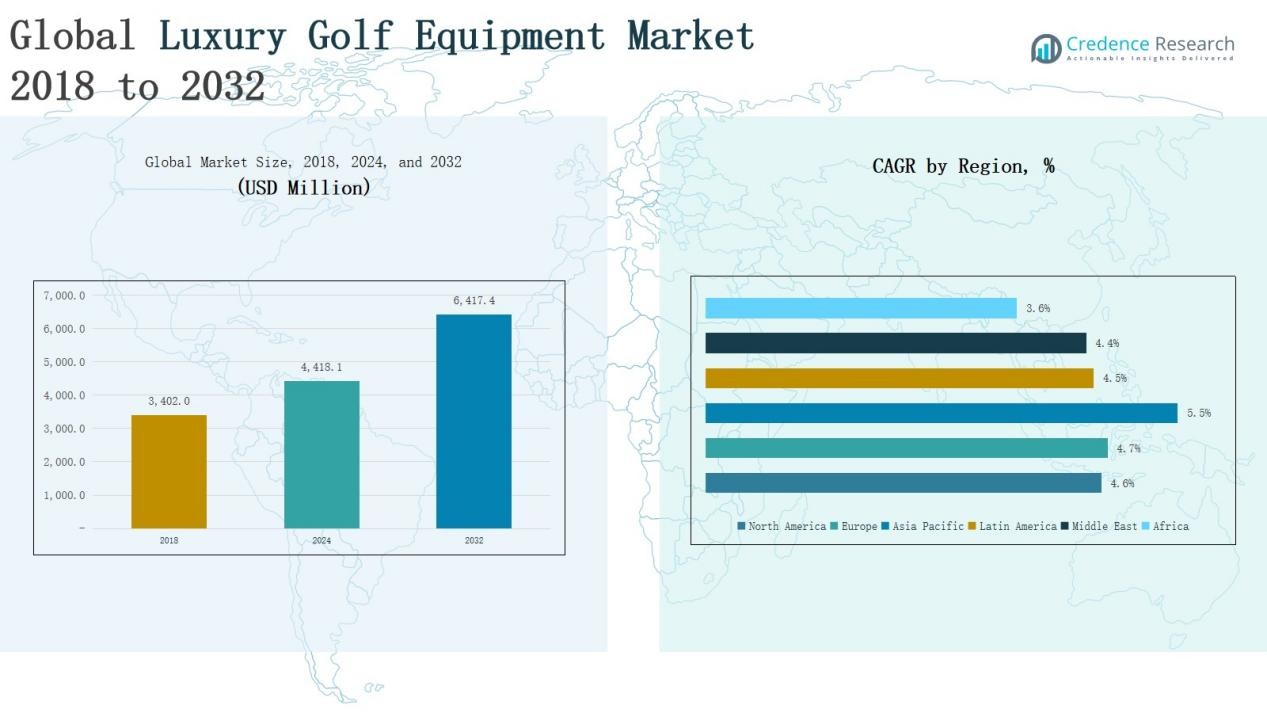
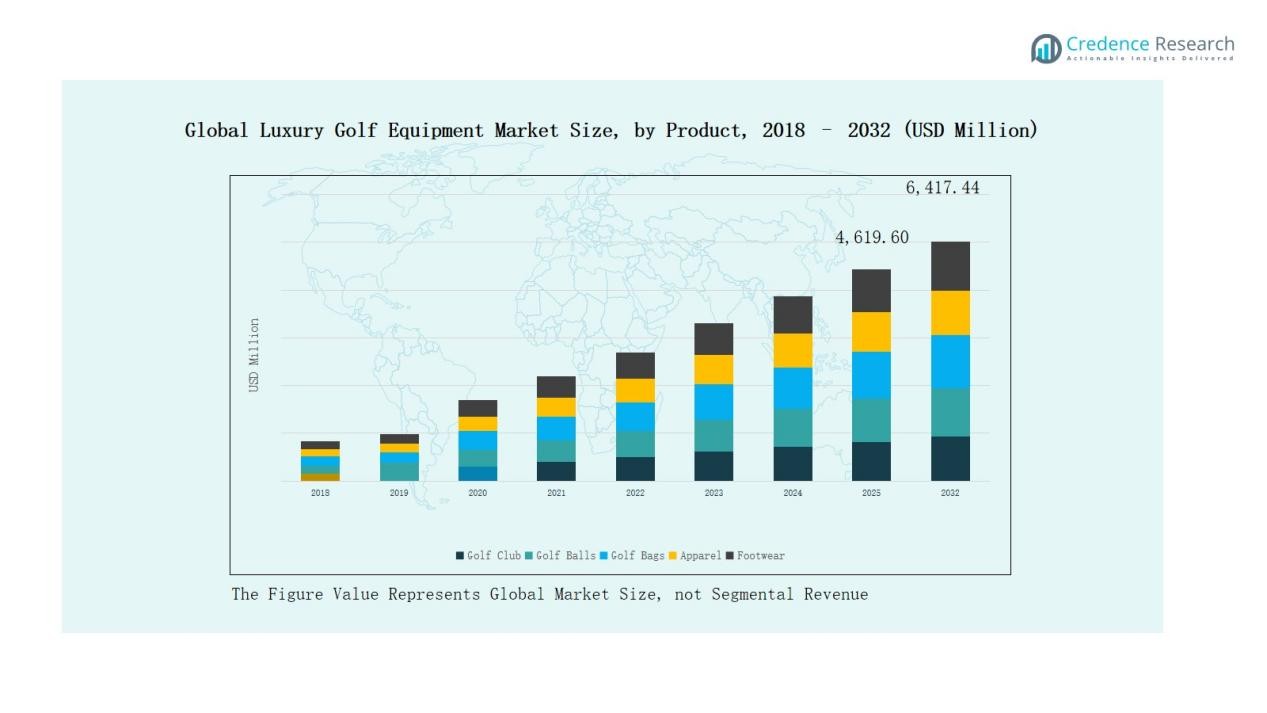
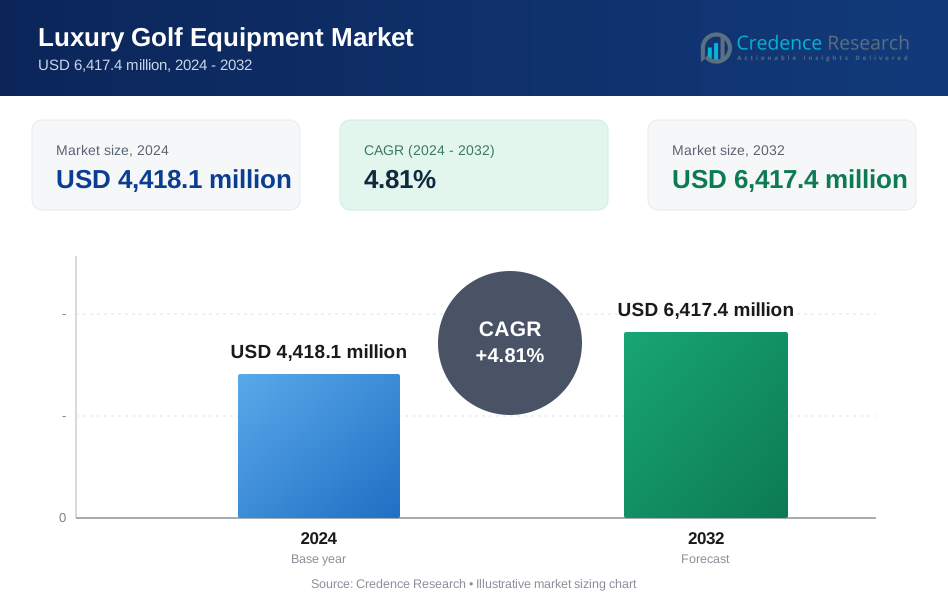
Luxury Golf Equipment Market size was valued at USD 3,402.0 million in 2018 to USD 4,418.1 million in 2024 and is anticipated to reach USD 6,417.4 million by 2032, at a CAGR of 4.81% during the forecast period.
| REPORT ATTRIBUTE | DETAILS |
|---|---|
| Historical Period | 2020-2024 |
| Base Year | 2024 |
| Forecast Period | 2025-2032 |
| Luxury Golf Equipment Market Size 2024 | USD 4,418.1 Million |
| Luxury Golf Equipment Market, CAGR | 4.81% |
| Luxury Golf Equipment Market Size 2032 | USD 6,417.4 Million |
In the Luxury Golf Equipment Market, the foremost players include Acushnet Holdings Corp., Callaway Golf Company, TaylorMade, Titleist, and Ping, each leading through advanced materials, performance engineering, and premium branding. The market shows a pronounced regional leadership by North America, which commands approximately 48.47 percent of the global golf equipment market share in 2024, driven by strong consumer spending, extensive golf course infrastructure, and a high concentration of professional tournaments that fuel consistent demand for premium golf clubs, balls, and accessories.
Market Insights
- The Luxury Golf Equipment Market grew from USD 3,402.0 million in 2018 to USD 4,418.1 million in 2024 and is expected to reach USD 6,417.4 million by 2032, driven by steady demand for premium performance products.
- Leading players such as Acushnet Holdings Corp., Callaway Golf Company, TaylorMade, Titleist, and Ping maintain dominance through innovation, advanced materials, and strong brand positioning in premium segments.
- Growth is supported by rising golf participation, technological advancements in equipment design, and the expansion of golf tourism and high-profile tournaments worldwide.
- Challenges include high price sensitivity in emerging markets, seasonal and regional demand fluctuations, and competition from counterfeit and low-cost alternatives.
- Europe leads the market with 33.5% share in 2024, followed by North America and Asia Pacific, while Latin America, the Middle East, and Africa show emerging growth opportunities.
Market Segment Insights
By Product
In the Luxury Golf Equipment Market, golf clubs represent the leading product segment, supported by continuous advancements in shaft materials, head designs, and weight optimization technologies that enhance accuracy and performance. Demand is reinforced by strong adoption among professional and serious amateur players, premium customization options, and high brand visibility through major tournaments. Celebrity endorsements and the introduction of limited-edition models further elevate consumer interest and strengthen the segment’s dominance over other categories.
- For instance, Callaway continues to innovate with their Paradym driver, utilizing carbon fiber components to reduce weight by over 20 grams, improving launch conditions and forgiveness.
By End User
The adult segment holds the leading position in the Luxury Golf Equipment Market, driven by greater purchasing power, brand loyalty, and active participation in both recreational and competitive golf. Adults tend to prioritize high-quality equipment that offers durability, style, and performance consistency. Growth in exclusive club memberships, increased participation in global golf events, and the desire for personalized or tour-grade products contribute to the segment’s sustained dominance.
- For instance, TaylorMade’s widely popular P790 irons are favored by many adults who value distance and playability, known from their usage by professional players like Dustin Johnson.
By Sales Channel
The offline channel remains the preferred sales route in the Luxury Golf Equipment Market, benefiting from premium in-store experiences at specialty golf outlets, pro shops, and luxury sports retailers. Consumers value the ability to physically assess product quality, receive professional fittings, and access expert guidance before making high-value purchases. The trust, brand immersion, and immediate availability offered by offline retail environments continue to position this channel ahead of online sales for luxury golf products.
Key Growth Drivers
Rising Participation in Golf
The increasing global participation in golf, fueled by growing awareness of the sport’s health and social benefits, is a primary driver for the luxury golf equipment market. Expanding golf course infrastructure, promotional initiatives by golf associations, and the rising popularity of televised tournaments are encouraging new players to invest in premium products. Luxury equipment appeals to both seasoned players and newcomers seeking enhanced performance and prestige. This expanding player base sustains demand across multiple product categories, from high-performance clubs to premium apparel and accessories.
- For instance, Bridgestone Sports leverages decades of materials science expertise to produce high-quality golf balls that emphasize energy transfer and control, a favorite among tour professionals aiming for consistent performance.
Technological Advancements in Equipment
Ongoing innovations in golf equipment design and materials are significantly boosting market growth. Manufacturers are incorporating advanced composites, precision engineering, and data-driven design to improve accuracy, distance, and player comfort. Features such as adjustable club heads, high-resilience golf balls, and ergonomic grips cater to performance-focused consumers willing to invest in premium solutions. These technological enhancements not only improve game quality but also strengthen brand differentiation, leading to increased adoption among professional players, golf enthusiasts, and affluent recreational users.
- For instance, MILESEEY Golf IONME2 rangefinder, featuring Ball-to-Pin™ Technology that measures distances between any two points on the course, improving course management with precision and speed.
Expansion of Golf Tourism and Events
The growth of golf tourism and the increasing number of high-profile tournaments worldwide are driving demand for luxury golf equipment. Prestigious events and exclusive golf destinations create opportunities for showcasing premium products to a global audience. Traveling golfers often invest in high-quality, portable equipment to enhance their playing experience. Additionally, sponsorship deals, brand activations, and on-site product demonstrations during tournaments help manufacturers capture affluent customer segments and reinforce their positioning in the premium sports equipment market.
Key Trends & Opportunities
Sustainability and Eco-Friendly Materials
Sustainable practices are emerging as a major trend in the luxury golf equipment market, with brands introducing eco-friendly materials and production methods. Recycled metals, biodegradable packaging, and sustainably sourced fabrics in apparel are gaining traction among environmentally conscious consumers. This shift not only aligns with global sustainability goals but also provides an opportunity for brands to attract a new demographic seeking responsible luxury. Positioning sustainability as a value-add helps manufacturers differentiate their offerings in a competitive premium segment.
- For instance, Vessel collaborated with Dow to create a luxury golf bag using LuxSense™ Silicone Leather, a sustainable synthetic material manufactured without volatile organic compounds, ensuring durability and a reduced carbon footprint.
Digital Integration and Customization
The integration of digital tools for product customization is opening new growth avenues in the luxury golf equipment sector. Consumers can now personalize club specifications, select unique finishes, and use simulation technology for fitting before purchase. These tailored solutions enhance the user experience and create a sense of exclusivity, encouraging higher spending on premium gear. Leveraging augmented reality, 3D printing, and online configurators allows brands to expand reach while maintaining a personalized service traditionally associated with offline luxury retail.
- For instance, TaylorMade partnered with Threekit to offer interactive 3D visualization and customization of their SIM2 driver, which doubled their forecasted website visits in six weeks and met their three-month sales target in just 30 days.
Key Challenges
High Price Sensitivity in Emerging Markets
Despite growing interest in golf, the high cost of luxury equipment remains a significant barrier in emerging markets. Limited disposable income among potential customers restricts adoption rates, as many opt for mid-range or second-hand equipment instead. This challenge is particularly relevant in regions where golf is still developing as a sport, making it essential for brands to balance premium positioning with targeted affordability strategies to capture untapped demand.
Dependence on Seasonal and Regional Demand
The luxury golf equipment market is highly influenced by seasonal and geographic factors. Sales often peak during specific climates and in regions with established golf cultures, limiting consistent revenue streams. In markets with harsh winters or monsoon seasons, demand can decline significantly. This dependency on seasonal activity forces manufacturers to diversify product lines and explore new markets to maintain stable year-round performance.
Competition from Counterfeit and Low-Cost Alternatives
The availability of counterfeit and low-cost imitation products poses a serious threat to luxury golf equipment brands. These alternatives often replicate the design of premium products at a fraction of the price, eroding brand value and reducing market share. The presence of such products, particularly in online marketplaces, challenges the integrity of authentic brands. Combating this issue requires investment in anti-counterfeiting technologies, consumer education, and strict enforcement of intellectual property rights.
Regional Analysis
North America
North America accounts for 25.5% of the global luxury golf equipment market in 2024, driven by an extensive network of golf courses, high participation rates, and strong brand presence. The region benefits from a mature golf culture supported by professional tournaments such as the PGA Tour, which influence purchasing trends. Premium product adoption is high due to affluent consumer segments and a preference for technologically advanced equipment. The market is projected to grow at a CAGR of 4.6%, with steady expansion supported by golf tourism, corporate events, and the popularity of exclusive golf clubs across the United States and Canada.
Europe
Europe holds the largest regional share at 33.5% in 2024, reflecting its deep-rooted golfing traditions, world-class courses, and strong participation in countries such as the UK, Germany, and France. The region benefits from a strong luxury retail network and active involvement in international golf tournaments like The Open Championship and Ryder Cup. High adoption of premium clubs, apparel, and accessories is supported by both professional and leisure players. With a CAGR of 4.7%, the market’s growth is sustained by tourism, modernization of golf facilities, and the increasing appeal of golf among younger demographics.
Asia Pacific
Asia Pacific represents 23.5% of the global luxury golf equipment market in 2024, emerging as the fastest-growing region with a CAGR of 5.5%. Rising disposable incomes, expanding golf infrastructure, and the influence of global sporting events have driven adoption in key markets such as China, Japan, South Korea, and Australia. International tournaments hosted in the region have elevated brand visibility and consumer demand for premium products. Growing interest among younger players, combined with targeted marketing strategies by global brands, positions Asia Pacific as a key driver of future market expansion in the luxury golf segment.
Latin America
Latin America commands 10.1% of the luxury golf equipment market in 2024, supported by increasing golf tourism, new course developments, and the sport’s growing popularity in countries such as Brazil, Mexico, and Argentina. The market benefits from hosting international golf events that promote brand awareness and product adoption. Rising interest among high-net-worth individuals in luxury sports products further fuels demand. With a CAGR of 4.5%, the region’s growth is bolstered by government and private investment in sports infrastructure, although it remains constrained by limited accessibility in rural areas and economic fluctuations in certain countries.
Middle East
The Middle East holds 5.7% of the global luxury golf equipment market in 2024, driven by high-spending golf tourists, luxury resort developments, and government-backed sports initiatives. Countries like the UAE, Qatar, and Saudi Arabia are investing heavily in world-class golf facilities to attract global tournaments and high-profile players. The market’s CAGR of 4.4% reflects stable growth, supported by year-round golfing conditions and the rising popularity of golf among affluent residents. Premium product demand is reinforced by the region’s luxury lifestyle culture and the association of golf with prestige and exclusivity.
Africa
Africa accounts for 1.9% of the luxury golf equipment market in 2024, with growth concentrated in South Africa, Egypt, and select tourism-driven regions. The market benefits from scenic courses that attract both local enthusiasts and international visitors. However, adoption is limited by economic disparities and low infrastructure penetration outside major cities. The segment is projected to grow at a CAGR of 3.6%, supported by investments in golf tourism and hosting of professional events. While small in share, Africa offers long-term growth potential as accessibility improves and interest in premium sports equipment expands among emerging middle-class consumers.
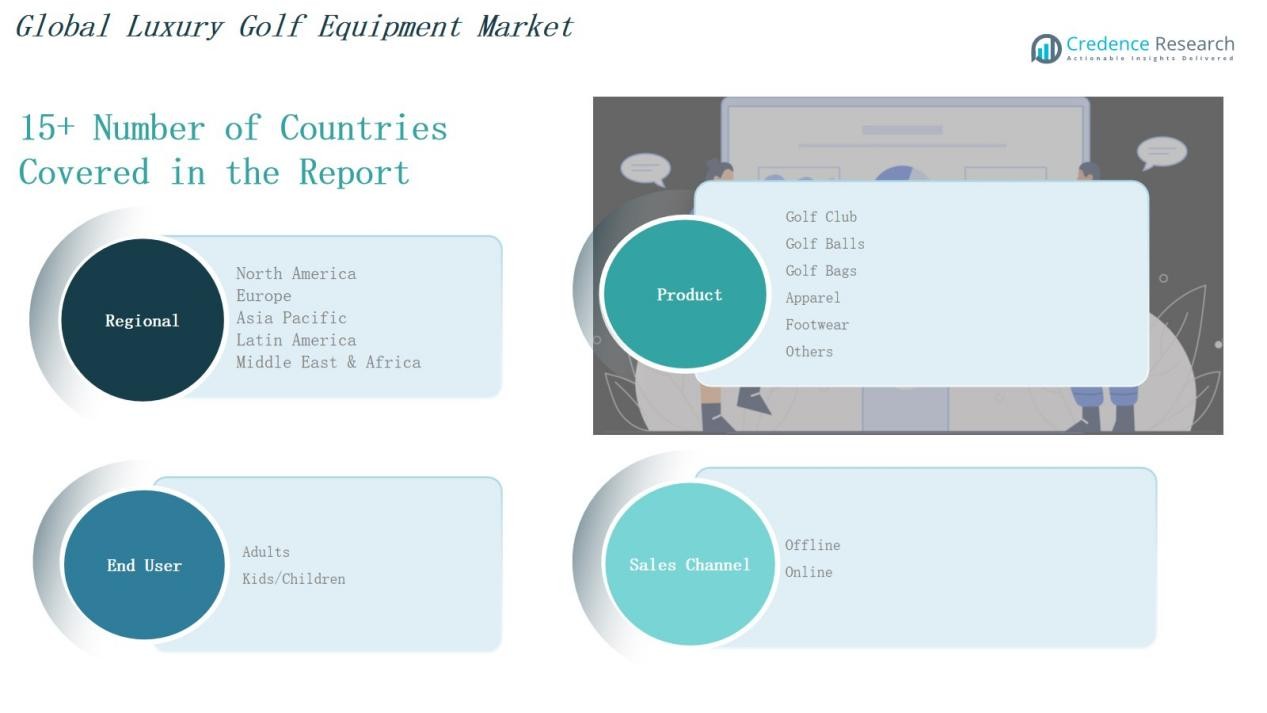
Market Segmentations:
By Product
- Golf Club
- Golf Balls
- Golf Bags
- Apparel
- Footwear
- Others
By End User
- Adult
- Kids/Children
By Sales Channel
- Online
- Offline
By Region
North America
- S.
- Canada
- Mexico
Europe
- UK
- France
- Germany
- Italy
- Spain
- Russia
- Rest of Europe
Asia Pacific
- China
- Japan
- South Korea
- India
- Australia
- Southeast Asia
- Rest of Asia Pacific
Latin America
- Brazil
- Argentina
- Rest of Latin America
Middle East
- GCC Countries
- Israel
- Turkey
- Rest of Middle East
Africa
- South Africa
- Egypt
- Rest of Africa
Competitive Landscape
The competitive landscape of the Luxury Golf Equipment Market is characterized by the presence of established global brands and specialized premium manufacturers competing through product innovation, brand positioning, and strategic endorsements. Leading players such as Topgolf Callaway Brands Corp., TaylorMade Golf Co. Inc., Acushnet Holding Corp., Mizuno Corporation, and PING maintain strong market visibility through advanced engineering, custom-fit solutions, and exclusive product lines. These companies invest heavily in R&D to enhance performance features, such as aerodynamic club designs, high-resilience golf balls, and lightweight yet durable materials. Strategic partnerships with professional golfers, sponsorship of major tournaments, and expansion into emerging golf markets reinforce brand loyalty and consumer engagement. Competitors also leverage multi-channel distribution strategies, balancing luxury in-store experiences with growing online personalization services. The market’s high entry barriers, driven by brand prestige, technological expertise, and customer trust, ensure dominance by established players while leaving limited scope for new entrants in the premium segment.
Key Players
- Topgolf Callaway Brands Corp.
- Misto Holdings Corp.
- TaylorMade Golf Co. Inc.
- Mizuno Corporation
- Acushnet Holding Corp.
- Wilson
- PING
- Srixon
- Ben Hogan Golf Company
- Bridgestone Golf
- Cobra
- Other Key Players
Recent Developments
- In July 2025, L.A.B. Golf was acquired by L Catterton (LVMH-backed) for over USD 200 million, highlighting luxury-sector interest in premium golf gear.
- In August 2025, Maxfli launched the 2025 Tour X golf ball (USD 39.99/dozen), already credited with two PGA Tour wins, including one by Ben Griffin.
- In January 2025, Wilson Golf launched a new product line, including the Duo Soft and Triad golf balls, designed to cater to both beginners and seasoned players.
- In January 2025, Stix Golf announced a collaboration with Nicklaus Companies to release a limited selection of golf clubs and accessories featuring the iconic Golden Bear’s influence.
- In April 2025, Adidas released its Originals Golf collection, reimagining vintage sneaker silhouettes and the Trefoil logo for golf apparel and footwear.
Market Concentration & Characteristics
The Luxury Golf Equipment Market exhibits a moderately high level of concentration, with a few dominant multinational brands controlling a significant share through strong brand equity, technological expertise, and extensive distribution networks. It is characterized by premium pricing, high product differentiation, and a focus on advanced materials, performance enhancements, and aesthetic appeal. Leading companies maintain a competitive edge through innovation in club design, customization options, and integration of professional endorsements to influence consumer preferences. The market caters primarily to affluent golfers, professional players, and enthusiasts seeking performance-driven products. It relies heavily on brand reputation, tour visibility, and consumer loyalty to sustain demand. Entry barriers remain substantial due to the need for advanced manufacturing capabilities, established retail partnerships, and global marketing reach. While niche brands compete through craftsmanship and exclusivity, established players dominate through large-scale production, global sponsorship deals, and consistent product launches that reinforce their leadership in the luxury sports equipment sector.
Report Coverage
The research report offers an in-depth analysis based on Product, End User, Sales Channel and Region. It details leading market players, providing an overview of their business, product offerings, investments, revenue streams, and key applications. Additionally, the report includes insights into the competitive environment, SWOT analysis, current market trends, as well as the primary drivers and constraints. Furthermore, it discusses various factors that have driven market expansion in recent years. The report also explores market dynamics, regulatory scenarios, and technological advancements that are shaping the industry. It assesses the impact of external factors and global economic changes on market growth. Lastly, it provides strategic recommendations for new entrants and established companies to navigate the complexities of the market.
Future Outlook
- Demand for personalized and custom-fit luxury golf equipment will continue to grow across all major markets.
- Technological innovations in materials and design will enhance performance and attract premium buyers.
- Sustainability initiatives will drive the adoption of eco-friendly materials and ethical manufacturing practices.
- Growth in golf tourism and international tournaments will expand global brand visibility.
- Online channels will gain greater traction through advanced virtual fitting and customization tools.
- Emerging markets will experience rising demand due to increasing disposable incomes and golf infrastructure development.
- Strategic partnerships with professional golfers will strengthen brand credibility and consumer trust.
- Limited-edition and exclusive product launches will appeal to collectors and high-net-worth individuals.
- Luxury retail experiences will remain a critical factor in influencing purchasing decisions.
- Brands will invest in digital engagement to reach younger demographics and expand their loyal customer base.
Request a Free Sample
Fill in your details and we'll send you a free sample report.
- Sample data tables & charts
- Research methodology
Need a Custom Version of This Report?
Tailor the scope, geography, or segments to your exact requirements.
- Custom geography or segment scope
- Direct access to our analyst team
Frequently Asked Questions
What is the current market size for Luxury Golf Equipment Market, and what is its projected size in 2032?
At what Compound Annual Growth Rate is the Luxury Golf Equipment Market projected to grow between 2025 and 2032?
Which Luxury Golf Equipment Market segment held the largest share in 2024?
What are the primary factors fueling the growth of the Luxury Golf Equipment Market?
Who are the leading companies in the Luxury Golf Equipment Market?
Q6: Which region commanded the largest share of the Luxury Golf Equipment Market in 2024?
Table of Content
Chapter 1. Report Introduction
- 1.1 Report Description & Purpose
- 1.1.1 Report Title & Market Definition
- 1.1.2 Unique Selling Propositions (USP) & Key Differentiators
- 1.1.3 Value Proposition for Stakeholders
- 1.2 Research Objectives
- 1.2.1 Market Sizing Objectives (Volume & Revenue)
- 1.2.2 Segmentation Objectives
- 1.2.3 Competitive Intelligence Objectives
- 1.2.4 Forecast & Scenario Objectives
- 1.3 Report Scope
- 1.3.1 Luxury Golf Equipment Scope – Types & Subtypes Covered
- 1.3.2 Geographic Scope – Regions & Countries Covered
- 1.3.3 Historical Period, Base Year & Forecast Period (2024; forecast to 2032)
- 1.3.4 Inclusions & Exclusions
- 1.4 HS Code & Classification Framework
- 1.5 Currency, Units & Pricing Basis
- 1.6 Target Stakeholders
- 1.7 Limitations & Assumptions
Chapter 2. Executive Summary
- 2.1 Global Luxury Golf Equipment Market Snapshot
- 2.1.1 Market Size – Historical (2024) & Forecast (2024-2032) (2024: USD 4,418.1 million → 2032: USD 6,417.4 million)
- 2.1.2 Volume & Revenue – Global Totals
- 2.1.3 Key Market Highlights – Top Five Facts
- 2.2 Luxury Golf Equipment Market Segmentation Snapshot
- 2.2.1 Market Split by Region – 2024 vs. 2032
- 2.3 Competitive Snapshot
- 2.3.1 Top 10 Players by Revenue Share – 2024
- 2.3.2 Top 10 Players by Volume Share – 2024
- 2.3.3 Recent Strategic Developments (18-Month Summary)
- 2.4 Key Investment Highlights & Strategic Conclusions
Chapter 3. Luxury Golf Equipment Market Dynamics & Industry Analysis
- 3.1 Market Overview & Context
- 3.1.1 Luxury Golf Equipment Market Position in the Broader Automotive Value Chain
- 3.1.2 OEM vs. Replacement Market Dynamics
- 3.1.3 Market Maturity & Development Stage by Region
- 3.2 Luxury Golf Equipment Market Drivers
- 3.3 Luxury Golf Equipment Market Restraints & Challenges
- 3.4 Luxury Golf Equipment Market Opportunities
- 3.5 Porter's Five Forces Analysis
- 3.5.1 Threat of New Entrants
- 3.5.2 Bargaining Power of Suppliers
- 3.5.3 Bargaining Power of Buyers
- 3.5.4 Threat of Substitutes
- 3.5.5 Competitive Rivalry – Intensity Assessment
- 3.6 Luxury Golf Equipment Value Chain Analysis
- 3.6.1 Upstream – Raw Material/Input Suppliers
- 3.6.1.1 Raw Material/Input 1
- 3.6.1.2 Raw Material/Input 2
- 3.6.1.3 Raw Material/Input 3
- 3.6.2 Midstream – Production/Manufacturing/Service Delivery
- 3.6.2.1 Production/Process Overview
- 3.6.2.2 Key Facility Locations & Capacity by Manufacturer
- 3.6.3 Downstream – Distribution & End Consumer
- 3.6.3.1 Primary Channel – B2B/OEM
- 3.6.3.2 Secondary Channels – Dealer, Retail, Online, Direct
- 3.6.4 Value Chain Profitability Analysis
- 3.6.1 Upstream – Raw Material/Input Suppliers
- 3.7 PESTEL Analysis
- 3.7.1 Political Factors
- 3.7.2 Economic Factors
- 3.7.3 Social Factors
- 3.7.4 Technological Factors
- 3.7.5 Environmental Factors
- 3.7.6 Legal Factors
- 3.8 Luxury Golf Equipment Supply Chain Analysis
- 3.8.1 Raw Material/Input Supply Risk Assessment
- 3.8.2 Manufacturing Concentration Risk (Geographic Exposure)
- 3.8.3 Trade Disruption Impact Analysis
- 3.9 Regulatory & Policy Landscape
Note: The regulatory and policy landscape section covers regulations based on their applicability to the market, Luxury Golf Equipment category, geography, and scope of the study. Only regulatory frameworks with a material impact on operations, compliance, trade, sustainability, or market access are analyzed in detail.
Chapter 4. Key Investment Pockets & Opportunity Analysis
- 4.1 Luxury Golf Equipment Market Attractiveness Analysis
- 4.1.1 By Region – Investment Attractiveness Matrix (Volume × CAGR)
- 4.2 Absolute Revenue Growth Opportunity
- 4.2.1 By Region – Absolute USD Growth Through 2032
- 4.3 Incremental Volume Opportunity
- 4.3.1 By Region – Incremental Volume Through 2032
- 4.3.2 Segment – Incremental Volume
- 4.4 Emerging Submarket Opportunity Deep Dive (Subject to Applicability)
- 4.5 Emerging Market Opportunity Scorecards
- 4.5.1 United States
- 4.5.2 Europe
- 4.5.3 Asia
- 4.5.4 Middle East & Africa
Note: Emerging Market Opportunity Scorecards will be included based on relevance and strategic importance. Regions listed are indicative and may vary depending on data availability and market dynamics.
Chapter 5. Luxury Golf Equipment Import-Export Analysis & Trade Flows
- 5.1 Global Trade Overview
- 5.1.1 Global Export Value by Country (2024)
- 5.1.2 Global Export Volume by Country (2024)
- 5.1.3 Global Import Value by Country (2024)
- 5.1.4 Global Import Volume by Country (2024)
- 5.1.5 Net Trade Balance by Country (2024)
- 5.2 Export Analysis – Segment
- 5.2.1 Type 1 (HS Code)
- 5.2.2 Type 2 (HS Code)
- 5.2.3 Type 3 (HS Code)
- 5.2.4 Type 4 (HS Code)
- 5.2.5 Type 5 (HS Code)
- 5.3 Import Analysis – Segment
- 5.3.1 Type 1 (HS Code)
- 5.3.2 Type 2 (HS Code)
- 5.3.3 Type 3 (HS Code)
- 5.3.4 Type 4 (HS Code)
- 5.3.5 Type 5 (HS Code)
- 5.4 Average Unit Trade Prices
- 5.4.1 Average Export Price – Segment & Country
- 5.4.2 Average Import Price – Segment & Source Country
- 5.4.3 Price Trends (2024)
- 5.5 Key Trade Route Analysis
- 5.5.1 Trade Route 1
- 5.5.2 Trade Route 2
- 5.5.3 Trade Route 3
- 5.5.4 Trade Route 4
- 5.5.5 Trade Route 5
- 5.6 Trade Policy Impact Assessment
- 5.6.1 US Anti-Dumping & Section 301 Tariffs
- 5.6.2 EU Customs Union Impact
- 5.6.3 Major Free Trade Agreements
- 5.6.4 USMCA Rules of Origin
Note: Trade policy analysis will be included only where relevant to the Luxury Golf Equipment market.
Chapter 6. Competitive Landscape & Company Benchmarking
- 6.1 Luxury Golf Equipment Market Concentration & Structure
- 6.1.1 Herfindahl-Hirschman Index (HHI) – vs. 2024
- 6.1.2 Tier 1, Tier 2 & Tier 3 Market Structure
- 6.1.3 Global, Regional & Local Player Dynamics
- 6.2 Luxury Golf Equipment Market Share Analysis – 2024
- 6.2.1 Global Revenue Share by Company
- 6.2.2 Global Volume Share by Company
- 6.2.3 Regional Revenue Share
- 6.2.4 Market Share Evolution ( vs. 2024)
- 6.2.5 OEM Segment Share by Company
- 6.2.6 Replacement Segment Share by Company
- 6.3 Production/Delivery Capacity & Facility Analysis
- 6.3.1 Global Installed Capacity
- 6.3.2 Capacity Utilization Rates
- 6.3.3 Production/Output Volume
- 6.3.4 Facility Locations & Capacity Map
- 6.3.5 Planned Capacity Additions
- 6.4 Luxury Golf Equipment Competitive Benchmarking Matrix
- 6.4.1 Revenue, Volume, CAGR & Profitability Comparison
- 6.4.2 Channel Revenue Mix
- 6.4.3 Geographic Revenue Exposure
- 6.4.4 R&D Intensity
- 6.4.5 Sustainability Maturity
- 6.5 Strategic Developments in Luxury Golf Equipment (Last 24 Months)
- 6.5.1 Mergers, Acquisitions & Divestments
- 6.5.2 New Luxury Golf Equipment Launches
- 6.5.3 Facility Expansions
- 6.5.4 Strategic Alliances, Joint Ventures & Partnerships
- 6.5.5 Distribution Expansion & Market Entry
- 6.5.6 Sustainability & ESG Initiatives
- 6.6 Competitive Strategy Mapping
- 6.6.1 Leader, Challenger, Follower & Niche Classification
- 6.6.2 Pricing Strategy Comparison
- 6.6.3 Channel Strategy Matrix
Note: Strategic developments are included based on their materiality and the availability of reliable information.
Chapter 7. Global Luxury Golf Equipment Market – By Distribution Channel
- 7.1 Segment Overview
- 7.1.1 Volume & Revenue Split by Channel (2024 & 2032)
- 7.1.2 Channel Mix Evolution (2024-2032)
Chapter 8. Regional Market Analysis – Global Overview
- 8.1 Global Regional Overview
- 8.1.1 Regional Volume Share
- 8.1.2 Regional Revenue Share
- 8.1.3 Regional Volume by Region
- 8.1.4 Regional Revenue by Region
- 8.1.5 Regional Forecast Through 2032
- 8.2 Cross-Regional Segment Analysis
- 8.2.1 By Distribution Channel
- 8.2.2 By Brand/Price Tier
Chapter 9. North America Luxury Golf Equipment Market
- 9.1 United States
- 9.2 Canada
- 9.3 Mexico
Chapter 10. Europe Luxury Golf Equipment Market
- 10.1 Germany
- 10.2 France
- 10.3 Italy
- 10.4 United Kingdom
- 10.5 Spain
- 10.6 Poland
- 10.7 Russia
- 10.8 Netherlands
- 10.9 Belgium
- 10.10 Sweden
- 10.11 Denmark
- 10.12 Norway
- 10.13 Rest of Europe
Chapter 11. Asia Pacific Luxury Golf Equipment Market
- 11.1 China
- 11.2 India
- 11.3 Japan
- 11.4 South Korea
- 11.5 Thailand
- 11.6 Indonesia
- 11.7 Vietnam
- 11.8 Malaysia
- 11.9 Australia
- 11.10 Rest of Asia Pacific
Chapter 12. Latin America Luxury Golf Equipment Market
- 12.1 Brazil
- 12.2 Argentina
- 12.3 Colombia
- 12.4 Chile
- 12.5 Rest of Latin America
Chapter 13. Middle East Luxury Golf Equipment Market
- 13.1 Saudi Arabia
- 13.2 United Arab Emirates
- 13.3 Turkey
- 13.4 Israel
- 13.5 Iran
- 13.6 Rest of the Middle East
Chapter 14. Africa Luxury Golf Equipment Market
- 14.1 South Africa
- 14.2 Egypt
- 14.3 Nigeria
- 14.4 Morocco
- 14.5 Rest of Africa
Chapter 15. Luxury Golf Equipment Company Profiles
- 15.1 [Company 01]
- 15.1.1 Company Overview
- 15.1.2 Key Management Personnel
- 15.1.3 Products & Services Portfolio
- 15.1.4 Financial Performance
- 15.1.5 Key Market Focus & Geographic Presence
- 15.1.6 Recent Developments & Strategic Initiatives
Note: The company profile list is preliminary and may change based on research findings, market developments, data availability, and client requirements.
Chapter 16. Appendices
- Appendix A – List of Abbreviations & Acronyms
- Appendix B – Industry Classification Code Reference – Full Series
- Appendix C – Production & Capacity Data Tables
- Appendix D – End-Use & Demand Base Tables
- Appendix E – Consumption & Replacement Rate Assumptions
- Appendix F – ASP Reference Tables
- Appendix G – Manufacturing & Facility Database
- Appendix H – Import-Export Data Tables
- Appendix I – Regulatory Summary Tables
- Appendix J – Primary Research Participant List (Anonymized)
- Appendix K – Primary Research Questionnaire Framework
- Appendix L – Data Sources & Bibliography
- Appendix M – Market Size Divergence & Source Comparison
Chapter 17. Research Methodology
- 17.1 Research Framework & Philosophy
- 17.2 Secondary Research – Sources, Hierarchy & Data Extraction
- 17.3 Data Modeling – Bottom-Up & Top-Down Market Sizing
- 17.4 Primary Research – Stakeholder Framework, LOI & Sample Sizes
- 17.5 Forecast Methodology – Regression, Scenario & Sensitivity Analysis
- 17.6 Quality Control – Four-Layer Validation Framework
- 17.7 Limitations & Standard Assumptions
- 17.8 Disclaimer
