
Market Overview:
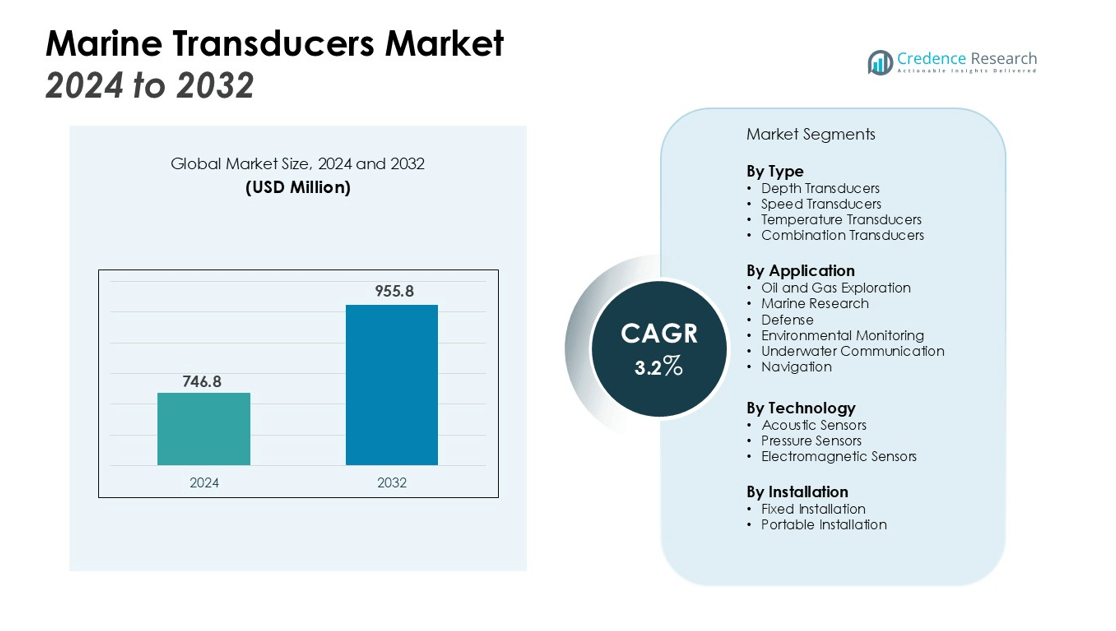
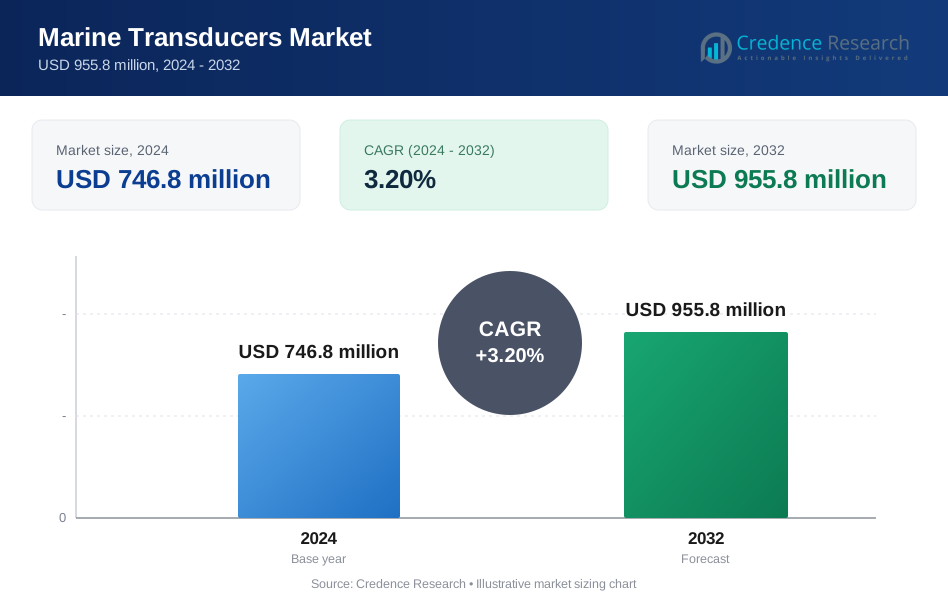
The Marine Transducers Market size was valued at USD 746.8 million in 2024 and is anticipated to reach USD 955.8 million by 2032, at a CAGR of 3.2% during the forecast period (2024-2032).
| REPORT ATTRIBUTE | DETAILS |
|---|---|
| Historical Period | 2020-2023 |
| Base Year | 2024 |
| Forecast Period | 2025-2032 |
| Marine Transducers Market Size 2024 | USD 746.8 million |
| Marine Transducers Market, CAGR | 3.2% |
| Marine Transducers Market Size 2032 | USD 955.8 million |
The key drivers fueling the market growth include the growing adoption of marine transducers in defense, commercial shipping, and scientific research sectors. Marine transducers are vital for applications such as sonar systems, oceanographic surveys, and underwater communication, where high accuracy and durability are essential. The increasing focus on energy-efficient and environmentally sustainable marine technologies also drives innovation in marine transducers. The integration of advanced technologies, such as IoT and AI, into marine systems further enhances the demand for sophisticated marine transducers, driving overall market growth.
Regionally, North America holds the largest market share, attributed to strong maritime infrastructure, defense spending, and advancements in marine research. The Asia-Pacific region is expected to witness the fastest growth, fueled by expanding maritime trade, rising naval investments, and the rapid development of marine research initiatives in countries like China, Japan, and South Korea. Europe also contributes significantly to market growth, supported by robust research and development in marine technologies and increasing defense budgets in key countries.
Market Insights:
- The Marine Transducers Market was valued at USD 746.8 million in 2024 and is expected to reach USD 955.8 million by 2032, growing at a CAGR of 3.2%.
- The demand for marine transducers is driven by their growing adoption in defense, commercial shipping, and scientific research applications such as sonar systems and underwater communication.
- Technological advancements, including IoT and AI integration, are increasing the demand for sophisticated marine transducers for real-time data collection and analysis.
- North America holds the largest market share of 35%, driven by strong maritime infrastructure, defense spending, and advancements in marine research.
- The Asia-Pacific region, with a 30% market share, is the fastest-growing region, fueled by expanding maritime trade, rising naval investments, and marine research development.
- Europe holds a 25% market share, supported by strong research and development in marine technologies and increasing demand for advanced sonar and defense systems.
- High costs of advanced transducer technologies and technological limitations such as signal interference and depth penetration are significant challenges to market growth.
Market Drivers:
Growing Demand in Defense and Maritime Security
The increasing use of marine transducers in defense applications is one of the primary drivers for the market's growth. These transducers are essential for sonar systems, underwater navigation, and communication, enabling military forces to perform precise operations in complex environments. With rising global security concerns and naval investments, the defense sector’s reliance on marine transducers continues to expand, particularly in advanced surveillance and reconnaissance missions.
- For instance, Ultra has delivered more than 15,000 of its TR-317 and TR-353 transducers to the U.S. Navy since 1997 for use in submarine sonar systems.
Advancements in Commercial Shipping and Offshore Exploration
Marine transducers play a crucial role in the commercial shipping industry, ensuring efficient navigation, cargo management, and communication in challenging marine environments. The demand for more accurate and reliable transducers has grown with the rise of global trade and offshore exploration activities. Their integration into automated systems helps improve operational efficiency, reduce risks, and enhance safety standards across the maritime transport and oil and gas sectors.
- For instance, a proof-of-concept AI-based autopilot was developed in collaboration with Volvo Penta, using a 15-meter test boat to create more adaptable path-following systems for vessels.
Expansion of Marine Research and Environmental Monitoring
Scientific research and environmental monitoring are significant contributors to the growth of the Marine Transducers Market. These transducers enable precise data collection during oceanographic surveys and underwater explorations, providing valuable insights into marine ecosystems. The increasing need for sustainable management of ocean resources and climate change studies further drives investments in high-performance transducers that can withstand extreme underwater conditions.
Technological Advancements and Integration of Smart Systems
The continuous advancement in marine technology, including the integration of IoT and AI, has significantly boosted the Marine Transducers Market. Smart marine systems demand sophisticated transducers that can collect, analyze, and transmit real-time data for more accurate decision-making. The development of energy-efficient, environmentally friendly solutions also enhances the appeal of modern marine transducers, promoting their widespread adoption across multiple marine sectors.
Market Trends:
Increasing Integration of Smart and Connected Marine Systems
One of the key trends in the Marine Transducers Market is the growing integration of smart and connected systems. As marine technologies evolve, transducers are increasingly being equipped with advanced features such as IoT connectivity and AI-driven analytics. These innovations allow for real-time monitoring, diagnostics, and data analysis, enhancing the performance and reliability of marine systems. The ability to collect and transmit data instantly improves decision-making processes, enabling faster response times in critical situations. This shift toward smarter, more connected systems is driving the demand for high-performance marine transducers that can seamlessly integrate with other advanced technologies across defense, commercial, and scientific sectors.
- For instance, Teledyne Marine's Hydrophone and Transducer series supports underwater acoustic data collection with operational depths reaching 6,000 meters, enabling robust and precise performance in deep-sea environments.
Growing Demand for Sustainable and Energy-Efficient Solutions
Sustainability and energy efficiency are rapidly becoming essential considerations in the Marine Transducers Market. With increasing pressure to reduce environmental impact, marine transducers are being designed to be more energy-efficient, helping reduce the overall carbon footprint of marine operations. These transducers are also becoming more durable, capable of withstanding extreme underwater conditions while minimizing the need for frequent maintenance. The shift toward environmentally friendly technologies is evident in the growing popularity of eco-friendly transducers that use less power and support sustainability efforts in maritime industries. This trend is expected to continue as companies and government organizations prioritize green initiatives and long-term environmental goals.
- For instance, Siemens designs its industrial transducers for high durability, enabling them to operate reliably in extreme ambient temperatures of at least 60°C (140°F).
Market Challenges Analysis:
High Costs of Advanced Marine Transducer Technologies
One of the primary challenges in the Marine Transducers Market is the high cost of advanced transducer technologies. The complexity of these systems, combined with the need for precision and durability, leads to significant production costs. This makes high-performance transducers inaccessible for smaller operators and research institutions with limited budgets. The substantial investment required for cutting-edge systems can deter organizations from adopting the latest technologies, hindering the overall market growth. The challenge lies in balancing innovation with affordability to make these solutions more accessible across various sectors.
Technological Limitations and Maintenance Requirements
The technological limitations of current marine transducers pose another challenge to the market. Despite advancements in sonar, navigation, and communication systems, existing transducers often face issues related to signal interference, environmental constraints, and limited depth penetration. These limitations can impact the accuracy and reliability of data collection, especially in complex underwater environments. Moreover, the maintenance needs of marine transducers, which must withstand harsh conditions, can be costly and time-consuming. These factors complicate the widespread adoption of advanced transducer systems, particularly in remote and challenging marine locations.
Market Opportunities:
Expansion of Marine Research and Environmental Monitoring Initiatives
The growing focus on marine research and environmental conservation presents significant opportunities in the Marine Transducers Market. Increased investments in oceanography, climate change studies, and sustainable resource management are driving the demand for advanced marine transducer systems. These systems are essential for gathering data on underwater ecosystems, monitoring marine life, and assessing environmental changes. As governments and research institutions expand their oceanic exploration programs, the need for high-performance, reliable transducers will rise, opening new avenues for market growth. This growing emphasis on marine conservation further enhances the demand for transducers that can operate efficiently in extreme underwater environments.
Advancements in Autonomous and Smart Marine Systems
The rise of autonomous marine systems presents another promising opportunity for the Marine Transducers Market. Autonomous vehicles, including drones and underwater robots, require advanced transducers for navigation, communication, and data collection. As these systems become more prevalent in industries such as defense, commercial shipping, and oil and gas exploration, the need for sophisticated, durable, and energy-efficient transducers increases. The integration of smart technologies, including IoT and AI, further accelerates the adoption of transducers that can support real-time monitoring and automated processes. This trend creates long-term growth potential for the market, driven by the ongoing push for innovation in marine systems.
Market Segmentation Analysis:
By Type
The market consists of depth, speed, temperature, and combination transducers. Combination transducers are the dominant segment, known for their versatility across various marine applications. Their widespread use continues to increase as they meet the diverse needs of marine technology.
By Application
Marine transducers are crucial in industries such as oil and gas exploration, marine research, and defense. They facilitate underwater communication, navigation, and environmental monitoring. The demand for these applications is rising, driven by the growth of autonomous underwater vehicles and advancements in oceanographic research.
- For instance, Stellar Technology’s PT36XX subsea wellbore pressure and temperature transducer provides reliable performance under working pressures up to 15,000 psi in subsea oil and gas environments.
By Technology
The technology segment includes acoustic sensors, pressure sensors, and electromagnetic sensors. Acoustic sensors, especially hydrophones, are experiencing rapid growth due to their key role in sonar and underwater communication systems. The expansion of these technologies is accelerating marine mapping and communication capabilities.
- For instance, Ocean Sonics’ icListen HF hydrophone features a sampling rate up to 512,000 samples per second, enabling high-fidelity underwater acoustic data collection.
Segmentations:
By Type:- Depth Transducers
- Speed Transducers
- Temperature Transducers
- Combination Transducers
- Oil and Gas Exploration
- Marine Research
- Defense
- Environmental Monitoring
- Underwater Communication
- Navigation
- Acoustic Sensors
- Pressure Sensors
- Electromagnetic Sensors
- Fixed Installation
- Portable Installation
- North America
- U.S.
- Canada
- Mexico
- Europe
- UK
- France
- Germany
- Italy
- Spain
- Russia
- Belgium
- Netherlands
- Austria
- Sweden
- Poland
- Denmark
- Switzerland
- Rest of Europe
- Asia Pacific
- China
- Japan
- South Korea
- India
- Australia
- Thailand
- Indonesia
- Vietnam
- Malaysia
- Philippines
- Taiwan
- Rest of Asia Pacific
- Latin America
- Brazil
- Argentina
- Peru
- Chile
- Colombia
- Rest of Latin America
- Middle East
- UAE
- KSA
- Israel
- Turkey
- Iran
- Rest of Middle East
- Africa
- Egypt
- Nigeria
- Algeria
- Morocco
- Rest of Africa
Regional Analysis:
North America: Market Leader Driven by Strong Maritime Infrastructure
North America holds a dominant share of 35% in the Marine Transducers Market, driven by its robust maritime infrastructure and technological advancements. The United States, with its large defense spending and active participation in marine research, significantly influences market dynamics in the region. The demand for high-precision sonar systems, underwater navigation, and communication tools continues to grow within both the defense and commercial shipping sectors. Research institutions and governmental organizations also contribute to the regional growth by investing in marine exploration and environmental monitoring. The region's commitment to innovation and sustainability further strengthens its position in the market.
Asia-Pacific: Fastest-Growing Region with Expanding Maritime Trade
The Asia-Pacific region commands a market share of 30%, experiencing the fastest growth in the Marine Transducers Market. This growth is driven by the rapid expansion of maritime trade, rising naval investments, and the increasing focus on marine research and exploration. Countries such as China, Japan, and South Korea are heavily investing in advanced maritime technologies, further driving the demand for sophisticated marine transducers. The growing importance of offshore energy exploration and defense applications in this region adds to the market's momentum. The need for reliable and high-performance marine transducers is expected to surge, particularly in countries with large naval and commercial fleets.
Europe: Steady Growth Fueled by Research and Development
Europe holds a 25% share of the Marine Transducers Market, driven by strong research and development activities in marine technologies. Countries such as the United Kingdom, Germany, and France focus heavily on underwater research, environmental monitoring, and defense systems, which require high-quality transducer solutions. The region’s commitment to green technologies and sustainable marine practices further fuels market growth, as environmentally friendly solutions gain importance. The European market is also supported by the rising demand for advanced sonar systems and automated marine vessels across both defense and commercial sectors.
Key Player Analysis:
- Marport Canada
- Navico Group
- Airmar Technology
- Johnson Outdoors
- SEIWA Marine Electronics
- Teledyne Technologies
- Kongsberg
- SAIYANG Marine Electronics
- Furuno Electric
- Garmin
Competitive Analysis:
The Marine Transducers Market is characterized by a moderately concentrated competitive landscape. Leading companies such as Airmar Technology, Furuno Electric, Garmin, Johnson Outdoors, Kongsberg, Marport Canada, Navico Group, SAIYANG Marine Electronics, SEIWA Marine Electronics, and Teledyne Technologies dominate the market. These firms leverage their established brand reputations, extensive product portfolios, and global distribution networks to maintain a competitive edge. Despite the presence of these major players, numerous smaller, specialized companies contribute significantly, particularly in niche applications. This dynamic environment fosters innovation and drives advancements in sonar and imaging technologies, positioning the market for continued growth and development.
Recent Developments:
- In June 2025, Kongsberg Discovery, a division of KONGSBERG, signed an agreement to acquire Sonatech, Inc., a U.S.-based company specializing in underwater acoustic technology for the defense market.
- In January 2025, Garmin Ltd., in partnership with Qualcomm Technologies, introduced the Garmin Unified Cabin™ 2025 at the Consumer Electronics Show (CES), a digital cockpit solution for vehicles built on the Snapdragon® Cockpit Elite platform.
- In January 2024, Smartgyro and Navico Group announced the official integration of Smartgyro's boat stabilization technology with Navico's multifunction displays (MFDs).
Report Coverage:
The research report offers an in-depth analysis based on Type, Application, Technology, Installation and Region. It details leading market players, providing an overview of their business, product offerings, investments, revenue streams, and key applications. Additionally, the report includes insights into the competitive environment, SWOT analysis, current market trends, as well as the primary drivers and constraints. Furthermore, it discusses various factors that have driven market expansion in recent years. The report also explores market dynamics, regulatory scenarios, and technological advancements that are shaping the industry. It assesses the impact of external factors and global economic changes on market growth. Lastly, it provides strategic recommendations for new entrants and established companies to navigate the complexities of the market.
Future Outlook:
- The demand for advanced marine transducers will increase due to growing maritime defense and research activities.
- Enhanced underwater communication technologies will drive innovations in transducer design and capabilities.
- The expansion of autonomous underwater vehicles will significantly boost the adoption of high-precision transducers.
- Marine research and environmental monitoring will benefit from new transducer technologies that offer greater accuracy and durability.
- Technological advancements in acoustic and electromagnetic sensors will improve the efficiency of marine transducers.
- The rising focus on energy-efficient marine technologies will accelerate the use of sustainable materials in transducer manufacturing.
- Increased investments in offshore oil and gas exploration will further push the demand for reliable marine transducers.
- The growth of the smart shipping industry will integrate advanced transducers for real-time data collection and navigation.
- The Asia-Pacific region is expected to become a key growth area due to expanding maritime trade and infrastructure investments.
- The ongoing trend toward miniaturization will lead to more compact and cost-effective marine transducers, improving their integration into various marine systems.
Request a Free Sample
Fill in your details and we'll send you a free sample report.
- Sample data tables & charts
- Research methodology
Need a Custom Version of This Report?
Tailor the scope, geography, or segments to your exact requirements.
- Custom geography or segment scope
- Direct access to our analyst team
Frequently Asked Questions
What is the current market size for Marine Transducers, and what is its projected size in 2032?
Which Marine Transducers market segment held the largest share in 2024?
What are the primary factors fueling the growth of the Marine Transducers market?
Who are the leading companies in the Marine Transducers market?
Table of Content
Chapter 1. Report Introduction
- 1.1 Report Description & Purpose
- 1.1.1 Report Title & Market Definition
- 1.1.2 Unique Selling Propositions (USP) & Key Differentiators
- 1.1.3 Value Proposition for Stakeholders
- 1.2 Research Objectives
- 1.2.1 Market Sizing Objectives (Volume & Revenue)
- 1.2.2 Segmentation Objectives
- 1.2.3 Competitive Intelligence Objectives
- 1.2.4 Forecast & Scenario Objectives
- 1.3 Report Scope
- 1.3.1 Marine Transducers Scope – Types & Subtypes Covered
- 1.3.2 Geographic Scope – Regions & Countries Covered
- 1.3.3 Historical Period, Base Year & Forecast Period (2024; forecast to 2032)
- 1.3.4 Inclusions & Exclusions
- 1.4 HS Code & Classification Framework
- 1.5 Currency, Units & Pricing Basis
- 1.6 Target Stakeholders
- 1.7 Limitations & Assumptions
Chapter 2. Executive Summary
- 2.1 Global Marine Transducers Market Snapshot
- 2.1.1 Market Size – Historical (2024) & Forecast (2024-2032) (2024: USD 746.8 million → 2032: USD 955.8 million)
- 2.1.2 Volume & Revenue – Global Totals
- 2.1.3 Key Market Highlights – Top Five Facts
- 2.2 Marine Transducers Market Segmentation Snapshot
- 2.2.1 Market Split by Region – 2024 vs. 2032
- 2.3 Competitive Snapshot
- 2.3.1 Top 10 Players by Revenue Share – 2024
- 2.3.2 Top 10 Players by Volume Share – 2024
- 2.3.3 Recent Strategic Developments (18-Month Summary)
- 2.4 Key Investment Highlights & Strategic Conclusions
Chapter 3. Marine Transducers Market Dynamics & Industry Analysis
- 3.1 Market Overview & Context
- 3.1.1 Marine Transducers Market Position in the Broader Automotive Value Chain
- 3.1.2 OEM vs. Replacement Market Dynamics
- 3.1.3 Market Maturity & Development Stage by Region
- 3.2 Marine Transducers Market Drivers
- 3.3 Marine Transducers Market Restraints & Challenges
- 3.4 Marine Transducers Market Opportunities
- 3.5 Porter's Five Forces Analysis
- 3.5.1 Threat of New Entrants
- 3.5.2 Bargaining Power of Suppliers
- 3.5.3 Bargaining Power of Buyers
- 3.5.4 Threat of Substitutes
- 3.5.5 Competitive Rivalry – Intensity Assessment
- 3.6 Marine Transducers Value Chain Analysis
- 3.6.1 Upstream – Raw Material/Input Suppliers
- 3.6.1.1 Raw Material/Input 1
- 3.6.1.2 Raw Material/Input 2
- 3.6.1.3 Raw Material/Input 3
- 3.6.2 Midstream – Production/Manufacturing/Service Delivery
- 3.6.2.1 Production/Process Overview
- 3.6.2.2 Key Facility Locations & Capacity by Manufacturer
- 3.6.3 Downstream – Distribution & End Consumer
- 3.6.3.1 Primary Channel – B2B/OEM
- 3.6.3.2 Secondary Channels – Dealer, Retail, Online, Direct
- 3.6.4 Value Chain Profitability Analysis
- 3.6.1 Upstream – Raw Material/Input Suppliers
- 3.7 PESTEL Analysis
- 3.7.1 Political Factors
- 3.7.2 Economic Factors
- 3.7.3 Social Factors
- 3.7.4 Technological Factors
- 3.7.5 Environmental Factors
- 3.7.6 Legal Factors
- 3.8 Marine Transducers Supply Chain Analysis
- 3.8.1 Raw Material/Input Supply Risk Assessment
- 3.8.2 Manufacturing Concentration Risk (Geographic Exposure)
- 3.8.3 Trade Disruption Impact Analysis
- 3.9 Regulatory & Policy Landscape
Note: The regulatory and policy landscape section covers regulations based on their applicability to the market, Marine Transducers category, geography, and scope of the study. Only regulatory frameworks with a material impact on operations, compliance, trade, sustainability, or market access are analyzed in detail.
Chapter 4. Key Investment Pockets & Opportunity Analysis
- 4.1 Marine Transducers Market Attractiveness Analysis
- 4.1.1 By Region – Investment Attractiveness Matrix (Volume × CAGR)
- 4.2 Absolute Revenue Growth Opportunity
- 4.2.1 By Region – Absolute USD Growth Through 2032
- 4.3 Incremental Volume Opportunity
- 4.3.1 By Region – Incremental Volume Through 2032
- 4.3.2 Segment – Incremental Volume
- 4.4 Emerging Submarket Opportunity Deep Dive (Subject to Applicability)
- 4.5 Emerging Market Opportunity Scorecards
- 4.5.1 United States
- 4.5.2 Europe
- 4.5.3 Asia
- 4.5.4 Middle East & Africa
Note: Emerging Market Opportunity Scorecards will be included based on relevance and strategic importance. Regions listed are indicative and may vary depending on data availability and market dynamics.
Chapter 5. Marine Transducers Import-Export Analysis & Trade Flows
- 5.1 Global Trade Overview
- 5.1.1 Global Export Value by Country (2024)
- 5.1.2 Global Export Volume by Country (2024)
- 5.1.3 Global Import Value by Country (2024)
- 5.1.4 Global Import Volume by Country (2024)
- 5.1.5 Net Trade Balance by Country (2024)
- 5.2 Export Analysis – Segment
- 5.2.1 Type 1 (HS Code)
- 5.2.2 Type 2 (HS Code)
- 5.2.3 Type 3 (HS Code)
- 5.2.4 Type 4 (HS Code)
- 5.2.5 Type 5 (HS Code)
- 5.3 Import Analysis – Segment
- 5.3.1 Type 1 (HS Code)
- 5.3.2 Type 2 (HS Code)
- 5.3.3 Type 3 (HS Code)
- 5.3.4 Type 4 (HS Code)
- 5.3.5 Type 5 (HS Code)
- 5.4 Average Unit Trade Prices
- 5.4.1 Average Export Price – Segment & Country
- 5.4.2 Average Import Price – Segment & Source Country
- 5.4.3 Price Trends (2024)
- 5.5 Key Trade Route Analysis
- 5.5.1 Trade Route 1
- 5.5.2 Trade Route 2
- 5.5.3 Trade Route 3
- 5.5.4 Trade Route 4
- 5.5.5 Trade Route 5
- 5.6 Trade Policy Impact Assessment
- 5.6.1 US Anti-Dumping & Section 301 Tariffs
- 5.6.2 EU Customs Union Impact
- 5.6.3 Major Free Trade Agreements
- 5.6.4 USMCA Rules of Origin
Note: Trade policy analysis will be included only where relevant to the Marine Transducers market.
Chapter 6. Competitive Landscape & Company Benchmarking
- 6.1 Marine Transducers Market Concentration & Structure
- 6.1.1 Herfindahl-Hirschman Index (HHI) – vs. 2024
- 6.1.2 Tier 1, Tier 2 & Tier 3 Market Structure
- 6.1.3 Global, Regional & Local Player Dynamics
- 6.2 Marine Transducers Market Share Analysis – 2024
- 6.2.1 Global Revenue Share by Company
- 6.2.2 Global Volume Share by Company
- 6.2.3 Regional Revenue Share
- 6.2.4 Market Share Evolution ( vs. 2024)
- 6.2.5 OEM Segment Share by Company
- 6.2.6 Replacement Segment Share by Company
- 6.3 Production/Delivery Capacity & Facility Analysis
- 6.3.1 Global Installed Capacity
- 6.3.2 Capacity Utilization Rates
- 6.3.3 Production/Output Volume
- 6.3.4 Facility Locations & Capacity Map
- 6.3.5 Planned Capacity Additions
- 6.4 Marine Transducers Competitive Benchmarking Matrix
- 6.4.1 Revenue, Volume, CAGR & Profitability Comparison
- 6.4.2 Channel Revenue Mix
- 6.4.3 Geographic Revenue Exposure
- 6.4.4 R&D Intensity
- 6.4.5 Sustainability Maturity
- 6.5 Strategic Developments in Marine Transducers (Last 24 Months)
- 6.5.1 Mergers, Acquisitions & Divestments
- 6.5.2 New Marine Transducers Launches
- 6.5.3 Facility Expansions
- 6.5.4 Strategic Alliances, Joint Ventures & Partnerships
- 6.5.5 Distribution Expansion & Market Entry
- 6.5.6 Sustainability & ESG Initiatives
- 6.6 Competitive Strategy Mapping
- 6.6.1 Leader, Challenger, Follower & Niche Classification
- 6.6.2 Pricing Strategy Comparison
- 6.6.3 Channel Strategy Matrix
Note: Strategic developments are included based on their materiality and the availability of reliable information.
Chapter 7. Global Marine Transducers Market – By Distribution Channel
- 7.1 Segment Overview
- 7.1.1 Volume & Revenue Split by Channel (2024 & 2032)
- 7.1.2 Channel Mix Evolution (2024-2032)
Chapter 8. Regional Market Analysis – Global Overview
- 8.1 Global Regional Overview
- 8.1.1 Regional Volume Share
- 8.1.2 Regional Revenue Share
- 8.1.3 Regional Volume by Region
- 8.1.4 Regional Revenue by Region
- 8.1.5 Regional Forecast Through 2032
- 8.2 Cross-Regional Segment Analysis
- 8.2.1 By Distribution Channel
- 8.2.2 By Brand/Price Tier
Chapter 9. North America Marine Transducers Market
- 9.1 United States
- 9.2 Canada
- 9.3 Mexico
Chapter 10. Europe Marine Transducers Market
- 10.1 Germany
- 10.2 France
- 10.3 Italy
- 10.4 United Kingdom
- 10.5 Spain
- 10.6 Poland
- 10.7 Russia
- 10.8 Netherlands
- 10.9 Belgium
- 10.10 Sweden
- 10.11 Denmark
- 10.12 Norway
- 10.13 Rest of Europe
Chapter 11. Asia Pacific Marine Transducers Market
- 11.1 China
- 11.2 India
- 11.3 Japan
- 11.4 South Korea
- 11.5 Thailand
- 11.6 Indonesia
- 11.7 Vietnam
- 11.8 Malaysia
- 11.9 Australia
- 11.10 Rest of Asia Pacific
Chapter 12. Latin America Marine Transducers Market
- 12.1 Brazil
- 12.2 Argentina
- 12.3 Colombia
- 12.4 Chile
- 12.5 Rest of Latin America
Chapter 13. Middle East Marine Transducers Market
- 13.1 Saudi Arabia
- 13.2 United Arab Emirates
- 13.3 Turkey
- 13.4 Israel
- 13.5 Iran
- 13.6 Rest of the Middle East
Chapter 14. Africa Marine Transducers Market
- 14.1 South Africa
- 14.2 Egypt
- 14.3 Nigeria
- 14.4 Morocco
- 14.5 Rest of Africa
Chapter 15. Marine Transducers Company Profiles
- 15.1 [Company 01]
- 15.1.1 Company Overview
- 15.1.2 Key Management Personnel
- 15.1.3 Products & Services Portfolio
- 15.1.4 Financial Performance
- 15.1.5 Key Market Focus & Geographic Presence
- 15.1.6 Recent Developments & Strategic Initiatives
Note: The company profile list is preliminary and may change based on research findings, market developments, data availability, and client requirements.
Chapter 16. Appendices
- Appendix A – List of Abbreviations & Acronyms
- Appendix B – Industry Classification Code Reference – Full Series
- Appendix C – Production & Capacity Data Tables
- Appendix D – End-Use & Demand Base Tables
- Appendix E – Consumption & Replacement Rate Assumptions
- Appendix F – ASP Reference Tables
- Appendix G – Manufacturing & Facility Database
- Appendix H – Import-Export Data Tables
- Appendix I – Regulatory Summary Tables
- Appendix J – Primary Research Participant List (Anonymized)
- Appendix K – Primary Research Questionnaire Framework
- Appendix L – Data Sources & Bibliography
- Appendix M – Market Size Divergence & Source Comparison
Chapter 17. Research Methodology
- 17.1 Research Framework & Philosophy
- 17.2 Secondary Research – Sources, Hierarchy & Data Extraction
- 17.3 Data Modeling – Bottom-Up & Top-Down Market Sizing
- 17.4 Primary Research – Stakeholder Framework, LOI & Sample Sizes
- 17.5 Forecast Methodology – Regression, Scenario & Sensitivity Analysis
- 17.6 Quality Control – Four-Layer Validation Framework
- 17.7 Limitations & Standard Assumptions
- 17.8 Disclaimer
