
Market overview
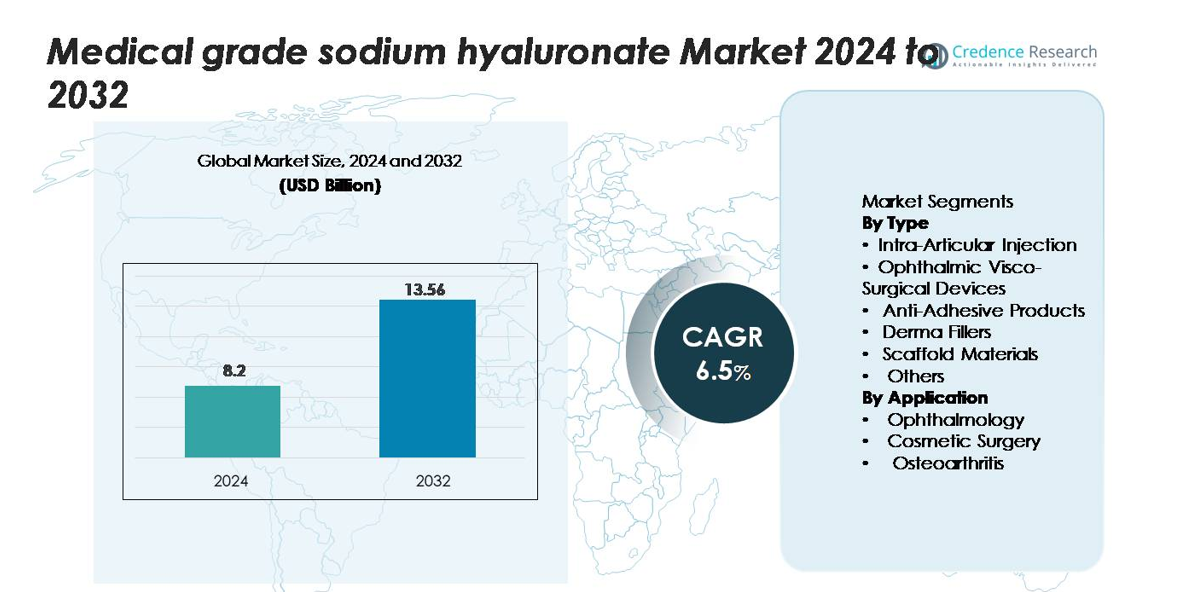
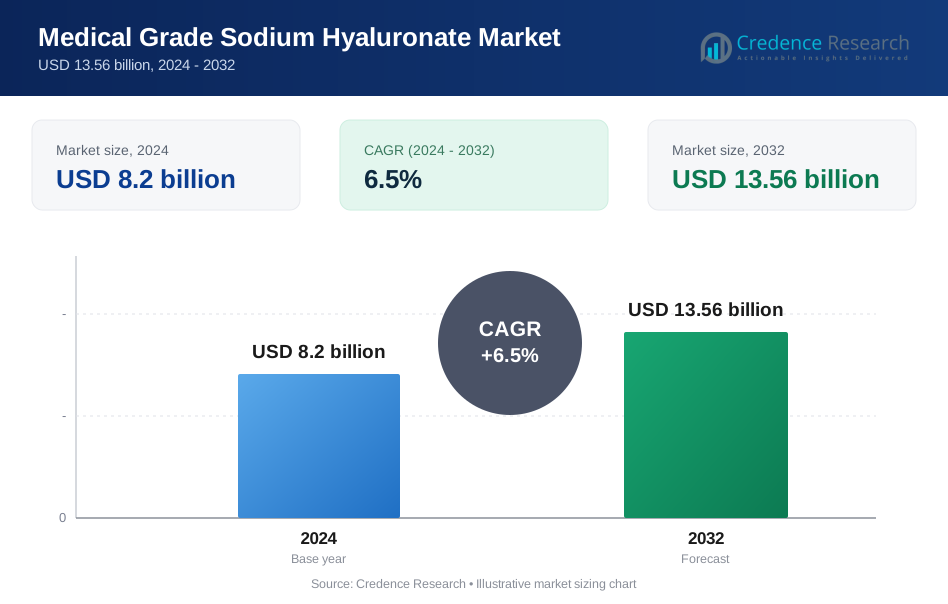
The Medical Grade Sodium Hyaluronate market was valued at USD 8.2 billion in 2024 and is anticipated to reach USD 13.56 billion by 2032, growing at a CAGR of 6.5% during the forecast period.
| REPORT ATTRIBUTE | DETAILS |
|---|---|
| Historical Period | 2020-2023 |
| Base Year | 2024 |
| Forecast Period | 2025-2032 |
| Medical Grade Sodium Hyaluronate Market Size 2024 | USD 8.2 billion |
| Medical Grade Sodium Hyaluronate Market, CAGR | 6.5% |
| Medical Grade Sodium Hyaluronate Market Size 2032 | USD 13.56 billion |
The medical grade sodium hyaluronate market is led by established pharmaceutical and biotechnology companies that supply products for orthopedic, ophthalmic, and cosmetic use. Major players focus on high-purity formulations, long-lasting injectables, and strong clinical validation to maintain a competitive edge. Strategic partnerships with hospitals, aesthetic clinics, and surgical centers expand product reach, while ongoing R&D supports new applications in drug delivery, tissue repair, and anti-adhesion therapy. North America remains the leading region with nearly 38% market share, driven by high procedure volumes in osteoarthritis and cataract surgery. Asia Pacific follows as the fastest-growing region due to expanding cosmetic treatments and improving healthcare access.
Market Insights
- The medical grade sodium hyaluronate market reached USD 8.2 billion in 2024 and is projected to hit USD 13.56 billion by 2032, growing at a 6.5% CAGR during the forecast period.
- Demand rises due to increasing osteoarthritis cases, expanding cataract surgeries, and rapid uptake of minimally invasive cosmetic fillers, making intra-articular injections the dominant segment with the highest share.
- A key trend is the shift toward long-lasting, high-purity formulations for better therapeutic outcomes in orthopedic, ophthalmic, and aesthetic procedures, supported by growing clinical approvals and improved product durability.
- Competition strengthens with global manufacturers investing in R&D, cross-linked filler innovation, and expanded hospital partnerships, though high treatment costs and uneven reimbursement remain major restraints.
- North America leads with nearly 38% share, supported by high procedure volumes, while Asia Pacific is the fastest-growing, driven by cosmetic demand and expanding healthcare capacity; Europe maintains strong presence in ophthalmic and orthopedic applications.
Market Segmentation Analysis:
By Type
Intra-articular injection holds the largest market share within medical grade sodium hyaluronate. Orthopedic clinics use these injections to restore joint lubrication, reduce pain, and delay knee replacement surgery. Growing osteoarthritis cases among elderly and overweight populations increase treatment demand. Clinicians prefer high-purity hyaluronate for its longer residence time and biocompatibility, supporting repeat procedures. Ophthalmic visco-surgical devices also show strong growth, driven by rising cataract and refractive surgeries. Surgeons value sodium hyaluronate’s viscoelastic properties, which protect corneal tissue and maintain chamber depth during lens implantation. Derma fillers form another fast-growing segment due to increased adoption of non-surgical cosmetic procedures. Aesthetic clinics use cross-linked hyaluronate gels for wrinkle reduction, lip enhancement, and facial contouring. Product improvements offering longer effects and better hydration support wider consumer acceptance. Anti-adhesive products and scaffold materials find use in postoperative care and tissue engineering, supported by research in regenerative medicine. The others segment includes niche medical applications where biocompatibility and moisture retention are essential.
- For instance, Fidia Farmaceutici’s Hyalgan is supplied in 2.0 mL syringes containing 20 mg of sodium hyaluronate and is administered once weekly for three injections, with clinical data showing measurable improvement in knee flexion within 30 days of treatment.
By Application
Osteoarthritis dominates the application landscape with the highest market share. Sodium hyaluronate injections support joint cushioning and mobility in patients who seek non-surgical relief. Demand grows due to the rising geriatric population and increased sports-related joint injuries. Clinicians favor viscosupplementation as it offers reduced side effects compared to oral anti-inflammatory drugs. Ophthalmology remains another key application, supported by expanding access to eye surgeries and adoption of premium intraocular lenses. The compound’s protective and lubricating properties help reduce intraoperative complications.
Cosmetic surgery shows rapid growth as consumers increasingly choose minimally invasive aesthetic treatments. Hyaluronate fillers provide natural-looking results with short recovery time, encouraging use in dermatology and medical spas. Social media influence and rising disposable incomes boost facial aesthetics demand across age groups. Manufacturers focus on advanced gel structures that improve lift capacity and durability. The application of sodium hyaluronate in skin rejuvenation and anti-aging procedures supports strong future potential for this segment.
- For instance, Anika Therapeutics’ Monovisc delivers a single 4.0 mL intra-articular injection containing 88 mg of non-avian sodium hyaluronate, with documented clinical trials showing measurable improvement in WOMAC pain scores within 14 days.
Key Growth Drivers
Rising Prevalence of Osteoarthritis and Joint Disorders
The growing number of osteoarthritis patients stands as a major driver for medical grade sodium hyaluronate. Age-related cartilage degeneration, obesity, and increased sports-related injuries continue to push the demand for viscosupplementation. Physicians use sodium hyaluronate injections to restore joint lubrication, reduce friction, and improve mobility, making it a preferred non-surgical treatment for early- to mid-stage arthritis. Patients also favor these injections due to quick recovery time and fewer systemic side effects compared to oral pain medication. As healthcare systems focus on delaying knee replacement surgeries, demand for intra-articular injections continues to rise. Expanding geriatric populations in regions such as North America, Europe, and Asia further strengthen the market outlook. The development of longer-lasting and high-viscosity formulations enhances clinical effectiveness, encouraging repeat procedures and wider adoption in orthopedic centers.
- For instance, Anika Therapeutics’ Orthovisc delivers a 2.0 mL injection containing 30 mg of ultra-pure, high-molecular-weight sodium hyaluronate, with clinical studies reporting measurable improvement in knee pain within 28 days of administration.
Growing Use in Ophthalmic Surgeries and Advanced Eye Care
Sodium hyaluronate plays a crucial role in cataract, glaucoma, and refractive surgeries, where surgeons rely on its viscoelastic properties to protect delicate ocular tissues. Rising cases of age-related vision loss and increased access to advanced ophthalmic procedures contribute to market expansion. The growing number of ambulatory surgical centers and adoption of premium intraocular lenses also create strong demand for viscoelastic agents. Developing nations are investing in eye care infrastructure, improving availability of cataract treatments for rural and low-income populations. Surgeons prefer high-purity, medical grade hyaluronate due to better patient outcomes, reduced intraoperative trauma, and faster healing. Ongoing product innovations involving better clarity and improved rheological properties continue to support market penetration across private hospitals and specialty clinics.
- For instance, Bausch & Lomb's Amvisc Plus provides a 0.8 mL dose at a concentration of 16 mg/mL (1.6%) sodium hyaluronate with a molecular weight of approximately 1.6 million Da, helping maintain a stable anterior chamber during phacoemulsification and reducing endothelial cell loss.
Growing Demand for Non-Surgical Cosmetic Enhancements
The increasing popularity of minimally invasive cosmetic procedures boosts the use of hyaluronate-based dermal fillers. Consumers seek natural anti-aging solutions for wrinkle reduction, skin hydration, and facial contouring. These fillers offer quick results, reversible effects, and short recovery periods, leading to strong acceptance among younger and aging populations. Social media influence and rising disposable incomes further drive aesthetic procedures across developed and emerging markets. Dermatology clinics prefer advanced cross-linked gel fillers that provide increased lift capacity and improved durability. Manufacturers continue to introduce differentiated filler grades targeted for lips, cheeks, and under-eye correction, helping expand product portfolios. As more men enter the cosmetic aesthetics segment and preventive skincare trends rise, dermal filler demand remains strong, supporting long-term market growth.
Key Trends & Opportunities
Shift Toward Biocompatible and Long-Lasting Formulations
A key trend shaping the market is the shift toward more durable and cross-linked sodium hyaluronate formulations, offering extended therapeutic benefits. In osteoarthritis, injectable products with longer residence time are gaining traction, reducing the frequency of treatments and improving patient satisfaction. In cosmetic applications, hybrid fillers combine hyaluronate with bioactive ingredients to promote collagen regeneration and enhanced hydration. The rise of regenerative medicine creates opportunities for sodium hyaluronate in tissue repair, scaffold development, and wound healing applications. Manufacturers also invest in high-purity biotechnology-based production to ensure safety, consistency, and enhanced clinical outcomes.
- For instance, Allergan’s Juvéderm Volift uses Vycross technology with a 17.5 mg/mL hyaluronic acid concentration and demonstrated measurable wrinkle improvement lasting up to 420 days in multicenter patient trials.
Widening Applications in Post-Surgical Care and Drug Delivery
Medical grade sodium hyaluronate sees expanding use in anti-adhesive products for postoperative healing, where it creates a barrier between tissues to prevent adhesion formation. Hospitals adopt these solutions in abdominal, gynecological, and orthopedic surgeries to reduce complications and recovery time. In parallel, research into drug delivery systems positions hyaluronate as a carrier for targeted therapies, especially in ophthalmology and oncology. Hydrogels incorporating hyaluronate can support sustained release of active molecules, improving treatment precision. These expanding applications open new commercial opportunities beyond traditional viscosupplementation and fillers.
- For instance, Ferring Pharmaceuticals’ DURASEAL Xact sealant delivers 2.0 mL of hydrogel composed of polyethylene glycol and sodium hyaluronate, forming a protective layer that polymerizes within 30 seconds to minimize postoperative tissue binding.
Key Challenges
High Treatment Costs and Limited Patient Affordability
Premium sodium hyaluronate products and injectable therapies carry high costs, limiting accessibility for low-income populations. In several countries, lack of reimbursement coverage makes viscosupplementation and dermal filler treatments cost-prohibitive. Cosmetic applications remain largely out-of-pocket expenses, restricting adoption among price-sensitive consumers. In developing regions, limited awareness and inadequate healthcare infrastructure further slow market penetration. Manufacturers face pressure to balance innovation with cost-efficient production to remain competitive.
Regulatory Approval Barriers and Product Safety Concerns
Medical grade sodium hyaluronate products must comply with strict regulatory standards, making approval timelines long and costly. Variations in regulatory requirements across the U.S., Europe, and Asia complicate global product launches. Safety concerns arise from improper handling, low-quality fillers, or unauthorized aesthetic procedures, which can lead to adverse effects and damage market trust. To maintain credibility, manufacturers must ensure strong clinical evidence, quality control, and physician training. These regulatory complexities and safety risks remain critical challenges for market participants.
Regional Analysis
North America
North America leads the medical grade sodium hyaluronate market with the largest share, driven by high adoption of viscosupplementation and advanced ophthalmic procedures. Strong presence of specialty hospitals, favorable reimbursement for osteoarthritis treatment, and rising demand for dermal fillers support regional dominance. The United States records the highest consumption due to its aging population and high awareness of minimally invasive therapies. Extensive use of premium viscoelastic agents in cataract surgeries also contributes to growth. Strategic product launches and FDA-approved formulations help manufacturers strengthen their position, keeping North America ahead of other regions in market share and revenue.
Europe
Europe holds a significant market share with strong demand for ophthalmic visco-surgical devices and intra-articular injections. Countries such as Germany, France, Italy, and the UK have well-established healthcare systems supporting access to advanced orthopedic and ophthalmic care. Increasing uptake of dermal fillers in medical spas and dermatology clinics further accelerates demand. The region benefits from widespread awareness of anti-aging treatments and growing preference for non-surgical options. Manufacturers focus on regulatory-compliant, high-purity formulations, improving market credibility. Rising geriatric population and joint degeneration cases ensure sustained consumption, keeping Europe among the leading revenue contributors.
Asia Pacific
Asia Pacific shows the fastest growth and continues gaining market share due to expanding healthcare infrastructure, rising cosmetic procedure volumes, and increasing cataract surgeries. China, Japan, South Korea, and India lead adoption, supported by large elderly populations and growing affordability of medical treatments. The region sees strong demand for sodium hyaluronate fillers as beauty awareness and preventive skincare increase. Hospitals and ophthalmic centers adopt viscoelastic agents for cataract surgery at a rapid pace. Domestic manufacturers also expand production capacity, making products more accessible. Government health programs and private investments drive further market penetration.
Latin America
Latin America holds a moderate market share, supported by rising adoption of dermal fillers and orthopedic treatments. Brazil and Mexico lead demand due to growing medical tourism, cosmetic surgery popularity, and improved access to private healthcare. Clinics increasingly use hyaluronate-based fillers for facial aesthetics, driven by social media influence and beauty trends. Ophthalmic product usage grows as cataract procedures rise among aging populations. However, limited reimbursement and uneven healthcare development restrict broader adoption. Growing awareness of minimally invasive therapies and entry of global brands create opportunities for future expansion.
Middle East & Africa
The Middle East & Africa account for a smaller share of the medical grade sodium hyaluronate market but show steady growth. The Gulf region experiences rising demand for aesthetic procedures and premium ophthalmic care due to high medical tourism and expanding private hospitals. Sodium hyaluronate injections gain traction in orthopedic clinics treating joint pain and mobility issues. In Africa, limited healthcare access and affordability challenges slow adoption, but urban hospitals increasingly perform cataract and cosmetic procedures. Increasing investment in specialized medical centers and entry of international manufacturers improve long-term growth prospects.
Market Segmentations:
By Type
- Intra-Articular Injection
- Ophthalmic Visco-Surgical Devices
- Anti-Adhesive Products
- Derma Fillers
- Scaffold Materials
- Others
By Application
- Ophthalmology
- Cosmetic Surgery
- Osteoarthritis
By Geography
- North America
- U.S.
- Canada
- Mexico
- Europe
- Germany
- France
- U.K.
- Italy
- Spain
- Rest of Europe
- Asia Pacific
- China
- Japan
- India
- South Korea
- South-east Asia
- Rest of Asia Pacific
- Latin America
- Brazil
- Argentina
- Rest of Latin America
- Middle East & Africa
- GCC Countries
- South Africa
- Rest of the Middle East and Africa
Competitive Landscape
The competitive landscape of the medical grade sodium hyaluronate market features a mix of global pharmaceutical companies, biotechnology firms, and specialty manufacturers focused on orthopedic, ophthalmic, and aesthetic applications. Leading players compete through high-purity formulations, advanced cross-linking technologies, and longer-lasting injectable products. Many companies invest in clinical trials to expand regulatory approvals for viscosupplementation, cataract surgery support, and dermal fillers. Strategic partnerships with hospitals, dermatology clinics, and ambulatory surgical centers improve product reach. Expansion into emerging markets strengthens distribution networks and lowers treatment costs. Manufacturers also focus on biocompatible production methods and improved viscoelastic properties to enhance safety and patient outcomes. Continuous product innovation, growing application areas such as wound care and anti-adhesion agents, and rising investments in R&D ensure a competitive and evolving market environment.
Key Player Analysis
- Zimmer Biomet Holdings, Inc.
- LG Chem Ltd.
- Ferring Pharmaceuticals
- Galderma S.A.
- Seikagaku Corporation
- Bausch Health Companies Inc.
- Fidia Farmaceutici S.p.A.
- Bohus BioTech AB
- Anika Therapeutics, Inc.
- Allergan (AbbVie Inc.)
Recent Developments
- In January 2025, Galderma S.A. presented new real-world data on its injectable aesthetic portfolio (including hyaluronic acid fillers) at the IMCAS 2025 Congress, reinforcing its leadership in HA-based aesthetics.
- In July 2024, LG Chem Ltd. announced the launch of its single-injection cross-linked hyaluronic acid product “Synovian” (exported as “Hyruan ONE”) in China via partner Yifan Pharmaceutical
Report Coverage
The research report offers an in-depth analysis based on Type, Application and Geography. It details leading market players, providing an overview of their business, product offerings, investments, revenue streams, and key applications. Additionally, the report includes insights into the competitive environment, SWOT analysis, current market trends, as well as the primary drivers and constraints. Furthermore, it discusses various factors that have driven market expansion in recent years. The report also explores market dynamics, regulatory scenarios, and technological advancements that are shaping the industry. It assesses the impact of external factors and global economic changes on market growth. Lastly, it provides strategic recommendations for new entrants and established companies to navigate the complexities of the market.
Future Outlook
- Demand for intra-articular injections will rise as osteoarthritis cases increase worldwide.
- Ophthalmic visco-surgical use will grow with more cataract and refractive surgeries.
- Dermal fillers will gain wider adoption due to rising interest in minimally invasive aesthetics.
- Product innovation will focus on long-lasting, high-viscosity and cross-linked formulations.
- Expanding applications in wound healing and anti-adhesion therapy will create new opportunities.
- Drug delivery systems using hyaluronate-based hydrogels will gain research and commercial attention.
- Manufacturers will strengthen global distribution through hospital and clinic partnerships.
- Growing medical tourism will boost adoption in Latin America, the Middle East, and Asia.
- Regulatory approvals for advanced formulations will support clinical trust and safety.
- Increased production capacity in emerging markets will improve affordability and access.
Request a Free Sample
Fill in your details and we'll send you a free sample report.
- Sample data tables & charts
- Research methodology
Need a Custom Version of This Report?
Tailor the scope, geography, or segments to your exact requirements.
- Custom geography or segment scope
- Direct access to our analyst team
Frequently Asked Questions
What is the current market size for the Medical Grade Sodium Hyaluronate market, and what is its projected size in 2032?
At what Compound Annual Growth Rate is the Medical Grade Sodium Hyaluronate market projected to grow between 2025 and 2032?
Which Medical Grade Sodium Hyaluronate segment held the largest share in 2024?
What are the primary factors fueling the growth of the Medical Grade Sodium Hyaluronate market?
Who are the leading companies in the Medical Grade Sodium Hyaluronate market?
Table of Content
Chapter 1. Report Introduction
- 1.1 Report Description & Purpose
- 1.1.1 Report Title & Market Definition
- 1.1.2 Unique Selling Propositions (USP) & Key Differentiators
- 1.1.3 Value Proposition for Stakeholders
- 1.2 Research Objectives
- 1.2.1 Market Sizing Objectives (Volume & Revenue)
- 1.2.2 Segmentation Objectives
- 1.2.3 Competitive Intelligence Objectives
- 1.2.4 Forecast & Scenario Objectives
- 1.3 Report Scope
- 1.3.1 Medical Grade Sodium Hyaluronate Scope – Types & Subtypes Covered
- 1.3.2 Geographic Scope – Regions & Countries Covered
- 1.3.3 Historical Period, Base Year & Forecast Period (2024; forecast to 2032)
- 1.3.4 Inclusions & Exclusions
- 1.4 HS Code & Classification Framework
- 1.5 Currency, Units & Pricing Basis
- 1.6 Target Stakeholders
- 1.7 Limitations & Assumptions
Chapter 2. Executive Summary
- 2.1 Global Medical Grade Sodium Hyaluronate Market Snapshot
- 2.1.1 Market Size – Historical (2024) & Forecast (2024-2032) (2024: USD 8.2 billion → 2032: USD 13.56 billion)
- 2.1.2 Volume & Revenue – Global Totals
- 2.1.3 Key Market Highlights – Top Five Facts
- 2.2 Medical Grade Sodium Hyaluronate Market Segmentation Snapshot
- 2.2.1 Market Split by Region – 2024 vs. 2032
- 2.3 Competitive Snapshot
- 2.3.1 Top 10 Players by Revenue Share – 2024
- 2.3.2 Top 10 Players by Volume Share – 2024
- 2.3.3 Recent Strategic Developments (18-Month Summary)
- 2.4 Key Investment Highlights & Strategic Conclusions
Chapter 3. Medical Grade Sodium Hyaluronate Market Dynamics & Industry Analysis
- 3.1 Market Overview & Context
- 3.1.1 Medical Grade Sodium Hyaluronate Market Position in the Broader Automotive Value Chain
- 3.1.2 OEM vs. Replacement Market Dynamics
- 3.1.3 Market Maturity & Development Stage by Region
- 3.2 Medical Grade Sodium Hyaluronate Market Drivers
- 3.3 Medical Grade Sodium Hyaluronate Market Restraints & Challenges
- 3.4 Medical Grade Sodium Hyaluronate Market Opportunities
- 3.5 Porter's Five Forces Analysis
- 3.5.1 Threat of New Entrants
- 3.5.2 Bargaining Power of Suppliers
- 3.5.3 Bargaining Power of Buyers
- 3.5.4 Threat of Substitutes
- 3.5.5 Competitive Rivalry – Intensity Assessment
- 3.6 Medical Grade Sodium Hyaluronate Value Chain Analysis
- 3.6.1 Upstream – Raw Material/Input Suppliers
- 3.6.1.1 Raw Material/Input 1
- 3.6.1.2 Raw Material/Input 2
- 3.6.1.3 Raw Material/Input 3
- 3.6.2 Midstream – Production/Manufacturing/Service Delivery
- 3.6.2.1 Production/Process Overview
- 3.6.2.2 Key Facility Locations & Capacity by Manufacturer
- 3.6.3 Downstream – Distribution & End Consumer
- 3.6.3.1 Primary Channel – B2B/OEM
- 3.6.3.2 Secondary Channels – Dealer, Retail, Online, Direct
- 3.6.4 Value Chain Profitability Analysis
- 3.6.1 Upstream – Raw Material/Input Suppliers
- 3.7 PESTEL Analysis
- 3.7.1 Political Factors
- 3.7.2 Economic Factors
- 3.7.3 Social Factors
- 3.7.4 Technological Factors
- 3.7.5 Environmental Factors
- 3.7.6 Legal Factors
- 3.8 Medical Grade Sodium Hyaluronate Supply Chain Analysis
- 3.8.1 Raw Material/Input Supply Risk Assessment
- 3.8.2 Manufacturing Concentration Risk (Geographic Exposure)
- 3.8.3 Trade Disruption Impact Analysis
- 3.9 Regulatory & Policy Landscape
Note: The regulatory and policy landscape section covers regulations based on their applicability to the market, Medical Grade Sodium Hyaluronate category, geography, and scope of the study. Only regulatory frameworks with a material impact on operations, compliance, trade, sustainability, or market access are analyzed in detail.
Chapter 4. Key Investment Pockets & Opportunity Analysis
- 4.1 Medical Grade Sodium Hyaluronate Market Attractiveness Analysis
- 4.1.1 By Region – Investment Attractiveness Matrix (Volume × CAGR)
- 4.2 Absolute Revenue Growth Opportunity
- 4.2.1 By Region – Absolute USD Growth Through 2032
- 4.3 Incremental Volume Opportunity
- 4.3.1 By Region – Incremental Volume Through 2032
- 4.3.2 Segment – Incremental Volume
- 4.4 Emerging Submarket Opportunity Deep Dive (Subject to Applicability)
- 4.5 Emerging Market Opportunity Scorecards
- 4.5.1 United States
- 4.5.2 Europe
- 4.5.3 Asia
- 4.5.4 Middle East & Africa
Note: Emerging Market Opportunity Scorecards will be included based on relevance and strategic importance. Regions listed are indicative and may vary depending on data availability and market dynamics.
Chapter 5. Medical Grade Sodium Hyaluronate Import-Export Analysis & Trade Flows
- 5.1 Global Trade Overview
- 5.1.1 Global Export Value by Country (2024)
- 5.1.2 Global Export Volume by Country (2024)
- 5.1.3 Global Import Value by Country (2024)
- 5.1.4 Global Import Volume by Country (2024)
- 5.1.5 Net Trade Balance by Country (2024)
- 5.2 Export Analysis – Segment
- 5.2.1 Type 1 (HS Code)
- 5.2.2 Type 2 (HS Code)
- 5.2.3 Type 3 (HS Code)
- 5.2.4 Type 4 (HS Code)
- 5.2.5 Type 5 (HS Code)
- 5.3 Import Analysis – Segment
- 5.3.1 Type 1 (HS Code)
- 5.3.2 Type 2 (HS Code)
- 5.3.3 Type 3 (HS Code)
- 5.3.4 Type 4 (HS Code)
- 5.3.5 Type 5 (HS Code)
- 5.4 Average Unit Trade Prices
- 5.4.1 Average Export Price – Segment & Country
- 5.4.2 Average Import Price – Segment & Source Country
- 5.4.3 Price Trends (2024)
- 5.5 Key Trade Route Analysis
- 5.5.1 Trade Route 1
- 5.5.2 Trade Route 2
- 5.5.3 Trade Route 3
- 5.5.4 Trade Route 4
- 5.5.5 Trade Route 5
- 5.6 Trade Policy Impact Assessment
- 5.6.1 US Anti-Dumping & Section 301 Tariffs
- 5.6.2 EU Customs Union Impact
- 5.6.3 Major Free Trade Agreements
- 5.6.4 USMCA Rules of Origin
Note: Trade policy analysis will be included only where relevant to the Medical Grade Sodium Hyaluronate market.
Chapter 6. Competitive Landscape & Company Benchmarking
- 6.1 Medical Grade Sodium Hyaluronate Market Concentration & Structure
- 6.1.1 Herfindahl-Hirschman Index (HHI) – vs. 2024
- 6.1.2 Tier 1, Tier 2 & Tier 3 Market Structure
- 6.1.3 Global, Regional & Local Player Dynamics
- 6.2 Medical Grade Sodium Hyaluronate Market Share Analysis – 2024
- 6.2.1 Global Revenue Share by Company
- 6.2.2 Global Volume Share by Company
- 6.2.3 Regional Revenue Share
- 6.2.4 Market Share Evolution ( vs. 2024)
- 6.2.5 OEM Segment Share by Company
- 6.2.6 Replacement Segment Share by Company
- 6.3 Production/Delivery Capacity & Facility Analysis
- 6.3.1 Global Installed Capacity
- 6.3.2 Capacity Utilization Rates
- 6.3.3 Production/Output Volume
- 6.3.4 Facility Locations & Capacity Map
- 6.3.5 Planned Capacity Additions
- 6.4 Medical Grade Sodium Hyaluronate Competitive Benchmarking Matrix
- 6.4.1 Revenue, Volume, CAGR & Profitability Comparison
- 6.4.2 Channel Revenue Mix
- 6.4.3 Geographic Revenue Exposure
- 6.4.4 R&D Intensity
- 6.4.5 Sustainability Maturity
- 6.5 Strategic Developments in Medical Grade Sodium Hyaluronate (Last 24 Months)
- 6.5.1 Mergers, Acquisitions & Divestments
- 6.5.2 New Medical Grade Sodium Hyaluronate Launches
- 6.5.3 Facility Expansions
- 6.5.4 Strategic Alliances, Joint Ventures & Partnerships
- 6.5.5 Distribution Expansion & Market Entry
- 6.5.6 Sustainability & ESG Initiatives
- 6.6 Competitive Strategy Mapping
- 6.6.1 Leader, Challenger, Follower & Niche Classification
- 6.6.2 Pricing Strategy Comparison
- 6.6.3 Channel Strategy Matrix
Note: Strategic developments are included based on their materiality and the availability of reliable information.
Chapter 7. Global Medical Grade Sodium Hyaluronate Market – By Distribution Channel
- 7.1 Segment Overview
- 7.1.1 Volume & Revenue Split by Channel (2024 & 2032)
- 7.1.2 Channel Mix Evolution (2024-2032)
Chapter 8. Regional Market Analysis – Global Overview
- 8.1 Global Regional Overview
- 8.1.1 Regional Volume Share
- 8.1.2 Regional Revenue Share
- 8.1.3 Regional Volume by Region
- 8.1.4 Regional Revenue by Region
- 8.1.5 Regional Forecast Through 2032
- 8.2 Cross-Regional Segment Analysis
- 8.2.1 By Distribution Channel
- 8.2.2 By Brand/Price Tier
Chapter 9. North America Medical Grade Sodium Hyaluronate Market
- 9.1 United States
- 9.2 Canada
- 9.3 Mexico
Chapter 10. Europe Medical Grade Sodium Hyaluronate Market
- 10.1 Germany
- 10.2 France
- 10.3 Italy
- 10.4 United Kingdom
- 10.5 Spain
- 10.6 Poland
- 10.7 Russia
- 10.8 Netherlands
- 10.9 Belgium
- 10.10 Sweden
- 10.11 Denmark
- 10.12 Norway
- 10.13 Rest of Europe
Chapter 11. Asia Pacific Medical Grade Sodium Hyaluronate Market
- 11.1 China
- 11.2 India
- 11.3 Japan
- 11.4 South Korea
- 11.5 Thailand
- 11.6 Indonesia
- 11.7 Vietnam
- 11.8 Malaysia
- 11.9 Australia
- 11.10 Rest of Asia Pacific
Chapter 12. Latin America Medical Grade Sodium Hyaluronate Market
- 12.1 Brazil
- 12.2 Argentina
- 12.3 Colombia
- 12.4 Chile
- 12.5 Rest of Latin America
Chapter 13. Middle East Medical Grade Sodium Hyaluronate Market
- 13.1 Saudi Arabia
- 13.2 United Arab Emirates
- 13.3 Turkey
- 13.4 Israel
- 13.5 Iran
- 13.6 Rest of the Middle East
Chapter 14. Africa Medical Grade Sodium Hyaluronate Market
- 14.1 South Africa
- 14.2 Egypt
- 14.3 Nigeria
- 14.4 Morocco
- 14.5 Rest of Africa
Chapter 15. Medical Grade Sodium Hyaluronate Company Profiles
- 15.1 [Company 01]
- 15.1.1 Company Overview
- 15.1.2 Key Management Personnel
- 15.1.3 Products & Services Portfolio
- 15.1.4 Financial Performance
- 15.1.5 Key Market Focus & Geographic Presence
- 15.1.6 Recent Developments & Strategic Initiatives
Note: The company profile list is preliminary and may change based on research findings, market developments, data availability, and client requirements.
Chapter 16. Appendices
- Appendix A – List of Abbreviations & Acronyms
- Appendix B – Industry Classification Code Reference – Full Series
- Appendix C – Production & Capacity Data Tables
- Appendix D – End-Use & Demand Base Tables
- Appendix E – Consumption & Replacement Rate Assumptions
- Appendix F – ASP Reference Tables
- Appendix G – Manufacturing & Facility Database
- Appendix H – Import-Export Data Tables
- Appendix I – Regulatory Summary Tables
- Appendix J – Primary Research Participant List (Anonymized)
- Appendix K – Primary Research Questionnaire Framework
- Appendix L – Data Sources & Bibliography
- Appendix M – Market Size Divergence & Source Comparison
Chapter 17. Research Methodology
- 17.1 Research Framework & Philosophy
- 17.2 Secondary Research – Sources, Hierarchy & Data Extraction
- 17.3 Data Modeling – Bottom-Up & Top-Down Market Sizing
- 17.4 Primary Research – Stakeholder Framework, LOI & Sample Sizes
- 17.5 Forecast Methodology – Regression, Scenario & Sensitivity Analysis
- 17.6 Quality Control – Four-Layer Validation Framework
- 17.7 Limitations & Standard Assumptions
- 17.8 Disclaimer
