
Microbial Fuel Technology Market Overview:
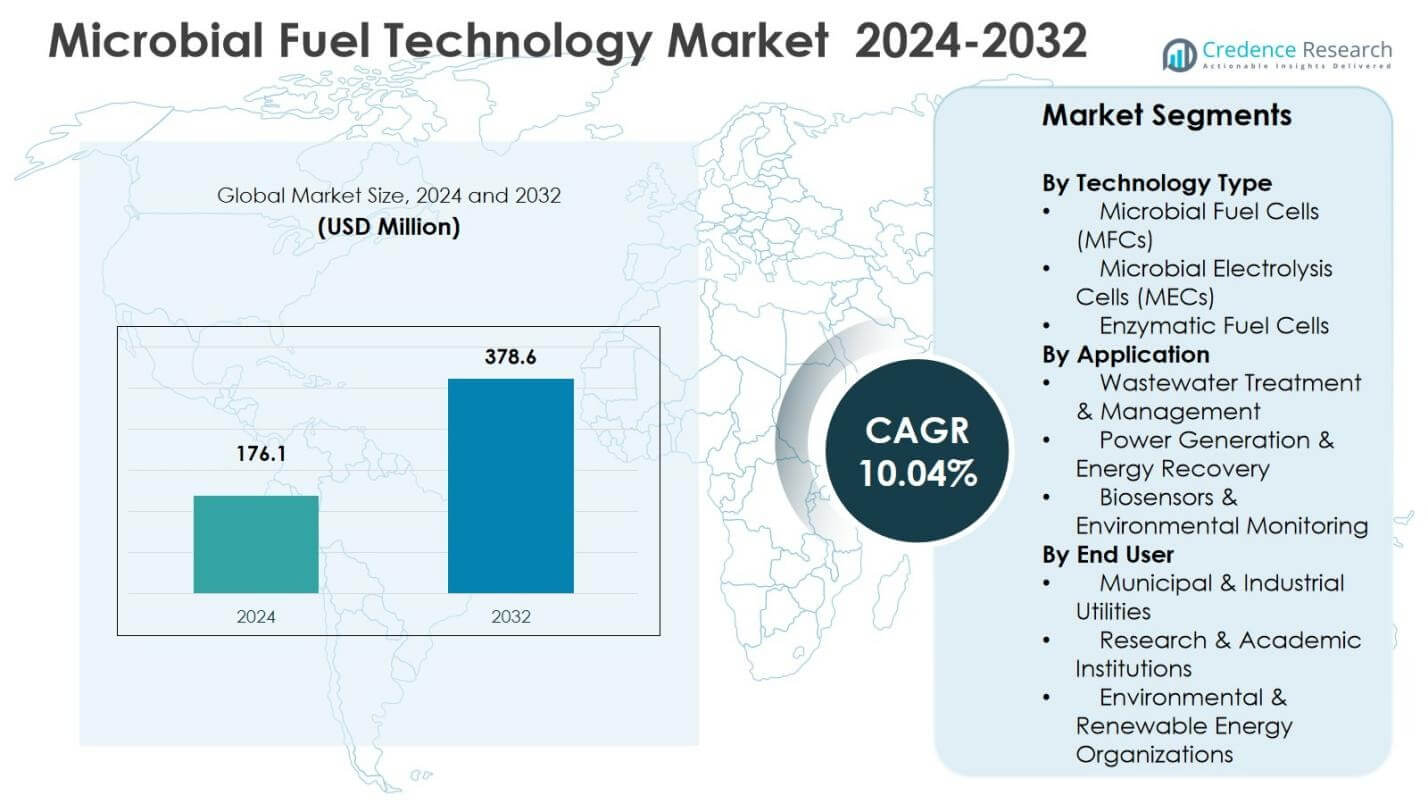
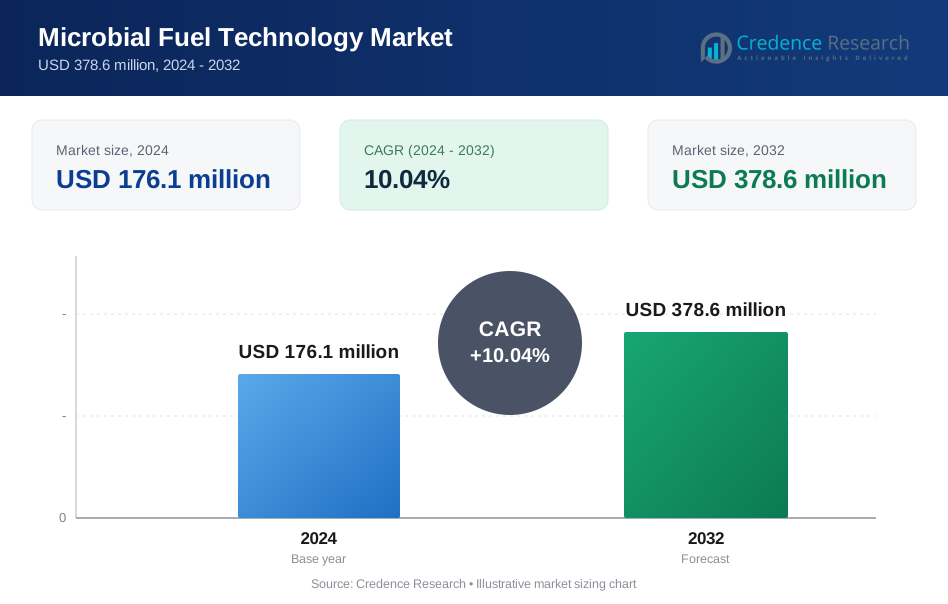
Microbial Fuel Technology Market size was valued at USD 176.1 million in 2024 and is anticipated to reach USD 378.6 million by 2032, growing at a CAGR of 10.04% during the forecast period.
| REPORT ATTRIBUTE | DETAILS |
|---|---|
| Historical Period | 2020-2023 |
| Base Year | 2024 |
| Forecast Period | 2025-2032 |
| Microbial Fuel Technology Market Size 2024 | USD 176.1 million |
| Microbial Fuel Technology Market, CAGR | 10.04% |
| Microbial Fuel Technology Market Size 2032 | USD 378.6 million |
Microbial Fuel Technology MarketInsights
- Market growth is driven by rising demand for energy-efficient wastewater treatment, stricter environmental regulations, and increasing adoption of circular economy practices that convert organic waste into usable energy.
- Technological progress in bioelectrochemical systems, electrode materials, and microbial optimization supports wider deployment, with Microbial Fuel Cells (MFCs) holding 52.6% segment share in 2024 due to higher maturity and operational simplicity.
- Market structure remains moderately fragmented, with players focusing on pilot-scale deployments, modular designs, and partnerships with utilities to improve scalability, efficiency, and long-term operational stability.
- North America led with 34.7% regional share in 2024, followed by Europe at 28.9% and Asia Pacific at 24.1%, while adoption in Latin America and the Middle East & Africa is supported by infrastructure development and sustainability initiatives.
Microbial Fuel Technology Market Segmentation Analysis:
By Technology Type:
The Microbial Fuel Technology Market by technology type is led by Microbial Fuel Cells (MFCs), which accounted for 52.6% market share in 2024, driven by their relatively mature development stage, direct electricity generation capability, and strong applicability in wastewater treatment systems. MFCs benefit from lower operational complexity and growing pilot-to-commercial deployments. Microbial Electrolysis Cells (MECs) follow due to rising interest in hydrogen recovery, while Enzymatic Fuel Cells hold a smaller share because of high enzyme costs and limited durability. Continuous advancements in electrode materials and biofilm optimization remain key growth drivers.
- For instance, Aquacycl's modular BioElectrochemical Treatment (BETT) system, with each reactor sized like a car battery, treats high-strength industrial wastewater such as from food processing, achieving up to 90% COD removal in pilots while reducing operational costs by 20-60% compared to traditional methods.
By Application:
By application, Wastewater Treatment & Management dominated the Microbial Fuel Technology Market with a 47.9% share in 2024, supported by the dual benefit of organic waste removal and energy recovery. Increasing regulatory pressure on industrial effluent discharge and the need for energy-efficient treatment technologies significantly drive adoption. Power Generation & Energy Recovery is expanding steadily due to integration with industrial waste streams, while Biosensors & Environmental Monitoring maintain a niche share, supported by growing demand for real-time water quality monitoring and environmental diagnostics in research and field applications.
- For instance, two 4 L tubular microbial fuel cells installed in a municipal wastewater facility achieved 65-70% chemical oxygen demand removal at an 11-hour hydraulic retention time over 400 days, supporting energy recovery from primary effluents.
By End User:
In terms of end users, Municipal & Industrial Utilities held the largest share of 44.3% in 2024, driven by large-scale wastewater infrastructure, high organic waste availability, and government support for sustainable treatment technologies. Utilities increasingly adopt microbial fuel systems to offset energy costs and reduce carbon emissions. Research & Academic Institutions represent a significant share due to ongoing pilot studies and technology development, while Environmental & Renewable Energy Organizations contribute steadily, supported by initiatives focused on circular economy models and decentralized clean energy solutions.
Key Growth Drivers
Rising Demand for Energy-Efficient Wastewater Treatment
The Microbial Fuel Technology Market is strongly driven by the growing demand for energy-efficient and sustainable wastewater treatment solutions. Increasing industrialization and urban population growth are generating high volumes of organic wastewater, compelling municipalities and industries to adopt advanced treatment technologies. Microbial fuel systems enable simultaneous wastewater treatment and electricity generation, reducing operational energy costs and sludge disposal expenses. Stricter environmental regulations on effluent discharge and carbon emissions further accelerate adoption, particularly in industrial utilities seeking compliance with sustainability mandates while improving process efficiency and energy recovery.
- For instance, Aquacycl deployed a large-scale microbial fuel cell (MFC) system comprising 12 MFCs with a total volume of 110 L at a small educational farm treating swine wastewater continuously for over 200 days.
Advancements in Bio electrochemical System Design
Continuous technological advancements in bio electrochemical systems significantly support market growth. Improvements in electrode materials, membrane efficiency, and microbial strain optimization have enhanced power density, system stability, and scalability of microbial fuel technologies. Research institutions and technology developers are focusing on cost-effective catalysts and high-performance anode materials to improve commercial viability. These innovations reduce performance limitations that previously restricted deployment to laboratory settings, enabling broader adoption in pilot-scale and commercial wastewater treatment, power generation, and environmental monitoring applications.
- For instance, Bacillus piscis OK324045 optimized in waste molasses-based dual-chamber microbial fuel cells produced a maximum power density of 31.98 mW m⁻² alongside 90.91% COD removal.
Increasing Focus on Renewable and Circular Energy Models
The global shift toward renewable energy and circular economy frameworks is a major driver for the Microbial Fuel Technology Market. Governments and environmental organizations increasingly promote technologies that recover value from waste streams while minimizing environmental impact. Microbial fuel systems align with circular energy objectives by converting organic waste into usable electricity or hydrogen. Public funding, sustainability grants, and clean-energy incentives encourage utilities and research bodies to deploy microbial fuel technologies as part of integrated waste-to-energy strategies, supporting long-term market expansion.
Key Trends & Opportunities
Integration with Smart and Decentralized Treatment Systems
A key trend in the Microbial Fuel Technology Market is the integration of microbial fuel systems with smart, decentralized wastewater treatment and energy recovery infrastructures. Decentralized systems reduce dependence on centralized grids and enable localized power generation in remote or infrastructure-limited regions. Digital monitoring tools, automation, and sensor integration enhance operational efficiency and real-time performance tracking. This trend creates strong opportunities for adoption in small municipalities, industrial clusters, and off-grid facilities seeking resilient, low-carbon wastewater treatment and energy solutions.
- For instance, Kurita Group advances microbial fuel cells using electricity-generating bacteria under anaerobic conditions to decompose organic matter in wastewater while generating electrical energy.
Expanding Research and Pilot-Scale Commercialization
Growing investment in research and pilot-scale commercialization represents a significant opportunity for market growth. Academic institutions, startups, and public-private partnerships are actively testing microbial fuel technologies across diverse applications, including industrial effluents, agricultural waste, and biosensing platforms. Successful pilot projects are accelerating the transition toward commercial deployment by demonstrating economic and environmental benefits. Increasing collaboration between technology developers and utilities is expected to improve system scalability, reduce costs, and open new revenue streams in waste-to-energy and environmental monitoring markets.
- For instance, A 110 L microbial fuel cell array at San Pasqual High School treated swine wastewater continuously for over 200 days, removing up to 65% COD at 5.0 kg COD/m³·day. With a 4-hour hydraulic residence time, it sustained operations via net energy recovery of 0.11 kWh/kg COD removed.
Key Challenges
High Capital Costs and Limited Power Output
High initial capital investment and relatively low power output remain major challenges for the Microbial Fuel Technology Market. Advanced electrode materials, membranes, and system components increase upfront costs, limiting adoption among cost-sensitive utilities and industries. While suitable for energy recovery, microbial fuel systems currently generate lower power densities compared to conventional renewable technologies. This restricts their use primarily to supplementary energy generation rather than primary power supply, slowing large-scale commercial penetration despite strong environmental benefits.
Scalability and Long-Term Operational Stability
Scalability and long-term operational stability present significant barriers to widespread deployment. Performance degradation due to biofouling, electrode deterioration, and microbial community imbalance affects system efficiency over extended operation. Maintaining consistent output across large installations remains technically complex. Additionally, variations in wastewater composition can impact microbial activity and power generation efficiency. Addressing these challenges requires continued research, standardized system designs, and improved operational controls to ensure reliable, long-term performance in real-world industrial and municipal environments.
Regional Analysis
North America
North America held 34.7% market share in 2024 in the Microbial Fuel Technology Market, driven by strong research infrastructure, early adoption of advanced wastewater treatment technologies, and supportive government funding for clean energy innovation. The United States leads regional demand due to extensive pilot projects and commercialization efforts by utilities and research institutions. Strict environmental regulations related to wastewater discharge and carbon emissions encourage adoption of energy-recovering treatment systems. Continuous investment in bioelectrochemical research, coupled with collaboration between universities and technology developers, further strengthens North America’s position as a leading innovation hub.
Europe
Europe accounted for 28.9% market share in 2024, supported by stringent environmental regulations and a strong focus on circular economy and sustainability initiatives. Countries such as Germany, the United Kingdom, and the Netherlands actively promote waste-to-energy technologies to reduce landfill dependency and energy consumption in wastewater treatment plants. European utilities increasingly adopt microbial fuel technologies to align with decarbonization targets and renewable energy policies. Robust public funding, EU-backed research programs, and cross-border collaborations accelerate technology validation and deployment, reinforcing Europe’s role as a key adopter of microbial fuel systems.
Asia Pacific
Asia Pacific captured 24.1% market share in 2024, driven by rapid urbanization, industrial expansion, and rising wastewater generation across China, Japan, South Korea, and India. Growing pressure on municipal infrastructure and increasing environmental awareness support the adoption of energy-efficient treatment solutions. Governments in the region are investing in smart water management and renewable technologies to address energy security and pollution challenges. Strong academic research activity and pilot-scale deployments further contribute to market growth, positioning Asia Pacific as the fastest-expanding regional market for microbial fuel technologies.
Latin America
Latin America represented 7.2% market share in 2024, supported by increasing investment in wastewater infrastructure modernization and sustainable energy solutions. Countries such as Brazil, Mexico, and Chile are gradually adopting advanced treatment technologies to address industrial effluents and urban wastewater challenges. Limited grid access in remote areas creates opportunities for decentralized energy recovery systems using microbial fuel technology. While adoption remains at an early stage, growing regulatory enforcement and international funding for environmental projects are expected to strengthen regional uptake over the forecast period.
Middle East & Africa
The Middle East & Africa accounted for 5.1% market share in 2024, driven by water scarcity concerns and the need for energy-efficient wastewater treatment solutions. Governments in the Gulf Cooperation Council countries are investing in advanced water treatment and sustainable technologies to support long-term resource management. In Africa, pilot projects supported by international organizations focus on decentralized wastewater treatment and off-grid energy generation. Although market penetration remains limited, rising infrastructure investment and sustainability initiatives are gradually improving adoption prospects across the region.
Microbial Fuel Technology Market Segmentations:
By Technology Type
- Microbial Fuel Cells (MFCs)
- Microbial Electrolysis Cells (MECs)
- Enzymatic Fuel Cells
By Application
- Wastewater Treatment & Management
- Power Generation & Energy Recovery
- Biosensors & Environmental Monitoring
By End User
- Municipal & Industrial Utilities
- Research & Academic Institutions
- Environmental & Renewable Energy Organizations
By Geography
- North America
- U.S.
- Canada
- Mexico
- Europe
- Germany
- France
- U.K.
- Italy
- Spain
- Rest of Europe
- Asia Pacific
- China
- Japan
- India
- South Korea
- South-east Asia
- Rest of Asia Pacific
- Latin America
- Brazil
- Argentina
- Rest of Latin America
- Middle East & Africa
- GCC Countries
- South Africa
- Rest of the Middle East and Africa
Competitive Landscape
Competitive landscape analysis of the Microbial Fuel Technology Market highlights the presence of key players such as Cambrian Innovation, Aquacycl, Kurita Water Industries, Emefcy, and Sainergy Tech. The market remains moderately fragmented, with companies focusing on pilot-scale deployments, wastewater-to-energy integration, and performance optimization of bioelectrochemical systems. Leading players prioritize R&D investments to enhance power density, reduce material costs, and improve long-term system stability. Strategic collaborations with municipal utilities, industrial facilities, and research institutions are common to accelerate commercialization. Several companies emphasize modular and decentralized system designs to address site-specific wastewater challenges. Competitive differentiation increasingly depends on technological efficiency, scalability, and the ability to deliver dual benefits of wastewater treatment and energy recovery, positioning innovation as the primary driver of market competition.
Key Player Analysis
- Microrganic Technologies
- Sainergy Tech
- Cambrian Innovation
- JSP Enviro
- Emefcy
- Cascade Clean Energy
- Electro-Active Technologies
- Frontis Energy
- Kurita Water Industries
- Aquacycl
Recent Developments
- In October 2024, Researchers at Tokyo University of Agriculture and Technology partnered with Shikoku Electric Power for an experimental project using microbial fuel cells to generate sustainable energy for remote agricultural monitoring.
- In July 2024, an AgTech startup launched a prototype soil microbial fuel cell producing 0.2 watts per square meter to power IoT devices in smart farming systems.
Report Coverage
The research report offers an in-depth analysis based on Technology Type, Application, End User and Geography. It details leading market players, providing an overview of their business, product offerings, investments, revenue streams, and key applications. Additionally, the report includes insights into the competitive environment, SWOT analysis, current market trends, as well as the primary drivers and constraints. Furthermore, it discusses various factors that have driven market expansion in recent years. The report also explores market dynamics, regulatory scenarios, and technological advancements that are shaping the industry. It assesses the impact of external factors and global economic changes on market growth. Lastly, it provides strategic recommendations for new entrants and established companies to navigate the complexities of the market.
Future Outlook
- Adoption will increase across municipal and industrial wastewater treatment facilities to improve energy efficiency and sustainability.
- Technological advancements will enhance power density, operational stability, and system lifespan.
- Integration with decentralized and off-grid energy systems will expand application scope.
- Research-driven innovation will accelerate the transition from pilot projects to commercial-scale deployments.
- Collaboration between utilities, technology providers, and academic institutions will intensify.
- Supportive environmental regulations will strengthen market penetration globally.
- Use of advanced electrode materials will reduce performance limitations and maintenance requirements.
- Applications in biosensing and environmental monitoring will gain stronger commercial relevance.
- Emerging economies will experience faster adoption due to infrastructure development needs.
- Alignment with circular economy and waste-to-energy strategies will support long-term market growth.
Request a Free Sample
Fill in your details and we'll send you a free sample report.
- Sample data tables & charts
- Research methodology
Need a Custom Version of This Report?
Tailor the scope, geography, or segments to your exact requirements.
- Custom geography or segment scope
- Direct access to our analyst team
Frequently Asked Questions
What is the current market size for the Microbial Fuel Technology Market, and what is its projected size in 2032?
At what Compound Annual Growth Rate is the Microbial Fuel Technology Market projected to grow between 2024 and 2032?
Which Microbial Fuel Technology Market segment held the largest share in 2024?
What are the primary factors fueling the growth of the Microbial Fuel Technology Market?
Who are the leading companies in the Microbial Fuel Technology Market?
Which region commanded the largest share of the Microbial Fuel Technology Market in 2024?
Table of Content
Chapter 1. Report Introduction
- 1.1 Report Description & Purpose
- 1.1.1 Report Title & Market Definition
- 1.1.2 Unique Selling Propositions (USP) & Key Differentiators
- 1.1.3 Value Proposition for Stakeholders
- 1.2 Research Objectives
- 1.2.1 Market Sizing Objectives (Volume & Revenue)
- 1.2.2 Segmentation Objectives
- 1.2.3 Competitive Intelligence Objectives
- 1.2.4 Forecast & Scenario Objectives
- 1.3 Report Scope
- 1.3.1 Microbial Fuel Technology Scope – Types & Subtypes Covered
- 1.3.2 Geographic Scope – Regions & Countries Covered
- 1.3.3 Historical Period, Base Year & Forecast Period (2024; forecast to 2032)
- 1.3.4 Inclusions & Exclusions
- 1.4 HS Code & Classification Framework
- 1.5 Currency, Units & Pricing Basis
- 1.6 Target Stakeholders
- 1.7 Limitations & Assumptions
Chapter 2. Executive Summary
- 2.1 Global Microbial Fuel Technology Market Snapshot
- 2.1.1 Market Size – Historical (2024) & Forecast (2024-2032) (2024: USD 176.1 million → 2032: USD 378.6 million)
- 2.1.2 Volume & Revenue – Global Totals
- 2.1.3 Key Market Highlights – Top Five Facts
- 2.2 Microbial Fuel Technology Market Segmentation Snapshot
- 2.2.1 Market Split by Region – 2024 vs. 2032
- 2.3 Competitive Snapshot
- 2.3.1 Top 10 Players by Revenue Share – 2024
- 2.3.2 Top 10 Players by Volume Share – 2024
- 2.3.3 Recent Strategic Developments (18-Month Summary)
- 2.4 Key Investment Highlights & Strategic Conclusions
Chapter 3. Microbial Fuel Technology Market Dynamics & Industry Analysis
- 3.1 Market Overview & Context
- 3.1.1 Microbial Fuel Technology Market Position in the Broader Automotive Value Chain
- 3.1.2 OEM vs. Replacement Market Dynamics
- 3.1.3 Market Maturity & Development Stage by Region
- 3.2 Microbial Fuel Technology Market Drivers
- 3.3 Microbial Fuel Technology Market Restraints & Challenges
- 3.4 Microbial Fuel Technology Market Opportunities
- 3.5 Porter's Five Forces Analysis
- 3.5.1 Threat of New Entrants
- 3.5.2 Bargaining Power of Suppliers
- 3.5.3 Bargaining Power of Buyers
- 3.5.4 Threat of Substitutes
- 3.5.5 Competitive Rivalry – Intensity Assessment
- 3.6 Microbial Fuel Technology Value Chain Analysis
- 3.6.1 Upstream – Raw Material/Input Suppliers
- 3.6.1.1 Raw Material/Input 1
- 3.6.1.2 Raw Material/Input 2
- 3.6.1.3 Raw Material/Input 3
- 3.6.2 Midstream – Production/Manufacturing/Service Delivery
- 3.6.2.1 Production/Process Overview
- 3.6.2.2 Key Facility Locations & Capacity by Manufacturer
- 3.6.3 Downstream – Distribution & End Consumer
- 3.6.3.1 Primary Channel – B2B/OEM
- 3.6.3.2 Secondary Channels – Dealer, Retail, Online, Direct
- 3.6.4 Value Chain Profitability Analysis
- 3.6.1 Upstream – Raw Material/Input Suppliers
- 3.7 PESTEL Analysis
- 3.7.1 Political Factors
- 3.7.2 Economic Factors
- 3.7.3 Social Factors
- 3.7.4 Technological Factors
- 3.7.5 Environmental Factors
- 3.7.6 Legal Factors
- 3.8 Microbial Fuel Technology Supply Chain Analysis
- 3.8.1 Raw Material/Input Supply Risk Assessment
- 3.8.2 Manufacturing Concentration Risk (Geographic Exposure)
- 3.8.3 Trade Disruption Impact Analysis
- 3.9 Regulatory & Policy Landscape
Note: The regulatory and policy landscape section covers regulations based on their applicability to the market, Microbial Fuel Technology category, geography, and scope of the study. Only regulatory frameworks with a material impact on operations, compliance, trade, sustainability, or market access are analyzed in detail.
Chapter 4. Key Investment Pockets & Opportunity Analysis
- 4.1 Microbial Fuel Technology Market Attractiveness Analysis
- 4.1.1 By Region – Investment Attractiveness Matrix (Volume × CAGR)
- 4.2 Absolute Revenue Growth Opportunity
- 4.2.1 By Region – Absolute USD Growth Through 2032
- 4.3 Incremental Volume Opportunity
- 4.3.1 By Region – Incremental Volume Through 2032
- 4.3.2 Segment – Incremental Volume
- 4.4 Emerging Submarket Opportunity Deep Dive (Subject to Applicability)
- 4.5 Emerging Market Opportunity Scorecards
- 4.5.1 United States
- 4.5.2 Europe
- 4.5.3 Asia
- 4.5.4 Middle East & Africa
Note: Emerging Market Opportunity Scorecards will be included based on relevance and strategic importance. Regions listed are indicative and may vary depending on data availability and market dynamics.
Chapter 5. Microbial Fuel Technology Import-Export Analysis & Trade Flows
- 5.1 Global Trade Overview
- 5.1.1 Global Export Value by Country (2024)
- 5.1.2 Global Export Volume by Country (2024)
- 5.1.3 Global Import Value by Country (2024)
- 5.1.4 Global Import Volume by Country (2024)
- 5.1.5 Net Trade Balance by Country (2024)
- 5.2 Export Analysis – Segment
- 5.2.1 Type 1 (HS Code)
- 5.2.2 Type 2 (HS Code)
- 5.2.3 Type 3 (HS Code)
- 5.2.4 Type 4 (HS Code)
- 5.2.5 Type 5 (HS Code)
- 5.3 Import Analysis – Segment
- 5.3.1 Type 1 (HS Code)
- 5.3.2 Type 2 (HS Code)
- 5.3.3 Type 3 (HS Code)
- 5.3.4 Type 4 (HS Code)
- 5.3.5 Type 5 (HS Code)
- 5.4 Average Unit Trade Prices
- 5.4.1 Average Export Price – Segment & Country
- 5.4.2 Average Import Price – Segment & Source Country
- 5.4.3 Price Trends (2024)
- 5.5 Key Trade Route Analysis
- 5.5.1 Trade Route 1
- 5.5.2 Trade Route 2
- 5.5.3 Trade Route 3
- 5.5.4 Trade Route 4
- 5.5.5 Trade Route 5
- 5.6 Trade Policy Impact Assessment
- 5.6.1 US Anti-Dumping & Section 301 Tariffs
- 5.6.2 EU Customs Union Impact
- 5.6.3 Major Free Trade Agreements
- 5.6.4 USMCA Rules of Origin
Note: Trade policy analysis will be included only where relevant to the Microbial Fuel Technology market.
Chapter 6. Competitive Landscape & Company Benchmarking
- 6.1 Microbial Fuel Technology Market Concentration & Structure
- 6.1.1 Herfindahl-Hirschman Index (HHI) – vs. 2024
- 6.1.2 Tier 1, Tier 2 & Tier 3 Market Structure
- 6.1.3 Global, Regional & Local Player Dynamics
- 6.2 Microbial Fuel Technology Market Share Analysis – 2024
- 6.2.1 Global Revenue Share by Company
- 6.2.2 Global Volume Share by Company
- 6.2.3 Regional Revenue Share
- 6.2.4 Market Share Evolution ( vs. 2024)
- 6.2.5 OEM Segment Share by Company
- 6.2.6 Replacement Segment Share by Company
- 6.3 Production/Delivery Capacity & Facility Analysis
- 6.3.1 Global Installed Capacity
- 6.3.2 Capacity Utilization Rates
- 6.3.3 Production/Output Volume
- 6.3.4 Facility Locations & Capacity Map
- 6.3.5 Planned Capacity Additions
- 6.4 Microbial Fuel Technology Competitive Benchmarking Matrix
- 6.4.1 Revenue, Volume, CAGR & Profitability Comparison
- 6.4.2 Channel Revenue Mix
- 6.4.3 Geographic Revenue Exposure
- 6.4.4 R&D Intensity
- 6.4.5 Sustainability Maturity
- 6.5 Strategic Developments in Microbial Fuel Technology (Last 24 Months)
- 6.5.1 Mergers, Acquisitions & Divestments
- 6.5.2 New Microbial Fuel Technology Launches
- 6.5.3 Facility Expansions
- 6.5.4 Strategic Alliances, Joint Ventures & Partnerships
- 6.5.5 Distribution Expansion & Market Entry
- 6.5.6 Sustainability & ESG Initiatives
- 6.6 Competitive Strategy Mapping
- 6.6.1 Leader, Challenger, Follower & Niche Classification
- 6.6.2 Pricing Strategy Comparison
- 6.6.3 Channel Strategy Matrix
Note: Strategic developments are included based on their materiality and the availability of reliable information.
Chapter 7. Global Microbial Fuel Technology Market – By Distribution Channel
- 7.1 Segment Overview
- 7.1.1 Volume & Revenue Split by Channel (2024 & 2032)
- 7.1.2 Channel Mix Evolution (2024-2032)
Chapter 8. Regional Market Analysis – Global Overview
- 8.1 Global Regional Overview
- 8.1.1 Regional Volume Share
- 8.1.2 Regional Revenue Share
- 8.1.3 Regional Volume by Region
- 8.1.4 Regional Revenue by Region
- 8.1.5 Regional Forecast Through 2032
- 8.2 Cross-Regional Segment Analysis
- 8.2.1 By Distribution Channel
- 8.2.2 By Brand/Price Tier
Chapter 9. North America Microbial Fuel Technology Market
- 9.1 United States
- 9.2 Canada
- 9.3 Mexico
Chapter 10. Europe Microbial Fuel Technology Market
- 10.1 Germany
- 10.2 France
- 10.3 Italy
- 10.4 United Kingdom
- 10.5 Spain
- 10.6 Poland
- 10.7 Russia
- 10.8 Netherlands
- 10.9 Belgium
- 10.10 Sweden
- 10.11 Denmark
- 10.12 Norway
- 10.13 Rest of Europe
Chapter 11. Asia Pacific Microbial Fuel Technology Market
- 11.1 China
- 11.2 India
- 11.3 Japan
- 11.4 South Korea
- 11.5 Thailand
- 11.6 Indonesia
- 11.7 Vietnam
- 11.8 Malaysia
- 11.9 Australia
- 11.10 Rest of Asia Pacific
Chapter 12. Latin America Microbial Fuel Technology Market
- 12.1 Brazil
- 12.2 Argentina
- 12.3 Colombia
- 12.4 Chile
- 12.5 Rest of Latin America
Chapter 13. Middle East Microbial Fuel Technology Market
- 13.1 Saudi Arabia
- 13.2 United Arab Emirates
- 13.3 Turkey
- 13.4 Israel
- 13.5 Iran
- 13.6 Rest of the Middle East
Chapter 14. Africa Microbial Fuel Technology Market
- 14.1 South Africa
- 14.2 Egypt
- 14.3 Nigeria
- 14.4 Morocco
- 14.5 Rest of Africa
Chapter 15. Microbial Fuel Technology Company Profiles
- 15.1 [Company 01]
- 15.1.1 Company Overview
- 15.1.2 Key Management Personnel
- 15.1.3 Products & Services Portfolio
- 15.1.4 Financial Performance
- 15.1.5 Key Market Focus & Geographic Presence
- 15.1.6 Recent Developments & Strategic Initiatives
Note: The company profile list is preliminary and may change based on research findings, market developments, data availability, and client requirements.
Chapter 16. Appendices
- Appendix A – List of Abbreviations & Acronyms
- Appendix B – Industry Classification Code Reference – Full Series
- Appendix C – Production & Capacity Data Tables
- Appendix D – End-Use & Demand Base Tables
- Appendix E – Consumption & Replacement Rate Assumptions
- Appendix F – ASP Reference Tables
- Appendix G – Manufacturing & Facility Database
- Appendix H – Import-Export Data Tables
- Appendix I – Regulatory Summary Tables
- Appendix J – Primary Research Participant List (Anonymized)
- Appendix K – Primary Research Questionnaire Framework
- Appendix L – Data Sources & Bibliography
- Appendix M – Market Size Divergence & Source Comparison
Chapter 17. Research Methodology
- 17.1 Research Framework & Philosophy
- 17.2 Secondary Research – Sources, Hierarchy & Data Extraction
- 17.3 Data Modeling – Bottom-Up & Top-Down Market Sizing
- 17.4 Primary Research – Stakeholder Framework, LOI & Sample Sizes
- 17.5 Forecast Methodology – Regression, Scenario & Sensitivity Analysis
- 17.6 Quality Control – Four-Layer Validation Framework
- 17.7 Limitations & Standard Assumptions
- 17.8 Disclaimer
