
Market Overview:
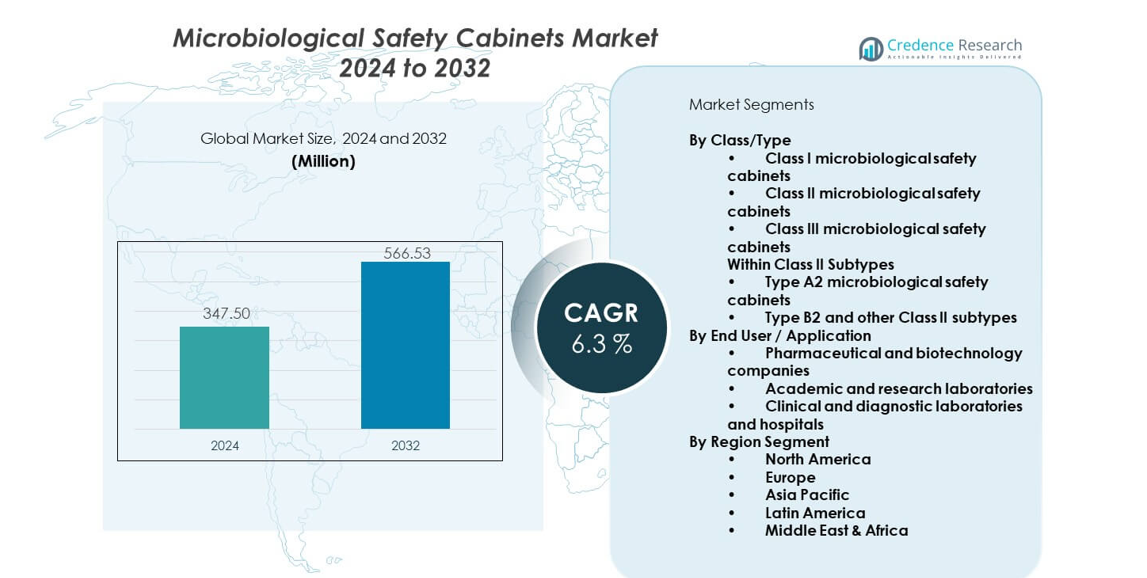
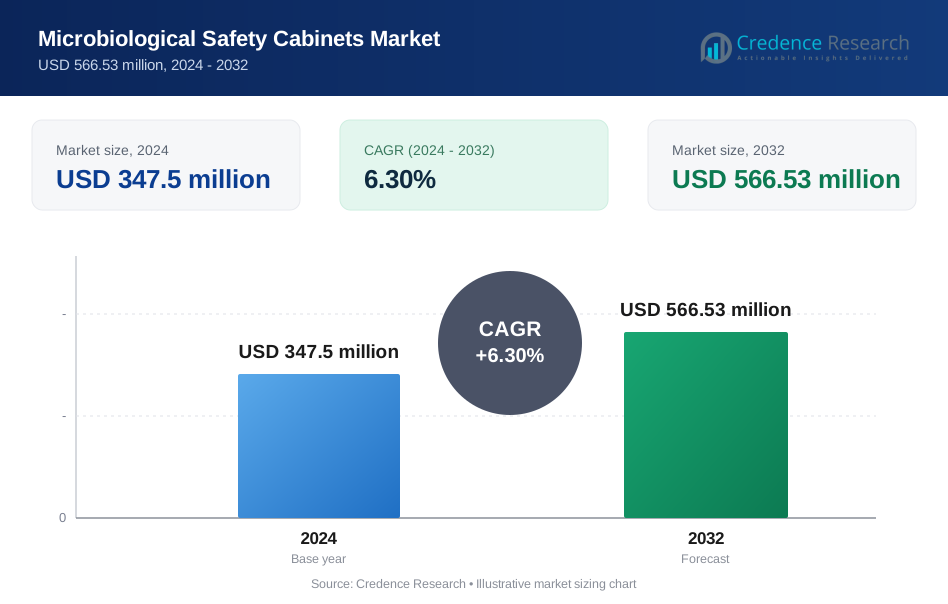
The microbiological safety cabinets market is projected to grow from USD 347.5 million in 2024 to an estimated USD 566.53 million by 2032, with a CAGR of 6.3% from 2024 to 2032. Demand rises as labs expand their biosafety standards and invest in controlled containment systems. Growth also reflects wider adoption in hospitals, biotech firms, and pharmaceutical facilities that rely on strict contamination control.
| REPORT ATTRIBUTE | DETAILS |
|---|---|
| Historical Period | 2020-2023 |
| Base Year | 2024 |
| Forecast Period | 2025-2032 |
| Microbiological Safety Cabinets Market Size 2024 | USD 347.5 million |
| Microbiological Safety Cabinets Market, CAGR | 6.3% |
| Microbiological Safety Cabinets Market Size 2032 | USD 566.53 million |
Strong drivers include rising focus on pathogen handling, broader diagnostic workloads, and rapid biotech expansion. Labs upgrade infrastructure to support high-risk sample processing and follow stricter biosafety rules. Growth in biologics, vaccine development, and advanced testing increases the need for safe airflow systems. Modern cabinets gain traction through energy-efficient blowers, real-time monitoring, and ergonomic designs that reduce operator fatigue. Companies prefer units with digital alarms and variable airflow control to reduce exposure risk while improving productivity.
Regional growth is led by North America due to advanced research networks and rigorous laboratory safety norms. Europe maintains strong demand through active pharmaceutical manufacturing and well-regulated healthcare systems. Asia Pacific is emerging rapidly as China, India, and South Korea expand biotech parks and boost national research funding. Latin America and the Middle East show steady adoption as governments upgrade infectious-disease labs and strengthen public-health systems, supporting broader integration of biosafety infrastructure across clinical and academic environments.
Market Insights:
- The Microbiological safety cabinets market is valued at USD 347.5 million in 2024 and is projected to reach USD 566.53 million by 2032, growing at a 3% CAGR through the forecast period.
- North America (38–40%), Europe (27–29%), and Asia Pacific (24–26%) lead the market due to advanced research capacity, strict biosafety rules, and expanding biopharma infrastructure.
- Asia Pacific, holding 24–26%, is the fastest-growing region driven by rising biotech investments, new research parks, and expanding hospital diagnostic workloads.
- Class II cabinets account for the largest share of the market with over 60%, driven by broad use in research and diagnostics.
- Pharmaceutical and biotechnology companies represent the leading end-user group with over 40% share due to strong biologics and vaccine development activities.
Market Drivers:
Rapid Expansion Of High-Risk Biological Research And Advanced Diagnostics
The microbiological safety cabinets market grows due to higher biosafety needs worldwide. Research labs handle complex pathogens that demand strict containment. Hospitals raise testing volumes for viral and bacterial threats. Biotech firms expand cell-based programs that need controlled airflow units. Vaccine developers strengthen clean workflows in core facilities. It supports safer handling of sensitive samples. Universities increase investments in modern biosafety labs. Rising global health threats push consistent upgrades across regions.
- For instance, the Thermo Scientific Herasafe 2030i Class II cabinet incorporates the Digital Airflow Verification Plus (DAVe Plus) system, which uses independent pressure sensors to monitor airflow velocities and provides alerts to any changes in airflow. The system is part of the "SmartFlow Plus" autonomous safety features that maintain proper airflow rates without user interaction.
Increasing Adoption Of Smart Airflow Control And Real-Time Monitoring Systems
R&D facilities adopt cabinets with digital airflow screens and alert systems. Real-time tracking improves operator safety during heavy workloads. Smart sensors detect airflow shifts quickly. Energy-efficient motors help labs cut operating expenses. It improves workflow quality in high-density research zones. Touchscreen interfaces support easier compliance checks. Automated calibration reduces human error. Growing preference for connected systems fuels wider deployment.
- For instance, Labconco Corporation’s Guardian Digital Airflow Monitor enables users to set face-velocity thresholds and triggers audible alarms when airflow falls below the setpoint of 50–250 fpm.
Growing Compliance Pressure From Biosafety And Occupational Health Regulations
Governments enforce strict laboratory safety norms across research sectors. Institutions upgrade equipment to maintain compliance. Strong focus on employee safety drives new cabinet purchases. It helps labs reduce contamination risk during routine tasks. Regulatory audits push adoption of certified Class II models. Hospitals require reliable containment during specimen handling. Biopharma firms follow global biosafety rules for new-product work. Rising inspection frequency strengthens core market demand.
Rising Investments In Biopharmaceutical Manufacturing And Cell-Based Production Platforms
Bioprocessing sites expand clean production zones to support new therapies. Cell and gene therapy units need stable containment during early work. It supports controlled transfers of sensitive cultures. Facilities adopt cabinets with high filtration efficiency. Contract manufacturers build new labs to meet global demand. Strong focus on contamination reduction boosts cabinet upgrades. Innovation in biologics pushes need for safer work zones. Expanding therapeutic pipelines increases long-term equipment requirements.
Market Trends:
Shift Toward Energy-Efficient, Low-Noise Designs With Improved User Comfort
Manufacturers release quieter cabinets with reduced vibration impact. Labs prefer models that support long-duty tasks comfortably. New units use energy-saving airflow systems. It helps facilities manage rising utility costs. LED lighting reduces heat buildup inside work zones. Ergonomic designs support safer hand movement. Smoother airflow patterns reduce turbulence. Growing comfort needs influence procurement choices.
- For instance, Thermo Fisher’s 1300 Series A2 units feature dual-motor DC blowers and longer expected lifetime of more than 11 years, significantly improving energy efficiency and service stability.
Integration Of Digital Connectivity And Remote Performance Diagnostics
Smart cabinets gain connectivity features for remote checks. Labs monitor performance metrics through secure dashboards. Predictive alerts reduce downtime. It improves safety during heavy workloads. Cloud-linked logs help compliance teams review airflow data. Automated reporting cuts manual record errors. Remote diagnostics support faster servicing. Growing digital adoption drives advanced model upgrades.
- For instance, Thermo Fisher’s 1500 Series Class II, Type A2 BSC includes a 7-inch touchscreen and built-in WiFi connectivity, enabling remote monitoring of airflow and equipment status via the Thermo Fisher Connect app.
Rising Preference For Modular And Space-Efficient Cabinet Designs
Facilities adopt compact cabinets for small lab rooms. Modular layouts support flexible research growth. Units fit easily into modern lab clusters. It improves workflow without major renovations. Mobile bases help users shift systems quickly. Standardized components reduce maintenance time. Labs value quick installation during expansion phases. Growth in small biotech firms fuels this trend.
Growing Demand For High-Containment Cabinets For AI-Driven And Automated Labs
Automated labs require stable containment for robotic tasks. High-containment units support advanced data-driven workflows. AI-based systems handle sensitive cultures. It enables consistent operation in sealed environments. Cabinets with stable airflow help robotic arms move accurately. Instrument integration becomes a key purchase driver. Programmable safety features support new lab formats. Rising automation adoption strengthens long-term demand.
Market Challenges Analysis:
High Upfront Costs, Complex Certification Needs, And Maintenance Burden
The microbiological safety cabinets market faces cost barriers for many labs. Advanced models require strong capital budgets. Certification fees raise overall setup costs. It creates challenges for small institutions. Regular filter changes increase service expenses. Strong airflow systems need skilled technicians. Complex standards require frequent audits. Limited budgets slow upgrades in emerging regions. Price pressure limits adoption in low-resource labs.
Performance Degradation Risks, Workflow Interruptions, And Global Supply Delays
Airflow systems lose efficiency without proper upkeep. It forces labs to halt routine work. Filter issues create contamination risk. Limited spare parts slow service cycles. Global supply delays affect cabinet delivery. Skilled workforce shortages increase repair time. Labs struggle during peak diagnostic seasons. Environmental rules raise design complexity for builders.
Market Opportunities:
Expansion Of Biotech Hubs, Research Parks, And Public-Health Lab Networks
The microbiological safety cabinets market gains strong potential from rising biotech clusters. Countries expand national research parks to support new therapies. It boosts large-scale procurement of advanced containment units. Health agencies upgrade facilities for rapid pathogen response. Universities add new biosafety rooms for academic growth. Digital-ready cabinets support modern lab formats. Growing state investments strengthen long-term demand. Emerging economies create fresh growth pools.
Rising Demand For Customizable Cabinets And Integrated Workflow Platforms
Labs seek tailored airflow units for unique research needs. It supports specialized handling of diverse cultures. Integrated platforms link instruments with containment zones. Touch-free systems reduce operator exposure. Demand rises for flexible models in hybrid labs. Manufacturers design plug-and-play modules. Growth in precision biotech increases system customization. Buyers prefer units that support future expansion.
Market Segmentation Analysis:
By Class/Type
The Microbiological safety cabinets market includes Class I, Class II, and Class III units, each serving different containment needs. Class I models support basic protection for operators and environments. Class II cabinets hold the dominant share due to broad use in research, diagnostics, and biopharma tasks. It provides strong filtration and controlled airflow suited for sensitive work. Class III units support high-containment labs that handle dangerous pathogens. Demand for these models grows in advanced research centers that follow strict biosafety rules.
- For instance, Haier Biomedical offers its HR40-IIA2 Class II unit with ULPA filters rated 99.9995% at 0.12 µm particulate capture.
Within Class II Subtypes
Type A2 cabinets remain the leading Class II subtype due to strong filtration and flexible installation. These units support most biological workflows and remain the preferred choice in high-volume labs. It offers stable containment that meets global safety standards. Type B2 and other B variants serve labs requiring full exhaust systems for sensitive or hazardous chemicals. These configurations support specialized applications in regulated environments.
- For instance, the Labconco Corporation's Purifier Logic+ Class II, Type A2 BSC features a nominal inflow velocity of 105 fpm (0.5 m/sec) and a nominal downflow velocity of 55 fpm (0.3 m/sec).
By End User / Application
Pharmaceutical and biotechnology companies represent a major user group due to expanding biologics and vaccine pipelines. These facilities adopt cabinets to protect operators and maintain sterile production zones. Academic and research laboratories show steady demand through continuous project growth. It helps universities maintain reliable containment for varied scientific work. Clinical and diagnostic laboratories and hospitals use cabinets for safe specimen handling and contamination control, supporting strict infection-prevention workflows.
Segmentation:
By Class/Type
- Class I microbiological safety cabinets
- Class II microbiological safety cabinets
- Class III microbiological safety cabinets
Within Class II Subtypes
- Type A2 microbiological safety cabinets
- Type B2 and other Class II subtypes
By End User / Application
- Pharmaceutical and biotechnology companies
- Academic and research laboratories
- Clinical and diagnostic laboratories and hospitals
By Region Segment
- North America
- U.S.
- Canada
- Mexico
- Europe
- Germany
- France
- U.K.
- Italy
- Spain
- Rest of Europe
- Asia Pacific
- China
- Japan
- India
- South Korea
- South-east Asia
- Rest of Asia Pacific
- Latin America
- Brazil
- Argentina
- Rest of Latin America
- Middle East & Africa
- GCC Countries
- South Africa
- Rest of the Middle East and Africa
Regional Analysis:
North America Leads With Strong Research Infrastructure And High Biosafety Compliance
North America holds the largest share of the microbiological safety cabinets market, accounting for nearly 38–40% of global demand. The region benefits from advanced research institutes, strict occupational safety rules, and strong federal support for infectious-disease programs. Hospitals and biopharma plants increase cabinet adoption to protect workers and maintain sterile workflows. It gains further growth momentum from large vaccine developers and genomic labs. Rising investments in life sciences drive continuous upgrades. Strong adoption of energy-efficient models supports steady replacement cycles.
Europe Maintains Significant Share Due To Robust Healthcare And Biopharma Activity
Europe captures roughly 27–29% of the global microbiological safety cabinets market driven by strong regulatory frameworks and active pharmaceutical production clusters. Research bodies across Germany, the UK, France, and the Nordics focus on high-quality containment to support biologics and cell-based research. Hospitals expand controlled environments to handle complex diagnostic workloads. It benefits from growth in regional biotech accelerators. Strict environmental guidelines influence cabinet selection. Steady modernization in public labs keeps long-term demand stable.
Asia Pacific Emerges As The Fastest-Growing Market With Expanding Biotech Investments
Asia Pacific holds about 24–26% share of the microbiological safety cabinets market and grows at the fastest pace among all regions. China, India, South Korea, and Singapore increase national capacity through new research parks and vaccine production sites. Hospitals upgrade containment systems to manage expanding test volumes. It gains strong momentum from government-backed biosafety projects. Local manufacturing expands model availability at competitive pricing. Rising academic research output strengthens long-term regional growth.
Key Player Analysis:
- Thermo Fisher Scientific Inc.
- Labconco Corporation
- Esco Lifesciences
- NuAire Inc.
- The Baker Company Inc.
- Haier Biomedical
- Biobase
- Germfree Laboratories Inc.
- Air Science Inc.
- Azbil Telstar S.L.U.
Competitive Analysis:
The Microbiological safety cabinets market features strong competition among global and regional manufacturers that focus on certified containment performance and advanced airflow technology. Leading companies invest in energy-efficient motors, HEPA filtration upgrades, and ergonomic design to strengthen product differentiation. It gains steady innovation from suppliers introducing digital monitoring systems and remote diagnostics to support continuous compliance. Major players expand distribution networks to capture hospital, biotech, and academic demand. Strategic partnerships with laboratory builders help brands secure large-volume procurement. Companies also compete through faster service cycles and flexible cabinet customization. Growing demand for safer work environments pushes firms to enhance reliability, reduce noise levels, and improve operator comfort across new models.
Recent Developments:
- Thermo Fisher Scientific Inc. has made headlines with its acquisition of Clario Holdings, Inc., a move announced on October 28, 2025. This acquisition is set to deepen Thermo Fisher's clinical research capabilities, providing pharma and biotech customers with more robust digital solutions to accelerate clinical innovation and patient safety standards.
- Labconco Corporation, a distinguished name in laboratory solutions, signed a significant partnership agreement with Premier, Inc. effective April 1, 2024. This partnership enables a broader distribution of Labconco’s biological safety cabinets and ventilation solutions to healthcare providers across the U.S. through Premier’s extensive network, making high-standard safety solutions more accessible to clinical laboratories.
Report Coverage:
The research report offers an in-depth analysis based on By Class/Type and By End User / Application. It details leading market players, providing an overview of their business, product offerings, investments, revenue streams, and key applications. Additionally, the report includes insights into the competitive environment, SWOT analysis, current market trends, as well as the primary drivers and constraints. Furthermore, it discusses various factors that have driven market expansion in recent years. The report also explores market dynamics, regulatory scenarios, and technological advancements that are shaping the industry. It assesses the impact of external factors and global economic changes on market growth. Lastly, it provides strategic recommendations for new entrants and established companies to navigate the complexities of the market.
Future Outlook:
- The Microbiological safety cabinets market will gain strength from expanding global biosafety mandates.
- Rising adoption of Class II and high-containment models will support advanced research growth.
- Energy-efficient airflow systems will see wider acceptance across new and renovated labs.
- Digital monitoring platforms will drive demand for smart, connected containment units.
- Integration with automated lab workflows will push manufacturers to develop robotics-ready designs.
- Growth in biopharma pipelines will increase the need for reliable containment during early development.
- Hospitals will upgrade cabinet fleets to improve operator protection and infection-control practices.
- Emerging biotech hubs will expand procurement, supported by government-backed research programs.
- Manufacturers will focus on modular cabinet formats to support flexible lab layouts.
- Global supply-chain improvements will help shorten delivery times and expand product availability across regions.
Request a Free Sample
Fill in your details and we'll send you a free sample report.
- Sample data tables & charts
- Research methodology
Need a Custom Version of This Report?
Tailor the scope, geography, or segments to your exact requirements.
- Custom geography or segment scope
- Direct access to our analyst team
Frequently Asked Questions
What is the current market size for the Microbiological safety cabinets market, and what is its projected size in 2032?
At what Compound Annual Growth Rate is the Microbiological safety cabinets market projected to grow between 2024 and 2032?
Which segments are covered in the global microbiological safety cabinets market report?
Which region is driving the Microbiological Safety Cabinets sector's expansion?
Who are the leading market participants in Microbiological Safety Cabinets?
What are the main economic factors driving the Microbiological Safety Cabinets market?
What are the main factors limiting the market for Microbiological Safety Cabinets?
What are the key market opportunities for the Microbiological Safety Cabinets sector?
Who are the leading companies in the Microbiological safety cabinets market?
Table of Content
Chapter 1. Report Introduction
- 1.1 Report Description & Purpose
- 1.1.1 Report Title & Market Definition
- 1.1.2 Unique Selling Propositions (USP) & Key Differentiators
- 1.1.3 Value Proposition for Stakeholders
- 1.2 Research Objectives
- 1.2.1 Market Sizing Objectives (Volume & Revenue) (Volume Where Applicable)
- 1.2.2 Segmentation Objectives
- 1.2.3 Competitive Intelligence Objectives
- 1.2.4 Forecast & Scenario Objectives
- 1.3 Report Scope
- 1.3.1 Microbiological Safety Cabinets Scope – Segments & Subsegments Covered
- 1.3.2 Geographic Scope – Regions & Countries Covered
- 1.3.3 Historical Period, Base Year & Forecast Period (2024; forecast to 2032)
- 1.3.4 Inclusions & Exclusions
- 1.4 Industry Classification & Applicable Codes
- 1.5 Currency, Measurement Units & Valuation Basis
- 1.6 Target Stakeholders
- 1.7 Limitations & Assumptions
Chapter 2. Executive Summary
- 2.1 Global Microbiological Safety Cabinets Market Snapshot
- 2.1.1 Market Size – Historical (2024) & Forecast (2024-2032) (2024: USD 347.5 million → 2032: USD 566.53 million)
- 2.1.2 Volume & Revenue – Global Totals (Volume Where Applicable)
- 2.1.3 Key Market Highlights – Top Five Facts
- 2.2 Microbiological Safety Cabinets Market Segmentation Snapshot
- 2.2.1 Market Split by Region – 2024 vs. 2032
- 2.3 Competitive Snapshot
- 2.3.1 Top 10 Players by Revenue Share – 2024
- 2.3.2 Top 10 Players by Volume Share – 2024 (Volume Where Applicable)
- 2.3.3 Recent Strategic Developments (18-Month Summary)
- 2.4 Key Investment Highlights & Strategic Conclusions
Chapter 3. Microbiological Safety Cabinets Market Dynamics & Industry Analysis
- 3.1 Market Overview & Context
- 3.1.1 Microbiological Safety Cabinets Market Position in the Broader Industry Value Chain
- 3.1.2 Demand Structure & Purchasing Dynamics
- 3.1.3 Market Maturity & Development Stage by Region
- 3.2 Microbiological Safety Cabinets Market Drivers
- 3.3 Microbiological Safety Cabinets Market Restraints & Challenges
- 3.4 Microbiological Safety Cabinets Market Opportunities
- 3.5 Porter's Five Forces Analysis
- 3.5.1 Threat of New Entrants
- 3.5.2 Bargaining Power of Suppliers
- 3.5.3 Bargaining Power of Buyers
- 3.5.4 Threat of Substitutes
- 3.5.5 Competitive Rivalry – Intensity Assessment
- 3.6 Microbiological Safety Cabinets Value Chain Analysis
- 3.6.1 Upstream – Key Inputs, Resources & Suppliers
- 3.6.1.1 Key Input/Resource 1
- 3.6.1.2 Key Input/Resource 2
- 3.6.1.3 Key Input/Resource 3
- 3.6.2 Midstream – Core Operations & Value Creation
- 3.6.2.1 Operating Model & Process Overview
- 3.6.2.2 Key Operating Locations & Capabilities by Company
- 3.6.3 Downstream – Market Channels & End Users
- 3.6.3.1 Direct Sales & Customer Engagement Channels
- 3.6.3.2 Indirect Sales, Intermediaries & Partner Channels
- 3.6.4 Value Chain Profitability Analysis
- 3.6.1 Upstream – Key Inputs, Resources & Suppliers
- 3.7 PESTEL Analysis
- 3.7.1 Political Factors
- 3.7.2 Economic Factors
- 3.7.3 Social Factors
- 3.7.4 Technological Factors
- 3.7.5 Environmental Factors
- 3.7.6 Legal Factors
- 3.8 Microbiological Safety Cabinets Supply Chain Analysis
- 3.8.1 Critical Input & Resource Availability Risk Assessment
- 3.8.2 Supplier & Operational Concentration Risk (Geographic Exposure)
- 3.8.3 Supply & Service Disruption Impact Analysis
- 3.9 Regulatory & Policy Landscape
Note: The regulatory and policy landscape section covers regulations based on their applicability to the market, Microbiological Safety Cabinets category, geography, and scope of the study. Only regulatory frameworks with a material impact on operations, compliance, trade, sustainability, or market access are analyzed in detail.
Chapter 4. Key Investment Pockets & Opportunity Analysis
- 4.1 Microbiological Safety Cabinets Market Attractiveness Analysis
- 4.1.1 By Region – Investment Attractiveness Matrix (Market Size × CAGR)
- 4.2 Absolute Revenue Growth Opportunity
- 4.2.1 By Region – Absolute Revenue Growth Through 2032
- 4.3 Incremental Demand Opportunity
- 4.3.1 By Region – Incremental Demand Through 2032
- 4.3.2 Segment – Incremental Demand
- 4.4 Emerging Submarket Opportunity Deep Dive (Subject to Applicability)
- 4.5 Priority Market Opportunity Scorecards
- 4.5.1 United States
- 4.5.2 Europe
- 4.5.3 Asia
- 4.5.4 Middle East & Africa
Note: Priority market opportunity scorecards reflect the geographic scope and strategic relevance of the study. Listed markets are indicative and may be adapted to the industry.
Chapter 5. Microbiological Safety Cabinets Cross-Border Trade & Market Access Analysis
- 5.1 International Trade & Cross-Border Activity Overview
- 5.1.1 Global Export Value by Country (2024)
- 5.1.2 Global Export Volume by Country (2024) (Volume Where Applicable)
- 5.1.3 Global Import Value by Country (2024)
- 5.1.4 Global Import Volume by Country (2024) (Volume Where Applicable)
- 5.1.5 Net Trade Balance by Country (2024)
- 5.2 Export Analysis – Segment
- 5.2.1 Category 1 (Applicable Classification Code)
- 5.2.2 Category 2 (Applicable Classification Code)
- 5.2.3 Category 3 (Applicable Classification Code)
- 5.2.4 Category 4 (Applicable Classification Code)
- 5.2.5 Category 5 (Applicable Classification Code)
- 5.3 Import Analysis – Segment
- 5.3.1 Category 1 (Applicable Classification Code)
- 5.3.2 Category 2 (Applicable Classification Code)
- 5.3.3 Category 3 (Applicable Classification Code)
- 5.3.4 Category 4 (Applicable Classification Code)
- 5.3.5 Category 5 (Applicable Classification Code)
- 5.4 Cross-Border Pricing & Transaction Benchmarks
- 5.4.1 Export Pricing – Segment & Country
- 5.4.2 Import Pricing – Segment & Source Country
- 5.4.3 Price Trends (2024)
- 5.5 Key Cross-Border Trade & Delivery Routes
- 5.5.1 Cross-Border Trade/Delivery Route 1
- 5.5.2 Cross-Border Trade/Delivery Route 2
- 5.5.3 Cross-Border Trade/Delivery Route 3
- 5.5.4 Cross-Border Trade/Delivery Route 4
- 5.5.5 Cross-Border Trade/Delivery Route 5
- 5.6 Trade Policy & Market Access Impact Assessment
- 5.6.1 Tariff & Non-Tariff Barriers
- 5.6.2 Regional Trade & Economic Integration Frameworks
- 5.6.3 Bilateral & Multilateral Trade Agreements
- 5.6.4 Cross-Border Operating, Licensing & Localization Requirements
Note: This chapter applies where cross-border trade or delivery is relevant to Microbiological Safety Cabinets. Goods, services, and digital offerings are assessed using applicable classifications and transaction measures. Import-export volumes, trade balances, and route analyses are included only where meaningful to the market.
Chapter 6. Competitive Landscape & Company Benchmarking
- 6.1 Microbiological Safety Cabinets Market Concentration & Structure
- 6.1.1 Herfindahl-Hirschman Index (HHI) – vs. 2024
- 6.1.2 Leading, Mid-Sized & Emerging Player Structure
- 6.1.3 Global, Regional & Local Player Dynamics
- 6.2 Microbiological Safety Cabinets Market Share Analysis – 2024
- 6.2.1 Global Revenue Share by Company
- 6.2.2 Global Volume Share by Company (Volume Where Applicable)
- 6.2.3 Regional Revenue Share
- 6.2.4 Market Share Evolution ( vs. 2024)
- 6.2.5 Company Market Share by Key Segment
- 6.2.6 Company Market Share by Customer Group
- 6.3 Operating Scale, Capacity & Infrastructure Analysis
- 6.3.1 Global Operating Scale & Supply Capacity
- 6.3.2 Resource Utilization & Operating Efficiency
- 6.3.3 Output, Service Delivery & Activity Metrics
- 6.3.4 Operating Footprint & Infrastructure Map
- 6.3.5 Planned Operational & Capacity Expansion
- 6.4 Microbiological Safety Cabinets Competitive Benchmarking Matrix
- 6.4.1 Revenue, Growth, Profitability & Operating Metric Comparison
- 6.4.2 Channel Revenue Mix
- 6.4.3 Geographic Revenue Exposure
- 6.4.4 R&D Intensity
- 6.4.5 Sustainability Maturity
- 6.5 Strategic Developments in Microbiological Safety Cabinets (Last 24 Months)
- 6.5.1 Mergers, Acquisitions & Divestments
- 6.5.2 New Products, Services & Solutions in Microbiological Safety Cabinets
- 6.5.3 Operational & Infrastructure Expansions
- 6.5.4 Strategic Alliances, Joint Ventures & Partnerships
- 6.5.5 Distribution Expansion & Market Entry
- 6.5.6 Sustainability & ESG Initiatives
- 6.6 Competitive Strategy Mapping
- 6.6.1 Leader, Challenger, Follower & Niche Classification
- 6.6.2 Pricing Strategy Comparison
- 6.6.3 Channel Strategy Matrix
Note: Strategic developments are included based on their materiality and the availability of reliable information.
Chapter 7. Global Microbiological Safety Cabinets Market – By Sales & Delivery Channel
- 7.1 Segment Overview
- 7.1.1 Volume & Revenue Split by Channel (2024 & 2032) (Volume Where Applicable)
- 7.1.2 Channel Mix Evolution (2024-2032)
Chapter 8. Regional Market Analysis – Global Overview
- 8.1 Global Regional Overview
- 8.1.1 Regional Volume Share (Volume Where Applicable)
- 8.1.2 Regional Revenue Share
- 8.1.3 Regional Volume by Region (Volume Where Applicable)
- 8.1.4 Regional Revenue by Region
- 8.1.5 Regional Forecast Through 2032
- 8.2 Cross-Regional Segment Analysis
- 8.2.1 By Sales & Delivery Channel
- 8.2.2 By Competitive Positioning & Price Tier
Chapter 9. North America Microbiological Safety Cabinets Market
- 9.1 United States
- 9.2 Canada
- 9.3 Mexico
Chapter 10. Europe Microbiological Safety Cabinets Market
- 10.1 Germany
- 10.2 France
- 10.3 Italy
- 10.4 United Kingdom
- 10.5 Spain
- 10.6 Poland
- 10.7 Russia
- 10.8 Netherlands
- 10.9 Belgium
- 10.10 Sweden
- 10.11 Denmark
- 10.12 Norway
- 10.13 Rest of Europe
Chapter 11. Asia Pacific Microbiological Safety Cabinets Market
- 11.1 China
- 11.2 India
- 11.3 Japan
- 11.4 South Korea
- 11.5 Thailand
- 11.6 Indonesia
- 11.7 Vietnam
- 11.8 Malaysia
- 11.9 Australia
- 11.10 Rest of Asia Pacific
Chapter 12. Latin America Microbiological Safety Cabinets Market
- 12.1 Brazil
- 12.2 Argentina
- 12.3 Colombia
- 12.4 Chile
- 12.5 Rest of Latin America
Chapter 13. Middle East Microbiological Safety Cabinets Market
- 13.1 Saudi Arabia
- 13.2 United Arab Emirates
- 13.3 Turkey
- 13.4 Israel
- 13.5 Iran
- 13.6 Rest of the Middle East
Chapter 14. Africa Microbiological Safety Cabinets Market
- 14.1 South Africa
- 14.2 Egypt
- 14.3 Nigeria
- 14.4 Morocco
- 14.5 Rest of Africa
Chapter 15. Microbiological Safety Cabinets Company Profiles
- 15.1 [Company 01]
- 15.1.1 Company Overview
- 15.1.2 Key Management Personnel
- 15.1.3 Products & Services Portfolio
- 15.1.4 Financial Performance
- 15.1.5 Key Market Focus & Geographic Presence
- 15.1.6 Recent Developments & Strategic Initiatives
Note: The company profile list is preliminary and may change based on research findings, market developments, data availability, and client requirements.
Chapter 16. Appendices
- Appendix A – List of Abbreviations & Acronyms
- Appendix B – Industry Classification Code Reference – Full Series
- Appendix C – Supply, Output & Operating Capacity Data Tables
- Appendix D – End-Use & Demand Base Tables
- Appendix E – Demand, Adoption & Usage Assumptions
- Appendix F – Pricing & Revenue Metric Reference Tables
- Appendix G – Company Operations & Infrastructure Database
- Appendix H – Cross-Border Trade & Activity Data Tables (Where Applicable)
- Appendix I – Regulatory Summary Tables
- Appendix J – Primary Research Participant List (Anonymized)
- Appendix K – Primary Research Questionnaire Framework
- Appendix L – Data Sources & Bibliography
- Appendix M – Market Size Divergence & Source Comparison
Chapter 17. Research Methodology
- 17.1 Research Framework & Philosophy
- 17.2 Secondary Research – Sources, Hierarchy & Data Extraction
- 17.3 Data Modeling – Bottom-Up & Top-Down Market Sizing
- 17.4 Primary Research – Stakeholder Framework, LOI & Sample Sizes
- 17.5 Forecast Methodology – Regression, Scenario & Sensitivity Analysis
- 17.6 Quality Control – Four-Layer Validation Framework
- 17.7 Limitations & Standard Assumptions
- 17.8 Disclaimer
