
Middle East In Vitro Diagnostics Market Overview:
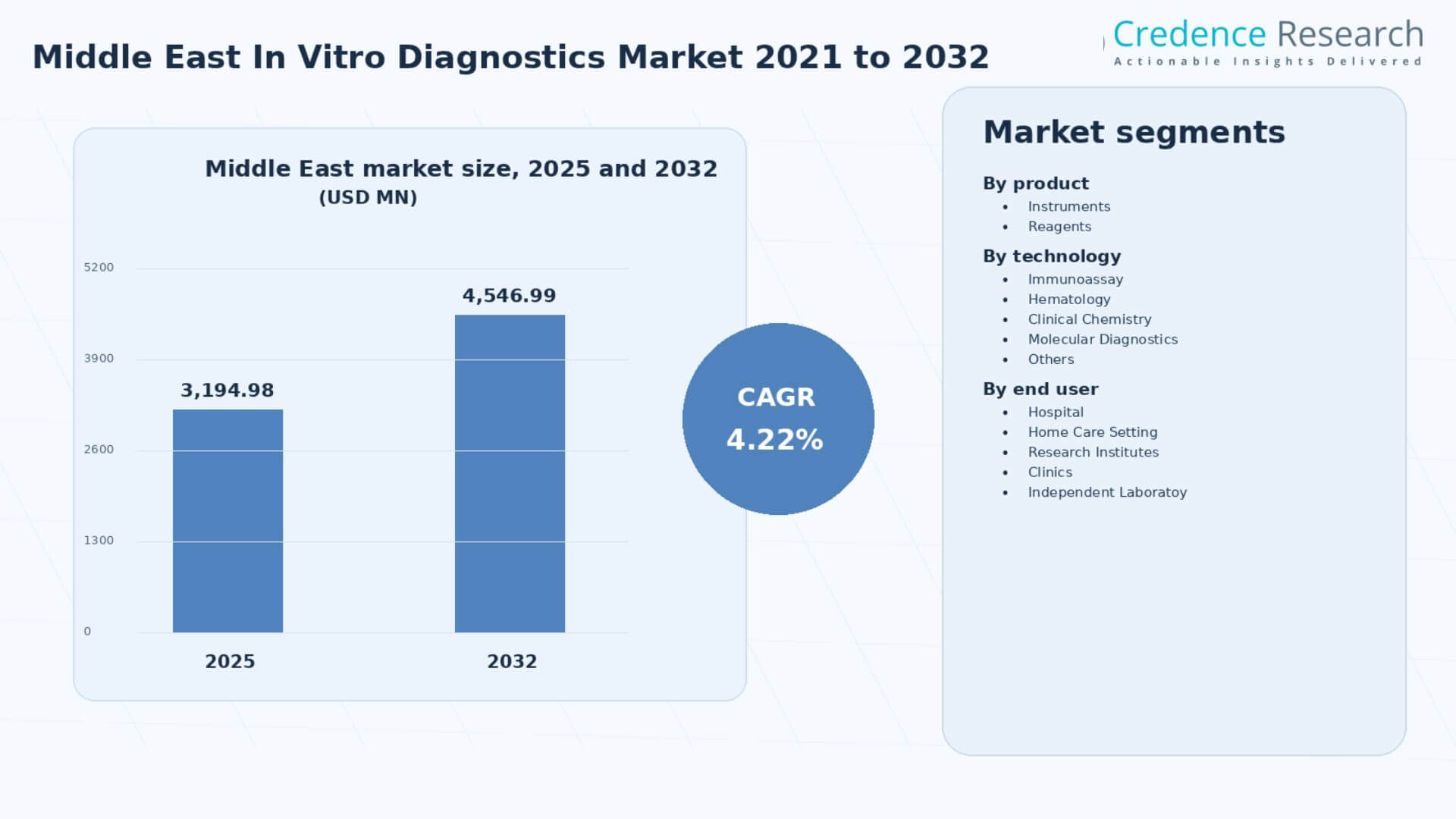
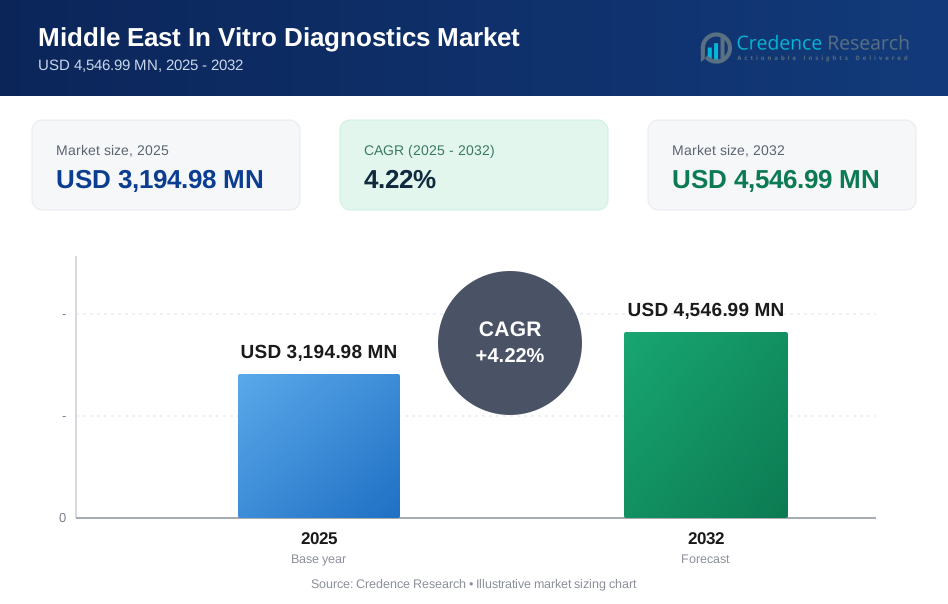
The Middle East In Vitro Diagnostics Market size was valued at USD 2,568.78 MN in 2021 and reached USD 3,194.98 MN in 2025. It is anticipated to reach USD 4,546.99 MN by 2032, growing at a CAGR of 4.22% during the forecast period.
| REPORT ATTRIBUTE | DETAILS |
|---|---|
| Historical Period | 2021-2024 |
| Base Year | 2025 |
| Forecast Period | 2025-2032 |
| Middle East In Vitro Diagnostics Market Size 2025 | USD 3,194.98 million |
| Middle East In Vitro Diagnostics Market, CAGR | 4.22% |
| Middle East In Vitro Diagnostics Market Size 2032 | USD 4,546.99 million |
Middle East In Vitro Diagnostics Market Insights
- Market growth is supported by rising chronic disease testing, infectious disease surveillance, hospital laboratory expansion, molecular diagnostics adoption and higher demand for recurring reagent consumption.
- Reagents hold a strong position because laboratories require continuous use of assay kits, calibrators, controls, stains, buffers and consumables across immunoassay, hematology, clinical chemistry and molecular diagnostics.
- Immunoassay and Clinical Chemistry remain major technology categories because hospitals and independent laboratories use them for routine endocrine, infectious disease, cardiac, metabolic and liver function testing.
- Hospitals remain the leading end-user segment because high-volume IVD testing requires laboratory infrastructure, automation, trained staff, quality controls, clinician integration and reimbursement support.
Middle East In Vitro Diagnostics Market Segment Insights
By product
By product, Reagents held the strongest position in 2025 because recurring test volumes create continuous demand for assay kits, controls, calibrators and consumables. Reagents are used across Immunoassay, Hematology, Clinical Chemistry, Molecular Diagnostics and other testing workflows. Instruments remain strategically important because analyzers, PCR systems, hematology platforms, chemistry analyzers, immunoassay systems and sample processing equipment establish laboratory capacity and lock in reagent pull-through. Instrument growth is linked to hospital laboratory modernization, independent lab expansion and private diagnostic networks. Reagents will continue to dominate revenue due to repeat purchasing, expanding test menus and higher utilization of installed systems.
By technology
By technology, Immunoassay held a strong position in 2025 because it supports infectious disease testing, endocrine panels, cardiac markers, tumor markers, fertility testing and autoimmune diagnostics. Clinical Chemistry remains a high-volume category due to routine testing for diabetes, liver function, kidney function, lipids and metabolic disorders. Hematology supports complete blood counts, anemia assessment, oncology care and infection evaluation. Molecular Diagnostics is gaining momentum due to PCR, syndromic respiratory panels, antimicrobial resistance testing, viral load testing and oncology-related molecular assays. Others include microbiology, coagulation, urinalysis, cytology, pathology and specialized laboratory testing.
By end user
By end user, Hospital held the strongest position in 2025 because hospitals conduct routine, emergency, inpatient, outpatient and specialty diagnostic testing. Hospitals also manage critical care testing, infection control, chronic disease monitoring and pre-surgical laboratory work. Independent Laboratoy represents a major growth area because private diagnostic chains and reference labs can aggregate test volumes, deploy automated platforms and serve clinics across large cities. Clinics support decentralized testing, rapid diagnostics and chronic disease screening. Research Institutes contribute to biomarker discovery, molecular testing validation and clinical research. Home Care Setting is growing gradually through point-of-care testing, remote sample collection and chronic disease self-monitoring.
Key Market Drivers
Chronic disease burden and routine testing demand
Chronic disease burden and routine testing demand represent major growth drivers for the Middle East In Vitro Diagnostics Market. WHO’s Eastern Mediterranean Region reports that noncommunicable diseases account for 66% of all deaths in the region, largely driven by unhealthy diets and lifestyles. The same WHO results report notes that all 22 Eastern Mediterranean countries now include healthy diets or prevention of obesity and diet-related NCDs in national policies, strategies or plans. This burden supports Clinical Chemistry, Immunoassay, Hematology, Reagents, Hospitals, Clinics and Independent Laboratoy testing. Diabetes, cardiovascular disease, cancer and chronic kidney disease require regular lab testing for diagnosis, risk stratification, treatment adjustment and long-term monitoring.
Infectious disease surveillance and molecular diagnostics
Infectious disease surveillance and molecular diagnostics support strong market demand because Middle Eastern health systems continue to strengthen respiratory, antimicrobial resistance and outbreak testing capacity. WHO reported that the Eastern Mediterranean Region has more than 700 million people and faces seasonal influenza, zoonotic influenza and other epidemic-prone respiratory diseases. By 2025, 18 of 22 countries reported influenza data regularly through regional and global databases, 18 maintained functional National Influenza Centres and at least 14 routinely shared influenza viruses with WHO Collaborating Centres. This driver supports Molecular Diagnostics, Immunoassay, Reagents, Hospitals and Research Institutes. Syndromic respiratory panels, PCR testing and surveillance-linked assays will remain important through 2032.
Antimicrobial resistance and laboratory capacity needs
Antimicrobial resistance and laboratory capacity needs are strengthening demand for microbiology, molecular testing, clinical chemistry and laboratory automation. WHO warned in 2025 that one in six laboratory-confirmed bacterial infections causing common infections worldwide in 2023 were resistant to antibiotic treatments. WHO estimated antibiotic resistance was highest in the South-East Asian and Eastern Mediterranean regions, where one in three reported infections were resistant. WHO’s Eastern Mediterranean results report also identifies laboratory capacity, infection prevention, surveillance systems and antimicrobial resistance as regional priorities. This driver supports Molecular Diagnostics, Hematology, Reagents, Hospitals and Independent Laboratoy networks.
Health system transformation and medical product access
Health system transformation and medical product access are supporting diagnostic infrastructure expansion across the Middle East. WHO said its Eastern Mediterranean regional initiative on equitable access to medical products provides a framework to strengthen regulatory systems, build resilient supply chains and promote local and regional production. WHO also reported that countries such as Jordan, Pakistan, Qatar, Tunisia and Yemen expanded use of the WHO Collaborative Registration Procedure to accelerate approval of WHO-prequalified products or products authorized by WHO Listed Authorities. Saudi Arabia’s Health Sector Transformation Program 2025 report also highlighted continued progress in building a more integrated and efficient health care ecosystem under Vision 2030. This driver supports Instruments, Reagents, Hospitals, Clinics and Independent Laboratoy expansion.
Global diagnostics portfolio investment
Global diagnostics portfolio investment supports market growth because leading IVD companies continue to invest in core laboratory, molecular, point-of-care and digital diagnostic solutions. Roche reported 2025 Diagnostics sales of CHF 13.8 billion and said its high-medical-value diagnostic solutions touched 258 million lives in 2025. Roche also reported Diagnostics key highlights including one new Molecular Lab test, one new Pathology Lab platform, three new Pathology Lab tests, 45 new Core Lab tests and five new Roche Information Solutions digital solutions. Abbott reported full-year 2025 global Diagnostics sales of USD 8.937 billion, including USD 5.360 billion in Core Laboratory sales. This driver supports Instruments, Reagents, Immunoassay, Clinical Chemistry, Molecular Diagnostics and hospital laboratory modernization.
Key Trends and Opportunities
Reagent-driven recurring revenue strengthens
Reagent-driven recurring revenue is strengthening because Middle East laboratories are expanding installed analyzer bases and test menus. Once instruments are installed, recurring assays, controls, calibrators and consumables create ongoing revenue for suppliers. This trend supports Reagents, Immunoassay, Clinical Chemistry, Hematology and Molecular Diagnostics. Hospitals and Independent Laboratoy networks will prefer platforms with broad menus, reliable supply, automation compatibility and service support. Suppliers with strong reagent availability, quality controls and flexible pricing will gain advantage.
Molecular diagnostics moves beyond pandemic testing
Molecular diagnostics is moving beyond pandemic testing into respiratory panels, antimicrobial resistance, sexually transmitted infections, tuberculosis, oncology, genetic disease and hospital infection control. WHO reported that many countries in the Eastern Mediterranean moved from single-disease surveillance systems to integrated multi-pathogen platforms for simultaneous monitoring of influenza, COVID-19, RSV and other respiratory viruses. This trend supports Molecular Diagnostics, Reagents, Hospitals, Research Institutes and Independent Laboratoy channels. Growth will depend on assay affordability, trained molecular lab staff, contamination controls and reimbursement.
Independent laboratories expand testing access
Independent laboratories are expanding testing access in large Middle Eastern cities as private health systems, employer screening programs, chronic disease monitoring and specialist referrals increase. Independent Laboratoy networks can aggregate high-volume testing and justify automation investment, especially for Clinical Chemistry, Immunoassay, Hematology and Molecular Diagnostics. This trend supports Reagents because higher test volumes drive recurring kit use. It also supports Instruments because laboratories need scalable analyzers, sample handling systems, digital reporting and quality controls. Growth will depend on accreditation, payer contracts, physician referral networks and digital patient access.
Automation and digital lab systems gain importance
Automation and digital lab systems are gaining importance as hospitals and reference laboratories manage higher test volumes, faster turnaround needs and quality control requirements. Siemens Healthineers reported fiscal 2025 revenue of around €23.4 billion and said the company is active in imaging, diagnostics, cancer care and minimally invasive therapies, augmented by digital technology and artificial intelligence. Roche also reported new Core Lab digital solutions and Roche Information Solutions launches in 2025, supporting digital diagnostics workflows. This trend supports Instruments, Reagents, Hospitals and Independent Laboratoy networks.
Key Market Challenges
Uneven laboratory access and workforce gaps
Uneven laboratory access and workforce gaps remain major challenges for the Middle East In Vitro Diagnostics Market. Advanced laboratories are concentrated in major cities and large hospital networks, while rural and conflict-affected areas face weaker diagnostic access. WHO’s Eastern Mediterranean results report says the region faces multiple overlapping crises affecting more than 115 million people and placing pressure on already overburdened health systems. This challenge affects Hospitals, Clinics, Independent Laboratoy and Home Care Setting. Shortages of trained pathologists, laboratory technologists, molecular diagnostics specialists and biomedical engineers can limit effective instrument utilization.
Supply chain dependence and reagent availability
Supply chain dependence and reagent availability can restrict market growth. IVD laboratories require continuous supplies of test kits, controls, calibrators, collection tubes, maintenance parts and service support. Disruption can affect test availability, turnaround times and hospital workflows. WHO identified weak regulatory systems, supply chain inefficiencies and high costs of health products as longstanding barriers in the Eastern Mediterranean Region. This challenge affects Reagents more directly than Instruments because recurring consumable supply is essential for daily testing. Local warehousing, distributor strength and resilient procurement will remain critical.
Pricing pressure and reimbursement limitations
Pricing pressure and reimbursement limitations affect adoption of premium IVD systems and molecular assays. Public health systems and private payers often scrutinize test cost, clinical utility and reimbursement eligibility. Routine Clinical Chemistry and Hematology tests may face price competition, while Molecular Diagnostics can be constrained by higher consumable costs and capital needs. Hospitals and Independent Laboratoy networks must balance accuracy, throughput, cost per test and service contracts. Companies must offer tiered systems, reagent rental models, managed service agreements and evidence-based test menus to expand adoption.
Regulatory variation and quality assurance burden
Regulatory variation and quality assurance burden can delay product launches and increase operating complexity. IVD suppliers must manage product registration, post-market surveillance, calibration standards, local approvals, distributor compliance and laboratory quality systems. WHO reported that regulatory strengthening remained a core focus in the Eastern Mediterranean Region and that countries advanced self-benchmarking, institutional development plans and post-market surveillance training. This challenge affects Instruments, Reagents, Molecular Diagnostics and cross-border distribution. Suppliers with regulatory expertise and strong quality documentation will have a competitive advantage.
Regional Analysis
Saudi Arabia
Saudi Arabia leads the Middle East In Vitro Diagnostics Market due to large hospital networks, public health investment, Vision 2030 health transformation and rising demand for laboratory modernization. Hospitals dominate IVD usage, while Independent Laboratoy and Clinics are expanding through private health care and preventive screening. Immunoassay, Clinical Chemistry, Hematology and Molecular Diagnostics benefit from chronic disease testing, infectious disease preparedness and routine hospital laboratory demand. Saudi Arabia’s Health Sector Transformation Program 2025 report highlighted continued progress toward an integrated and efficient health care ecosystem, supporting demand for diagnostic infrastructure.
United Arab Emirates
The United Arab Emirates represents a high-value market supported by advanced hospitals, private health care, medical tourism, preventive screening and digital health adoption. Dubai and Abu Dhabi support strong demand for automated laboratory systems, molecular diagnostics, immunoassays and clinical chemistry analyzers. Hospitals lead due to specialist care and high-throughput testing, while Independent Laboratoy networks support outpatient and employer-linked testing. Clinics are gaining demand for routine tests, wellness diagnostics and chronic disease monitoring. Growth will depend on private insurance coverage, laboratory accreditation, service contracts and digital patient engagement.
Qatar, Kuwait, Bahrain and Oman
Qatar, Kuwait, Bahrain and Oman represent steady IVD markets supported by public health spending, hospital upgrades, preventive care and chronic disease management. Clinical Chemistry, Immunoassay and Hematology remain core demand areas, while Molecular Diagnostics is growing through infection control, respiratory testing and specialized laboratories. Hospitals remain the main end users, while Clinics and Independent Laboratoy networks support outpatient testing. WHO’s Eastern Mediterranean results report notes that Qatar expanded use of the WHO Collaborative Registration Procedure, supporting faster access to WHO-prequalified or recognized products.
Israel
Israel is an advanced IVD market supported by strong clinical research, digital health integration, molecular diagnostics, academic hospitals and biotechnology innovation. Hospitals and Research Institutes play an important role in advanced testing, biomarker research, oncology diagnostics and infectious disease surveillance. Molecular Diagnostics has strong growth potential due to genetics, oncology testing, precision medicine and hospital laboratory innovation. Clinics and health maintenance organizations support routine testing through structured care pathways. Growth will depend on reimbursement, technology assessment, clinical evidence and partnerships between diagnostics companies, hospitals and research centers.
Turkey and Iran
Turkey and Iran represent large-volume markets with strong demand for routine diagnostics, hospital laboratory testing and chronic disease monitoring. Turkey benefits from a broad hospital base, regional manufacturing ambitions and growing private health care activity. Iran has substantial diagnostic need but faces supply and procurement constraints. Clinical Chemistry, Hematology and Immunoassay remain core categories, while Molecular Diagnostics grows through infectious disease, oncology and specialized testing. Hospitals and Independent Laboratoy networks remain central. Growth will depend on affordability, procurement conditions, local distribution, currency stability and regulatory access.
Rest of Middle East
Rest of Middle East includes markets with varied infrastructure, funding and health system capacity. Countries with stronger hospital networks will adopt automated IVD platforms faster, while fragile and lower-resource settings will prioritize essential diagnostics, infectious disease testing, basic hematology, clinical chemistry and public health laboratories. WHO’s public health laboratory guidance identifies credible and accessible laboratory service as a cornerstone of a country’s capacity to investigate public health events and perform surveillance, prevention and emergency response functions. Long-term growth will depend on donor support, procurement systems, workforce training and regional supply resilience.
Report Attribute Details
| Report Attribute | Details |
| Historical Period | 2021–2024 |
| Base Year | 2025 |
| Forecast Period | 2025–2032 |
| Market Size in 2021 | USD 2,568.78 MN |
| Market Size in 2025 | USD 3,194.98 MN |
| Market Size in 2032 | USD 4,546.99 MN |
| CAGR | 4.22% |
| Segments Covered | Product, Technology, End User and Geography |
| Key Companies Covered | Abbott, Bio-Rad Laboratories, Inc, Siemens Healthineers AG, BIOMÉRIEUX, BD, QIAGEN, Quidel Corporation, F. Hoffmann-La Roche Ltd., Danaher Corporation, Quest Diagnostics Incorporated and Agilent Technologies, Inc. |
Middle East In Vitro Diagnostics Market Segmentations
By Product
- Instruments
- Reagents
By Technology
- Immunoassay
- Hematology
- Clinical Chemistry
- Molecular Diagnostics
- Others
By End User
- Hospital
- Home Care Setting
- Research Institutes
- Clinics
- Independent Laboratoy
Key Players
- Abbott
- Bio-Rad Laboratories, Inc
- Siemens Healthineers AG
- BIOMÉRIEUX
- BD
- QIAGEN
- Quidel Corporation
- F. Hoffmann-La Roche Ltd.
- Danaher Corporation
- Quest Diagnostics Incorporated
- Agilent Technologies, Inc.
Recent Developments
- In 2025, Roche reported Diagnostics sales of CHF 13.8 billion, up 2% at constant exchange rates, and said its high-medical-value diagnostic solutions touched 258 million lives.
- In January 2026, Abbott reported full-year 2025 global Diagnostics sales of USD 8.937 billion, including USD 5.360 billion in Core Laboratory sales, USD 517 million in Molecular sales, USD 606 million in Point of Care sales and USD 2.454 billion in Rapid Diagnostics sales.
- In February 2026, bioMérieux reported full-year 2025 sales of €4,070 million, representing 6.2% organic sales growth. The company also reported BIOFIRE non-respiratory panel sales of €598 million and SPOTFIRE sales of €168 million.
- In November 2025, Siemens Healthineers reported fiscal 2025 revenue of around €23.4 billion and said Diagnostics comparable revenue was flat in the fourth quarter, with an adjusted EBIT margin of 7.5%.
- In 2025, WHO reported that 18 of 22 Eastern Mediterranean countries regularly reported influenza data through regional and global databases and that 18 countries maintained functional National Influenza Centres.
Report Coverage
The research report offers an in-depth analysis based on product, technology, end user and geography. It details leading market players, providing an overview of their business positioning, IVD product portfolios, reagent platforms, laboratory instruments, immunoassay systems, hematology analyzers, clinical chemistry systems, molecular diagnostics solutions, point-of-care testing exposure, digital laboratory tools and strategic relevance in the Middle East In Vitro Diagnostics Market. The report includes insights into the competitive environment, market trends, growth drivers, restraints and opportunities. It also examines chronic disease testing, infectious disease surveillance, antimicrobial resistance, respiratory diagnostics, hospital laboratory modernization, independent laboratory expansion, reagent pull-through and regulatory strengthening as major factors shaping market development. The report assesses the impact of workforce shortages, supply chain dependence, reagent availability, pricing pressure, reimbursement limitations and quality assurance burden on market growth. It provides strategic recommendations for IVD manufacturers, hospitals, independent laboratories, research institutes, clinics, distributors, payers, investors and new entrants seeking to navigate the Middle East IVD ecosystem.
Future outlook
- Demand for IVD products will continue to rise as Middle Eastern health systems expand chronic disease monitoring, infection surveillance and preventive screening.
- Reagents will remain the leading product segment because recurring test volumes require continuous assay kit, calibrator and control consumption.
- Instruments will grow through hospital laboratory upgrades, automated analyzer adoption and molecular platform installation.
- Immunoassay will remain important for endocrine, infectious disease, cardiac, fertility and tumor marker testing.
- Clinical Chemistry will remain a high-volume category due to diabetes, renal, liver, lipid and metabolic testing.
- Hematology will support routine hospital testing, anemia workups, infection evaluation and oncology care.
- Molecular Diagnostics will grow through respiratory panels, AMR testing, oncology markers, viral load monitoring and surveillance programs.
- Hospitals will remain the leading end-user segment due to high test volume, specialist care and laboratory infrastructure.
- Independent Laboratoy networks will gain share as private diagnostic chains expand automated testing and digital reporting.
- Competition will increase as companies compete on reagent reliability, automation, test menu breadth, service uptime, local distribution, pricing and digital lab integration.
Request a Free Sample
Fill in your details and we'll send you a free sample report.
- Sample data tables & charts
- Research methodology
Need a Custom Version of This Report?
Tailor the scope, geography, or segments to your exact requirements.
- Custom geography or segment scope
- Direct access to our analyst team
Frequently Asked Questions
What is the current market size for the Middle East In Vitro Diagnostics Market and what is its projected size in 2032?
At what CAGR is the Middle East In Vitro Diagnostics Market projected to grow?
Which product segment is expected to lead the market?
Which technology segment supports strong demand?
Which end-user segment leads the market?
Who are the leading companies in the market?
Which countries are important in the Middle East market?
Table of Content
Chapter 1. Report Introduction
- 1.1 Report Description & Purpose
- 1.1.1 Report Title & Market Definition
- 1.1.2 Unique Selling Propositions (USP) & Key Differentiators
- 1.1.3 Value Proposition for Stakeholders
- 1.2 Research Objectives
- 1.2.1 Market Sizing Objectives (Volume & Revenue)
- 1.2.2 Segmentation Objectives
- 1.2.3 Competitive Intelligence Objectives
- 1.2.4 Forecast & Scenario Objectives
- 1.3 Report Scope
- 1.3.1 Middle East In Vitro Diagnostics Scope – Types & Subtypes Covered
- 1.3.2 Geographic Scope – Regions & Countries Covered
- 1.3.3 Historical Period, Base Year & Forecast Period (2025; forecast to 2032)
- 1.3.4 Inclusions & Exclusions
- 1.4 HS Code & Classification Framework
- 1.5 Currency, Units & Pricing Basis
- 1.6 Target Stakeholders
- 1.7 Limitations & Assumptions
Chapter 2. Executive Summary
- 2.1 Global Middle East In Vitro Diagnostics Market Snapshot
- 2.1.1 Market Size – Historical (2025) & Forecast (2025-2032) (2025: USD 3,194.98 MN → 2032: USD 4,546.99 MN)
- 2.1.2 Volume & Revenue – Global Totals
- 2.1.3 Key Market Highlights – Top Five Facts
- 2.2 Middle East In Vitro Diagnostics Market Segmentation Snapshot
- 2.2.1 Market Split by Region – 2025 vs. 2032
- 2.3 Competitive Snapshot
- 2.3.1 Top 10 Players by Revenue Share – 2025
- 2.3.2 Top 10 Players by Volume Share – 2025
- 2.3.3 Recent Strategic Developments (18-Month Summary)
- 2.4 Key Investment Highlights & Strategic Conclusions
Chapter 3. Middle East In Vitro Diagnostics Market Dynamics & Industry Analysis
- 3.1 Market Overview & Context
- 3.1.1 Middle East In Vitro Diagnostics Market Position in the Broader Automotive Value Chain
- 3.1.2 OEM vs. Replacement Market Dynamics
- 3.1.3 Market Maturity & Development Stage by Region
- 3.2 Middle East In Vitro Diagnostics Market Drivers
- 3.3 Middle East In Vitro Diagnostics Market Restraints & Challenges
- 3.4 Middle East In Vitro Diagnostics Market Opportunities
- 3.5 Porter's Five Forces Analysis
- 3.5.1 Threat of New Entrants
- 3.5.2 Bargaining Power of Suppliers
- 3.5.3 Bargaining Power of Buyers
- 3.5.4 Threat of Substitutes
- 3.5.5 Competitive Rivalry – Intensity Assessment
- 3.6 Middle East In Vitro Diagnostics Value Chain Analysis
- 3.6.1 Upstream – Raw Material/Input Suppliers
- 3.6.1.1 Raw Material/Input 1
- 3.6.1.2 Raw Material/Input 2
- 3.6.1.3 Raw Material/Input 3
- 3.6.2 Midstream – Production/Manufacturing/Service Delivery
- 3.6.2.1 Production/Process Overview
- 3.6.2.2 Key Facility Locations & Capacity by Manufacturer
- 3.6.3 Downstream – Distribution & End Consumer
- 3.6.3.1 Primary Channel – B2B/OEM
- 3.6.3.2 Secondary Channels – Dealer, Retail, Online, Direct
- 3.6.4 Value Chain Profitability Analysis
- 3.6.1 Upstream – Raw Material/Input Suppliers
- 3.7 PESTEL Analysis
- 3.7.1 Political Factors
- 3.7.2 Economic Factors
- 3.7.3 Social Factors
- 3.7.4 Technological Factors
- 3.7.5 Environmental Factors
- 3.7.6 Legal Factors
- 3.8 Middle East In Vitro Diagnostics Supply Chain Analysis
- 3.8.1 Raw Material/Input Supply Risk Assessment
- 3.8.2 Manufacturing Concentration Risk (Geographic Exposure)
- 3.8.3 Trade Disruption Impact Analysis
- 3.9 Regulatory & Policy Landscape
Note: The regulatory and policy landscape section covers regulations based on their applicability to the market, Middle East In Vitro Diagnostics category, geography, and scope of the study. Only regulatory frameworks with a material impact on operations, compliance, trade, sustainability, or market access are analyzed in detail.
Chapter 4. Key Investment Pockets & Opportunity Analysis
- 4.1 Middle East In Vitro Diagnostics Market Attractiveness Analysis
- 4.1.1 By Region – Investment Attractiveness Matrix (Volume × CAGR)
- 4.2 Absolute Revenue Growth Opportunity
- 4.2.1 By Region – Absolute USD Growth Through 2032
- 4.3 Incremental Volume Opportunity
- 4.3.1 By Region – Incremental Volume Through 2032
- 4.3.2 Segment – Incremental Volume
- 4.4 Emerging Submarket Opportunity Deep Dive (Subject to Applicability)
- 4.5 Emerging Market Opportunity Scorecards
- 4.5.1 United States
- 4.5.2 Europe
- 4.5.3 Asia
- 4.5.4 Middle East & Africa
Note: Emerging Market Opportunity Scorecards will be included based on relevance and strategic importance. Regions listed are indicative and may vary depending on data availability and market dynamics.
Chapter 5. Middle East In Vitro Diagnostics Import-Export Analysis & Trade Flows
- 5.1 Global Trade Overview
- 5.1.1 Global Export Value by Country (2025)
- 5.1.2 Global Export Volume by Country (2025)
- 5.1.3 Global Import Value by Country (2025)
- 5.1.4 Global Import Volume by Country (2025)
- 5.1.5 Net Trade Balance by Country (2025)
- 5.2 Export Analysis – Segment
- 5.2.1 Type 1 (HS Code)
- 5.2.2 Type 2 (HS Code)
- 5.2.3 Type 3 (HS Code)
- 5.2.4 Type 4 (HS Code)
- 5.2.5 Type 5 (HS Code)
- 5.3 Import Analysis – Segment
- 5.3.1 Type 1 (HS Code)
- 5.3.2 Type 2 (HS Code)
- 5.3.3 Type 3 (HS Code)
- 5.3.4 Type 4 (HS Code)
- 5.3.5 Type 5 (HS Code)
- 5.4 Average Unit Trade Prices
- 5.4.1 Average Export Price – Segment & Country
- 5.4.2 Average Import Price – Segment & Source Country
- 5.4.3 Price Trends (2025)
- 5.5 Key Trade Route Analysis
- 5.5.1 Trade Route 1
- 5.5.2 Trade Route 2
- 5.5.3 Trade Route 3
- 5.5.4 Trade Route 4
- 5.5.5 Trade Route 5
- 5.6 Trade Policy Impact Assessment
- 5.6.1 US Anti-Dumping & Section 301 Tariffs
- 5.6.2 EU Customs Union Impact
- 5.6.3 Major Free Trade Agreements
- 5.6.4 USMCA Rules of Origin
Note: Trade policy analysis will be included only where relevant to the Middle East In Vitro Diagnostics market.
Chapter 6. Competitive Landscape & Company Benchmarking
- 6.1 Middle East In Vitro Diagnostics Market Concentration & Structure
- 6.1.1 Herfindahl-Hirschman Index (HHI) – vs. 2025
- 6.1.2 Tier 1, Tier 2 & Tier 3 Market Structure
- 6.1.3 Global, Regional & Local Player Dynamics
- 6.2 Middle East In Vitro Diagnostics Market Share Analysis – 2025
- 6.2.1 Global Revenue Share by Company
- 6.2.2 Global Volume Share by Company
- 6.2.3 Regional Revenue Share
- 6.2.4 Market Share Evolution ( vs. 2025)
- 6.2.5 OEM Segment Share by Company
- 6.2.6 Replacement Segment Share by Company
- 6.3 Production/Delivery Capacity & Facility Analysis
- 6.3.1 Global Installed Capacity
- 6.3.2 Capacity Utilization Rates
- 6.3.3 Production/Output Volume
- 6.3.4 Facility Locations & Capacity Map
- 6.3.5 Planned Capacity Additions
- 6.4 Middle East In Vitro Diagnostics Competitive Benchmarking Matrix
- 6.4.1 Revenue, Volume, CAGR & Profitability Comparison
- 6.4.2 Channel Revenue Mix
- 6.4.3 Geographic Revenue Exposure
- 6.4.4 R&D Intensity
- 6.4.5 Sustainability Maturity
- 6.5 Strategic Developments in Middle East In Vitro Diagnostics (Last 24 Months)
- 6.5.1 Mergers, Acquisitions & Divestments
- 6.5.2 New Middle East In Vitro Diagnostics Launches
- 6.5.3 Facility Expansions
- 6.5.4 Strategic Alliances, Joint Ventures & Partnerships
- 6.5.5 Distribution Expansion & Market Entry
- 6.5.6 Sustainability & ESG Initiatives
- 6.6 Competitive Strategy Mapping
- 6.6.1 Leader, Challenger, Follower & Niche Classification
- 6.6.2 Pricing Strategy Comparison
- 6.6.3 Channel Strategy Matrix
Note: Strategic developments are included based on their materiality and the availability of reliable information.
Chapter 7. Global Middle East In Vitro Diagnostics Market – By Distribution Channel
- 7.1 Segment Overview
- 7.1.1 Volume & Revenue Split by Channel (2025 & 2032)
- 7.1.2 Channel Mix Evolution (2025-2032)
Chapter 8. Regional Market Analysis – Global Overview
- 8.1 Global Regional Overview
- 8.1.1 Regional Volume Share
- 8.1.2 Regional Revenue Share
- 8.1.3 Regional Volume by Region
- 8.1.4 Regional Revenue by Region
- 8.1.5 Regional Forecast Through 2032
- 8.2 Cross-Regional Segment Analysis
- 8.2.1 By Distribution Channel
- 8.2.2 By Brand/Price Tier
Chapter 9. North America Middle East In Vitro Diagnostics Market
- 9.1 United States
- 9.2 Canada
- 9.3 Mexico
Chapter 10. Europe Middle East In Vitro Diagnostics Market
- 10.1 Germany
- 10.2 France
- 10.3 Italy
- 10.4 United Kingdom
- 10.5 Spain
- 10.6 Poland
- 10.7 Russia
- 10.8 Netherlands
- 10.9 Belgium
- 10.10 Sweden
- 10.11 Denmark
- 10.12 Norway
- 10.13 Rest of Europe
Chapter 11. Asia Pacific Middle East In Vitro Diagnostics Market
- 11.1 China
- 11.2 India
- 11.3 Japan
- 11.4 South Korea
- 11.5 Thailand
- 11.6 Indonesia
- 11.7 Vietnam
- 11.8 Malaysia
- 11.9 Australia
- 11.10 Rest of Asia Pacific
Chapter 12. Latin America Middle East In Vitro Diagnostics Market
- 12.1 Brazil
- 12.2 Argentina
- 12.3 Colombia
- 12.4 Chile
- 12.5 Rest of Latin America
Chapter 13. Middle East Middle East In Vitro Diagnostics Market
- 13.1 Saudi Arabia
- 13.2 United Arab Emirates
- 13.3 Turkey
- 13.4 Israel
- 13.5 Iran
- 13.6 Rest of the Middle East
Chapter 14. Africa Middle East In Vitro Diagnostics Market
- 14.1 South Africa
- 14.2 Egypt
- 14.3 Nigeria
- 14.4 Morocco
- 14.5 Rest of Africa
Chapter 15. Middle East In Vitro Diagnostics Company Profiles
- 15.1 [Company 01]
- 15.1.1 Company Overview
- 15.1.2 Key Management Personnel
- 15.1.3 Products & Services Portfolio
- 15.1.4 Financial Performance
- 15.1.5 Key Market Focus & Geographic Presence
- 15.1.6 Recent Developments & Strategic Initiatives
Note: The company profile list is preliminary and may change based on research findings, market developments, data availability, and client requirements.
Chapter 16. Appendices
- Appendix A – List of Abbreviations & Acronyms
- Appendix B – Industry Classification Code Reference – Full Series
- Appendix C – Production & Capacity Data Tables
- Appendix D – End-Use & Demand Base Tables
- Appendix E – Consumption & Replacement Rate Assumptions
- Appendix F – ASP Reference Tables
- Appendix G – Manufacturing & Facility Database
- Appendix H – Import-Export Data Tables
- Appendix I – Regulatory Summary Tables
- Appendix J – Primary Research Participant List (Anonymized)
- Appendix K – Primary Research Questionnaire Framework
- Appendix L – Data Sources & Bibliography
- Appendix M – Market Size Divergence & Source Comparison
Chapter 17. Research Methodology
- 17.1 Research Framework & Philosophy
- 17.2 Secondary Research – Sources, Hierarchy & Data Extraction
- 17.3 Data Modeling – Bottom-Up & Top-Down Market Sizing
- 17.4 Primary Research – Stakeholder Framework, LOI & Sample Sizes
- 17.5 Forecast Methodology – Regression, Scenario & Sensitivity Analysis
- 17.6 Quality Control – Four-Layer Validation Framework
- 17.7 Limitations & Standard Assumptions
- 17.8 Disclaimer
