
Middle East Vaccines Market Overview:
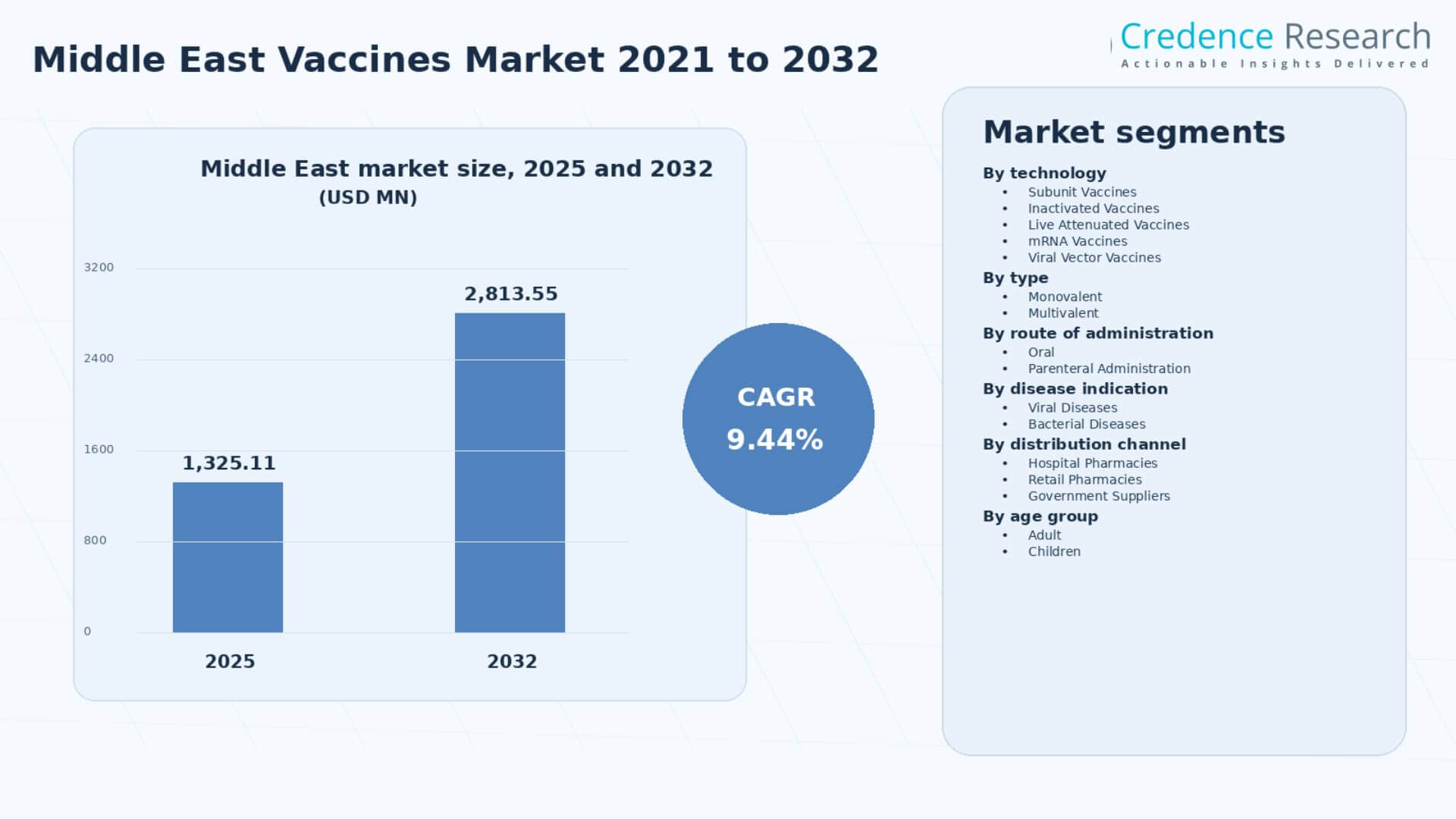
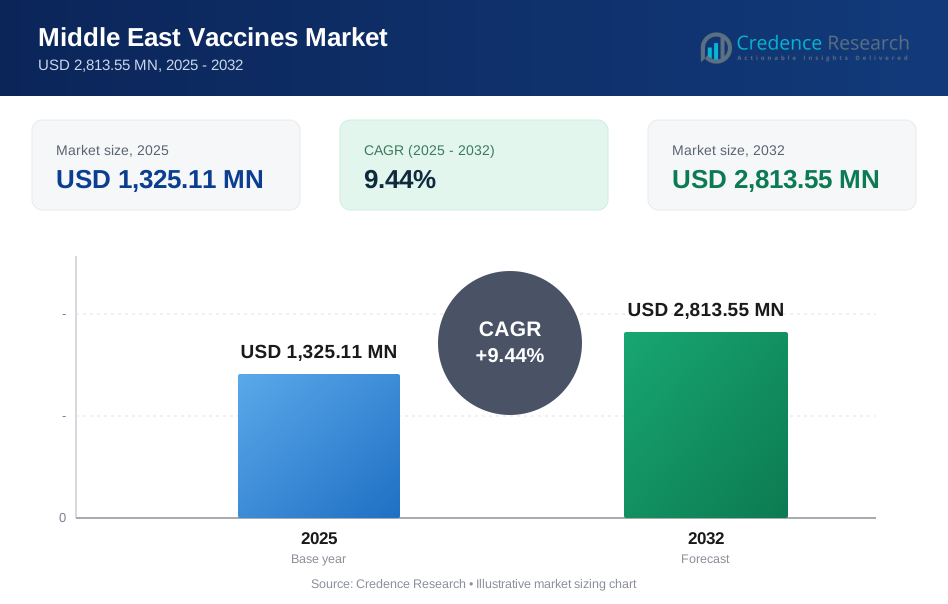
The Middle East Vaccines Market size was valued at USD 873.98 MN in 2021 and reached USD 1,325.11 MN in 2025. It is anticipated to reach USD 2,813.55 MN by 2032, growing at a CAGR of 9.44% during the forecast period.
| REPORT ATTRIBUTE | DETAILS |
|---|---|
| Historical Period | 2021-2024 |
| Base Year | 2025 |
| Forecast Period | 2026-2032 |
| Middle East Vaccines Market Size 2025 | USD 1,325.11 million |
| Middle East Vaccines Market, CAGR | 9.44% |
| Middle East Vaccines Market Size 2032 | USD 2,813.55 million |
Middle East Vaccines Market Insights
- Market growth is supported by national immunization programs, Hajj and Umrah vaccination requirements, pediatric catch-up campaigns, adult vaccination demand, respiratory disease prevention and broader use of advanced vaccine technologies.
- Inactivated Vaccines hold a strong position because they remain widely used in routine immunization, travel health, influenza prevention and government-led vaccination programs.
- Parenteral Administration remains the leading route because most pediatric, adult, respiratory, meningococcal, pneumococcal and COVID-19 vaccines are delivered by injection.
- Government Suppliers remain the leading distribution channel because public procurement, national vaccine schedules and mass immunization campaigns shape vaccine access across the region.
Middle East Vaccines Market Segment Insights
By technology
By technology, Inactivated Vaccines held a strong position in 2025 because national immunization schedules, influenza vaccination, polio vaccination and travel-related vaccines rely heavily on established inactivated platforms. Subunit Vaccines are gaining demand through influenza, recombinant respiratory and other protein-based vaccine formats. Live Attenuated Vaccines remain important in pediatric schedules and outbreak prevention for selected viral diseases. mRNA Vaccines gained market relevance after COVID-19 and continue to support seasonal variant-linked vaccine updates. Viral Vector Vaccines remain relevant for pandemic preparedness and selected infectious disease programs. Growth across technologies will depend on procurement policy, regulatory approval, cold-chain capacity, disease burden and public confidence.
By type
By type, Multivalent held a strong position in 2025 because health systems prefer vaccines that protect against multiple strains, serotypes or diseases within a single product. Multivalent vaccines support pediatric schedules, meningococcal protection, pneumococcal vaccination, influenza coverage and combination immunization programs. Monovalent vaccines remain relevant where disease targets are strain-specific, outbreak-focused or platform-specific. COVID-19 variant-adapted vaccines and selected travel vaccines can support Monovalent demand depending on official recommendations. Multivalent products will remain important as governments seek fewer clinic visits, simpler logistics and broader disease protection. Adoption will depend on pricing, national schedules, supplier availability and cold-chain requirements.
By route of administration
By route of administration, Parenteral Administration held the strongest position in 2025 because most vaccines are administered through intramuscular or subcutaneous injection. Hospital Pharmacies, primary care clinics, government vaccination centers and travel health facilities rely on injectable vaccines for children and adults. Oral remains smaller but important for selected vaccines, including oral polio vaccine and certain travel or enteric disease applications. Parenteral Administration will continue to dominate because subunit, inactivated, mRNA and viral vector vaccines are mainly injectable. Growth will depend on age group coverage, booster policies, adult immunization campaigns and vaccination requirements for large gatherings.
By disease indication
By disease indication, Viral Diseases held the strongest position in 2025 because influenza, COVID-19, measles, mumps, rubella, hepatitis, polio and HPV prevention drive broad vaccine demand. Viral vaccine use is supported by pediatric schedules, adult boosters, travel health, outbreak response and respiratory disease prevention. Bacterial Diseases remain important due to pneumococcal, meningococcal, diphtheria, tetanus, pertussis and other routine immunization programs. Hajj and Umrah requirements also strengthen bacterial vaccine demand, especially for meningococcal vaccination. Both segments will grow as governments improve coverage, update schedules and expand adult vaccination programs.
By distribution channel
By distribution channel, Government Suppliers held the strongest position in 2025 because vaccines are largely procured through ministries of health, national immunization programs and public-sector tenders. Government channels support pediatric immunization, catch-up campaigns, school-based programs and mass vaccination drives. Hospital Pharmacies remain important for adult vaccination, travel health, specialty vaccines and high-risk patient care. Retail Pharmacies are gaining relevance in private markets where adult influenza, COVID-19 and travel vaccines are offered through pharmacy-linked channels. Growth will favor channels with reliable cold-chain logistics, appointment systems, vaccine traceability and public health reporting.
By age group
By age group, Children held a strong position in 2025 because routine immunization programs prioritize pediatric protection against viral and bacterial diseases. Pediatric schedules support demand for inactivated, live attenuated, subunit and multivalent vaccines. Adult vaccination is gaining momentum due to influenza, COVID-19 boosters, RSV prevention, pneumococcal vaccination, travel vaccination and Hajj-related requirements. Aging populations in Gulf markets and high-risk adult groups will support Adult segment growth. Age group dynamics will depend on public procurement, private insurance coverage, national recommendations, pharmacy participation and awareness of adult vaccine-preventable disease risk.
Key Market Drivers
Routine immunization and zero-dose catch-up demand
Routine immunization and zero-dose catch-up demand represent major growth drivers for the Middle East Vaccines Market. National programs continue to prioritize pediatric vaccination against viral and bacterial diseases, while catch-up campaigns address gaps left by conflict, displacement and pandemic-era disruption.
WHO’s Eastern Mediterranean Region campaign for World Immunization Week 2025 said 14.5 million children worldwide did not receive any routine vaccine dose in 2023, including nearly 3 million children in the Eastern Mediterranean Region, and highlighted UNICEF and WHO support for a Syria Ministry of Health-led campaign to reach 3.4 million children. This burden supports demand for Children, Government Suppliers, Inactivated Vaccines, Live Attenuated Vaccines and Multivalent products. Governments are expected to remain central buyers as countries seek to recover missed immunization and prevent outbreaks.
Global vaccine-preventable disease gaps
Global vaccine-preventable disease gaps support sustained demand for vaccines in the Middle East because the region remains exposed to cross-border movement, conflict-related access barriers and disease importation risk.
WHO reported that 13.5 million children globally missed any vaccination in 2025, DTP3 coverage was 85% and measles first-dose coverage was 84%, while nearly 21 million children missed their routine first measles dose. WHO also reported that 13.5 million infants did not receive an initial DTP dose and 6 million were partially vaccinated in 2025. These gaps reinforce the need for pediatric schedules, catch-up campaigns, outbreak response and government-led procurement. The driver supports Viral Diseases, Bacterial Diseases, Children and Government Suppliers through 2032.
Hajj and mass-gathering vaccination requirements
Hajj and mass-gathering vaccination requirements strengthen vaccine demand in the Middle East, especially in Saudi Arabia and neighboring travel markets. Large gatherings require preventive measures against meningococcal disease, influenza, COVID-19 and other infectious diseases.
Saudi Arabia’s Ministry of Health launched the Hajj 1447H vaccination campaign in February 2026, requiring the meningococcal vaccine for pilgrims and health care practitioners without a dose in the past five years and recommending seasonal influenza and COVID-19 vaccination under defined timing rules. The ministry also confirmed in May 2026 that the meningococcal vaccine was mandatory for Hajj workers and that vaccination status was tied to work permit readiness. This driver supports Adult vaccination, Bacterial Diseases, Viral Diseases and Government Suppliers.
Adult vaccination and respiratory disease prevention
Adult vaccination and respiratory disease prevention are gaining importance as countries expand protection beyond childhood schedules. Influenza, COVID-19, RSV, pneumococcal disease and travel-related vaccination are increasing demand among older adults, high-risk patients and large-gathering participants.
GSK reported 2025 Vaccines sales of £9.2 billion, up 2%, with Shingrix at £3.6 billion, meningitis vaccines at £1.6 billion and Arexvy at £0.6 billion. Pfizer said it delivered the 3-billionth dose of Prevnar by the end of 2025 and produces about 45 billion doses of more than 500 medicines and vaccines each year for about 200 countries and territories. This scale supports broader access to adult and pediatric vaccines through hospital, retail and government channels.
Key Trends and Opportunities
mRNA vaccine platforms remain strategically relevant
mRNA vaccine platforms remain strategically relevant as manufacturers update COVID-19 vaccines and explore broader infectious disease applications. Pfizer and BioNTech received FDA approval for an LP.8.1-adapted monovalent COMIRNATY formula for adults aged 65 and older and individuals aged 5 through 64 with risk conditions, and the companies said 5 billion doses of the Pfizer-BioNTech COVID-19 vaccine had been distributed globally. BioNTech also reported Phase 3 data showing at least a fourfold increase in LP.8.1-neutralizing antibody titers after the 2025-2026 formula. This trend supports mRNA Vaccines, Monovalent products, Viral Diseases and Adult vaccination.
Adult respiratory vaccines expand
Adult respiratory vaccines are expanding as health systems place more emphasis on influenza, COVID-19, RSV and pneumococcal prevention. GSK said the European Commission approved Arexvy for adults aged 18 years and older in Europe and reported that Arexvy was already approved for adults aged 60 and older in more than 65 countries and for adults aged 50–59 at increased risk in more than 60 countries. While this approval is outside the Middle East, it shows how adult respiratory vaccine indications are widening globally. The trend creates opportunities for Hospital Pharmacies, Retail Pharmacies and private providers as high-risk adult vaccination becomes more structured.
Government-led procurement strengthens supply resilience
Government-led procurement is strengthening supply resilience as countries prioritize vaccine availability, national preparedness and reliable cold-chain systems. Government Suppliers will remain the most important channel because childhood schedules, mass campaigns and public health requirements depend on centralized procurement. Hajj vaccination campaigns also show how governments can drive seasonal and event-linked vaccine demand. This trend creates opportunities for manufacturers with broad portfolios, tender experience, reliable supply and regional distribution partners. Supplier differentiation will depend on pricing, delivery performance, cold-chain quality, product breadth and public-sector relationships.
Key Market Challenges
Cold-chain and logistics complexity
Cold-chain and logistics complexity remain key challenges for the Middle East Vaccines Market. Vaccines require temperature-controlled storage, validated transport, trained staff and reliable inventory systems. mRNA Vaccines, multidose vials and large-scale campaigns can add operational complexity. Remote areas, conflict-affected locations and high-temperature climates raise handling risk. Government Suppliers, Hospital Pharmacies and Retail Pharmacies must maintain quality from procurement to administration. Investments in cold-chain monitoring, digital stock systems and trained vaccinators will remain essential.
Vaccine hesitancy and misinformation
Vaccine hesitancy and misinformation can reduce uptake across pediatric and adult programs. Concerns about safety, side effects, religious acceptability and misinformation can affect vaccination behavior, especially during new vaccine introductions or booster campaigns. Adult vaccination faces additional barriers because many people view vaccines as childhood products unless national campaigns clearly explain risk. Health authorities, physicians, pharmacists and community leaders must communicate evidence clearly. Companies and governments need transparent safety information, culturally appropriate education and strong pharmacovigilance systems to maintain trust.
Uneven access across conflict-affected markets
Uneven access across conflict-affected markets can slow market growth and widen immunization gaps. Countries facing displacement, supply disruption or weakened health infrastructure may struggle to maintain routine vaccination, reach zero-dose children and manage outbreaks. Government Suppliers and donor-supported programs become critical in these settings. Security conditions, funding gaps, logistics constraints and workforce shortages can delay campaigns. This challenge affects Children, Viral Diseases, Bacterial Diseases and public procurement. Regional coordination and international support will remain important to improve access.
Regional Analysis
Saudi Arabia
Saudi Arabia leads the Middle East Vaccines Market due to strong public health infrastructure, large pilgrimage-related vaccination demand and high government procurement capacity. Hajj and Umrah vaccination requirements support recurring demand for meningococcal, influenza, COVID-19 and other recommended vaccines. The Ministry of Health’s 2026 Hajj campaign required meningococcal vaccination for eligible pilgrims and practitioners and recommended seasonal influenza and COVID-19 vaccination, supporting Adult and Government Suppliers segments. Hospital Pharmacies and primary health care centers also support adult vaccination access through digital appointment systems. Saudi Arabia will remain a major regional demand center through 2032.
United Arab Emirates
The United Arab Emirates represents a high-value vaccine market supported by strong health care infrastructure, private health care access, travel health demand and digital health systems. Pediatric vaccination remains central through public health programs, while adult vaccination is supported by influenza, COVID-19, travel, occupational health and high-risk patient needs. Hospital Pharmacies and private clinics play a strong role in adult and travel vaccination, while government procurement supports national schedules. Retail Pharmacies may gain relevance where policy allows vaccine administration and refill-linked preventive care. Growth will depend on national recommendations, insurance coverage, pharmacy participation and supplier availability.
Qatar, Kuwait, Bahrain and Oman
Qatar, Kuwait, Bahrain and Oman represent steady vaccine markets supported by public health programs, government procurement and high health care access levels. Pediatric immunization remains the largest demand base, while adult vaccination is supported by influenza, travel health, COVID-19 boosters and large-gathering exposure risk. Government Suppliers remain central because ministries of health manage routine schedules and public campaigns. Hospital Pharmacies support high-risk patients and specialty vaccines. These markets will remain attractive for premium vaccine suppliers due to strong purchasing capacity, public-sector organization and growing interest in adult preventive care.
Israel
Israel represents an advanced vaccine market supported by digital health infrastructure, strong immunization systems and rapid adoption of new public health technologies. Pediatric schedules and adult vaccination programs support demand across viral and bacterial disease prevention. mRNA Vaccines gained strong relevance during the COVID-19 era and continue to support booster and preparedness strategies. Hospital Pharmacies and health maintenance organizations play a major role in distribution and monitoring. Growth will depend on national advisory recommendations, real-world evidence, population risk and procurement decisions. Israel remains strategically important for vaccine surveillance and early adoption models.
Turkey and Iran
Turkey and Iran represent sizable markets with large populations, established immunization systems and demand across pediatric, adult and infectious disease prevention. Public procurement supports routine vaccines, while private and hospital channels support selected adult and specialty vaccines. Local manufacturing and regional procurement strategies may shape competition over time. Viral Diseases remain the largest indication, but Bacterial Diseases gain importance through pneumococcal, meningococcal and other routine vaccines. Growth will depend on economic conditions, currency pressure, public budgets, domestic supply policy and access to multinational portfolios.
Rest of Middle East
Rest of Middle East includes markets with different levels of health care access, vaccine coverage and political stability. Jordan and Lebanon support demand through public and private health systems, while Iraq, Syria, Yemen and Palestinian territories face access challenges related to conflict, displacement and funding constraints. Catch-up campaigns and donor-backed programs are important in lower-access markets. Government Suppliers remain critical, while Hospital Pharmacies support high-risk and specialty vaccination. Growth will depend on routine immunization recovery, international support, cold-chain resilience, security conditions and procurement capacity.
Report Attribute Details
| Report Attribute | Details |
| Historical Period | 2021–2024 |
| Base Year | 2025 |
| Forecast Period | 2025–2032 |
| Market Size in 2021 | USD 873.98 MN |
| Market Size in 2025 | USD 1,325.11 MN |
| Market Size in 2032 | USD 2,813.55 MN |
| CAGR | 9.44% |
| Segments Covered | Technology, Type, Route Of Administration, Disease Indication, Distribution Channel, Age Group and Geography |
| Key Companies Covered | Serum Institute of India Pvt. Ltd., Sanofi, Merck & Co., Inc., Pfizer Inc., AstraZeneca, GSK plc, Sinovac Biotech Ltd., Chongqing Zhifei Biological Products Co., Ltd., Johnson & Johnson and BioNTech SE |
Middle East Vaccines Market segmentations
By Technology
- Subunit Vaccines
- Inactivated Vaccines
- Live Attenuated Vaccines
- mRNA Vaccines
- Viral Vector Vaccines
By Type
- Monovalent
- Multivalent
By Route Of Administration
- Oral
- Parenteral Administration
By Disease Indication
- Viral Diseases
- Bacterial Diseases
By Distribution Channel
- Hospital Pharmacies
- Retail Pharmacies
- Government Suppliers
By Age Group
- Adult
- Children
Key Players
- Serum Institute of India Pvt. Ltd.
- Sanofi
- Merck & Co., Inc.
- Pfizer Inc.
- AstraZeneca
- GSK plc
- Sinovac Biotech Ltd.
- Chongqing Zhifei Biological Products Co., Ltd.
- Johnson & Johnson
- BioNTech SE
Recent Developments
- In February 2026, Saudi Arabia’s Ministry of Health launched the Hajj 1447H vaccination campaign and required the meningococcal vaccine for pilgrims and health care practitioners who had not received it within the past five years.
- In May 2026, Saudi Arabia’s Ministry of Health confirmed that the meningococcal vaccine was mandatory for Hajj 1447H workers and recommended seasonal influenza and COVID-19 vaccines to strengthen preparedness.
- In September 2025, Pfizer and BioNTech announced Phase 3 data for their LP.8.1-adapted COVID-19 vaccine 2025-2026 formula, reporting at least a fourfold increase in neutralizing antibody titers in evaluated adult cohorts.
- In February 2026, GSK reported 2025 Vaccines sales of £9.2 billion, including Shingrix at £3.6 billion, meningitis vaccines at £1.6 billion and Arexvy at £0.6 billion.
Report Coverage
The research report offers an in-depth analysis based on technology, type, route of administration, disease indication, distribution channel, age group and geography. It details leading market players, providing an overview of their business positioning, vaccine portfolios, technology platforms, adult and pediatric vaccines, public procurement relevance, manufacturing strength and strategic role in the Middle East Vaccines Market. The report includes insights into the competitive environment, market trends, growth drivers, restraints and opportunities. It also examines routine immunization, zero-dose recovery, Hajj vaccination requirements, adult respiratory vaccine demand, mRNA vaccine updates, government procurement and cold-chain infrastructure as major factors shaping market development. The report assesses the impact of logistics complexity, vaccine hesitancy, conflict-related access gaps and policy variation on market growth. It provides strategic recommendations for vaccine manufacturers, ministries of health, hospital systems, retail pharmacy networks, government suppliers, distributors, investors and new entrants seeking to navigate Middle East vaccine demand and access pathways.
Future Outlook
- Demand for vaccines will continue to rise as Middle East governments expand routine immunization, adult vaccination and outbreak prevention programs.
- Inactivated Vaccines will remain important due to broad use in routine schedules, influenza vaccination and travel-related prevention.
- Subunit Vaccines will grow as respiratory, meningococcal, HPV and other targeted vaccines gain wider use.
- mRNA Vaccines will remain strategically relevant for COVID-19 variant updates and future infectious disease preparedness.
- Multivalent vaccines will gain demand as governments seek broader protection and simplified immunization schedules.
- Parenteral Administration will remain dominant because most modern vaccines require injection.
- Viral Diseases will remain the largest disease indication due to influenza, COVID-19, measles, hepatitis, polio and HPV prevention.
- Government Suppliers will remain the leading distribution channel due to public procurement and mass campaign responsibility.
- Adult vaccination will grow through influenza, COVID-19, RSV, pneumococcal and Hajj-related vaccination.
- Competition will increase as companies compete on portfolio breadth, supply reliability, tender pricing, cold-chain support, regulatory approvals and public-sector partnerships.
Request a Free Sample
Fill in your details and we'll send you a free sample report.
- Sample data tables & charts
- Research methodology
Need a Custom Version of This Report?
Tailor the scope, geography, or segments to your exact requirements.
- Custom geography or segment scope
- Direct access to our analyst team
Frequently Asked Questions
What is the current market size for the Middle East Vaccines Market and what is its projected size in 2032?
At what CAGR is the Middle East Vaccines Market projected to grow?
Which technology segment is expected to lead the market?
Which disease indication supports strong market demand?
Which distribution channel leads the market?
Who are the leading companies in the market?
Which country leads the Middle East market?
Table of Content
Chapter 1. Report Introduction
- 1.1 Report Description & Purpose
- 1.1.1 Report Title & Market Definition
- 1.1.2 Unique Selling Propositions (USP) & Key Differentiators
- 1.1.3 Value Proposition for Stakeholders
- 1.2 Research Objectives
- 1.2.1 Market Sizing Objectives (Volume & Revenue)
- 1.2.2 Segmentation Objectives
- 1.2.3 Competitive Intelligence Objectives
- 1.2.4 Forecast & Scenario Objectives
- 1.3 Report Scope
- 1.3.1 Middle East Vaccines Scope – Types & Subtypes Covered
- 1.3.2 Geographic Scope – Regions & Countries Covered
- 1.3.3 Historical Period, Base Year & Forecast Period (2025; forecast to 2032)
- 1.3.4 Inclusions & Exclusions
- 1.4 HS Code & Classification Framework
- 1.5 Currency, Units & Pricing Basis
- 1.6 Target Stakeholders
- 1.7 Limitations & Assumptions
Chapter 2. Executive Summary
- 2.1 Global Middle East Vaccines Market Snapshot
- 2.1.1 Market Size – Historical (2025) & Forecast (2025-2032) (2025: USD 1,325.11 MN → 2032: USD 2,813.55 MN)
- 2.1.2 Volume & Revenue – Global Totals
- 2.1.3 Key Market Highlights – Top Five Facts
- 2.2 Middle East Vaccines Market Segmentation Snapshot
- 2.2.1 Market Split by Region – 2025 vs. 2032
- 2.3 Competitive Snapshot
- 2.3.1 Top 10 Players by Revenue Share – 2025
- 2.3.2 Top 10 Players by Volume Share – 2025
- 2.3.3 Recent Strategic Developments (18-Month Summary)
- 2.4 Key Investment Highlights & Strategic Conclusions
Chapter 3. Middle East Vaccines Market Dynamics & Industry Analysis
- 3.1 Market Overview & Context
- 3.1.1 Middle East Vaccines Market Position in the Broader Automotive Value Chain
- 3.1.2 OEM vs. Replacement Market Dynamics
- 3.1.3 Market Maturity & Development Stage by Region
- 3.2 Middle East Vaccines Market Drivers
- 3.3 Middle East Vaccines Market Restraints & Challenges
- 3.4 Middle East Vaccines Market Opportunities
- 3.5 Porter's Five Forces Analysis
- 3.5.1 Threat of New Entrants
- 3.5.2 Bargaining Power of Suppliers
- 3.5.3 Bargaining Power of Buyers
- 3.5.4 Threat of Substitutes
- 3.5.5 Competitive Rivalry – Intensity Assessment
- 3.6 Middle East Vaccines Value Chain Analysis
- 3.6.1 Upstream – Raw Material/Input Suppliers
- 3.6.1.1 Raw Material/Input 1
- 3.6.1.2 Raw Material/Input 2
- 3.6.1.3 Raw Material/Input 3
- 3.6.2 Midstream – Production/Manufacturing/Service Delivery
- 3.6.2.1 Production/Process Overview
- 3.6.2.2 Key Facility Locations & Capacity by Manufacturer
- 3.6.3 Downstream – Distribution & End Consumer
- 3.6.3.1 Primary Channel – B2B/OEM
- 3.6.3.2 Secondary Channels – Dealer, Retail, Online, Direct
- 3.6.4 Value Chain Profitability Analysis
- 3.6.1 Upstream – Raw Material/Input Suppliers
- 3.7 PESTEL Analysis
- 3.7.1 Political Factors
- 3.7.2 Economic Factors
- 3.7.3 Social Factors
- 3.7.4 Technological Factors
- 3.7.5 Environmental Factors
- 3.7.6 Legal Factors
- 3.8 Middle East Vaccines Supply Chain Analysis
- 3.8.1 Raw Material/Input Supply Risk Assessment
- 3.8.2 Manufacturing Concentration Risk (Geographic Exposure)
- 3.8.3 Trade Disruption Impact Analysis
- 3.9 Regulatory & Policy Landscape
Note: The regulatory and policy landscape section covers regulations based on their applicability to the market, Middle East Vaccines category, geography, and scope of the study. Only regulatory frameworks with a material impact on operations, compliance, trade, sustainability, or market access are analyzed in detail.
Chapter 4. Key Investment Pockets & Opportunity Analysis
- 4.1 Middle East Vaccines Market Attractiveness Analysis
- 4.1.1 By Region – Investment Attractiveness Matrix (Volume × CAGR)
- 4.2 Absolute Revenue Growth Opportunity
- 4.2.1 By Region – Absolute USD Growth Through 2032
- 4.3 Incremental Volume Opportunity
- 4.3.1 By Region – Incremental Volume Through 2032
- 4.3.2 Segment – Incremental Volume
- 4.4 Emerging Submarket Opportunity Deep Dive (Subject to Applicability)
- 4.5 Emerging Market Opportunity Scorecards
- 4.5.1 United States
- 4.5.2 Europe
- 4.5.3 Asia
- 4.5.4 Middle East & Africa
Note: Emerging Market Opportunity Scorecards will be included based on relevance and strategic importance. Regions listed are indicative and may vary depending on data availability and market dynamics.
Chapter 5. Middle East Vaccines Import-Export Analysis & Trade Flows
- 5.1 Global Trade Overview
- 5.1.1 Global Export Value by Country (2025)
- 5.1.2 Global Export Volume by Country (2025)
- 5.1.3 Global Import Value by Country (2025)
- 5.1.4 Global Import Volume by Country (2025)
- 5.1.5 Net Trade Balance by Country (2025)
- 5.2 Export Analysis – Segment
- 5.2.1 Type 1 (HS Code)
- 5.2.2 Type 2 (HS Code)
- 5.2.3 Type 3 (HS Code)
- 5.2.4 Type 4 (HS Code)
- 5.2.5 Type 5 (HS Code)
- 5.3 Import Analysis – Segment
- 5.3.1 Type 1 (HS Code)
- 5.3.2 Type 2 (HS Code)
- 5.3.3 Type 3 (HS Code)
- 5.3.4 Type 4 (HS Code)
- 5.3.5 Type 5 (HS Code)
- 5.4 Average Unit Trade Prices
- 5.4.1 Average Export Price – Segment & Country
- 5.4.2 Average Import Price – Segment & Source Country
- 5.4.3 Price Trends (2025)
- 5.5 Key Trade Route Analysis
- 5.5.1 Trade Route 1
- 5.5.2 Trade Route 2
- 5.5.3 Trade Route 3
- 5.5.4 Trade Route 4
- 5.5.5 Trade Route 5
- 5.6 Trade Policy Impact Assessment
- 5.6.1 US Anti-Dumping & Section 301 Tariffs
- 5.6.2 EU Customs Union Impact
- 5.6.3 Major Free Trade Agreements
- 5.6.4 USMCA Rules of Origin
Note: Trade policy analysis will be included only where relevant to the Middle East Vaccines market.
Chapter 6. Competitive Landscape & Company Benchmarking
- 6.1 Middle East Vaccines Market Concentration & Structure
- 6.1.1 Herfindahl-Hirschman Index (HHI) – vs. 2025
- 6.1.2 Tier 1, Tier 2 & Tier 3 Market Structure
- 6.1.3 Global, Regional & Local Player Dynamics
- 6.2 Middle East Vaccines Market Share Analysis – 2025
- 6.2.1 Global Revenue Share by Company
- 6.2.2 Global Volume Share by Company
- 6.2.3 Regional Revenue Share
- 6.2.4 Market Share Evolution ( vs. 2025)
- 6.2.5 OEM Segment Share by Company
- 6.2.6 Replacement Segment Share by Company
- 6.3 Production/Delivery Capacity & Facility Analysis
- 6.3.1 Global Installed Capacity
- 6.3.2 Capacity Utilization Rates
- 6.3.3 Production/Output Volume
- 6.3.4 Facility Locations & Capacity Map
- 6.3.5 Planned Capacity Additions
- 6.4 Middle East Vaccines Competitive Benchmarking Matrix
- 6.4.1 Revenue, Volume, CAGR & Profitability Comparison
- 6.4.2 Channel Revenue Mix
- 6.4.3 Geographic Revenue Exposure
- 6.4.4 R&D Intensity
- 6.4.5 Sustainability Maturity
- 6.5 Strategic Developments in Middle East Vaccines (Last 24 Months)
- 6.5.1 Mergers, Acquisitions & Divestments
- 6.5.2 New Middle East Vaccines Launches
- 6.5.3 Facility Expansions
- 6.5.4 Strategic Alliances, Joint Ventures & Partnerships
- 6.5.5 Distribution Expansion & Market Entry
- 6.5.6 Sustainability & ESG Initiatives
- 6.6 Competitive Strategy Mapping
- 6.6.1 Leader, Challenger, Follower & Niche Classification
- 6.6.2 Pricing Strategy Comparison
- 6.6.3 Channel Strategy Matrix
Note: Strategic developments are included based on their materiality and the availability of reliable information.
Chapter 7. Global Middle East Vaccines Market – By Distribution Channel
- 7.1 Segment Overview
- 7.1.1 Volume & Revenue Split by Channel (2025 & 2032)
- 7.1.2 Channel Mix Evolution (2025-2032)
Chapter 8. Regional Market Analysis – Global Overview
- 8.1 Global Regional Overview
- 8.1.1 Regional Volume Share
- 8.1.2 Regional Revenue Share
- 8.1.3 Regional Volume by Region
- 8.1.4 Regional Revenue by Region
- 8.1.5 Regional Forecast Through 2032
- 8.2 Cross-Regional Segment Analysis
- 8.2.1 By Distribution Channel
- 8.2.2 By Brand/Price Tier
Chapter 9. North America Middle East Vaccines Market
- 9.1 United States
- 9.2 Canada
- 9.3 Mexico
Chapter 10. Europe Middle East Vaccines Market
- 10.1 Germany
- 10.2 France
- 10.3 Italy
- 10.4 United Kingdom
- 10.5 Spain
- 10.6 Poland
- 10.7 Russia
- 10.8 Netherlands
- 10.9 Belgium
- 10.10 Sweden
- 10.11 Denmark
- 10.12 Norway
- 10.13 Rest of Europe
Chapter 11. Asia Pacific Middle East Vaccines Market
- 11.1 China
- 11.2 India
- 11.3 Japan
- 11.4 South Korea
- 11.5 Thailand
- 11.6 Indonesia
- 11.7 Vietnam
- 11.8 Malaysia
- 11.9 Australia
- 11.10 Rest of Asia Pacific
Chapter 12. Latin America Middle East Vaccines Market
- 12.1 Brazil
- 12.2 Argentina
- 12.3 Colombia
- 12.4 Chile
- 12.5 Rest of Latin America
Chapter 13. Middle East Middle East Vaccines Market
- 13.1 Saudi Arabia
- 13.2 United Arab Emirates
- 13.3 Turkey
- 13.4 Israel
- 13.5 Iran
- 13.6 Rest of the Middle East
Chapter 14. Africa Middle East Vaccines Market
- 14.1 South Africa
- 14.2 Egypt
- 14.3 Nigeria
- 14.4 Morocco
- 14.5 Rest of Africa
Chapter 15. Middle East Vaccines Company Profiles
- 15.1 [Company 01]
- 15.1.1 Company Overview
- 15.1.2 Key Management Personnel
- 15.1.3 Products & Services Portfolio
- 15.1.4 Financial Performance
- 15.1.5 Key Market Focus & Geographic Presence
- 15.1.6 Recent Developments & Strategic Initiatives
Note: The company profile list is preliminary and may change based on research findings, market developments, data availability, and client requirements.
Chapter 16. Appendices
- Appendix A – List of Abbreviations & Acronyms
- Appendix B – Industry Classification Code Reference – Full Series
- Appendix C – Production & Capacity Data Tables
- Appendix D – End-Use & Demand Base Tables
- Appendix E – Consumption & Replacement Rate Assumptions
- Appendix F – ASP Reference Tables
- Appendix G – Manufacturing & Facility Database
- Appendix H – Import-Export Data Tables
- Appendix I – Regulatory Summary Tables
- Appendix J – Primary Research Participant List (Anonymized)
- Appendix K – Primary Research Questionnaire Framework
- Appendix L – Data Sources & Bibliography
- Appendix M – Market Size Divergence & Source Comparison
Chapter 17. Research Methodology
- 17.1 Research Framework & Philosophy
- 17.2 Secondary Research – Sources, Hierarchy & Data Extraction
- 17.3 Data Modeling – Bottom-Up & Top-Down Market Sizing
- 17.4 Primary Research – Stakeholder Framework, LOI & Sample Sizes
- 17.5 Forecast Methodology – Regression, Scenario & Sensitivity Analysis
- 17.6 Quality Control – Four-Layer Validation Framework
- 17.7 Limitations & Standard Assumptions
- 17.8 Disclaimer
