
Market Overview
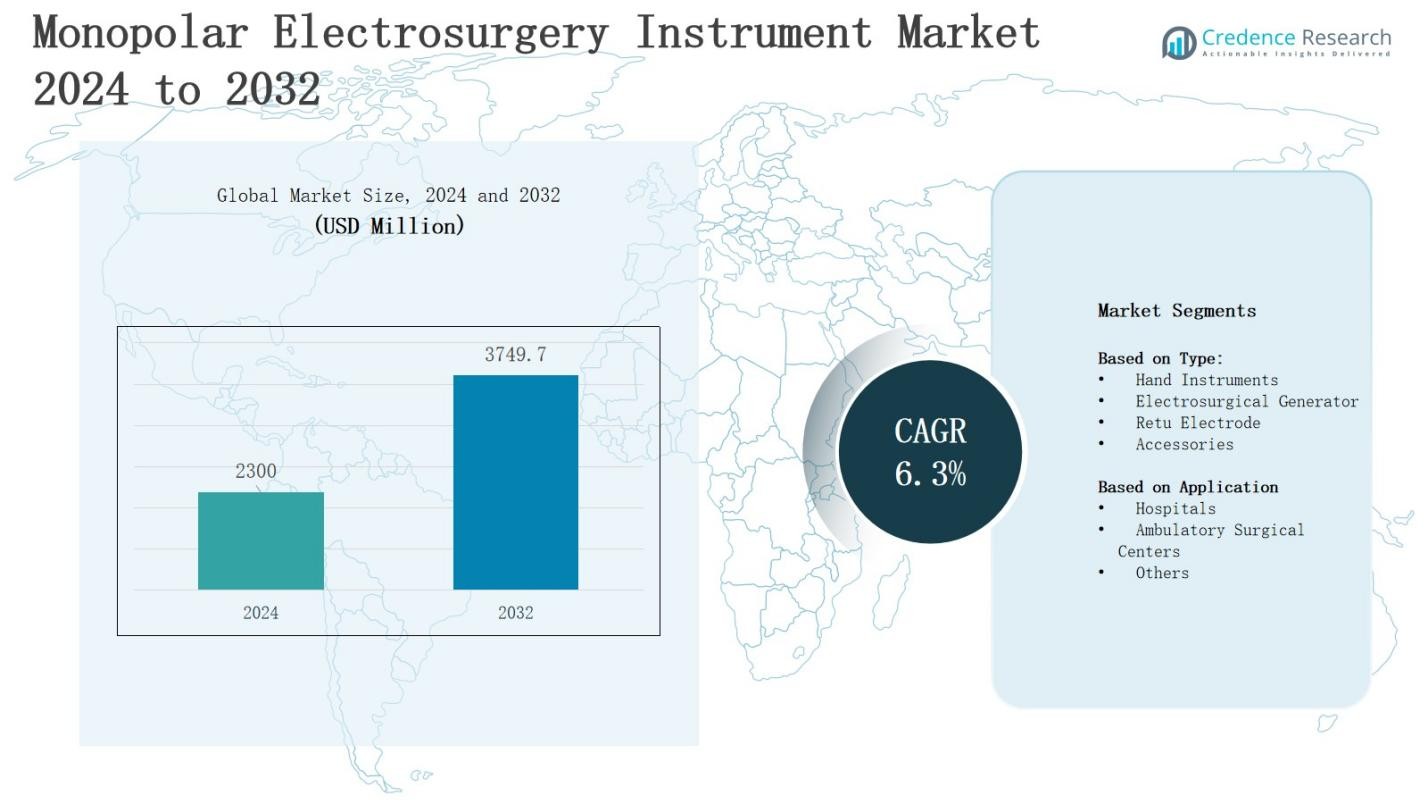
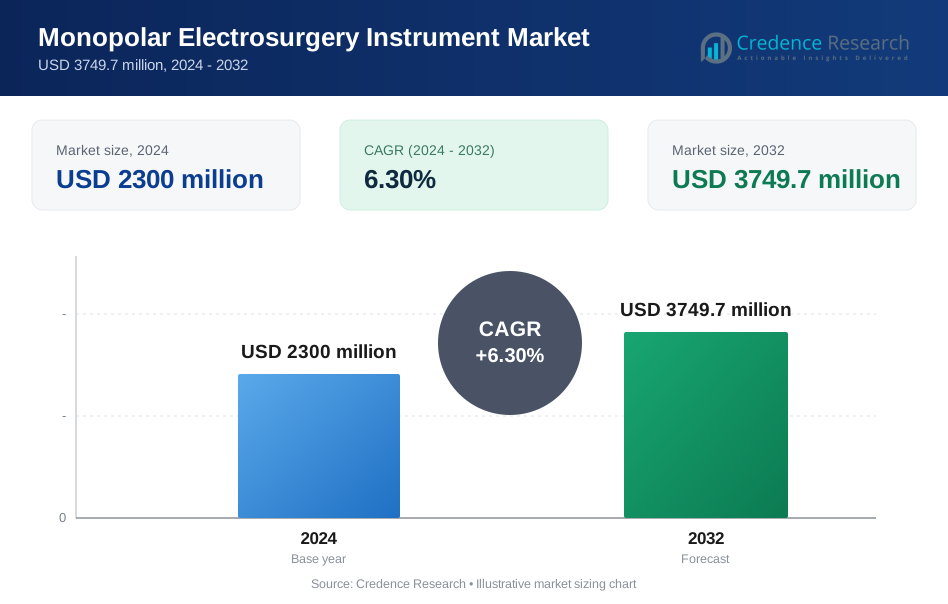
The Monopolar Electrosurgery Instrument Market is projected to grow from USD 2300 million in 2024 to USD 3749.7 million by 2032, registering a CAGR of 6.3% during the forecast period.
| REPORT ATTRIBUTE | DETAILS |
|---|---|
| Historical Period | 2020-2024 |
| Base Year | 2024 |
| Forecast Period | 2025-2032 |
| Monopolar Electrosurgery Instrument Market Size 2024 | USD 2300 Million |
| Monopolar Electrosurgery Instrument Market, CAGR | 6.3% |
| Monopolar Electrosurgery Instrument Market Size 2032 | USD 3749.7 Million |
The monopolar electrosurgery instrument market is driven by rising surgical procedures, growing demand for minimally invasive techniques, and increasing adoption of advanced electrosurgical devices in hospitals and ambulatory surgical centers. Surge in chronic diseases, aging populations, and preference for quicker recovery times strengthen its growth. Technological advancements, including devices with enhanced safety features and precision, are improving outcomes and reducing complications. Market trends highlight integration of digital platforms, adoption in outpatient settings, and expansion in emerging economies due to improved healthcare access. Continuous R&D efforts by key players further support innovation and competitive differentiation in this market.
The monopolar electrosurgery instrument market demonstrates diverse regional dynamics, with North America holding the largest share, followed by Europe and Asia-Pacific as key growth hubs. Latin America and the Middle East & Africa contribute smaller shares but show rising potential with healthcare modernization and expanding access. It is shaped by strong competition from global players including Conmed, Olympus Corporation, Medtronic Plc, KLS Martin, B. Braun Melsungen AG, Stryker, Apyx Medical Corporation, Johnson & Johnson, Integra LifeSciences, Stingray Surgical Products, LLC, and Surgical Holdings.
Market Insights
- The monopolar electrosurgery instrument market will grow from USD 2300 million in 2024 to USD 3749.7 million by 2032, registering a CAGR of 6.3% during the forecast period.
- Rising surgical procedures, aging populations, and demand for minimally invasive techniques drive adoption, while hospitals and ambulatory surgical centers accelerate growth through advanced infrastructure and preference for quicker recovery outcomes.
- Electrosurgical generators dominated with 38% share in 2024, followed by hand instruments at 27%, return electrodes at 20%, and accessories at 15%, reflecting varied clinical utility across surgical settings.
- By application, hospitals led with 61% share, ambulatory surgical centers captured 28%, and others held 11%, showing strong preference for established surgical facilities supported by advanced equipment availability.
- Regionally, North America led with 34%, Europe held 28%, Asia-Pacific reached 24%, Latin America stood at 8%, and Middle East & Africa captured 6%, highlighting broad yet uneven global market presence.
Market Drivers
Rising Demand for Minimally Invasive Surgeries
The monopolar electrosurgery instrument market is supported by the increasing demand for minimally invasive procedures. Patients prefer such surgeries due to shorter hospital stays, reduced blood loss, and faster recovery. Surgeons use monopolar electrosurgery devices for precise cutting and coagulation during various procedures. Growing acceptance of advanced surgical tools in both developed and developing healthcare systems strengthens adoption. It also aligns with healthcare providers’ focus on cost-effective treatment solutions while maintaining high patient safety standards.
- For instance, Medtronic's Valleylab™ electrosurgical generators are used by surgeons to perform monopolar cutting and coagulation during laparoscopic and open surgeries, supporting tissue dissection and hemostasis in a variety of minimally invasive procedures
Growing Prevalence of Chronic Diseases and Aging Population
The monopolar electrosurgery instrument market benefits from the growing burden of chronic diseases such as cancer, cardiovascular disorders, and gastrointestinal conditions. These illnesses often require surgical intervention supported by reliable electrosurgical instruments. Aging populations in major regions further contribute, as elderly patients frequently need surgeries for age-related diseases. It gains importance in ensuring effective surgical management and shorter recovery timelines. Expanding access to healthcare in emerging economies also drives higher procedural volumes.
- For instance, the World Health Organization reported in 2022 that cardiovascular diseases account for approximately 17.9 million deaths annually worldwide, many necessitating surgical treatment where electrosurgical devices are essential for precision and safety.
Technological Advancements in Electrosurgical Devices
The monopolar electrosurgery instrument market experiences strong growth with the integration of advanced technologies. Innovations in energy delivery, precision cutting, and improved safety features enhance surgical outcomes and minimize risks. Manufacturers invest in research and development to create instruments with ergonomic designs and higher efficiency. It enables surgeons to perform complex procedures with greater control. Continuous product innovation strengthens competitive advantage and supports increasing adoption across healthcare facilities worldwide.
Expansion of Outpatient and Ambulatory Surgical Centers
The monopolar electrosurgery instrument market is influenced by the rapid growth of ambulatory surgical centers and outpatient facilities. These centers emphasize efficiency, cost-effectiveness, and reduced patient recovery time. Monopolar electrosurgery instruments support quick procedures in such environments with consistent safety. It encourages broader acceptance of these devices outside traditional hospitals. Rising healthcare expenditure and focus on decentralized surgical care create favorable conditions for expansion, further driving sustained demand across multiple regions.
Market Trends
Integration of Advanced Safety and Precision Features
The monopolar electrosurgery instrument market is witnessing increasing adoption of devices equipped with advanced safety features. Surgeons prefer instruments that minimize collateral tissue damage and ensure precise energy delivery. Companies are innovating with controlled energy settings and improved insulation technologies to enhance patient outcomes. It strengthens the trust of healthcare providers in using these instruments for complex surgeries. Growing awareness of safer surgical practices supports this trend across both developed and emerging regions.
- For instance, Medtronic’s Valleylab FX8 energy platform includes the TissueFect sensing technology, which continuously monitors tissue response to deliver consistent energy while reducing the risk of thermal injury.
Shift Toward Ambulatory and Outpatient Surgical Settings
The monopolar electrosurgery instrument market benefits from the shift toward outpatient and ambulatory care centers. Healthcare systems are focusing on reducing hospital stays while maintaining quality care standards. Instruments designed for portability and cost-effectiveness are increasingly used in these settings. It helps facilities perform high volumes of routine and elective surgeries efficiently. Rising healthcare expenditure and expansion of same-day surgery centers further promote this trend, boosting instrument adoption across multiple specialties.
Adoption of Digital Platforms and Smart Electrosurgery Systems
The monopolar electrosurgery instrument market is evolving with the integration of digital technologies. Smart systems with automated energy control and real-time monitoring improve surgical accuracy. Manufacturers are introducing devices that integrate with hospital IT systems for better procedural tracking and documentation. It supports data-driven clinical decisions and enhances efficiency during surgeries. Growing demand for technologically advanced instruments positions digital adoption as a key trend shaping the competitive landscape.
- For instance, Ethicon, a Johnson & Johnson company, has developed advanced digital electrosurgery platforms with automated energy modulation that enhance surgical precision while linking with electronic medical records for seamless documentation.
Expansion in Emerging Economies with Healthcare Modernization
The monopolar electrosurgery instrument market is expanding rapidly in emerging economies driven by rising healthcare investments. Countries in Asia-Pacific, Latin America, and the Middle East are modernizing surgical infrastructure to meet rising patient demand. Affordable devices with reliable performance are gaining significant traction in these regions. It supports higher surgical volumes and wider accessibility to advanced care. International manufacturers are partnering with regional distributors, strengthening the availability of electrosurgery instruments across diverse healthcare markets.
Market Challenges Analysis
Risk of Surgical Complications and Safety Concerns
The monopolar electrosurgery instrument market faces challenges due to risks linked with tissue burns, unintended injuries, and electrical hazards. Surgeons and hospitals remain cautious, as improper use can cause complications that impact patient safety. It requires strict adherence to training protocols and safety standards, which can delay adoption in some facilities. Regulatory bodies demand compliance with rigorous guidelines, increasing approval timelines. Growing awareness of potential risks creates hesitation among healthcare providers and limits widespread acceptance.
High Costs and Limited Access in Emerging Markets
The monopolar electrosurgery instrument market encounters barriers related to high device costs and limited access in developing regions. Advanced instruments equipped with safety features often remain expensive for smaller healthcare centers. It restricts usage to well-funded hospitals, leaving rural and low-income areas underserved. Economic constraints in emerging economies reduce purchasing capacity for high-end instruments. Competitive pricing pressure also challenges manufacturers striving to balance affordability with innovation. These factors slow down global market penetration.
Market Opportunities
Growing Adoption in Emerging Healthcare Systems
The monopolar electrosurgery instrument market holds strong opportunities in emerging healthcare systems where surgical volumes are rapidly increasing. Countries in Asia-Pacific, Latin America, and parts of the Middle East are investing heavily in modernizing hospital infrastructure. It creates demand for advanced surgical instruments that ensure efficiency and safety. Expanding insurance coverage and government healthcare initiatives are improving patient access to surgical care. Rising awareness among surgeons and healthcare providers further accelerates adoption in these high-growth regions.
Innovation and Integration of Advanced Technologies
The monopolar electrosurgery instrument market can benefit significantly from ongoing technological innovation. Manufacturers are focusing on integrating advanced safety mechanisms, real-time monitoring, and ergonomic designs. It opens opportunities for premium product segments catering to hospitals and specialized surgical centers. Growing demand for minimally invasive surgeries supports adoption of instruments with enhanced precision. Strategic collaborations between device makers and healthcare facilities encourage faster commercialization. Expanding digital integration also positions this market for long-term growth potential.
Market Segmentation Analysis:
By Type
The monopolar electrosurgery instrument market, by type, is categorized into hand instruments, electrosurgical generators, return electrodes, and accessories. Electrosurgical generators held the dominant share of 38% in 2024, driven by their critical role in providing controlled energy for diverse surgical procedures. Hand instruments accounted for 27% share, supported by their widespread use in routine operations. Return electrodes captured 20% share due to their importance in ensuring patient safety. Accessories represented 15%, reflecting steady demand for complementary components.
- For instance, Ethicon’s Harmonic Ace® hand instruments are frequently utilized in minimally invasive procedures to enable precise tissue dissection alongside electrosurgery tools. Return electrodes captured 20% share due to their importance in ensuring patient safety.
By Application
The monopolar electrosurgery instrument market, by application, is divided into hospitals, ambulatory surgical centers, and others. Hospitals dominated with a 61% share in 2024, attributed to high patient volumes, advanced infrastructure, and adoption of innovative electrosurgical technologies. Ambulatory surgical centers accounted for 28% share, supported by the rising shift toward outpatient procedures and cost-effective care. The others segment held 11% share, representing usage across smaller clinics and specialty centers seeking efficient surgical solutions.
- For instance, the Mayo Clinic integrated Medtronic’s Valleylab™ FT10 energy platform across multiple specialty departments to enhance precision and reduce procedure time.
Segments:
Based on Type:
- Hand Instruments
- Electrosurgical Generator
- Retu Electrode
- Accessories
Based on Application
- Hospitals
- Ambulatory Surgical Centers
- Others
Based on the Geography:
- North America
- U.S.
- Canada
- Mexico
- Europe
- Germany
- France
- U.K.
- Italy
- Spain
- Rest of Europe
- Asia Pacific
- China
- Japan
- India
- South Korea
- South-east Asia
- Rest of Asia Pacific
- Latin America
- Brazil
- Argentina
- Rest of Latin America
- Middle East & Africa
- GCC Countries
- South Africa
- Rest of the Middle East and Africa
Regional Analysis
North America
North America held the largest share of 34% in the monopolar electrosurgery instrument market in 2024. Strong presence of advanced healthcare infrastructure and early adoption of innovative surgical technologies drive regional growth. High prevalence of chronic diseases and growing demand for minimally invasive procedures strengthen the market position. It benefits from favorable reimbursement policies and strong purchasing power among hospitals and surgical centers. Leading manufacturers actively expand portfolios and distribution networks, ensuring consistent market dominance across the region.
Europe
Europe accounted for 28% share in the monopolar electrosurgery instrument market in 2024. Rising number of surgical procedures and increased preference for electrosurgery in complex operations support market expansion. Regulatory focus on patient safety drives the adoption of advanced devices with improved energy control and safety features. It gains momentum from robust public healthcare systems and rising healthcare expenditure. Strong presence of established medical device companies and strategic collaborations continue to boost product availability across major European countries.
Asia-Pacific
Asia-Pacific represented 24% share in the monopolar electrosurgery instrument market in 2024. Rapid growth of healthcare infrastructure, increasing patient population, and rising medical tourism accelerate demand. Emerging economies like China and India invest significantly in hospital modernization and surgical advancements. It benefits from rising awareness about advanced surgical solutions and growing acceptance of minimally invasive techniques. Expansion of private healthcare providers and strong focus on affordability encourage adoption, making Asia-Pacific the fastest-growing region in this market.
Latin America
Latin America accounted for 8% share in the monopolar electrosurgery instrument market in 2024. Growing investments in healthcare modernization and increasing accessibility of surgical services drive regional growth. Brazil and Mexico lead with higher demand, supported by government initiatives and private sector expansion. It benefits from rising surgical volumes in urban centers and broader awareness of advanced surgical technologies. Limited resources in rural areas pose challenges, but rising collaborations with international suppliers enhance market penetration.
Middle East & Africa
The Middle East & Africa captured 6% share in the monopolar electrosurgery instrument market in 2024. Investments in modern hospitals and specialty care centers support market demand. Gulf countries lead adoption due to higher healthcare expenditure and strong focus on advanced treatment solutions. It gains traction with international players entering regional markets through partnerships. Limited healthcare infrastructure in parts of Africa remains a challenge, yet growing government initiatives improve surgical care access and create long-term opportunities.
Key Player Analysis
- Johnson & Johnson
- Conmed
- Stryker
- Olympus Corporation
- Surgical Holdings
- Apyx Medical Corporation
- Medtronic Plc
- Stingray Surgical Products, LLC
- KLS Martin
- Braun Melsungen AG
- Integra LifeSciences
Competitive Analysis
The monopolar electrosurgery instrument market is highly competitive, with global and regional players focusing on innovation, safety, and performance. Key companies such as Conmed, Olympus Corporation, Medtronic Plc, KLS Martin, B. Braun Melsungen AG, Stryker, Apyx Medical Corporation, Johnson & Johnson, Integra LifeSciences, Stingray Surgical Products, LLC, and Surgical Holdings strengthen their positions through continuous product development, strategic collaborations, and distribution expansion. It is influenced by rising demand for minimally invasive surgeries, driving companies to enhance device precision, safety mechanisms, and digital integration. Established players invest in advanced technologies to address surgical complexities, while smaller companies compete by offering cost-effective solutions with niche advantages. The market also reflects strong emphasis on regulatory compliance, pushing firms to meet stringent safety standards. Competitive intensity remains high, as companies pursue mergers, acquisitions, and regional partnerships to expand portfolios and gain access to emerging economies. It highlights a dynamic landscape where innovation, global reach, and pricing strategies play critical roles in determining long-term leadership.
Recent Developments
- In January 2024, Olympus Corporation announced the full market availability of its redesigned ESG-410 Surgical Energy Platform, which offers a comprehensive energy solution for various surgical specialties including monopolar and bipolar modes, advanced energy applications, ultrasonic dissection, and hybrid energy.
- In March 2025, Johnson & Johnson introduced the DUALTO™ surgical energy system, a modular platform designed to power monopolar, bipolar, ultrasonic, and advanced bipolar instruments from a single unit. It reduces footprint by 46% compared to separate generators and offers a dual configuration that allows two surgeons to operate simultaneously from one electrosurgical unit.
- In February 2024, Medtronic introduced a new generation of electrosurgical generators with enhanced energy delivery algorithms aimed at improving surgical precision. This launch adds to their monopolar and bipolar electrosurgery product portfolio.
Report Coverage
The research report offers an in-depth analysis based on Type, Application and Geography. It details leading market players, providing an overview of their business, product offerings, investments, revenue streams, and key applications. Additionally, the report includes insights into the competitive environment, SWOT analysis, current market trends, as well as the primary drivers and constraints. Furthermore, it discusses various factors that have driven market expansion in recent years. The report also explores market dynamics, regulatory scenarios, and technological advancements that are shaping the industry. It assesses the impact of external factors and global economic changes on market growth. Lastly, it provides strategic recommendations for new entrants and established companies to navigate the complexities of the market.
Future Outlook
- Growing demand for minimally invasive surgeries will continue driving adoption across global healthcare facilities.
- Hospitals will maintain dominance, but ambulatory surgical centers will expand rapidly with outpatient procedure growth.
- Technological innovation will focus on safety features, energy control, and enhanced surgical precision worldwide.
- Digital integration and smart electrosurgery systems will improve efficiency and support data-driven surgical decision making.
- Emerging economies will create strong opportunities through healthcare modernization and increasing surgical infrastructure investments.
- Aging populations and chronic disease prevalence will consistently boost surgical volumes requiring electrosurgery instruments.
- Key players will strengthen positions through mergers, acquisitions, and global distribution network expansion strategies.
- Cost-effective instruments will gain traction in developing markets, addressing affordability challenges and wider accessibility.
- Rising awareness about patient safety will drive stricter regulatory compliance and adoption of advanced devices.
- Continuous R&D investments will foster product differentiation, enhancing competitiveness and supporting long-term market growth.
Request a Free Sample
Fill in your details and we'll send you a free sample report.
- Sample data tables & charts
- Research methodology
Need a Custom Version of This Report?
Tailor the scope, geography, or segments to your exact requirements.
- Custom geography or segment scope
- Direct access to our analyst team
Frequently Asked Questions
What is the current market size for monopolar electrosurgery instrument market, and what is its projected size in 2032?
At what Compound Annual Growth Rate is the monopolar electrosurgery instrument market projected to grow between 2025 and 2032?
Which monopolar electrosurgery instrument market segment held the largest share in 2024?
What are the primary factors fueling the growth of the monopolar electrosurgery instrument market?
Who are the leading companies in the monopolar electrosurgery instrument market?
Which region commanded the largest share of the monopolar electrosurgery instrument market in 2024?
Table of Content
Chapter 1. Report Introduction
- 1.1 Report Description & Purpose
- 1.1.1 Report Title & Market Definition
- 1.1.2 Unique Selling Propositions (USP) & Key Differentiators
- 1.1.3 Value Proposition for Stakeholders
- 1.2 Research Objectives
- 1.2.1 Market Sizing Objectives (Volume & Revenue)
- 1.2.2 Segmentation Objectives
- 1.2.3 Competitive Intelligence Objectives
- 1.2.4 Forecast & Scenario Objectives
- 1.3 Report Scope
- 1.3.1 Monopolar Electrosurgery Instrument Scope – Types & Subtypes Covered
- 1.3.2 Geographic Scope – Regions & Countries Covered
- 1.3.3 Historical Period, Base Year & Forecast Period (2024; forecast to 2032)
- 1.3.4 Inclusions & Exclusions
- 1.4 HS Code & Classification Framework
- 1.5 Currency, Units & Pricing Basis
- 1.6 Target Stakeholders
- 1.7 Limitations & Assumptions
Chapter 2. Executive Summary
- 2.1 Global Monopolar Electrosurgery Instrument Market Snapshot
- 2.1.1 Market Size – Historical (2024) & Forecast (2024-2032) (2024: USD 2300 million → 2032: USD 3749.7 million)
- 2.1.2 Volume & Revenue – Global Totals
- 2.1.3 Key Market Highlights – Top Five Facts
- 2.2 Monopolar Electrosurgery Instrument Market Segmentation Snapshot
- 2.2.1 Market Split by Region – 2024 vs. 2032
- 2.3 Competitive Snapshot
- 2.3.1 Top 10 Players by Revenue Share – 2024
- 2.3.2 Top 10 Players by Volume Share – 2024
- 2.3.3 Recent Strategic Developments (18-Month Summary)
- 2.4 Key Investment Highlights & Strategic Conclusions
Chapter 3. Monopolar Electrosurgery Instrument Market Dynamics & Industry Analysis
- 3.1 Market Overview & Context
- 3.1.1 Monopolar Electrosurgery Instrument Market Position in the Broader Automotive Value Chain
- 3.1.2 OEM vs. Replacement Market Dynamics
- 3.1.3 Market Maturity & Development Stage by Region
- 3.2 Monopolar Electrosurgery Instrument Market Drivers
- 3.3 Monopolar Electrosurgery Instrument Market Restraints & Challenges
- 3.4 Monopolar Electrosurgery Instrument Market Opportunities
- 3.5 Porter's Five Forces Analysis
- 3.5.1 Threat of New Entrants
- 3.5.2 Bargaining Power of Suppliers
- 3.5.3 Bargaining Power of Buyers
- 3.5.4 Threat of Substitutes
- 3.5.5 Competitive Rivalry – Intensity Assessment
- 3.6 Monopolar Electrosurgery Instrument Value Chain Analysis
- 3.6.1 Upstream – Raw Material/Input Suppliers
- 3.6.1.1 Raw Material/Input 1
- 3.6.1.2 Raw Material/Input 2
- 3.6.1.3 Raw Material/Input 3
- 3.6.2 Midstream – Production/Manufacturing/Service Delivery
- 3.6.2.1 Production/Process Overview
- 3.6.2.2 Key Facility Locations & Capacity by Manufacturer
- 3.6.3 Downstream – Distribution & End Consumer
- 3.6.3.1 Primary Channel – B2B/OEM
- 3.6.3.2 Secondary Channels – Dealer, Retail, Online, Direct
- 3.6.4 Value Chain Profitability Analysis
- 3.6.1 Upstream – Raw Material/Input Suppliers
- 3.7 PESTEL Analysis
- 3.7.1 Political Factors
- 3.7.2 Economic Factors
- 3.7.3 Social Factors
- 3.7.4 Technological Factors
- 3.7.5 Environmental Factors
- 3.7.6 Legal Factors
- 3.8 Monopolar Electrosurgery Instrument Supply Chain Analysis
- 3.8.1 Raw Material/Input Supply Risk Assessment
- 3.8.2 Manufacturing Concentration Risk (Geographic Exposure)
- 3.8.3 Trade Disruption Impact Analysis
- 3.9 Regulatory & Policy Landscape
Note: The regulatory and policy landscape section covers regulations based on their applicability to the market, Monopolar Electrosurgery Instrument category, geography, and scope of the study. Only regulatory frameworks with a material impact on operations, compliance, trade, sustainability, or market access are analyzed in detail.
Chapter 4. Key Investment Pockets & Opportunity Analysis
- 4.1 Monopolar Electrosurgery Instrument Market Attractiveness Analysis
- 4.1.1 By Region – Investment Attractiveness Matrix (Volume × CAGR)
- 4.2 Absolute Revenue Growth Opportunity
- 4.2.1 By Region – Absolute USD Growth Through 2032
- 4.3 Incremental Volume Opportunity
- 4.3.1 By Region – Incremental Volume Through 2032
- 4.3.2 Segment – Incremental Volume
- 4.4 Emerging Submarket Opportunity Deep Dive (Subject to Applicability)
- 4.5 Emerging Market Opportunity Scorecards
- 4.5.1 United States
- 4.5.2 Europe
- 4.5.3 Asia
- 4.5.4 Middle East & Africa
Note: Emerging Market Opportunity Scorecards will be included based on relevance and strategic importance. Regions listed are indicative and may vary depending on data availability and market dynamics.
Chapter 5. Monopolar Electrosurgery Instrument Import-Export Analysis & Trade Flows
- 5.1 Global Trade Overview
- 5.1.1 Global Export Value by Country (2024)
- 5.1.2 Global Export Volume by Country (2024)
- 5.1.3 Global Import Value by Country (2024)
- 5.1.4 Global Import Volume by Country (2024)
- 5.1.5 Net Trade Balance by Country (2024)
- 5.2 Export Analysis – Segment
- 5.2.1 Type 1 (HS Code)
- 5.2.2 Type 2 (HS Code)
- 5.2.3 Type 3 (HS Code)
- 5.2.4 Type 4 (HS Code)
- 5.2.5 Type 5 (HS Code)
- 5.3 Import Analysis – Segment
- 5.3.1 Type 1 (HS Code)
- 5.3.2 Type 2 (HS Code)
- 5.3.3 Type 3 (HS Code)
- 5.3.4 Type 4 (HS Code)
- 5.3.5 Type 5 (HS Code)
- 5.4 Average Unit Trade Prices
- 5.4.1 Average Export Price – Segment & Country
- 5.4.2 Average Import Price – Segment & Source Country
- 5.4.3 Price Trends (2024)
- 5.5 Key Trade Route Analysis
- 5.5.1 Trade Route 1
- 5.5.2 Trade Route 2
- 5.5.3 Trade Route 3
- 5.5.4 Trade Route 4
- 5.5.5 Trade Route 5
- 5.6 Trade Policy Impact Assessment
- 5.6.1 US Anti-Dumping & Section 301 Tariffs
- 5.6.2 EU Customs Union Impact
- 5.6.3 Major Free Trade Agreements
- 5.6.4 USMCA Rules of Origin
Note: Trade policy analysis will be included only where relevant to the Monopolar Electrosurgery Instrument market.
Chapter 6. Competitive Landscape & Company Benchmarking
- 6.1 Monopolar Electrosurgery Instrument Market Concentration & Structure
- 6.1.1 Herfindahl-Hirschman Index (HHI) – vs. 2024
- 6.1.2 Tier 1, Tier 2 & Tier 3 Market Structure
- 6.1.3 Global, Regional & Local Player Dynamics
- 6.2 Monopolar Electrosurgery Instrument Market Share Analysis – 2024
- 6.2.1 Global Revenue Share by Company
- 6.2.2 Global Volume Share by Company
- 6.2.3 Regional Revenue Share
- 6.2.4 Market Share Evolution ( vs. 2024)
- 6.2.5 OEM Segment Share by Company
- 6.2.6 Replacement Segment Share by Company
- 6.3 Production/Delivery Capacity & Facility Analysis
- 6.3.1 Global Installed Capacity
- 6.3.2 Capacity Utilization Rates
- 6.3.3 Production/Output Volume
- 6.3.4 Facility Locations & Capacity Map
- 6.3.5 Planned Capacity Additions
- 6.4 Monopolar Electrosurgery Instrument Competitive Benchmarking Matrix
- 6.4.1 Revenue, Volume, CAGR & Profitability Comparison
- 6.4.2 Channel Revenue Mix
- 6.4.3 Geographic Revenue Exposure
- 6.4.4 R&D Intensity
- 6.4.5 Sustainability Maturity
- 6.5 Strategic Developments in Monopolar Electrosurgery Instrument (Last 24 Months)
- 6.5.1 Mergers, Acquisitions & Divestments
- 6.5.2 New Monopolar Electrosurgery Instrument Launches
- 6.5.3 Facility Expansions
- 6.5.4 Strategic Alliances, Joint Ventures & Partnerships
- 6.5.5 Distribution Expansion & Market Entry
- 6.5.6 Sustainability & ESG Initiatives
- 6.6 Competitive Strategy Mapping
- 6.6.1 Leader, Challenger, Follower & Niche Classification
- 6.6.2 Pricing Strategy Comparison
- 6.6.3 Channel Strategy Matrix
Note: Strategic developments are included based on their materiality and the availability of reliable information.
Chapter 7. Global Monopolar Electrosurgery Instrument Market – By Distribution Channel
- 7.1 Segment Overview
- 7.1.1 Volume & Revenue Split by Channel (2024 & 2032)
- 7.1.2 Channel Mix Evolution (2024-2032)
Chapter 8. Regional Market Analysis – Global Overview
- 8.1 Global Regional Overview
- 8.1.1 Regional Volume Share
- 8.1.2 Regional Revenue Share
- 8.1.3 Regional Volume by Region
- 8.1.4 Regional Revenue by Region
- 8.1.5 Regional Forecast Through 2032
- 8.2 Cross-Regional Segment Analysis
- 8.2.1 By Distribution Channel
- 8.2.2 By Brand/Price Tier
Chapter 9. North America Monopolar Electrosurgery Instrument Market
- 9.1 United States
- 9.2 Canada
- 9.3 Mexico
Chapter 10. Europe Monopolar Electrosurgery Instrument Market
- 10.1 Germany
- 10.2 France
- 10.3 Italy
- 10.4 United Kingdom
- 10.5 Spain
- 10.6 Poland
- 10.7 Russia
- 10.8 Netherlands
- 10.9 Belgium
- 10.10 Sweden
- 10.11 Denmark
- 10.12 Norway
- 10.13 Rest of Europe
Chapter 11. Asia Pacific Monopolar Electrosurgery Instrument Market
- 11.1 China
- 11.2 India
- 11.3 Japan
- 11.4 South Korea
- 11.5 Thailand
- 11.6 Indonesia
- 11.7 Vietnam
- 11.8 Malaysia
- 11.9 Australia
- 11.10 Rest of Asia Pacific
Chapter 12. Latin America Monopolar Electrosurgery Instrument Market
- 12.1 Brazil
- 12.2 Argentina
- 12.3 Colombia
- 12.4 Chile
- 12.5 Rest of Latin America
Chapter 13. Middle East Monopolar Electrosurgery Instrument Market
- 13.1 Saudi Arabia
- 13.2 United Arab Emirates
- 13.3 Turkey
- 13.4 Israel
- 13.5 Iran
- 13.6 Rest of the Middle East
Chapter 14. Africa Monopolar Electrosurgery Instrument Market
- 14.1 South Africa
- 14.2 Egypt
- 14.3 Nigeria
- 14.4 Morocco
- 14.5 Rest of Africa
Chapter 15. Monopolar Electrosurgery Instrument Company Profiles
- 15.1 [Company 01]
- 15.1.1 Company Overview
- 15.1.2 Key Management Personnel
- 15.1.3 Products & Services Portfolio
- 15.1.4 Financial Performance
- 15.1.5 Key Market Focus & Geographic Presence
- 15.1.6 Recent Developments & Strategic Initiatives
Note: The company profile list is preliminary and may change based on research findings, market developments, data availability, and client requirements.
Chapter 16. Appendices
- Appendix A – List of Abbreviations & Acronyms
- Appendix B – Industry Classification Code Reference – Full Series
- Appendix C – Production & Capacity Data Tables
- Appendix D – End-Use & Demand Base Tables
- Appendix E – Consumption & Replacement Rate Assumptions
- Appendix F – ASP Reference Tables
- Appendix G – Manufacturing & Facility Database
- Appendix H – Import-Export Data Tables
- Appendix I – Regulatory Summary Tables
- Appendix J – Primary Research Participant List (Anonymized)
- Appendix K – Primary Research Questionnaire Framework
- Appendix L – Data Sources & Bibliography
- Appendix M – Market Size Divergence & Source Comparison
Chapter 17. Research Methodology
- 17.1 Research Framework & Philosophy
- 17.2 Secondary Research – Sources, Hierarchy & Data Extraction
- 17.3 Data Modeling – Bottom-Up & Top-Down Market Sizing
- 17.4 Primary Research – Stakeholder Framework, LOI & Sample Sizes
- 17.5 Forecast Methodology – Regression, Scenario & Sensitivity Analysis
- 17.6 Quality Control – Four-Layer Validation Framework
- 17.7 Limitations & Standard Assumptions
- 17.8 Disclaimer
