
Market Overview:
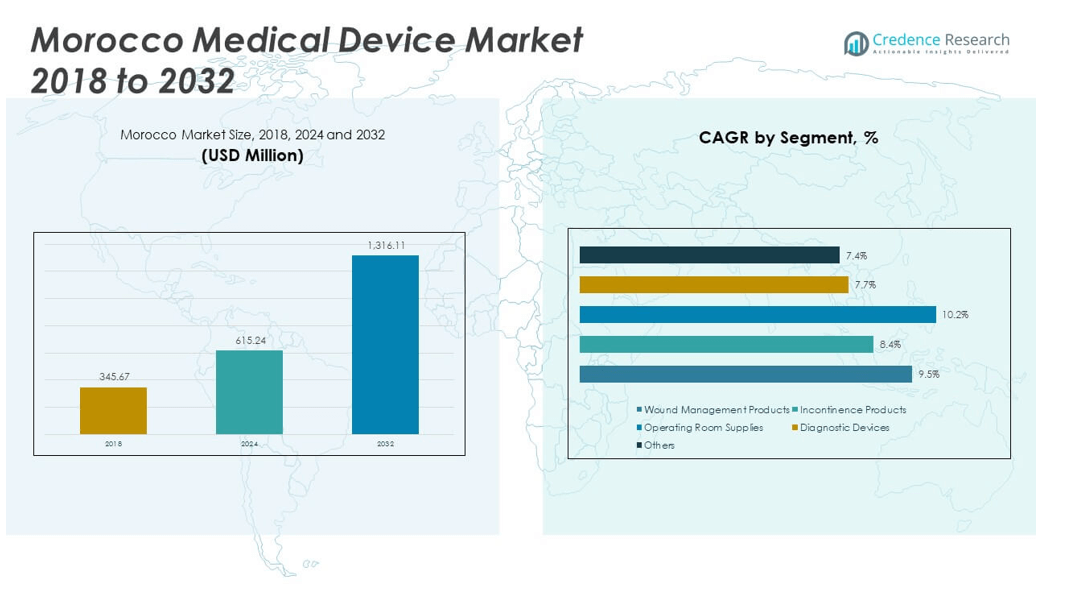
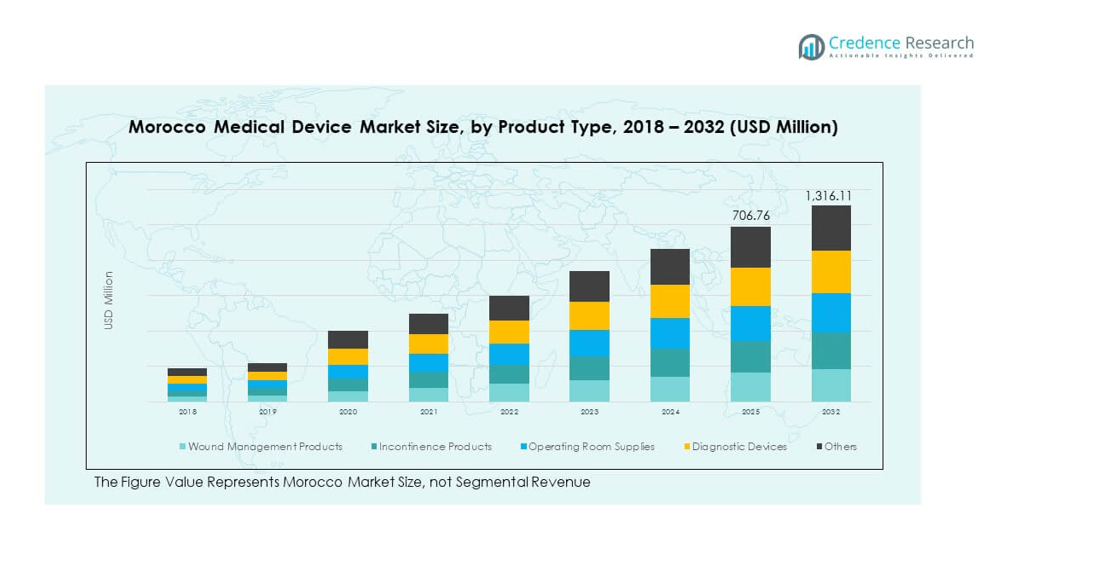
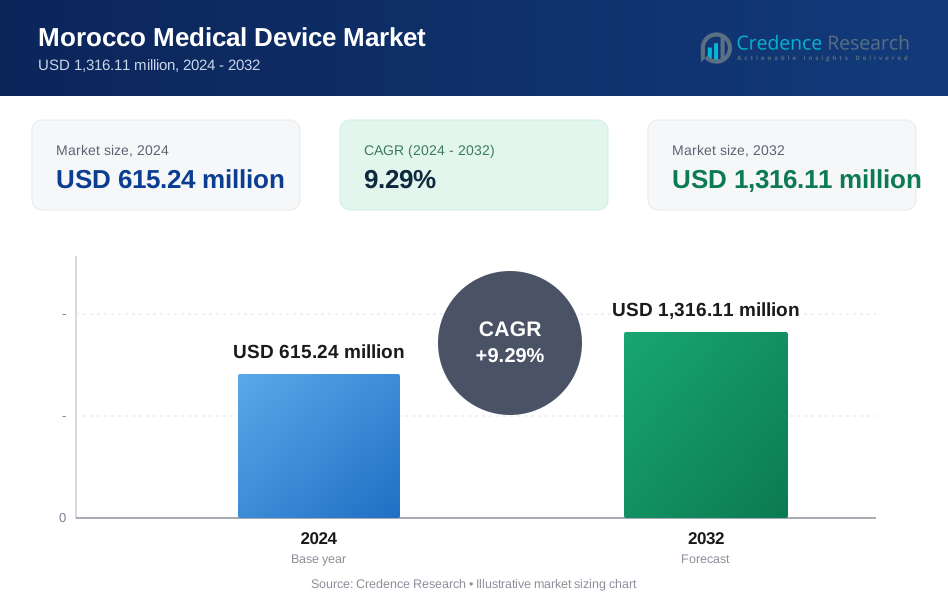
The Morocco Medical Device Market size was valued at USD 345.67 million in 2018 to USD 615.24 million in 2024 and is anticipated to reach USD 1,316.11 million by 2032, at a CAGR of 9.29% during the forecast period.
| REPORT ATTRIBUTE | DETAILS |
|---|---|
| Historical Period | 2020-2023 |
| Base Year | 2024 |
| Forecast Period | 2025-2032 |
| Morocco Medical Device Market Size 2024 | USD 615.24 million |
| Morocco Medical Device Market, CAGR | 9.29% |
| Morocco Medical Device Market Size 2032 | USD 1,316.11 million |
Growth in the Morocco Medical Device Market is fueled by multiple drivers, including government investment in healthcare infrastructure, rising prevalence of chronic diseases, and greater patient awareness about advanced treatment options. Higher disposable incomes are enabling patients to seek modern diagnostic and therapeutic solutions. Hospitals and clinics are expanding procurement of surgical tools, diagnostic devices, and consumables to improve service delivery. Increasing participation of private healthcare providers further accelerates device adoption. Local manufacturing and regulatory support are creating opportunities for both domestic and international suppliers.
In geographic terms, northern Morocco leads the market, supported by strong infrastructure and urban populations seeking advanced healthcare. Central regions, including Casablanca and Rabat, follow closely due to their role as commercial and medical hubs with expanding private sector participation. Southern Morocco remains an emerging subregion, with investments directed toward rural health facilities and portable devices to improve accessibility. While disparities in infrastructure exist, all subregions contribute to market expansion through targeted government initiatives and private sector involvement. This balanced growth enhances Morocco’s position as a developing hub for medical device adoption in North Africa.
Market Insights
- The Morocco Medical Device Market was valued at USD 345.67 million in 2018, reached USD 615.24 million in 2024, and is projected to attain USD 1,316.11 million by 2032, expanding at a CAGR of 9.29%.
- Northern Morocco held the largest share at 42.5% in 2024, supported by stronger infrastructure and urban healthcare demand, followed by Central Morocco with 36.8% and Southern Morocco with 20.7%.
- Northern Morocco is also the fastest-growing subregion, benefiting from government-backed investments, trade access to Europe, and concentration of advanced hospitals.
- Operating room supplies accounted for the largest product share at 33.4% in 2024, reflecting high demand for surgical gloves, drapes, and kits across hospitals.
- Diagnostic devices contributed 28.7% of market share in 2024, driven by increasing cases of chronic diseases and growing focus on early detection and monitoring.
Market Drivers
Government Healthcare Spending And Regulatory Support Creating A Strong Growth Path
The Moroccan government has prioritized healthcare spending to modernize facilities and expand access. Regulatory reforms are attracting foreign direct investment and encouraging global manufacturers to establish operations in the country. Hospitals and clinics benefit from upgraded procurement systems that ensure timely access to advanced devices. The Morocco Medical Device Market is supported by initiatives aimed at strengthening local manufacturing and reducing dependency on imports. Government-backed insurance coverage is widening patient access to innovative technologies. Strategic partnerships with international institutions create room for capacity building in the health sector. Policymakers focus on enhancing standards and compliance with global benchmarks. These steps position Morocco as a competitive hub for medical devices in North Africa.
- For example, in October 2024, Morocco’s Ministry of Health, through the Direction de l’Approvisionnement en Médicaments et Produits de Santé, issued a national tender for the purchase of medical devices intended for primary health care establishments and SEGMA hospital centers. The tender deadline was set for November 19, 2024.
Rising Prevalence Of Chronic Diseases Driving Greater Demand For Devices
An increasing burden of chronic conditions such as diabetes, cardiovascular disorders, and cancer drives consistent demand for advanced diagnostic and therapeutic devices. Hospitals are seeking devices that improve early detection and enable better treatment outcomes. The Morocco Medical Device Market is responding to the pressure of a growing aging population that requires long-term care and specialized equipment. It is stimulating hospitals and clinics to upgrade their medical infrastructure. Diagnostic imaging, cardiology devices, and surgical tools are witnessing heightened adoption across urban healthcare centers. Medical professionals emphasize evidence-based treatment that relies heavily on technology-driven solutions. This creates steady growth in demand for innovative devices. Chronic disease management continues to act as a vital driver of market expansion.
Improving Patient Awareness And Growing Disposable Income Supporting Adoption
Patient awareness about modern treatment methods is rising, creating higher acceptance of advanced medical technologies. Expanding middle-class households are willing to invest in better healthcare options. The Morocco Medical Device Market benefits from an environment where consumers demand safer and more effective medical interventions. It is encouraging hospitals to focus on service quality and integrate more device-based treatment methods. Consumer education campaigns highlight the benefits of early diagnosis and preventive care. Urbanization accelerates healthcare adoption as people seek improved medical outcomes in cities. Private hospitals are competing by offering technology-driven services to retain patients. These factors strengthen the alignment between consumer expectations and medical device usage.
Expansion Of Healthcare Infrastructure Strengthening Market Growth Momentum
Large investments in healthcare infrastructure projects are supporting demand for advanced devices. Morocco is witnessing the expansion of both private and public hospitals equipped with modern technologies. The Morocco Medical Device Market is closely tied to infrastructure improvements that enhance overall capacity and efficiency. It is allowing physicians to access advanced surgical and monitoring devices within new facilities. Rural healthcare centers are gradually being upgraded, ensuring wider distribution of devices beyond major cities. Public-private partnerships encourage rapid deployment of specialized equipment across regions. Training programs for healthcare professionals promote effective device usage and strengthen patient trust. These combined efforts continue to accelerate medical device penetration across the Moroccan healthcare system.
- For example, Under Morocco’s National Healthcare Plan 2025, the government committed to rehabilitating hospitals, upgrading rural health centers, and constructing new University Hospital Centers in cities such as Agadir, Laayoune, Errachidia, Guelmim, and Béni Mellal to strengthen national health infrastructure and expand access to advanced care.
Market Trends
Rising Focus On Digital Health Integration And Remote Monitoring Solutions
Digital health tools are increasingly integrated into clinical workflows to improve patient outcomes. Remote monitoring solutions gain popularity among hospitals and homecare providers to manage chronic conditions. The Morocco Medical Device Market is seeing higher investment in software-enabled platforms that connect devices with medical records. It is allowing healthcare professionals to track real-time data for better decision-making. Telemedicine platforms now link directly with diagnostic equipment to support consultations. Wearable health devices find acceptance among urban consumers seeking proactive wellness solutions. Healthcare providers emphasize convenience and accuracy when adopting digital technologies. This trend highlights the future of connected healthcare systems in Morocco.
- For example, Morocco’s National Telemedicine Initiative, launched in 2018 by the Ministry of Health and the Moroccan Telemedicine Society (SMT), targets 1.5 million people and aims to cover 80% of medical deserts by 2025. By 2023, the Marrakech-Safi region had 28 rural sites equipped with telemedicine technology, enabling remote medical consultations.
Strong Interest In Minimally Invasive Procedures Supported By Advanced Devices
Medical professionals prioritize minimally invasive procedures that reduce recovery times and lower complications. Hospitals demand advanced surgical devices that support precision and improve safety. The Morocco Medical Device Market is aligning with global adoption of laparoscopic, endoscopic, and robotic systems. It is reinforcing the shift toward less invasive techniques preferred by patients and doctors. Consumer demand for reduced hospital stays creates growth for devices supporting outpatient procedures. Investments in training surgeons on advanced systems expand adoption rates. Industry players focus on providing compact and reliable devices tailored for regional hospitals. The trend of minimally invasive treatments will remain a defining factor in shaping medical practices.
- By the end of 2023, Intuitive Surgical’s da Vinci Surgical System had surpassed 14 million cumulative global procedures, with over 1.8 million procedures performed in 2022 alone. The company reported an installed base of more than 8,600 da Vinci systems worldwide, reinforcing its position as the benchmark for robotic-assisted surgery.
Growing Emphasis On Local Manufacturing And Supply Chain Efficiency
Efforts to reduce reliance on imports encourage the development of local manufacturing units. Policymakers provide incentives for companies willing to establish facilities in Morocco. The Morocco Medical Device Market benefits from faster availability of products at lower costs when local production increases. It is strengthening supply chain efficiency and ensuring steady distribution of devices. Hospitals now access essential equipment without long import delays. Companies invest in packaging, sterilization, and assembly operations within Morocco to meet demand. Partnerships with global players improve technology transfer and quality compliance. The movement toward self-sufficiency aligns with national healthcare goals.
Shift Toward Preventive Healthcare And Homecare Devices Adoption
Preventive healthcare gains importance as patients focus on wellness and early diagnosis. Homecare devices such as glucose monitors, blood pressure meters, and portable imaging tools see wider use. The Morocco Medical Device Market expands through adoption of technologies that support personalized patient management. It is enabling consumers to monitor their health outside hospital environments. Growing urban populations demand user-friendly devices for everyday use. Retail pharmacies and online platforms boost accessibility of homecare medical tools. Hospitals recommend such devices to reduce patient inflow and support long-term monitoring. This trend positions preventive and homecare solutions as a vital growth pillar.
Market Challenges Analysis
Limited Healthcare Access And High Dependence On Imports Affecting Market Growth
Healthcare access remains uneven across rural and urban areas, reducing penetration of advanced devices. Many rural clinics face shortages of modern diagnostic tools and essential surgical equipment. The Morocco Medical Device Market is heavily dependent on imports for most categories, creating higher costs and longer delivery times. It is vulnerable to global supply disruptions that affect availability of critical devices. Small healthcare providers struggle with financing and procurement of advanced technologies. Patients in remote regions often travel long distances for specialized treatments. Regulatory delays on imported products further extend timelines for adoption. These issues create barriers that slow market expansion despite rising demand.
Shortage Of Skilled Workforce And High Device Maintenance Costs Hindering Adoption
The healthcare sector faces a shortage of professionals trained in handling complex devices. Limited technical expertise restricts the full utilization of advanced technologies in hospitals. The Morocco Medical Device Market is affected by high maintenance costs that burden smaller healthcare facilities. It is pushing providers to limit purchases to essential equipment only. Technical servicing infrastructure remains underdeveloped, leading to frequent delays in repairs and replacements. Hospitals incur higher operational costs when maintaining imported equipment. This restricts widespread adoption of cutting-edge devices across the healthcare network. Addressing workforce and maintenance challenges is critical for long-term sustainability of the market.
Market Opportunities
Rising Role Of Public-Private Partnerships And Regional Trade Integration Creating New Potential
Public-private partnerships are increasing investments in healthcare facilities and device procurement programs. International collaborations promote knowledge transfer and enhance training opportunities for medical professionals. The Morocco Medical Device Market benefits from Morocco’s trade integration with regional and European partners. It is opening access to advanced technologies and encouraging foreign companies to establish partnerships locally. Regional trade agreements ease cross-border flows of devices, improving affordability. Strengthening collaboration between government and private investors fuels innovation. These efforts help Morocco become a hub for advanced medical solutions in North Africa. Market players can leverage this momentum to expand their presence.
Expanding Demand For Specialized Devices And Growth Of Private Healthcare Sector
Growing consumer demand for specialized medical devices creates opportunities across cardiology, orthopedics, and diagnostics. Private healthcare providers expand aggressively to cater to urban populations seeking quality services. The Morocco Medical Device Market benefits from rising patient spending power and preference for advanced treatments. It is creating room for suppliers to introduce niche products targeting specific medical conditions. Hospitals focus on offering differentiation through modern devices that improve treatment efficiency. Global firms can invest in training and after-sales support to enhance market penetration. Growth in private healthcare aligns with Morocco’s demographic shift toward urbanization. These dynamics provide a strong pipeline of opportunities for device manufacturers.
Market Segmentation Analysis
The Morocco Medical Device Market demonstrates balanced growth across
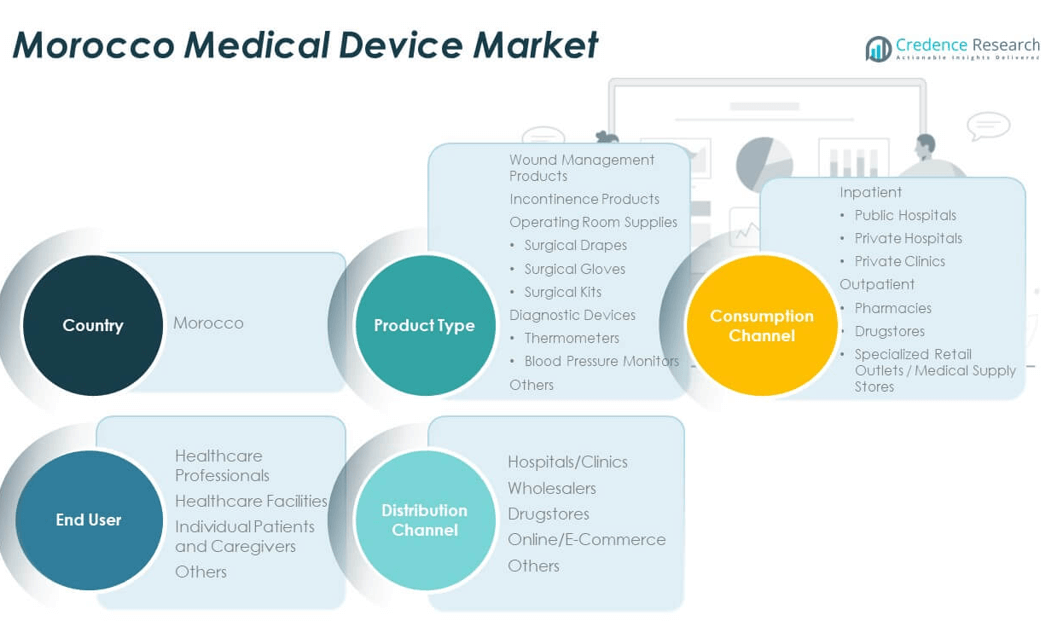
By Product type categories, with operating room supplies leading demand. Surgical gloves, drapes, and kits remain critical due to their wide usage across hospitals and clinics. Diagnostic devices, including thermometers and blood pressure monitors, show steady adoption driven by chronic disease prevalence. Wound management and incontinence products also maintain strong presence, supporting both inpatient and outpatient care.
By Consumption channels, inpatient settings dominate due to procurement by public and private hospitals, followed by private clinics that increasingly invest in advanced equipment. Outpatient demand is rising through pharmacies, drugstores, and specialized medical supply outlets, expanding accessibility to individual patients.
- For instance: Morocco’s Ministry of Health and the Moroccan Society of Telemedicine (SMT) launched a telemedicine expansion program: after a 2019 pilot phase covering 35 non-medically serviced remote units, the program is now scaling to 123 priority communes by 2025, using teleconsultations and digital equipment as outlined in the SMT’s partnership roadmap.
By End users are largely healthcare facilities and professionals, who require a broad range of devices for daily operations. Individual patients and caregivers represent a growing base, driven by preventive care and home monitoring solutions. It reflects an evolving trend toward patient-centered healthcare delivery.
- For instance, according to Morocco’s 2022 e-health White Paper, Lalla Salma Foundation for the Prevention and Treatment of Cancer (FLSLC) has implemented a patient-focused integrated information system for oncology centers. This system supports patient management, digital record-keeping, and inter-professional data sharing across participating cancer treatment hospitals.
By Distribution channels are led by hospitals and clinics, followed by wholesalers who bridge supply gaps across regions. Drugstores play a significant role in retail distribution, while online and e-commerce platforms are expanding reach in urban areas. This diversified segmentation underscores steady and inclusive growth across the Moroccan market landscape.
Segmentation
By Product Type
- Wound Management Products
- Incontinence Products
- Operating Room Supplies
- Surgical Drapes
- Surgical Gloves
- Surgical Kits
- Diagnostic Devices
- Thermometers
- Blood Pressure Monitors
- Others
By Consumption Channel
- Inpatient
- Public Hospitals
- Private Hospitals
- Private Clinics
- Outpatient
- Pharmacies
- Drugstores
- Specialized Retail Outlets / Medical Supply Stores
By End User
- Healthcare Professionals
- Healthcare Facilities
- Individual Patients and Caregivers
- Others
By Distribution Channel
- Hospitals/Clinics
- Wholesalers
- Drugstores
- Online/E-Commerce
- Others
Regional Analysis
Northern Morocco
Northern Morocco holds the largest share of the Morocco Medical Device Market, accounting for 42.5% in 2024. Strong healthcare infrastructure in cities like Tangier and Tetouan drives higher adoption of advanced devices. Public hospitals in this subregion receive consistent government funding to upgrade facilities and expand service capacity. It is also a preferred location for international suppliers due to proximity to European trade routes. Private clinics and diagnostic centers expand rapidly to meet urban healthcare demand. Northern Morocco benefits from higher patient income levels, supporting adoption of specialized devices.
Central Morocco
Central Morocco represents 36.8% of the market share in 2024, supported by Casablanca and Rabat as key medical hubs. Casablanca’s role as the commercial capital enables stronger distribution networks for global and local suppliers. The Morocco Medical Device Market here benefits from private sector investment in hospitals, driving procurement of advanced diagnostic and surgical tools. It is also home to major teaching hospitals that increase demand for sophisticated medical devices. Urbanization and lifestyle-related health issues raise demand for monitoring and treatment equipment. Growth is further supported by partnerships between private clinics and international companies.
Southern Morocco
Southern Morocco accounts for 20.7% of the market share in 2024, with gradual expansion driven by healthcare access improvements. Regional cities such as Agadir and Laayoune are upgrading healthcare facilities to reduce patient outflow to northern centers. The Morocco Medical Device Market in this subregion is supported by government programs targeting rural healthcare development. It is witnessing higher adoption of portable diagnostic devices to serve remote areas. Private hospitals are limited but slowly expanding their reach across smaller urban centers. While infrastructure gaps remain, growth prospects are improving as new investments aim to balance healthcare access across Morocco.
Key Player Analysis
- OXYDOM
- Pharcomedic S.A.R.L
- PROMAMEC
- Promu Medical
- Rocmed
- SAHARAMED SARL
- Siemens Healthineers Maroc
Competitive Analysis
The Morocco Medical Device Market features a mix of domestic manufacturers, regional suppliers, and multinational players. Local companies such as OXYDOM, Pharcomedic S.A.R.L, PROMAMEC, and SAHARAMED SARL focus on providing affordable and accessible products, often tailored to public healthcare requirements. Their strong presence in consumables and hospital supplies gives them a competitive edge in cost-sensitive segments. International firms such as Siemens Healthineers Maroc dominate in advanced diagnostic imaging, surgical devices, and high-tech equipment, strengthening their foothold through technology-driven solutions and training support. It is characterized by steady partnerships between private hospitals and global players seeking to enhance medical infrastructure. Competition is fueled by government incentives that encourage local assembly and production, reducing reliance on imports. Companies compete on price, quality, after-sales service, and regulatory compliance to maintain market share. Growing demand for homecare devices and specialized diagnostic tools opens opportunities for both established players and new entrants. Mergers, acquisitions, and distribution partnerships continue to reshape the market, ensuring a dynamic competitive environment. The balance between domestic firms meeting essential demand and multinational companies driving technological advancement defines the current competitive landscape across Morocco.
Recent Developments
- In September 2025, Dislog Group made significant strides in consolidating its position in the Moroccan medical device market by finalizing the legal and financial structuring of Dislog Medical Devices (DMD). This involved unifying six specialized subsidiaries including Megaflex, Afrobiomedic, Farmalac, Eramedic, Promedstore Imaging, and Scomedica under one centralized entity to target the growing healthcare equipment sector in Morocco.
- In August 2025, leading global biopharmaceutical company AstraZeneca Morocco announced a strategic partnership with the Fondation Mohammed VI des Sciences et de la Santé (FM6SS). The agreement, signed in the presence of key stakeholders, aims to establish Centers of Excellence for Rare Diseases. This collaboration is focused on advancing diagnostics, capacity building, data generation, clinical research, and expanding access to therapeutic innovation, marking a new era for rare disease care in Morocco and aligning with global healthcare standards.
- In July 2023, Promamec, a leading Moroccan distributor and producer of medical consumables and equipment, welcomed a €30 million equity investment from Vantage Capital to facilitate a significant minority stake acquisition and to fund Promamec’s next growth phase. This investment has enabled Promamec to pursue its ambitious development plan, including the construction of a new production plant, expansion into new product categories, and a strategic focus on strengthening the company’s position in sub-Saharan Africa.
Report Coverage
The research report offers an in-depth analysis based on Product Type, Consumption Channel, End User and Distribution Channel. It details leading market players, providing an overview of their business, product offerings, investments, revenue streams, and key applications. Additionally, the report includes insights into the competitive environment, SWOT analysis, current market trends, as well as the primary drivers and constraints. Furthermore, it discusses various factors that have driven market expansion in recent years. The report also explores market dynamics, regulatory scenarios, and technological advancements that are shaping the industry. It assesses the impact of external factors and global economic changes on market growth. Lastly, it provides strategic recommendations for new entrants and established companies to navigate the complexities of the market.
Future Outlook
- The Morocco Medical Device Market will witness strong momentum through expansion of healthcare infrastructure nationwide.
- Demand for advanced diagnostic devices will rise with growing prevalence of chronic illnesses.
- Local manufacturing initiatives will reduce dependency on imports and enhance supply chain resilience.
- Digital health integration and connected devices will gain adoption in hospitals and homecare settings.
- Private sector investments in clinics and specialty hospitals will stimulate demand for advanced equipment.
- Preventive healthcare solutions and home monitoring devices will expand market opportunities.
- Training programs for healthcare professionals will improve device utilization and service quality.
- Partnerships with international firms will drive technology transfer and product innovation.
- Regional trade integration will strengthen Morocco’s role as a medical device hub in North Africa.
- Growing consumer awareness and higher spending power will encourage adoption of specialized devices.
Request a Free Sample
Fill in your details and we'll send you a free sample report.
- Sample data tables & charts
- Research methodology
Need a Custom Version of This Report?
Tailor the scope, geography, or segments to your exact requirements.
- Custom geography or segment scope
- Direct access to our analyst team
Frequently Asked Questions
What is the current market size for Morocco Medical Device Market, and what is its projected size in 2032?
At what Compound Annual Growth Rate is the Morocco Medical Device Market projected to grow between 2024 and 2032?
Which Morocco Medical Device Market segment held the largest share in 2024?
What are the primary factors fueling the growth of the Morocco Medical Device Market?
Who are the leading companies in the Morocco Medical Device Market?
Table of Content
Chapter 1. Report Introduction
- 1.1 Report Description & Purpose
- 1.1.1 Report Title & Market Definition
- 1.1.2 Unique Selling Propositions (USP) & Key Differentiators
- 1.1.3 Value Proposition for Stakeholders
- 1.2 Research Objectives
- 1.2.1 Market Sizing Objectives (Volume & Revenue)
- 1.2.2 Segmentation Objectives
- 1.2.3 Competitive Intelligence Objectives
- 1.2.4 Forecast & Scenario Objectives
- 1.3 Report Scope
- 1.3.1 Morocco Medical Device Scope – Types & Subtypes Covered
- 1.3.2 Geographic Scope – Regions & Countries Covered
- 1.3.3 Historical Period, Base Year & Forecast Period (2024; forecast to 2032)
- 1.3.4 Inclusions & Exclusions
- 1.4 HS Code & Classification Framework
- 1.5 Currency, Units & Pricing Basis
- 1.6 Target Stakeholders
- 1.7 Limitations & Assumptions
Chapter 2. Executive Summary
- 2.1 Global Morocco Medical Device Market Snapshot
- 2.1.1 Market Size – Historical (2024) & Forecast (2024-2032) (2024: USD 615.24 million → 2032: USD 1,316.11 million)
- 2.1.2 Volume & Revenue – Global Totals
- 2.1.3 Key Market Highlights – Top Five Facts
- 2.2 Morocco Medical Device Market Segmentation Snapshot
- 2.2.1 Market Split by Region – 2024 vs. 2032
- 2.3 Competitive Snapshot
- 2.3.1 Top 10 Players by Revenue Share – 2024
- 2.3.2 Top 10 Players by Volume Share – 2024
- 2.3.3 Recent Strategic Developments (18-Month Summary)
- 2.4 Key Investment Highlights & Strategic Conclusions
Chapter 3. Morocco Medical Device Market Dynamics & Industry Analysis
- 3.1 Market Overview & Context
- 3.1.1 Morocco Medical Device Market Position in the Broader Automotive Value Chain
- 3.1.2 OEM vs. Replacement Market Dynamics
- 3.1.3 Market Maturity & Development Stage by Region
- 3.2 Morocco Medical Device Market Drivers
- 3.3 Morocco Medical Device Market Restraints & Challenges
- 3.4 Morocco Medical Device Market Opportunities
- 3.5 Porter's Five Forces Analysis
- 3.5.1 Threat of New Entrants
- 3.5.2 Bargaining Power of Suppliers
- 3.5.3 Bargaining Power of Buyers
- 3.5.4 Threat of Substitutes
- 3.5.5 Competitive Rivalry – Intensity Assessment
- 3.6 Morocco Medical Device Value Chain Analysis
- 3.6.1 Upstream – Raw Material/Input Suppliers
- 3.6.1.1 Raw Material/Input 1
- 3.6.1.2 Raw Material/Input 2
- 3.6.1.3 Raw Material/Input 3
- 3.6.2 Midstream – Production/Manufacturing/Service Delivery
- 3.6.2.1 Production/Process Overview
- 3.6.2.2 Key Facility Locations & Capacity by Manufacturer
- 3.6.3 Downstream – Distribution & End Consumer
- 3.6.3.1 Primary Channel – B2B/OEM
- 3.6.3.2 Secondary Channels – Dealer, Retail, Online, Direct
- 3.6.4 Value Chain Profitability Analysis
- 3.6.1 Upstream – Raw Material/Input Suppliers
- 3.7 PESTEL Analysis
- 3.7.1 Political Factors
- 3.7.2 Economic Factors
- 3.7.3 Social Factors
- 3.7.4 Technological Factors
- 3.7.5 Environmental Factors
- 3.7.6 Legal Factors
- 3.8 Morocco Medical Device Supply Chain Analysis
- 3.8.1 Raw Material/Input Supply Risk Assessment
- 3.8.2 Manufacturing Concentration Risk (Geographic Exposure)
- 3.8.3 Trade Disruption Impact Analysis
- 3.9 Regulatory & Policy Landscape
Note: The regulatory and policy landscape section covers regulations based on their applicability to the market, Morocco Medical Device category, geography, and scope of the study. Only regulatory frameworks with a material impact on operations, compliance, trade, sustainability, or market access are analyzed in detail.
Chapter 4. Key Investment Pockets & Opportunity Analysis
- 4.1 Morocco Medical Device Market Attractiveness Analysis
- 4.1.1 By Region – Investment Attractiveness Matrix (Volume × CAGR)
- 4.2 Absolute Revenue Growth Opportunity
- 4.2.1 By Region – Absolute USD Growth Through 2032
- 4.3 Incremental Volume Opportunity
- 4.3.1 By Region – Incremental Volume Through 2032
- 4.3.2 Segment – Incremental Volume
- 4.4 Emerging Submarket Opportunity Deep Dive (Subject to Applicability)
- 4.5 Emerging Market Opportunity Scorecards
- 4.5.1 United States
- 4.5.2 Europe
- 4.5.3 Asia
- 4.5.4 Middle East & Africa
Note: Emerging Market Opportunity Scorecards will be included based on relevance and strategic importance. Regions listed are indicative and may vary depending on data availability and market dynamics.
Chapter 5. Morocco Medical Device Import-Export Analysis & Trade Flows
- 5.1 Global Trade Overview
- 5.1.1 Global Export Value by Country (2024)
- 5.1.2 Global Export Volume by Country (2024)
- 5.1.3 Global Import Value by Country (2024)
- 5.1.4 Global Import Volume by Country (2024)
- 5.1.5 Net Trade Balance by Country (2024)
- 5.2 Export Analysis – Segment
- 5.2.1 Type 1 (HS Code)
- 5.2.2 Type 2 (HS Code)
- 5.2.3 Type 3 (HS Code)
- 5.2.4 Type 4 (HS Code)
- 5.2.5 Type 5 (HS Code)
- 5.3 Import Analysis – Segment
- 5.3.1 Type 1 (HS Code)
- 5.3.2 Type 2 (HS Code)
- 5.3.3 Type 3 (HS Code)
- 5.3.4 Type 4 (HS Code)
- 5.3.5 Type 5 (HS Code)
- 5.4 Average Unit Trade Prices
- 5.4.1 Average Export Price – Segment & Country
- 5.4.2 Average Import Price – Segment & Source Country
- 5.4.3 Price Trends (2024)
- 5.5 Key Trade Route Analysis
- 5.5.1 Trade Route 1
- 5.5.2 Trade Route 2
- 5.5.3 Trade Route 3
- 5.5.4 Trade Route 4
- 5.5.5 Trade Route 5
- 5.6 Trade Policy Impact Assessment
- 5.6.1 US Anti-Dumping & Section 301 Tariffs
- 5.6.2 EU Customs Union Impact
- 5.6.3 Major Free Trade Agreements
- 5.6.4 USMCA Rules of Origin
Note: Trade policy analysis will be included only where relevant to the Morocco Medical Device market.
Chapter 6. Competitive Landscape & Company Benchmarking
- 6.1 Morocco Medical Device Market Concentration & Structure
- 6.1.1 Herfindahl-Hirschman Index (HHI) – vs. 2024
- 6.1.2 Tier 1, Tier 2 & Tier 3 Market Structure
- 6.1.3 Global, Regional & Local Player Dynamics
- 6.2 Morocco Medical Device Market Share Analysis – 2024
- 6.2.1 Global Revenue Share by Company
- 6.2.2 Global Volume Share by Company
- 6.2.3 Regional Revenue Share
- 6.2.4 Market Share Evolution ( vs. 2024)
- 6.2.5 OEM Segment Share by Company
- 6.2.6 Replacement Segment Share by Company
- 6.3 Production/Delivery Capacity & Facility Analysis
- 6.3.1 Global Installed Capacity
- 6.3.2 Capacity Utilization Rates
- 6.3.3 Production/Output Volume
- 6.3.4 Facility Locations & Capacity Map
- 6.3.5 Planned Capacity Additions
- 6.4 Morocco Medical Device Competitive Benchmarking Matrix
- 6.4.1 Revenue, Volume, CAGR & Profitability Comparison
- 6.4.2 Channel Revenue Mix
- 6.4.3 Geographic Revenue Exposure
- 6.4.4 R&D Intensity
- 6.4.5 Sustainability Maturity
- 6.5 Strategic Developments in Morocco Medical Device (Last 24 Months)
- 6.5.1 Mergers, Acquisitions & Divestments
- 6.5.2 New Morocco Medical Device Launches
- 6.5.3 Facility Expansions
- 6.5.4 Strategic Alliances, Joint Ventures & Partnerships
- 6.5.5 Distribution Expansion & Market Entry
- 6.5.6 Sustainability & ESG Initiatives
- 6.6 Competitive Strategy Mapping
- 6.6.1 Leader, Challenger, Follower & Niche Classification
- 6.6.2 Pricing Strategy Comparison
- 6.6.3 Channel Strategy Matrix
Note: Strategic developments are included based on their materiality and the availability of reliable information.
Chapter 7. Global Morocco Medical Device Market – By Distribution Channel
- 7.1 Segment Overview
- 7.1.1 Volume & Revenue Split by Channel (2024 & 2032)
- 7.1.2 Channel Mix Evolution (2024-2032)
Chapter 8. Regional Market Analysis – Global Overview
- 8.1 Global Regional Overview
- 8.1.1 Regional Volume Share
- 8.1.2 Regional Revenue Share
- 8.1.3 Regional Volume by Region
- 8.1.4 Regional Revenue by Region
- 8.1.5 Regional Forecast Through 2032
- 8.2 Cross-Regional Segment Analysis
- 8.2.1 By Distribution Channel
- 8.2.2 By Brand/Price Tier
Chapter 9. North America Morocco Medical Device Market
- 9.1 United States
- 9.2 Canada
- 9.3 Mexico
Chapter 10. Europe Morocco Medical Device Market
- 10.1 Germany
- 10.2 France
- 10.3 Italy
- 10.4 United Kingdom
- 10.5 Spain
- 10.6 Poland
- 10.7 Russia
- 10.8 Netherlands
- 10.9 Belgium
- 10.10 Sweden
- 10.11 Denmark
- 10.12 Norway
- 10.13 Rest of Europe
Chapter 11. Asia Pacific Morocco Medical Device Market
- 11.1 China
- 11.2 India
- 11.3 Japan
- 11.4 South Korea
- 11.5 Thailand
- 11.6 Indonesia
- 11.7 Vietnam
- 11.8 Malaysia
- 11.9 Australia
- 11.10 Rest of Asia Pacific
Chapter 12. Latin America Morocco Medical Device Market
- 12.1 Brazil
- 12.2 Argentina
- 12.3 Colombia
- 12.4 Chile
- 12.5 Rest of Latin America
Chapter 13. Middle East Morocco Medical Device Market
- 13.1 Saudi Arabia
- 13.2 United Arab Emirates
- 13.3 Turkey
- 13.4 Israel
- 13.5 Iran
- 13.6 Rest of the Middle East
Chapter 14. Africa Morocco Medical Device Market
- 14.1 South Africa
- 14.2 Egypt
- 14.3 Nigeria
- 14.4 Morocco
- 14.5 Rest of Africa
Chapter 15. Morocco Medical Device Company Profiles
- 15.1 [Company 01]
- 15.1.1 Company Overview
- 15.1.2 Key Management Personnel
- 15.1.3 Products & Services Portfolio
- 15.1.4 Financial Performance
- 15.1.5 Key Market Focus & Geographic Presence
- 15.1.6 Recent Developments & Strategic Initiatives
Note: The company profile list is preliminary and may change based on research findings, market developments, data availability, and client requirements.
Chapter 16. Appendices
- Appendix A – List of Abbreviations & Acronyms
- Appendix B – Industry Classification Code Reference – Full Series
- Appendix C – Production & Capacity Data Tables
- Appendix D – End-Use & Demand Base Tables
- Appendix E – Consumption & Replacement Rate Assumptions
- Appendix F – ASP Reference Tables
- Appendix G – Manufacturing & Facility Database
- Appendix H – Import-Export Data Tables
- Appendix I – Regulatory Summary Tables
- Appendix J – Primary Research Participant List (Anonymized)
- Appendix K – Primary Research Questionnaire Framework
- Appendix L – Data Sources & Bibliography
- Appendix M – Market Size Divergence & Source Comparison
Chapter 17. Research Methodology
- 17.1 Research Framework & Philosophy
- 17.2 Secondary Research – Sources, Hierarchy & Data Extraction
- 17.3 Data Modeling – Bottom-Up & Top-Down Market Sizing
- 17.4 Primary Research – Stakeholder Framework, LOI & Sample Sizes
- 17.5 Forecast Methodology – Regression, Scenario & Sensitivity Analysis
- 17.6 Quality Control – Four-Layer Validation Framework
- 17.7 Limitations & Standard Assumptions
- 17.8 Disclaimer
