
| REPORT ATTRIBUTE | DETAILS |
|---|---|
| Historical Period | 2019-2022 |
| Base Year | 2023 |
| Forecast Period | 2024-2032 |
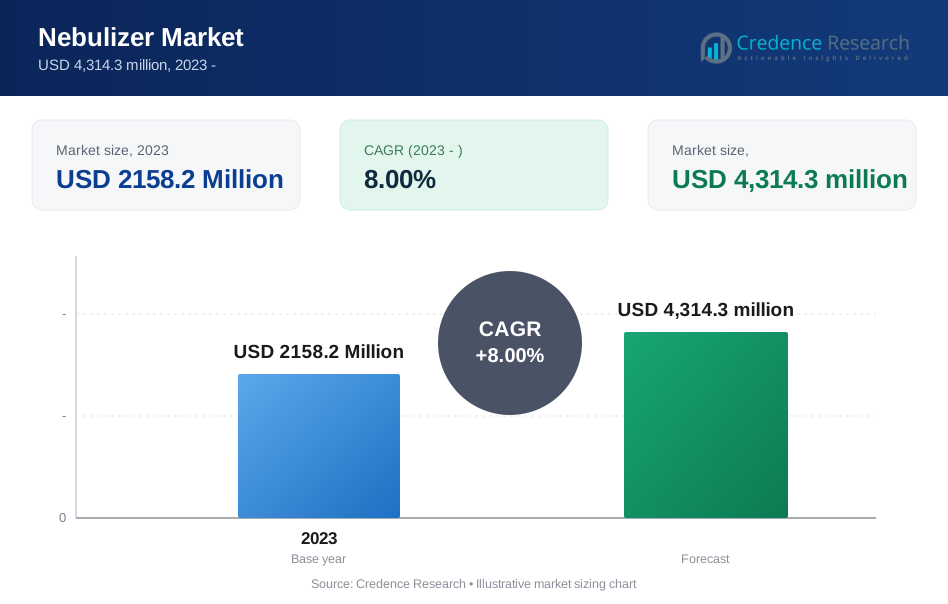
| Nebulizer market Size 2023 | USD 2158.2 million |
| Nebulizer market, CAGR | 8.00% |
| Nebulizer market Size 2032 | USD 4314.3 million |
Market Insights
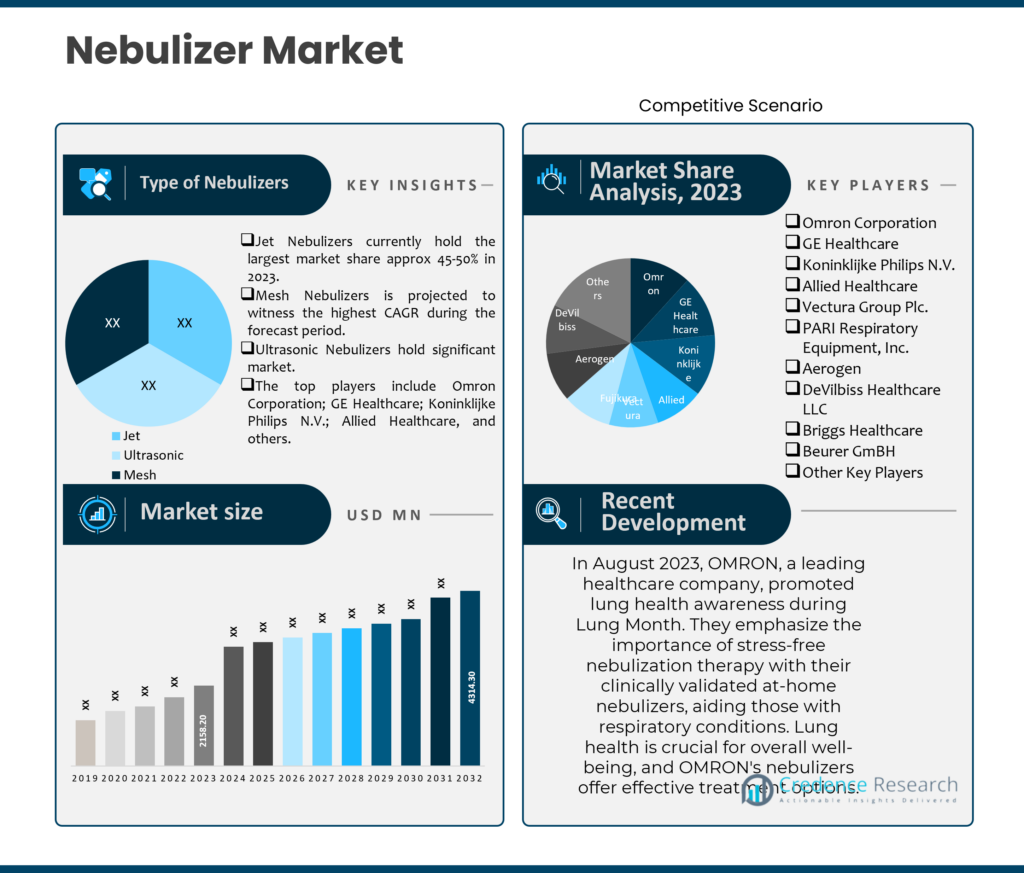
- Among the key segments, Jet Nebulizers emerged as the dominant type, holding approximately 45-50% of the total market share in 2023. However, Mesh Nebulizers are projected to witness the highest growth rate during the forecast period.
- Electric Nebulizers currently hold the largest market share approx 50-60% in 2023. They are desirable in areas where electricity sources are always available and are generally more cost-effective in the long run.
- Tabletop Nebulizers currently hold the largest market share approx 55-60% in 2023 owing to widespread use in healthcare settings such as hospitals, clinics, and home care facilities helps them gain a dominant position in the market.
- Nebulizer Kits currently hold the largest market share approx 28-32% in 2023 owing to their important role in nebulizer operation, the need for regular replacement to maintain sanitation efficiency.
- Hospitals and Clinics hold the largest share of the market by end-user, accounting for approximately 50-52% in 2023, attributed to the primary usage of nebulizers in treating acute and chronic respiratory conditions.
- North America holds the largest share of the market in 2023, followed by Asia Pacific and Europe with a collective share of just under 55%.
- The rise in demand for nebulizers, driven by the increasing prevalence of respiratory diseases, technological advancements, and the aging population, fuels the growth of the Nebulizer Market.
- Key opportunities in the market include expanding applications beyond traditional hospital settings, adoption of various strategies among market players, and technological advancements in nebulizer design and functionality, fostering market expansion.
Executive Summary
Market Definition
Nebulizer market includes manufacturing, distribution and sales of nebulizers, medical devices for delivery of drugs in the form of a flood when inhaled into the lungs. Nebulizers are commonly used for respiratory conditions such as asthma, chronic obstructive pulmonary disease (COPD), cystic. It is used to treat fibrosis, and other respiratory diseases. The nebulizer market includes a range of products from traditional jet nebulizers to modern ultrasonic mesh nebulizers. Jet nebulizers are most commonly used and are triggered by compressed air, providing good dryness. Ultrasonic nebulizers use pulsations to create mist, while vaporizers use pulses to create fresh air. Various factors drive this market, such as increasing incidence of respiratory diseases, increasing air pollution, elderly people who are prone to respiratory problems Technological advancements have also played an important role in the growth of nebuliser market in They are enhanced.
Market Overview
The Nebulizer Market has demonstrated consistent expansion and is projected to maintain a robust CAGR of 8.00% from 2024 to 2032. Valued at USD 2158.2 million in 2023, this market is expected to reach USD 4314.3 million by 2032.
Among the primary segments, jet nebulizers dominated the market landscape by type, comprising approximately 45-50% of the total market share in 2023. However, mesh nebulizers are anticipated to observe the highest cagr over the forecast period.
Electric nebulizers dominated the market landscape by power source, approx 50-60% in 2023. However, battery-operated nebulizers is projected to witness the highest cagr during the forecast period.
Tabletop nebulizers by size and portability, currently hold the largest market share approx 55-60% in 2023. However, portable nebulizers is projected to witness the highest cagr during the forecast period.
Nebulizer kits by nebulizer accessories and features, currently hold the largest market share approx 28-32% in 2023. However, mask types is projected to witness the highest cagr during the forecast period.
The hospitals and clinics emerged as the leading application segment in 2023, with a market share of about 50-52%, primarily due to the necessity of nebulizers in treating acute and chronic respiratory conditions.
North america constituted a significant portion of the market in 2023, followed by asia pacific and europe, collectively representing just under 55% of the market share.
The rise in demand for nebulizers is driven by factors such as the increasing prevalence of respiratory diseases, technological advancements in nebulizer design and functionality, and the aging population.
Continuous advancements in technology, including innovations in portable and battery-operated nebulizers, are further driving the demand for nebulizers, especially in regions with well-established healthcare systems and high healthcare spending.
Segmentation by Type of Nebulizers
- Jet Nebulizers currently hold the largest market share approx 45-50% in 2023. Jet nebulizers have been widely used for decades, are known for their convenience, low cost and ability to nebulize a wide range of drugs and are used in hospitals, clinics and home care settings especially in developing countries due to its low price and availability.
- Mesh Nebulizers is projected to witness the highest CAGR during the forecast period. Mesh nebulizers are gaining popularity due to their advanced technology, portability, and ability to deliver drugs efficiently and with short treatment times compared to jet-ultrasonic nebulizers are gaining popularity.
Segmentation by Power Source
- Electric Nebulizers currently hold the largest market share approx 50-60% in 2023. Electric nebulizers are generally more powerful and suitable for patients requiring more frequent or prolonged nebulizer therapy. They are desirable in areas where electricity sources are always available and are generally more cost-effective in the long run.
- Battery-operated Nebulizers is projected to witness the highest CAGR during the forecast period. With advances in technology, battery-powered nebulizers have become more efficient, providing longer battery life and better portability.
Segmentation by Size and Portability
- Tabletop Nebulizers currently hold the largest market share approx 55-60% in 2023. Their widespread use in healthcare settings such as hospitals, clinics, and home care facilities helps them gain a dominant position in the market.
- Portable Nebulizers is projected to witness the highest CAGR during the forecast period. The growing demand for convenient, mobile healthcare solutions is the primary reason for the high CAGR in portable nebulizers Patients demanding nebulizers for travel, outdoor activities, or those who prioritize positivity and flexibility in their treatment, prefer this device.
Segmentation by Nebulizer Accessories and Features
- Nebulizer Kits currently hold the largest market share approx 28-32% in 2023. The demand for nebulizer kits stems from their important role in nebulizer operation, the need for regular replacement to maintain sanitation efficiency.
- Mask Types is projected to witness the highest CAGR during the forecast period. The demand for different types of masks, such as standard masks, children’s masks and masks special for specific breathing conditions It is driven by necessity.
Segmentation by End-User
- Hospitals and Clinics currently hold the largest market share approx 50-52% in 2023. Hospitals and clinics deal with a wide range of people with respiratory disease, from acute cases requiring immediate treatment to chronic patients requiring regular nebulizer therapy, with plans and skilled healthcare professionals needed to properly administer nebulizers.
- Homecare Settings is projected to witness the highest CAGR during the forecast period. Home care settings offer convenience, privacy, and cost reduction through the need for there is no need for frequent visits to the hospital.
Segmentation by Region
- North America held significant share around 32-35% of the market in 2023. This dominance is primarily due to availability of well-established healthcare infrastructure, large number of patients with respiratory conditions, high healthcare costs in the region.
- Asia Pacific and Europe collectively account for just under 55% share in 2023, with Europe holding over 20% share in the same year.
- The rest of the world, including Latin America, the Middle East, and Africa, supplies the remaining demand for Nebulizer.
Advanced healthcare systems, aging population, and increasing prevalence of respiratory diseases are the major factors driving the market growth.
The North America region continues to dominate the nebulizers market, holding the largest market share for several reasons. First, the region has a well-established healthcare infrastructure with advanced medical facilities and research institutes. This facilitates the adoption of nebulizers as a preferred option for respiratory therapy, boosting market growth. Second, the high prevalence of respiratory diseases such as asthma, chronic obstructive pulmonary disease (COPD), and cystic fibrosis in North America drives the demand for nebulizers. For instance, according to the Asthma and Allergy Foundation of America, Asthma is a significant health concern in the United States, affecting over 22 million adults aged 18 and older. Notably, Black and Indigenous American adults have the highest asthma rates in the country. These devices provide effective and immediate relief from respiratory symptoms, eliminating the need to manage chronic respiratory conditions. Moreover,he region is a hub for medical device manufacturers and innovators, which has led to the introduction of new and improved nebulizer models that are more efficient, user-friendly and portable. For instance, the Dr Trust USA Portable Ultrasonic Mesh Nebulizer offers benefits for both children and adults. The compact design makes it portable. Ultrasonic mesh technology delivers effective formulations with particles of 2-5 microns, aiding lung penetration. Quiet operation, fast nebulization, and easy-to-clean materials enhance the user experience. Suitable for all ages, safe, effective and ideal for home or travel.
The Asia-Pacific is hold prominent share in the Nebulizer Market. There is a large and growing population in the region, with increasing urbanization and industrialization leading to increased levels of pollution, followed by an increase in respiratory diseases. For instance, according to the National Library of Medicine, In Beijing, China, respiratory illnesses among children under 15 increased in 2023, as observed by a surveillance system. This rise in respiratory infections led to more children seeking outpatient clinic treatment in hospitals. This growing number of patients a have respiratory ailments these are driving the demand for nebulizers as a medical necessity, driving the market growth. Alongwith, improving healthcare infrastructure and higher healthcare expenditure in Asia-Pacific countries improved the availability of medical devices including nebulizers Government and private sector investment in healthcare has contributed to the expansion of healthcare facilities and the adoption of advanced medical technologies. Additionally, increasing awareness about respiratory health and the benefits of early diagnosis and treatment among both healthcare professionals and the general population has propelled the demand for nebulizers. Additionally, the availability of cost-effective nebulizer options and the availability of local manufacturers offering affordable products meet the needs of the population in Asia Pacific. This affordablilty factor has made nebulizers more accessible to a broader segment of the population, driving market penetration and growth.
Key Highlights of the Report
The nebulizer market is segmented by type of nebulizers, power source, end-user, size and portability, nebulizer accessories and features, and region. The growing demand for nebulizers is driven by factors such as the increasing prevalence of respiratory diseases, technological advancements, and the need for effective respiratory therapy management across various healthcare settings.
Jet Nebulizers dominate the segment, serving essential functions in delivering a wide range of medications to treat respiratory conditions due to their reliability and effectiveness. Mesh Nebulizers lead the segment in terms of growth rate, offering portable and efficient options for patients and healthcare facilities.
Hospitals and Clinics hold a significant market share in the end-user segment, utilizing nebulizers to treat acute and chronic respiratory conditions and improve the quality of patient care. The homecare settings application segment is witnessing rapid growth, driven by the increasing demand for convenient and portable respiratory therapy solutions.
North America held the largest share of the Nebulizer market, supported by advanced healthcare infrastructure and high healthcare spending. Key players such as Omron Corporation, GE Healthcare, and Koninklijke Philips N.V. focus on product innovation and strategic collaborations to maintain their market position and competitiveness.
What Are The Main Drivers Of The Global Nebulizer Market?
Global Nebulizer Market is primarily driven by increasing incidence of respiratory diseases such as asthma, COPD and cystic fibrosis, which drives the demand for effective respiratory therapies. Technological advancements have led to more efficient and portable nebuliser devices will be used, to increase acceptance. Furthermore, increasing healthcare coverage, rising healthcare expenditure, better reimbursement arrangements across sectors contribute to the growth of the market.
What Are The Major Challenges Faced By The Global Nebulizer Market?
The global Nebulizer market faces challenges including the presence of alternative respiratory drug delivery methods such as inhalers and dry powder inhalers, which compete for market share. Regulatory hurdles and stringent approval processes for new nebulizer devices can also hinder market growth. Moreover, the high cost of advanced nebulizer models may limit their adoption, especially in developing regions with limited healthcare budgets.
What Are The Growth Opportunities In The Global Nebulizer Market?
The global Nebulizer market presents growth opportunities driven by including technological advancements to develop new and more efficient nebulizer devices delivering better clinical outcomes and patient convenience. Expansion in emerging markets with healthcare a increasing prevalence of respiratory diseases provides untapped growth potential. Furthermore, strategic partnerships and collaboration among Nebulizer suppliers, manufacturers and retailers can facilitate the market growth.
Market Drivers
Increasing Incidence Of Respiratory Diseases Such As Asthma, COPD And Cystic Fibrosis
Increasing incidence of respiratory diseases such as asthma, COPD and cystic fibrosis drive the demand of Nebulizer Market. These chronic respiratory conditions are common throughout the world, affecting millions of people and requiring ongoing management and treatment. For instance, the prevalence of asthma is increasing globally, affecting approximately 339 million people. Nebulizers play an important role in delivering drugs directly into the lungs, providing immediate relief from respiratory symptoms and improving patients’ quality of life. Pollution, smoking and a growing number of environmentalists contributing to the rise in respiratory illnesses are reporting, driving demand for more than nebulizer demand.
Market Restraints
Regulatory Hurdles
Regulatory hurdles restraints the Nebulizer market. Stringent approval processes for new nebulizer devices and health regulations could delay product launches and increase manufacturer development costs. Compliance with different regulatory frameworks in different industries adds complexity and challenges to market access and expansion. In addition, changing regulatory standards and requirements require constant monitoring and adjustment, affecting manufacturers’ operational efficiency and strategic planning. These regulatory challenges can stifle innovation, making market growth possible slow and create barriers for new entrants, hindering the overall growth and competitiveness of the nebulizer market.
Opportunities
Adoption Of Various Strategies Among Market Players
The major companies serving the global Nebulizer Market are Ziccum., Omron Corporation; GE Healthcare; Koninklijke Philips N.V., among others. The market players are considerably contributing to the market growth by the adoption of various strategies including mergers & acquisitions, collaborations, funding, and new product launches, to stay competitive in the market. For instance, in June 2022, Ziccum partnered with TEKCELEO, an innovative mechatronic manufacturer with advanced knowledge of nebulizers, for the development of a new nebulizer component for its LaminarPace system. This partnership is significant as the new nebulizer component is central to the advanced drying capabilities and scale-up of Ziccum's LaminarPace system, which formulates vaccines as thermostable powders that do not require cold chain transport.
Competitive Landscape
Key Players
The global Nebulizer market is highly competitive, with several key players. Some of the major players in the market and their market share are as follows:
- Omron Corporation
- GE Healthcare
- Koninklijke Philips N.V.
- Allied Healthcare
- Vectura Group Plc.
- PARI Respiratory Equipment, Inc.
- Aerogen
- DeVilbiss Healthcare LLC
- Briggs Healthcare
- Beurer GmBH
- Others
These organizations prioritize product innovation, distribution channel expansion, and mergers and acquisitions to stay competitive.
The global Nebulizer market's key players continually seek to stay ahead by offering new products and developments.
In August 2023, OMRON, a leading healthcare company, promoted lung health awareness during Lung Month. They emphasize the importance of stress-free nebulization therapy with their clinically validated at-home nebulizers, aiding those with respiratory conditions. Lung health is crucial for overall well-being, and OMRON's nebulizers offer effective treatment options.
In August 2022, Savara Inc. received the Innovation Passport in the UK for its molgramostim nebulizer solution, a potential inhaled biologic treatment. This recognition highlights the promise of molgramostim as an innovative therapy delivered via nebulization, using optimized eFlow Technology.
Summary of Key Findings
- The Nebulizer Market is experiencing significant growth, driven by the increasing prevalence of respiratory diseases, technological advancements, and the need for effective respiratory therapy management across various healthcare settings. Key drivers fueling this growth include the rising demand for portable and efficient nebulizers, the aging population, and the increasing awareness about respiratory health.
- Market segmentation within the Nebulizer Market includes factors such as type of nebulizers, power source, end-user, size and portability, nebulizer accessories and features, and region, reflecting the diverse uses and applications of nebulizers in healthcare settings.
- Jet Nebulizers emerge as the dominant segment, holding the majority market share due to their reliability and effectiveness in delivering a wide range of medications to treat respiratory conditions. Mesh Nebulizers witness notable growth, driven by their portability and efficiency.
- Electric nebulizers dominated the market landscape by power source. However, battery-operated nebulizers is projected to witness the highest cagr during the forecast period.
- Tabletop nebulizers by size and portability, currently hold the largest market in 2023. However, portable nebulizers is projected to witness the highest cagr during the forecast period.
- Nebulizer kits by nebulizer accessories and features, currently hold the largest market share in 2023. However, mask types is projected to witness the highest cagr during the forecast period.
- Hospitals and Clinics emerge as the leading end-user segment, utilizing nebulizers to treat acute and chronic respiratory conditions and improve the quality of patient care. Homecare settings witness substantial growth, driven by the increasing demand for convenient and portable respiratory therapy solutions.
- Geographically, North America holds the largest market share in the Nebulizer Market, supported by advanced healthcare infrastructure and high healthcare spending. Asia Pacific and Europe collectively account for a significant share of the market, with Asia Pacific witnessing growth due to increasing demand for nebulizers and advanced medical technologies.
Future Outlook
- The future outlook for the Nebulizer Market indicates promising growth opportunities, particularly within sectors such as healthcare, respiratory therapy, and homecare settings, driven by the increasing prevalence of respiratory diseases, technological advancements, and the aging population. However, anticipated challenges include stringent regulations, high initial costs, technical limitations, and competition from alternative respiratory drug delivery methods.
- To maintain competitiveness in the Nebulizer Market, industry players should adopt various strategies such as continuous technological innovation, strategic collaborations, securing investments for research and development, and expanding market reach. It is crucial for companies to prioritize addressing regulatory requirements, improving nebulizer efficiency, and exploring new applications in emerging markets to ensure sustained growth amidst evolving healthcare dynamics.
How CXOs Can Benefit from the Credence Research Nebulizer Market Report
The Credence Research Nebulizer Market Report provides CXOs with a comprehensive overview of the market, including:
- Market size and growth forecast:The report provides detailed estimates of the global Nebulizer market size, segmented by type of nebulizers, power source, end-user, size and portability, nebulizer accessories and features, and region. It also includes forecasts for the market through 2032, based on key trends and drivers.
- Market segmentation:The report segments the Nebulizer market by type of nebulizers, power source, end-user, size and portability, nebulizer accessories and features, and region. The increasing demand for advanced solutions is driven. This segmentation provides CXOs with a granular understanding of the market and the opportunities in each segment.
- Competitive landscape:The report profiles the key players in the Nebulizer market and provides insights into their strategies, product offerings, and financial performance. This information can help CXOs to identify and assess their competition.
- Key trends and drivers:The report identifies and analyzes the key trends and drivers that are shaping the Nebulizer market. This information can help CXOs to make informed decisions about their investments and strategies.
CXOs can use the insights from the Credence Research Nebulizer Market Report to:
- Identify growth opportunities:The report can help CXOs to identify new growth opportunities in the Nebulizer market. For example, the report identifies the growing demand for Nebulizer from cloud computing providers and telecom companies as a key opportunity.
- Make informed investment decisions:The report can help CXOs to make informed investment decisions about Nebulizer. For example, the report provides insights into the key factors to consider when evaluating Nebulizer providers and selecting Nebulizer solutions.
- Develop competitive strategies:The report can help CXOs to develop competitive strategies for their Nebulizer businesses. For example, the report identifies the key strategies that Nebulizer providers are using to differentiate themselves from their competitors.
- Track market developments:The report can help CXOs to track market developments and stay ahead of the curve. For example, the report provides insights into the latest trends and innovations in the Nebulizer market.
Overall, the Credence Research Nebulizer Market Report is a valuable resource for CXOs who are looking to gain a deeper understanding of the market and identify opportunities for growth.
Segmentation
-
Type of Nebulizers:
- Jet Nebulizers
- Ultrasonic Nebulizers
- Mesh Nebulizers
-
Power Source:
- Electric Nebulizers
- Battery-operated Nebulizers
-
Size and Portability:
- Tabletop Nebulizers
- Portable Nebulizers
-
Nebulizer Accessories and Features:
- Nebulizer Kits
- Mask Types
- Medication Delivery Modes
- Noise Level
- Ease of Cleaning and Maintenance
-
End-User:
- Hospitals and Clinics
- Homecare Settings
- Long-term Care Facilities
-
By Region
- North America
- US
- Canada
- Mexico
- Europe
- Germany
- France
- UK.
- Italy
- Spain
- Rest of Europe
- Asia Pacific
- China
- Japan
- India
- South Korea
- South-east Asia
- Rest of Asia Pacific
- Latin America
- Brazil
- Argentina
- Rest of Latin America
- Middle East & Africa
- GCC Countries
- South Africa
- Rest of Middle East and Africa
- North America
Adjacent Markets
In the Nebulizer market, there are several adjacent markets which has high revenue growth opportunities. The key adjacent markets for Nebulizer market -Adjacent Markets
| Respiratory Drug Market | Asthma Management Market | Allergy Relief Products Market |
| Portable Medical Devices Market | COPD Treatment Market | Telehealth and Remote Patient Monitoring Market |
| Home Healthcare Market | Inhalation Therapy Devices Market | Respiratory Monitoring Devices Market |
Request a Free Sample
Fill in your details and we'll send you a free sample report.
- Sample data tables & charts
- Research methodology
Need a Custom Version of This Report?
Tailor the scope, geography, or segments to your exact requirements.
- Custom geography or segment scope
- Direct access to our analyst team
Frequently Asked Questions
What is the current size of the global Nebulizer market?
What is the expected growth rate of the Nebulizer market between 2024 and 2032?
Which segment is leading the market share in terms of Type of Nebulizers?
Which Power Source Segments governs the demand for Nebulizers in the world?
Which Nebulizer Accessories and Features Specific Nebulizer segment is expected to post the highest CAGR during the forecast period?
Which region is fueling the growth of the Nebulizer industry?
Who are the major players in the global Nebulizer market?
What are the major market drivers of the Nebulizer industry?
What are the major market restraints of the Nebulizer industry?
What are the major market opportunities of the Nebulizer industry?
Table of Content
Chapter 1. Report Introduction
- 1.1 Report Description & Purpose
- 1.1.1 Report Title & Market Definition
- 1.1.2 Unique Selling Propositions (USP) & Key Differentiators
- 1.1.3 Value Proposition for Stakeholders
- 1.2 Research Objectives
- 1.2.1 Market Sizing Objectives (Volume & Revenue)
- 1.2.2 Segmentation Objectives
- 1.2.3 Competitive Intelligence Objectives
- 1.2.4 Forecast & Scenario Objectives
- 1.3 Report Scope
- 1.3.1 Nebulizer Scope – Types & Subtypes Covered
- 1.3.2 Geographic Scope – Regions & Countries Covered
- 1.3.3 Historical Period, Base Year & Forecast Period (2023; forecast to the forecast period)
- 1.3.4 Inclusions & Exclusions
- 1.4 HS Code & Classification Framework
- 1.5 Currency, Units & Pricing Basis
- 1.6 Target Stakeholders
- 1.7 Limitations & Assumptions
Chapter 2. Executive Summary
- 2.1 Global Nebulizer Market Snapshot
- 2.1.1 Market Size – Historical (2023) & Forecast (the forecast period) (2023: USD 2158.2 Million → forecast year: USD 4,314.3 million)
- 2.1.2 Volume & Revenue – Global Totals
- 2.1.3 Key Market Highlights – Top Five Facts
- 2.2 Nebulizer Market Segmentation Snapshot
- 2.2.1 Market Split by Region – 2023 vs.
- 2.3 Competitive Snapshot
- 2.3.1 Top 10 Players by Revenue Share – 2023
- 2.3.2 Top 10 Players by Volume Share – 2023
- 2.3.3 Recent Strategic Developments (18-Month Summary)
- 2.4 Key Investment Highlights & Strategic Conclusions
Chapter 3. Nebulizer Market Dynamics & Industry Analysis
- 3.1 Market Overview & Context
- 3.1.1 Nebulizer Market Position in the Broader Automotive Value Chain
- 3.1.2 OEM vs. Replacement Market Dynamics
- 3.1.3 Market Maturity & Development Stage by Region
- 3.2 Nebulizer Market Drivers
- 3.3 Nebulizer Market Restraints & Challenges
- 3.4 Nebulizer Market Opportunities
- 3.5 Porter's Five Forces Analysis
- 3.5.1 Threat of New Entrants
- 3.5.2 Bargaining Power of Suppliers
- 3.5.3 Bargaining Power of Buyers
- 3.5.4 Threat of Substitutes
- 3.5.5 Competitive Rivalry – Intensity Assessment
- 3.6 Nebulizer Value Chain Analysis
- 3.6.1 Upstream – Raw Material/Input Suppliers
- 3.6.1.1 Raw Material/Input 1
- 3.6.1.2 Raw Material/Input 2
- 3.6.1.3 Raw Material/Input 3
- 3.6.2 Midstream – Production/Manufacturing/Service Delivery
- 3.6.2.1 Production/Process Overview
- 3.6.2.2 Key Facility Locations & Capacity by Manufacturer
- 3.6.3 Downstream – Distribution & End Consumer
- 3.6.3.1 Primary Channel – B2B/OEM
- 3.6.3.2 Secondary Channels – Dealer, Retail, Online, Direct
- 3.6.4 Value Chain Profitability Analysis
- 3.6.1 Upstream – Raw Material/Input Suppliers
- 3.7 PESTEL Analysis
- 3.7.1 Political Factors
- 3.7.2 Economic Factors
- 3.7.3 Social Factors
- 3.7.4 Technological Factors
- 3.7.5 Environmental Factors
- 3.7.6 Legal Factors
- 3.8 Nebulizer Supply Chain Analysis
- 3.8.1 Raw Material/Input Supply Risk Assessment
- 3.8.2 Manufacturing Concentration Risk (Geographic Exposure)
- 3.8.3 Trade Disruption Impact Analysis
- 3.9 Regulatory & Policy Landscape
Note: The regulatory and policy landscape section covers regulations based on their applicability to the market, Nebulizer category, geography, and scope of the study. Only regulatory frameworks with a material impact on operations, compliance, trade, sustainability, or market access are analyzed in detail.
Chapter 4. Key Investment Pockets & Opportunity Analysis
- 4.1 Nebulizer Market Attractiveness Analysis
- 4.1.1 By Region – Investment Attractiveness Matrix (Volume × CAGR)
- 4.2 Absolute Revenue Growth Opportunity
- 4.2.1 By Region – Absolute USD Growth Through the forecast period
- 4.3 Incremental Volume Opportunity
- 4.3.1 By Region – Incremental Volume Through the forecast period
- 4.3.2 Segment – Incremental Volume
- 4.4 Emerging Submarket Opportunity Deep Dive (Subject to Applicability)
- 4.5 Emerging Market Opportunity Scorecards
- 4.5.1 United States
- 4.5.2 Europe
- 4.5.3 Asia
- 4.5.4 Middle East & Africa
Note: Emerging Market Opportunity Scorecards will be included based on relevance and strategic importance. Regions listed are indicative and may vary depending on data availability and market dynamics.
Chapter 5. Nebulizer Import-Export Analysis & Trade Flows
- 5.1 Global Trade Overview
- 5.1.1 Global Export Value by Country (2023)
- 5.1.2 Global Export Volume by Country (2023)
- 5.1.3 Global Import Value by Country (2023)
- 5.1.4 Global Import Volume by Country (2023)
- 5.1.5 Net Trade Balance by Country (2023)
- 5.2 Export Analysis – Segment
- 5.2.1 Type 1 (HS Code)
- 5.2.2 Type 2 (HS Code)
- 5.2.3 Type 3 (HS Code)
- 5.2.4 Type 4 (HS Code)
- 5.2.5 Type 5 (HS Code)
- 5.3 Import Analysis – Segment
- 5.3.1 Type 1 (HS Code)
- 5.3.2 Type 2 (HS Code)
- 5.3.3 Type 3 (HS Code)
- 5.3.4 Type 4 (HS Code)
- 5.3.5 Type 5 (HS Code)
- 5.4 Average Unit Trade Prices
- 5.4.1 Average Export Price – Segment & Country
- 5.4.2 Average Import Price – Segment & Source Country
- 5.4.3 Price Trends (2023)
- 5.5 Key Trade Route Analysis
- 5.5.1 Trade Route 1
- 5.5.2 Trade Route 2
- 5.5.3 Trade Route 3
- 5.5.4 Trade Route 4
- 5.5.5 Trade Route 5
- 5.6 Trade Policy Impact Assessment
- 5.6.1 US Anti-Dumping & Section 301 Tariffs
- 5.6.2 EU Customs Union Impact
- 5.6.3 Major Free Trade Agreements
- 5.6.4 USMCA Rules of Origin
Note: Trade policy analysis will be included only where relevant to the Nebulizer market.
Chapter 6. Competitive Landscape & Company Benchmarking
- 6.1 Nebulizer Market Concentration & Structure
- 6.1.1 Herfindahl-Hirschman Index (HHI) – vs. 2023
- 6.1.2 Tier 1, Tier 2 & Tier 3 Market Structure
- 6.1.3 Global, Regional & Local Player Dynamics
- 6.2 Nebulizer Market Share Analysis – 2023
- 6.2.1 Global Revenue Share by Company
- 6.2.2 Global Volume Share by Company
- 6.2.3 Regional Revenue Share
- 6.2.4 Market Share Evolution ( vs. 2023)
- 6.2.5 OEM Segment Share by Company
- 6.2.6 Replacement Segment Share by Company
- 6.3 Production/Delivery Capacity & Facility Analysis
- 6.3.1 Global Installed Capacity
- 6.3.2 Capacity Utilization Rates
- 6.3.3 Production/Output Volume
- 6.3.4 Facility Locations & Capacity Map
- 6.3.5 Planned Capacity Additions
- 6.4 Nebulizer Competitive Benchmarking Matrix
- 6.4.1 Revenue, Volume, CAGR & Profitability Comparison
- 6.4.2 Channel Revenue Mix
- 6.4.3 Geographic Revenue Exposure
- 6.4.4 R&D Intensity
- 6.4.5 Sustainability Maturity
- 6.5 Strategic Developments in Nebulizer (Last 24 Months)
- 6.5.1 Mergers, Acquisitions & Divestments
- 6.5.2 New Nebulizer Launches
- 6.5.3 Facility Expansions
- 6.5.4 Strategic Alliances, Joint Ventures & Partnerships
- 6.5.5 Distribution Expansion & Market Entry
- 6.5.6 Sustainability & ESG Initiatives
- 6.6 Competitive Strategy Mapping
- 6.6.1 Leader, Challenger, Follower & Niche Classification
- 6.6.2 Pricing Strategy Comparison
- 6.6.3 Channel Strategy Matrix
Note: Strategic developments are included based on their materiality and the availability of reliable information.
Chapter 7. Global Nebulizer Market – By Distribution Channel
- 7.1 Segment Overview
- 7.1.1 Volume & Revenue Split by Channel (2023 & )
- 7.1.2 Channel Mix Evolution (the forecast period)
Chapter 8. Regional Market Analysis – Global Overview
- 8.1 Global Regional Overview
- 8.1.1 Regional Volume Share
- 8.1.2 Regional Revenue Share
- 8.1.3 Regional Volume by Region
- 8.1.4 Regional Revenue by Region
- 8.1.5 Regional Forecast Through the forecast period
- 8.2 Cross-Regional Segment Analysis
- 8.2.1 By Distribution Channel
- 8.2.2 By Brand/Price Tier
Chapter 9. North America Nebulizer Market
- 9.1 United States
- 9.2 Canada
- 9.3 Mexico
Chapter 10. Europe Nebulizer Market
- 10.1 Germany
- 10.2 France
- 10.3 Italy
- 10.4 United Kingdom
- 10.5 Spain
- 10.6 Poland
- 10.7 Russia
- 10.8 Netherlands
- 10.9 Belgium
- 10.10 Sweden
- 10.11 Denmark
- 10.12 Norway
- 10.13 Rest of Europe
Chapter 11. Asia Pacific Nebulizer Market
- 11.1 China
- 11.2 India
- 11.3 Japan
- 11.4 South Korea
- 11.5 Thailand
- 11.6 Indonesia
- 11.7 Vietnam
- 11.8 Malaysia
- 11.9 Australia
- 11.10 Rest of Asia Pacific
Chapter 12. Latin America Nebulizer Market
- 12.1 Brazil
- 12.2 Argentina
- 12.3 Colombia
- 12.4 Chile
- 12.5 Rest of Latin America
Chapter 13. Middle East Nebulizer Market
- 13.1 Saudi Arabia
- 13.2 United Arab Emirates
- 13.3 Turkey
- 13.4 Israel
- 13.5 Iran
- 13.6 Rest of the Middle East
Chapter 14. Africa Nebulizer Market
- 14.1 South Africa
- 14.2 Egypt
- 14.3 Nigeria
- 14.4 Morocco
- 14.5 Rest of Africa
Chapter 15. Nebulizer Company Profiles
- 15.1 [Company 01]
- 15.1.1 Company Overview
- 15.1.2 Key Management Personnel
- 15.1.3 Products & Services Portfolio
- 15.1.4 Financial Performance
- 15.1.5 Key Market Focus & Geographic Presence
- 15.1.6 Recent Developments & Strategic Initiatives
Note: The company profile list is preliminary and may change based on research findings, market developments, data availability, and client requirements.
Chapter 16. Appendices
- Appendix A – List of Abbreviations & Acronyms
- Appendix B – Industry Classification Code Reference – Full Series
- Appendix C – Production & Capacity Data Tables
- Appendix D – End-Use & Demand Base Tables
- Appendix E – Consumption & Replacement Rate Assumptions
- Appendix F – ASP Reference Tables
- Appendix G – Manufacturing & Facility Database
- Appendix H – Import-Export Data Tables
- Appendix I – Regulatory Summary Tables
- Appendix J – Primary Research Participant List (Anonymized)
- Appendix K – Primary Research Questionnaire Framework
- Appendix L – Data Sources & Bibliography
- Appendix M – Market Size Divergence & Source Comparison
Chapter 17. Research Methodology
- 17.1 Research Framework & Philosophy
- 17.2 Secondary Research – Sources, Hierarchy & Data Extraction
- 17.3 Data Modeling – Bottom-Up & Top-Down Market Sizing
- 17.4 Primary Research – Stakeholder Framework, LOI & Sample Sizes
- 17.5 Forecast Methodology – Regression, Scenario & Sensitivity Analysis
- 17.6 Quality Control – Four-Layer Validation Framework
- 17.7 Limitations & Standard Assumptions
- 17.8 Disclaimer
