
North America Anticancer Drugs/Oncology Drugs Market Overview:
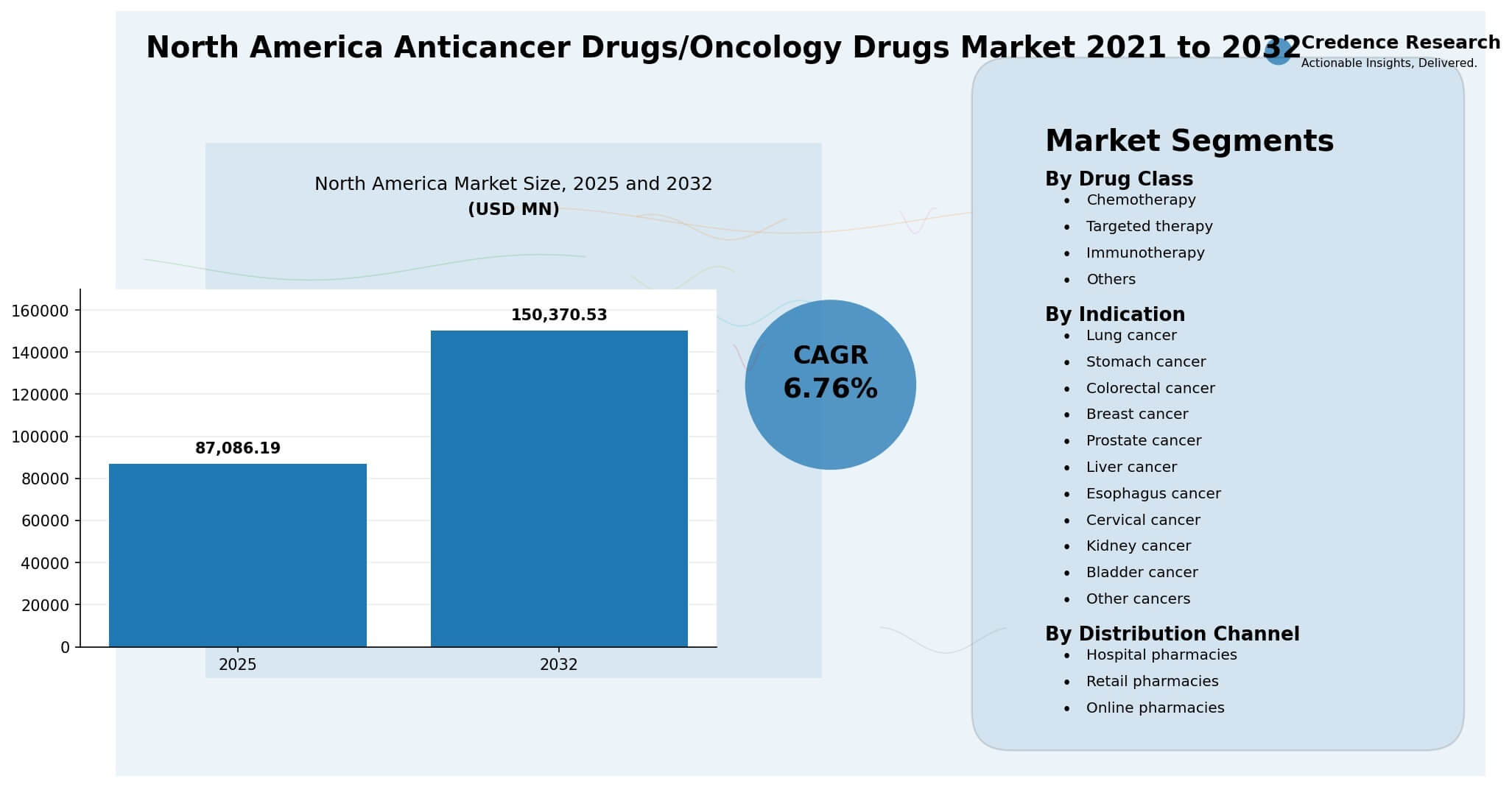
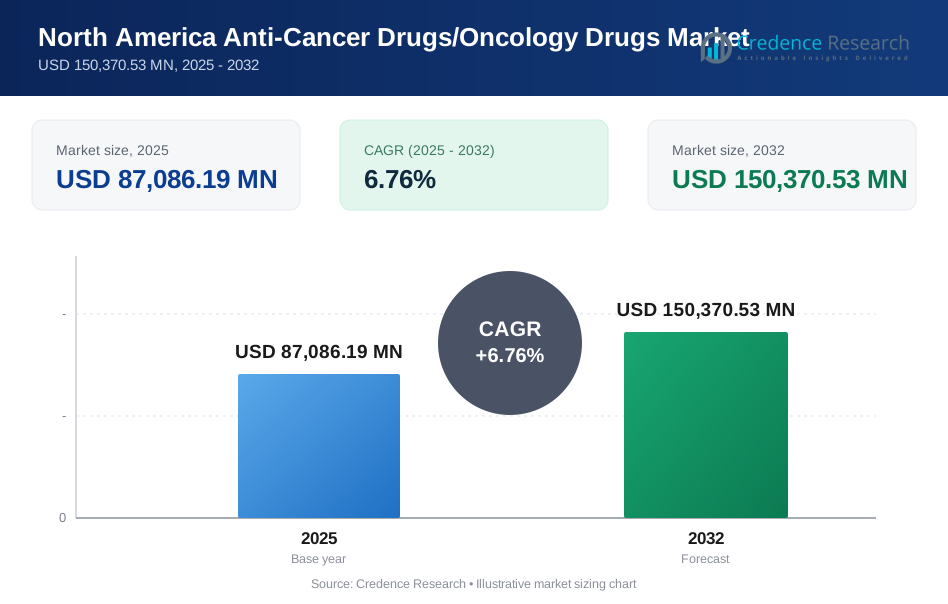
The North America Anticancer Drugs/Oncology Drugs Market size was valued at USD 64,394.03 MN in 2021 and reached USD 87,086.19 MN in 2025. It is anticipated to reach USD 150,370.53 MN by 2032, growing at a CAGR of 6.76% during the forecast period.
| REPORT ATTRIBUTE | DETAILS |
|---|---|
| Historical Period | 2021-2024 |
| Base Year | 2025 |
| Forecast Period | 2025-2032 |
| North America Anticancer Drugs/Oncology Drugs Market Size 2025 | USD 87,086.19 million |
| North America Anticancer Drugs/Oncology Drugs Market, CAGR | 6.76% |
| North America Anticancer Drugs/Oncology Drugs Market Size 2032 | USD 150,370.53 million |
North America Anticancer Drugs/Oncology Drugs Market Insights
- Market growth is supported by rising cancer incidence, accelerated oncology drug approvals, biomarker-based treatment adoption, immunotherapy expansion and increasing use of targeted therapies.
- Targeted Therapy holds a strong position because oncology treatment is shifting toward biomarker-driven regimens, molecular testing and precision medicine across major cancer indications.
- Immunotherapy continues to gain share as checkpoint inhibitors and combination regimens expand across lung cancer, stomach cancer, colorectal cancer, breast cancer and other cancers.
- Hospital Pharmacies remain the leading distribution channel because complex oncology drugs require specialist administration, reimbursement coordination, cold-chain handling and clinical monitoring.
North America Anticancer Drugs/Oncology Drugs Market Segment Insights
By drug class
By drug class, Targeted Therapy held a strong position in 2025 because cancer treatment is increasingly driven by molecular diagnostics, tumor biomarkers and mutation-specific drug selection. These therapies support better patient stratification and are widely used across lung cancer, breast cancer, colorectal cancer, kidney cancer and other oncology indications. Immunotherapy continues to expand as checkpoint inhibitors and combination regimens move into earlier lines of treatment and broader tumor types. Chemotherapy remains relevant because it is still used alone and in combination with immunotherapy, targeted therapy and supportive care drugs. Others include hormonal therapies, radiopharmaceuticals, antibody-drug conjugates and emerging cell and gene-based oncology treatments.
By indication
By indication, Lung Cancer held a strong position in 2025 because it remains one of the largest therapeutic areas for immunotherapy, targeted therapy and chemotherapy combinations. Breast Cancer and Prostate Cancer also account for strong demand due to large patient pools, biomarker-based treatment expansion and high use of long-term systemic therapy. Colorectal Cancer, Stomach Cancer and Liver Cancer are gaining importance as targeted and immunotherapy options expand into more defined patient groups. Kidney Cancer and Bladder Cancer benefit from immuno-oncology regimens and newer targeted combinations. Cervical Cancer, Esophagus Cancer and Other Cancers create additional growth opportunities as oncology drug development broadens across tumor types and treatment settings.
By distribution channel
By distribution channel, Hospital Pharmacies held the strongest position in 2025 because many oncology drugs require infusion, specialist supervision, patient monitoring and coordination with cancer treatment centers. Hospital-based distribution also supports complex biologics, immunotherapies, antibody-drug conjugates and chemotherapy regimens that require controlled handling. Retail Pharmacies remain relevant for oral oncology drugs, supportive care products and maintenance therapies used outside inpatient or infusion settings. Online Pharmacies are gaining gradual traction due to specialty medication fulfillment, home delivery and digital refill management. However, high-value oncology therapies still require strong clinical oversight, reimbursement support and temperature-controlled distribution. Channel growth will favor integrated specialty pharmacy models that connect clinicians, payers and patients.
Key market drivers
Precision oncology and biomarker-led prescribing
Precision oncology and biomarker-led prescribing represent a major growth driver for the North America Anticancer Drugs/Oncology Drugs Market. Treatment decisions increasingly depend on molecular testing, tumor profiling and companion diagnostics that identify patients most likely to respond to a therapy. This shift supports demand for targeted therapies, immunotherapies and antibody-drug conjugates across lung cancer, breast cancer, colorectal cancer, prostate cancer and other cancers. Drug manufacturers benefit when biomarker-defined indications support premium pricing, stronger clinical differentiation and label expansion. Health systems also use precision treatment pathways to improve outcomes and reduce ineffective therapy use. This driver will remain central through 2032 as oncology pipelines focus on smaller but better-defined patient groups.
Immunotherapy and combination regimen expansion
Immunotherapy and combination regimen expansion support market growth as checkpoint inhibitors and immune-based regimens move across more tumor types and treatment lines. Immunotherapy is increasingly used with chemotherapy, targeted therapy, radiation and other immune modulators to improve treatment response. These combinations are especially important in Lung Cancer, Stomach Cancer, Kidney Cancer, Bladder Cancer and Other Cancers. Pharmaceutical companies continue to study new regimens that extend treatment duration and increase total drug utilization per patient. This supports market revenue growth even as competition rises in mature immuno-oncology categories. The driver will remain important as clinical practice adopts more combination and maintenance strategies.
Aging population and higher oncology treatment access
Aging population and higher oncology treatment access continue to strengthen demand for anticancer drugs across North America. Older populations face higher cancer risk, which increases diagnosis, screening, treatment and long-term therapy needs. Expanded insurance coverage, specialty oncology networks and broader access to cancer centers also support treatment volume. Patients increasingly receive systemic therapy for longer periods due to maintenance regimens, adjuvant treatment and metastatic disease management. This supports demand across chemotherapy, targeted therapy, immunotherapy and supportive drug categories. Market growth will remain linked to payer coverage, oncology guideline adoption and improved access to high-cost specialty medicines.
Oral oncology and specialty pharmacy growth
Oral oncology and specialty pharmacy growth are reshaping distribution and treatment delivery. More targeted therapies and maintenance regimens are available in oral formats, which increases the role of Retail Pharmacies, specialty pharmacies and Online Pharmacies. These channels support refill management, adherence programs, payer coordination and patient education. However, oral oncology drugs still require careful monitoring because toxicity, interactions and dose adjustments can affect treatment outcomes. Specialty pharmacy models help bridge hospital-based oncology care and home-based drug administration. This driver will support channel diversification while Hospital Pharmacies remain central for infused and complex therapies.
Key Trends and Opportunities
Antibody-drug conjugates gain stronger adoption
Antibody-drug conjugates are becoming a major opportunity because they combine targeted delivery with cytotoxic payloads to improve tumor-specific treatment. They are expanding across breast cancer, lung cancer, bladder cancer and other tumor types. These drugs can support premium pricing and strong clinical differentiation when they address biomarker-defined populations or patients with limited options. Manufacturers are investing in next-generation linker, payload and antibody designs to improve efficacy and manage toxicity. The category also creates logistics and pharmacy requirements due to infusion administration and controlled handling. Antibody-drug conjugates will remain a high-growth opportunity within targeted oncology.
Radiopharmaceuticals and nuclear oncology expand
Radiopharmaceuticals and nuclear oncology are gaining momentum as targeted radiation therapies expand into prostate cancer and other indications. These therapies require specialized manufacturing, isotope supply, treatment site readiness, radiation safety protocols and trained clinical teams. They offer strong growth potential because they address defined patient groups and can extend treatment options beyond conventional systemic therapy. Pharmaceutical companies are investing in radioligand therapy platforms, supply networks and clinical trials. Distribution complexity can create barriers, but it also supports premium value and specialist provider relationships. The opportunity will grow as more cancer centers build radiopharmaceutical capacity.
Digital specialty pharmacy and adherence programs rise
Digital specialty pharmacy and adherence programs are rising as oral oncology therapies become more common. Patients using oral targeted therapies often need refill reminders, side effect support, financial assistance and monitoring coordination. Digital platforms help pharmacies track adherence, manage prior authorization and connect patients with care teams. Online Pharmacies can support convenience, but oncology medication management requires specialist oversight. Retail and specialty pharmacies that combine digital tools with oncology expertise can gain stronger channel relevance. This trend will support distribution channel diversification through 2032.
Key Market Challenges
High drug cost and payer access pressure
High drug cost and payer access pressure remain key challenges for the North America Anticancer Drugs/Oncology Drugs Market. Many targeted therapies, immunotherapies, antibody-drug conjugates and radiopharmaceuticals carry high treatment costs. Payers increasingly use prior authorization, step therapy, evidence reviews and value-based contracting to manage oncology spending. These controls can slow patient access and increase administrative burden for providers. Drug manufacturers must demonstrate survival benefit, quality-of-life improvement and strong evidence in defined patient populations. Cost pressure will remain a central challenge as more premium oncology drugs enter the market.
Clinical complexity and treatment sequencing
Clinical complexity and treatment sequencing create challenges for oncologists, payers and drug manufacturers. Patients may receive chemotherapy, immunotherapy, targeted therapy, radiopharmaceuticals and supportive treatments across multiple lines of therapy. Biomarker testing, resistance mutations and combination regimens make treatment selection more complex. Sequencing decisions can affect drug utilization, reimbursement and competitive positioning. Manufacturers must generate evidence showing where their therapies fit within changing standards of care. Clear guidelines, real-world evidence and diagnostic integration will become more important.
Manufacturing and supply chain sensitivity
Manufacturing and supply chain sensitivity can affect availability of complex oncology drugs. Biologics, antibody-drug conjugates, radiopharmaceuticals and sterile injectables require specialized production, quality control and cold-chain handling. Supply disruptions can affect treatment schedules and create risks for patients and providers. Radiopharmaceuticals face additional constraints because isotope availability and time-sensitive logistics are critical. Specialty pharmacies and hospital pharmacies must coordinate storage, documentation and dispensing carefully. Companies with resilient manufacturing networks and strong distribution planning will manage this challenge more effectively.
Regional Analysis
United States
The United States leads the North America Anticancer Drugs/Oncology Drugs Market due to its large treated patient base, strong oncology research ecosystem, broad cancer center network and high adoption of premium therapies. The country has strong demand for Targeted Therapy, Immunotherapy, antibody-drug conjugates, radiopharmaceuticals and oral oncology drugs. Hospital Pharmacies and specialty pharmacy networks play a central role because many therapies require complex reimbursement support and clinical monitoring. Drug manufacturers prioritize the U.S. for launches, label expansions and patient support programs because of the size and value of the market. The United States is expected to remain the primary revenue contributor through 2032.
Canada
Canada represents a steady oncology drugs market supported by public health coverage, cancer care networks, specialty pharmacy services and clinical adoption of high-value therapies. Demand is strongest across Lung Cancer, Breast Cancer, Colorectal Cancer, Prostate Cancer and other major tumor types. Market access depends on health technology assessment, provincial reimbursement and clinical guideline adoption. Hospital Pharmacies play a major role in oncology drug distribution, while retail and specialty channels support oral cancer therapies. Canada’s market growth will remain linked to reimbursement decisions, biosimilar adoption, precision testing access and patient access programs.
Mexico
Mexico offers a smaller but gradually expanding market within North America. Demand is supported by rising cancer diagnosis, improving private health care access and growing availability of oncology therapies through hospitals and specialty channels. Hospital Pharmacies remain central because complex therapies require oncologist supervision and controlled administration. Retail Pharmacies and private specialty channels support selected oral oncology drugs and supportive treatments. Affordability and reimbursement constraints remain important challenges, especially for premium immunotherapies and targeted therapies. Growth will depend on access expansion, private hospital investment and broader availability of cancer diagnostics.
Report Attribute Details
| Report Attribute | Details |
| Historical Period | 2021–2024 |
| Base Year | 2025 |
| Forecast Period | 2025–2032 |
| Market Size in 2021 | USD 64,394.03 MN |
| Market Size in 2025 | USD 87,086.19 MN |
| Market Size in 2032 | USD 150,370.53 MN |
| CAGR | 6.76% |
| Segments Covered | Drug Class, Indication, Distribution Channel and Geography |
| Key Companies Covered | AstraZeneca plc, Novartis AG, Merck & Co., Inc., Amgen, Pfizer Inc., AbbVie Inc., Astellas Pharma Inc., F. Hoffmann-La Roche Ltd., Johnson & Johnson and Bristol-Myers Squibb Company |
Market Segmentations
By Drug Class
- Chemotherapy
- Targeted Therapy
- Immunotherapy
- Others
By Indication
- Lung Cancer
- Stomach Cancer
- Colorectal Cancer
- Breast Cancer
- Prostate Cancer
- Liver Cancer
- Esophagus Cancer
- Cervical Cancer
- Kidney Cancer
- Bladder Cancer
- Other Cancers
By Distribution Channel
- Hospital Pharmacies
- Retail Pharmacies
- Online Pharmacies
Key Players
- AstraZeneca plc
- Novartis AG
- Merck & Co., Inc.
- Amgen
- Pfizer Inc.
- AbbVie Inc.
- Astellas Pharma Inc.
- F. Hoffmann-La Roche Ltd.
- Johnson & Johnson
- Bristol-Myers Squibb Company
Recent Developments
- In June 2026, the FDA approved capivasertib, marketed as Truqap by AstraZeneca, with abiraterone and prednisone for adults with PTEN-deficient metastatic androgen pathway modulation-naïve or -sensitive prostate cancer.
- In March 2025, the FDA expanded Pluvicto, marketed by Novartis, for adults with PSMA-positive metastatic castration-resistant prostate cancer who had received androgen receptor pathway inhibitor therapy and were considered appropriate to delay taxane-based chemotherapy.
- In March 2025, the FDA granted traditional approval to pembrolizumab, marketed as Keytruda by Merck, with trastuzumab, fluoropyrimidine and platinum-containing chemotherapy for first-line treatment of HER2-positive gastric or gastroesophageal junction adenocarcinoma expressing PD-L1.
- In May 2025, the FDA granted accelerated approval to telisotuzumab vedotin-tllv, marketed as Emrelis by AbbVie, for certain adults with previously treated locally advanced or metastatic non-squamous non-small cell lung cancer with high c-Met protein overexpression.
Report Coverage
The research report offers an in-depth analysis based on drug class, indication, distribution channel and geography. It details leading market players, providing an overview of their business positioning, oncology portfolios, pipeline relevance, market access capabilities and strategic role in the North America Anticancer Drugs/Oncology Drugs Market. The report includes insights into the competitive environment, market trends, growth drivers, restraints and opportunities. It also examines precision oncology, biomarker testing, immunotherapy expansion, targeted therapy adoption, specialty pharmacy growth and high-value drug reimbursement as major factors shaping market development. The report assesses the impact of drug cost, treatment sequencing, manufacturing complexity and distribution channel evolution on market growth. It provides strategic recommendations for pharmaceutical companies, hospital systems, specialty pharmacies, payers, distributors, investors and new entrants seeking to navigate North America’s oncology drugs ecosystem.
Future Outlook
- Demand for anticancer drugs will continue to rise as oncology treatment shifts toward precision medicine, immunotherapy and targeted regimens.
- Targeted Therapy will remain a major drug class because molecular testing and biomarker-defined prescribing continue to expand.
- Immunotherapy will gain further adoption across earlier treatment lines and broader tumor types.
- Chemotherapy will remain relevant as a combination backbone in several oncology protocols.
- Lung Cancer will remain a leading indication due to high use of targeted drugs, immunotherapies and combination regimens.
- Breast Cancer and Prostate Cancer will continue to support strong revenue due to long-term systemic treatment and advanced therapy adoption.
- Hospital Pharmacies will remain the leading distribution channel for infused, complex and high-value oncology medicines.
- Retail Pharmacies and Online Pharmacies will gain relevance as oral oncology drug use expands.
- Radiopharmaceuticals and antibody-drug conjugates will create high-value growth opportunities for specialized oncology portfolios.
- Competition will increase as leading companies compete on clinical benefit, biomarker strategy, label expansion, market access and patient support programs.
Request a Free Sample
Fill in your details and we'll send you a free sample report.
- Sample data tables & charts
- Research methodology
Need a Custom Version of This Report?
Tailor the scope, geography, or segments to your exact requirements.
- Custom geography or segment scope
- Direct access to our analyst team
Frequently Asked Questions
What is the current market size for the North America Anticancer Drugs/Oncology Drugs Market and what is its projected size in 2032?
At what CAGR is the North America Anticancer Drugs/Oncology Drugs Market projected to grow?
Which drug class segment is expected to lead the market?
Which indication segment supports strong market demand?
Which distribution channel holds the strongest position?
Who are the leading companies in the market?
Which geography leads the North America market?
Table of Content
Chapter 1. Report Introduction
- 1.1 Report Description & Purpose
- 1.1.1 Report Title & Market Definition
- 1.1.2 Unique Selling Propositions (USP) & Key Differentiators
- 1.1.3 Value Proposition for Stakeholders
- 1.2 Research Objectives
- 1.2.1 Market Sizing Objectives (Volume & Revenue)
- 1.2.2 Segmentation Objectives
- 1.2.3 Competitive Intelligence Objectives
- 1.2.4 Forecast & Scenario Objectives
- 1.3 Report Scope
- 1.3.1 North America Anti-Cancer Drugs/Oncology Drugs Scope – Types & Subtypes Covered
- 1.3.2 Geographic Scope – Regions & Countries Covered
- 1.3.3 Historical Period, Base Year & Forecast Period (2025; forecast to 2032)
- 1.3.4 Inclusions & Exclusions
- 1.4 HS Code & Classification Framework
- 1.5 Currency, Units & Pricing Basis
- 1.6 Target Stakeholders
- 1.7 Limitations & Assumptions
Chapter 2. Executive Summary
- 2.1 Global North America Anti-Cancer Drugs/Oncology Drugs Market Snapshot
- 2.1.1 Market Size – Historical (2025) & Forecast (2025-2032) (2025: USD 87,086.19 MN → 2032: USD 150,370.53 MN)
- 2.1.2 Volume & Revenue – Global Totals
- 2.1.3 Key Market Highlights – Top Five Facts
- 2.2 North America Anti-Cancer Drugs/Oncology Drugs Market Segmentation Snapshot
- 2.2.1 Market Split by Region – 2025 vs. 2032
- 2.3 Competitive Snapshot
- 2.3.1 Top 10 Players by Revenue Share – 2025
- 2.3.2 Top 10 Players by Volume Share – 2025
- 2.3.3 Recent Strategic Developments (18-Month Summary)
- 2.4 Key Investment Highlights & Strategic Conclusions
Chapter 3. North America Anti-Cancer Drugs/Oncology Drugs Market Dynamics & Industry Analysis
- 3.1 Market Overview & Context
- 3.1.1 North America Anti-Cancer Drugs/Oncology Drugs Market Position in the Broader Automotive Value Chain
- 3.1.2 OEM vs. Replacement Market Dynamics
- 3.1.3 Market Maturity & Development Stage by Region
- 3.2 North America Anti-Cancer Drugs/Oncology Drugs Market Drivers
- 3.3 North America Anti-Cancer Drugs/Oncology Drugs Market Restraints & Challenges
- 3.4 North America Anti-Cancer Drugs/Oncology Drugs Market Opportunities
- 3.5 Porter's Five Forces Analysis
- 3.5.1 Threat of New Entrants
- 3.5.2 Bargaining Power of Suppliers
- 3.5.3 Bargaining Power of Buyers
- 3.5.4 Threat of Substitutes
- 3.5.5 Competitive Rivalry – Intensity Assessment
- 3.6 North America Anti-Cancer Drugs/Oncology Drugs Value Chain Analysis
- 3.6.1 Upstream – Raw Material/Input Suppliers
- 3.6.1.1 Raw Material/Input 1
- 3.6.1.2 Raw Material/Input 2
- 3.6.1.3 Raw Material/Input 3
- 3.6.2 Midstream – Production/Manufacturing/Service Delivery
- 3.6.2.1 Production/Process Overview
- 3.6.2.2 Key Facility Locations & Capacity by Manufacturer
- 3.6.3 Downstream – Distribution & End Consumer
- 3.6.3.1 Primary Channel – B2B/OEM
- 3.6.3.2 Secondary Channels – Dealer, Retail, Online, Direct
- 3.6.4 Value Chain Profitability Analysis
- 3.6.1 Upstream – Raw Material/Input Suppliers
- 3.7 PESTEL Analysis
- 3.7.1 Political Factors
- 3.7.2 Economic Factors
- 3.7.3 Social Factors
- 3.7.4 Technological Factors
- 3.7.5 Environmental Factors
- 3.7.6 Legal Factors
- 3.8 North America Anti-Cancer Drugs/Oncology Drugs Supply Chain Analysis
- 3.8.1 Raw Material/Input Supply Risk Assessment
- 3.8.2 Manufacturing Concentration Risk (Geographic Exposure)
- 3.8.3 Trade Disruption Impact Analysis
- 3.9 Regulatory & Policy Landscape
Note: The regulatory and policy landscape section covers regulations based on their applicability to the market, North America Anti-Cancer Drugs/Oncology Drugs category, geography, and scope of the study. Only regulatory frameworks with a material impact on operations, compliance, trade, sustainability, or market access are analyzed in detail.
Chapter 4. Key Investment Pockets & Opportunity Analysis
- 4.1 North America Anti-Cancer Drugs/Oncology Drugs Market Attractiveness Analysis
- 4.1.1 By Region – Investment Attractiveness Matrix (Volume × CAGR)
- 4.2 Absolute Revenue Growth Opportunity
- 4.2.1 By Region – Absolute USD Growth Through 2032
- 4.3 Incremental Volume Opportunity
- 4.3.1 By Region – Incremental Volume Through 2032
- 4.3.2 Segment – Incremental Volume
- 4.4 Emerging Submarket Opportunity Deep Dive (Subject to Applicability)
- 4.5 Emerging Market Opportunity Scorecards
- 4.5.1 United States
- 4.5.2 Europe
- 4.5.3 Asia
- 4.5.4 Middle East & Africa
Note: Emerging Market Opportunity Scorecards will be included based on relevance and strategic importance. Regions listed are indicative and may vary depending on data availability and market dynamics.
Chapter 5. North America Anti-Cancer Drugs/Oncology Drugs Import-Export Analysis & Trade Flows
- 5.1 Global Trade Overview
- 5.1.1 Global Export Value by Country (2025)
- 5.1.2 Global Export Volume by Country (2025)
- 5.1.3 Global Import Value by Country (2025)
- 5.1.4 Global Import Volume by Country (2025)
- 5.1.5 Net Trade Balance by Country (2025)
- 5.2 Export Analysis – Segment
- 5.2.1 Type 1 (HS Code)
- 5.2.2 Type 2 (HS Code)
- 5.2.3 Type 3 (HS Code)
- 5.2.4 Type 4 (HS Code)
- 5.2.5 Type 5 (HS Code)
- 5.3 Import Analysis – Segment
- 5.3.1 Type 1 (HS Code)
- 5.3.2 Type 2 (HS Code)
- 5.3.3 Type 3 (HS Code)
- 5.3.4 Type 4 (HS Code)
- 5.3.5 Type 5 (HS Code)
- 5.4 Average Unit Trade Prices
- 5.4.1 Average Export Price – Segment & Country
- 5.4.2 Average Import Price – Segment & Source Country
- 5.4.3 Price Trends (2025)
- 5.5 Key Trade Route Analysis
- 5.5.1 Trade Route 1
- 5.5.2 Trade Route 2
- 5.5.3 Trade Route 3
- 5.5.4 Trade Route 4
- 5.5.5 Trade Route 5
- 5.6 Trade Policy Impact Assessment
- 5.6.1 US Anti-Dumping & Section 301 Tariffs
- 5.6.2 EU Customs Union Impact
- 5.6.3 Major Free Trade Agreements
- 5.6.4 USMCA Rules of Origin
Note: Trade policy analysis will be included only where relevant to the North America Anti-Cancer Drugs/Oncology Drugs market.
Chapter 6. Competitive Landscape & Company Benchmarking
- 6.1 North America Anti-Cancer Drugs/Oncology Drugs Market Concentration & Structure
- 6.1.1 Herfindahl-Hirschman Index (HHI) – vs. 2025
- 6.1.2 Tier 1, Tier 2 & Tier 3 Market Structure
- 6.1.3 Global, Regional & Local Player Dynamics
- 6.2 North America Anti-Cancer Drugs/Oncology Drugs Market Share Analysis – 2025
- 6.2.1 Global Revenue Share by Company
- 6.2.2 Global Volume Share by Company
- 6.2.3 Regional Revenue Share
- 6.2.4 Market Share Evolution ( vs. 2025)
- 6.2.5 OEM Segment Share by Company
- 6.2.6 Replacement Segment Share by Company
- 6.3 Production/Delivery Capacity & Facility Analysis
- 6.3.1 Global Installed Capacity
- 6.3.2 Capacity Utilization Rates
- 6.3.3 Production/Output Volume
- 6.3.4 Facility Locations & Capacity Map
- 6.3.5 Planned Capacity Additions
- 6.4 North America Anti-Cancer Drugs/Oncology Drugs Competitive Benchmarking Matrix
- 6.4.1 Revenue, Volume, CAGR & Profitability Comparison
- 6.4.2 Channel Revenue Mix
- 6.4.3 Geographic Revenue Exposure
- 6.4.4 R&D Intensity
- 6.4.5 Sustainability Maturity
- 6.5 Strategic Developments in North America Anti-Cancer Drugs/Oncology Drugs (Last 24 Months)
- 6.5.1 Mergers, Acquisitions & Divestments
- 6.5.2 New North America Anti-Cancer Drugs/Oncology Drugs Launches
- 6.5.3 Facility Expansions
- 6.5.4 Strategic Alliances, Joint Ventures & Partnerships
- 6.5.5 Distribution Expansion & Market Entry
- 6.5.6 Sustainability & ESG Initiatives
- 6.6 Competitive Strategy Mapping
- 6.6.1 Leader, Challenger, Follower & Niche Classification
- 6.6.2 Pricing Strategy Comparison
- 6.6.3 Channel Strategy Matrix
Note: Strategic developments are included based on their materiality and the availability of reliable information.
Chapter 7. Global North America Anti-Cancer Drugs/Oncology Drugs Market – By Distribution Channel
- 7.1 Segment Overview
- 7.1.1 Volume & Revenue Split by Channel (2025 & 2032)
- 7.1.2 Channel Mix Evolution (2025-2032)
Chapter 8. Regional Market Analysis – Global Overview
- 8.1 Global Regional Overview
- 8.1.1 Regional Volume Share
- 8.1.2 Regional Revenue Share
- 8.1.3 Regional Volume by Region
- 8.1.4 Regional Revenue by Region
- 8.1.5 Regional Forecast Through 2032
- 8.2 Cross-Regional Segment Analysis
- 8.2.1 By Distribution Channel
- 8.2.2 By Brand/Price Tier
Chapter 9. North America North America Anti-Cancer Drugs/Oncology Drugs Market
- 9.1 United States
- 9.2 Canada
- 9.3 Mexico
Chapter 10. Europe North America Anti-Cancer Drugs/Oncology Drugs Market
- 10.1 Germany
- 10.2 France
- 10.3 Italy
- 10.4 United Kingdom
- 10.5 Spain
- 10.6 Poland
- 10.7 Russia
- 10.8 Netherlands
- 10.9 Belgium
- 10.10 Sweden
- 10.11 Denmark
- 10.12 Norway
- 10.13 Rest of Europe
Chapter 11. Asia Pacific North America Anti-Cancer Drugs/Oncology Drugs Market
- 11.1 China
- 11.2 India
- 11.3 Japan
- 11.4 South Korea
- 11.5 Thailand
- 11.6 Indonesia
- 11.7 Vietnam
- 11.8 Malaysia
- 11.9 Australia
- 11.10 Rest of Asia Pacific
Chapter 12. Latin America North America Anti-Cancer Drugs/Oncology Drugs Market
- 12.1 Brazil
- 12.2 Argentina
- 12.3 Colombia
- 12.4 Chile
- 12.5 Rest of Latin America
Chapter 13. Middle East North America Anti-Cancer Drugs/Oncology Drugs Market
- 13.1 Saudi Arabia
- 13.2 United Arab Emirates
- 13.3 Turkey
- 13.4 Israel
- 13.5 Iran
- 13.6 Rest of the Middle East
Chapter 14. Africa North America Anti-Cancer Drugs/Oncology Drugs Market
- 14.1 South Africa
- 14.2 Egypt
- 14.3 Nigeria
- 14.4 Morocco
- 14.5 Rest of Africa
Chapter 15. North America Anti-Cancer Drugs/Oncology Drugs Company Profiles
- 15.1 [Company 01]
- 15.1.1 Company Overview
- 15.1.2 Key Management Personnel
- 15.1.3 Products & Services Portfolio
- 15.1.4 Financial Performance
- 15.1.5 Key Market Focus & Geographic Presence
- 15.1.6 Recent Developments & Strategic Initiatives
Note: The company profile list is preliminary and may change based on research findings, market developments, data availability, and client requirements.
Chapter 16. Appendices
- Appendix A – List of Abbreviations & Acronyms
- Appendix B – Industry Classification Code Reference – Full Series
- Appendix C – Production & Capacity Data Tables
- Appendix D – End-Use & Demand Base Tables
- Appendix E – Consumption & Replacement Rate Assumptions
- Appendix F – ASP Reference Tables
- Appendix G – Manufacturing & Facility Database
- Appendix H – Import-Export Data Tables
- Appendix I – Regulatory Summary Tables
- Appendix J – Primary Research Participant List (Anonymized)
- Appendix K – Primary Research Questionnaire Framework
- Appendix L – Data Sources & Bibliography
- Appendix M – Market Size Divergence & Source Comparison
Chapter 17. Research Methodology
- 17.1 Research Framework & Philosophy
- 17.2 Secondary Research – Sources, Hierarchy & Data Extraction
- 17.3 Data Modeling – Bottom-Up & Top-Down Market Sizing
- 17.4 Primary Research – Stakeholder Framework, LOI & Sample Sizes
- 17.5 Forecast Methodology – Regression, Scenario & Sensitivity Analysis
- 17.6 Quality Control – Four-Layer Validation Framework
- 17.7 Limitations & Standard Assumptions
- 17.8 Disclaimer
