
Oil Free Eye Serum Market Overview:
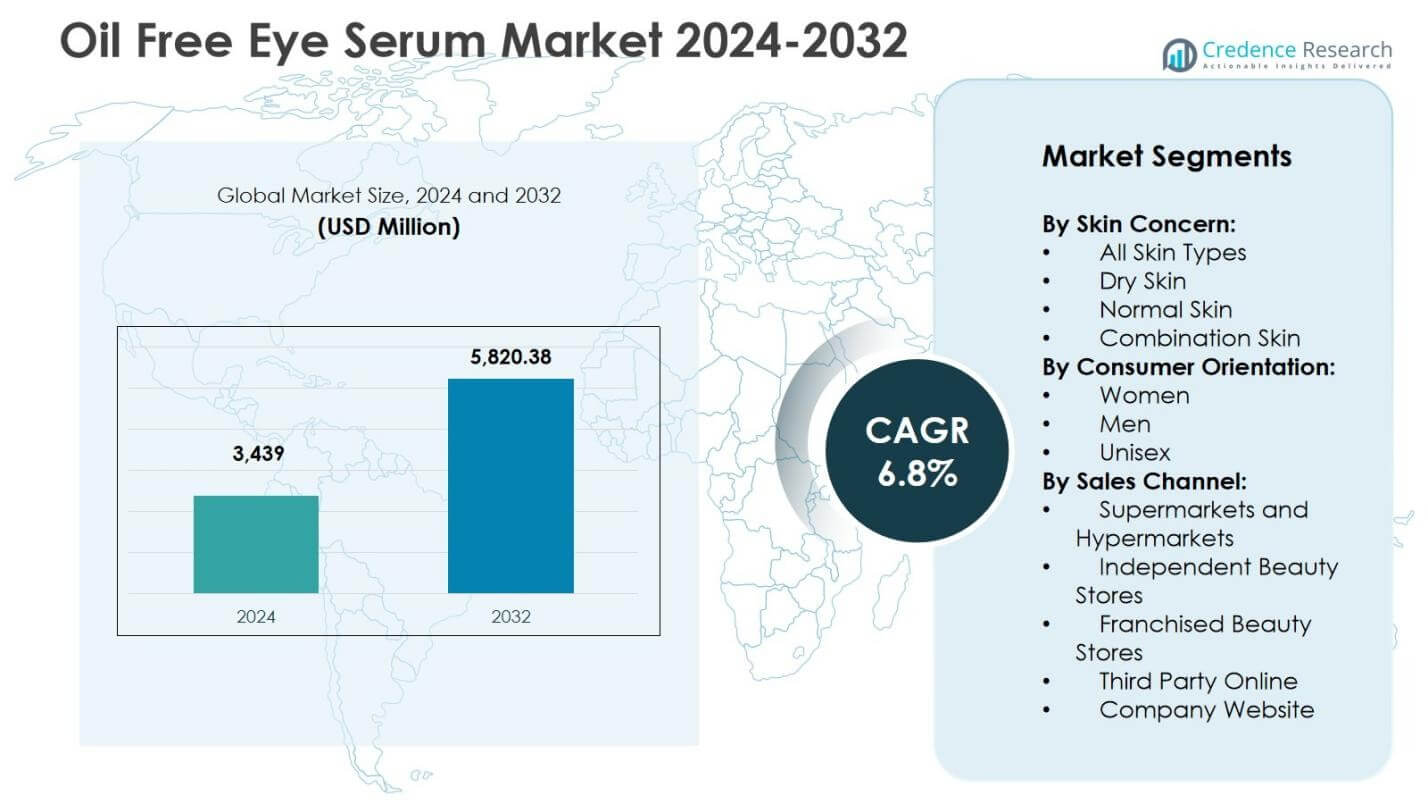
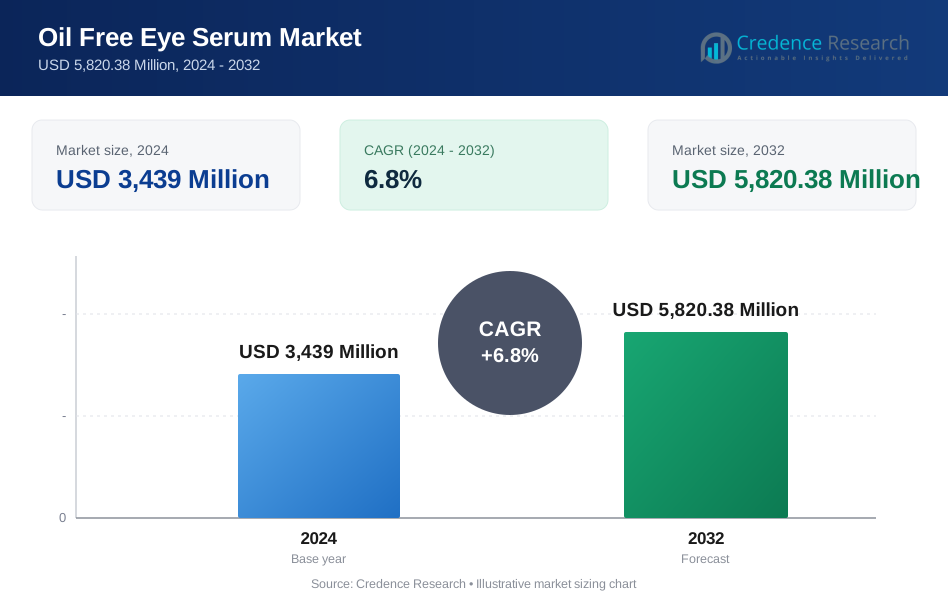
Oil Free Eye Serum Market size was valued USD 3,439 Million in 2024 and is anticipated to reach USD 5,820.38 Million by 2032, at a CAGR of 6.8% during the forecast period.
| REPORT ATTRIBUTE | DETAILS |
|---|---|
| Historical Period | 2020-2023 |
| Base Year | 2024 |
| Forecast Period | 2025-2032 |
| Oil Free Eye Serum Market Size 2024 | USD 3,439 million |
| Oil Free Eye Serum Market, CAGR | 6.8% |
| Oil Free Eye Serum Market Size 2032 | USD 5,820.38 million |
Oil Free Eye Serum Market Insights
- Oil Free Eye Serum Market size was USD 3,439 Million in 2024 and will reach USD 5,820.38 Million by 2032 at a CAGR of 6.8%.
- Market growth is driven by rising demand for lightweight, non-comedogenic eye care products, increasing adoption of preventive anti-aging routines, and strong consumer shift toward dermatology-tested, oil-free formulations across premium and masstige skincare categories.
- The market is witnessing trends such as clean-label and vegan formulations, multifunctional serums for hydration and brightening, and growing online beauty engagement supported by influencer recommendations and ingredient-focused product positioning.
- Key players focus on innovation, clinical validation, and portfolio expansion, strengthening brand presence through product differentiation, digital marketing, and strong distribution networks across retail, pharmacy, and e-commerce channels.
- North America leads the market with a 34.2% regional share, while the Women segment dominates with a 55.2% share and Third-Party Online channels hold 42.5% share, supported by strong premium skincare adoption and digital-first purchasing behavior.
Oil Free Eye Serum Market Segmentation Analysis:
By Skin Concern
In the Oil Free Eye Serum Market, the All Skin Types segment emerged as the dominant sub-segment with a 2024 market share of 38.6%, driven by its broad suitability across diverse consumer groups and dermatologically balanced formulations. The growing demand for lightweight, non-comedogenic eye serums that address puffiness, fine lines, and dark circles without causing oil buildup significantly strengthens this segment’s position. Meanwhile, the Combination Skin segment, holding 24.3% share, is gaining traction as brands introduce targeted, oil-free hydration products tailored for uneven texture and dual-concern skin profiles.
- For instance, CeraVe Eye Repair Cream, formulated for all skin types, features three essential ceramides, hyaluronic acid, and niacinamide in a non-greasy, fast-absorbing base to minimize dark circles and puffiness.
By Consumer Orientation
The Women segment led the Oil Free Eye Serum Market with a 2024 market share of 55.2%, supported by rising premium skincare adoption, increased focus on anti-aging eye care, and strong brand engagement through beauty retail and digital platforms. Growing awareness of preventive skincare routines and greater product penetration in urban markets further reinforce the dominance of this segment. The Unisex category, accounting for 28.7% share, is expanding quickly as manufacturers promote gender-neutral, dermatologist-tested oil-free eye serums aligned with inclusive beauty positioning and lifestyle-wellness preferences.
- For instance, Neutrogena Hydro Boost Eye Gel-Cream serves unisex needs as an ophthalmologist-tested, non-comedogenic product with a water-gel formula that hydrates without clogging pores, aligning with gender-neutral wellness preferences.
By Sales Channel
Third-Party Online platforms dominated the Oil Free Eye Serum Market with a 2024 market share of 42.5%, driven by the rapid expansion of e-commerce beauty marketplaces, influencer-led product discovery, and convenient price comparison and delivery options. The channel benefits from strong promotional campaigns and subscription-based purchasing behavior among digitally active consumers. Supermarkets and Hypermarkets accounted for 21.9% share, sustained by growing shelf visibility for premium and dermo-cosmetic eye serums and rising consumer inclination toward organized retail formats offering product bundling and seasonal discount programs.
Key Growth Drivers
Rising Demand for Lightweight, Non-Comedogenic Eye Care
The Oil Free Eye Serum Market is experiencing strong growth due to increasing consumer preference for lightweight, fast-absorbing, and non-comedogenic formulations that address under-eye puffiness, dark circles, and fine lines without clogging pores. The shift toward oil-free skincare is especially prominent among consumers with acne-prone, sensitive, and combination skin, who actively avoid heavy creams and occlusive ingredients. Growing awareness of ingredient transparency, dermatologist-recommended products, and clean-label serums further strengthens adoption. Expanding availability of oil-free formulations in premium, masstige, and clinical skincare categories continues to accelerate market penetration across both developed and emerging regions.
- For instance, 100% PURE's Coffee Bean Caffeine Brightening Eye Cream, powered by green tea and coffee extracts, delivers verified results from a four-week independent clinical study. Nearly 97% of participants saw reduced puffiness with continued use, while 87% noted fewer dark circles.
Expansion of Preventive and Anti-Aging Skincare Routines
Market growth is strongly supported by the rising emphasis on preventive skincare, with consumers beginning eye-care routines earlier to delay visible aging signs around the delicate eye area. The increasing visibility of digital beauty education, influencer-led awareness, and professional skincare consultations has encouraged routine-based product adoption, including daily use of serums for hydration, firmness, and wrinkle reduction. The expanding working-age population, higher disposable incomes, and premiumization of eye-care products are also contributing to sustained demand for oil-free eye serums positioned for long-term skin health, anti-fatigue benefits, and youthful appearance.
- For instance, La Roche-Posay Hyalu B5 Eye Serum, with dual hyaluronic acid and vitamin B5, hydrates and plumps the eye area instantly, visibly reducing wrinkles and dark circles in two weeks for firmer, revitalized contours. Its lightweight gel suits daily routines targeting fatigue and aging.
Growth of E-Commerce and Personalized Beauty Solutions
The Oil Free Eye Serum Market benefits significantly from rapid e-commerce expansion, subscription-based beauty platforms, and AI-enabled virtual skin consultations that support personalized product recommendations. Online channels enable greater access to dermatologist-tested, ingredient-focused oil-free serums, particularly among urban and tech-savvy consumers. Enhanced visibility through digital marketing, brand storytelling, and review-driven purchase behavior accelerates product discovery. At the same time, brands are launching targeted variants for hydration, brightening, and under-eye rejuvenation, catering to specific lifestyle and skin-concern groups, which strengthens portfolio differentiation and drives recurring purchase cycles.
Key Trends & Opportunities
Growing Adoption of Clean, Vegan, and Dermatology-Backed Formulations
A major trend shaping the Oil Free Eye Serum Market is the rising adoption of clean-label, vegan, cruelty-free, and fragrance-free formulations supported by dermatology-tested safety claims. Consumers are increasingly prioritizing serums featuring peptides, hyaluronic acid, niacinamide, and caffeine rather than heavy oils or synthetic occlusives. This shift presents strong opportunities for brands to innovate with multi-functional, irritation-free actives designed for sensitive under-eye skin. Premium clinical skincare brands and cosmeceutical manufacturers are leveraging research-driven ingredient positioning, strengthening consumer trust and enabling premium pricing strategies across global markets.
- For instance, The Derma Co's 5% Caffeine Under Eye Serum uses 5% caffeine as an antioxidant and anti-inflammatory agent alongside 1% peptides to reduce dark circles and puffiness through improved circulation.
Increasing Focus on Men’s Grooming and Unisex Eye Care Products
The growing acceptance of men’s grooming and self-care culture is creating new opportunities for unisex and male-targeted oil-free eye serums. Factors such as urban lifestyles, screen exposure fatigue, and workplace grooming awareness are driving male consumers to adopt eye-care routines focused on puffiness control and tired-eye reduction. Brands are responding with minimalist packaging, functional claims, and performance-based positioning suitable for diverse skin types without oil-based textures. This evolving consumer base expands addressable market potential and encourages new product lines within premium, professional, and mass-market grooming segments.
- For instance, Brickell Men's Products launched its Restoring Eye Cream, a lightweight, fast-absorbing formula free of greasy residue that uses caffeine from green tea extract to reduce puffiness by boosting circulation and hyaluronic acid to retain over 1,000 times its weight in water for hydration.
Key Challenges
High Product Differentiation Requirements in a Competitive Skincare Landscape
One of the key challenges in the Oil Free Eye Serum Market is the high level of product differentiation required to stand out in a crowded skincare environment dominated by multi-brand portfolios and established cosmetic companies. As consumers compare efficacy claims, ingredient transparency, and dermatological proof, brands face pressure to invest in clinical validation, advanced formulation science, and targeted messaging. The need for innovation across texture, absorption performance, and multi-benefit claims increases development costs and intensifies competition between premium, derma-cosmetic, and niche specialty brands.
Consumer Sensitivity to Pricing and Perceived Value Proposition
Another major challenge arises from consumer sensitivity toward pricing in the eye-care category, where purchase decisions are strongly influenced by perceived value, visible results, and long-term performance. Oil-free eye serums positioned in the premium and clinical segments must justify higher price points through proven benefits and brand credibility. At the same time, mass-market alternatives and private-label offerings create pricing pressure and increase substitution risk. This dynamic compels brands to balance affordability with innovation, packaging aesthetics, and experiential product attributes while sustaining profitability in competitive retail environments.
Regional Analysis
North America
North America held the largest share of the Oil Free Eye Serum Market with a market share of 34.2%, driven by strong consumer inclination toward premium skincare, high awareness of dermatology-tested formulations, and widespread adoption of preventive anti-aging routines. The region benefits from the presence of leading cosmetic brands, advanced retail infrastructure, and strong penetration of e-commerce beauty platforms. Demand is further supported by growing preference for lightweight, oil-free formulations among consumers with sensitive and acne-prone skin. Increasing product innovation, clinical claims, and ingredient-centric marketing continue to reinforce market expansion across the United States and Canada.
Europe
Europe accounted for a market share of 27.5% in the Oil Free Eye Serum Market, supported by rising demand for clean-label, vegan, and fragrance-free formulations aligned with strict cosmetic safety regulations. The region’s mature beauty and personal care sector, strong consumer focus on dermatological efficacy, and expanding adoption of under-eye care routines contribute significantly to market growth. Premium beauty retail chains, pharmacy-led dermo-cosmetic brands, and luxury skincare portfolios play a major role in shaping product adoption. Increasing emphasis on skin-health wellness, sustainability, and ingredient transparency continues to strengthen market performance across key Western European economies.
Asia Pacific
Asia Pacific captured a market share of 24.8% in the Oil Free Eye Serum Market, driven by rapid urbanization, growing skincare awareness among young consumers, and rising influence of K-beauty and J-beauty product trends. The region experiences strong demand for lightweight, fast-absorbing, and oil-free eye serums suited to humid climates and combination skin profiles. Expanding middle-class income levels, increasing digital beauty engagement, and the growth of online beauty platforms accelerate market adoption. Local and international brands are investing in brightening, hydration, and fatigue-reduction serums, supporting portfolio expansion across China, Japan, South Korea, India, and Southeast Asian markets.
Latin America
Latin America recorded a market share of 7.9% in the Oil Free Eye Serum Market, supported by increasing beauty-care spending, expanding retail access to international skincare brands, and rising consumer inclination toward lightweight under-eye serums. Urban millennials and working professionals are adopting oil-free eye care solutions to address dark circles and stress-related eye fatigue. Economic recovery trends, social-media-driven beauty awareness, and growth of pharmacy and specialty beauty outlets are contributing to gradual market penetration. However, price sensitivity and limited availability of premium clinical skincare in certain countries influence purchasing behavior across Brazil, Mexico, and emerging regional markets.
Middle East & Africa
The Middle East and Africa region accounted for a market share of 5.6% in the Oil Free Eye Serum Market, driven by increasing demand for high-performance skincare among urban consumers and growing retail expansion of international cosmetic brands. Rising awareness of anti-aging and under-eye care routines, along with preference for lightweight, non-oily formulations suited to warm climates, supports product adoption. Premium beauty boutiques, dermatology clinics, and online beauty platforms play a key role in category development. Market growth remains progressively supported by evolving lifestyle trends and increasing penetration of luxury and derma-cosmetic skincare products across key GCC markets.
Oil Free Eye Serum Market Segmentations:
By Skin Concern:
- All Skin Types
- Dry Skin
- Normal Skin
- Combination Skin
By Consumer Orientation:
- Women
- Men
- Unisex
By Sales Channel:
- Supermarkets and Hypermarkets
- Independent Beauty Stores
- Franchised Beauty Stores
- Third Party Online
- Company Website
By Geography
- North America
- U.S.
- Canada
- Mexico
- Europe
- Germany
- France
- U.K.
- Italy
- Spain
- Rest of Europe
- Asia Pacific
- China
- Japan
- India
- South Korea
- South-east Asia
- Rest of Asia Pacific
- Latin America
- Brazil
- Argentina
- Rest of Latin America
- Middle East & Africa
- GCC Countries
- South Africa
- Rest of the Middle East and Africa
Competitive Landscape
Competitive landscape analysis in the Oil Free Eye Serum Market is shaped by the presence of leading players such as L’Oréal, Estée Lauder Companies, Lancôme Paris, Natura Bissé, Cosmetics A La Carte Ltd, SkinCeuticals, Beaueli, First Aid Beauty, Petunia Skincare, and Prolong Lash, who collectively drive innovation, portfolio expansion, and premium positioning in the category. These companies focus on dermatology-backed formulations, lightweight textures, and ingredient-centric claims to strengthen consumer trust and differentiate products in a highly specialized eye-care segment. The market is characterized by strong competition across premium, cosmeceutical, and masstige brands, supported by active investments in R&D, clinical validation, and targeted anti-aging and brightening solutions. Digital marketing, influencer engagement, and e-commerce-led product discovery play a critical role in expanding market reach and strengthening brand visibility. Companies are also emphasizing sustainability, clean beauty credentials, and personalized skincare solutions, reinforcing brand loyalty while intensifying competition through continuous product upgrades and positioning strategies.
Key Player Analysis
- First Aid Beauty
- SkinCeuticals
- Prolong Lash
- Natura Bisse
- L’Oreal
- Beaueli
- Cosmetics A La Carte Ltd
- Estee Lauder Companies
- Petunia Skincare
- Lancome Paris
Recent Developments
- In January 2025, MAC launched the Hyper Real Eye Brightening Treatment, a lightweight serum formulated with vitamin C, niacinamide, and peptides to brighten dark circles and smooth skin texture (part of its Hyper Real skincare range).
- In September 2023, Ourself launched the HA+ replenishing eye serum featuring subtopical firming technology for the oil-free eye serum market.
Report Coverage
The research report offers an in-depth analysis based on Skin Concern, Consumer Orientation, Sales Channel and Geography. It details leading market players, providing an overview of their business, product offerings, investments, revenue streams, and key applications. Additionally, the report includes insights into the competitive environment, SWOT analysis, current market trends, as well as the primary drivers and constraints. Furthermore, it discusses various factors that have driven market expansion in recent years. The report also explores market dynamics, regulatory scenarios, and technological advancements that are shaping the industry. It assesses the impact of external factors and global economic changes on market growth. Lastly, it provides strategic recommendations for new entrants and established companies to navigate the complexities of the market.
Future Outlook
- The market will witness sustained growth as consumers increasingly prefer lightweight, non-comedogenic eye care formulations for daily skincare routines.
- Brands will continue to invest in clinically validated, dermatology-backed formulations to strengthen product credibility and performance positioning.
- Demand will rise for multi-functional oil free eye serums that address hydration, dark circles, puffiness, and fine lines within a single product.
- E-commerce and digital beauty platforms will play a stronger role in product discovery, consumer education, and repeat purchases.
- Premiumization will intensify as consumers show higher willingness to pay for clean, safe, and high-performance eye care solutions.
- Growth in unisex and men’s grooming categories will expand the consumer base for oil free eye serums across global markets.
- Innovation will increase around peptide-based, caffeine-based, and hyaluronic acid-based formulations tailored for sensitive under-eye skin.
- Sustainability-focused packaging and ingredient transparency will become key factors influencing brand preference and purchase decisions.
- Regional brands will gain traction as they introduce climate-specific and skin-type-focused oil free eye care solutions.
- Strategic partnerships, product line extensions, and technology-enabled personalization will shape long-term market differentiation and competitiveness.
Request a Free Sample
Fill in your details and we'll send you a free sample report.
- Sample data tables & charts
- Research methodology
Need a Custom Version of This Report?
Tailor the scope, geography, or segments to your exact requirements.
- Custom geography or segment scope
- Direct access to our analyst team
Frequently Asked Questions
What is the current market size for Oil Free Eye Serum Market, and what is its projected size in 2032?
At what Compound Annual Growth Rate is the Oil Free Eye Serum Market projected to grow between 2024 and 2032?
Which Oil Free Eye Serum Market segment held the largest share in 2024?
What are the primary factors fueling the growth of the Oil Free Eye Serum Market?
Who are the leading companies in the Oil Free Eye Serum Market?
Which region commanded the largest share of the Oil Free Eye Serum Market in 2024?
Table of Content
Chapter 1. Report Introduction
- 1.1 Report Description & Purpose
- 1.1.1 Report Title & Market Definition
- 1.1.2 Unique Selling Propositions (USP) & Key Differentiators
- 1.1.3 Value Proposition for Stakeholders
- 1.2 Research Objectives
- 1.2.1 Market Sizing Objectives (Volume & Revenue)
- 1.2.2 Segmentation Objectives
- 1.2.3 Competitive Intelligence Objectives
- 1.2.4 Forecast & Scenario Objectives
- 1.3 Report Scope
- 1.3.1 Oil Free Eye Serum Scope – Types & Subtypes Covered
- 1.3.2 Geographic Scope – Regions & Countries Covered
- 1.3.3 Historical Period, Base Year & Forecast Period (2024; forecast to 2032)
- 1.3.4 Inclusions & Exclusions
- 1.4 HS Code & Classification Framework
- 1.5 Currency, Units & Pricing Basis
- 1.6 Target Stakeholders
- 1.7 Limitations & Assumptions
Chapter 2. Executive Summary
- 2.1 Global Oil Free Eye Serum Market Snapshot
- 2.1.1 Market Size – Historical (2024) & Forecast (2024-2032) (2024: USD 3,439 Million → 2032: USD 5,820.38 Million)
- 2.1.2 Volume & Revenue – Global Totals
- 2.1.3 Key Market Highlights – Top Five Facts
- 2.2 Oil Free Eye Serum Market Segmentation Snapshot
- 2.2.1 Market Split by Region – 2024 vs. 2032
- 2.3 Competitive Snapshot
- 2.3.1 Top 10 Players by Revenue Share – 2024
- 2.3.2 Top 10 Players by Volume Share – 2024
- 2.3.3 Recent Strategic Developments (18-Month Summary)
- 2.4 Key Investment Highlights & Strategic Conclusions
Chapter 3. Oil Free Eye Serum Market Dynamics & Industry Analysis
- 3.1 Market Overview & Context
- 3.1.1 Oil Free Eye Serum Market Position in the Broader Automotive Value Chain
- 3.1.2 OEM vs. Replacement Market Dynamics
- 3.1.3 Market Maturity & Development Stage by Region
- 3.2 Oil Free Eye Serum Market Drivers
- 3.3 Oil Free Eye Serum Market Restraints & Challenges
- 3.4 Oil Free Eye Serum Market Opportunities
- 3.5 Porter's Five Forces Analysis
- 3.5.1 Threat of New Entrants
- 3.5.2 Bargaining Power of Suppliers
- 3.5.3 Bargaining Power of Buyers
- 3.5.4 Threat of Substitutes
- 3.5.5 Competitive Rivalry – Intensity Assessment
- 3.6 Oil Free Eye Serum Value Chain Analysis
- 3.6.1 Upstream – Raw Material/Input Suppliers
- 3.6.1.1 Raw Material/Input 1
- 3.6.1.2 Raw Material/Input 2
- 3.6.1.3 Raw Material/Input 3
- 3.6.2 Midstream – Production/Manufacturing/Service Delivery
- 3.6.2.1 Production/Process Overview
- 3.6.2.2 Key Facility Locations & Capacity by Manufacturer
- 3.6.3 Downstream – Distribution & End Consumer
- 3.6.3.1 Primary Channel – B2B/OEM
- 3.6.3.2 Secondary Channels – Dealer, Retail, Online, Direct
- 3.6.4 Value Chain Profitability Analysis
- 3.6.1 Upstream – Raw Material/Input Suppliers
- 3.7 PESTEL Analysis
- 3.7.1 Political Factors
- 3.7.2 Economic Factors
- 3.7.3 Social Factors
- 3.7.4 Technological Factors
- 3.7.5 Environmental Factors
- 3.7.6 Legal Factors
- 3.8 Oil Free Eye Serum Supply Chain Analysis
- 3.8.1 Raw Material/Input Supply Risk Assessment
- 3.8.2 Manufacturing Concentration Risk (Geographic Exposure)
- 3.8.3 Trade Disruption Impact Analysis
- 3.9 Regulatory & Policy Landscape
Note: The regulatory and policy landscape section covers regulations based on their applicability to the market, Oil Free Eye Serum category, geography, and scope of the study. Only regulatory frameworks with a material impact on operations, compliance, trade, sustainability, or market access are analyzed in detail.
Chapter 4. Key Investment Pockets & Opportunity Analysis
- 4.1 Oil Free Eye Serum Market Attractiveness Analysis
- 4.1.1 By Region – Investment Attractiveness Matrix (Volume × CAGR)
- 4.2 Absolute Revenue Growth Opportunity
- 4.2.1 By Region – Absolute USD Growth Through 2032
- 4.3 Incremental Volume Opportunity
- 4.3.1 By Region – Incremental Volume Through 2032
- 4.3.2 Segment – Incremental Volume
- 4.4 Emerging Submarket Opportunity Deep Dive (Subject to Applicability)
- 4.5 Emerging Market Opportunity Scorecards
- 4.5.1 United States
- 4.5.2 Europe
- 4.5.3 Asia
- 4.5.4 Middle East & Africa
Note: Emerging Market Opportunity Scorecards will be included based on relevance and strategic importance. Regions listed are indicative and may vary depending on data availability and market dynamics.
Chapter 5. Oil Free Eye Serum Import-Export Analysis & Trade Flows
- 5.1 Global Trade Overview
- 5.1.1 Global Export Value by Country (2024)
- 5.1.2 Global Export Volume by Country (2024)
- 5.1.3 Global Import Value by Country (2024)
- 5.1.4 Global Import Volume by Country (2024)
- 5.1.5 Net Trade Balance by Country (2024)
- 5.2 Export Analysis – Segment
- 5.2.1 Type 1 (HS Code)
- 5.2.2 Type 2 (HS Code)
- 5.2.3 Type 3 (HS Code)
- 5.2.4 Type 4 (HS Code)
- 5.2.5 Type 5 (HS Code)
- 5.3 Import Analysis – Segment
- 5.3.1 Type 1 (HS Code)
- 5.3.2 Type 2 (HS Code)
- 5.3.3 Type 3 (HS Code)
- 5.3.4 Type 4 (HS Code)
- 5.3.5 Type 5 (HS Code)
- 5.4 Average Unit Trade Prices
- 5.4.1 Average Export Price – Segment & Country
- 5.4.2 Average Import Price – Segment & Source Country
- 5.4.3 Price Trends (2024)
- 5.5 Key Trade Route Analysis
- 5.5.1 Trade Route 1
- 5.5.2 Trade Route 2
- 5.5.3 Trade Route 3
- 5.5.4 Trade Route 4
- 5.5.5 Trade Route 5
- 5.6 Trade Policy Impact Assessment
- 5.6.1 US Anti-Dumping & Section 301 Tariffs
- 5.6.2 EU Customs Union Impact
- 5.6.3 Major Free Trade Agreements
- 5.6.4 USMCA Rules of Origin
Note: Trade policy analysis will be included only where relevant to the Oil Free Eye Serum market.
Chapter 6. Competitive Landscape & Company Benchmarking
- 6.1 Oil Free Eye Serum Market Concentration & Structure
- 6.1.1 Herfindahl-Hirschman Index (HHI) – vs. 2024
- 6.1.2 Tier 1, Tier 2 & Tier 3 Market Structure
- 6.1.3 Global, Regional & Local Player Dynamics
- 6.2 Oil Free Eye Serum Market Share Analysis – 2024
- 6.2.1 Global Revenue Share by Company
- 6.2.2 Global Volume Share by Company
- 6.2.3 Regional Revenue Share
- 6.2.4 Market Share Evolution ( vs. 2024)
- 6.2.5 OEM Segment Share by Company
- 6.2.6 Replacement Segment Share by Company
- 6.3 Production/Delivery Capacity & Facility Analysis
- 6.3.1 Global Installed Capacity
- 6.3.2 Capacity Utilization Rates
- 6.3.3 Production/Output Volume
- 6.3.4 Facility Locations & Capacity Map
- 6.3.5 Planned Capacity Additions
- 6.4 Oil Free Eye Serum Competitive Benchmarking Matrix
- 6.4.1 Revenue, Volume, CAGR & Profitability Comparison
- 6.4.2 Channel Revenue Mix
- 6.4.3 Geographic Revenue Exposure
- 6.4.4 R&D Intensity
- 6.4.5 Sustainability Maturity
- 6.5 Strategic Developments in Oil Free Eye Serum (Last 24 Months)
- 6.5.1 Mergers, Acquisitions & Divestments
- 6.5.2 New Oil Free Eye Serum Launches
- 6.5.3 Facility Expansions
- 6.5.4 Strategic Alliances, Joint Ventures & Partnerships
- 6.5.5 Distribution Expansion & Market Entry
- 6.5.6 Sustainability & ESG Initiatives
- 6.6 Competitive Strategy Mapping
- 6.6.1 Leader, Challenger, Follower & Niche Classification
- 6.6.2 Pricing Strategy Comparison
- 6.6.3 Channel Strategy Matrix
Note: Strategic developments are included based on their materiality and the availability of reliable information.
Chapter 7. Global Oil Free Eye Serum Market – By Distribution Channel
- 7.1 Segment Overview
- 7.1.1 Volume & Revenue Split by Channel (2024 & 2032)
- 7.1.2 Channel Mix Evolution (2024-2032)
Chapter 8. Regional Market Analysis – Global Overview
- 8.1 Global Regional Overview
- 8.1.1 Regional Volume Share
- 8.1.2 Regional Revenue Share
- 8.1.3 Regional Volume by Region
- 8.1.4 Regional Revenue by Region
- 8.1.5 Regional Forecast Through 2032
- 8.2 Cross-Regional Segment Analysis
- 8.2.1 By Distribution Channel
- 8.2.2 By Brand/Price Tier
Chapter 9. North America Oil Free Eye Serum Market
- 9.1 United States
- 9.2 Canada
- 9.3 Mexico
Chapter 10. Europe Oil Free Eye Serum Market
- 10.1 Germany
- 10.2 France
- 10.3 Italy
- 10.4 United Kingdom
- 10.5 Spain
- 10.6 Poland
- 10.7 Russia
- 10.8 Netherlands
- 10.9 Belgium
- 10.10 Sweden
- 10.11 Denmark
- 10.12 Norway
- 10.13 Rest of Europe
Chapter 11. Asia Pacific Oil Free Eye Serum Market
- 11.1 China
- 11.2 India
- 11.3 Japan
- 11.4 South Korea
- 11.5 Thailand
- 11.6 Indonesia
- 11.7 Vietnam
- 11.8 Malaysia
- 11.9 Australia
- 11.10 Rest of Asia Pacific
Chapter 12. Latin America Oil Free Eye Serum Market
- 12.1 Brazil
- 12.2 Argentina
- 12.3 Colombia
- 12.4 Chile
- 12.5 Rest of Latin America
Chapter 13. Middle East Oil Free Eye Serum Market
- 13.1 Saudi Arabia
- 13.2 United Arab Emirates
- 13.3 Turkey
- 13.4 Israel
- 13.5 Iran
- 13.6 Rest of the Middle East
Chapter 14. Africa Oil Free Eye Serum Market
- 14.1 South Africa
- 14.2 Egypt
- 14.3 Nigeria
- 14.4 Morocco
- 14.5 Rest of Africa
Chapter 15. Oil Free Eye Serum Company Profiles
- 15.1 [Company 01]
- 15.1.1 Company Overview
- 15.1.2 Key Management Personnel
- 15.1.3 Products & Services Portfolio
- 15.1.4 Financial Performance
- 15.1.5 Key Market Focus & Geographic Presence
- 15.1.6 Recent Developments & Strategic Initiatives
Note: The company profile list is preliminary and may change based on research findings, market developments, data availability, and client requirements.
Chapter 16. Appendices
- Appendix A – List of Abbreviations & Acronyms
- Appendix B – Industry Classification Code Reference – Full Series
- Appendix C – Production & Capacity Data Tables
- Appendix D – End-Use & Demand Base Tables
- Appendix E – Consumption & Replacement Rate Assumptions
- Appendix F – ASP Reference Tables
- Appendix G – Manufacturing & Facility Database
- Appendix H – Import-Export Data Tables
- Appendix I – Regulatory Summary Tables
- Appendix J – Primary Research Participant List (Anonymized)
- Appendix K – Primary Research Questionnaire Framework
- Appendix L – Data Sources & Bibliography
- Appendix M – Market Size Divergence & Source Comparison
Chapter 17. Research Methodology
- 17.1 Research Framework & Philosophy
- 17.2 Secondary Research – Sources, Hierarchy & Data Extraction
- 17.3 Data Modeling – Bottom-Up & Top-Down Market Sizing
- 17.4 Primary Research – Stakeholder Framework, LOI & Sample Sizes
- 17.5 Forecast Methodology – Regression, Scenario & Sensitivity Analysis
- 17.6 Quality Control – Four-Layer Validation Framework
- 17.7 Limitations & Standard Assumptions
- 17.8 Disclaimer
