
Market Overview:
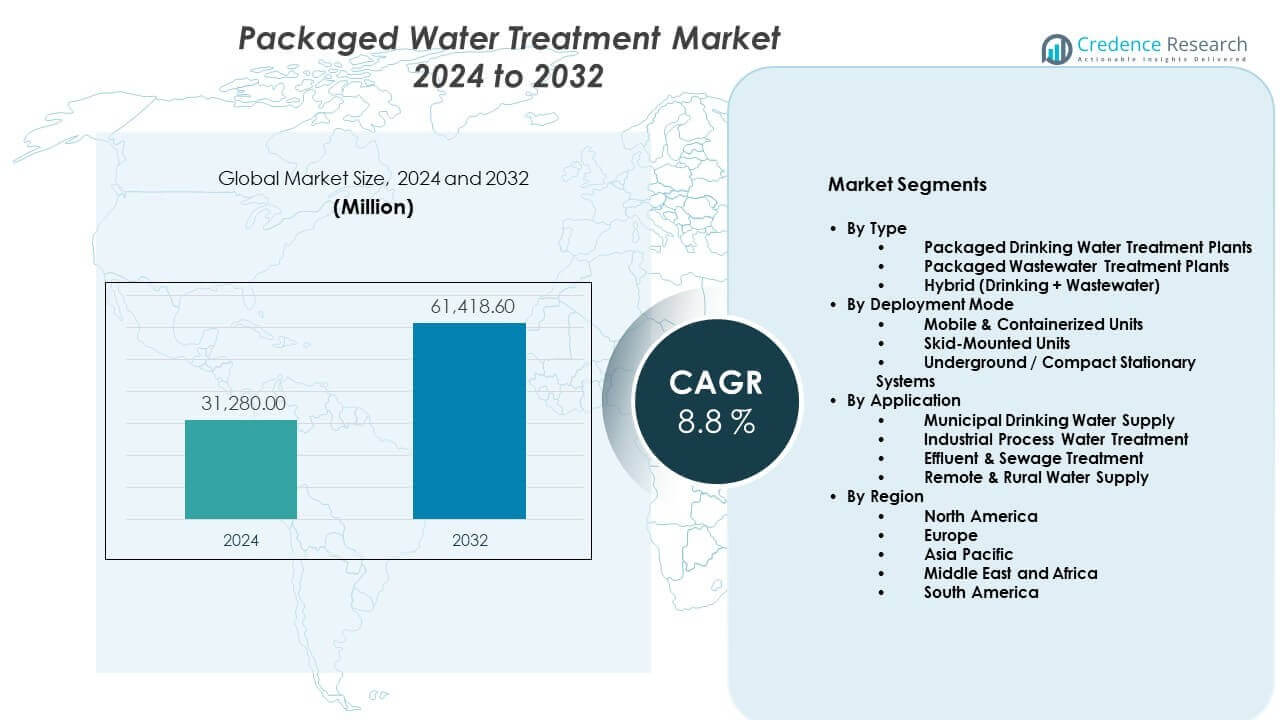
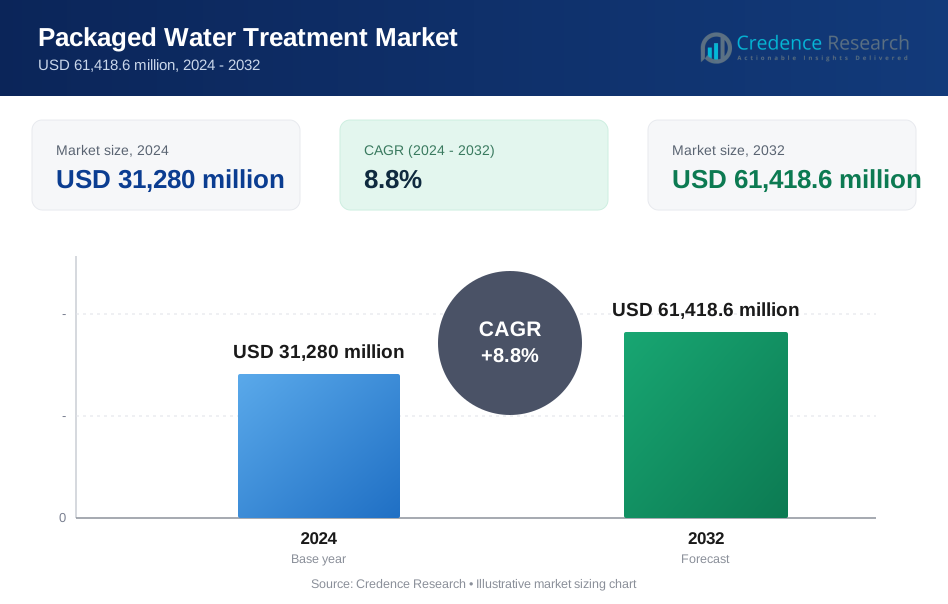
The Packaged Water Treatment Market is projected to grow from USD 31,280 million in 2024 to USD 61,418.6 million by 2032. The market is expected to expand at a CAGR of 8.8% from 2024 to 2032.
| REPORT ATTRIBUTE | DETAILS |
|---|---|
| Historical Period | 2020-2023 |
| Base Year | 2024 |
| Forecast Period | 2025-2032 |
| Packaged Water Treatment Market Size 2024 | USD 31,280 million |
| Packaged Water Treatment Market, CAGR | 8.8% |
| Packaged Water Treatment Market Size 2032 | USD 61,418.6 million |
Demand for packaged water treatment systems rises due to water scarcity and quality concerns. Industries need reliable systems to meet discharge and reuse norms. Urban growth increases pressure on existing water infrastructure. Packaged plants provide quick deployment for housing and commercial projects. Municipal bodies prefer modular units for decentralized treatment needs. Industrial users adopt these systems to reduce downtime. Stricter environmental rules push compliance investments. Cost control and operational ease improve buyer preference. Technology upgrades improve efficiency and automation across installations.
North America and Europe lead adoption due to strict water regulations and aging infrastructure. The United States shows strong demand from municipal upgrades and industrial reuse needs. Western Europe focuses on compliance-driven wastewater treatment projects. Asia Pacific emerges as a high-growth region due to urban expansion and industrialization. China and India invest in decentralized water treatment for cities and factories. Southeast Asia sees rising demand from tourism and manufacturing hubs. The Middle East adopts packaged systems to manage water scarcity and reuse programs.
Market Insights:
- The market was valued at USD 31,280 million in 2024 and is projected to reach USD 61,418.6 million by 2032, growing at a CAGR of 8.8% due to rising modular water treatment adoption.
- North America leads with 32% share due to strict regulations, followed by Asia Pacific at 29% from rapid urban growth, and Europe at 27% driven by compliance and reuse focus.
- Asia Pacific is the fastest-growing region with a 29% share, supported by urban expansion, industrialization, and decentralized water infrastructure programs.
- Municipal drinking water supply accounts for nearly 38% share, driven by city-level capacity expansion and aging infrastructure replacement.
- Packaged wastewater treatment plants hold about 34% share, supported by industrial discharge compliance and wastewater reuse demand.
Market Drivers:
Rising Pressure On Municipal Water And Wastewater Infrastructure Capacity
Urban population growth strains public water systems across cities. Municipal bodies face limits in legacy treatment plants. The Packaged water treatment market supports fast capacity expansion without long build cycles. Authorities select modular plants for decentralized deployment. These systems fit peri-urban and remote zones well. Short installation timelines improve project feasibility. Standardized designs reduce technical risk for operators. Public agencies value predictable output quality. Budget planning benefits from phased system deployment.
- For instance, Veolia’s Actiflo Pack units have over 900 packaged plants globally, treating high flows with turbidity and suspended solids removal up to 99%.
Industrial Compliance Needs Across Diverse End-Use Sectors
Industries face strict discharge and reuse rules across regions. Manufacturing sites require stable treatment performance. The Packaged water treatment market addresses site-specific water profiles effectively. Units support textile, food, power, and chemical plants. Compact layouts suit space-constrained facilities. Automation improves operational control and reliability. Firms adopt these systems to avoid penalties. Internal water recycling lowers freshwater intake. Compliance targets drive steady procurement demand.
- For instance, Veolia’s Actiflo Pack ACP2 units deliver up to 1,441 m³/h net flow for industrial wastewater treatment.
Growing Demand For Rapid Deployment And Modular Treatment Solutions
Project timelines influence technology selection decisions. Developers prefer solutions with minimal civil work. The Packaged water treatment market aligns with this requirement. Pre-engineered systems reduce on-site labor needs. Skid-mounted designs ease transport and setup. Contractors meet deadlines with fewer dependencies. Modular capacity supports phased expansion plans. Reliability under varied load conditions matters. Speed and flexibility strengthen adoption across sectors.
Focus On Cost Control And Operational Simplicity
Water treatment budgets face close scrutiny. Operators seek systems with lower lifecycle cost. The Packaged water treatment market offers standardized maintenance routines. Simple operation reduces training burden. Energy-efficient components limit power use. Remote monitoring supports proactive service planning. Downtime risk stays low with proven designs. Spare part availability improves uptime. Cost visibility supports long-term planning.
Market Trends:
Shift Toward Smart And Digitally Enabled Treatment Systems
Digital tools gain acceptance in water infrastructure. Operators demand real-time system visibility. The Packaged water treatment market integrates sensors and control platforms. Data analytics support early fault detection. Remote access improves operational response time. Automation reduces manual intervention needs. Performance tracking aids compliance reporting. Smart features attract utility buyers. Technology maturity supports wider rollout.
- For instance, Xylem Vue integrates data from any source into a single platform, enabling real-time analytics and unified network control across utilities.
Growing Preference For Containerized And Mobile Treatment Units
Temporary water needs rise across projects. Construction and disaster relief require flexible solutions. The Packaged water treatment market supports mobile configurations. Containerized units enable rapid relocation. Deployment suits mining and oilfield sites. Rental models gain acceptance among users. Mobility improves asset utilization rates. Standard footprints ease logistics planning. Flexibility shapes purchasing decisions.
- For instance, Veolia offers mobile potable water treatment solutions producing up to 100 m³/hr for emergency and remote applications.
Increased Adoption Of Decentralized Treatment Architectures
Centralized plants face land and cost limits. Communities explore localized treatment options. The Packaged water treatment market fits decentralized strategies well. Smaller units serve housing clusters. Treated water supports local reuse needs. Losses from long pipelines decline. Community-level control improves service reliability. Policy support encourages distributed models. Urban planning trends reinforce adoption.
Integration Of Advanced Filtration And Membrane Technologies
Water quality requirements continue to tighten. Users demand higher treatment efficiency. The Packaged water treatment market incorporates advanced membranes. These systems improve contaminant removal rates. Compact design suits high-performance modules. Consistent output supports industrial reuse. Technology cost trends favor adoption. Vendors standardize advanced options. Quality focus drives system upgrades.
Market Challenges Analysis:
High Initial Capital Cost For Small And Mid-Scale Users
Upfront investment remains a key concern. Smaller users face budget constraints. The Packaged water treatment market requires careful cost justification. Advanced components raise purchase prices. Financing access varies by region. Public tenders face approval delays. Private users seek fast payback periods. Cost sensitivity limits adoption pace. Value communication remains critical.
Operational Skill Gaps And Maintenance Constraints In Emerging Regions
System performance depends on skilled operation. Many regions lack trained personnel. The Packaged water treatment market faces service gaps. Poor maintenance affects output stability. Spare part access varies by location. Training programs require time and cost. Remote monitoring helps but needs connectivity. Vendor support networks stay uneven. Capability gaps slow deployment.
Market Opportunities:
Expansion Of Water Reuse And Recycling Projects Across Industries
Water reuse gains strategic importance globally. Industries aim to cut freshwater intake. The Packaged water treatment market supports reuse applications well. Treated output meets process water needs. Modular plants fit retrofit projects. Reuse lowers operating risk during shortages. Sustainability goals influence procurement decisions. Policy support strengthens project pipelines. Reuse demand creates long-term opportunity.
Infrastructure Development In Emerging Urban And Industrial Zones
Emerging economies invest in new infrastructure. Cities expand faster than utilities can scale. The Packaged water treatment market fills this gap. New industrial parks need quick solutions. Developers favor standardized treatment units. Decentralized plants support phased city growth. Tourism and logistics hubs require reliable water. Infrastructure funding supports adoption. Growth regions offer strong demand potential.
Market Segmentation Analysis:
By Type
Packaged drinking water treatment plants serve urban and semi-urban supply needs. These systems deliver safe potable water with consistent quality control. Packaged wastewater treatment plants address sewage and industrial discharge requirements. Industries and municipalities select these units for compliance and reuse goals. Hybrid systems treat both drinking water and wastewater within one platform. This format improves asset use and reduces footprint needs. The Packaged water treatment market reflects demand for flexible treatment capability across varied water sources.
- For instance, Veolia’s Actiflo Pack Mini units achieve turbidity and TSS removal above 99% across drinking and wastewater treatment streams.
By Deployment Mode
Mobile and containerized units support temporary and emergency water needs. These systems suit construction sites and remote operations. Skid-mounted units offer fixed yet modular installation options. Operators value quick setup and scalable capacity. Underground and compact stationary systems fit dense urban locations. These designs minimize visual impact and land use. Deployment choice depends on site condition, capacity demand, and project timeline.
- For instance, modular packaged plants like Veolia’s pre-engineered units integrate into existing infrastructure quickly with standardized modules for faster site deployment.
By Application
Municipal drinking water supply remains a core application area. Cities rely on packaged systems to expand treatment capacity quickly. Industrial process water treatment supports manufacturing continuity and quality control. Effluent and sewage treatment units manage discharge and reuse requirements. Remote and rural water supply systems improve access in underserved regions. Reliability and ease of operation drive adoption across these use cases.
Segmentation:
By Type- Packaged Drinking Water Treatment Plants
- Packaged Wastewater Treatment Plants
- Hybrid (Drinking + Wastewater)
- Mobile & Containerized Units
- Skid-Mounted Units
- Underground / Compact Stationary Systems
- Municipal Drinking Water Supply
- Industrial Process Water Treatment
- Effluent & Sewage Treatment
- Remote & Rural Water Supply
- North America
- U.S.
- Canada
- Mexico
- Europe
- Germany
- France
- U.K.
- Italy
- Spain
- Rest of Europe
- Asia Pacific
- China
- Japan
- India
- South Korea
- South-east Asia
- Rest of Asia Pacific
- Latin America
- Brazil
- Argentina
- Rest of Latin America
- Middle East & Africa
- GCC Countries
- South Africa
- Rest of the Middle East and Africa
Regional Analysis:
North America And Europe
North America accounts for nearly 32% of the global market share. Strong municipal spending and strict discharge norms support adoption. The United States leads demand from infrastructure upgrades and industrial reuse projects. The Packaged water treatment market benefits from replacement of aging plants across cities. Europe holds close to 27% market share due to regulatory enforcement. Countries such as Germany, France, and the UK invest in decentralized systems. Focus on water reuse and sustainability sustains regional demand.
Asia Pacific
Asia Pacific represents around 29% of the total market share. Rapid urban growth increases pressure on water supply systems. China and India drive large-scale adoption across municipal and industrial sectors. The Packaged water treatment market expands through decentralized and modular projects. Industrial zones require fast deployment to support manufacturing output. Government programs promote rural water access. Cost-effective systems gain preference across developing economies.
Middle East, Africa, And South America
The Middle East and Africa region holds about 8% market share. Water scarcity drives investment in treatment and reuse solutions. Gulf countries deploy packaged systems for industrial and municipal needs. The Packaged water treatment market gains traction in mining and oil operations. South America accounts for nearly 4% market share. Brazil and Chile invest in wastewater treatment upgrades. Infrastructure funding and urban expansion support gradual growth.
Key Player Analysis:
- Veolia Environment
- Toray Industries
- Suez Water Technologies & Solutions
- GE Water & Process Technologies
- Fluence
Competitive Analysis:
The Packaged water treatment market features a mix of global solution providers and regional specialists. Leading companies compete through technology depth, system reliability, and service reach. Firms focus on modular designs to address diverse site needs. Strong after-sales support influences buyer preference. Strategic partnerships help expand geographic presence. Product customization supports sector-specific demand. Cost efficiency remains a key differentiator. Digital control features strengthen competitive positioning. Brand credibility supports long-term contracts.
Recent Developments:
- In November 2025, Veolia announced a landmark acquisition of Clean Earth from Enviri Corporation for $3 billion (€2.6 billion), significantly strengthening its position in the hazardous waste and industrial water treatment sectors in North America. This strategic move aligns with Veolia's GreenUp strategic program and reflects the company's commitment to expand into high-growth environmental service segments. Earlier in 2025, Veolia completed the acquisition of a 30% stake in its subsidiary Water Technologies and Solutions (WTS) from CDPQ for $1.75 billion (~€1.5 billion) in May, achieving full ownership and enabling the company to unlock approximately €90 million in run-rate cost synergies by 2027. Additionally, Veolia acquired Chameleon Industries, a Texas-based specialty chemical producer serving the semiconductor and microelectronics industries, further expanding its circular economy capabilities across North America. On the contract front, Veolia secured substantial wins in the first quarter of 2025, including a $550 million deal to design, construct, and operate a state-of-the-art semiconductor manufacturing water treatment facility in the Midwest with 16-year operational commitment, and a $34 million contract to equip San Francisco's Southeast wastewater treatment plant with MemGas™ technology to produce biomethane. Furthermore, Veolia joined a consortium with Marafiq and Lamar to secure a $500 million industrial water treatment facility project with SATORP in Saudi Arabia in September 2025, featuring advanced treatment technologies including sulfate removal processes. In July 2025, Veolia formalized a strategic three-year partnership with the Agence Française de Développement (AFD) to combine technical expertise with local implementation capacity, focusing on water and sanitation, waste management, and energy services across Latin America, Central Asia, the Balkans, Africa, and the Middle East.
- Toray Industries has demonstrated substantial innovation momentum in the water treatment sector throughout 2024-2025. In February 2025, the company unveiled a groundbreaking high-efficiency ultrafiltration (UF) membrane designed to reduce carbon dioxide emissions by more than 30% compared to conventional offerings, with mass production commencing in mid-2025 and initial launch targeting North America followed by Japan and other regions. The new UF membrane reduces biopolymer transmission a primary cause of RO membrane contamination by over two-thirds, significantly improving treatment performance in wastewater reuse applications. In November 2024, Toray introduced its TBW-XHR series of reverse osmosis membranes engineered to double the efficiency of urea removal in ultrapure water production from recycled wastewater, addressing critical demands in semiconductor and advanced manufacturing sectors. A pivotal strategic initiative came in April 2025 when Toray Membrane Middle East LLC launched the Middle East Water Treatment Technical Center (MEWTEC) in Dammam, Saudi Arabia, providing comprehensive integrated technology services across the entire water treatment process, including advanced analysis tools, pilot-scale systems, and collaborative research platforms to serve the Middle East, Africa, and neighboring regions. The facility represents Toray's commitment to strengthening its regional presence and addressing water scarcity challenges in rapidly industrializing areas. Additionally, the company's Taweelah seawater desalination project in the United Arab Emirates achieved commercial operation status in 2024, demonstrating Toray's market leadership in high-performance RO membrane technology for desalination applications.
Report Coverage:
The research report offers an in-depth analysis based on By Type, By Deployment Mode, and By Application segments. It details leading market players, providing an overview of their business, product offerings, investments, revenue streams, and key applications. Additionally, the report includes insights into the competitive environment, SWOT analysis, current market trends, as well as the primary drivers and constraints. Furthermore, it discusses various factors that have driven market expansion in recent years. The report also explores market dynamics, regulatory scenarios, and technological advancements that are shaping the industry. It assesses the impact of external factors and global economic changes on market growth. Lastly, it provides strategic recommendations for new entrants and established companies to navigate the complexities of the market.
Future Outlook:
- Urban expansion will continue to increase demand for decentralized packaged water treatment solutions.
- Water reuse initiatives will support wider adoption across municipal and industrial users.
- Industrial growth will drive higher demand for reliable process water treatment systems.
- Modular system designs will gain preference due to flexible capacity expansion options.
- Automation and digital monitoring will improve operational efficiency and service reliability.
- Rural water access programs will accelerate deployment of packaged treatment plants.
- Compact system designs will suit space-constrained urban and industrial locations.
- Service-based delivery models will strengthen long-term customer relationships.
- Technology upgrades will enhance treatment performance and compliance capability.
- Regulatory enforcement will sustain consistent investment in water treatment infrastructure.
Request a Free Sample
Fill in your details and we'll send you a free sample report.
- Sample data tables & charts
- Research methodology
Need a Custom Version of This Report?
Tailor the scope, geography, or segments to your exact requirements.
- Custom geography or segment scope
- Direct access to our analyst team
Frequently Asked Questions
What is the current market size for Packaged water treatment market, and what is its projected size in 2032?
At what Compound Annual Growth Rate is the Packaged water treatment market projected to grow between 2025 and 2032?
Which Packaged water treatment market segment held the largest share in 2024?
What are the primary factors fueling the growth of the Packaged water treatment market?
Who are the leading companies in the Packaged water treatment market?
Which region commanded the largest share of the Packaged water treatment market in 2024?
Table of Content
Chapter 1. Report Introduction
- 1.1 Report Description & Purpose
- 1.1.1 Report Title & Market Definition
- 1.1.2 Unique Selling Propositions (USP) & Key Differentiators
- 1.1.3 Value Proposition for Stakeholders
- 1.2 Research Objectives
- 1.2.1 Market Sizing Objectives (Volume & Revenue)
- 1.2.2 Segmentation Objectives
- 1.2.3 Competitive Intelligence Objectives
- 1.2.4 Forecast & Scenario Objectives
- 1.3 Report Scope
- 1.3.1 Packaged Water Treatment Scope – Types & Subtypes Covered
- 1.3.2 Geographic Scope – Regions & Countries Covered
- 1.3.3 Historical Period, Base Year & Forecast Period (2024; forecast to 2032)
- 1.3.4 Inclusions & Exclusions
- 1.4 HS Code & Classification Framework
- 1.5 Currency, Units & Pricing Basis
- 1.6 Target Stakeholders
- 1.7 Limitations & Assumptions
Chapter 2. Executive Summary
- 2.1 Global Packaged Water Treatment Market Snapshot
- 2.1.1 Market Size – Historical (2024) & Forecast (2024-2032) (2024: USD 31,280 million → 2032: USD 61,418.6 million)
- 2.1.2 Volume & Revenue – Global Totals
- 2.1.3 Key Market Highlights – Top Five Facts
- 2.2 Packaged Water Treatment Market Segmentation Snapshot
- 2.2.1 Market Split by Region – 2024 vs. 2032
- 2.3 Competitive Snapshot
- 2.3.1 Top 10 Players by Revenue Share – 2024
- 2.3.2 Top 10 Players by Volume Share – 2024
- 2.3.3 Recent Strategic Developments (18-Month Summary)
- 2.4 Key Investment Highlights & Strategic Conclusions
Chapter 3. Packaged Water Treatment Market Dynamics & Industry Analysis
- 3.1 Market Overview & Context
- 3.1.1 Packaged Water Treatment Market Position in the Broader Automotive Value Chain
- 3.1.2 OEM vs. Replacement Market Dynamics
- 3.1.3 Market Maturity & Development Stage by Region
- 3.2 Packaged Water Treatment Market Drivers
- 3.3 Packaged Water Treatment Market Restraints & Challenges
- 3.4 Packaged Water Treatment Market Opportunities
- 3.5 Porter's Five Forces Analysis
- 3.5.1 Threat of New Entrants
- 3.5.2 Bargaining Power of Suppliers
- 3.5.3 Bargaining Power of Buyers
- 3.5.4 Threat of Substitutes
- 3.5.5 Competitive Rivalry – Intensity Assessment
- 3.6 Packaged Water Treatment Value Chain Analysis
- 3.6.1 Upstream – Raw Material/Input Suppliers
- 3.6.1.1 Raw Material/Input 1
- 3.6.1.2 Raw Material/Input 2
- 3.6.1.3 Raw Material/Input 3
- 3.6.2 Midstream – Production/Manufacturing/Service Delivery
- 3.6.2.1 Production/Process Overview
- 3.6.2.2 Key Facility Locations & Capacity by Manufacturer
- 3.6.3 Downstream – Distribution & End Consumer
- 3.6.3.1 Primary Channel – B2B/OEM
- 3.6.3.2 Secondary Channels – Dealer, Retail, Online, Direct
- 3.6.4 Value Chain Profitability Analysis
- 3.6.1 Upstream – Raw Material/Input Suppliers
- 3.7 PESTEL Analysis
- 3.7.1 Political Factors
- 3.7.2 Economic Factors
- 3.7.3 Social Factors
- 3.7.4 Technological Factors
- 3.7.5 Environmental Factors
- 3.7.6 Legal Factors
- 3.8 Packaged Water Treatment Supply Chain Analysis
- 3.8.1 Raw Material/Input Supply Risk Assessment
- 3.8.2 Manufacturing Concentration Risk (Geographic Exposure)
- 3.8.3 Trade Disruption Impact Analysis
- 3.9 Regulatory & Policy Landscape
Note: The regulatory and policy landscape section covers regulations based on their applicability to the market, Packaged Water Treatment category, geography, and scope of the study. Only regulatory frameworks with a material impact on operations, compliance, trade, sustainability, or market access are analyzed in detail.
Chapter 4. Key Investment Pockets & Opportunity Analysis
- 4.1 Packaged Water Treatment Market Attractiveness Analysis
- 4.1.1 By Region – Investment Attractiveness Matrix (Volume × CAGR)
- 4.2 Absolute Revenue Growth Opportunity
- 4.2.1 By Region – Absolute USD Growth Through 2032
- 4.3 Incremental Volume Opportunity
- 4.3.1 By Region – Incremental Volume Through 2032
- 4.3.2 Segment – Incremental Volume
- 4.4 Emerging Submarket Opportunity Deep Dive (Subject to Applicability)
- 4.5 Emerging Market Opportunity Scorecards
- 4.5.1 United States
- 4.5.2 Europe
- 4.5.3 Asia
- 4.5.4 Middle East & Africa
Note: Emerging Market Opportunity Scorecards will be included based on relevance and strategic importance. Regions listed are indicative and may vary depending on data availability and market dynamics.
Chapter 5. Packaged Water Treatment Import-Export Analysis & Trade Flows
- 5.1 Global Trade Overview
- 5.1.1 Global Export Value by Country (2024)
- 5.1.2 Global Export Volume by Country (2024)
- 5.1.3 Global Import Value by Country (2024)
- 5.1.4 Global Import Volume by Country (2024)
- 5.1.5 Net Trade Balance by Country (2024)
- 5.2 Export Analysis – Segment
- 5.2.1 Type 1 (HS Code)
- 5.2.2 Type 2 (HS Code)
- 5.2.3 Type 3 (HS Code)
- 5.2.4 Type 4 (HS Code)
- 5.2.5 Type 5 (HS Code)
- 5.3 Import Analysis – Segment
- 5.3.1 Type 1 (HS Code)
- 5.3.2 Type 2 (HS Code)
- 5.3.3 Type 3 (HS Code)
- 5.3.4 Type 4 (HS Code)
- 5.3.5 Type 5 (HS Code)
- 5.4 Average Unit Trade Prices
- 5.4.1 Average Export Price – Segment & Country
- 5.4.2 Average Import Price – Segment & Source Country
- 5.4.3 Price Trends (2024)
- 5.5 Key Trade Route Analysis
- 5.5.1 Trade Route 1
- 5.5.2 Trade Route 2
- 5.5.3 Trade Route 3
- 5.5.4 Trade Route 4
- 5.5.5 Trade Route 5
- 5.6 Trade Policy Impact Assessment
- 5.6.1 US Anti-Dumping & Section 301 Tariffs
- 5.6.2 EU Customs Union Impact
- 5.6.3 Major Free Trade Agreements
- 5.6.4 USMCA Rules of Origin
Note: Trade policy analysis will be included only where relevant to the Packaged Water Treatment market.
Chapter 6. Competitive Landscape & Company Benchmarking
- 6.1 Packaged Water Treatment Market Concentration & Structure
- 6.1.1 Herfindahl-Hirschman Index (HHI) – vs. 2024
- 6.1.2 Tier 1, Tier 2 & Tier 3 Market Structure
- 6.1.3 Global, Regional & Local Player Dynamics
- 6.2 Packaged Water Treatment Market Share Analysis – 2024
- 6.2.1 Global Revenue Share by Company
- 6.2.2 Global Volume Share by Company
- 6.2.3 Regional Revenue Share
- 6.2.4 Market Share Evolution ( vs. 2024)
- 6.2.5 OEM Segment Share by Company
- 6.2.6 Replacement Segment Share by Company
- 6.3 Production/Delivery Capacity & Facility Analysis
- 6.3.1 Global Installed Capacity
- 6.3.2 Capacity Utilization Rates
- 6.3.3 Production/Output Volume
- 6.3.4 Facility Locations & Capacity Map
- 6.3.5 Planned Capacity Additions
- 6.4 Packaged Water Treatment Competitive Benchmarking Matrix
- 6.4.1 Revenue, Volume, CAGR & Profitability Comparison
- 6.4.2 Channel Revenue Mix
- 6.4.3 Geographic Revenue Exposure
- 6.4.4 R&D Intensity
- 6.4.5 Sustainability Maturity
- 6.5 Strategic Developments in Packaged Water Treatment (Last 24 Months)
- 6.5.1 Mergers, Acquisitions & Divestments
- 6.5.2 New Packaged Water Treatment Launches
- 6.5.3 Facility Expansions
- 6.5.4 Strategic Alliances, Joint Ventures & Partnerships
- 6.5.5 Distribution Expansion & Market Entry
- 6.5.6 Sustainability & ESG Initiatives
- 6.6 Competitive Strategy Mapping
- 6.6.1 Leader, Challenger, Follower & Niche Classification
- 6.6.2 Pricing Strategy Comparison
- 6.6.3 Channel Strategy Matrix
Note: Strategic developments are included based on their materiality and the availability of reliable information.
Chapter 7. Global Packaged Water Treatment Market – By Distribution Channel
- 7.1 Segment Overview
- 7.1.1 Volume & Revenue Split by Channel (2024 & 2032)
- 7.1.2 Channel Mix Evolution (2024-2032)
Chapter 8. Regional Market Analysis – Global Overview
- 8.1 Global Regional Overview
- 8.1.1 Regional Volume Share
- 8.1.2 Regional Revenue Share
- 8.1.3 Regional Volume by Region
- 8.1.4 Regional Revenue by Region
- 8.1.5 Regional Forecast Through 2032
- 8.2 Cross-Regional Segment Analysis
- 8.2.1 By Distribution Channel
- 8.2.2 By Brand/Price Tier
Chapter 9. North America Packaged Water Treatment Market
- 9.1 United States
- 9.2 Canada
- 9.3 Mexico
Chapter 10. Europe Packaged Water Treatment Market
- 10.1 Germany
- 10.2 France
- 10.3 Italy
- 10.4 United Kingdom
- 10.5 Spain
- 10.6 Poland
- 10.7 Russia
- 10.8 Netherlands
- 10.9 Belgium
- 10.10 Sweden
- 10.11 Denmark
- 10.12 Norway
- 10.13 Rest of Europe
Chapter 11. Asia Pacific Packaged Water Treatment Market
- 11.1 China
- 11.2 India
- 11.3 Japan
- 11.4 South Korea
- 11.5 Thailand
- 11.6 Indonesia
- 11.7 Vietnam
- 11.8 Malaysia
- 11.9 Australia
- 11.10 Rest of Asia Pacific
Chapter 12. Latin America Packaged Water Treatment Market
- 12.1 Brazil
- 12.2 Argentina
- 12.3 Colombia
- 12.4 Chile
- 12.5 Rest of Latin America
Chapter 13. Middle East Packaged Water Treatment Market
- 13.1 Saudi Arabia
- 13.2 United Arab Emirates
- 13.3 Turkey
- 13.4 Israel
- 13.5 Iran
- 13.6 Rest of the Middle East
Chapter 14. Africa Packaged Water Treatment Market
- 14.1 South Africa
- 14.2 Egypt
- 14.3 Nigeria
- 14.4 Morocco
- 14.5 Rest of Africa
Chapter 15. Packaged Water Treatment Company Profiles
- 15.1 [Company 01]
- 15.1.1 Company Overview
- 15.1.2 Key Management Personnel
- 15.1.3 Products & Services Portfolio
- 15.1.4 Financial Performance
- 15.1.5 Key Market Focus & Geographic Presence
- 15.1.6 Recent Developments & Strategic Initiatives
Note: The company profile list is preliminary and may change based on research findings, market developments, data availability, and client requirements.
Chapter 16. Appendices
- Appendix A – List of Abbreviations & Acronyms
- Appendix B – Industry Classification Code Reference – Full Series
- Appendix C – Production & Capacity Data Tables
- Appendix D – End-Use & Demand Base Tables
- Appendix E – Consumption & Replacement Rate Assumptions
- Appendix F – ASP Reference Tables
- Appendix G – Manufacturing & Facility Database
- Appendix H – Import-Export Data Tables
- Appendix I – Regulatory Summary Tables
- Appendix J – Primary Research Participant List (Anonymized)
- Appendix K – Primary Research Questionnaire Framework
- Appendix L – Data Sources & Bibliography
- Appendix M – Market Size Divergence & Source Comparison
Chapter 17. Research Methodology
- 17.1 Research Framework & Philosophy
- 17.2 Secondary Research – Sources, Hierarchy & Data Extraction
- 17.3 Data Modeling – Bottom-Up & Top-Down Market Sizing
- 17.4 Primary Research – Stakeholder Framework, LOI & Sample Sizes
- 17.5 Forecast Methodology – Regression, Scenario & Sensitivity Analysis
- 17.6 Quality Control – Four-Layer Validation Framework
- 17.7 Limitations & Standard Assumptions
- 17.8 Disclaimer
