
Market Overview:
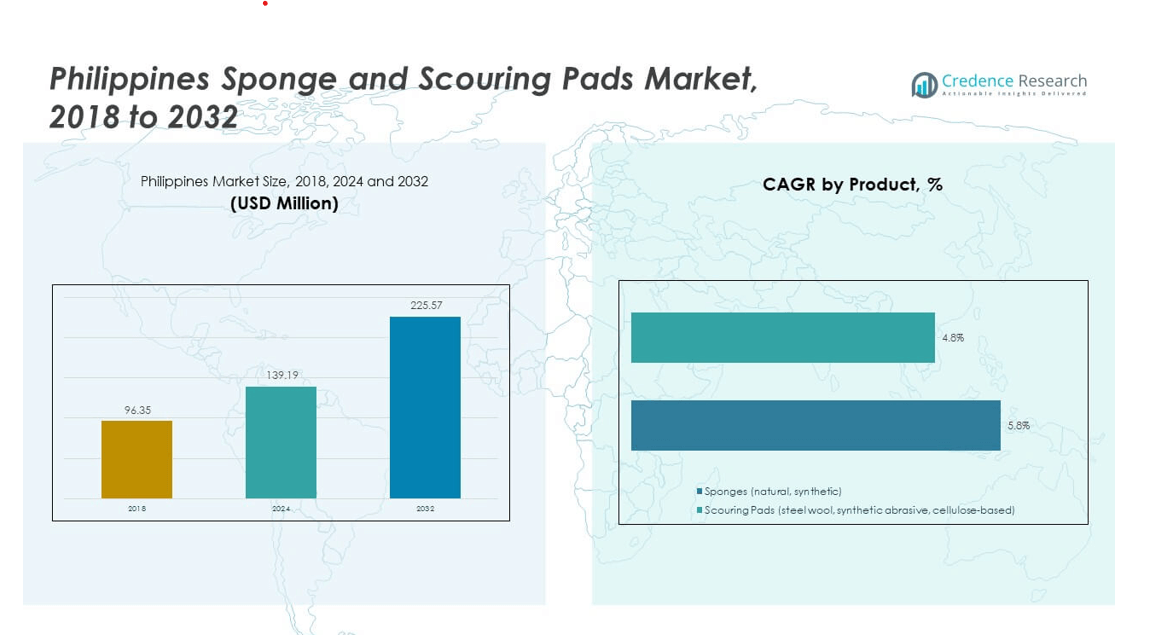
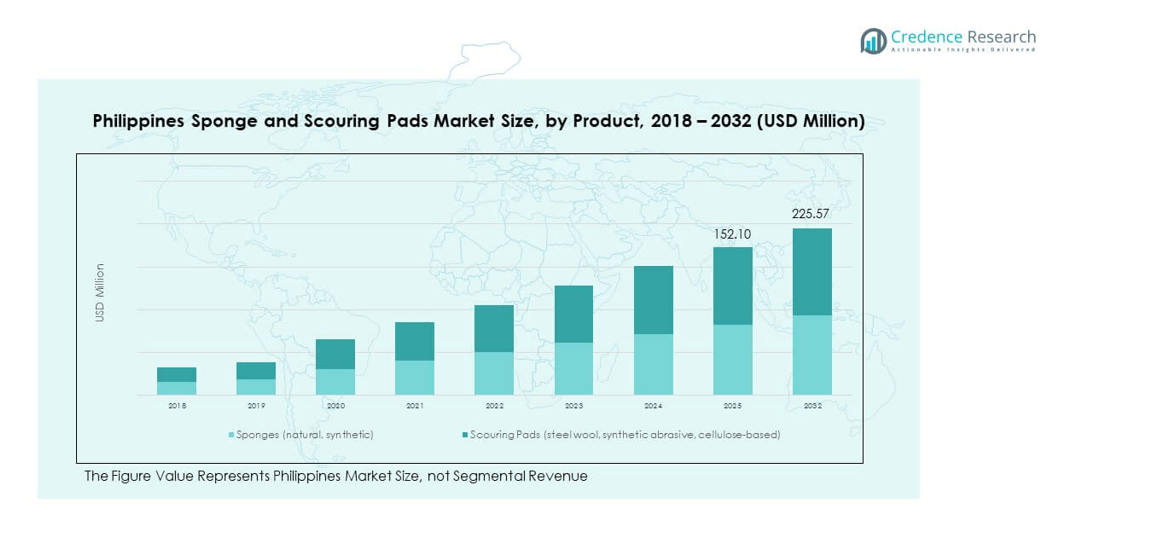
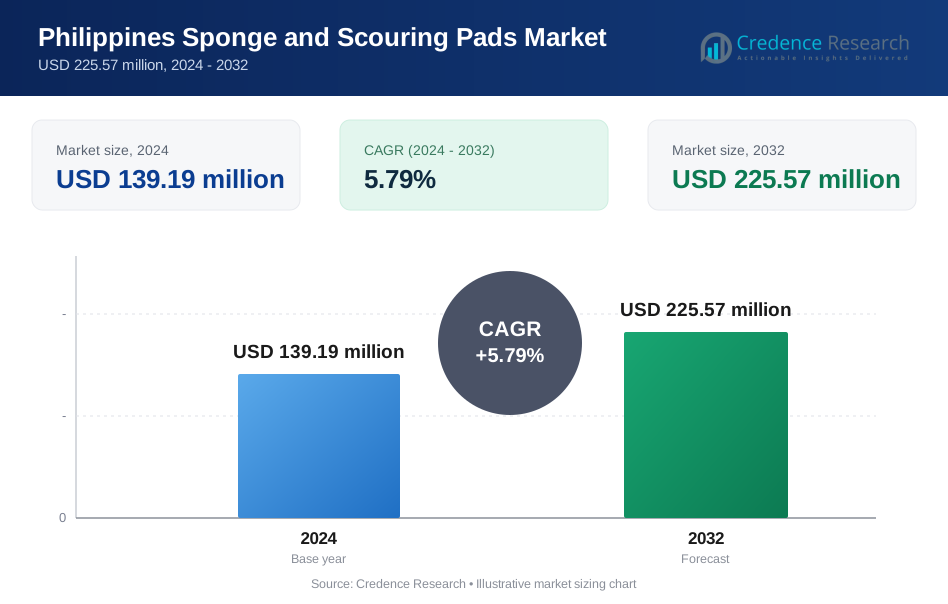
The Philippines Sponge and Scouring Pads Market size was valued at USD 96.35 million in 2018 and increased to USD 139.19 million in 2024. The market is anticipated to reach USD 225.57 million by 2032. This growth reflects a CAGR of 5.79% during the forecast period.
| REPORT ATTRIBUTE | DETAILS |
|---|---|
| Historical Period | 2020-2023 |
| Base Year | 2024 |
| Forecast Period | 2025-2032 |
| Philippines Sponge and Scouring Pads Market Size 2024 | USD 139.19 million |
| Philippines Sponge and Scouring Pads Market, CAGR | 5.79% |
| Philippines Sponge and Scouring Pads Market Size 2032 | USD 225.57 million |
Market growth is driven by rising urbanization and changing household routines. Urban families rely on convenient cleaning tools for daily kitchen use. Growth in restaurants, cafes, and cloud kitchens increases bulk consumption. Retail expansion strengthens product availability across supermarkets and convenience stores. Hygiene awareness supports regular replacement of cleaning pads. Manufacturers improve durability and grease removal performance. Anti-bacterial features attract health-focused consumers. Competitive pricing encourages repeat purchases across income groups. Private labels intensify competition and shelf presence.
Metro Manila leads the market due to dense households and strong foodservice activity. Central Luzon and CALABARZON follow, supported by housing growth and retail development. These regions benefit from higher disposable incomes and modern trade access. Visayas regions show rising demand from tourism-driven hospitality sectors. Cebu acts as a key consumption hub outside Luzon. Mindanao emerges steadily with improving distribution reach. Davao and Cagayan de Oro drive regional uptake. Rural areas adopt value-focused products through traditional retail networks.
Market Insights:
- The Philippines Sponge and Scouring Pads Market was valued at USD 96.35 million in 2018, reached USD 139.19 million in 2024, and is projected to reach USD 225.57 million by 2032, expanding at a CAGR of 5.79% due to steady household and commercial demand.
- Metro Manila leads with about 38% share due to dense households and foodservice concentration, followed by CALABARZON at nearly 24% from housing growth and retail access, and Central Luzon at around 18% supported by suburban expansion and logistics connectivity.
- Mindanao is the fastest-growing region with close to 7% share, driven by urban growth in Davao and Cagayan de Oro, rising household consumption, and improving retail distribution coverage.
- Sponge pads account for roughly 60% of total demand, reflecting dominant use in daily household dishwashing and routine kitchen cleaning activities.
- Scouring pads contribute about 40% share, supported by demand from commercial kitchens, foodservice operations, and heavy-duty cleaning requirements.
Market Drivers:
Rising Urban Household Formation And Daily Kitchen Cleaning Needs
Urban housing growth increases regular demand for basic cleaning tools. Nuclear families rely on sponges for daily dishwashing tasks. Compact kitchens favor easy-to-store cleaning products. Higher meal preparation frequency raises usage cycles. Replacement demand stays steady due to hygiene expectations. Affordable pricing supports routine household purchase behavior. The Philippines Sponge and Scouring Pads Market benefits from predictable domestic consumption. It remains resilient across income segments.
- For instance, 3M’s Scotch-Brite® Heavy Duty Sponge is tested to last up to 3× longer than standard sponges in controlled abrasion tests, supporting frequent household replacement needs. The Philippines Sponge and Scouring Pads Market benefits from predictable domestic consumption and remains resilient across income segments.
Expansion Of Foodservice, Hospitality, And Institutional Kitchens
Restaurant chains expand across cities and transport hubs. Cafes and cloud kitchens require frequent utensil cleaning. Hotels maintain strict kitchen hygiene standards. Institutional kitchens support bulk sponge consumption. High turnover rates raise replacement frequency. Cleaning efficiency supports operational speed. The Philippines Sponge and Scouring Pads Market gains from commercial demand. It sustains volume sales beyond households.
Growth Of Organized Retail And Improved Product Accessibility
Supermarkets expand across urban and semi-urban locations. Convenience stores stock affordable cleaning essentials. Shelf visibility improves brand awareness. Retail promotions support trial purchases. Organized trade supports private label growth. Distribution efficiency improves regional coverage. The Philippines Sponge and Scouring Pads Market benefits from retail reach. It gains consistent point-of-sale exposure.
Rising Hygiene Awareness Across Households And Workplaces
Public health messaging raises focus on kitchen cleanliness. Households replace cleaning tools more often. Workplaces adopt basic hygiene protocols. Schools and offices increase pantry maintenance. Product packaging highlights sanitation benefits. Consumer trust supports repeat buying. The Philippines Sponge and Scouring Pads Market aligns with hygiene habits. It supports long-term demand stability.
Market Trends:
Shift Toward Multi-Layer And Dual-Surface Cleaning Products
Manufacturers introduce dual-texture sponge formats. Soft layers protect cookware surfaces. Abrasive sides improve grease removal. Product versatility appeals to consumers. Fewer tools support convenience. Brand differentiation strengthens shelf competition. The Philippines Sponge and Scouring Pads Market reflects functional upgrades. It favors performance-focused designs.
- For instance, Scotch-Brite® Dual Purpose sponges combine a cellulose sponge with a synthetic abrasive layer rated to remove stuck-on grease in under 10 scrubbing strokes during internal performance testing.
Growing Preference For Value Packs And Bulk Purchase Formats
Households favor multipacks for cost efficiency. Bulk formats reduce shopping frequency. Retailers promote bundled offerings. Commercial buyers select economy packs. Packaging innovation supports storage ease. Unit cost savings attract price-conscious buyers. The Philippines Sponge and Scouring Pads Market reflects value-led purchasing. It supports volume-driven sales strategies.
Rising Penetration Of Private Labels In Modern Trade
Retailers expand store-brand cleaning products. Competitive pricing attracts mass consumers. Quality parity improves consumer acceptance. Shelf placement favors private labels. Brand loyalty shifts toward retailers. Margin control benefits retailers. The Philippines Sponge and Scouring Pads Market reflects private label growth. It reshapes competitive dynamics.
Gradual Adoption Of Mild And Surface-Safe Cleaning Materials
Consumers show caution toward harsh abrasives. Cookware protection influences buying decisions. Non-scratch surfaces gain attention. Manufacturers adjust material blends. Product labeling highlights surface safety. Household education supports this shift. The Philippines Sponge and Scouring Pads Market reflects safer material trends. It supports gradual product evolution.
Market Challenges Analysis:
Intense Price Competition And Limited Product Differentiation
Low entry barriers attract many small manufacturers. Price wars reduce margin stability. Product similarity limits brand distinction. Consumers switch brands easily. Promotions drive short-term sales spikes. Cost pressure affects material quality. The Philippines Sponge and Scouring Pads Market faces margin strain. It challenges long-term brand investment.
Distribution Gaps Across Rural And Remote Areas
Logistics costs remain high in remote regions. Traditional retail dominates rural markets. Limited shelf space restricts product variety. Brand visibility stays uneven. Informal distribution affects quality consistency. Regional demand stays underpenetrated. The Philippines Sponge and Scouring Pads Market faces access constraints. It limits nationwide scale efficiency.
Market Opportunities:
Expansion Of Premium And Purpose-Specific Cleaning Variants
Specialized sponges target cookware types. Premium formats support higher price points. Surface-specific labeling guides consumers. Performance focus improves brand loyalty. Urban consumers accept premium cleaning tools. Retailers support differentiated assortments. The Philippines Sponge and Scouring Pads Market supports product segmentation. It enables value growth beyond volume.
Growth Potential In Institutional And Contract Cleaning Segments
Offices outsource pantry maintenance services. Cleaning contractors buy supplies in bulk. Standardized procurement supports steady demand. Product durability matters in institutional use. Long-term supply contracts improve volume predictability. Brand partnerships strengthen repeat orders. The Philippines Sponge and Scouring Pads Market gains institutional traction. It opens stable revenue channels.
Market Segmentation Analysis:
By Product Type
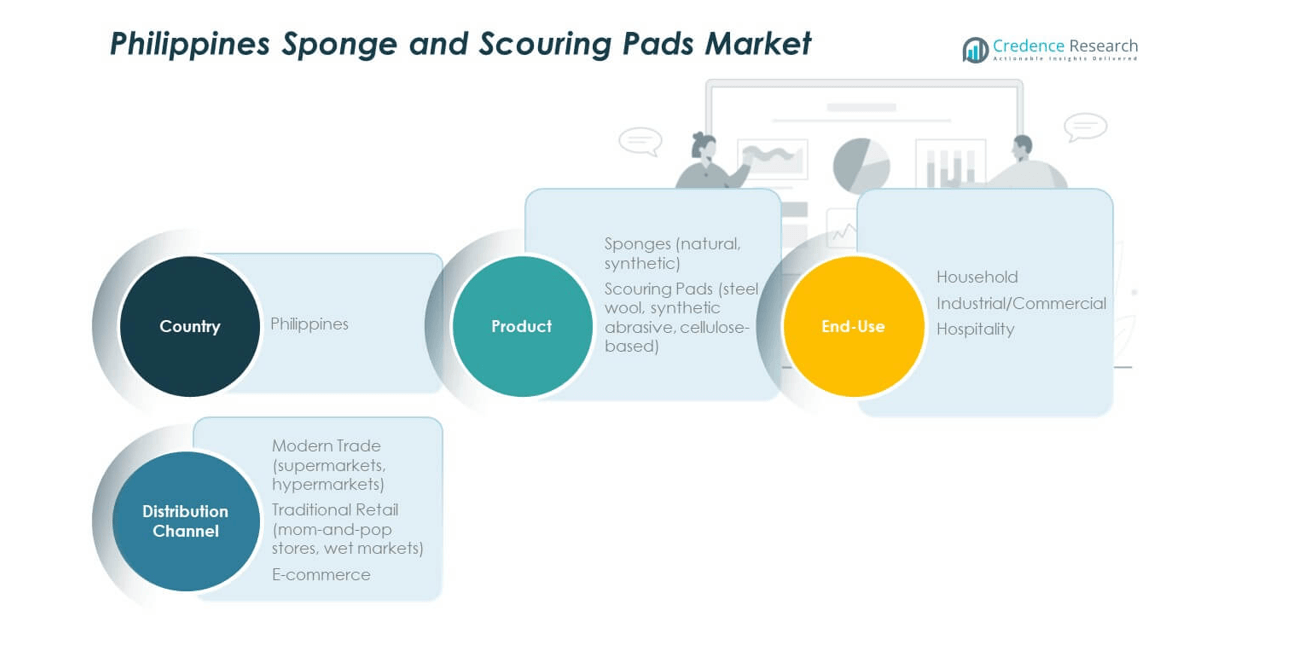
Sponge pads lead demand due to daily household dishwashing needs. Scouring pads support tougher grease and residue removal tasks. Combination sponge–scourers gain preference for dual functionality and space efficiency. Steel wool pads serve heavy-duty cleaning in commercial kitchens. Specialty cleaning pads address cookware protection and surface-specific requirements. The Philippines Sponge and Scouring Pads Market reflects strong volume demand from basic product types. It supports steady replacement cycles across segments.
- For instance, 3M Scotch-Brite stainless steel scrubbers use uniform steel filament thickness to ensure consistent abrasion across multiple cleaning cycles. The Philippines Sponge and Scouring Pads Market reflects strong volume demand and supports steady replacement cycles.
By End-Use
Household use dominates due to routine kitchen cleaning activities. Commercial kitchens rely on durable products for frequent utensil washing. Foodservice and hospitality segments require consistent supply to meet hygiene standards. Institutional use covers schools, offices, and healthcare facilities. Industrial cleaning applies to maintenance areas with tougher residue needs. The Philippines Sponge and Scouring Pads Market benefits from balanced demand across end users. It maintains stable consumption across economic cycles.
- For instance, McDonald’s Philippines, which surpassed its 800-store milestone in June 2025 at Davao Global Township, enforces standardized kitchen cleaning protocols that mandate the use of color-coded cloths sanitized and rotated every 20 to 30 minutes rather than sponges to maintain strict food safety and prevent cross-contamination. This frequent rotation of cleaning tools within the commercial sector supports the stable consumption patterns seen in the Philippines sponge and scouring pads market, which continues to see robust demand in 2025 as the region’s hospitality and food service sectors expand.
By Distribution Channel
Supermarkets and hypermarkets lead sales through wide product availability. Convenience stores support frequent small-quantity purchases. Traditional retail stores serve price-sensitive and rural consumers. Online retail gains traction through bundled offers and doorstep delivery. Wholesale and distributors support bulk procurement for commercial buyers. The Philippines Sponge and Scouring Pads Market relies on diverse retail access. It ensures reach across urban and regional markets.
Segmentation:
By Product Type
- Sponge Pads
- Scouring Pads
- Combination Sponge–Scourers
- Steel Wool Pads
- Specialty Cleaning Pads
By End-Use
- Household
- Commercial Kitchens
- Foodservice and Hospitality
- Institutional Use
- Industrial Cleaning
By Distribution Channel
- Supermarkets and Hypermarkets
- Convenience Stores
- Traditional Retail Stores
- Online Retail
- Wholesale and Distributors
By Region
- Metro Manila
- Central Luzon
- CALABARZON
- Visayas
- Mindanao
Regional Analysis:
Metro Manila And CALABARZON As Core Consumption Hubs
Metro Manila holds the largest share at around 38% of total demand due to dense households and strong foodservice activity. CALABARZON follows with nearly 24% market share, supported by rapid housing growth and modern retail presence. High urbanization drives frequent replacement of cleaning products. Organized retail penetration improves product visibility. Commercial kitchens contribute steady bulk demand. The Philippines Sponge and Scouring Pads Market shows strong stability across these core regions.
Central Luzon And Visayas As Established Growth Regions
Central Luzon accounts for about 18% market share, driven by suburban housing expansion and retail spillover from Metro Manila. The region benefits from improving logistics access and rising middle-income households. Visayas represents nearly 13% share, supported by tourism-driven hospitality demand. Cebu acts as a major consumption center outside Luzon. Hotels and restaurants raise usage frequency. The Philippines Sponge and Scouring Pads Market maintains steady growth across these established regions.
Mindanao As An Emerging Demand Center
Mindanao contributes close to 7% of total market share and shows gradual expansion. Urban centers such as Davao and Cagayan de Oro lead regional consumption. Population growth supports household demand. Retail networks continue to expand beyond major cities. Commercial activity supports consistent cleaning product usage. The Philippines Sponge and Scouring Pads Market gains long-term potential from improving distribution reach in Mindanao.
Key Player Analysis:
- 3M
- Joyco Philippines
- Scotch-Brite
- Summit Industrial Supply
Competitive Analysis:
Competition in the Philippines Sponge and Scouring Pads Market remains fragmented, with both multinational brands and local manufacturers active. Global brands focus on product quality, brand recall, and wide retail reach. Local players compete through aggressive pricing and strong presence in traditional retail. Private labels gain shelf space in modern trade formats. Product differentiation stays limited, which keeps price competition high. Distribution strength plays a key role in volume leadership. Brand promotions influence short-term sales performance. The Philippines Sponge and Scouring Pads Market favors players with strong logistics networks. It rewards consistent supply and retail partnerships.
Report Coverage:
The research report offers an in-depth analysis based on product type, end-use, distribution channel, and region. It details leading market players, providing an overview of their business, product offerings, investments, revenue streams, and key applications. Additionally, the report includes insights into the competitive environment, SWOT analysis, current market trends, as well as the primary drivers and constraints. Furthermore, it discusses various factors that have driven market expansion in recent years. The report also explores market dynamics, regulatory scenarios, and technological advancements that are shaping the industry. It assesses the impact of external factors and global economic changes on market growth. Lastly, it provides strategic recommendations for new entrants and established companies to navigate the complexities of the market.
Future Outlook:
- Household demand will remain the primary volume driver due to routine kitchen usage.
- Commercial kitchens will support stable bulk consumption across urban centers.
- Product innovation will focus on durability and surface-safe materials.
- Private labels will expand further within modern retail formats.
- Traditional retail will continue to serve rural and price-sensitive consumers.
- Online channels will gain relevance through bundled and bulk offerings.
- Distribution efficiency will shape regional growth performance.
- Institutional demand will rise from offices and public facilities.
- Brand loyalty will depend on consistent quality and availability.
- The Philippines Sponge and Scouring Pads Market will sustain steady long-term demand.
Request a Free Sample
Fill in your details and we'll send you a free sample report.
- Sample data tables & charts
- Research methodology
Need a Custom Version of This Report?
Tailor the scope, geography, or segments to your exact requirements.
- Custom geography or segment scope
- Direct access to our analyst team
Frequently Asked Questions
What is the current market size for the Philippines Sponge and Scouring Pads Market, and what is its projected size in 2032?
At what Compound Annual Growth Rate is the Philippines Sponge and Scouring Pads Market projected to grow between 2024 and 2032?
Which Philippines Sponge and Scouring Pads Market segment held the largest share in 2024?
What are the primary factors fueling the growth of the Philippines Sponge and Scouring Pads Market?
Who are the leading companies in the Philippines Sponge and Scouring Pads Market?
Table of Content
Chapter 1. Report Introduction
- 1.1 Report Description & Purpose
- 1.1.1 Report Title & Market Definition
- 1.1.2 Unique Selling Propositions (USP) & Key Differentiators
- 1.1.3 Value Proposition for Stakeholders
- 1.2 Research Objectives
- 1.2.1 Market Sizing Objectives (Volume & Revenue)
- 1.2.2 Segmentation Objectives
- 1.2.3 Competitive Intelligence Objectives
- 1.2.4 Forecast & Scenario Objectives
- 1.3 Report Scope
- 1.3.1 Philippines Sponge and Scouring Pads Scope – Types & Subtypes Covered
- 1.3.2 Geographic Scope – Regions & Countries Covered
- 1.3.3 Historical Period, Base Year & Forecast Period (2024; forecast to 2032)
- 1.3.4 Inclusions & Exclusions
- 1.4 HS Code & Classification Framework
- 1.5 Currency, Units & Pricing Basis
- 1.6 Target Stakeholders
- 1.7 Limitations & Assumptions
Chapter 2. Executive Summary
- 2.1 Global Philippines Sponge and Scouring Pads Market Snapshot
- 2.1.1 Market Size – Historical (2024) & Forecast (2024-2032) (2024: USD 139.19 million → 2032: USD 225.57 million)
- 2.1.2 Volume & Revenue – Global Totals
- 2.1.3 Key Market Highlights – Top Five Facts
- 2.2 Philippines Sponge and Scouring Pads Market Segmentation Snapshot
- 2.2.1 Market Split by Region – 2024 vs. 2032
- 2.3 Competitive Snapshot
- 2.3.1 Top 10 Players by Revenue Share – 2024
- 2.3.2 Top 10 Players by Volume Share – 2024
- 2.3.3 Recent Strategic Developments (18-Month Summary)
- 2.4 Key Investment Highlights & Strategic Conclusions
Chapter 3. Philippines Sponge and Scouring Pads Market Dynamics & Industry Analysis
- 3.1 Market Overview & Context
- 3.1.1 Philippines Sponge and Scouring Pads Market Position in the Broader Automotive Value Chain
- 3.1.2 OEM vs. Replacement Market Dynamics
- 3.1.3 Market Maturity & Development Stage by Region
- 3.2 Philippines Sponge and Scouring Pads Market Drivers
- 3.3 Philippines Sponge and Scouring Pads Market Restraints & Challenges
- 3.4 Philippines Sponge and Scouring Pads Market Opportunities
- 3.5 Porter's Five Forces Analysis
- 3.5.1 Threat of New Entrants
- 3.5.2 Bargaining Power of Suppliers
- 3.5.3 Bargaining Power of Buyers
- 3.5.4 Threat of Substitutes
- 3.5.5 Competitive Rivalry – Intensity Assessment
- 3.6 Philippines Sponge and Scouring Pads Value Chain Analysis
- 3.6.1 Upstream – Raw Material/Input Suppliers
- 3.6.1.1 Raw Material/Input 1
- 3.6.1.2 Raw Material/Input 2
- 3.6.1.3 Raw Material/Input 3
- 3.6.2 Midstream – Production/Manufacturing/Service Delivery
- 3.6.2.1 Production/Process Overview
- 3.6.2.2 Key Facility Locations & Capacity by Manufacturer
- 3.6.3 Downstream – Distribution & End Consumer
- 3.6.3.1 Primary Channel – B2B/OEM
- 3.6.3.2 Secondary Channels – Dealer, Retail, Online, Direct
- 3.6.4 Value Chain Profitability Analysis
- 3.6.1 Upstream – Raw Material/Input Suppliers
- 3.7 PESTEL Analysis
- 3.7.1 Political Factors
- 3.7.2 Economic Factors
- 3.7.3 Social Factors
- 3.7.4 Technological Factors
- 3.7.5 Environmental Factors
- 3.7.6 Legal Factors
- 3.8 Philippines Sponge and Scouring Pads Supply Chain Analysis
- 3.8.1 Raw Material/Input Supply Risk Assessment
- 3.8.2 Manufacturing Concentration Risk (Geographic Exposure)
- 3.8.3 Trade Disruption Impact Analysis
- 3.9 Regulatory & Policy Landscape
Note: The regulatory and policy landscape section covers regulations based on their applicability to the market, Philippines Sponge and Scouring Pads category, geography, and scope of the study. Only regulatory frameworks with a material impact on operations, compliance, trade, sustainability, or market access are analyzed in detail.
Chapter 4. Key Investment Pockets & Opportunity Analysis
- 4.1 Philippines Sponge and Scouring Pads Market Attractiveness Analysis
- 4.1.1 By Region – Investment Attractiveness Matrix (Volume × CAGR)
- 4.2 Absolute Revenue Growth Opportunity
- 4.2.1 By Region – Absolute USD Growth Through 2032
- 4.3 Incremental Volume Opportunity
- 4.3.1 By Region – Incremental Volume Through 2032
- 4.3.2 Segment – Incremental Volume
- 4.4 Emerging Submarket Opportunity Deep Dive (Subject to Applicability)
- 4.5 Emerging Market Opportunity Scorecards
- 4.5.1 United States
- 4.5.2 Europe
- 4.5.3 Asia
- 4.5.4 Middle East & Africa
Note: Emerging Market Opportunity Scorecards will be included based on relevance and strategic importance. Regions listed are indicative and may vary depending on data availability and market dynamics.
Chapter 5. Philippines Sponge and Scouring Pads Import-Export Analysis & Trade Flows
- 5.1 Global Trade Overview
- 5.1.1 Global Export Value by Country (2024)
- 5.1.2 Global Export Volume by Country (2024)
- 5.1.3 Global Import Value by Country (2024)
- 5.1.4 Global Import Volume by Country (2024)
- 5.1.5 Net Trade Balance by Country (2024)
- 5.2 Export Analysis – Segment
- 5.2.1 Type 1 (HS Code)
- 5.2.2 Type 2 (HS Code)
- 5.2.3 Type 3 (HS Code)
- 5.2.4 Type 4 (HS Code)
- 5.2.5 Type 5 (HS Code)
- 5.3 Import Analysis – Segment
- 5.3.1 Type 1 (HS Code)
- 5.3.2 Type 2 (HS Code)
- 5.3.3 Type 3 (HS Code)
- 5.3.4 Type 4 (HS Code)
- 5.3.5 Type 5 (HS Code)
- 5.4 Average Unit Trade Prices
- 5.4.1 Average Export Price – Segment & Country
- 5.4.2 Average Import Price – Segment & Source Country
- 5.4.3 Price Trends (2024)
- 5.5 Key Trade Route Analysis
- 5.5.1 Trade Route 1
- 5.5.2 Trade Route 2
- 5.5.3 Trade Route 3
- 5.5.4 Trade Route 4
- 5.5.5 Trade Route 5
- 5.6 Trade Policy Impact Assessment
- 5.6.1 US Anti-Dumping & Section 301 Tariffs
- 5.6.2 EU Customs Union Impact
- 5.6.3 Major Free Trade Agreements
- 5.6.4 USMCA Rules of Origin
Note: Trade policy analysis will be included only where relevant to the Philippines Sponge and Scouring Pads market.
Chapter 6. Competitive Landscape & Company Benchmarking
- 6.1 Philippines Sponge and Scouring Pads Market Concentration & Structure
- 6.1.1 Herfindahl-Hirschman Index (HHI) – vs. 2024
- 6.1.2 Tier 1, Tier 2 & Tier 3 Market Structure
- 6.1.3 Global, Regional & Local Player Dynamics
- 6.2 Philippines Sponge and Scouring Pads Market Share Analysis – 2024
- 6.2.1 Global Revenue Share by Company
- 6.2.2 Global Volume Share by Company
- 6.2.3 Regional Revenue Share
- 6.2.4 Market Share Evolution ( vs. 2024)
- 6.2.5 OEM Segment Share by Company
- 6.2.6 Replacement Segment Share by Company
- 6.3 Production/Delivery Capacity & Facility Analysis
- 6.3.1 Global Installed Capacity
- 6.3.2 Capacity Utilization Rates
- 6.3.3 Production/Output Volume
- 6.3.4 Facility Locations & Capacity Map
- 6.3.5 Planned Capacity Additions
- 6.4 Philippines Sponge and Scouring Pads Competitive Benchmarking Matrix
- 6.4.1 Revenue, Volume, CAGR & Profitability Comparison
- 6.4.2 Channel Revenue Mix
- 6.4.3 Geographic Revenue Exposure
- 6.4.4 R&D Intensity
- 6.4.5 Sustainability Maturity
- 6.5 Strategic Developments in Philippines Sponge and Scouring Pads (Last 24 Months)
- 6.5.1 Mergers, Acquisitions & Divestments
- 6.5.2 New Philippines Sponge and Scouring Pads Launches
- 6.5.3 Facility Expansions
- 6.5.4 Strategic Alliances, Joint Ventures & Partnerships
- 6.5.5 Distribution Expansion & Market Entry
- 6.5.6 Sustainability & ESG Initiatives
- 6.6 Competitive Strategy Mapping
- 6.6.1 Leader, Challenger, Follower & Niche Classification
- 6.6.2 Pricing Strategy Comparison
- 6.6.3 Channel Strategy Matrix
Note: Strategic developments are included based on their materiality and the availability of reliable information.
Chapter 7. Global Philippines Sponge and Scouring Pads Market – By Distribution Channel
- 7.1 Segment Overview
- 7.1.1 Volume & Revenue Split by Channel (2024 & 2032)
- 7.1.2 Channel Mix Evolution (2024-2032)
Chapter 8. Regional Market Analysis – Global Overview
- 8.1 Global Regional Overview
- 8.1.1 Regional Volume Share
- 8.1.2 Regional Revenue Share
- 8.1.3 Regional Volume by Region
- 8.1.4 Regional Revenue by Region
- 8.1.5 Regional Forecast Through 2032
- 8.2 Cross-Regional Segment Analysis
- 8.2.1 By Distribution Channel
- 8.2.2 By Brand/Price Tier
Chapter 9. North America Philippines Sponge and Scouring Pads Market
- 9.1 United States
- 9.2 Canada
- 9.3 Mexico
Chapter 10. Europe Philippines Sponge and Scouring Pads Market
- 10.1 Germany
- 10.2 France
- 10.3 Italy
- 10.4 United Kingdom
- 10.5 Spain
- 10.6 Poland
- 10.7 Russia
- 10.8 Netherlands
- 10.9 Belgium
- 10.10 Sweden
- 10.11 Denmark
- 10.12 Norway
- 10.13 Rest of Europe
Chapter 11. Asia Pacific Philippines Sponge and Scouring Pads Market
- 11.1 China
- 11.2 India
- 11.3 Japan
- 11.4 South Korea
- 11.5 Thailand
- 11.6 Indonesia
- 11.7 Vietnam
- 11.8 Malaysia
- 11.9 Australia
- 11.10 Rest of Asia Pacific
Chapter 12. Latin America Philippines Sponge and Scouring Pads Market
- 12.1 Brazil
- 12.2 Argentina
- 12.3 Colombia
- 12.4 Chile
- 12.5 Rest of Latin America
Chapter 13. Middle East Philippines Sponge and Scouring Pads Market
- 13.1 Saudi Arabia
- 13.2 United Arab Emirates
- 13.3 Turkey
- 13.4 Israel
- 13.5 Iran
- 13.6 Rest of the Middle East
Chapter 14. Africa Philippines Sponge and Scouring Pads Market
- 14.1 South Africa
- 14.2 Egypt
- 14.3 Nigeria
- 14.4 Morocco
- 14.5 Rest of Africa
Chapter 15. Philippines Sponge and Scouring Pads Company Profiles
- 15.1 [Company 01]
- 15.1.1 Company Overview
- 15.1.2 Key Management Personnel
- 15.1.3 Products & Services Portfolio
- 15.1.4 Financial Performance
- 15.1.5 Key Market Focus & Geographic Presence
- 15.1.6 Recent Developments & Strategic Initiatives
Note: The company profile list is preliminary and may change based on research findings, market developments, data availability, and client requirements.
Chapter 16. Appendices
- Appendix A – List of Abbreviations & Acronyms
- Appendix B – Industry Classification Code Reference – Full Series
- Appendix C – Production & Capacity Data Tables
- Appendix D – End-Use & Demand Base Tables
- Appendix E – Consumption & Replacement Rate Assumptions
- Appendix F – ASP Reference Tables
- Appendix G – Manufacturing & Facility Database
- Appendix H – Import-Export Data Tables
- Appendix I – Regulatory Summary Tables
- Appendix J – Primary Research Participant List (Anonymized)
- Appendix K – Primary Research Questionnaire Framework
- Appendix L – Data Sources & Bibliography
- Appendix M – Market Size Divergence & Source Comparison
Chapter 17. Research Methodology
- 17.1 Research Framework & Philosophy
- 17.2 Secondary Research – Sources, Hierarchy & Data Extraction
- 17.3 Data Modeling – Bottom-Up & Top-Down Market Sizing
- 17.4 Primary Research – Stakeholder Framework, LOI & Sample Sizes
- 17.5 Forecast Methodology – Regression, Scenario & Sensitivity Analysis
- 17.6 Quality Control – Four-Layer Validation Framework
- 17.7 Limitations & Standard Assumptions
- 17.8 Disclaimer
