
Polymer Nanomembrane Market Overview:
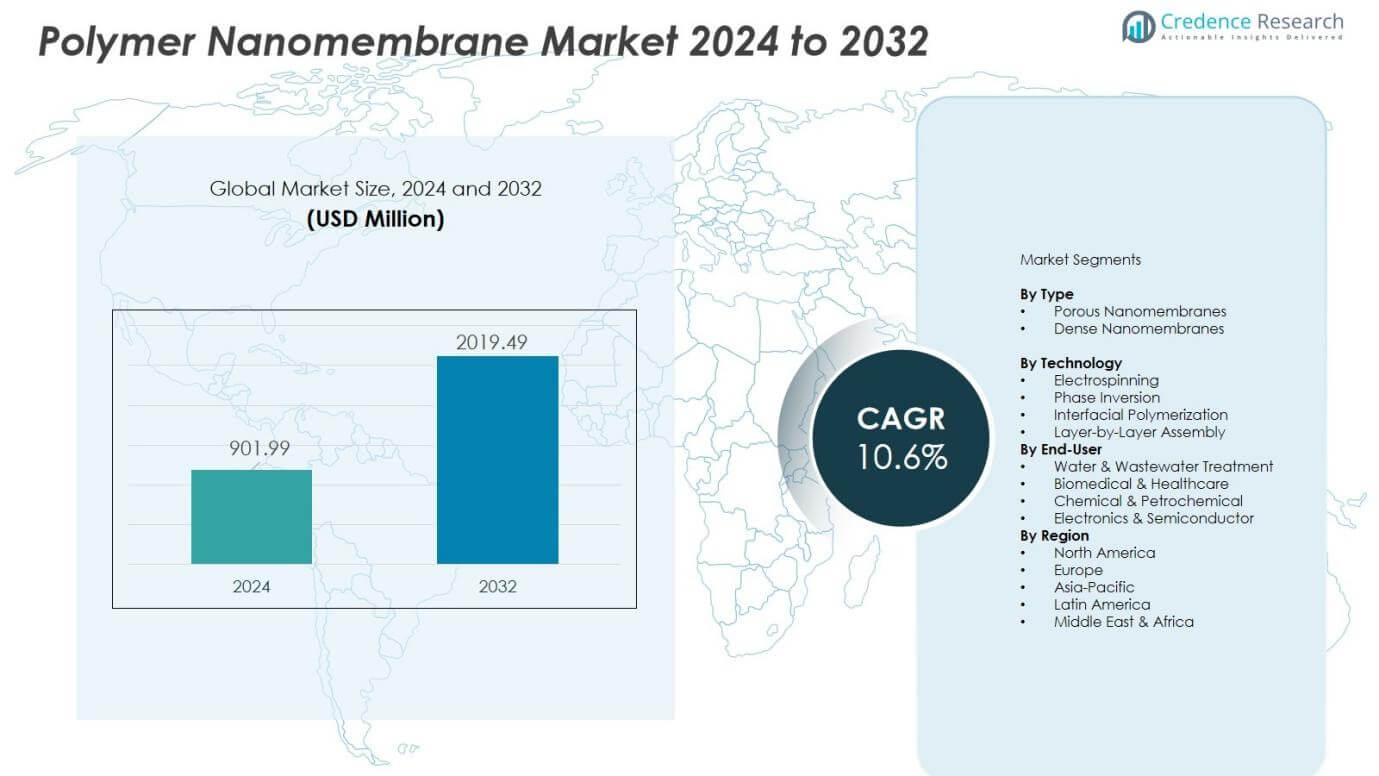
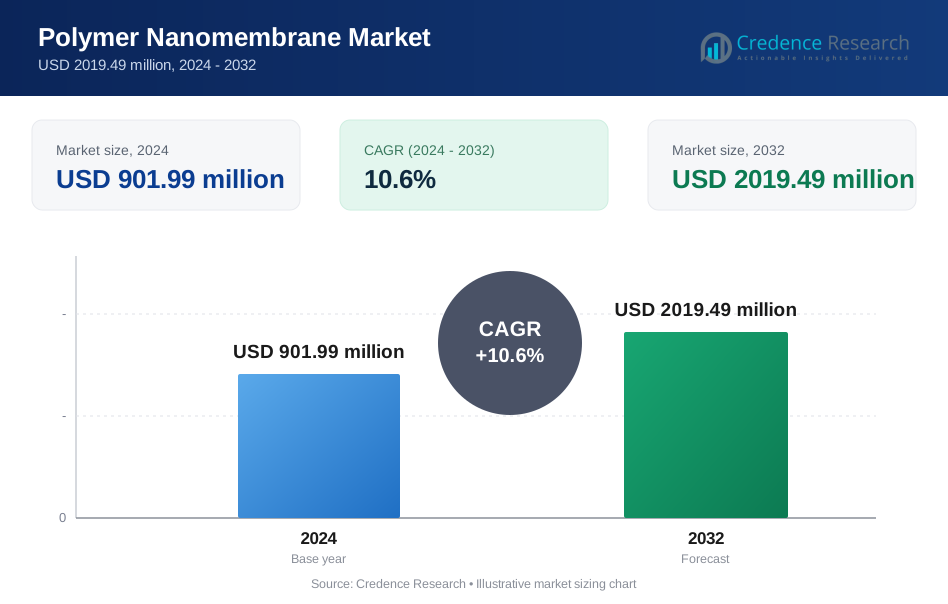
The Polymer Nanomembrane Market size was valued at USD 901.99 million in 2024 and is anticipated to reach USD 2019.49 million by 2032, at a CAGR of 10.6 % during the forecast period.
| REPORT ATTRIBUTE | DETAILS |
|---|---|
| Historical Period | 2020-2024 |
| Base Year | 2025 |
| Forecast Period | 2026-2032 |
| Polymer Nanomembrane Market Size 2024 | USD 901.99 million |
| Polymer Nanomembrane Market, CAGR | 10.6 % |
| Polymer Nanomembrane Market Size 2032 | USD 2019.49 million |
Polymer Nanomembrane Market Insights:
- Asia-Pacific accounted for the largest regional share at 39.7% in 2024, driven by rapid industrialization, growing pharmaceutical manufacturing, and government investments in water infrastructure.
- North America held the second-largest share at 25.1%, supported by advanced biotechnology R&D, environmental compliance standards, and strong adoption in chemical and healthcare sectors. Europe followed with a 21.4% share, backed by strict regulatory frameworks and innovations in sustainable purification technologies.
- The Middle East & Africa is the fastest-growing region with a projected CAGR above the global average and a 7.2% market share in 2024, fueled by desalination projects, industrial expansion, and public-private partnerships for water treatment.
- By application, water & wastewater treatment dominated with a 45.3% share in 2024 due to high demand for ultrapure water and industrial recycling; medical & diagnostics followed with a 23.6% share, supported by rising adoption in drug delivery and protein filtration systems.
Polymer Nanomembrane Market Drivers:
Growing Demand for Precision Filtration in High-Value Industries
High-value industries increasingly deploy advanced filtration solutions to maintain stringent purity standards. Semiconductor manufacturing, pharmaceutical processing, and biotechnology research rely on ultrapure water and contaminant-free environments, creating strong demand for nanomembrane systems. The Polymer Nanomembrane Market benefits from nanoscale pore precision that supports selective molecular and ion separation. It enhances operational efficiency by offering low energy requirements and high throughput capacity, driving adoption across mission-critical facilities.
- For instance, TSMC deployed polymer membrane systems in its 3nm node process, achieving ultrapure water impurity levels below 1 part per trillion.
Rising Need for Sustainable and Energy-Efficient Separation Technologies
Industries adopt energy-efficient separation solutions to reduce operational cost and environmental impact. Polymer nanomembranes support low-pressure filtration and reduced chemical usage, creating measurable sustainability benefits. It replaces conventional thermal and chemical separation methods that consume more resources and generate waste. The shift toward greener industrial systems encourages broader usage of nanomembranes in desalination, chemical processing, and wastewater recycling applications.
- For instance, PLA nanofibrous membranes reinforced with PVDF achieved a maximum liquid entry pressure of 32 kPa while enabling complete degradation via alkaline hydrolysis with 0.4 M NaOH after 30 min
Advancements in Nanofabrication and Polymeric Engineering Techniques
Innovations in electrospinning, phase inversion, and layer-by-layer deposition significantly enhance membrane structure and selectivity. Manufacturers develop polymer nanomembranes with improved mechanical strength, surface charge control, and higher permeability rates. The Polymer Nanomembrane Market gains value from controlled pore design that accommodates complex separation needs in medical diagnostics and gas separation. It enables reliable processing of biomolecules, organic compounds, and hazardous pollutants in diverse industrial settings.
Growing Adoption in Medical, Diagnostic, and Healthcare Applications
Healthcare facilities increasingly depend on precise membrane technology for diagnostics, drug delivery systems, and sterile filtration. Polymer nanomembranes support controlled molecular transport, enabling efficient pathogen removal and targeted therapeutic delivery. It assists medical laboratories by offering high separation accuracy for proteins and biomolecules. Rising investment in advanced medical equipment and bioprocessing solutions strengthens nanomembrane utilization in global healthcare supply chains.
Polymer Nanomembrane Market Trends:
Shift Toward Smart, Functionalized, and Biocompatible Nanomembranes
Manufacturers focus on producing functionalized nanomembranes with tailored surface chemistry to improve selectivity, fouling resistance, and molecular transport efficiency. These smart membranes support applications in drug delivery systems, bioseparation, and pathogen filtration by integrating biosensing capabilities and biocompatible coatings. Functional polymers and hybrid nanocomposites enhance precision filtration performance and extend membrane life in harsh conditions. The Polymer Nanomembrane Market advances with custom-engineered materials that meet regulatory demands in medical, pharmaceutical, and environmental uses. It benefits from rising interest in membranes that control charge, hydrophilicity, and pore responsiveness under variable operating conditions. Demand continues to grow for nanomembranes that combine high throughput and controlled separation accuracy.
- For Instance, W. L. Gore & Associates are pioneers in advanced material science and a leading manufacturer of high-performance membranes, particularly those made from expanded polytetrafluoroethylene (e-PTFE), such as the GORE-TEX® and GORE-SELECT® product lines.
Expansion of Membrane Technologies for Circular Water Management and Industrial Decarbonization
Industries invest in membrane infrastructure to support water reuse and minimize dependence on conventional desalination and chemical purification methods. Polymer nanomembranes enable low-energy filtration, supporting sustainable wastewater recovery and zero-liquid-discharge initiatives. It plays a critical role in decarbonizing industrial operations by reducing the use of thermal separation and lowering overall emissions. Manufacturers explore scalable nanofabrication to improve membrane cost efficiency and meet volume requirements in municipal and industrial facilities. Gas separation and solvent recovery applications expand as companies work to minimize volatile emissions and manage hazardous streams more responsibly. Growing emphasis on circular water systems and cleaner industrial processes strengthens the commercial relevance of advanced nanomembrane technologies.
- For instance, DuPont's IntegraFlux ultrafiltration modules typically achieve a design flux rate of 40 to 120 L/m²·h (which is 40 to 120 kg/m²·h) in commercial wastewater treatment applications.
Polymer Nanomembrane Market Challenges Analysis:
High Manufacturing Cost and Complex Fabrication Requirements
High production cost remains a primary concern for membrane developers due to sophisticated nanofabrication techniques and stringent quality control standards. Polymer nanomembranes require precision engineering to achieve controlled pore size, hydrophilic balance, and mechanical strength, which increases technical and operational expense. Manual calibration of membrane thickness and uniformity further raises production effort. The Polymer Nanomembrane Market faces cost barriers that limit widespread adoption in low-budget industrial sectors. It struggles to compete with conventional membranes in price-sensitive segments where filtration accuracy is less critical. Limited scalability of certain fabrication processes slows industry expansion.
Performance Limitations in Harsh Operating Conditions and Fouling Control
Industrial environments demand membranes that withstand extreme chemical exposure, high pressure, and fluctuating temperatures. Polymer nanomembranes often experience fouling, pore blockage, and degradation that compromise separation performance and raise maintenance cost. It requires specialized coatings and surface modification strategies to maintain efficiency, adding another layer of technical complexity. Harsh operating conditions reduce membrane life and increase replacement frequency, discouraging large-scale deployment in heavy industries. Real-time monitoring tools and cleaning protocols remain underdeveloped, limiting long-term reliability. Persistent durability concerns push end users to evaluate alternative separation technologies more carefully.
Polymer Nanomembrane Market Opportunities:
Expansion Potential in Biomedical Engineering and High-Precision Healthcare Applications
Growing investment in advanced medical devices, bioprocessing systems, and targeted therapeutic delivery creates strong opportunity for high-performance nanomembrane solutions. Polymer nanomembranes support controlled molecular transport, enabling selective drug release, rapid diagnostics, and sterile filtration for biologics. The Polymer Nanomembrane Market benefits from the rising demand for membranes that demonstrate biocompatibility, reduced fouling, and customized surface functionality. It aligns with the industry shift toward precision medicine, microfluidics, and regenerative healthcare technologies. Manufacturers can differentiate products through specialized coatings, nanoporous structures, and tailored membrane interfaces. Increasing research partnerships between medical institutions and material developers further expands adoption.
Growth Opportunity in Circular Water Systems and Energy-Efficient Industrial Operations
Industries seek sustainable purification systems that reduce chemical use and minimize energy consumption. Polymer nanomembranes offer an opportunity to scale low-pressure water treatment, solvent recovery, and zero-liquid-discharge systems. It enables high-selectivity separation for emerging applications such as hydrogen purification, carbon capture, and low-emission manufacturing. Municipal utilities and industrial facilities invest in recyclable nanomembrane designs that support long-term water reuse targets. Integration with smart monitoring technologies enhances predictive maintenance and reduces operational cost. Expansion of circular water management programs encourages broad deployment across large processing facilities and infrastructure projects.
Polymer Nanomembrane Market Segmentation Analysis:
By Type
Polymer nanomembranes are segmented into porous nanomembranes and dense nanomembranes. Porous variants lead demand due to their suitability for liquid filtration, bioprocessing, and water treatment systems requiring high throughput and selective molecular separation. Dense nanomembranes gain traction in gas separation, controlled drug release, and protective microbarrier applications. The Polymer Nanomembrane Market strengthens its position by leveraging advanced pore customization to improve selectivity across both types. It benefits from rising consumption in healthcare, chemical processing, and semiconductor applications that require nanoscale precision.
- For instance, researchers have developed porous polymer nanomembranes with enhanced flux rates, achieving up to 4400 GPU in \(\text{CO}_{2}\) permeance for precise filtration in academic settings.
By Technology
Key technologies include electrospinning, interfacial polymerization, phase inversion, and layer-by-layer assembly. Electrospinning dominates due to its ability to create consistent nanofibrous structures with controlled diameter and high surface area. Phase inversion supports membrane integrity for harsh industrial environments, while interfacial polymerization enables chemical resistance and ultra‐thin barrier layers. Layer-by-layer assembly finds increasing demand for functional coatings in diagnostics and drug delivery solutions. Technology adoption depends on industry requirements for permeability, charge control, and fouling resistance.
- For instance, polyurethane urea (PUU) electrospinning at 12.8 wt% concentration by researchers (specifically, Demir et al.) produced primary fibers with a 1 μm average diameter alongside secondary, finer structures with an average diameter closer to 0.4 μm (or within the sub-micron range, generally defined as nanometer to micrometer scale).
By End-Use
Major end-use sectors include water and wastewater treatment, biomedical and healthcare, chemical and petrochemical processing, and electronics manufacturing. Water treatment facilities rely on nanomembranes for low-energy desalination and high-precision contaminant removal. Biomedical and pharmaceutical industries use them for sterile filtration, bioseparation, and microfluidic devices. Electronics manufacturers incorporate nanomembranes to support ultrapure water systems and contamination control. Increasing focus on sustainable and high-value processing drives broader deployment across industrial and clinical environments.
Segmentations:
By Type
- Porous Nanomembranes
- Dense Nanomembranes
By Technology
- Electrospinning
- Phase Inversion
- Interfacial Polymerization
- Layer-by-Layer Assembly
By End-Use
- Water & Wastewater Treatment
- Biomedical & Healthcare
- Chemical & Petrochemical
- Electronics & Semiconductor
By Region
- North America
- U.S.
- Canada
- Mexico
- Europe
- Germany
- France
- U.K.
- Italy
- Spain
- Rest of Europe
- Asia Pacific
- China
- Japan
- India
- South Korea
- South-east Asia
- Rest of Asia Pacific
- Latin America
- Brazil
- Argentina
- Rest of Latin America
- Middle East & Africa
- GCC Countries
- South Africa
- Rest of the Middle East and Africa
Regional Analysis:
Asia-Pacific Strengthens Leadership Through Industrial Expansion and Water Infrastructure Investment
Asia-Pacific holds the leading position due to strong industrial expansion, growth in pharmaceutical manufacturing, and heightened demand for advanced water purification systems. Governments in China, India, and Southeast Asia prioritize membrane-based water recycling and sustainable desalination projects to overcome increasing water scarcity. The region benefits from rapid growth in electronics production that requires ultrapure water supported by precision nanomembranes. Local manufacturers invest in scalable nanofabrication, improving supply capabilities for domestic and export markets. The Polymer Nanomembrane Market accelerates in this region due to high infrastructure spending and rising adoption in biomedical diagnostics. It continues to experience strong investment momentum from private and public water treatment facilities.
North America and Europe Drive Innovation Through Advanced Research and Sustainability Standards
North America and Europe maintain strong demand supported by mature biotechnology industries, stringent environmental regulations, and long-term investment in research-based membrane engineering. The regions emphasize high-performance filtration for pharmaceuticals, medical devices, and chemical processing applications. Strict wastewater compliance standards create a favorable market for nanomembranes with energy-efficient, low-impact purification capabilities. Research institutions and manufacturers collaborate to develop functionalized nanomembranes with greater fouling resistance and controlled surface chemistry. The market benefits from government funding for circular water systems and industrial decarbonization initiatives. It remains supported by robust production of specialty coatings and high-value membrane components.
Emerging Markets Expand Adoption Through Infrastructure Modernization and Resource Management Goals
Latin America, the Middle East, and parts of Africa adopt nanomembrane technology to address growing water security concerns and increasing industrialization. Municipal utilities explore membrane-based solutions to reduce treatment cost and support long-term water reuse strategies. Industrial sectors in petrochemicals, mining, and manufacturing evaluate nanomembranes to improve separation efficiency and reduce chemical consumption. Investment programs in desalination and wastewater management stimulate broader interest in scalable polymer membrane systems. International partnerships help transfer advanced membrane technology and support local capacity building. It encourages gradual market penetration as infrastructure upgrades align with sustainability goals.
Key Player Analysis:
- Toray Industries, Inc.
- Asahi Kasei Corporation
- SUEZ Water Technologies & Solutions
- DuPont de Nemours, Inc.
- LG Chem
- Merck KGaA (EMD Millipore)
- Hydranautics
Competitive Analysis:
The Polymer Nanomembrane Market features strong competition driven by material innovation, functional membrane design, and large‐scale water treatment solutions. Leading companies focus on enhancing surface properties, pore architecture, and biocompatibility to support advanced filtration in pharmaceuticals, electronics, and industrial utilities. Toray Industries, Inc. and Asahi Kasei Corporation expand their membrane portfolios using polymer engineering for high‐efficiency desalination and biotechnology applications. SUEZ Water Technologies & Solutions and DuPont de Nemours, Inc. strengthen competitiveness through integrated water management systems that support low‐energy purification and sustainable municipal treatment. LG Chem contributes to market growth by developing nanomembranes with improved durability for harsh operating environments. It remains defined by strategic partnerships, investments in scalable nanofabrication, and growing focus on functionalized membranes for high‐value separation processes.
Recent Developments:
- In September 2025, Toray Industries announced a joint venture with MAS Holdings named Toray MAS Apparel India to establish a manufacturing facility in Odisha, India, for advanced sustainable textiles, targeting operations in early 2026.
- In December 2025, Asahi Kasei Advance, a subsidiary, entered an absorption-type merger with Teijin Frontier to form a joint venture focused on high-performance fibers for apparel and industrial materials, effective October 2026.
Report Coverage:
The research report offers an in-depth analysis based on Type, Technology, End-Use and Region. It details leading Market players, providing an overview of their business, product offerings, investments, revenue streams, and key applications. Additionally, the report includes insights into the competitive environment, SWOT analysis, current Market trends, as well as the primary drivers and constraints. Furthermore, it discusses various factors that have driven Market expansion in recent years. The report also explores Market dynamics, regulatory scenarios, and technological advancements that are shaping the industry. It assesses the impact of external factors and global economic changes on Market growth. Lastly, it provides strategic recommendations for new entrants and established companies to navigate the complexities of the Market.
Future Outlook:
- Advancements in nanofabrication will enable membranes with higher selectivity and greater fouling resistance, supporting wider industrial deployment.
- Growing demand from biopharmaceutical manufacturing will increase adoption of sterile and high-purity nanomembrane filtration systems.
- Functionalized and smart nanomembranes with responsive surfaces will gain traction in diagnostics, drug delivery, and targeted therapeutic applications.
- Expansion of circular water management initiatives will accelerate use of low-pressure nanomembranes in municipal and industrial treatment facilities.
- Integration of membranes with digital monitoring systems will improve predictive maintenance and reduce operational costs in large purification plants.
- Hybrid polymer–nanocomposite membranes will gain relevance for challenging separations in petrochemicals, mining, and solvent recovery.
- Electronics and semiconductor industries will expand usage of ultrapure filtration solutions to support advanced chip fabrication technologies.
- Manufacturers will invest in scalable production methods to reduce cost and make nanomembrane technology accessible to emerging markets.
- Collaborations between material scientists, medical institutions, and industrial utilities will drive development of highly customized membrane solutions.
- Sustainability regulations and growing concern over water scarcity will continue to shift industry preference toward energy-efficient polymer nanomembrane systems.
Request a Free Sample
Fill in your details and we'll send you a free sample report.
- Sample data tables & charts
- Research methodology
Need a Custom Version of This Report?
Tailor the scope, geography, or segments to your exact requirements.
- Custom geography or segment scope
- Direct access to our analyst team
Frequently Asked Questions
What is the current market size for the Polymer Nanomembrane Market, and what is its projected size in 2032?
At what Compound Annual Growth Rate is the Polymer Nanomembrane Market projected to grow between 2024 and 2032?
Which Polymer Nanomembrane Market segment held the largest share in 2024?
What are the primary factors fueling the growth of the Polymer Nanomembrane Market?
Who are the leading companies in the Polymer Nanomembrane Market?
Which region commanded the largest share of the Polymer Nanomembrane Market in 2024?
Table of Content
Chapter 1. Report Introduction
- 1.1 Report Description & Purpose
- 1.1.1 Report Title & Market Definition
- 1.1.2 Unique Selling Propositions (USP) & Key Differentiators
- 1.1.3 Value Proposition for Stakeholders
- 1.2 Research Objectives
- 1.2.1 Market Sizing Objectives (Volume & Revenue)
- 1.2.2 Segmentation Objectives
- 1.2.3 Competitive Intelligence Objectives
- 1.2.4 Forecast & Scenario Objectives
- 1.3 Report Scope
- 1.3.1 Polymer Nanomembrane Scope – Types & Subtypes Covered
- 1.3.2 Geographic Scope – Regions & Countries Covered
- 1.3.3 Historical Period, Base Year & Forecast Period (2024; forecast to 2032)
- 1.3.4 Inclusions & Exclusions
- 1.4 HS Code & Classification Framework
- 1.5 Currency, Units & Pricing Basis
- 1.6 Target Stakeholders
- 1.7 Limitations & Assumptions
Chapter 2. Executive Summary
- 2.1 Global Polymer Nanomembrane Market Snapshot
- 2.1.1 Market Size – Historical (2024) & Forecast (2024-2032) (2024: USD 901.99 million → 2032: USD 2019.49 million)
- 2.1.2 Volume & Revenue – Global Totals
- 2.1.3 Key Market Highlights – Top Five Facts
- 2.2 Polymer Nanomembrane Market Segmentation Snapshot
- 2.2.1 Market Split by Region – 2024 vs. 2032
- 2.3 Competitive Snapshot
- 2.3.1 Top 10 Players by Revenue Share – 2024
- 2.3.2 Top 10 Players by Volume Share – 2024
- 2.3.3 Recent Strategic Developments (18-Month Summary)
- 2.4 Key Investment Highlights & Strategic Conclusions
Chapter 3. Polymer Nanomembrane Market Dynamics & Industry Analysis
- 3.1 Market Overview & Context
- 3.1.1 Polymer Nanomembrane Market Position in the Broader Automotive Value Chain
- 3.1.2 OEM vs. Replacement Market Dynamics
- 3.1.3 Market Maturity & Development Stage by Region
- 3.2 Polymer Nanomembrane Market Drivers
- 3.3 Polymer Nanomembrane Market Restraints & Challenges
- 3.4 Polymer Nanomembrane Market Opportunities
- 3.5 Porter's Five Forces Analysis
- 3.5.1 Threat of New Entrants
- 3.5.2 Bargaining Power of Suppliers
- 3.5.3 Bargaining Power of Buyers
- 3.5.4 Threat of Substitutes
- 3.5.5 Competitive Rivalry – Intensity Assessment
- 3.6 Polymer Nanomembrane Value Chain Analysis
- 3.6.1 Upstream – Raw Material/Input Suppliers
- 3.6.1.1 Raw Material/Input 1
- 3.6.1.2 Raw Material/Input 2
- 3.6.1.3 Raw Material/Input 3
- 3.6.2 Midstream – Production/Manufacturing/Service Delivery
- 3.6.2.1 Production/Process Overview
- 3.6.2.2 Key Facility Locations & Capacity by Manufacturer
- 3.6.3 Downstream – Distribution & End Consumer
- 3.6.3.1 Primary Channel – B2B/OEM
- 3.6.3.2 Secondary Channels – Dealer, Retail, Online, Direct
- 3.6.4 Value Chain Profitability Analysis
- 3.6.1 Upstream – Raw Material/Input Suppliers
- 3.7 PESTEL Analysis
- 3.7.1 Political Factors
- 3.7.2 Economic Factors
- 3.7.3 Social Factors
- 3.7.4 Technological Factors
- 3.7.5 Environmental Factors
- 3.7.6 Legal Factors
- 3.8 Polymer Nanomembrane Supply Chain Analysis
- 3.8.1 Raw Material/Input Supply Risk Assessment
- 3.8.2 Manufacturing Concentration Risk (Geographic Exposure)
- 3.8.3 Trade Disruption Impact Analysis
- 3.9 Regulatory & Policy Landscape
Note: The regulatory and policy landscape section covers regulations based on their applicability to the market, Polymer Nanomembrane category, geography, and scope of the study. Only regulatory frameworks with a material impact on operations, compliance, trade, sustainability, or market access are analyzed in detail.
Chapter 4. Key Investment Pockets & Opportunity Analysis
- 4.1 Polymer Nanomembrane Market Attractiveness Analysis
- 4.1.1 By Region – Investment Attractiveness Matrix (Volume × CAGR)
- 4.2 Absolute Revenue Growth Opportunity
- 4.2.1 By Region – Absolute USD Growth Through 2032
- 4.3 Incremental Volume Opportunity
- 4.3.1 By Region – Incremental Volume Through 2032
- 4.3.2 Segment – Incremental Volume
- 4.4 Emerging Submarket Opportunity Deep Dive (Subject to Applicability)
- 4.5 Emerging Market Opportunity Scorecards
- 4.5.1 United States
- 4.5.2 Europe
- 4.5.3 Asia
- 4.5.4 Middle East & Africa
Note: Emerging Market Opportunity Scorecards will be included based on relevance and strategic importance. Regions listed are indicative and may vary depending on data availability and market dynamics.
Chapter 5. Polymer Nanomembrane Import-Export Analysis & Trade Flows
- 5.1 Global Trade Overview
- 5.1.1 Global Export Value by Country (2024)
- 5.1.2 Global Export Volume by Country (2024)
- 5.1.3 Global Import Value by Country (2024)
- 5.1.4 Global Import Volume by Country (2024)
- 5.1.5 Net Trade Balance by Country (2024)
- 5.2 Export Analysis – Segment
- 5.2.1 Type 1 (HS Code)
- 5.2.2 Type 2 (HS Code)
- 5.2.3 Type 3 (HS Code)
- 5.2.4 Type 4 (HS Code)
- 5.2.5 Type 5 (HS Code)
- 5.3 Import Analysis – Segment
- 5.3.1 Type 1 (HS Code)
- 5.3.2 Type 2 (HS Code)
- 5.3.3 Type 3 (HS Code)
- 5.3.4 Type 4 (HS Code)
- 5.3.5 Type 5 (HS Code)
- 5.4 Average Unit Trade Prices
- 5.4.1 Average Export Price – Segment & Country
- 5.4.2 Average Import Price – Segment & Source Country
- 5.4.3 Price Trends (2024)
- 5.5 Key Trade Route Analysis
- 5.5.1 Trade Route 1
- 5.5.2 Trade Route 2
- 5.5.3 Trade Route 3
- 5.5.4 Trade Route 4
- 5.5.5 Trade Route 5
- 5.6 Trade Policy Impact Assessment
- 5.6.1 US Anti-Dumping & Section 301 Tariffs
- 5.6.2 EU Customs Union Impact
- 5.6.3 Major Free Trade Agreements
- 5.6.4 USMCA Rules of Origin
Note: Trade policy analysis will be included only where relevant to the Polymer Nanomembrane market.
Chapter 6. Competitive Landscape & Company Benchmarking
- 6.1 Polymer Nanomembrane Market Concentration & Structure
- 6.1.1 Herfindahl-Hirschman Index (HHI) – vs. 2024
- 6.1.2 Tier 1, Tier 2 & Tier 3 Market Structure
- 6.1.3 Global, Regional & Local Player Dynamics
- 6.2 Polymer Nanomembrane Market Share Analysis – 2024
- 6.2.1 Global Revenue Share by Company
- 6.2.2 Global Volume Share by Company
- 6.2.3 Regional Revenue Share
- 6.2.4 Market Share Evolution ( vs. 2024)
- 6.2.5 OEM Segment Share by Company
- 6.2.6 Replacement Segment Share by Company
- 6.3 Production/Delivery Capacity & Facility Analysis
- 6.3.1 Global Installed Capacity
- 6.3.2 Capacity Utilization Rates
- 6.3.3 Production/Output Volume
- 6.3.4 Facility Locations & Capacity Map
- 6.3.5 Planned Capacity Additions
- 6.4 Polymer Nanomembrane Competitive Benchmarking Matrix
- 6.4.1 Revenue, Volume, CAGR & Profitability Comparison
- 6.4.2 Channel Revenue Mix
- 6.4.3 Geographic Revenue Exposure
- 6.4.4 R&D Intensity
- 6.4.5 Sustainability Maturity
- 6.5 Strategic Developments in Polymer Nanomembrane (Last 24 Months)
- 6.5.1 Mergers, Acquisitions & Divestments
- 6.5.2 New Polymer Nanomembrane Launches
- 6.5.3 Facility Expansions
- 6.5.4 Strategic Alliances, Joint Ventures & Partnerships
- 6.5.5 Distribution Expansion & Market Entry
- 6.5.6 Sustainability & ESG Initiatives
- 6.6 Competitive Strategy Mapping
- 6.6.1 Leader, Challenger, Follower & Niche Classification
- 6.6.2 Pricing Strategy Comparison
- 6.6.3 Channel Strategy Matrix
Note: Strategic developments are included based on their materiality and the availability of reliable information.
Chapter 7. Global Polymer Nanomembrane Market – By Distribution Channel
- 7.1 Segment Overview
- 7.1.1 Volume & Revenue Split by Channel (2024 & 2032)
- 7.1.2 Channel Mix Evolution (2024-2032)
Chapter 8. Regional Market Analysis – Global Overview
- 8.1 Global Regional Overview
- 8.1.1 Regional Volume Share
- 8.1.2 Regional Revenue Share
- 8.1.3 Regional Volume by Region
- 8.1.4 Regional Revenue by Region
- 8.1.5 Regional Forecast Through 2032
- 8.2 Cross-Regional Segment Analysis
- 8.2.1 By Distribution Channel
- 8.2.2 By Brand/Price Tier
Chapter 9. North America Polymer Nanomembrane Market
- 9.1 United States
- 9.2 Canada
- 9.3 Mexico
Chapter 10. Europe Polymer Nanomembrane Market
- 10.1 Germany
- 10.2 France
- 10.3 Italy
- 10.4 United Kingdom
- 10.5 Spain
- 10.6 Poland
- 10.7 Russia
- 10.8 Netherlands
- 10.9 Belgium
- 10.10 Sweden
- 10.11 Denmark
- 10.12 Norway
- 10.13 Rest of Europe
Chapter 11. Asia Pacific Polymer Nanomembrane Market
- 11.1 China
- 11.2 India
- 11.3 Japan
- 11.4 South Korea
- 11.5 Thailand
- 11.6 Indonesia
- 11.7 Vietnam
- 11.8 Malaysia
- 11.9 Australia
- 11.10 Rest of Asia Pacific
Chapter 12. Latin America Polymer Nanomembrane Market
- 12.1 Brazil
- 12.2 Argentina
- 12.3 Colombia
- 12.4 Chile
- 12.5 Rest of Latin America
Chapter 13. Middle East Polymer Nanomembrane Market
- 13.1 Saudi Arabia
- 13.2 United Arab Emirates
- 13.3 Turkey
- 13.4 Israel
- 13.5 Iran
- 13.6 Rest of the Middle East
Chapter 14. Africa Polymer Nanomembrane Market
- 14.1 South Africa
- 14.2 Egypt
- 14.3 Nigeria
- 14.4 Morocco
- 14.5 Rest of Africa
Chapter 15. Polymer Nanomembrane Company Profiles
- 15.1 [Company 01]
- 15.1.1 Company Overview
- 15.1.2 Key Management Personnel
- 15.1.3 Products & Services Portfolio
- 15.1.4 Financial Performance
- 15.1.5 Key Market Focus & Geographic Presence
- 15.1.6 Recent Developments & Strategic Initiatives
Note: The company profile list is preliminary and may change based on research findings, market developments, data availability, and client requirements.
Chapter 16. Appendices
- Appendix A – List of Abbreviations & Acronyms
- Appendix B – Industry Classification Code Reference – Full Series
- Appendix C – Production & Capacity Data Tables
- Appendix D – End-Use & Demand Base Tables
- Appendix E – Consumption & Replacement Rate Assumptions
- Appendix F – ASP Reference Tables
- Appendix G – Manufacturing & Facility Database
- Appendix H – Import-Export Data Tables
- Appendix I – Regulatory Summary Tables
- Appendix J – Primary Research Participant List (Anonymized)
- Appendix K – Primary Research Questionnaire Framework
- Appendix L – Data Sources & Bibliography
- Appendix M – Market Size Divergence & Source Comparison
Chapter 17. Research Methodology
- 17.1 Research Framework & Philosophy
- 17.2 Secondary Research – Sources, Hierarchy & Data Extraction
- 17.3 Data Modeling – Bottom-Up & Top-Down Market Sizing
- 17.4 Primary Research – Stakeholder Framework, LOI & Sample Sizes
- 17.5 Forecast Methodology – Regression, Scenario & Sensitivity Analysis
- 17.6 Quality Control – Four-Layer Validation Framework
- 17.7 Limitations & Standard Assumptions
- 17.8 Disclaimer
